
















By Harmeet Shah Singh | Opinion |
Every time the Shiromani Akali Dal (SAD) makes a political or religious move, a familiar chorus of self-appointed Panthic guardians takes to Facebook, their preferred forum, to pronounce judgement. The platform’s ageing user base, with much of the younger generation having moved elsewhere, makes the irony hard to miss. Those losing reach among young Sikhs continue to claim authority over the Panth, measuring their influence in likes and comments.
The Akali-BJP reunion has predictably triggered another round of outrage from people who seem convinced that a Sikh name alone confers proprietary rights over Punjab’s political choices. Their indignation is ritualistic. Their electoral relevance (or irrelevance) is another matter.
Six years after their acrimonious separation over the farm laws, the Shiromani Akali Dal and the Bharatiya Janata Party are, nevertheless, back together. Their rapprochement ahead of the 2027 assembly elections has revived an old political equation and introduced a fresh challenge for both the Aam Aadmi Party (AAP) and Congress.
The more important question concerns the electoral viability of the revived alliance.
Moga will provide the first test
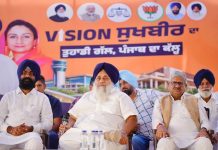
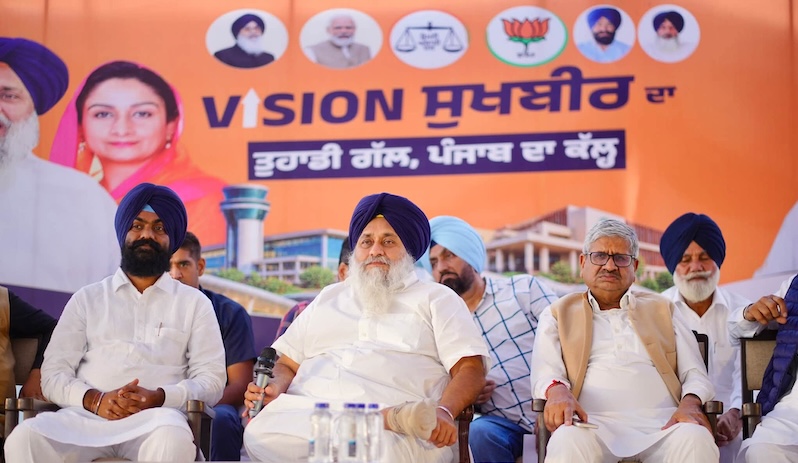
The first test comes on December 8. Prime Minister Narendra Modi and SAD president Sukhbir Singh Badal are scheduled to share the stage at a joint rally at the Moga grain market. It will be the first major public show of strength by the reunited partners and the first time the PM and the Akali chief share a public platform in years. Both parties will want to demonstrate that their organisational networks can still command a substantial political gathering.
The seat-sharing arrangement remains unsettled. Under the old formula, which operated from 1996 until the split in 2020, the SAD contested 94 of Punjab’s 117 assembly seats and the BJP 23. That distribution reflected SAD’s senior position in the partnership. The BJP may now be seeking a substantially larger share. Reports suggest that it is looking at around 40 to 50 seats, with some accounts putting the Akali allocation at 70 to 72. These are reported negotiating positions, not an officially announced agreement.
Home Minister Amit Shah has made one important point clear. The SAD will remain the senior partner, and the chief minister, if the alliance forms the government, will come from SAD. This represents a recalibration of the relationship. The BJP has expanded its political ambitions in Punjab, and the SAD has to accommodate a partner seeking a much larger electoral footprint.
Bhagwant Mann’s welfare politics
Chief Minister Bhagwant Mann remains a formidable electoral proposition. His command of public speaking, his ability to draw large crowds and the AAP government’s welfare measures continue to give him political capital. The intervention of the Akal Takht against him appears to have had a limited effect on his popular appeal. His rallies continue to attract substantial audiences, including rural Sikh constituencies. The government’s welfare delivery has a constituency of its own. His relative distance from the more contentious aspects of Sikh religious politics has also helped him retain room for manoeuvre.
For the rivals, this presents a serious challenge. Anti-incumbency will have to contend with a chief minister who retains considerable public visibility and an established connection with large sections of the electorate.
There is also an interesting development in the Congress camp. Pargat Singh’s political outreach suggests a widening of his political idiom. His earlier public positioning frequently drew upon Sikh cultural references. His recent approach appears more explicitly secular. His meeting with Radha Soami Satsang Beas head Gurinder Singh Dhillon, alongside wider outreach involving Dera leadership, reflects an understanding of Punjab’s social arithmetic.
SEE ALSO: The Nattak of Democracy in Punjab
SEE ALSO: Manpreet Ayali quits SAD faction ahead of Panjab’s 2027 polls
SEE ALSO: This is a defeat for the Badal family
The electoral significance is considerable. Punjab’s political geography cannot be reduced to one dominant Sikh or Hindu caste group, one religious constituency or a single ideological vocabulary. Dera networks, rural communities, urban voters, the Mazhbis, the Balmikis, the Ravidassias, upper-caste Hindu constituencies and different shades of Sikh opinion all contribute to the state’s electoral outcome. A party seeking power must speak across these constituencies.
The Shiromani Akali Dal’s one-person assembly presence
For the SAD, the arithmetic of the reunion is stark. The party has effectively been reduced to one MLA in the Punjab assembly. Ganieve Kaur Majithia, representing Majitha, remains its lone legislator in political terms. Dr Sukhwinder Kumar Sukhi, elected from Banga on SAD ticket, joined AAP in August 2024. Manpreet Singh Ayali, the Dakha MLA, moved to Akali Dal (Waris Punjab De) in June 2026.
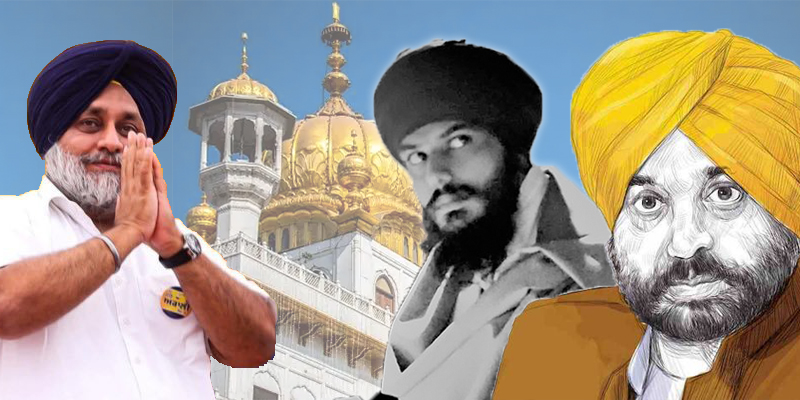
There is a technical distinction here. Both continue to hold their assembly seats, and the formal legislative position has not fully caught up with their political realignments. For Sukhbir Singh Badal, however, the effective political strength of his party in the assembly is one. It can’t be worse.
A party that governed Punjab for two consecutive terms between 2007 and 2017 is confronting an extraordinary electoral decline. The BJP reunion offers the Shiromani Akali Dal an opportunity to rebuild its infrastructure and recover political space. The party still retains a rural network, a historical association with Punjab’s agrarian politics and a substantial political legacy. The challenge is to translate these assets into renewed public confidence.
The BJP, meanwhile, enters this arrangement with a changed political position in rural Punjab. The farm agitation and its confrontation with the farmers’ movement severely damaged its acceptability across large parts of the countryside. Its political isolation has eased to some extent, although the party still has considerable ground to cover. Its independent electoral strength has yet to demonstrate the capacity to secure a statewide mandate.
Their coming together changes the voter calculations for AAP and Congress. The Shiromani Akali Dal brings a history of rural organisation, local leadership and a connection with Punjab’s farming and Sikh constituencies. The BJP brings a national organisation, resources, central welfare schemes and a distinct support base among sections of urban Punjab. Their combined electoral machinery gives the opposition a wider geographical and social spread. It also complicates the calculations of AAP and Congress in constituencies where their respective support bases overlap.
The alliance’s immediate task is to re-establish itself as a credible opposition as elections near. That will require a common political programme, agreement over candidates and a convincing response to questions surrounding its years in government. The BJP, in turn, will have to negotiate its renewed presence in rural Punjab, particularly among sections of the electorate shaped by the farmers’ agitation.
Waris Punjab De and the Panthic pressure
Then there is Waris Punjab De, a hardline variable in Punjab’s electoral calculations.
The outfit associated with Amritpal Singh, the elected MP from Khadoor Sahib, occupy a distinctive space in the state’s politics. Its registration remains pending with the Election Commission.
Waris Punjab De’s leadership has indicated its intention to contest the 2027 assembly elections, even if its candidates have to enter the fray as independents. Formal registration and an election symbol would give it a more coherent organisational identity. Its electoral influence will ultimately depend on its candidates, constituencies and ability to convert ideological support into votes.
Its significance, however, extends beyond the number of seats it might contest. The outfit represents a harder ideological strand of Panthic politics and creates pressure on the Shiromani Akali Dal from its own ideological flank. This could compel the traditional Akali leadership to navigate its engagement with Sikh religious and political concerns smartly, even as it retains a wider, mainstream constituency across Punjab.
There is a distinction between addressing genuine Sikh concerns and allowing electoral politics to become captive to demands that cannot command support beyond a narrow ideological constituency, though. The Shiromani Akali Dal has to negotiate that distinction carefully.
Waris Punjab De, or its independent candidates, could, therefore, emerge as vote-cutters in constituencies where the Panthic vote is divided.
Beyond ideological politics, the economic question
Beyond ideology and questions of representation, the economic proposition each party brings to ordinary Punjabis will carry considerable weight. Employment, agricultural viability, industrial investment, migration, the drug scourge, public debt and opportunities for young people will shape the electoral conversation.
Punjab’s voters have lived through successive political promises. They will be looking for a credible account of how a change in government could improve household incomes, create jobs and restore economic confidence. The party that can connect its political programme with tangible improvements in everyday life will have an important advantage in the debate.
Punjab’s coming election will therefore be fought on several overlapping fronts. AAP will seek to defend its welfare-based political constituency and CM Bhagwant Mann’s personal appeal. Congress will attempt to consolidate its broader social coalition. The reunited SAD-BJP combine will seek to recover lost ground through organisational strength and a division of electoral labour. Waris Punjab De will test the depth of the Panthic vote outside the established Akali framework.
The December 8 rally in Moga will provide the first public spectacle of this reunion. The harder work lies in dividing the 117 constituencies, reconciling competing ambitions and persuading voters that an old political partnership has a new purpose.
Punjab has seen this alliance govern before. Its return now sets the terms for a very different electoral contest.
CHECK OUT MORE FEEDBACKS FOR THIS REPORT AT FACEBOOK AND INSTAGRAM
Harmeet Shah Singh is a career journalist currently serving as Communications and Advocacy Director at UNITED SIKHS (UK), a charity registered in England and Wales.
* This is the opinion of the writer and does not necessarily represent the views of Asia Samachar.
RELATED STORY:
Why India’s poll-bound Panjab won’t welcome Cockroaches (Asia Samachar, 17 Oct 2026)
Former Akal Takht chief Harpreet to steer Akali Dal breakaway faction (Asia Samachar, 12 Aug 2025)
ASIA SAMACHAR is an online newspaper for Sikhs / Punjabis in Southeast Asia and beyond. You can leave your comments at our website, Facebook, Twitter, and Instagram. We will delete comments we deem offensive or potentially libelous. You can reach us via WhatsApp +6017-335-1399 or email: asia.samachar@gmail.com. For obituary announcements, click here