





















By Manjit Kaur (UK) | OPINION |
Have you ever been told to ‘get real’ or asked ‘which world are you living in?’ These phrases are used when someone feels that you are failing to face up to the ‘reality’ of a situation. Whilst in casual conversation, facing reality may just be about taking responsibility, in truth, defining reality is not an easy task. Within most Indian religious traditions, reality is defined in terms of the concept of ‘dharma‘. Simply speaking, dharma means ‘path’, a way of life, or the natural order of things as set down in ancient texts. In western traditions, reality is related to the world as we perceive it, and how this is represented in the human mind.
So where does Sikhi stand in terms of ‘reality’? According to the teachings of Guru Nanak, there is a physical reality that is governed by the laws of nature, which is called Sargun (visible or seen) and a reality that is beyond material existence, which is Nirgun (invisible or unseen). In Sikhi, both are real. Indeed, Gurbani clearly states that being born into human form or manukhi jeevan, one has the opportunity to become one with Akaal Purakh or the universal formless divine power in this world.
To succeed in this mission, there are some clear instructions. One of these is doing ‘nishkaam seva‘ or selfless service. This is easier said than done, especially in today’s world where we are only concerned about our needs and material things. If that wasn’t challenging enough, Guru Nanak focuses on the importance of serving in the ‘real world’. “By serving in this world, you shall be given a place of honour in the Court of the divine”. (Guru Granth Sahib, p24). The Guru also states that the greatest ‘seva‘ is to serve the Guru.
The next question is, how can one serve the Guru? The answer that Guru Nanak gives is, that to serve the world (duneya) is to serve the Guru! The air, the water and the land are, according to Guru Nanak, your ‘Guru’, your ‘father’ and your ‘mother’. By emphasising the importance of serving in the world, Guru Nanak offers a much deeper concept of seva. Whilst service in the Gurdwara, such as making and serving langar, offering donations, cleaning, performing prayers and kirtan is important, serving in the world can involve many other things. Indeed, one can see the idea of ‘serving in the world’ as an invitation to focus on one’s wider responsibility to humanity.
This then has led me to think about several questions, such as, how should I live as a human being? What does it mean to serve humanity? And, perhaps, most importantly, what does it mean to truly live in the ‘real’ world?
There are no easy answers to these questions and in some senses, we will all need to find the answer for ourselves. Here are some brief reflections from my journey toward living in the real world; you may or may not find these helpful as you walk your path in life.
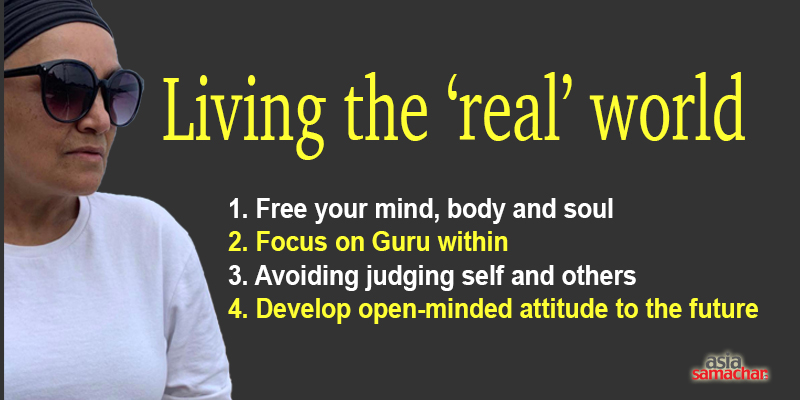
1: Free your mind, body and soul: Living in the real world means having a free spirit and this is not possible without a free mind. And without a free mind, you can not have a free or healthy body; all these things are connected. If we are not free to think, then I believe our spirit will be imprisoned. So the question arises, what do we need to free ourselves from? In this regard, I think there are three things that Gurmat advises. One is that we need to free ourselves from ‘agiaanta‘ (ignorance or lack of knowledge), which leads to superstition and irrational beliefs, an over-reliance on materialism, and most importantly egotism.
2: Focus on the Guru within: To become free from the ego or the five thieves of lust, greed, pride, attachment and anger, we need the help of the Guru, and that means realising the Guru is within every one of us. Living in the real world means seeing the Guru everywhere and everpresent. And when we do this we will not see Sikhi as a performance and will avoid behaving as ‘Sunday Sikhs’. It is important to attend Gurdwara because this helps you to remain connected to the sangat and to become spiritually charged. Nothing can be more blissful than listening to Kirtan in the Sangat and wearing traditional Sikhi bana, but our Sikhi needs to be 24/7, at home, at play, at work, in the community and everywhere else. If we truly believe in the Guru then we will reject false idols and rituals and with the help of our Guru, we will take charge of our lives. As Gurbani says, “it is with our own hands that we can resolve the challenges we face in life”
3: Avoiding judging self and others: When we harshly criticise others or ourselves we may think we are being powerful but in truth, it is a sign of weakness. Being judgemental means you haven’t worked hard on yourself to learn about the importance of self-love, self-control and kindness. Often criticism of others is simply a projection of our inner negativity or inability to deal with our problems, so we put these onto others. Sikhi demands that we should not judge others, but sadly, my experience, especially of some Amritdhari Sikhs, is that they can be highly judgemental about such things as race, caste, and gender. Whilst it is important for us all to dress in a dignified way, I do think we should stop judging women who may choose to dress as they wish. I am not talking about women revealing their bodies, but simply wanting to express their personality in a certain way. I believe that ancient Islamic influences about the requirement for women to cover their entire bodies are still very strong within Panjabi culture, even though our Gurus advocated women’s empowerment.
4: Develop an open-minded attitude to the future: Though we are all influenced by the generation in which we live our lives, in reality, culture, society and the world are constantly changing. Because of the development of technology, media, and the ongoing mix of people, social norms are changing. Just look, for example, at attitudes towards marriage, which have changed to the extent that nowadays children are making their own choices in finding their partners, and their parents are required to understand their feelings and wishes; this was not the norm when I was growing up. Indeed, attitudes towards traditional beliefs and rules have also dramatically changed, and most people have much more liberal attitudes. But sadly, whilst people generally have become much more tolerant towards each other, I do find amongst some Amritdhari Sikhs, especially those who associate with groups, jathas and deras, to be quite rigid. It is as if they fear by mixing with others they will lose their Sikhi. Some even think of other Sikhs, who may have different views on Sikhi, as ‘weak’ or ‘bad Sikhs’. In this regard, I say we Sikhs can become our own worst enemies, but if we are truly to call ourselves the followers of Guru Nanak, then we must embrace humanity and embrace the future and stop judging.
Living in the real world can sometimes feel like being on a fast roller coaster. Today, because of so much technology, the world is changing before our very eyes. All change is not good, but generally, we have to go with the flow, but that does not mean abandoning the Guru or Sikhi, but it does mean adapting and using the Guru’s message as a guide to navigate and overcome the many challenges that the real world poses. Some of those challenges are ones that every generation has had to face, but others are completely new, which means at times letting go and taking risks. But in the end, we don’t have a choice but to learn to live in the real world; there are no hiding places! But don’t forget, wherever you go the Guru is there to guide you, but only if you realise this to be true.

Manjit Kaur, a UK-based therapist and counsellor, is a presenter of the 1 Show on Akaal Channel. She can be contacted via email at manjitkaur1show@gmail.com
RELATED STORY:
Who is the real enemy of the Sikhs? (Asia Samachar, 19 Sept 2021)
ASIA SAMACHAR is an online newspaper for Sikhs / Punjabis in Southeast Asia and beyond.Facebook | WhatsApp +6017-335-1399 | Email: editor@asiasamachar.com | Twitter | Instagram | Obituary announcements, click here |