


















SYNOPSIS: Guru Tegh Bahadar Sahib, the ninth Sikh Guru, accepted martyrdom in 1675 to defend freedom of belief for others. His life of service, equality and spiritual leadership uplifted communities across Indian sub-continent. His sacrifice challenged Mughal oppression, inspired the Khalsa’s formation, and endures today as a universal stand against coercion and injustice.
By Harmeet Shah Singh | Opinion |
Exactly 350 years ago, a sword fell in Delhi.
The holy head beneath it was fifty-four.
It belonged to Guru Tegh Bahadar Sahib, the ninth of the ten Gurus who shaped a spiritual, moral and civilisational force that transformed the subcontinent from 1469 to 1708. Their work grew far beyond the scale of a movement. It altered how ordinary people understood power, spirituality and dignity.
Guru Tegh Bahadar Sahib embraced martyrdom so that people who did not follow him could keep their faith.
Born in 1621 in Punjab’s Amritsar, he grew up in a household where sacred manuscripts and weapons rested on the same floor.
His father, Guru Hargobind Sahib, had confronted Mughal armies more than once, so the young Tegh Bahadar learned both horse and hymn.
FOR MORE STORIES ON GURU TEGH BAHADUR, CLICK HERE
He spent many years in Bakala, a quiet village in Punjab. His life there moved between active meditation and long journeys through towns and cities.
When Guru Harkrishan Sahib left this world in Delhi, his last words were “Baba Bakala.”
Many impostors stepped forward, each hoping the ambiguity would hand them spiritual authority. A sea trader tested them with two gold coins. Only one figure reminded him of the five hundred he had promised earlier. Truth surfaced through a cry from a rooftop that still rings in Sikh memory.
Guru Tegh Bahadar Sahib founded a new township, Anandpur, on the Himalayan foothills.
From there he walked thousands of miles across eastern India.
Congregations rose in Patna, Dhaka and the hills of Assam. Wherever he stopped, men and women sat on the same ground. Caste lines in those remote regions dissolved. Wells appeared in dry villages. Landless farmers received cattle. Entire communities shifted from resignation to self-respect.
Aurangzeb watched with rising hostility. His Mughal empire revived the tax on non-Muslims, banned Hindu festivals, and ordered temple demolitions.
In Kashmir, the royal governor gave scholars a choice between conversion and death. Thousands faced annihilation while local kings remained silent.
In the summer of 1675, a group of Kashmiri Pandits reached Anandpur. They bowed before the Guru and asked for protection. Their tradition was different from his. The bond he felt made no distinction.
His nine-year-old son asked who could stop such cruelty. The father answered that the moment called for a supreme sacrifice. The son said the world had no one greater than him.
Guru Tegh Bahadar Sahib left for Delhi. He knew the road ended at the execution ground.
Imperial troops arrested him. They offered three choices: perform a miracle, accept Islam or die. He chose death.
In November 1675, in the heart of Chandni Chowk, the executioner brought the sword down. A storm swept across the Walled City that evening. One Sikh carried the severed head to Anandpur through the night. Another set fire to his own home in Delhi so that the Guru’s body could be cremated in secret.
That martyrdom altered the course of the subcontinent. It gave communities the resolve to defend every tradition under threat.
Twenty-four years later, his son laid the foundations of the Khalsa, which broke the machinery of Mughal coercion for good.
Guru Tegh Bahadar Sahib’s call still stirs the soul: Fear no one; frighten no one.
In 2025, those words speak to a world where apostasy is still punished with death, where shrines are attacked and where enforced sameness remains a political tool.
Guru Tegh Bahadar Sahib never asked anyone to become Sikh. His life stands for something wider.
On this 350th anniversary, his story is not Sikh history. It is human history.
Guru Tegh Bahadar Sahib showed that shielding the conscience of strangers is the strongest way to protect one’s own. His stand covered believers and non-believers alike, because the freedom he upheld rested on choice, not identity.
Three and a half centuries later, his example remains a measure against which injustice is recognised. It strengthens those who face pressure to surrender their convictions and helps communities name coercion for what it is.
The struggle continues, and Guru Tegh Bahadar Sahib’s resolve continues to guide it.
Remember the date. Remember the choice.
CHECK COMMENTS AT ASIA SAMACHAR FACEBOOK AND INSTAGRAM
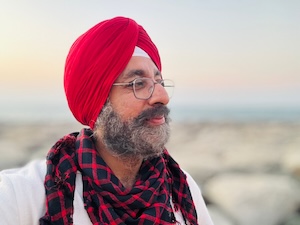
Harmeet Shah Singh is a career journalist currently serving as Communications and Advocacy Director at UNITED SIKHS (UK), a charity registered in England and Wales.
* This is the opinion of the writer and does not necessarily represent the views of Asia Samachar.
RELATED STORY:
The Truth of Guru Teg Bahadur Ji’s Martyrdom (Asia Samachar, 23 Nov 2022)
ASIA SAMACHAR is an online newspaper for Sikhs / Punjabis in Southeast Asia and beyond. You can leave your comments at our website, Facebook, Twitter, and Instagram. We will delete comments we deem offensive or potentially libelous. You can reach us via WhatsApp +6017-335-1399 or email: asia.samachar@gmail.com. For obituary announcements, click here