






















By Harmeet Shah Singh | Opinion |
Majoritarian politics has tightened its grip across continents, pushing minorities into paths they have not walked in this form before.
These paths are not new in a historical sense, yet history offers limited help when the present moves at digital speed and public opinion is shaped minute by minute.
State power, social media and identity now collide daily. For communities evolving through migration, this collision is constant and difficult to escape.
Sikhs outside India’s Punjab live as minorities almost everywhere. The faith’s recorded history spans roughly five-and-a-half centuries, making it young compared to many others, though dense with struggle. Its early decades unfolded under imperial rule, whether Mughal, Afghan (invasions) or British. In the late 20th century, Punjab entered a violent phase as sections of the Sikh community confronted the Indian state over water sharing, language rights, religious autonomy and the balance of power between the state and the centre. The events of 1984 altered the course of that conflict. A separatist movement expanded through the decade that followed, and was eventually crushed within India.
That defeat did not end the idea. It travelled with migrants and found room overseas, particularly in parts of the Anglosphere where expression is protected so long as it remains lawful.
For years, the Indian state chose restraint. Media avoided sustained coverage of overseas separatist protests. Blacklists softened as everyday relations between Sikhs and Hindus improved, rooted in shared social life. Punjab returned to elections, administration and ordinary disputes. The issue appeared closed.
This changed after 2014, when a majoritarian BJP government took firm control in India. Small Sikh separatist protests abroad began receiving amplified coverage on Indian media. What was once ignored became headline material. No separatist movement re-emerged in Punjab, yet overseas activism was presented as attempted revival. Meetings between protest figures and foreign politicians were framed as ideological endorsement, while the plain fact remained that developed countries do not sacrifice their strategic and economic interests in India for symbolic gestures or minority causes. Optics, nevertheless, replaced proportion.
In this environment, a new type of public figure gained visibility. Diasporic Sikh influencers learned to speak to two audiences. In Western nations, they addressed vocal separatist groups rooted in gurdwara committees and community bodies. In India, they engaged comfortably with a Hindutva dominated public and media sphere, often under the language of dialogue, education and historical interest. This back and forth delivered reach and insulation, even when positions collided.
Separatists apparently remain a minority within a minority. But they do organise, dominate certain institutions and speak with volume in some countries. That volume is often mistaken for mandate. Social media amplifies those who provoke reaction. Influencers who mastered symbolic balancing gained traction on both sides, even when their stands contradicted one another.
The cost of this balancing act shows most clearly in how the things are handled. Agriculture is presented as the sole Sikh occupation, suggesting a community under targeted economic assault. This ignores the diversity of Sikh life and turns an India-wide agrarian crisis into a communal grievance. The claim circulates easily among overseas audiences far removed from the subcontinent’s rural realities.
Sikh history is also reshaped to suit present alignments. In some retellings, the hill rajas are cast as principal enemies, while Mughal authority is softened through selective focus. These narratives are layered with modern-day strategic language. The period from Guru Nanak Sahib to Guru Gobind Singh Sahib becomes crowded with intrigue and counter strategy, while the social and spiritual revolution introduced during that time is pushed aside. Faith is treated as a political instrument rather than a guide for divinity.
Scholars who depend on institutional approval, in general, lose credibility. Theologians who write to please committees flatten scripture into slogans. In the Asian subcontinent, many archives carry bias. Mughal chronicles, colonial records, Sikh writings, left-leaning historians and right-wing polemicists all distrust one another.
Serious work requires comparison, patience and the willingness to sit with uncomfortable material. It does not emerge from applause.
Several diasporic influencers seem to be avoiding this labour. They speak of cultural threat and assimilation on overseas platforms, but share stages and social spaces with majoritarian ideologues while visiting India. Engagement becomes cover. Each side hears what it wants. Contradiction grows alongside popularity.
This leaves the Sikh diaspora in an uneasy position. Public speech becomes reactive, shaped by who is listening rather than by what needs to be said. Important distinctions are blurred to maintain access on all sides.
Over time, this weakens internal debate and reduces disagreement to factional noise rather than informed argument.
The dilemma, then, is not about loyalty to one camp or another, but about whether Sikh public life can sustain serious thinking without borrowing outrage from one side and protection from the other.
Without that, the diasporic community is likely to remain suspended between the rock of majoritarian nationalism and the water of overseas separatist pressure, moving constantly yet deciding little, visible everywhere yet grounded nowhere.
CHECK OUT FEEDBACK FOR THIS STORY AT ASIA SAMACHAR FACEBOOK AND INSTAGRAM
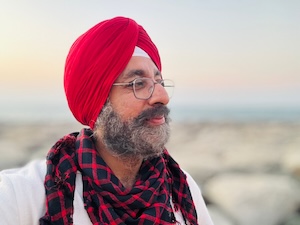
Harmeet Shah Singh is a career journalist currently serving as Communications and Advocacy Director at UNITED SIKHS (UK), a charity registered in England and Wales.
* This is the opinion of the writer and does not necessarily represent the views of Asia Samachar.
RELATED STORY:
The Demise of the Akali Dal and the Badal Dynasty: What Next for the Panth? (Asia Samachar, 5 Aug 2024)
ASIA SAMACHAR is an online newspaper for Sikhs / Punjabis in Southeast Asia and beyond. You can leave your comments at our website, Facebook, Twitter, and Instagram. We will delete comments we deem offensive or potentially libelous. You can reach us via WhatsApp +6017-335-1399 or email: asia.samachar@gmail.com. For obituary announcements, click here