

















By Raag & Reel | Movie Review |
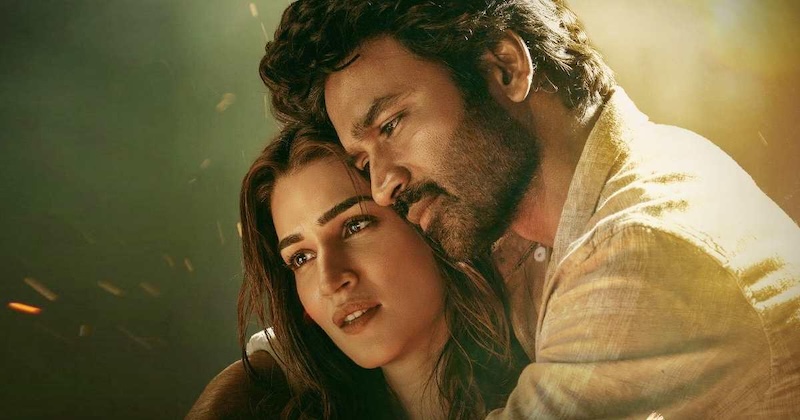
Tere Ishk Mein opens with love as a fever—unreciprocated, consuming, and dangerously misconstrued as destiny. Shankar Gurukkul, portrayed by Dhanush, pursues Mukti Beniwal (Kriti Sanon) with an intensity that is less romance than entitlement. The film is most unsettling when it reveals how desire corrodes respect, and how passion, unchecked, mutates into possession.
From its earliest moments, the narrative is threaded with rebellion, fear, assertion, and power. Shankar’s defiance of authority is not merely insubordination; it is a rejection of social structures that dictate who may desire and who must submit. Mukti’s scornful insult—“ghendi nali ka keera”—cuts deeper than cruelty. It exposes fear masquerading as superiority, class anxiety disguised as ridicule. Power operates everywhere: between wealth and poverty, men and women, obedience and defiance. The film insists that love is never neutral; it is shaped, constrained, and often wounded by these forces.
Produced by Aanand L. Rai and released in 2025, Tere Ishk Mein positions itself as a spiritual successor to Raanjhanaa. Its emotional architecture is amplified by A. R. Rahman, whose score mirrors the film’s moral turbulence. Rebellion surges with urgency, grief lingers in aching restraint, and redemption rises in measured crescendos. The music becomes an invisible connective tissue, binding Shankar’s fractured arc into a universal meditation on love and loss.
Beneath Shankar’s obsession lies a damaged child—scarred by his mother’s death and starved of affection. This psychological fracture explains, though never excuses, his need to claim love as compensation for trauma. The film’s most decisive turn arrives when Shankar chooses sacrifice over entitlement. By saving Jessi, Mukti’s husband, he relinquishes his claim entirely. Love, in that moment, is no longer about possession but about preservation.
Every act of rebellion, every assertion of power, every wound of fear circles back to the film’s central question: can love, born of obsession and trauma, evolve into something mature enough to heal rather than harm? Tere Ishk Mein suggests that it can—but only through surrender.
What ultimately lingers is not the intensity of desire but the evolution of love itself. From entitlement to sacrifice, from humiliation to dignity, the film traces a difficult but necessary maturation. True love, it argues, resists control. It cannot be ordered, owned, or enforced. It redeems itself only when it learns to release.
And so the question extends beyond the screen: when power and fear are stripped away, what does love mean to you?
RELATED STORY:
What to watch: When survival is mistaken for shame in Laaga Chunari Mein Daag (Asia Samachar, 11 Jan 2026)
ASIA SAMACHAR is an online newspaper for Sikhs / Punjabis in Southeast Asia and beyond. You can leave your comments at our website, Facebook, Twitter, and Instagram. We will delete comments we deem offensive or potentially libelous. You can reach us via WhatsApp +6017-335-1399 or email: asia.samachar@gmail.com. For obituary announcements, click here