


















By Jasmir Kaur Thiara | Singapore |
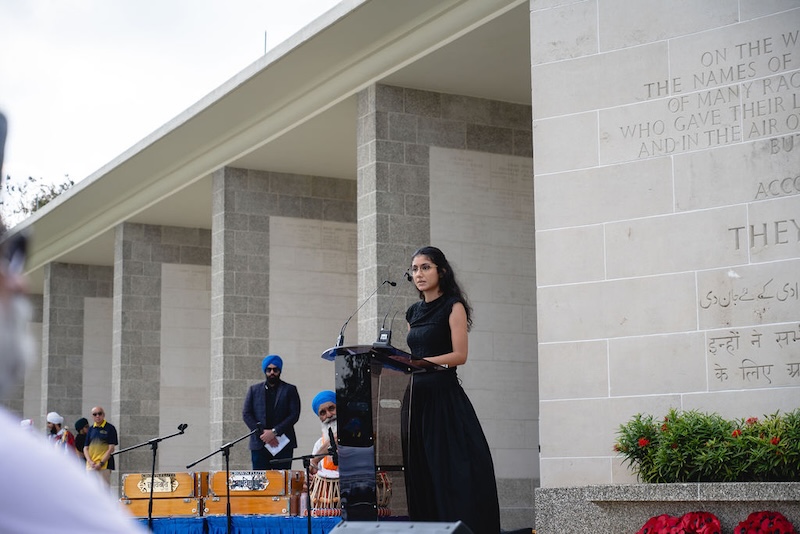
We stand today at Kranji, where the land is quiet, but not empty. It holds names. It holds distances. It holds unfinished conversations.
When you move through this place, you begin to feel what remembrance really is: not a lesson delivered from a podium, but a responsibility shared across generations.
Today, I speak as a young Sikh, representing my community. But first and foremost, I speak as someone grateful to those who gave their tomorrows so that ours could arrive.
1) The fallen Sikh soldiers
Here at Kranji, that gratitude has a shape. It is carved into stone — in names from many places, many backgrounds, many faiths — each one a life that did not get to finish its own story.
Among the many who served and fell in the wars were Sikh soldiers.
Many of these soldiers were young men with simple lives — family responsibilities, familiar routines, and values shaped at home. They were not born into legend. They were ordinary men called into extra-ordinary circumstances.
For many people in the audience, these men were not just “history.” They were the older brother someone still talks about softly. The grand-uncle whose name is repeated at the dinner table. The neighbour from the next lane who showed up when help was needed.
One day, they were sent far from home — into unfamiliar heat, unfamiliar terrain, unfamiliar names on a map — to protect people they had never met, here in Singapore and beyond.
And in the hardest moments, what held them steady was not grand ideology. It was something simpler and stronger: a belief that humanity is worth protecting.
The Sikh tradition has a phrase for that spirit: Chardi Kala — a resilient, forward-facing courage. Not denial of pain, but the strength to move through it with dignity.
2) Teachings and sacrifices of Guru Gobind Singh Ji
And when we ask where that kind of courage comes from, we are led naturally to the teachings of Guru Gobind Singh Ji — who taught that strength must be guided by conscience, and that to stand for justice is not a slogan, but a duty.
One word captures this teaching powerfully: Nirbhau — fearlessness. Not the absence of fear, but freedom from its hold. The strength to face oppression and still stand for justice.
But his teaching was never about aggression. It was about responsibility. He called people to stand up against injustice, without losing compassion, and to defend what is right, not what is convenient.
He created Khalsa so this teaching would not remain only words — it would become a way of life: a disciplined community grounded in service and integrity, committed to upholding righteousness and defending the oppressed.
And he lived these ideals at profound personal cost, showing what it means to stay true to your values even when it demands immense sacrifice.
That is the spirit we recognise in the fallen we honour today.
3) Oneness: teachings of Guru Nanak Dev Ji
After the courage of Guru Gobind Singh Ji, it is important to remember the gentler foundation beneath it: Guru Nanak Dev Ji’s teaching of oneness.
Guru Nanak taught Ik Onkar — one reality, one human family.
In simple terms, it is the refusal to split people into us and them, insider and outsider, equal and lesser. It is a way of seeing that makes hatred harder to justify, and indifference harder to defend.
That teaching matters deeply on a day like this.
Because today’s remembrance is not for one community, one regiment, or one faith — it is for all who fell in the wars — whatever uniform they wore, whatever language they spoke, whatever name they prayed in.
Here at Kranji, the names remind us of a basic truth: loss does not come neatly labelled, and grief does not stop at borders.
4) What this memorial asks of us now
So what do we learn from a day like this?
I belong to a generation that inherited peace as normal. We grew up assuming progress was automatic — that rights would expand, that the world would keep getting safer.
And then we watched how quickly that assumption can break. Societies fracture. People are reduced to labels. Fear turns into hostility.
So remembrance must leave us with more than emotion. It must leave us with wisdom.
First: gratitude, grounded in truth — a clear-eyed respect for what was endured, and how fragile peace can be.
Second: unity, lived with intention — the daily choice, in a diverse society, to treat differences with respect rather than suspicion.
Third: courage, guided by conscience — the courage to choose humanity out loud, every day, and especially when it’s uncomfortable.
Taken together, they turn remembrance into responsibility.
The Sikh prayer ends with a wish for “Sarbat da Bhala” — the welfare of all. Not only those who look like us, vote like us, or pray like us. All.
That is a message worthy of this place.
Closing
So today, we honour the fallen best not only by remembering how they died, but by protecting what they made possible: a society where every person is treated as equal, where difference is not feared, and where dignity is not conditional.
May these names keep us humble, and may the peace we have be the peace we strengthen — together.
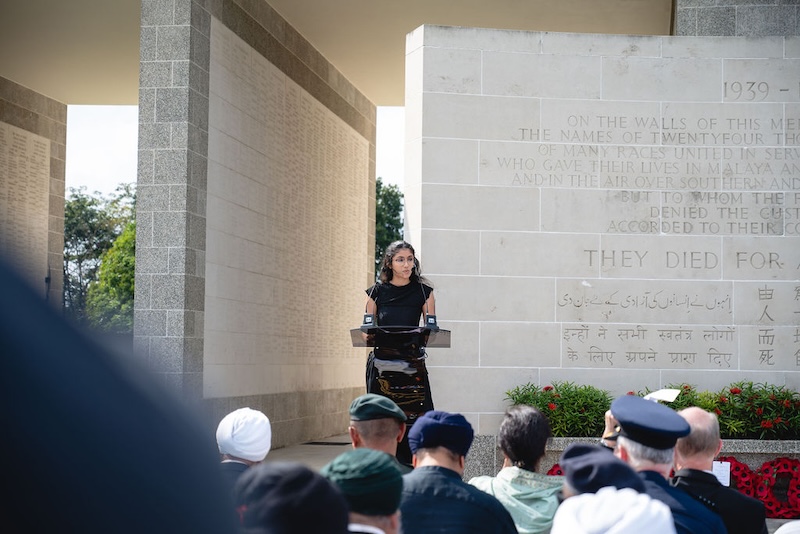
(Jasmir Kaur Thiara gave a speech from a young Sikh’s perspective at the Remembrance Day Memorial Service at the Kranji War Memorial on February 8, 2026.The service honours the lives and sacrifices of 3,318 fallen soldiers bearing the name “Singh”, drawn from communities across the undivided Punjab, who served and fell during times of war. The event was hosted by Pardesi Khalsa Dharmak Diwan (PKDD) as part of its centenary celebration which culminates in August 2026).
Join the conversation on this story on Asia Samachar’s Facebook and Instagram pages.
RELATED STORY:
Senior minister, 7 high commissioners to attend Kranji War Memorial remembrance service (Asia Samachar, 28 Jan 2028)
ASIA SAMACHAR is an online newspaper for Sikhs / Punjabis in Southeast Asia and beyond. You can leave your comments at our website, Facebook, Twitter, and Instagram. We will delete comments we deem offensive or potentially libelous. You can reach us via WhatsApp +6017-335-1399 or email: asia.samachar@gmail.com. For obituary announcements, click here