
























(The views expressed in this article are personal reflections intended to encourage thoughtful discussion on the contemporary role of the Kirpan in modern society. They are not intended as an interpretation of the Sikh Rehat Maryada or as a theological ruling.)
By Dr. B. S. Bains | Opinion |
I write with the utmost respect for the Sikh faith, the Sikh Gurus and the sanctity of the Five Kakkars (Ks).
The Kirpan is one of Sikhism’s most sacred articles of faith. It is not merely a blade, but a profound reminder of a Sikh’s commitment to justice, courage, compassion and the protection of the vulnerable.
The Gurus did not prescribe the Kirpan as an instrument of aggression. Rather, it symbolised moral responsibility and the readiness to stand against tyranny at a time when oppression was widespread and institutions capable of protecting the innocent were often absent.
Nearly three centuries later, the world has changed.
Most of us now live in societies governed by constitutional law, professional police forces, independent courts and established justice systems. Modern warfare is no longer fought with swords, but with firearms, missiles, drones, cyber technology and sophisticated weaponry.
Against this backdrop, one must ask a sincere question: What is the practical role of the Kirpan today?
If a Sikh were confronted with an act of violence in public, could the Kirpan realistically be used to defend another person?
Legally, the answer is complicated — and, in practical terms, largely no. In many countries, using a bladed instrument against another person, even in defence of oneself or someone else, could result in arrest, prosecution and years of legal proceedings. An individual may genuinely have acted to save a life, but establishing lawful self-defence under legal scrutiny can be difficult. The courts will examine necessity, proportionality and the circumstances surrounding the action.
FOR MORE ARTICLES ON KIRPAN, CLICK HERE
Therefore, despite the noble intention behind the Kirpan, its practical use as a defensive weapon has become extremely limited in today’s context.
There may be exceptional situations in which the Kirpan could serve as an emergency rescue tool rather than as a weapon. It might, for example, be used to cut a seat belt after a road accident, free someone trapped by a rope or cord, release a person caught in fishing nets or dense vegetation, or cut away clothing entangled in machinery.
In rare circumstances, it might even help free someone from the grip of a dangerous animal, such as a large python.
SEE ALSO: Explainer: From Henry Nowak’s murder to the debate over the kirpan
However, when we examine the Kirpan itself, we find that while it has a pointed tip and a mild curve, many Kirpans are not sharp enough to cut or peel a fruit. Such emergency situations, therefore, do not define its everyday purpose in the lives of most Sikhs.
In daily life, most Sikhs will never draw their Kirpan.
SACRED SYMBOL?
This leads to another important reflection. If the Kirpan today is rarely, if ever, intended for physical use, should greater emphasis be placed on understanding it as a sacred symbol rather than as a weapon?
Many democratic nations recognise the Kirpan as an article of religious faith. Courts have generally permitted Sikhs to wear it not because they regard it as a weapon, but because they recognise its profound religious significance.
Such accommodation reflects respect, trust and a commitment to multiculturalism.
As beneficiaries of that trust, Sikhs also have a responsibility to ensure that the Kirpan is always presented in a manner that reflects peace, dignity, humility and service to humanity.
Religious liberty flourishes when it is accompanied by sensitivity towards the wider society in which we live.
THE KHALSA IDENTITY
Another question also deserves thoughtful consideration. Why do many Sikhs continue to present themselves in attire that reflects an era of constant armed conflict?
During the time of Guru Hargobind Sahib and Guru Gobind Singh Sahib, Sikhs faced relentless persecution. The visible identity of the Khalsa, including the Kirpan, was inseparable from the duty to defend the oppressed against armed tyranny.
Today’s circumstances are fundamentally different.
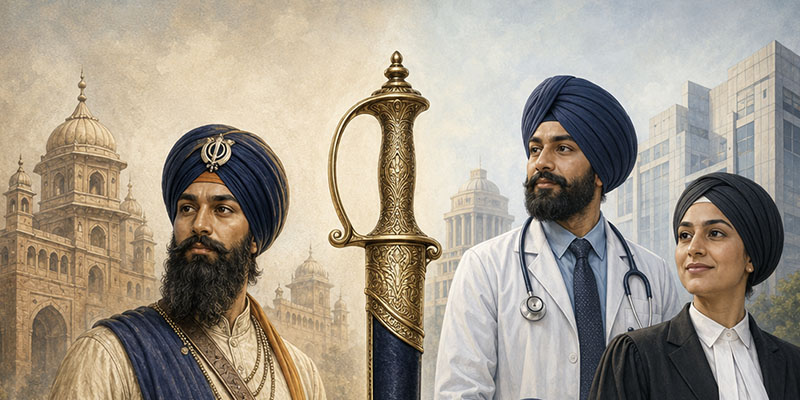
The average Sikh today may be a professional, entrepreneur, academic, doctor, lawyer, teacher, public servant or ordinary citizen. We contribute to society through knowledge, integrity, service and leadership rather than through armed resistance.
Should our public image, therefore, place greater emphasis on these timeless Sikh values rather than on visual elements that some may mistakenly associate with weaponry?
This is not a criticism of the Kirpan. It is an invitation to rediscover its deeper meaning.
The true Kirpan has always been the sword of righteousness.
Its sharpest edge is truth. Its greatest strength is compassion. Its finest victory is the protection of another human being without hatred or revenge.
Imagine, for a moment, that a modern Sikh nation were confronted by contemporary warfare. Could the Kirpan defend against missiles, drones, fighter aircraft or precision-guided weapons?
Obviously not.
Its military relevance has long passed. Its spiritual relevance, however, remains eternal.
Perhaps that is precisely where our emphasis should lie.
The Kirpan should remind every Sikh that injustice must never be ignored, that the vulnerable deserve protection, that courage is a daily virtue and that moral strength is infinitely greater than physical force.
The world does not judge Sikhs by the steel we wear. It judges us by the character we display.
When our conduct reflects honesty, humility, compassion, justice and selfless service, we honour the true spirit of the Kirpan far more profoundly than through its physical presence alone.
The Gurus gave humanity principles that transcend time. While circumstances evolve, those principles remain constant.
KIRPAN IN 21st CENTURY
The challenge for every generation is not merely whether to preserve the symbols, but whether we continue to understand and embody the values they were meant to represent.
Perhaps the greatest Kirpan a Sikh can carry in the 21st century is not one that is drawn from its sheath, but one whose spirit is reflected in every word, every action and every act of service to humanity.
Is it not time for the temporal authority of the Sikh faith, the Shiromani Gurdwara Parbandhak Committee (SGPC), to proactively re-examine how the Kirpan is worn and presented in contemporary society?
While preserving its sanctity and religious significance, greater emphasis could perhaps be placed on its symbolic and spiritual meaning rather than on its outward display as an exposed article worn with one’s attire.
The SGPC may also wish to broaden its perspective beyond the social realities of Panjab. Millions of Sikhs today live in highly structured, legally regulated and multicultural societies around the world.
The evolving global Sikh diaspora presents new challenges and opportunities that call for thoughtful engagement. The aim should be to ensure that the timeless principles of the Sikh faith continue to be upheld while remaining relevant and clearly understood in diverse modern contexts.
May our lives remain sharper than our steel, stronger than our pride and forever guided by the eternal ideals bestowed upon us by the Gurus.
Join the conversation on this story on Asia Samachar’s Facebook and Instagram pages.

The writer, Dr. Balwant Singh Bains, is a Kuala Lumpur-based physiotherapist. He writes on culture, interfaith harmony, and the evolution of tradition in the modern Malaysian context.
RELATED STORY:
Rethinking Sikh governance: SGPC failings and call for global reform (Asia Samachar, 14 July 2025)
ASIA SAMACHAR is an online newspaper for Sikhs / Punjabis in Southeast Asia and beyond. You can leave your comments at our website, Facebook, Twitter, and Instagram. We will delete comments we deem offensive or potentially libelous. You can reach us via WhatsApp +6017-335-1399 or email: asia.samachar@gmail.com. For obituary announcements, click here





Thank you very much, Mr. Kartar Singh, for your thoughtful and encouraging remarks. I am truly grateful that you have understood the spirit in which the article was written.
I believe another aspect that deserves honest reflection is the increasingly rigid or dogmatic emphasis placed by some on the conspicuous display of the Kirpan as part of one’s outward attire. While every Sikh has the unquestionable right to honour the Rehat Maryada according to his or her conscience, we must also recognise that we live in societies far removed from the historical circumstances of seventeenth-century Punjab.
Outside Punjab, particularly in multicultural societies, the visible display of what is perceived by the general public as a weapon can unintentionally create apprehension among those who do not understand its sacred significance. This is not because the Kirpan is dangerous in itself, but because perception is often shaped by limited knowledge and sensational media coverage.
For centuries, Sikhs have earned worldwide admiration as honest, compassionate, courageous, and peace-loving people. We should be careful that unnecessary emphasis on the outward display of the Kirpan does not, however unintentionally, overshadow those noble qualities or create misconceptions that could diminish the trust and goodwill our community has built over generations.
Perhaps the time has come for institutions such as the SGPC to engage the global Sikh diaspora in an open and constructive dialogue on how the timeless values represented by the Kirpan can continue to be preserved while being presented in a manner that inspires confidence, understanding, and respect in today’s multicultural world. Ultimately, it is our character—not the prominence of the steel we wear—that will continue to define Sikhism in the eyes of humanity.
Thank you very much, Mr. Kartar Singh, for your thoughtful and encouraging remarks. I am truly grateful that you have understood the spirit in which the article was written. I wish many many more couid express their opinion frankly so that we from the Diaspora lenses can approach SGPC to come with some directions to Sikhs from Punjab going out into the world and those who like to be in that attire would take into consideration the outward perception of muticultured and multi religious society around us. Even the people in different part of India this attire with exposed Kirpan irks then too.
I believe another aspect that deserves honest reflection is the increasingly rigid or dogmatic emphasis placed by some on the conspicuous display of the Kirpan as part of one’s outward attire. While every Sikh has the unquestionable right to honour the Rehat Maryada according to his or her conscience, we must also recognise that we live in societies far removed from the historical circumstances of seventeenth-century Punjab.
Outside Punjab, particularly in multicultural societies, the visible display of what is perceived by the general public as a weapon can unintentionally create apprehension among those who do not understand its sacred significance. This is not because the Kirpan is dangerous in itself, but because perception is often shaped by limited knowledge and sensational media coverage.
For centuries, Sikhs have earned worldwide admiration as honest, compassionate, courageous, and peace-loving people. We should be careful that unnecessary emphasis on the outward display of the Kirpan does not, however unintentionally, overshadow those noble qualities or create misconceptions that could diminish the trust and goodwill our community has built over generations.
Perhaps the time has come for institutions such as the SGPC to engage the global Sikh diaspora in an open and constructive dialogue on how the timeless values represented by the Kirpan can continue to be preserved while being presented in a manner that inspires confidence, understanding, and respect in today’s multicultural world. Ultimately, it is our character—not the prominence of the steel we wear—that will continue to define Sikhism in the eyes of humanity.
Thank you, Dato Dr Bains, for a brilliantly written, deeply reflective, and well-articulated piece. You have beautifully captured how the timeless, spiritual principles of the Kirpan transcend its physical form in the 21st century.Your point about how the wider public views the Kirpan is incredibly timely. We recently saw this play out in a tragic UK court case, where an individual wearing full Khalsa attire murdered an innocent young man. While justice was served and the killer was imprisoned, media and public discussions repeatedly and incorrectly pointed to his “Kirpan” as the murder weapon. In reality, the crime was committed with a completely unrelated Persian dagger.This dangerous misidentification perfectly highlights the core issue you raised: when people do not understand the noble principles of justice and compassion behind the Kirpan, a sacred article of faith is easily misconstrued as a mere tool of aggression. When someone wearing the external symbols of the faith fails to embody its internal values, it puts the community’s hard-earned trust and religious reputation at risk. It is indeed time for the community and authorities like the SGPC to actively steer the narrative, emphasizing character and spiritual values over outward misconceptions.
Dr Balwant Singh Bains : A brilliant write-up. It takes a lot of effort, time and bravery to write a full and comprehensive article on the kirpan and its full comprehensive meaning as Guru Gobind Singh Dev Ji had envised more than 300 years ago. As Dr Bains so brilliantly articulated the Sikh Diaspora now live in well structured rule based societies, Sikh leadership in Amritsar must propagate Dr Bains above concept of the meaning of the kirpan.
Despite some shortcomings in Malaysian Society, Malaysian Sikhs have used the strong points of Malaysian Society to inculcate many positive ideas to the World Wide Sikh Diaspora. I hope more Malaysian Sikhs will help propagate this concept of symbolic gesture of the kirpan envision by Dr Bains.
I carry a very small symbolic kirpan in my wallet. Very important I must always declare it at every metal detector and also to put in my cargo luggage at airports.
Once again thank you Dr Balwant Singh Bains.
Kuldip Singh son of Durbara Singh.
Petaling Jaya, Malaysia.
Sun. 19 July 2026.
Comments are closed.