


















K E Y P O I N T S
- Mathematics has long been central to civilisation, from the urban planning of the Indus Valley to Egyptian construction and Babylonian astronomy. Pasted text
- Mathematics evolved from practical measurement into an abstract and philosophical discipline, with algebra, geometry, zero and numerical systems shaping how humans understand reality. Pasted text
- Sikh thought does not claim a separate mathematical system, but Sikh architecture, scripture and Gurbani reflect strong ideas of order, structure, proportion and pattern. Pasted text
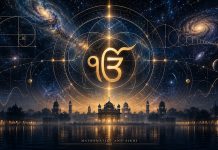
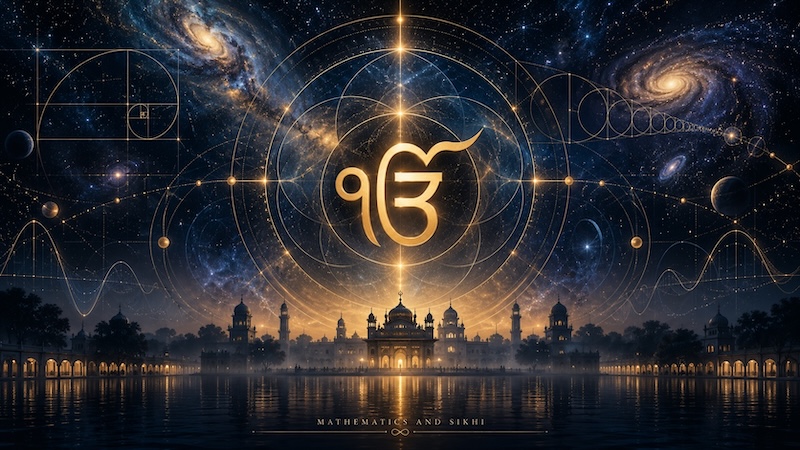
- ੴ (Ik Oankaar) expresses an underlying unity beneath the diversity of existence, making oneness and interconnectedness central to the Sikh view of reality. Pasted text
- The concept of Sunn points beyond ordinary notions of emptiness, while modern physics similarly shows that what appears empty can possess structure, energy and potential—though the article stresses that the two are not equivalent. Pasted text
- Sikh philosophy holds unity and diversity together through Nirgun and Sargun, seeing the many forms of creation as expressions of one underlying reality. Pasted text
- Science, mathematics and Sikhi ask different kinds of questions but share points of resonance, especially around interconnectedness; the article concludes that knowledge must ultimately be accompanied by wisdom and realisation. Pasted text
By Gurnam Singh | Opinion |
The archaeological record reveals that thousands of years after the emergence of language, civilisations had already developed remarkably sophisticated systems of standardisation and measurement. For example, although the script of the Indus Valley Civilisation remains undeciphered, the construction of Harappa and Mohenjo-Daro around 2600 BCE demonstrates an extraordinary level of mathematical knowledge. The cities of the Panjab-based Indus Valley Civilisation were built using precise geometric planning, standardised brick sizes, advanced drainage systems, and carefully measured urban layouts. Such achievements would have been impossible without a highly developed understanding of practical mathematics.
Similarly, ancient Egyptians employed sophisticated mathematical techniques in the construction of temples and pyramids, monuments whose precision continues to amaze modern engineers. Babylonian scholars developed methods to calculate astronomical cycles and predict celestial movements with remarkable accuracy. In all these cases, mathematics emerged not merely as an abstract intellectual pursuit but as a practical means of understanding, organising, and engaging with the natural world and the cosmos.
The Development of Algebra
Alongside these practical applications, mathematics gradually evolved into a more abstract and systematised discipline. One of its most significant developments was algebra, the branch of mathematics that uses symbols and letters to represent quantities, relationships, and unknown values.
Around 1900 BCE, Babylonian mathematicians recorded solutions to linear and quadratic equations on clay tablets, establishing some of the earliest foundations of algebraic thinking. Ancient Egyptians used equations to solve practical challenges involving trade, taxation, and land distribution. In Greece, mathematicians developed geometric proofs to explore numerical relationships, while Indian scholars introduced revolutionary concepts such as zero, negative numbers, and sophisticated numerical notation systems.
As mathematics became increasingly abstract, it also acquired philosophical significance. Greek thinkers such as Pythagoras and Plato believed that numbers revealed the hidden architecture of reality itself. For Pythagoras, number represented the fundamental principle underlying the cosmos. In India, mathematical concepts became intertwined with religious reflection, cosmology, and questions concerning the nature of existence. Numbers were not simply tools for calculation; they became symbols through which people explored the deeper structure of reality.
Across cultures, mathematics increasingly served a dual purpose. It remained a practical instrument for commerce, engineering, and astronomy, while simultaneously becoming a means of contemplating humanity’s place within the cosmos.
Modern science continues this tradition. Physics relies on mathematics to describe phenomena ranging from the behaviour of subatomic particles to the movement of galaxies. Yet, paradoxically, the deeper scientists probe into reality, the stranger it appears. Matter is no longer understood as a collection of solid, independent objects. Instead, contemporary physics increasingly portrays a universe composed of fields, relationships, probabilities, energies, and interconnected processes. What once appeared fixed and separate now seems fluid, relational, and profoundly interconnected.
The Emergence of a Sikh Mathematical Perspective
As a relatively recent faith tradition, Sikhi does not claim to possess a distinct system of mathematics comparable to Euclidean geometry or algebra. Nevertheless, there is considerable evidence of profound mathematical thought within Sikh history, architecture, and scripture.
The design and construction of historic gurdwaras often demonstrate careful attention to symmetry, proportion, geometry, and spatial balance.
Likewise, the compilation of the Guru Granth Sahib exhibits remarkable structural sophistication. The scripture is organised according to a highly systematic and precise framework based on ragas, authorship, and poetic forms. Such organisation reflects both intellectual discipline and an appreciation of order, pattern, and coherence.
Numbers and numerical imagery also appear frequently throughout Gurbani. They are often employed to express the vastness of creation, the limitations of human understanding, and the infinite dimensions of Divine reality. Numerical references are not used merely for counting; they serve as metaphors for contemplating the relationship between the finite and the infinite.
Although Sikhi and modern mathematics pursue different objectives, both invite us to question the assumption that reality is composed of isolated and independent entities. This does not mean that Guru Nanak anticipated quantum mechanics, nor that modern science somehow validates Sikh teachings. Such simplistic comparisons do a disservice to both traditions. Rather, the more meaningful observation is that both challenge narrow and reductionist understandings of reality.
Guru Nanak begins not with a declaration of prophetic authority, nor with a detailed description of God in the manner common to many religious traditions. Instead, he opens with one of the most profound and compact statements in religious history, ੴ (Ik Oankaar). The word Ik means “One.” It affirms that beneath the immense diversity of existence lies a single underlying unity or ‘oneness’. Everything emerges from this unity, depends upon it, and remains connected to it. Diversity is real, but it is grounded in an even deeper unity.
In many ways, Guru Nanak’s opening insight is an invitation to move from dubidha (duality, division, fragmentation) towards an awareness of oneness. The Sikh spiritual journey is therefore not an escape from the world but a transformation in how the world is perceived. The individual gradually comes to recognise both the interconnectedness of existence and the divine potential within the self.
Sunn: Beyond the Idea of Nothingness
One of the most profound concepts within Sikh philosophy is Sunn. It is often translated as “void,” “emptiness,” or “deep stillness,” but none of these translations fully captures its meaning. Sunn does not imply non-existence. Rather, it points towards a reality beyond form, beyond time, beyond attributes, and beyond ordinary conceptual thought. It is not a barren absence but an inexhaustible presence that transcends language itself. Gurbani states: ਸਰਗੁਨ ਨਿਰਗੁਨ ਨਿਰੰਕਾਰ ਸੁੰਨ ਸਮਾਧੀ ਆਪਿ ॥ “He is manifest and unmanifest; the Formless One Himself abides in profound stillness.”
Interestingly, contemporary physics has also challenged conventional assumptions about emptiness. What appears to be empty space is now understood to contain fluctuating energy fields and quantum activity. Physicists no longer regard the vacuum as a simple void. Instead, it possesses hidden structure, potential, and dynamism.
Similarly, one of the most significant discoveries of modern cosmology is the existence of dark matter. Current evidence suggests that dark matter constitutes approximately 85 per cent of all matter in the universe. Yet scientists still do not know precisely what dark matter is because it cannot be observed directly. Its existence is inferred through its gravitational influence on galaxies and larger cosmic structures.
Of course, any comparison between Sunn and these scientific concepts has clear limitations. The quantum vacuum and dark matter are scientific ideas subject to observation, measurement, and experimentation. Sunn, by contrast, is a metaphysical and spiritual insight concerned with the nature of existence and consciousness. Nevertheless, both perspectives challenge the everyday assumption that emptiness simply means “nothing.” Both point towards dimensions of reality that lie beyond immediate sensory perception.
The One and the Many
One of humanity’s oldest philosophical questions is this: if reality is fundamentally one, why does the world appear so diverse?
Sikh philosophy addresses this through the concepts of Nirgun and Sargun. Nirgun refers to the Divine beyond all attributes, categories, and forms. Sargun refers to the same Divine manifest within creation. They are not separate realities but complementary dimensions of a single reality. Guru Nanak writes: ਕੇਤਾ ਕੀਤਾ ਪਸਾਉ ਏਕੋ ਕਵਾਉ ॥ “By the One command, the vast expanse of creation came into being.” From this perspective, diversity is not the opposite of unity. Rather, diversity is unity revealing itself through countless expressions.
Mathematics offers a useful analogy. Infinity can produce an unlimited number of patterns, sequences, and structures while remaining a single coherent concept. Likewise, Sikh thought sees the multiplicity of the cosmos not as evidence of fragmentation but as the unfolding expression of an underlying oneness.
The challenge, therefore, is not to choose between unity and diversity but to understand their relationship. Unity without diversity becomes abstraction; diversity without unity becomes fragmentation. Sikh philosophy seeks to hold both together simultaneously.
Interconnectedness, Naam and Human Consciousness
One of the most significant themes emerging from modern scientific thought is interconnectedness. Quantum physics, ecology, complexity theory, and systems thinking all challenge the notion that entities exist in complete isolation from one another. Increasingly, relationships are recognised as being just as important as the objects involved in those relationships.
Sikh philosophy has long approached reality through a similar relational lens, expressed most clearly through the concept of Naam. Naam is often misunderstood as simply another word for God. In Sikh thought, however, Naam signifies far more. It refers to the Divine presence, order, and sustaining principle permeating all existence. It is the underlying reality through which life emerges, unfolds, and remains interconnected.
As Guru Arjan in Sukhmani Bani states, ਨਾਮ ਕੇ ਧਾਰੇ ਸਗਲੇ ਜੰਤ ॥ ਨਾਮ ਕੇ ਧਾਰੇ ਖੰਡ ਬ੍ਰਹਮੰਡ॥ “The Naam is the Support of all creatures. The Naam is the Support of the earth and solar systems.” Elsewhere, Guru Sahib proclaims: ਏਕੁ ਅਨੇਕ ਬਿਆਪਕ ਪੂਰਕ ਜਤ ਦੇਖਉ ਤਤ ਸੋਈ ॥ “The One pervades the many; wherever I look, there I see the same One.”
Both these verses reflect conceptual parallels to the fundamental forces and physical laws governing the cosmos. The assertion of Naam as a supporter of all life, planets, and solar systems aligns with ideas such as gravity, dark matter, and dark energy in that they too act as invisible forces holding the universe together.
Concluding Reflections
Science, mathematics, and Sikh philosophy are not competitors because they seek answers to fundamentally different kinds of questions. Mathematics provides the language through which science describes the physical universe. Physics uses mathematics to investigate matter, energy, space, time, and the laws governing their behaviour. Through observation, experimentation, and analysis, science seeks to explain how the universe functions.
Sikhi addresses a different but equally important set of questions. What is the meaning of existence? What is consciousness? What is the nature of the self? How should human beings live? What does it mean to recognise our interconnectedness with one another and with the wider cosmos?
The methods are different, but there are intriguing points of resonance. Both challenge simplistic notions of separateness. Both reveal a reality that is more interconnected, dynamic, and mysterious than ordinary perception often suggests. Modern physics increasingly uncovers patterns of relationship underlying physical reality. Sikh philosophy arrives at a comparable appreciation of interconnectedness through the principle of Ik Oankaar and the experience of Naam.
Ultimately, mathematics helps us recognise patterns hidden beneath complexity. Physics helps us understand the laws governing the observable universe. Sikhi reminds us that understanding alone is not enough. Knowledge must be accompanied by wisdom and realisation.

Gurnam Singh is an academic activist dedicated to human rights, liberty, equality, social and environmental justice. He is a Professor of Sociology at University of Warwick, UK. He can be contacted at Gurnam.singh.1@warwick.ac.uk
* This is the opinion of the writer and does not necessarily represent the views of Asia Samachar.
RELATED STORY:
Super Intelligence: AI, Ego and the Future of Humanity (Asia Samachar, 24 Sept 2026)
ASIA SAMACHAR is an online newspaper for Sikhs / Punjabis in Southeast Asia and beyond. You can leave your comments at our website, Facebook, Twitter, and Instagram. We will delete comments we deem offensive or potentially libelous. You can reach us via WhatsApp +6017-335-1399 or email: asia.samachar@gmail.com. For obituary announcements, click here