


















By Gurnam Singh | Opinion |
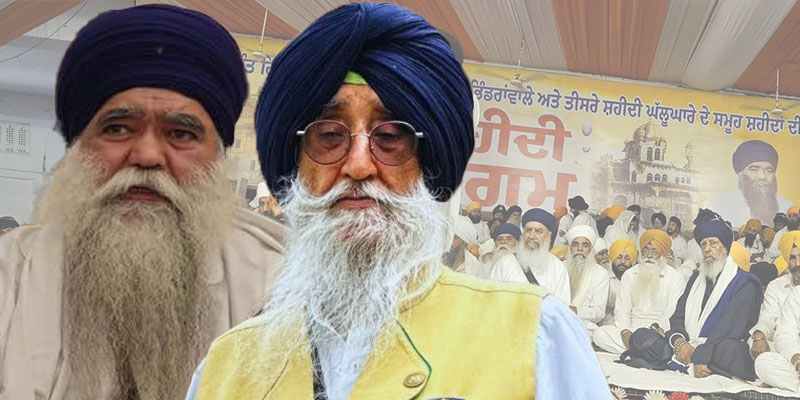
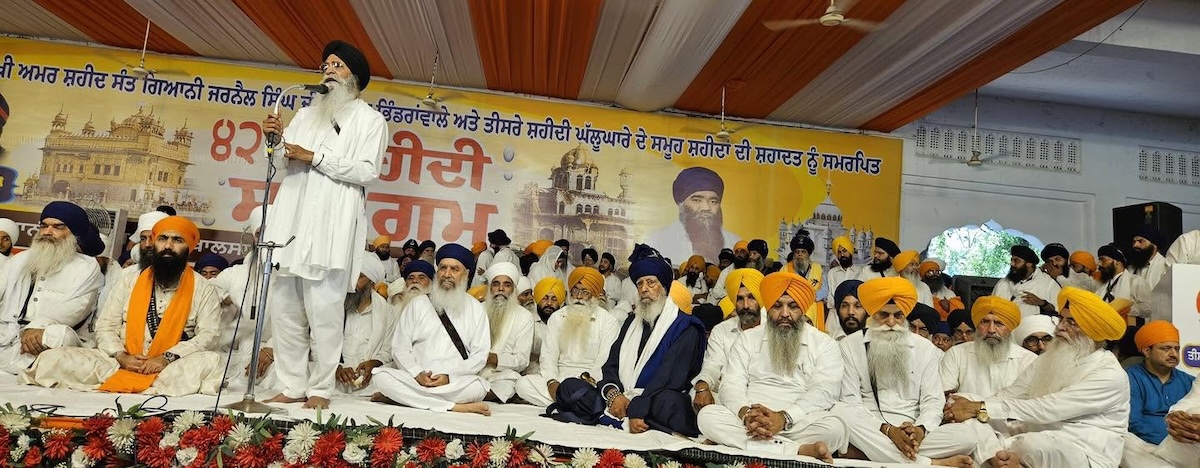
The recent public fallout between Baba Harnam Singh Dhumma, head of the Damdami Taksal at Mehta Chowk, and former Member of Parliament Simranjit Singh Mann during the commemoration of the 42nd anniversary of Operation Blue Star on 6 June has once again exposed deep fractures within sections of Sikh political and religious leadership.
While tensions between the two figures have existed for some time, the dispute has now escalated to a troubling level. Mann accused Dhumma of acting as an agent of the Indian state and betraying the legacy of Sant Jarnail Singh Bhindranwale through his perceived proximity to the Bharatiya Janata Party (BJP). Dhumma, without directly naming Mann, responded from the stage at Mehta Chowk with remarks that many interpreted as a veiled death threat. Such exchanges reflect not only personal animosity but also broader ideological divisions and personality clashes amongst the Sikh leadershaip that continue to shape Sikh politics in Punjab and across the global diaspora.
These divisions are particularly significant because they emerge at a time when the political landscape in Punjab is undergoing substantial transformation. Since the farmers’ movement of 2020–21, which witnessed unprecedented Sikh mobilisation and international attention, the Indian government appears to have shifted from a strategy of overt demonisation of Sikh political aspirations to a more nuanced approach that seeks to manage, influence and fragment Sikh opinion through selective engagement with religious and community leaders.
Political patronage has long been one of the most effective instruments of imperial and state power. Throughout history, rulers have sought to neutralise opposition not only through violent suppression and coercion but also by cultivating loyal intermediaries. By elevating certain religious leaders, providing financial incentives, granting privileges or offering political recognition, states have frequently attempted to reshape communities from within.
The controversy surrounding Dhumma is therefore not simply about one individual or one institution. Rather, it raises a much broader question that has recurred throughout Sikh history: how have states sought to co-opt Sikh leadership, and how have Sikhs responded?
A survey of Sikh history reveals a recurring pattern. Across different eras, external powers have often relied upon local collaborators and compliant religious elites to secure influence within Punjab. Yet running parallel to this history of accommodation has been an equally powerful tradition of resistance rooted in Sikh ideals of sovereignty, justice and collective self-determination.
Imperial Patronage During the Guru Period
Attempts to divide the Sikh community through state-supported rivals can be traced back to the period of the Sikh Gurus themselves.
The Mughal state frequently sought to undermine the authority of the Gurus by recognising alternative claimants to leadership. One notable example was Prithi Chand, the elder brother of Guru Arjan, who challenged the succession and sought support from Mughal authorities. His followers, known as the Minas, established a parallel tradition that attempted to weaken the growing Sikh movement.
Similarly, Ram Rai, the eldest son of Guru Har Rai, secured favour at the Mughal court after modifying a verse from Gurbani to satisfy Emperor Aurangzeb. He was subsequently granted land in what became Dehradun and developed a separate following under imperial patronage.
These episodes reveal an early pattern: whenever the Sikh movement posed a challenge to established authority, the state sought to promote alternative centres of loyalty.
The corruption of the Masand system also illustrates the dangers of institutional power detached from spiritual accountability. Established to facilitate communication and collect offerings on behalf of the Gurus, some Masands gradually accumulated wealth and influence for personal gain. Reports of misconduct became so widespread that Guru Gobind Singh eventually abolished the institution altogether, reaffirming direct accountability between the Guru and the Khalsa.
State Formation and the Sikh Empire
The establishment of the Sikh Empire under Maharaja Ranjit Singh represented a remarkable achievement in Sikh political history. Yet state formation itself brought new tensions.
The Khalsa had emerged through decentralised networks of autonomous warrior bands known as misls. These confederacies embodied a degree of collective leadership and participatory governance that distinguished them from many contemporary political systems. However, the consolidation of power under a centralised monarchy inevitably altered this political culture.
Ranjit Singh relied heavily on influential courtiers and administrators, among whom the Dogra brothers, Dhian Singh, Gulab Singh and Suchet Singh, became particularly prominent. Through extensive grants of land and political authority, they acquired considerable influence within the Lahore Darbar.
Following Ranjit Singh’s death in 1839, factional struggles intensified. Historians continue to debate the extent of Dogra involvement in the decline of the Sikh Empire, but there is broad agreement that internal rivalries, court intrigues and competing ambitions significantly weakened the state, facilitating British expansion into Punjab.
At the same time, influential Akali and Nihang leaders who maintained a more independent conception of Sikh sovereignty often found themselves at odds with the increasingly centralised structures of the kingdom. The tension between state authority and religious autonomy remained unresolved.
British Colonialism and Institutional Control
Following the annexation of Punjab in 1849, the British refined the politics of patronage into a sophisticated system of colonial governance.
Recognising the importance of religious institutions, colonial administrators sought to exercise influence through the management of historic gurdwaras. Control was frequently vested in hereditary Mahants and Udasi custodians who enjoyed legal protection and administrative support from the colonial state.
Many of these custodians became increasingly disconnected from mainstream Sikh religious practices. Allegations of corruption, caste discrimination and the introduction of non-Sikh rituals into major shrines generated widespread dissatisfaction.
The situation reached a breaking point in the early twentieth century. One of the most controversial episodes occurred when establishment religious authorities condemned members of the Ghadar movement, many of whom were Sikh revolutionaries committed to ending British rule. Such actions reinforced perceptions that religious institutions had become instruments of colonial control.
The resulting Gurdwara Reform Movement transformed Sikh politics. Thousands of ordinary Sikhs mobilised to reclaim their historic institutions, often facing imprisonment, violence and death. The creation of the Shiromani Gurdwara Parbandhak Committee (SGPC) emerged from this struggle and represented a decisive rejection of state-sponsored religious authority.
Contemporary Punjab and the Politics of Influence
The debate surrounding state influence within Sikh institutions did not end with independence. Rather, it has evolved in new forms.
Punjab’s contemporary political landscape is characterised by the presence of numerous deras, sectarian organisations and religious networks that command substantial followings. Political parties across the ideological spectrum have sought support from such institutions, recognising their ability to influence electoral outcomes.
Critics argue that this process often encourages the depoliticisation of Sikh teachings by emphasising personal spirituality and ritual observance while downplaying the tradition’s historic commitment to justice, equality and political agency. Others contend that such institutions provide important social services and spiritual guidance in an increasingly fragmented society.
Against this backdrop, allegations regarding the relationship between particular Sikh leaders and the BJP acquire broader significance. Whether justified or not, such accusations resonate because they touch upon a longstanding historical concern: the fear that religious authority may become dependent upon state patronage.
The controversy surrounding Baba Harnam Singh Dhumma is particularly sensitive because of the symbolic status of the Damdami Taksal. Under the leadership of Baba Jarnail Singh Bhindranwale, the Taksal became associated with resistance to state intervention and defence of Sikh identity during one of the most turbulent periods in modern Punjab’s history. Indeed, mostly because of the legacy left by Baba Jarnail Singh, many self proclaimed Taksalis continue to align themselves with the Khalistan movement, even though their ‘leader’ is being hailed as an Indian patriot by his BJP friends.
For critics, any perception of political accommodation with a central government viewed as promoting a Hindu nationalist agenda raises questions about continuity with that legacy. Supporters of Dhumma, however, insist that engagement with political power does not necessarily imply subservience and, as I note in a previous article, Harnam Singh Dhumma’s Support for BJP: Realpolitik or Betrayal? – may represent a pragmatic strategy in a complex political environment.
The Enduring Tradition of Resistance
Yet to focus solely on collaboration would be to misunderstand Sikh history.
The defining narrative of the Sikh tradition has not been one of accommodation but of resistance. From the martyrdoms of Guru Arjan and Guru Tegh Bahadur to the revolutionary social reforms of Banda Singh Bahadur, from the sacrifices of the eighteenth-century Khalsa to the Gurdwara Reform Movement of the 1920s, Sikhs have repeatedly challenged systems of domination and injustice.
Baba Banda Singh Bahadur dismantled feudal landholding structures and redistributed land to peasants. Akali leaders confronted colonial authority despite overwhelming odds. Akali Baba Phula Singh, for instance demonstrated the principle that even the most powerful rulers could be held accountable before the collective authority of the Panth.
These episodes continue to resonate because they affirm a central principle of Sikh thought: that religious integrity cannot be purchased through political favour, nor can spiritual authority be sustained through dependence upon temporal power.
The current disputes within Sikh leadership should therefore be understood not merely as personal rivalries but as manifestations of a much older historical struggle. The question at stake is one that has confronted Sikhs repeatedly over the past five centuries: whether institutions exist to serve the community and uphold its values, or whether they become instruments of external power.
As Punjab moves towards the 2027 Assembly elections, this question is likely to become increasingly significant. History suggests that while states may succeed in cultivating compliant intermediaries, the Sikh tradition has repeatedly generated voices of dissent and resistance. The tension between patronage and sovereignty remains unresolved, but it is precisely this tension that continues to shape Sikh political consciousness today.
And as for the personal feud between Harnam Singh Dhumma and Simranjit Singh Maan, one can only hope it doesn’t end in violence, since the consequences could lead to a chain reaction that will further divide Sikhs and damage our reputation in the eye of others.
Join the conversation on this story on Asia Samachar’s Facebook and Instagram pages.

Gurnam Singh is an academic activist dedicated to human rights, liberty, equality, social and environmental justice. He is a Professor of Sociology at University of Warwick, UK. He can be contacted at Gurnam.singh.1@warwick.ac.uk
* This is the opinion of the writer and does not necessarily represent the views of Asia Samachar.
RELATED STORY:
Harnam Singh Dhumma’s Support for BJP: Realpolitik or Betrayal? (Asia Samachar, 23 Nov 2024)
ASIA SAMACHAR is an online newspaper for Sikhs / Punjabis in Southeast Asia and beyond. You can leave your comments at our website, Facebook, Twitter, and Instagram. We will delete comments we deem offensive or potentially libelous. You can reach us via WhatsApp +6017-335-1399 or email: asia.samachar@gmail.com. For obituary announcements, click here