Rajinder (left) is Singh Laksa’s ‘chief laksa chef’, while Manjit handles the rest of the food. – Photo: The Star
By Asia Samachar | Malaysia |
A Cantonese-speaking Sikh is the man behind a well-known laksa dish in Seremban, the state capital of the Negeri Sembilan here, to rival Penang’s famed asam laksa.
He runs a stall named Singh Laksa, which offers the dish comprising curry powder, turmeric, coriander, curry leaves and lemongrass. Each bowl is served with homemade vegetarian sambal, reportedThe Star.
Both Negeri Sembilan and Penang are states that make up part of Malaysia.
“We are inspired by Malaysia’s rich culinary heritage,” Rajinder Singh, the 70-year-old stall operator whose mother is Chinese, told the Malaysian newspaper.
A bowl of laksa offered at his stall features noodles in a spice-rich gravy that combines Chinese, Indian and Malay influences. It resembles a version of the curry laksa or curry mee popular in Malaysia’s central region. But unlike most curry mee, Singh Laksa’s gravy is made without coconut milk. The stock is also vegetarian, according to the report.
“We experimented with different spice blends and ingredients, taking into account customer preference,” said his wife Manjit Kaur, 63, who has been on his side running the business for more than 20 years now. “We finally settled on a recipe that features a vegetarian gravy made with evaporated milk instead of coconut milk.”
A standard bowl at the pork-free stall includes a selection of noodles (kway teow, beehoon or yellow noodles), topped with the vegetarian gravy and tofu puffs. Non-vegetarians can opt for hard-boiled eggs, fishballs and fishcake slices.
The story of Singh Laksa — located along Jalan Temiang and close SMJK Chan Wa — began when Rajinder was working in the sales department of a multinational company.
With their four children all grown up, Manjit – a homemaker and passionate cook whose culinary repertoire includes Punjabi, Chinese, Malay, South Indian and Western food – soon got bored at home. Then, she learned of an elderly Chinese couple who ran a laksa stall and wanted to call it a day. Manjit took the opportunity to learn the basics of laksa-making from them, the report added.
ASIA SAMACHAR is an online newspaper for Sikhs / Punjabis in Southeast Asia and beyond. You can leave your comments at our website, Facebook, Twitter, and Instagram. We will delete comments we deem offensive or potentially libelous. You can reach us via WhatsApp +6017-335-1399 or email: asia.samachar@gmail.com. For obituary announcements, click here
And brothers & sister in laws and sisters & brother in laws, nephews & nieces and relatives.
PATH DA BHOG Kirtan Diwan, Katha and Path Da Phog followed by Guru Ka Langgar. Sunday, 19th January 2025, 9.30am to 12.00noon Gurdwara Sahib Mainduab, Kuala Lumpur
ASIA SAMACHAR is an online newspaper for Sikhs / Punjabis in Southeast Asia and beyond. You can leave your comments at our website, Facebook, Twitter, and Instagram. We will delete comments we deem offensive or potentially libelous. You can reach us via WhatsApp +6017-335-1399 or email: asia.samachar@gmail.com. For obituary announcements, click here
Darling Wife, Loving Mother and A Doting Grandmother & Great Grandmother.
It is with profound sadness that we announce the passing of our beloved mother, Sardani Harcharon Kour, wife of Sardar Karpal Singh (Ex-Immigration, Penang), who was called to her heavenly abode on January 7, 2025
| Entry: 7 Jan 2025; Updated: 9 Jan 2025 | Source: Family
ASIA SAMACHAR is an online newspaper for Sikhs / Punjabis in Southeast Asia and beyond. You can leave your comments at our website, Facebook, Twitter, and Instagram. We will delete comments we deem offensive or potentially libelous. You can reach us via WhatsApp +6017-335-1399 or email: asia.samachar@gmail.com. For obituary announcements, click here
Brig Gen Jagjit Singh (right) takes over as Commander of 13th Infantry Brigade from Brig Gen Hashim Osman in a ceremony on Jan 6, 2025 presided by 5th Division Commander Major General Noorrul Azril Ariffin
By Asia Samachar | Malaysia |
Brigadier General Jagjit Singh, the senior most ranking serving Sikh in the Malaysian armed forces, has been appointed as the Commander of the 13th Infantry Brigade based in Lahad Datu, Sabah.
Jagjit took over the command of the infantry brigade today (Jan 6) from Brig Gen Hashim Osman in a ceremony presided by 5th Division Commander Major General Noorrul Azril Ariffin.
The 13th Infantry Brigade was formed in 2019 after the 2013 Lahad Datu incident when Sulu armed militia from southern Philippines staged an armed attack on the east coast of Sabah.
In 2012, Ranjit Singh Ramday, then a 57-year-old brigadier-general, was appointed as the Commander of the Lok Kawi-based Fifth Infantry Brigade in Sabah, making him the first Sabahan, as well as the first Sikh, to assume the post of commander in the brigade’s history. Ranjit, who had served as the Commander of the army’s 1 Division in East Malaysia, retired as a major general.
Born on 17 April 1967 in Batu Arang, Selangor, he was raised in Batang Berjuntai, now called Bestari Jaya. Jagjit’s father, Indar Singh, worked as a tin miner and his mother Mohinder Kaur was a homemaker to a family of 5 sons and a daughter.
Jagjit is married to Kiranjeet Kaur, a former leading stewardess with Malaysia Airlines. The couple has two sons, Harveer Singh and Rajveer Singh, both pursuing their undergraduate studies in business and law, respectively.
ASIA SAMACHAR is an online newspaper for Sikhs / Punjabis in Southeast Asia and beyond. You can leave your comments at our website, Facebook, Twitter, and Instagram. We will delete comments we deem offensive or potentially libelous. You can reach us via WhatsApp +6017-335-1399 or email: asia.samachar@gmail.com. For obituary announcements, click here
The Malayan Sikhs Education Aid Fund (MSEAF), an outfit set-up before Malaya gained its independence and which has ramped up its funding activities in the recent past, has unveiled a new leadership.
At its Annual General Meeting on Dec 9, 2024, MSEAF has elected Manraj Singh as its new chairman and Mahinder Singh Gill as the vice chairman, for the next two years (2024-26).
Manraj, a 40-year-old founder and director of an IT-based company, was the vice chair in the outgoing committee and takes over from Amarjit Singh Deo.
The others elected were Sharonjit Kaur (secretary), Sukhpal Singh (assistant secretary), Amar Singh (treasurer), Harnil Singh Randhawa (assistant treasurer) and Parpur Singh, Sukhdav Singh and Amritpal Singh (committee members). Its aministrative executives are Sangeta Kaur and Pranjit Kaur.
“MSEAF extends its deepest gratitude to the outgoing committee members for their invaluable contributions and unwavering commitment over the years. Their dedication has paved the way for this new chapter of growth and innovation.
“This leadership team brings fresh perspectives and a passionate drive to make education accessible to more individuals, ensuring no one is left behind. The team is committed to inspiring positive change and supporting the Sikh community and beyond,” MSEAF said in a note sent to Asia Samachar.
MSEAF provides interest-free loans of up to RM50,000 to Sikh students pursuing degrees and RM30,000 for diploma studies.
Since 1990, the fund has given close to RM3 million to about 200 students. As at October 2024, it approved a new sum of RM650,000 to 15 students, RM130,000 to five students in 2023 and RM183,000 to nine students in 2022.
The fund, set up in 1951, is in the midst of raising at least RM5 million to boost its coffers. Donors can claim tax deductions on their annual tax returns based on the amount donated to MSEAF as the fund has been recognised by the Inland Revenue Board of Malaysia (IRBM) as a qualifying institution for tax exemptions. See here.
For more information on its programs, initiatives, or how you can contribute to MSEAF’s efforts, visit its website or call its main line at 019 409 1918.
ASIA SAMACHAR is an online newspaper for Sikhs / Punjabis in Southeast Asia and beyond. You can leave your comments at our website, Facebook, Twitter, and Instagram. We will delete comments we deem offensive or potentially libelous. You can reach us via WhatsApp +6017-335-1399 or email: asia.samachar@gmail.com. For obituary announcements, click here
Great grandchildren, sisters, brothers-in-law, sisters-in-law, nieces, nephews and a host of other relatives and friends.
LAST RITES 6th January 2025 (Monday) 10am onwards: Visitation at residence 14, Jalan USJ 6/6N, Subang Jaya, Selangor 1:30pm: Cortège leaves 2:30pm: Saskaar (cremation) at Nirvana Memorial Park Shah Alam
ANTIM ARDAAS & PATH DA BHOG 11 January 2025 (Saturday) 10am-12pm Gurdwara Sahib Subang
A loving and caring mother, grandmother, great grandmother, sister, and aunt. Her strong spirit, compassionate nature, warmth and love will be deeply missed and forever remembered.
ASIA SAMACHAR is an online newspaper for Sikhs / Punjabis in Southeast Asia and beyond. You can leave your comments at our website, Facebook, Twitter, and Instagram. We will delete comments we deem offensive or potentially libelous. You can reach us via WhatsApp +6017-335-1399 or email: asia.samachar@gmail.com. For obituary announcements, click here
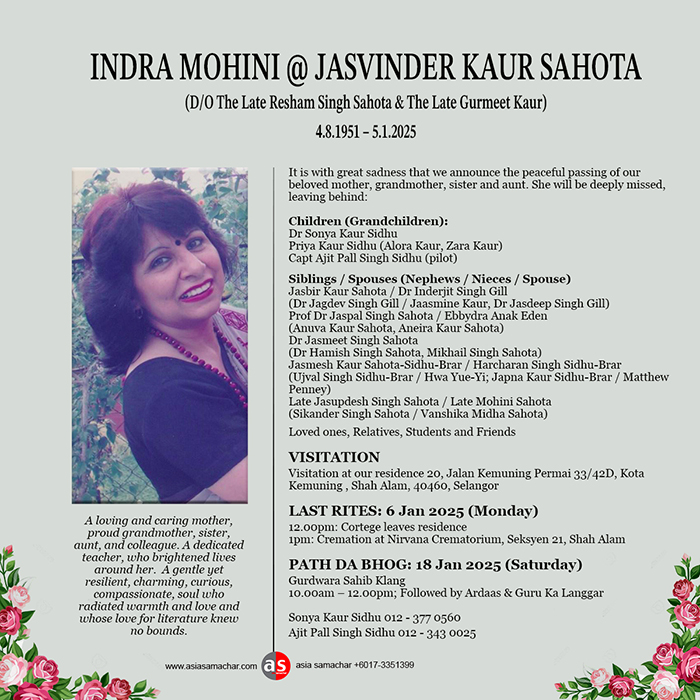
Siblings / Spouses (Nephews / Nieces / Spouse) Jasbir Kaur Sahota / Dr Inderjit Singh Gill (Dr Jagdev Singh Gill / Jaasmine Kaur, Dr Jasdeep Singh Gill) Prof Dr Jaspal Singh Sahota / Ebbydra Anak Eden (Anuva Kaur Sahota, Aneira Kaur Sahota) Dr Jasmeet Singh Sahota (Dr Hamish Singh Sahota, Mikhail Singh Sahota) Jasmesh Kaur Sahota-Sidhu-Brar / Harcharan Singh Sidhu-Brar (Ujval Singh Sidhu-Brar / Hwa Yue-Yi; Japna Kaur Sidhu-Brar / Matthew Penney) Late Jasupdesh Singh Sahota / Late Mohini Sahota (Sikander Singh Sahota / Vanshika Midha Sahota)
Loved ones, Relatives, Students and Friends
A loving and caring mother, proud grandmother, sister, aunt, and colleague. A dedicated teacher, who brightened lives around her. A gentle yet resilient, charming, curious, compassionate, soul who radiated warmth and love and whose love for literature knew no bounds.
Nature’s first green is gold, Her hardest hue to hold, Her early leaf’s a flower, But only so an hour. Then leaf subsides to leaf, So Eden sank to grief, So dawn goes down to day, Nothing gold can stay.
Robert Frost
VISITATION Visitation at our residence 20, Jalan Kemuning Permai 33/42D, Kota Kemuning, Shah Alam, 40460, Selangor
LAST RITES: 6 Jan 2025 (Monday) 12.00pm: Cortege leaves residence 1pm: Cremation at Nirvana Crematorium, Seksyen 21, Shah Alam
PATH DA BHOG: 18 Jan 2025 (Saturday), 10.00am – 12.00pm Gurdwara Sahib Klang Followed by Ardaas & Guru Ka Langgar
ASIA SAMACHAR is an online newspaper for Sikhs / Punjabis in Southeast Asia and beyond. You can leave your comments at our website, Facebook, Twitter, and Instagram. We will delete comments we deem offensive or potentially libelous. You can reach us via WhatsApp +6017-335-1399 or email: asia.samachar@gmail.com. For obituary announcements, click here
Maa, you were the foundation of our family, the one we turned to for comfort, advice, and unconditional love. Your laughter was like music, the meals you cooked, the lessons you shared, and the love you poured into our lives will forever be imprinted on our hearts. We love you maa, always and forever, our Queen.
| Entry: 5 Jan 2025; Updated: 7 Jan 2024 | Source: Family
ASIA SAMACHAR is an online newspaper for Sikhs / Punjabis in Southeast Asia and beyond. You can leave your comments at our website, Facebook, Twitter, and Instagram. We will delete comments we deem offensive or potentially libelous. You can reach us via WhatsApp +6017-335-1399 or email: asia.samachar@gmail.com. For obituary announcements, click here
Guru Gobind and the Khlasa in 1699 – Skecth by Kanwar Singh (Art of Punjab)
By Bhupinder ‘Bo’ Singh | Opinion |
Abstract
The short life of 42 years of Guru Gobind Singh Ji was full of challenges right from his childhood. Despite his lack of resources, how he faced those daunting challenges and what he achieved in his life is unparalleled. In this article we will explore his Five lasting legacies.
Introduction
The beheading of Guru Tegh Bahadur Ji in 1675, was a major turning point in the Sikh history. His son Gobind Rai, nine years old, assumed the responsibility of Guruship. While departing for Delhi to offer his head in sacrifice, Guru Ji had charged Gobind Rai to shield the oppressed even at the cost of his own life. Young Gobind Rai (later Singh) was fired with zeal, to endeavor for the fulfillment of his mission. The task before him was stupendous, while his resources were almost nonexistent – no estate, wealth, etc., and he was facing formidable forces of Emperor Aurangzeb whose empire encompassed the Indian subcontinent. The way he geared to face these challenges, we can see the qualities of – character, charisma, competence, courage, discipline, focus, generosity, humility, initiative, leadership, military strategist, passion, poetic temperament, positive outlook, problem solving, strategic planning, valor, and vision. All the odds could not shake his single-minded determination and resolute demeanor. He had lost his father, four sons, and old mother, endured hunger, loss, starvation, and deprivation; yet nothing could dampen his determination or enthusiasm. He is lovingly revered as “Sarbans Daani” – one who willingly sacrificed his whole family. For a Sikh, the only aspiration is to live to his legacies, and he is the Guru whose life captivates the Sikhs and inspires them. Let us explore five of his legacies.
The Founding of the Khalsa Order
Guru Gobind Singh Ji, after a deep deliberation about the state of Sikhs and their affairs, came to the conclusion on the need to initiate the order of the Khalsa. Guru Ji had witnessed a state of forced cruelty and conversions, plunder, and abduction of young girls for forced marriages with the rulers and elites. Guru Ji’s conviction was also born out of the realization that the Sikhs having shrunk from recognition at the time Guru Tegh Bahadur’s execution should never be able to conceal their identity. His other objective was that he wanted to turn the timid sparrows into brave hawks. He found the foothills of northern Himalayas most suited for his revolutionary endeavor. To give formal shape to his vision Guru Ji had sent out invitations to all the Sikh sangats to come to Anandpur on 30 March 1699 for a special event.
There were 80,000 in attendance and most are familiar with the history of the event, so it is not being repeated here. But the significant aspect was that Guru Ji had dramatically introduced the new rite of initiation in the Khalsa order with the Kirpan, called Khande De Pahul. After initiating the five, Guru Ji asked them to baptize him, which was a unique affair, where the Master was asking for a favor from his chosen disciples. The newly minted to the Khalsa order were also given a new code of conduct called – Rehat by Guru Ji, which was to be observed by the initiated. With this new initiation rites Guru Ji established two basic principles of universal brotherhood and the spirit of sacrificing the self with demur. After the initiation ceremony Guru Ji had declared to those gathered for the occasion that he has obeyed the mandate of Lord Akal, which enshrines the uplifting of the down trodden. Sainapat, a contemporary has given his version of Hukamnamma as:
“In the Khalsa will you see me, With the Khalsa is my sole concern, My physical form have I, Bestowed on to the Khalsa.”
Thus, with one stroke, Guru Ji was trying to change the course of history by infusing valor, bravery, and self-respect in the frigid blood of the natives. Later events proved how the transformation by Guru Ji imprinted its stamp on the course of history. With the Khalsa as the guiding spirit of the reconstituted Sikh army, Guru Gobind Singh moved against the Sikhs’ enemies on two fronts: one army against the Mughals and the other against the hill tribes. His troops were totally devoted and totally committed to Sikh ideals, ever willing to risk everything in the cause of Sikh religious and political freedom.
Guru Ji paid a heavy personal price for this new spirit that he had infused in the living dead. In the battle of Chamkaur, he lost his two older sons and three of the Five (Punj) Pyares, along with many Khalsa warriors. He also lost his two younger sons aged 9 and 7 in Sirhand, when they were bricked alive, and his old mother died there. Despite the challenging situations that he faced he never gave up his determination, courage, foresight, and unwavering spirit.
2. The Gift of Kirpan
Kirpan is the name of the sword given to the Khalsa by the Guru. Guru Ji had given Khalsa the Kirpan to employ it for protection of life, defense, freedom, along with the power of ensuring and exercising compassion, victory, and noble authority through its use. In the Sikh tradition, the role of weapons has been uplifted from consideration as ‘the tool of enemies, foes and tyrants,’ to that of ‘constant protector, trustworthy ally, and victorious champion.’ Weapons have been employed throughout human history as implements to subdue others, harm, and destruction, but with Kirpan Guru Ji had established new credentials for its use. Guru Ji first used Kirpan for the initiation ceremony in Anandpur Sahib. The initiated ones were asked to carry Kirpan as a part of five Kakars that Guru Ji required all the initiated to carry with them.
Hari Singh Nalwa, a great general of Maharaja Ranjit Singh’s kingdom. – Painting by Bhagat Singh (Sikh Art)
The word Kirpan is a compound word made from Kirpa + An. The word ‘Kirpa’ means blessing, and ‘An’ means honor, so the coined word means blessing for protection of honor. Thus, even the name established the credentials of this as a defensive weapon. To Guru Ji, ‘the sword is useless without God’s grace.’ In the process Guru Ji created a strong, resolute, and self-respecting community from the downtrodden, weak, emaciated. The Kirpan also plays a significant role in other Sikh practices. Kirpans are used prominently in ceremonies marking major life events, including religious initiation (Amrit Sanchar), marriage (Anand Karaj). In the regular congregational settings, a kirpan is touched to parshad (blessed sweet pudding) to indicate the grace of the Guru and then distributed for consumption.
3. Institution of Five Beloved (Punj Pyare)
On the 30th of March 1699, the Sikh Guru Gobind Singh called together a special assembly at the Keshgarh Fort in Anandpur. Following the morning devotions, the Guru asked for a volunteer, saying, “The entire sangat is very dear to me; but is there a devoted Sikh who will give his head to me here and now? A need has arisen at this moment, which calls for a head.” One man arose and followed the Guru out of the room to enclosed tent. When the Guru returned to the assembly with a bloodied sword, he asked for another volunteer. Another man followed; this was repeated three more times. Finally, the Guru emerged with a clean sword and all five men alive and well. Those five, who volunteered would become the first disciples of the Khalsa, the martial community within the Sikh religion.
The Sikhs had risen to the occasion and had creditably passed the challenging test. These five had unflinchingly placed their necks under the sword of their Guru. Guru Ji had presented these five to the sangat next day and called them “Five Beloved,” thereby giving birth to the concept of collective leadership. Even Guru Ji himself had abided by the collective unanimous decisions by these five, even when his personal viewpoint was different. By this initiation Guru Ji had instituted a unique system for Sikhs to manage their collective issues. Guru Ji had set a condition for the operation of this conclave, requiring their meeting should take place in the presence of Guru Granth Sahib.
Today, when we look at how our community affairs are being tackled we can clearly see that we have deviated so much from this Guru initiated practice. As a consequence, we don’t come across the institution of five beloved in life, where their collective decisions will be abided by the entire community. The outcomes are clearly visible to all of us, as we find ourselves in the doldrums on most of the issues and challenges. It is about time that we reverted back to this Guru-given institution that has stood test of time and proven to be an effective way to manage the challenges facing the community.
4. Infusing the spirit of Self-Sacrifice
As we have seen above, Guru Ji found that self-respect and honor was completely lacking in the masses, and the spirit of self-sacrifice was completely absent. According to Daulat Rai the Rajputs who were the finest flowers of Hindu chivalry, their pride, glory, and manhood had been ground so fine that they were vying against each other to offer their daughters in marriage to Muslim princes and nobles. The Brahmins who embraced Islam were flatteringly called Sayyads. The Hindus had lost their country and were on the verge of losing their identity along with their faith. There was no fellow feelings left; in fact, the raft of Hinduism was sinking fast. In desperation the Kashmiri Pandits came to Guru Tegh Bahadur Ji to share their plight of being forced to change their faith. Young Gobind Rai walked into the meeting and inquired about the visitor’s purpose. Upon finding out, he had suggested to his father that there was no one better suited than him to offer self-sacrifice. Guru Tegh Bahadur Ji suggested to Kirpa Ram, the leader of the delegation that they should inform the ruler that if Guru Tegh Bahadur agrees for conversion we all will follow suit. Guru Tegh Bahadur sacrificed his life on November 11, 1675, and before his own execution his three associates were mercilessly tortured and killed to set a gory example of defying and weaken the resolve of Guru. Guru Gobind Singh Ji deeply reflected on the precarious situation in the country and realized that the spirit of self-sacrifice needs to be infused in the people. This he initiated in an overly dramatic manner during the Vaisakhi of 1699 in Anandpur as we discussed above.
The five lasting legacies of Guru Gobind Singh – Sketch: Bhupinder ‘Bo’ Singh
The later turn of events of history categorically established that Guru Ji was able to infuse this spirit. The almost eight months long siege of Anandpur Fort with supplies cutoff, Battles of Chamkaur and Mukatsar saw a vivid demonstration of the spirit of self-Sacrifice during Guru Ji’s life time. The spirit was zealously displayed when Banda Singh Bahadur started his campaign in Punjab in 1710 to his own execution in 1713. The spirit infused by Guru Ji is still alive and well, which shows up in the time of crisis.
5. The Gift perpetual Guru
This was an incredibly unique concept that Guru Gobind Singh initiated in 1708, a day before his death that after him, his successor will be the Guru Granth Sahib. It was a first that the holy scripture had been anointed as a living Prophet, and even to date it continues to be so. By anointing the Sri Guru Granth Sahib (SGGS) as the perpetual Guru, Guru Gobind Singh had put an end to the tradition of living human Guru. In his Rahitnama, or Code of Conduct, Bhai Nand Lal, who was at Nanded in the camp of Bahadur Shah Zafar, had recorded Guru Ji’s last words of injunction in Punjabi verse as:
“He who would wish to see Guru. Let him come and see the Granth.”
Bhai Prahlad Singh, another disciple of the Guru, has attested to these Guru’s commandments as:
“By the word of Timeless One, Has Khalsa been manifested. This is my commandment for all of my Sikhs, You shall acknowledge Granth as the Guru.”
A detailed account of the events Guru Gobind Singh Ji installing the Guru Granth Sahib as the Guru a day before his own departure is available in Bhatt Vahi of Bhadson Thanesar. The words enshrined in SGGS were revered by the Gurus, and the Sikhs consider those as divine revelations. With this act Guru Ji, Guruship in SGGS had been bestowed for eternal and everlasting times. Thus, Guru had attached the Khalsa to the “Word.”
Guru Nanak had selected Bhai Lehna as his successor on merit, by-passing his own sons. That tradition was continued by Guru Angad (Bhai Lehna’s given name by his predecessor) when he selected his successor in Guru Amar Das. Similar rigorous yardstick for selection of next successor were – service, remembrance (Simran), sweetness, humility plus willingness to sacrifice were the criterion. Now Guru Gobind Singh’s unique selection was infusion of “Guru Nanak’s jot (light) in the SGGS, elevating it to the status of living Guru forever. Thus, in the collective understanding of Sikhs and their conviction SGGS has become the Guru. If a Sikh is following someone else besides SGGS, then the person has deviated from the Guru’s path. Thus, in one stroke, Guru Gobind Singh puts an end to the tradition of living human Gurus.
Conclusion
Guru Gobind Singh Ji came into this world at times of great peril, and what he achieved in short span of 42 years can only be termed as miracle. He distinguished himself as a person of action, a hero of many battles, a distinguished poet, full of humility, and a person of impeccable integrity. His lasting legacies had been an inspiration and will continue to inspire the future generations to come.
References:
Rai, Daulat. Sahibe Kamal Guru Gobind Singh. Gurmat Sahit Charitable Trust (1993).
McLead, W. H. The Sikhs. History, Religion and Society. Columbia University Press (1989).
Singh, Harbans. Berkley Lectures on Sikhism. Guru Nanak Foundation (1983).
Bhupinder ‘Bo’ Singh, Houston. Born in Bhamo, Myanmar, he now lives in Houston, US, where he runs a manufacturing company formed with his son. A mechanical engineer by training, he has authored a number of books, including Connecting with the Master – A collection of essays on topics related to Sikhism (2006) and In Bully’s Eyes – An Illustrated Children’s book on Bullying (2019).
ASIA SAMACHAR is an online newspaper for Sikhs / Punjabis in Southeast Asia and beyond. You can leave your comments at our website, Facebook, Twitter, and Instagram. We will delete comments we deem offensive or potentially libelous. You can reach us via WhatsApp +6017-335-1399 or email: asia.samachar@gmail.com. For obituary announcements, click here
Leaving behind children, grandchildren, great grandchildren, a host of relatives and friends.
FINAL RITES 4 January 2025 (Saturday) 10am-2pm: Visitation at Gurdwara Sahib Kuyow, KL 2.30pm: Cortege leaves 3.30pm: Saskar (cremation) at Shamshan Bhoomi Hall, Jalan Loke Yew Crematorium, KL
PATH DA BHOG : 19 January 2025 (Sunday) 9am-11.30am Gurdwara Sahib Kuyow
Mummy/Maa, you and only you, made the impossible possible for many, threaded on various beaten path courageously, stood tall in weathering adversity, holding on to faith as your guiding strength.
ASIA SAMACHAR is an online newspaper for Sikhs / Punjabis in Southeast Asia and beyond. You can leave your comments at our website, Facebook, Twitter, and Instagram. We will delete comments we deem offensive or potentially libelous. You can reach us via WhatsApp +6017-335-1399 or email: asia.samachar@gmail.com. For obituary announcements, click here