ASIA SAMACHAR is an online newspaper for Sikhs / Punjabis in Southeast Asia and beyond. You can leave your comments at our website, Facebook, Twitter, and Instagram. We will delete comments we deem offensive or potentially libelous. You can reach us via WhatsApp +6017-335-1399 or email: asia.samachar@gmail.com. For obituary announcements, click here
NKJ at Bangkok, Thailand in a kirtan parchaar tour in May-June 2024
By Asia Samachar | Malaysia |
Bhai Harinder Singh from the Nirvair Khalsa Jatha (NKJ) is set to visit Malaysia from Nov 7-18, 2024. They will have programmes at Johor (Johor Bahru), Kuala Lumpur (Tatt Khalsa) and Perak (Changkat, Batu Gajah and Wadda Gurdwara Sahib Ipoh).
Harinder is passionately about exploring Gurbani in a way that it resonates with the Sanggat, even the young children.
ASIA SAMACHAR is an online newspaper for Sikhs / Punjabis in Southeast Asia and beyond. You can leave your comments at our website, Facebook, Twitter, and Instagram. We will delete comments we deem offensive or potentially libelous. You can reach us via WhatsApp +6017-335-1399 or email: asia.samachar@gmail.com. For obituary announcements, click here
A REAL BLAST: Setia City Sikhs Yaariyan Di Raat in July 2024
By Asia Samachar | Malaysia |
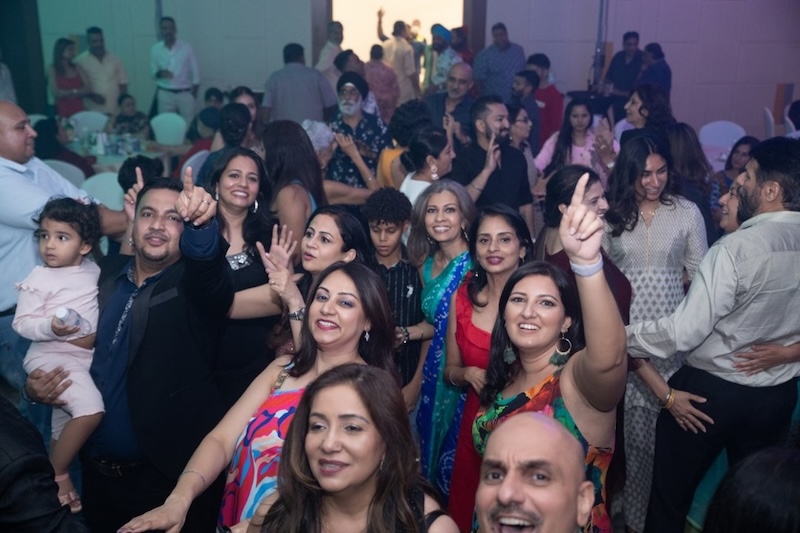
The recent fellowship dinner hosted by the Setia City Sikh community was a resounding success, marking a triumphant return after several years. This year’s event, held on July 27, 2024, was a vibrant celebration of the enduring friendships and fellowship that bind the Setia City Sikhs community together.
A Unifying Force: Central to the cohesion of the Sikh community in Setia Alam, is the Setia City Darbar, a cornerstone established in 2013. This institution serves over 60 Sikh families and has been pivotal in fostering a sense of belonging and unity among the Sikh community.
Celebrating Our Unity: The tradition of hosting these dinners began nine years ago, with the inaugural event held in 2015. Over the years, the Setia City Sikhs community has come together to celebrate and connect through a series of successful events – alternating between fun filled family days and amazing fellowship dinners. The last dinner prior to this was held in 2018.
The event was organised by a team led by Amar Singh and Sukhpall Singh. The success of this year’s dinner, attended by 200 guests, reflected on the vibrant and resilient spirit of the Sikh community in Setia Alam, a township located in Shah Alam, Selangor.
ASIA SAMACHAR is an online newspaper for Sikhs / Punjabis in Southeast Asia and beyond. You can leave your comments at our website, Facebook, Twitter, and Instagram. We will delete comments we deem offensive or potentially libelous. You can reach us via WhatsApp +6017-335-1399 or email: asia.samachar@gmail.com. For obituary announcements, click here
ASIA SAMACHAR is an online newspaper for Sikhs / Punjabis in Southeast Asia and beyond. You can leave your comments at our website, Facebook, Twitter, and Instagram. We will delete comments we deem offensive or potentially libelous. You can reach us via WhatsApp +6017-335-1399 or email: asia.samachar@gmail.com. For obituary announcements, click here
Declan McBay is an Irish man with a heart immersed in sewa (selfless services). The Derry resident first visited the gurdwara in 2015 in an organised tour. What he saw captured his heart, and kept him coming back.
ASIA SAMACHAR is an online newspaper for Sikhs / Punjabis in Southeast Asia and beyond. You can leave your comments at our website, Facebook, Twitter, and Instagram. We will delete comments we deem offensive or potentially libelous. You can reach us via WhatsApp +6017-335-1399 or email: asia.samachar@gmail.com. For obituary announcements, click here
Many articles are being written by Sikhs discouraging anniversaries as well as cultural celebrations like Lodi and Diwali, labeling them as “ignorant, foolish and unnecessary rituals” that stray from the core teachings of Gurbani.
This creates confusion, guilt and conflict in our Sikh society. My question is why not?
Things have changed over generations and we cannot take examples of the past to fit into today’s lifestyle. Here’s a possible counter-argument if it may interest you.
Cultural Evolution: Traditions and practices evolve over time, and what may not have been practiced in the past could gain significance in later generations. Just because a ritual wasn’t observed during the Guru’s time doesn’t mean it’s inherently wrong today. Celebrating Guru Sahib’s wedding anniversary or other events could serve as a means for modern Sikhs to connect emotionally with their history and heritage.
Intent Behind Celebrations: The key aspect of any religious observance is the intent behind it. If these celebrations inspire devotion, bring the families and community together, and serve as moments to reflect on Guru Sahib’s teachings or individual families’ memories of joy, they could be seen as positive. The outward form of a celebration does not necessarily take away from its spiritual depth if the purpose remains rooted in reflection on Gurbani and the Gurus’ teachings.
Diverse Interpretations: Sikhism has a rich tradition of interpretation. While some argue that these celebrations are a diversion from the essence of Sikhism, others might view them as additional opportunities to remember the Gurus or bring families together.
In the pretext of history, remembering the Gurus’ lives, including their personal milestones, can be viewed as a way of honoring their legacy.
The Role of History and Oral Tradition: Just because certain practices or ceremonies were not recorded or celebrated in documented history doesn’t mean they lack value. Oral traditions, community-driven practices, and evolving customs have always been part of religious and cultural life.
Personal Devotion: Finally, for many Sikhs, these observances are deeply personal expressions of love and devotion. Criticizing them outright as “ignorance” might overlook the personal connection individuals and communities feel with their faith.
In essence, while some may argue through their articles advocating a return to the “pure” form of Sikhism based solely on Gurbani and historical precedents, many Sikhs find meaning in the evolving practices that help them stay connected to their heritage in a contemporary context. The spiritual essence of a practice, however, often lies in the intention and devotion behind it.
I say go ahead, find a reason to celebrate togetherness. May it be Lodi, Rakhi Bandan, Diwali and any other anniversaries.
Years ago in the early 1990s, my late wife, Taranjit, and I introduced children’s playbooks to the market, similar to the well-known Ladybird books in English. Despite our efforts, we faced significant criticism and dissatisfaction, especially from senior members of the community. The challenge among us Sikhs is that we often conflate religion with language, script, culture, clothing, grooming, and music. We need to separate these elements to allow each one its own identity and space for growth.
Today, there seems to be a greater understanding as ideologies evolve. However, the latest controversy centers around the use of thumb drives and mobile phones to access Gurbani. It’s important to remember that Gurbani’s wisdom came from the divine thin air, Bani is Guru. That is what Guru Ji bowed before. Since writing on paper was the available technology at the time, it took the form of a book we now call the Granth. But our reverence is not for the paper or ink; it’s for the divine message itself.
Dr Balwant Singh Bains is a Malaysia-based kirtan enthusiast and a practicing physiotherapist with a chain of physiotherapy clinics.
ASIA SAMACHAR is an online newspaper for Sikhs / Punjabis in Southeast Asia and beyond. You can leave your comments at our website, Facebook, Twitter, and Instagram. We will delete comments we deem offensive or potentially libelous. You can reach us via WhatsApp +6017-335-1399 or email: asia.samachar@gmail.com. For obituary announcements, click here
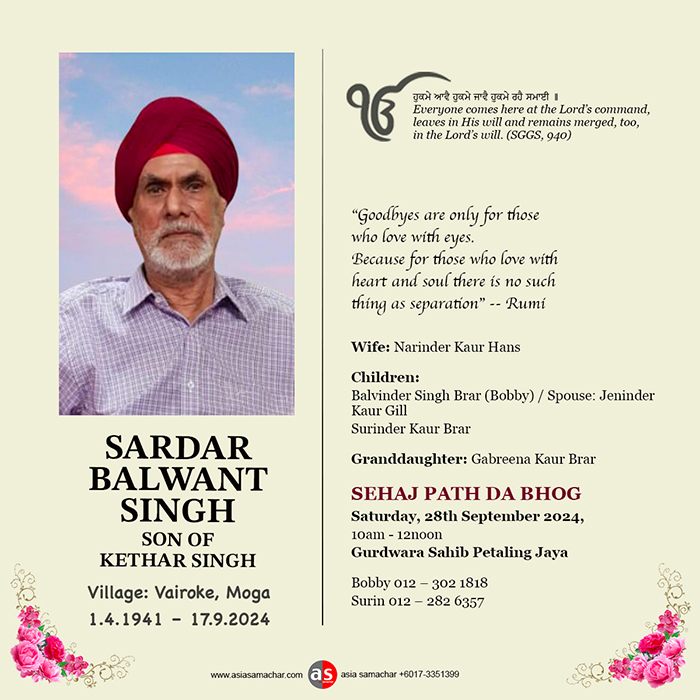
(A long-serving sewadar, Gurdwara Manager, at Gurdwara Sahib Melaka)
27.3.1948 – 16.9.2024
A humble family man. Born in Ipoh, Perak, he spent his early adult life in Raub, Pahang, and later committed to sewa at Gurdwara Sahib Melaka.
Wife: Sarbjit Kaur Late Karam Kaur (passed away)
Children: Ranjeeta Kaurr Dhesi Surmukh Singh Dhesi Baldip Singh Dhesii Gur Karan Vir Singh Dhesi
Grandchild: Aryan Vir Singh
FUNERAL: 17 Sept 2024 (Tuesday) 2.15pm: Cortège leaves from residence at 10, Jalan Puteri 12/18, Bandar Puteri Puchong, 47100 Selangor 3pm: Saskaar (cremation) at Puchong Crematorium (Add: Lot 7374, Jalan Bunga Kertas, Puchong, Batu 14, 47100 Puchong, Selangor)
PATH DA BHOG: 29 September 2024, Sunday, 10am onwards Gurdwara Sahib Melaka
ASIA SAMACHAR is an online newspaper for Sikhs / Punjabis in Southeast Asia and beyond. You can leave your comments at our website, Facebook, Twitter, and Instagram. We will delete comments we deem offensive or potentially libelous. You can reach us via WhatsApp +6017-335-1399 or email: asia.samachar@gmail.com. For obituary announcements, click here
Hazur Sahib – located on the banks of the Godavari River at the city of Nanded in the state of Maharashtra – marks the site where Guru Gobind Singh, in 1708, was convalescing after being attacked by two would-be assassins. The Guru had himself named Nanded as “Abchalnagar” (literally “Steadfast city”)
One of the attackers stabbed the Guru, and was killed by him with a single stroke of his talwar. The other was killed by Sikhs as he tried to escape. The Guru’s wound was deep, but initially healed after being stitched by an English surgeon sent by Bahadur Shah I, who served as his doctor, and Dara Shikoh before him. However, the wound re-opened a few days later when the Guru was stringing a bow for one of his Sikhs. Subsequently, the Guru passed on after declaring the Shabd Guru as his successor.
Today Hazur Sahib is also known as Takht Sachkhand Sri Hazur Abchalnagar Sahib, and is one of the five Takhts (seats of authority) of Sikhism. The gurdwara (Sikh house of worship) was built between 1832 and 1837 by Maharaja Ranjit Singh (1780–1839). The structure is built at the place where Guru Gobind Singh passed on.
The gurdwara within the complex is known as Sachkhand (Realm of the Divine). The gurdwara’s inner room is called the Angitha Sahib and is built over the place where Gobind Singh was cremated in 1708.
The Diwan of Haidrabad, Chandu Lal, had ensured that the care and control of Hazur Sahib was in the hands of followers of the Udasi Sect – an anti-Sikh sect founded by Sri Chand, the rebel and kudalni yoga practitioner son of Guru Nanak.
Maharaja Ranjit Singh had sent builders, craftsmen and soldiers from Punjab to build the place. Many of these Sikhs stayed behind and eventually took physical control of the Gurdwara. But they either paid no attention to the ongoing and distorted maryada that was introduced by the Udasis, had no real understanding of the anti-Gurmat elements of the maryada; or were prevented by local administrators and sangats from reverting the maryada to be one that was in line with Gurmat tenets.
In any case, the peculiar, odd and strange practices remain. The main ones are listed below:
1. The daily performance of Snatani acts such as ringing of bells, the singing of Aarti with lamps and the use of paraphernalia contained within a plate, and the lighting of oil lamps.
2. The practice of using the tip of an arrow for the purposes of sanctifying the Karah Parshad instead of a kirpan as is done in all other gurdwaras around the world.
3. The conduct of ritualistic slaughter of a goat during occasions such as Dushera, Holla Mahala, Vaisakhi etc, and the use of the animal’s blood as tilak offerings of weapons that are on display at Angitha Sahib.
4. Ritualistic worship of myriad of weapons that are stored within the precincts of the Takhat.
The shasthar (weapons) at Hazur Sahib – Photo: Takhat Sachkhand Sri Hazur Sahib Abchalnagar
5. The dramatic manner of grinding sandalwood every morning and the act of placing tikkas of this sandalwood paste on the foreheads of the sangats who have come to listen to the kirtan of Asa Di Vaar.
6. The offering of the intoxicant of Bhang in the name of Guru Gobind Singh three times daily.
7. The conduct of an Ardas that mentions Snatani elements such as the ishnan (baths) at Ganga Godawri and mention of places such as Hemkunt, Tilganji and Baspat Nagar within the same Ardas.
8. The non-recitation of the Dohra Agiya Bhaee Akaal Ki, Guru Maneyo Granth at the close of every Ardas.
9. The installation of the Dasam Granth (a.k.a Bachittar Nattak) side by side the Sri Guru Granth Sahib. A “hukumnama” is taken from this granth daily, and katha (discourse) from within its compositions is done daily at noon. Akhand Paaths of this granth are done regularly, but at a much higher rate than those of the Sri Guru Granth Sahib ji. A goat is slaughtered at the Bhog of each Akhand Path of the DG.
10. A Gristhee (family man) cannot serve as Jathedar of the Takhat. One of the primary conditions is that he must be a celibate.
11. When partaking in the Khande di pahul ceremony, women are separated from men and are subject to different ceremonies. The pahul for women is stirred with a kirpan and that of men with a khanda. The pahul for women is prepared by just one person, while five people do so for men. The pahul for women is prepared by reading only Jup bani, while that of the men is prepared by reading multiple (more than 5) bannis.
12. During an Akhand Path, Snatani paraphanelia such as Kumbh, Nareeyal and oil lamp lighted Jyot is used.
13. When Sodar is read at this Takhat, it is mixed up with a host of compositions that are outside the SGGS.
14. The Takhat conducts diwans wherein kirtan, katha, sodar and sohela is recited, while Akhand Paaths go on simultaneously within the same diwan.
15. The interior of the Takhat and Angitha Sahib is adorned with all sorts of paintings representing our 10 Gurus.
16. One night prior to Diwali, the premises within the Takhat are washed. The water for the washing is brought from the Godawri river in containers by lines of sangats.
There is little doubt that the un-gurmat practices at Hazur Sahib have turned a role model institution into a rogue one. But it’s a rogue institution that has been condoned and supported even by those who hold the reins of power within the Sikh apparatus.
The Gurdwara Act has stipulated a 17-member Board to run Hazoor Sahib, of which 4 are reserved for the Shiromani Gurdwara Parbandhak Committee (SGPC) and one for Chief Khalsa Diwan. The later Gurcharan Singh Tohrra, who was SGPC president for a quarter of a century, headed this Board for decades.
The Jathedars of the Takhats in Punjab, head of SGPC and leaders of other Sikh bodies visit Hazoor Sahib regularly. These individuals seem happy to receive siropaos from the chief pujaris of Hazoor Sahib but have never once publicly raised the issue of the anti-gurmat practices that are rampant in this place.
ASIA SAMACHAR is an online newspaper for Sikhs / Punjabis in Southeast Asia and beyond. You can leave your comments at our website, Facebook, Twitter, and Instagram. We will delete comments we deem offensive or potentially libelous. You can reach us via WhatsApp +6017-335-1399 or email: asia.samachar@gmail.com. For obituary announcements, click here
ASIA SAMACHAR is an online newspaper for Sikhs / Punjabis in Southeast Asia and beyond. You can leave your comments at our website, Facebook, Twitter, and Instagram. We will delete comments we deem offensive or potentially libelous. You can reach us via WhatsApp +6017-335-1399 or email: asia.samachar@gmail.com. For obituary announcements, click here
ASIA SAMACHAR is an online newspaper for Sikhs / Punjabis in Southeast Asia and beyond. You can leave your comments at our website, Facebook, Twitter, and Instagram. We will delete comments we deem offensive or potentially libelous. You can reach us via WhatsApp +6017-335-1399 or email: asia.samachar@gmail.com. For obituary announcements, click here