| Entry: 26 Feb 2024; Updated: 5 March 2024 | Source: Family
ASIA SAMACHAR is an online newspaper for Sikhs / Punjabis in Southeast Asia and beyond. You can leave your comments at our website, Facebook, Twitter, and Instagram. We will delete comments we deem offensive or potentially libelous. You can reach us via WhatsApp +6017-335-1399 or email: asia.samachar@gmail.com. For obituary announcements, click here
ASIA SAMACHAR is an online newspaper for Sikhs / Punjabis in Southeast Asia and beyond. You can leave your comments at our website, Facebook, Twitter, and Instagram. We will delete comments we deem offensive or potentially libelous. You can reach us via WhatsApp +6017-335-1399 or email: asia.samachar@gmail.com. For obituary announcements, click here
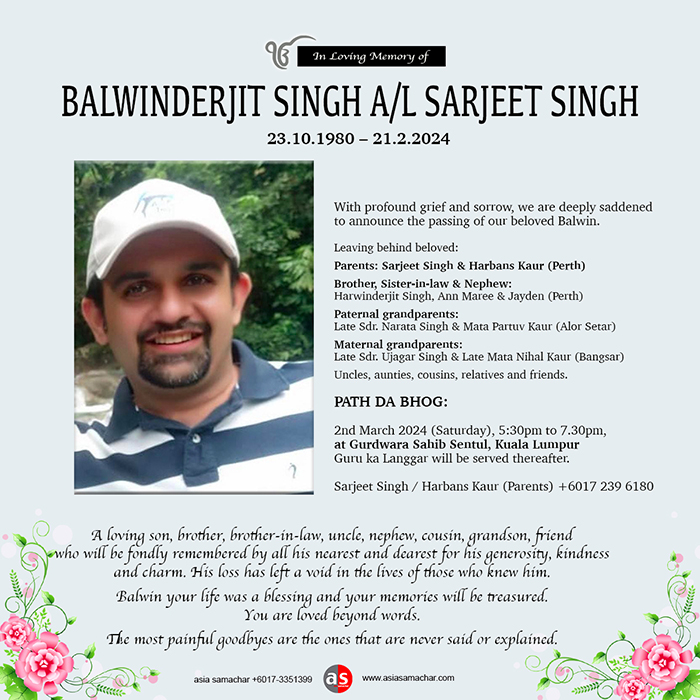
A loving son, brother, brother-in-law, uncle, nephew, cousin, grandson, friend who will be fondly remembered by all his nearest and dearest for his generosity, kindness and charm.His loss has left a void in the lives of those who knew him.
Balwin your life was a blessing and your memories will be treasured.You are loved beyond words.
The most painful goodbyes are the ones that are never said or explained.
ASIA SAMACHAR is an online newspaper for Sikhs / Punjabis in Southeast Asia and beyond. You can leave your comments at our website, Facebook, Twitter, and Instagram. We will delete comments we deem offensive or potentially libelous. You can reach us via WhatsApp +6017-335-1399 or email: asia.samachar@gmail.com. For obituary announcements, click here
Guru Gobind Singh looms large in the minds of Sikhs. What are the life lessons that we can pick up from the tenth Master of the Sikhs? We asked Karminder Singh Dhillon to put on his thinking turban to list them out.
Tasks That Are Entrusted to One Must Be Completed.
The task of creating a complete spiritual being amongst human kind was conceptualized by Guru Nanak upon his coming on the 1st of Vesakh 1469. Eight subsequent Gurus were assigned the task of progressing this task. Guru Gobind Singh ji was entrusted the task of completing the mission – which he did on the 1st of Vesakh 1699. Had he not done so, the entire mission and the efforts and sacrifices of his predecessor Gurus would have become futile.
Perfecting a Human Being Takes Time.
The task of elevating the human being towards becoming one with the Creator within and one with Humanity without took 10 Gurus 239 years in total (1469 till 1708). This is because human beings have to be persuaded, convinced and won over in terms of their hearts and minds for them to accept change; and because the human being must want to change. Both of these processes require a great deal of time.
It is Not How Long One Lives, But What One Does in One’s Lifetime.
Guru Gobind Singh ji’s life span was 42 years. In this short life he accomplished an enormous amount of tasks and made even more enormous sacrifices. He steered Guru Nanak’s mission towards completion, established the Khalsa, fought 13 defensive battles and re-edited the entire Pothi Sahib to present it as the Aad Guru Granth Sahib. He also sacrificed his father first, and his 4 sons subsequently – thus ending his blood lineage – and his mother too. Writer Shah Mohamad has put it well – One could count the stars in the night sky if one was sufficiently diligent, but not the contributions of Guru Gobind Singh.
Fight for Principles, the Wronged and Downtrodden, not for Self Gain.
All 13 of the battles that Guru Gobind Singh fought were defensive, on the principle of self-determination and against oppressors. Of these, two were against the ruling tyrant and intolerant extremist Aurangzeb. The remainder were against the Hindu Hill Rajas who wanted to annihilate Guru Gobind Singh ji because his principles of equality of humankind, embracement of human beings who were considered “low caste” by the religious dogma, and gender equality went against the beliefs that were held by the Hill Rajas. The Guru came out victorious in all 13 battles, but he did not occupy one inch of territory, loot one cent from anybody, or capture war gains of any sort. His fight simply was of a different type.
Fight Against Wrongs, Injustices and Tyranny Not Against People Who Subscribe to These.
This principle may appear contradictory but only if the nuances are ignored. Guru Gobind Singh fought against Aurangzeb and all the people who supported the Mugal ruler’s tyranny and intolerance. But the battle was against the tyranny per se. It was against the tyrants – only for as long as they subscribed to tyranny. When Aurangzeb’s successor Bahadur Shah discarded the tyrannical ways of the Mugal empire, the Guru struck a friendship with him – joining him on hunting expeditions even. Had Aurangzeb changed his ways, there is no reason to believe that the Guru would not have treated him the same was as he did Bahadur Shah.
When it Comes to Use of Force, Never Take the First Resort.
In the Battle of Bhangani, the Hill Raja Hari Chand challenged Guru Gobind Singh to a duel. The Guru accepted his challenge because the reasoning was that the duel would decide the outcome of the battle; and thousands of deaths of the soldiers on both sides could be thus avoided. In the duel, Guru Gobind Singh ji gave the first attack opportunity to Hari Chand who aimed his arrow at Guru ji’s horse to prevent the Guru from escaping should the Guru change his mind. When he missed, the Guru gave him a second opportunity. This time he aimed at the Guru, and missed again. The Guru offered him yet another opportunity. This time the arrow from Hari Chand’s bow pierced the Guru’s leather armor and injured him. The Guru claimed his turn and eliminated Hari Chand. Offering three chances to the enemy that has come to kill you is the Guru’s way of saying “I do not subscribe to use of force at the first resort.”
Numbers don’t Matter, Conviction Does.
In all of his 13 battles, the Guru was grossly outnumbered – in some cases a hundred to one. At the Chamkaur Fort, all he had was some 40 warriors. But he was victorious in all his battles. This is because while the other side had numbers, well paid mercenaries, the backing of kings, and equipment; the Guru’s Sikhs were imbued with a just cause, passion to fight for their principles, their love for their Guru, and an unparalleled determination to sacrifice. The Guru proved that the ones fighting to earn a living – no matter how big their numbers – cannot defeat those with deep convictions – no matter how small their numbers.
Leave a Legacy that Benefits Mankind.
Most mortals leave behind gifts, inheritances, bequests and legacies that benefit the next of kin or families. What Guru Gobind Singh left behind was for mankind as a whole. His greatest gift to mankind is the Aad Sri Guru Granth Sahib ji. This is a legacy for the entire human race; for the entirety of the spiritual world and for humanity in general. No one single group can lay claim to this legacy.
Role-modeling Begins at Home.
Leaders – religious ones included – are often seen to be good at preaching to the outside world while failing in their own homes. The fact that the Guru’s four young sons aged 7 till 16 were able to walk the path of principles instilled in them by their father is clear indication that he had been a good role model for his own family as much as he was to the world at large.
Caste and Socio-economic Status Are Dividing Forces That Need to be Eliminated.
The principle had been introduced by Guru Nanak, the subsequent Gurus, and expounded on passionately by the 35 spiritualists whose writings are contained within the Sri Guru Granth Sahib. Guru Gobind Singh ji added his part by ensuring that the initiation ceremony of the Khalsa in 1699 was participated in by individuals from all walks of life. He further insured that the first five Sikhs who partook in the initiation came from different geographic locations, had disparate socio-economic backgrounds, and belonged to different “castes.” It was his way of unifying humanity by eliminating the dividing factors.
ASIA SAMACHAR is an online newspaper for Sikhs / Punjabis in Southeast Asia and beyond. You can leave your comments at our website, Facebook, Twitter, and Instagram. We will delete comments we deem offensive or potentially libelous. You can reach us via WhatsApp +6017-335-1399 or email: asia.samachar@gmail.com. For obituary announcements, click here
MADAM GURCHARAN KAUR d/o LATE KAPOOR SINGH (SEREMBAN)
WIFE OF LATE SARJIT SINGH (BOSS) IPOH
4.4.1934 – 25.2.2024
Husband: Late Sarjit Singh (Boss) Ipoh
Children / Spouse: Rashpal Singh/ Paramjeet Kaur Jasbir Singh/ Poonam Kaur (Chee Siew Yin) Late Siva Kaur/ Sohan Singh
Grandchildren: Resham Jeet Kaur, Savinder Singh, Hardip Kaur, Kiran Kaur, Dr. Aaron Singh, Dr. Avinder Kaur
Madam Gurcharan leaves behind Sister, Brother-In- Laws, Sister-In-Laws, Grand Children, Great Grandchildren, Nephews, Nieces, Grand Nephews and Grand Nieces
SASKAAR / CREMATION:
26 Feb 2024 (Monday) at 12.00noon at Bercham Crematorium, Ipoh Cortège Leaves from 146, Jalan Chamberlain Hulu, Taman Chateau, 30250 Ipoh Perak at 11am
PATH DA BHOG
3 March 2024 (Sunday) 10.00am -12.00pm Wadda Gurdwara Sahib Ipoh
For further enquries, please contact: Jasbir Singh 016 534 1908 Rashpal Singh 017 770 2417
ਹੁਕਮੇ ਆਵੈ ਹੁਕਮੇ ਜਾਵੈ ਹੁਕਮੇ ਰਹੈ ਸਮਾਈ ॥ Everyone comes here at the Lord’s command, leaves in His will and remains merged, too, in the Lord’s will. (SGGS, 940)
ASIA SAMACHAR is an online newspaper for Sikhs / Punjabis in Southeast Asia and beyond. You can leave your comments at our website, Facebook, Twitter, and Instagram. We will delete comments we deem offensive or potentially libelous. You can reach us via WhatsApp +6017-335-1399 or email: asia.samachar@gmail.com. For obituary announcements, click here
People used to throng a gurdwara on the outskirts of Jalandhar, Panjab, offering toy planes for their prayers to move abroad. It came to such a silly state that the Akal Takht had to step in to put a stop the practice.
Panjab is no stranger to its people looking out for a better life aboad. This is the underlying story behind ‘Dunki‘, a Shah Rukh Khan’s movie now on Netflix after its run at the theaters.
The title comes from the ‘donkey journey’ for the eager illegal migrants, taking them on an arduous and treacherous journey in their quest for a better life.
Among the big names in the Bollywood movie are Taapsee Pannu, Boman Irani, Vicky Kaushal, Anil Grover and Vikram Kochar.
If you catch it, do tell us how you found it. Was it worth your time?
ASIA SAMACHAR is an online newspaper for Sikhs / Punjabis in Southeast Asia and beyond. You can leave your comments at our website, Facebook, Twitter, and Instagram. We will delete comments we deem offensive or potentially libelous. You can reach us via WhatsApp +6017-335-1399 or email: asia.samachar@gmail.com. For obituary announcements, click here
The Palestinian and Punjab liberation struggles have striking similarities. Presently, both Palestine and Punjab find themselves under occupation, with Palestine being occupied by Israel and Punjab by India. Neither peoples have formally recognised the existence or legitimacy of what were new countries that were established against the backdrop of colonialism. Further still, seeing the erosion of their respective territories over the years, coupled with government policies that are resulting in deepening levels of deprivation and poor, both physical and mental health, and rapid declines in populations both, sets of people rightly fear an existential threat.
Historically, both Israel and India were under the rule of the British and both came into existence in 1947 and both Palestine and Punjab were subject to the partitioning of their lands.
In the case of Israel, Britain took charge of Palestine in 1920 under a League of Nations Mandate. Over the next two decades, tensions arose due to the mass Jewish immigration facilitated by Britain. The UN-approved 1947 partition plan led to a civil war, culminating in Israel declaring independence on May 14, 1948. The roots of the Palestinian struggle can be traced back to this period of historical upheaval.
Similarly, India experienced a significant shift in 1919 after the Jallianwala Bagh massacre in Amritsar, which turbocharged the free India movement. The partition resulted in the creation of the new countries of Pakistan and India. And, just as the Palestinians in the newly established Israeli state faced challenges, Punjabis in India were greatly affected. The partition split the former British province of Punjab between India and Pakistan, leading to massive displacement and inter-communal violence, with an estimated 12 million people migrating across Punjab.
If we look at the liberation struggles of the Palestinian and Panjabi people, we see some uncanny parallels. The Palestinian Liberation Organization (PLO) was founded in 1964 with the explicit aim of establishing an independent Palestinian nation. Until 1993, the PLO engaged in armed struggle, but following the Oslo Accords in 1993, they abandoned this approach. The Oslo Accords, consisting of the Oslo I Accord in 1993 and the Oslo II Accord in 1995, marked the beginning of a peace process between Israel and the PLO. This process led to the recognition of Israel by the PLO and vice versa, with notable outcomes including the creation of the Palestinian National Authority and international acknowledgment of the PLO as Israel’s partner in negotiations regarding the Israeli–Palestinian conflict.
Similarly, resigned to the fact that the pore colonial independent nation of Punjab was now a relic of history, the people of East or Indian occupied Punjab have been fighting for greater autonomy and the protection of the natural resources of the state. After India gained independence in 1947, Sikhs faced challenges related to the partition, with many Sikhs migrating from Pakistan to India. Tensions arose due to issues like the demand for a Sikh-majority state, which led to the formation of the Panjabi speaking state in 1966. However, subsequent political and economic grievances fuelled discontent and called for greater autonomy following the adoption of the Anandpur Sahib Resolution in 1973.The resolution outlined the demands and aspirations of the Sikh community in India and the state of Punjab. It called for greater autonomy for states, including Punjab, and sought economic and political concessions to address the perceived discrimination against Punjab and Sikhs.
The demands included a reorganization of states on linguistic lines, fair distribution of river waters, and more autonomy for states in economic matters. While the Anandpur Sahib Resolution aimed at addressing the concerns of the Sikh community, it became a source of contention and contributed to political tensions in the region. The situation escalated in the 1980s with the demand for an independent Sikh state, leading to Operation Blue Star in 1984 and the subsequent assassination of Prime Minister Indira Gandhi. The period witnessed significant political and social consequences, culminating in the tragic anti-Sikh riots in November 1984 and a decade long armed insurgency in Punjab and the deaths of many thousands of Punjabi youths in fake encounters which are documented in detail by Pav Singh in his book, 1984: India’s Guilty Secret published in 2017.
History rarely unfolds in neat narratives of good versus evil. The complexities of the human experience often blur the lines, forcing us to confront uncomfortable truths, one being the potential for the oppressed to become the oppressors. While acknowledging the horrors of the Holocaust experiences by European Jews and the violence’s of British imperialism in India is crucial, we must also look beyond to understand how these experiences can shape present realities in what might be characterised as the post-imperial, post-colonial period.
Both Israel and India were born from the ashes of colonialism. The Jewish yearning for a homeland after centuries of persecution culminated in the creation of Israel, while India’s independence movement led to the dismantling of British rule. However, this shared history of oppression does not guarantee empathy or justice. In fact, it can sometimes sow the seeds of future oppression.
Victims of historical injustices can carry deep scars – fear, anger, and a desire for retribution. These traumas can morph into a need for power and dominance, leading former victims to adopt the oppressive tactics they once endured. This cycle of pain and power becomes evident when examining certain policies.
Israel’s treatment of Palestinians has been heavily criticised, drawing comparisons to the historical persecution of Jews. The construction of settlements on occupied land, restrictions on movement, and military operations raise questions about mirroring past injustices rather than learning from them. Similarly, India’s growing Hindu nationalism and instances of anti-Muslim sentiment have sparked concerns about echoes of its colonial past. The way that the Indian government, driven by a determination to shift from small-scale family-based to corporate farming, has behaved towards Punjabi farmers, especially those from Punjab, Haryana and UP, leading to huge farmers’ protests, has been described as a genocide in the making.
It’s important to remember that not all members of a group that experienced oppression become oppressors. Generalising entire populations is dangerous and inaccurate. However, acknowledging this historical cycle allows us to critically examine present circumstances and work towards breaking the chain of suffering.
The brave Indian Feminist writer Amrit Wilson, who, after publishing a revealing pamphlet entitled Hindutva and Its Relationship with Zionism in 2022 in which she highlighted the growing alliance between Israel and India, had her Overseas Citizenship of India (OCI) card cancelled. Her crime was to point out that the India of her childhood, or freedom and liberation was a far cry from the India of Narendra Modi and his band of India Nationalism. Influenced by their shared ideologies of Zionism and Hindutva, she argued that both countries were facing escalating violence and internal turmoil, with Israel’s assaults on Gazan Palestinians and India’s rising anti-Muslim sentiment highlighted. But, despite facing economic turmoil, she exposes how Indian billionaire Gautam Adani, who has recently been accused of wide-scale illegal tax evasion, continues to receive support from Israel’s Netanyahu, further solidifying the controversial partnership. She argues that “In this era of rising fascism, these two remarkably similar ideologies are crucially important in cementing the economic and military alliance between two of the world’s most repressive right-wing states.”
In a similar vein, in a short blog entitled Think about the Nation, published in the London Review of Books on 16th Feb 2024, Skye Arundhati Thomas reveals a worrying trend of rising Hindu nationalism in India, manifesting in cultural and political spheres and leading to increased persecution and violence against minorities, but Muslims in particular. It is centred on the infamous Bollywood actress Kangana Ranaut’s visit to the Israeli embassy and promotion of her film Tejas. In doing so, it highlights the growing economic, security and ideological alliance between India and Israel, including the procurement of military-grade drones, which are becoming the new weapon of war, not only against external threats but increasingly, as we are seeing at this very moment in Gazza and the borders of Punjab, on civilian internal populations. As Thomas notes:
“…a company called Atharva Advanced Systems and Technologies was incorporated in Gujarat as a wholly owned subsidiary of Adani Defence Systems and Technologies. In November, Adani sold a 44 per cent stake to Israel’s Elbit Systems. Adani and Elbit have been building Hermes 900 drones together in Hyderabad since 2018; the primary user is the Israeli Air Force. Last year Adani bought a majority stake in the Port of Haifa (where Elbit happens to be based). The Indian tricolour flies next to the Israeli flag.’
The historical experiences of oppression can have a complex and lasting impact on the present. While it is important to remember the horrors of the past, such as the Holocaust and British imperialism in India, it is also crucial to look beyond them and understand how these experiences can shape current realities. Both Israel and India were born from the ashes of colonialism, and both countries have grappled with the legacy of oppression. In Israel, the treatment of Palestinians has been heavily criticized, with some drawing comparisons to the historical persecution of Jews. In India, the rise of Hindu nationalism and oppression faced by ethnic and religious minorities, Adivasis, Dalits, and women, have sparked concerns about echoes of the country’s colonial past.
It is important to remember that not all members of a group that will have experienced historical oppression, up to and including genocide, become oppressors, and no doubt that the vast majority of ordinary Israelis and Indians, home and amongst the diaspora, would support justice, freedom, the rule of law and human rights. So, generalising entire populations is dangerous and inaccurate. However, acknowledging this historical cycle allows us to critically examine present circumstances and work towards breaking the chain of suffering. We must learn from the past to create a more just and equitable future. This means confronting uncomfortable truths, understanding the complexities of human experience, and working to build a world where all people can live free from oppression.
The struggle against oppression is the responsibility of all, though intellectuals and influencers have a special role. In the face of the rise of violent dictators across the world, the role of progressive intellectuals delineated by the late, great Palestinian activist and scholar, Edward Said, could not be more precinct: “For the intellectual, the task…is explicitly to universalise the crisis, to give greater human scope to what a particular race or nation suffered, to associate that experience with the sufferings of others.” Here, by calling for the “universalising the crisis”, Said is imploring intellectuals to connect particular instances of suffering, such as what is happening in Gaza at the moment, to broader common historical patterns of human oppression. It is by recognizing similar struggles and suffering across different groups, that one can promote empathy and solidarity. Ultimately, Said is calling on thinkers to deploy their intellectual labour to inform and inspire action for a more just world.
Gurnam Singh is an academic activist dedicated to human rights, liberty, equality, social and environmental justice. He is an Associate Professor of Sociology at University of Warwick, UK. He can be contacted at Gurnam.singh.1@warwick.ac.uk
* This is the opinion of the writer and does not necessarily represent the views of Asia Samachar.
ASIA SAMACHAR is an online newspaper for Sikhs / Punjabis in Southeast Asia and beyond. You can leave your comments at our website, Facebook, Twitter, and Instagram. We will delete comments we deem offensive or potentially libelous. You can reach us via WhatsApp +6017-335-1399 or email: asia.samachar@gmail.com. For obituary announcements, click here
Farmer protest in progress on Feb 13, 2024 – Photo: Gaon Savera
By Gurmukh Singh | Opinion |
The G20 Summit show-cased the best of India to world leaders. The moon-landing and the lavish Ram Mandar opening gave further political boost the BJP government led by PM Modi. However, the farmers uprising in northern India has struck like a bolt of lightning and the BJP government is in trouble just before the elections.
The farmers uprising in North-West India is a complex agro-economics issue which also shows the mis-management of agriculture sector by successive State and Centre governments. Farm production and pricing issues are complex and farm experts are divided. The earlier protest by farmers was only the beginning of what we are likely to see in future. There are likely to be continual rounds of confrontations between the government of anypolitical party and the farmers of India.
False promises will be made to farmers and broken. For example, doubling of small farmers real income was promised by BJP a few years ago. It was not kept because it made no viability sense! The days of small farmers are numbered but the proud kisan-jawan sons of farmers of Panjab and Haryana have not been given a dignified way to get out of farming through higher education and alternative employment.
In a very short time, PM Modi, reaching for the stars, has been brought down to earth. Subramanian Swamy, an Indian politician and economist, himself a Hindu nationalist and a member of the BJP, does not mince his words about Modi and his poor grasp of economics. Swami believes that Modi has specialist advisors but he tells them what advice to give him!
The situation has been made worse by the authoritarian style in which Modi government has mishandled the whole farm issue. Today, an aerial view of Panjab and Haryana gives the impression of a war zone! Tear gas canisters have been ped from a drone on thousands of farmers on the road to Delhi at the border between Panjab and Haryana. Police has sealed roads by erecting barriers of barbed wire, spikes and cement blocks. The army has been called in, The fortified road blocks on national highways manned by armed men in uniform give the impression of confrontation between two countries. The revolt is spreading rapidly to other northern states and even the rest of India.
The present farm crisis is the result of political mismanagement of agro-economics and agro-ecology – the relation between agricultural crops and the environment. For decades, agricultural diversification has been preached by experts at universities like the Punjab Agricultural University, but never put into practice through government agro-policy and pricing mechanisms. Minimum Support Price (MSP) could have been used to move farmers away from wheat and rice production to other commodities while saving Panjab from long term environmental damage including the ping water table. Also, the smooth employment transition from agriculture to industry, IT and services through better education has been neglected. Non-agricultural sectors have been kept away from Panjab.
The agricultural and allied sectors are the most important for the Indian economy. About 60 percent of the Indian population works in agriculture contributing about 18 percent to India’s Gross Domestic Product (GDP). Take-over of agriculture by the corporate sector is pushing small but proud farmers to become labourers.
That is unlikely to be acceptable to the farmers.
Gurmukh Singh OBE, a retired UK senior civil servant, chairs the Advisory Board of The Sikh Missionary Society UK. Email: sewauk2005@yahoo.co.uk. Click here for more details on the author.
* This is the opinion of the writer, organisation or publication and does not necessarily represent the views of Asia Samachar.
ASIA SAMACHAR is an online newspaper for Sikhs / Punjabis in Southeast Asia and beyond. You can leave your comments at our website, Facebook, Twitter, and Instagram. We will delete comments we deem offensive or potentially libelous. You can reach us via WhatsApp +6017-335-1399 or email: asia.samachar@gmail.com. For obituary announcements, click here
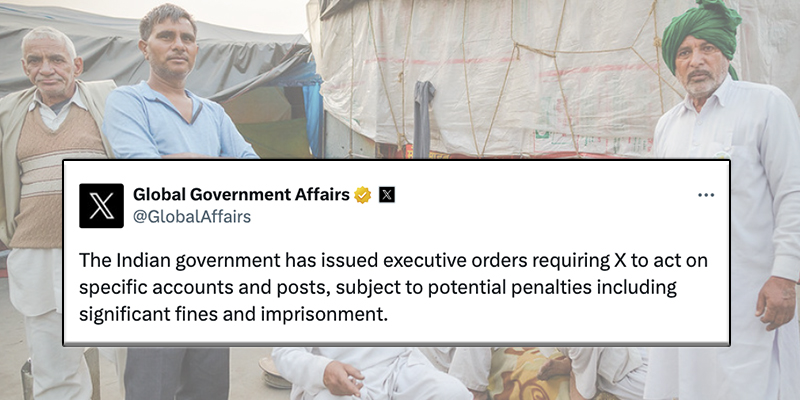
X’s official statement on taking down posts and accounts upon “executive orders” from the Indian government
By Asia Samachar | India |
Social media major X, formerly Twitter, has admitted to taking down accounts and posts related to the ongoing farmers’ protests in India, after receiving “executive orders” from the Indian government.
In an entry at its handle @GlobalAffairs, the giant communication platform said:
“The Indian government has issued executive orders requiring X to act on specific accounts and posts, subject to potential penalties including significant fines and imprisonment.
“In compliance with the orders, we will withhold these accounts and posts in India alone; however, we disagree with these actions and maintain that freedom of expression should extend to these posts.
“Consistent with our position, a writ appeal challenging the Indian government’s blocking orders remains pending. We have also provided the impacted users with notice of these actions in accordance with our policies.
“Due to legal restrictions, we are unable to publish the executive orders, but we believe that making them public is essential for transparency. This lack of disclosure can lead to a lack of accountability and arbitrary decision-making.”
Haryana-based journalist Mandeep Punia told the BBC that his account and that of his news platform – Gaon Savera – have been withheld.
“We are professional journalists covering rural India. We are reporting from the ground and the government doesn’t want that. The government is blocking our voice, but equally this also affects our livelihood, our means of earning a living,” said Mandeep, who was arrested by Delhi Police during 2020–2021 Indian farmers’ protest.
Several farm unions in India have been on strike since 13 February seeking floor pricing, which is also called minimum support price, for their crops. The protesters have been attempting to march to India’s capital, Delhi, from the neighbouring states of Punjab, Haryana and Uttar Pradesh.
But the authorities have heavily barricaded the city borders with barbed wire and cement blocks to stop them. Haryana and Uttar Pradesh states, which are ruled by the governing Bharatiya Janata Party (BJP), have deployed a large number of police and paramilitary troops to stop the farmers from reaching Delh, reported BBC.
ASIA SAMACHAR is an online newspaper for Sikhs / Punjabis in Southeast Asia and beyond. You can leave your comments at our website, Facebook, Twitter, and Instagram. We will delete comments we deem offensive or potentially libelous. You can reach us via WhatsApp +6017-335-1399 or email: asia.samachar@gmail.com. For obituary announcements, click here
Misstep: A man jumped over a railing at Darbar Sahib, Amritsar, in 2021 and snatched a kirpan lying in front of Sri Guru Granth Sahib.
By Balraj Kahlon | Opinion |
In October 2021, in the midst of the farmer’s protest, a Nihang group maimed Lakhbir Singh and strung him up to die while he begged for mercy. His death was punishment for desecrating the Sarbloh Granth (not the Sri Guru Granth Sahib) which are scriptures revered by the Nihang community. Sikhs should know that the Sarbloh Granth is considered an encyclopedia on Hindu mythology, and there are doubts of its origins or if it was written by Guru Gobind Singh Ji.
Later that year a man jumped over a railing at Darbar Sahib and snatched a kirpan lying in front of Sri Guru Granth Sahib. SGPC employees grabbed the man within seconds and he was subsequently beaten to death. His dead body was found lying on the floor of the complex with men gathered around treating it like a trophy killing.
The defence of these killings are not only troublesome but also reveal the dishonesty and lack of credibility among those with an extremist mindset.
The Nihangs first claimed the sacrilege was of the Guru Granth Sahib Ji but then said it was the Sarbloh Granth. They claimed the sacrilege is part of a government conspiracy but their leader Aman Singh was revealed to be breaking bread with political leaders. They said they have proof of the sacrilege but proof was never provided even though Lakhbir’s father pleaded for proof. Moreover, 27 UK Sikh organizations issued a statement in support of the killing and falsely claiming Lakhbir committed sacrilege of Sri Guru Granth Sahib Ji. Their statement goes onto say that Indian agencies are using addicts and oppressed people to attack the Granth Sahib. But if they know the masterminds then why kill oppressed people. Then, three years later the Sikh PA is still claiming that Lakhbir attacked the Guru Granth Sahib Ji.
The Akal Takht Jathedar also claimed the sacrilegious cases are a political conspiracy but then he is himself with India’s Minister of Home Affairs. Baaz news, a news outlet geared towards diaspora-born Sikhs, described the Darbar Sahib killing as Khalsa’s justice. This begs an explanation how a just penalty for picking up the sword is death.
Desecration acts should be addressed but a thinking person does not take such a cavalier attitude towards using lethal force. Moreover, the religious fanaticism condoning the killings has given license for continued nonsensical violence.
This includes a man hacked to death for chewing tobacco on a public street near Darbar Sahib. Parvinder Kaur was shot dead for drinking liquor in a gurdwara. She was a divorced woman struggling with alcohol addiction and depression. A Dalit daily wager tied up and beaten to death for trying to steal money from a gollack (money box). In January 2024, a Nihang killed a man because he planned to commit sacrilege.
It should be noted that the Sri Guru Granth Sahib was never touched in these incidents. So does this mean does anything considered disrespectful give Sikhs permission to kill? Then should we murder those who misuse the Sri Guru Granth Sahib for fraudulent or contract marriages? Should we murder people who engage in caste-based discrimination in gurdwaras? And should we murder SGPC members for distributing drugs and alcohol during SGPC elections?
To understand Sikh principles regarding conflict and lethal force Sikhs only need to look to Guru Gobind Singh Ji – the person who institutionalized the martial tradition in Sikhi.
The devout, Bhai Kanhaiya served water to both Guru Gobind Singh Ji’s soldiers and enemy soldiers. He was brought before Guru Gobind Singh Ji to explain himself. Bhai Kanhaiya explained that he only sees humans and he wants to destroy the enmity of their enemies. Guru Gobind Singh Ji praised him for understanding the true meaning of Gurbani and encouraged him to continue.
The ruler Aurangzeb was responsible for countless deaths including Guru Gobind Singh Ji’s children. Yet Guru Gobind Singh Ji offered to meet and forgive Aurangzeb if he would change his ways (Zafarnama verse 60). Guru Gobind Singh Ji was also known to shoot golden tipped arrows to provide for the families of enemies killed in battle. Above all, Guru Gobind Singh emphasized practising restraint in using force. In Zafarnama (verse 22) he explains:
When all means for solving a conflict or problem are exhausted, only then placing your hand to the sword is legitimate.
Given these examples I don’t think anyone can conclude Guru Gobind Singh Ji would approve of these sacrilege killings.
Most perplexing is how Sikhs who so revere Sri Guru Granth Sahib Ji that they support killing in its name, disregard Sri Guru Granth Sahib Ji’s teachings. The Granth clearly condemns the powerful attacking the weak (p. 360) and stresses the virtue of forgiveness. The people killed in these incidents were not powerful threats.
Many critical of this article may be more devout than myself but I try to understand the Sikh Gurus’ teachings; I cannot find anything justifying taking a human life for sacrilege. People also must realize that many Sikh leaders and public figures justifying the violence are not killing anyone themselves and suffering the consequences. Moreover, nobody can argue killing will solve the problem because the sacrilege continues.
To end, we should be heedful of those who disguise their personal views as religious doctrine. Such people will dismiss their critics as too modernized or sell-outs. However, even Guru Nanak challenged religious authorities and promoted dialogue.
Balraj S. Kahlon is a community volunteer and public policy professional in the civil service in Canada.
ASIA SAMACHAR is an online newspaper for Sikhs / Punjabis in Southeast Asia and beyond. You can leave your comments at our website, Facebook, Twitter, and Instagram. We will delete comments we deem offensive or potentially libelous. You can reach us via WhatsApp +6017-335-1399 or email: asia.samachar@gmail.com. For obituary announcements, click here