















UA-56202873-1
Page 168

Sikhi and AI: Opportunities and Dangers

1
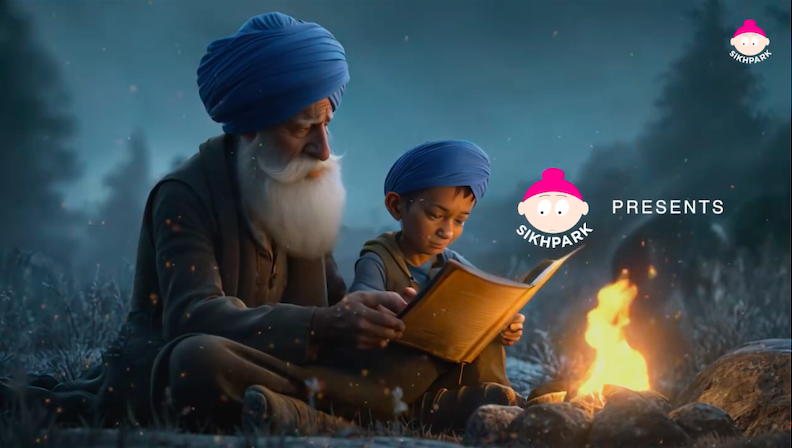
A screen grab from a ‘Lohri Story’ video whipped up by SikhPark using AI. They tell us: “It wasn’t a piece of cake…Hours of tweaking prompts by to get the perfect images…Balancing day jobs, we squeezed in 20 intense hours.”

By Jogishwar Singh | Opinion |

Artificial intelligence (AI) has become a burning topic of our days. ChatGPT recently completed a year of its existence with a drama in the media about the dismissal of its CEO, Sam Altman, followed by his rapid reinstatement following a revolt by his company staff demanding his return.

All Sikhs should be concerned about the impact of AI on Sikhi, especially on Sikh youth settled outside India who are now quite numerous. There was recently an article about Sikhi and AI in a magazine from Kolkata1, so the issue is beginning to be discussed (The Sikh Review, September 2023, Dr Devinder Pal Singh). It is divided into two sub-sections with titles: “Using AI for Promoting Sikhism” and “Overcoming the Challenges of AI”. It raises pertinent issues by first briefly explaining what AI is and what it can do. Right at the start it says, “The appropriate usage of AI can help in the promotion of Sikhism. However, awareness of the pitfalls of using AI for religious purposes is essential. So, we must use AI with caution in spiritual matters”. It goes on to say, ”While AI can provide valuable insights and resources, human guidance remains essential. Religious leaders, scholars and experts should play a central role in interpreting and contextualizing the teachings of Sikhism. …………. With the vast amounts of information available through AI-powered platforms, it becomes crucial to validate the sources and ensure the authenticity of content.” (Page 8, ibid).

These few words are key to an issue which needs much more elaboration without eliciting extremist reactions which seem to be the bane of any scholarly discussion on the issue of authentic interpretation of the message of the Sikh Gurus, a message which has become diluted over the years through deliberate misinterpretations, deliberately falsified sources, translations based on such inaccurate sources and the hijacking of Sikh institutions by persons having a vested interest in suppressing the true message of Sikh Gurus, especially that of Guru Nanak, since it weakens their hold on credulous Sikh masses.

Such a phenomenon is not unique to Sikhi. Doctrines propagated by the Roman Catholic Church already in 325 A.D. after the First Council of Nicaea were challenged by scholars who tried to show that the decisions elaborated at this Council convened by Emperor Constantine I did not reflect the true message of Jesus Christ. They cited different sources like the Gnostic Gospels from some of the earliest Christian congregations in Alexandria to contest the official doctrine being imposed on believers by the Church at the behest of the emperor.

Several centuries later, Martin Luther nailed his 95 theses to the church door in Wittenburg on October 31, 1517, which began the Protestant Reformation. Luther was not exactly the first person questioning the doctrines being preached by the Catholic Church having a Pope at its apex. He was influenced by thinkers like Desiderius Erasmus, John Wycliffe, Jan Hus, Augustine of Hippo, Girolamo Savonarola, and others. Their views, crystallised by Luther through the Reformation, can be summarised in three “Solas”: Sola gratia, Sola fide and Sola scriptura, meaning by faith alone, by grace alone and by scripture alone. Luther vehemently opposed the sale of Indulgences by the Catholic Church. Indulgences were instruments sold by the Roman Catholic Church through which believers could purchase full or partial remission of the punishment of sin for their family members.

These historical precedents bear resemblance to the state of present-day Sikh institutions which are in the hands of what has evolved to be a kind of priestly privileged class, in total contradiction to what Guru Nanak and other Gurus said. Their message was a social revolutionary challenge to the caste ridden Indian society. It was and is a message of liberation and enlightenment, freeing Sikhs from the hold of rituals, superstitions, priests, pilgrimages and the rule of fear imposed by religious and political masters. Guru Nanak gave us this creed of fearlessness; Guru Gobind Singh formalised its manifestation.

Sikhi has no place for a priestly class acting as an intermediary between the Sikh and the Almighty. The message of Guru Nanak posed such a challenge to privileged classes that centuries long efforts have been made to counter it by distorting Sikhi as a kind of sect or offshoot of preceding religious beliefs in order to dilute its revolutionary character.

DISTORTIONS GALORE

Imaginary hagiographies were created in the 18th and 19th centuries to present Guru Nanak as some kind of miracle worker. A snake was supposed to have shielded his face from the sun. Similar distortions were foisted on the life of Guru Gobind Singh by making him a worshipper of Goddesses with a prior life meditating in the Himalayas. Any scholar challenging such distortions is subjected to abuse, threats of expulsion from the Panth or even physical violence.

People from other religions used such spurious sources to publish translations of the Guru Granth Sahib which have now become the sources for further study by most Sikh and non-Sikh scholars endeavouring to decipher the message of the Sikh Gurus. This is where the link to AI comes in since ChatGPT or other AI engines like Bing provide information based on such published sources. Scholars like Dr Karminder Singh Dhillon try to counter Nirmala influenced sources by proposing Sri Guru Granth Sahib as the only reliable source of Tat Gurmat, exposing Janam Sakhis and other such sources as unreliable distortions meant to weaken the revolutionary character of the Gurus’ message. For them Gurbani should be understood only through Gurbani and not through unreliable hagiographic accounts.

Hence, if the data pool is itself corrupted, all sampling done by AI and ChatGPT will be corrupted as well. Particular attention has to be given to cleaning up the data pool. The emphasis has to be placed on such cleaning up of sources rather than wide use of AI. The sheer volume of corrupted data means that it cannot be removed. However, Tat Gurmat scholars can put content based on Gurbani on the internet in English since this language is the medium of AI. A lot of such content based on Tat Gurmat is in Punjabi. Several books and videos of scholars like Prof. Gurmukh Singh, Giani Dit Singh and Bhai Sahib Bhai Kahn Singh Nabha which are in Punjabi need to be translated into English and put on the internet. New and original content can be simultaneously added in English through books and magazines.

Such rectification is the work of institutions, universities, research centres, most of which are under control of Nirmala, Dera, Taksali or Sampardayi thought. It would be unrealistic to expect rectification from such institutions, universities or academies named after Guru Granth Sahib which keep propagating messages distorting the revolutionary egalitarian liberating message of Guru Nanak and other Sikh Gurus. This work seems to be falling to individuals who have very limited resources.

Hence the acute danger that AI could accentuate the distortions making Sikhi resemble just another offshoot of existing religions with their social practices which Sikh Gurus totally rejected. Violent reactions by established Sikh hierarchy against scholars questioning such distortions are just a reflection of their fear that their privileges could be challenged if true interpretations of Sikh Gurus’ message of liberation and enlightenment were to become general currency among Sikhs, most of whom remain enmeshed in the net woven by such interested parties. When no arguments can be found to counter Tat Gurmat interpretations by some scholars, physical violence is used to silence such voices. Not quite the tortures inflicted by the Catholic Inquisition, but present-day Sikh institutions have their lot of Torquemadas desperate to suppress any voices challenging established orthodoxy.

AI can prove to be a double-edged sword if enough Tat Gurmat data is put on the internet to provide a balancing act to the voluminous mass of hijacked hagiographies, translations of the Guru Granth Sahib and deliberately distorted documents flooding the internet.

The advent of social media led to multiple sources of data and data bases. AI and machine learning technologies come to play a role when big data is available in open space. It is, by definition, complex, contradictory, spread over several inter-connected machines. Some describe it as “Garbage in, garbage out” but big data is complex, ambiguous, contradictory, and enormous information expressed by different people with different backgrounds. What is relevant for one person can be garbage for another.

The intention or purpose of those who develop AI programs is important. A Nirmala influenced developer wanting to paint a tainted picture of Sikhi will design and develop an AI application in such a way that only such datasets of big data are selected as suit his/her purpose. On the other hand, Tat Gurmat proponents will select only those datasets which reflect their view. They will ignore those datasets which are not in line with the message of Sri Guru Granth Sahib as per their understanding.

It could be a digital tussle between people with divergent views and divergent interests. Industry regulators, the European Union being one of them, are trying to foresee what could go wrong. They are debating how the AI industry should be regulated for the benefit of the general public. AI program developers need to be made conscious that AI programs must differentiate between what is relevant and what is not relevant. They need to learn how to understand and interpret linguistics.

Tat Gurmat scholars believe that vested interests bent on distorting the true message of Guru Nanak have hijacked Sikh institutions. This already creates a difficult initial situation. AI programs by default would tend to pick up what is already spread as big data by the Nirmalas and other such parties. Their version is widely accepted as the true version of Sikhi by general Sikh masses.

It would not be fair to blame credulous Sikh masses for not challenging such distortions in a more forceful manner. The fault lies with Sikh leaders, heads of Sikh institutions, Katha Vachaks, Dera Chiefs, myriad Sants / Babas and Taksalis who are more concerned with preserving their privileged status by tightening their hold on Sikh masses using such spurious sources as bases of Sikhi.

TURNING THE TIDE

Hope arises since an increasing number of young Sikhs, men and women, especially outside India, who, having been educated in Western educational institutions, away from the influences of Babas, Deras, Taksals etc, are striving to get a proper understanding of the true message of Sikhi which is in tune with their views about the environment, rational thinking and liberation from fear in a menace ridden world where intolerance is rising. The Guru Granth Sahib shows them that there exists a universal message of peace, co-existence and enlightenment which frees us from meaningless rituals, superstitions, the hold of a venal priestly class and intolerance.

AI can assist their views by making it easier for scholars to access their views. Without a sustained corrective effort to present the Tat Gurmat view on the internet, AI will contribute to further entrenching the presently current hijacked view of Sikhi as just another offshoot of miracle fostering inegalitarian religious doctrines. Guru Nanak set an example of Samvaad. He not only questioned existing religious and social practices but had the gumption to debate with Sidhs, Mullas, Pandits and others to challenge their views without fear. Our future generations need to emulate this example without being cowed down by existing shackles of orthodoxy. Sikhi means questioning existing practices and understanding the genuine message of our Gurus.

AI can not only provide a tool for providing right interpretations of Sikhi but also provide a channel for unearthing hijacked versions of Sikhi to properly counter them by providing detailed Shabads from the Guru Granth Sahib to establish the primacy of the Shabad Guru to replace the presently prevalent practice of bodily Gurus in the form of Babas, Deras, Sants et al. The double-edged sword of AI needs to be wielded by educated young Sikh scholars motivated to free themselves from the hold of vested interests masquerading as the guardians of Sikhi and Sikh institutions. AI might enable new Sikh reformers to arise by using AI to nail their Tat Gurmat beliefs to the doors of existing institutions, undeterred by threats of physical or mental violence.

WHAT NEEDS TO BE DONE

What needs to be done? Right information must be provided in English. Sikhs need to be observant and provide feedback to AI programs available in the AI sector, for example ChatGPT or Bing, which might be spreading information not in line with the message of the Sri Guru Granth Sahib. Sikhs should actively engage with them to make them rectify sources of false information. Sikh scholars should design and develop their own KI programs to identify fake information to make general public aware of this.

Herein lies a big opportunity to win back what has been hijacked by vested interests. Sikh forums should actively participate in European Union organs discussing regulations about utilisation of AI. The agenda here should be to ensure that religious texts are interpreted as per their true spirit and understood as meant by their creators. In this way, AI and machine learning technologies can be major opportunities for Sikhs and others.

Jogishwar Singh, PhD, has close to five decades of professional experience in government and private sector. Officer of the Indian Police Service and the Indian Administrative Service in India before moving to Switzerland in 1985. Direct experience in financial restructuring of companies and banking in Switzerland from 1987 till 2018 before becoming an independent adviser in 2019. He can be reached at jogishwarsingh@gmail.com. This article appeared as the editorial of the The Sikh Bulletin – 2023 Issue 3 (July – September 2023)

RELATED STORY:

Changing tunes at the face of accountability (Asia Samachar, 3 Dec 2023)

ASIA SAMACHAR is an online newspaper for Sikhs / Punjabis in Southeast Asia and beyond. You can leave your comments at our website, FacebookTwitter, and Instagram. We will delete comments we deem offensive or potentially libelous. You can reach us via WhatsApp +6017-335-1399 or email: asia.samachar@gmail.com. For obituary announcements, click here
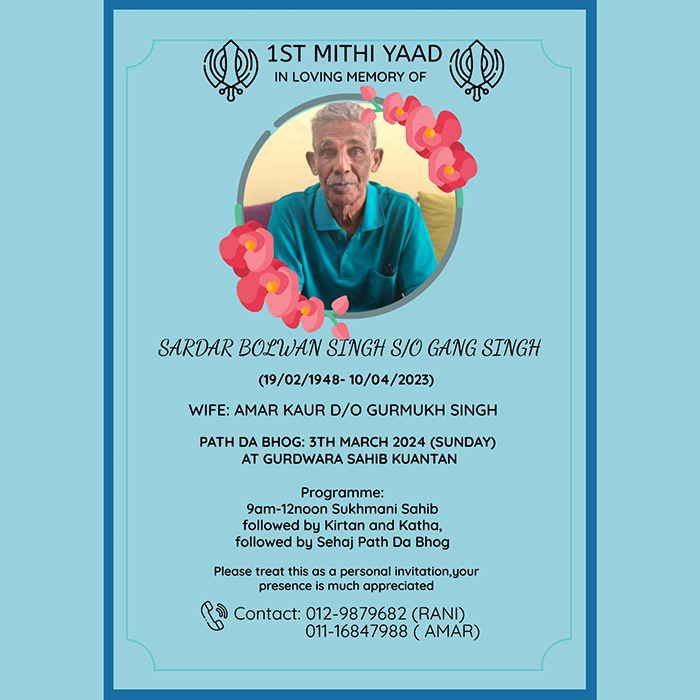
In Loving Memory: Sardar Bolwan Singh (1948 – 2023), Kuantan

1st MITHI YAAD

SARDAR BOLWAN SINGH S/O GANG SINGH

19.2.1948 – 10.4.2023

Wife: Amar Kaur d/o Gurmukh Singh

PATH DA BHOG: 3rd March 2024 (Sunday) at Gurwara Sahib Kuantan

Programme:
9am -12noon Sukhmani Sahib followed by Kirtan & Katha

Please treat this as a personal invitation. Your presence is much appreciated.

Contact:
Rani 012 987 9682
Amar 011 1684 7988

From Punjabi by Nature to a Punjabi Speaker

1
How to reverse this downward spiral of the Panjabi language? Four basic ideas from Bhupinder ‘Bo’ Singh

By Bhupinder ‘Bo’ Singh | Opinion |

Introduction

Like other years the International Mother Language Day falls on February 21, and it is time to lament on future of Punjabi language.

Punjabi, the mother language of over 130 million is endangered today because of the apathy of the very people, claiming as Punjabi. Punjabis will proudly proclaim that they are “Punjabi by Nature;” but please do not expect them to patronize their mother language. The result is that it is not being taught, spoken, or propagated in the houses of Punjabis.

If we look at it historically, the decline started after Sikh Kingdom was annexed by British in 1859. During the British rule English and Urdu were the official languages of business. The situation changed slightly when Indian subcontinent gained independence in 1947. The unfortunate tragedy was the division of Punjab at the time of independence which split the Punjabi speaking population on the either side of hastily drawn border. The two newly independent nations embarked on adopting a single native language as the national language in the name of integration and the single national identity became a political expediency. These nationalistic aspirations were casting shadows on the psyche of the masses. The push to promote the national language is actually costing neglect in learning of native mother languages. The results are Punjabi have labeled their mother language as “Paendu”, meaning language of rustics, farmers, laborers, and servants. The suave, educated and sophisticated in urban areas were quite happy to join in the nationalistic fervor on both sides of divided Punjab at the cost of Punjabi.

SEE ALSO: Punjabi Mother Tongue

Soon the new fervor of going abroad for higher education plus looking for greener pastures thrust English at the forefront again. The consequences are that we find our mother language’s survival is at stake. It is pretty grim and scary news that should become a wake-up call for us. Upon stepping into these advanced countries, one is faced with the challenges of making it there, fitting there and becoming successful.

In these new settings three points become the new reality, these are:

  1. Sudden reduction of people’s pool including opportunities to communicate with other speakers in native language.
  2. Assimilation pressures to fit in this new environment, makes us adopt the English as spoken there.
  3. The kids born or raised there do not get an opportunity to speak their mother language, as parents talk to them in English so that they can become proficient and excel in school. In fact, sometimes parents are trying to become themselves proficient in English by practicing with their kids.

The result is retaining fluency in mother language takes a back seat, lower on the totem pole of life’s priorities. This year 2024, UNESCO’s international Mother Language Day theme is ‘multilingual education – a necessity to transform education.UNESCO encourages and promotes multilingual education based on mother language or first language. We need to take cue from UNESCO’s realization and galvanize to promote Punjabi. According to UNESCO every two weeks a language disappears taking with it an entire cultural and intellectual heritage. At least 43% of the estimated six thousand languages spoken in the world are endangered. 

How do we reverse this downward spiral? Let us start with four basic ideas, surely there will be many more ideas. But here the motive is to make us think about it seriously.

Action Plan

1) At Parents Level – We have to make a beginning at our homes first. Not only the parents should talk to each other in Punjabi, but also to their children. First the realization has to down that “Losing my mother language should feel like a serious risk.” For our children we need to realize that the risk to children’s future was higher as “Our language is our identity,” and we are losing it with our apathy. In fact, “It is not just our identity alone; it is our roots, our culture; our music, our food. It is everything, even its soil and aroma of its food. It is who we are.” If we claim that we are “Punjabi” but minus these, then our claim is shallow, for namesake alone. We don’t want our children to feel rootless that way. So, make an early start by talking in Punjabi. Why not start talking to the child in womb in Punjabi? If not, it is still best to start as early as possible after birth. Make sure, that the child exposed to it through daily activities, helping parents at home, through children’s TV programs, books in Punjabi and listening to stories at bedtime.

2) Schools/After-schools– For Diaspora kids the official language of school instructions is English. Although, the picture in India/Pakistan is supposed to be different, but with our craze for English Medium Schools the situation is similar. In the remaining schools the emphasis is on Hindi/Urdu. The result is children whose native language is not Hindi/Urdu get deprived of getting the education in their mother language. The only way the impact of the system can be dented is by having an after-school program. The kids after school are brought to a convenient place of worship. There, under a trained teacher’s guidance the kids complete their school homework. Followed by a break cum refreshments time. After which they get to play with other kids whose mother language is the same as theirs. Here they are only permitted to communicate in their mother language. This way they can hone their mother language communication skills daily in a play setting.

    3) Places of Worship – Many places of worship have Sunday children’s classes to teach their mother language. This is a really good initiative and should be encouraged. However, this does not translate into proficient speakers and readers. As they are only exposed to the language for a few hours a week. Then for the rest of the week they are not using what they learned. Somehow, practice and implementation needs to be included so that whatever is being learnt is retained and not lost over time. In addition, the institutions should arrange speech, debate, scripture reading and recital, cultural events for kids where they can hone their mother language skills. Also once the children have successfully graduated there should be refreshers to ensure they are not unlearning Punjabi, because of lack of exposure.

    4) Cultural Immersion – This is the fastest and quickest way of experiencing and imbibing the cultural milieu. When one gets thrown in such an environment one feels that s/he needs to make drastic changes, to become a part of the new setting. Casting all pretentions, so called alien makes a deep dive into the cultural waters, getting wet in the process, and emerge out as a swimmer. Now s/he can tread on this cultural landscape without any inhibition. So, it is especially important that children in their formative years, especially from the diaspora, are afforded a cultural immersion process not just to experience the milieu but to experience that biological sense of belonging.

    It is not always possible to get cultural immersion, but the other option is to make an effort to be part of cultural, religious, and literary events taking place in the place of residence. Speaking in Punjabi should be a matter of pride instead of carrying an inferiority complex or a guilty feeling.

    Conclusion

    Punjabi is what connects us to the land called Punjab. We consider it our land, land of parents and our ancestors. Punjabi is the language that can truly make us feel Punjabi at heart wherever we are. So, why get disconnected from it? When we get disconnected it makes us feel rootless, which is not a good feeling at any time, more so while growing up. Punjab is the land of five rivers with its language and culture dating back to the Indus Valley Civilization. The land expects its children to reclaim their mother language. We can make it happen by adopting a four point strategy listed above. Now add the fifth a COMMITMENT, born out of our concern for it. We will have to produce more quality content as books, movies, and songs in that language. If we want to have a meaningful relationship with our Guru it will be through Gurbani, and Gurbani can only be understood when we can read Gurbani. So Punjabi is essential for our spiritual journey as well. We can make it happen and prevent it from becoming an extinct language. Let us all make an effort to save our mother language by putting it on a new thrust and earning the moniker of “FROM ENDANGERED TO THRIVING.” In the process there will be a change within, as from Punjabi food by choice one will come an authentic Punjabi by nature who is fluent in Punjabi.

    References:

    1. UNESCO Report: MOTHER LANGUAGE MATTERS: LOCAL LANGUAGE AS A KEY TO
      EFFECTIVE LEARNING. 2008

    Bhupinder ‘Bo’ Singh, Houston. Born in Bhamo, Myanmar, he now lives in Houston, US, where he runs a manufacturing company formed with his son. A mechanical engineer by training, he has authored a number of books, including Connecting with the Master – A collection of essays on topics related to Sikhism (2006) and In Bully’s Eyes – An Illustrated Children’s book on Bullying (2019).

    RELATED STORY:

    Family Dynamics and Perspectives (Asia Samachar, 8 Jan 2024)

    ASIA SAMACHAR is an online newspaper for Sikhs / Punjabis in Southeast Asia and beyond. You can leave your comments at our website, FacebookTwitter, and Instagram. We will delete comments we deem offensive or potentially libelous. You can reach us via WhatsApp +6017-335-1399 or email: asia.samachar@gmail.com. For obituary announcements, click here

    Adventure hiking with Subang Sikh Youth

    0
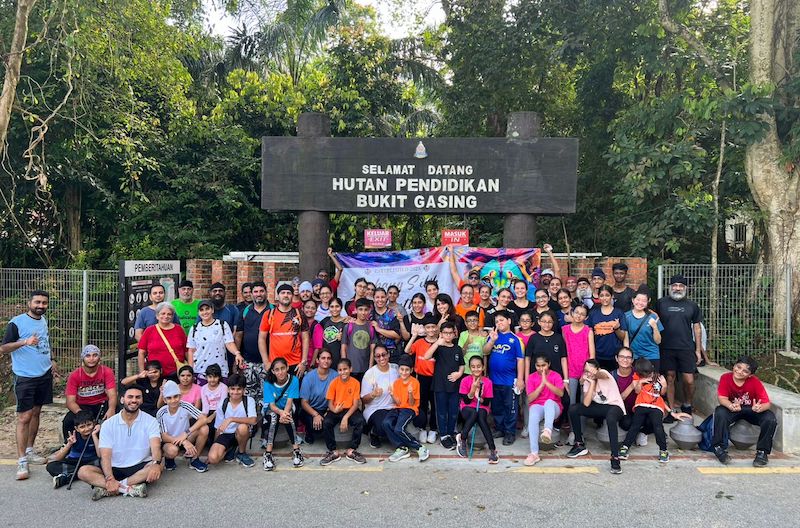
    Subang Sikh Youth hiking adventure at Bukit Gasing – Photo: Supplied

    By Asia Samachar | Malaysia |

    Some 90 participants of all ages took part in the Bukit Gasing hiking organised by the Subang Sikh Youths over the weekend (Feb 18, 2024). The youngest participant was six years-old. The oldest: 68. All in, they hit some 7,800 steps. The project was led by Harman Kaur. Bukit Gasing is a tropical forest located between Kuala Lumpur and Petaling Jaya.

    To see more photos, go to Asia Samachar Facebook here.

    RELATED STORY:

    Subang Sikh Youth Club up and running (Asia Samachar, 22 July 2023)

    ASIA SAMACHAR is an online newspaper for Sikhs / Punjabis in Southeast Asia and beyond. You can leave your comments at our website, FacebookTwitter, and Instagram. We will delete comments we deem offensive or potentially libelous. You can reach us via WhatsApp +6017-335-1399 or email: asia.samachar@gmail.com. For obituary announcements, click here

    Ranjit Singh Sekhon (1973 – 2024), Shah Alam

    RANJIT SINGH SEKHON

    S/O LATE SARDAR JAJJIT SINGH SEKHON & LATE MATA BALBIR KAUR (of Taman Rishah, Ipoh)

    19.5.1973 – 18.2.2024

    Leaving behind beloved

    Wife: Harmeet Kaur Sandhu d/o Late Dato’ Amar Singh Sandhu & Datin Amar Kor (Formerly Jerantut & Temerloh, Pahang)

    Son: Manraaj Singh Sekhon

    Deeply missed and fondly remembered by his siblings:

    1. Dr Gurcharan Jit Singh
    2. Kuldip Singh
    3. Baljinder Jit Kaur & Dr Premjeet Singh
    4. Dr Baljit Kaur
    5. Jasvinderjeet Kaur

    Nieces and nephew:
    Harpreet Kaur, Precilla Kaur, Soniajeet Kaur, Toreenapreet Kaur and Gurvwinraj Singh Sekhon

    And host of relatives and friends.

    PATH DA BHOG

    3rd March 2024 (Sunday), 10 am to 12pm
    Gurdwara Sahib Petaling Jaya

    Sarvin 016-289 1265
    Parvin 013- 665 9693
    Dr Gurcharan Jit 017 790 9737

    Link to posting at Facebook and Instagram

    | Entry: 19 Feb 2024; Updated: 23 Feb 2024 | Source: Family

    ASIA SAMACHAR is an online newspaper for Sikhs / Punjabis in Southeast Asia and beyond. You can leave your comments at our website, FacebookTwitter, and Instagram. We will delete comments we deem offensive or potentially libelous. You can reach us via WhatsApp +6017-335-1399 or email: asia.samachar@gmail.com. For obituary announcements, click here
    ‘Valentine’s Week’ sees young Indians spend millions on gifts – Report

    0

    By Asia Samachar | India |

    Young Indians are buying record amounts of roses, chocolates and hampers to celebrate “Valentine’s Week,” in another sign of increased spending and rising income levels in world’s most populous nation, reports Bloomberg.

    While Feb. 14 is recognized as Valentine’s Day around the world, the week preceding it has gained popularity in India. Feb. 7 is known as Rose Day, while the 9th is associated with chocolates and 10th with teddy bears. The other days of the week are linked to romantic gestures like promises and hugs. E-commerce platforms, along with dating sites, are pushing the trend and engaging in aggressive campaigns to promote romantic products, the report added.

    Indian gifting platform FNP E Retail Pvt., known as FNP.com, delivered a record 350 roses per minute ahead of Valentine’s Day, the New Delhi-based company said in an emailed statement. Food delivery platform Zomato Ltd.’s unit Blinkit dispatched 406 chocolates per minute on Feb. 9, Chief Executive Officer Albinder Dhindsa wrote in a post on X, the social network formerly known as Twitter.

    “We expect at least about 25% increase in sales this year,” said Pawan Gadia, director and chief executive officer global at FNP.com, over the phone. “We started preparing six months ago as Valentine’s is a flagship event for us.”

    The surge in Valentine’s Day-linked spending comes as the country’s growing middle class — particularly young adults — spend extensively on retail plaforms and dining in glitzy restaurants and cafes. About half of Indian consumers are choosing invest in experiences over purchases that have practical benefits, market research agency Mintel’s Consumer Spending Priorities 2023 report shows, according to the Bloomberg report.

    The increased spending comes despite protests from ultra-right wing Hindu organizations who have in the past few years campaigned against Valentine’s Day celebrations. For now, though, many Indian consumers have side-stepped those protests
    as they snap up gifts for their loved ones, it added.

    “It’s an opportunity for me to express my feelings,” said Arpit Kothari, a 27-year-old finance professional who bought a bouquet of roses online for his partner of seven years. “I don’t mind spending a little amount of money.”

    RELATED STORY:

    Valentine’s Day: A Sikh perspective on true love (Asia Samachar, 14 Feb 2023)

    ASIA SAMACHAR is an online newspaper for Sikhs / Punjabis in Southeast Asia and beyond. You can leave your comments at our website, FacebookTwitter, and Instagram. We will delete comments we deem offensive or potentially libelous. You can reach us via WhatsApp +6017-335-1399 or email: asia.samachar@gmail.com. For obituary announcements, click here

    Next, compulsory registration when NRI/OCI weds Indian citizen

    0
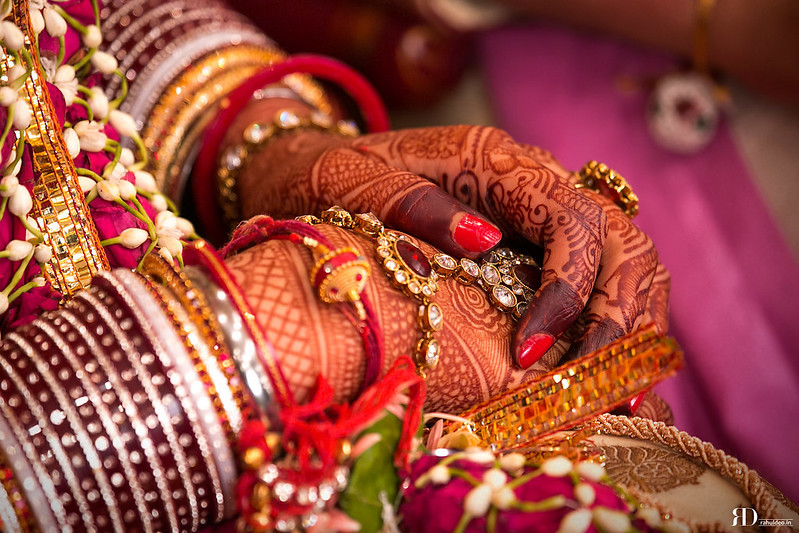
    Indian wedding – Photo: Rahul Deo / Flickr

    By Asia Samachar | India |

    All marriages between the Non-Resident Indians (NRIs) / Overseas Citizen of India (OCI) and Indian citizens should be made compulsorily registered in India.

    This is one of the recommendations of the Law Commission of India in a recent report as a measure to curb practices like false assurances, misrepresentation and abandonment.

    “The rising occurrence of fraudulent marriages involving NRIs marrying Indian partners is a worrisome trend,” said Justice Ritu Raj Awasthi who led the commission.

    In its newly released report, the law commission has proposed a central legislation that should be ‘comprehensive enough to cater to all facets involving marriages of NRIs as well as foreign citizens of Indian origin with that of Indian citizens’.

    It said such a legislation should be made applicable not only to the NRIs but also to those individuals who come within the definition of OCIs as laid down under Section 7A of the Citizenship Act, 1955.

    The proposed central legislation should also include provisions on divorce, maintenance of spouse, custody and maintenance of children, serving of summons, warrants, or judicial documents on the NRIs/OCIs, it added.

    Further, it has recommended that amendments need to be introduced in the Passports Act, 1967 to mandate the declaration of marital status, the linking of a spouse’s passport with the other and mentioning of the Marriage Registration Number on the passports of both the spouses.

    The 89-page Report No 287 is titled “Law on Matrimonial Issues Relating to Non-Resident Indians and Overseas Citizens of India”.

    In his note, Justice Awasthi said there had been a rapid rise in the legal issues arising out of such relationships.

    “Several reports highlight an increasing pattern where these marriages turn out to be deceptive, putting Indian spouses, especially women, in precarious situations. Deceptive practices like false assurances, misrepresentation, and abandonment are commonly associated with these fraudulent unions, causing distress to the Indian partners.

    “The inter-country nature of these marriages further intensifies the vulnerability, making it challenging for affected individuals to pursue legal remedies and support. Challenges such as financial exploitation and the complex legal aspects across multiple jurisdictions contribute to the hardships faced by those involved in such marriages,” he wrote in a covering note dated Feb 15, 2024.

    In order to deal with the emerging situation, he said the Registration of Marriage of Non-Resident Indians Bill, 2019, was introduced by the Govemment in the Rajya Sabha on 11th February, 2019.

    Initially, the Sixteenth Lok Sabha referred the Bill to the Committee on External Affairs (2018-2019). Subsequently, the same Bill was again referred to the Committee on External Affairs (2019-2020) after the Seventeenth Lok Sabha was constituted, for further examination and report submission.

    In furtherance of the deliberations being held, he said the Law commission received a reference on the NRI Bill, 2019 from the Ministry of External Affairs, conveyed through the Ministry of Law and Justice vide letter dated 1Oth April, 2023.

    ASIA SAMACHAR is an online newspaper for Sikhs / Punjabis in Southeast Asia and beyond. You can leave your comments at our website, FacebookTwitter, and Instagram. We will delete comments we deem offensive or potentially libelous. You can reach us via WhatsApp +6017-335-1399 or email: asia.samachar@gmail.com. For obituary announcements, click here

    Sardarni Jaswant Kaur (1963 – 2024), Seberang Jaya, Perai, Penang

    SARDARNI JASWANT KAUR

    Parents: Late Sardar Akbal Singh & Late Sardarni Joginder Kaur of Selayang Baru, Selangor

    6.7.1963 – 14.2.2024

    Spouse: Sardar Pajan Singh s/o Late Sardar Sadhu Singh Harpur & Late Sardarni Minder Kaur of Seberang Jaya

    Children & Spouses:
    Sardarni Jaspreet Kaur & Sardar Ravinder Singh
    Sardar Jeffrinderpal Singh & Sardarni Inderpreet Kaur

    A Host of Relatives & Friends

    PATH DA BHOG & ANTHIM ARDAAS

    A Jodhmela by the family towards the Athmak Shanti of Late Sardarni Jaswant Kaur will be held on
    Sunday, 25 February 2024, from 9am to 12noon
    and followed by the Anthim Ardaas at
    Gurdwara Sahib Butterworth (Jalan Todak, Seberang Jaya, Perai, Penang)

    She was a gem of a person and the pillar of The Khera’s!
    Leaving behind a legacy of warmth, love, and cherished memories.

    Contact:
    Pajan Singh 013 430 3309
    Jaspreet Kaur 018 325 1501
    Jeffrinderpal Singh 012 446 0509

    Link to posting at Facebook and Instagram

    | Entry: 18 Feb 2024 | Source: Family

    ASIA SAMACHAR is an online newspaper for Sikhs / Punjabis in Southeast Asia and beyond. You can leave your comments at our website, FacebookTwitter, and Instagram. We will delete comments we deem offensive or potentially libelous. You can reach us via WhatsApp +6017-335-1399 or email: asia.samachar@gmail.com. For obituary announcements, click here
    In Loving Memory: Late Surinderjit Singh (Shindi) (1967 – 2024)

    LATE SURINDERJIT SINGH (SHINDI)

    5.7.1967 – 3.3.2023

    Son of Late Sardar Harmek Singh and Sardarni Gurdev Kaur, village Chak Bhai Ka, formerly from Segamat, Johor

    Dearly missed by family and loved ones.

    SAHEJ PATH DA BHOG

    25 February 2024, Sunday, 10am to 12pm.
    Gurdwara Sahib Subang Jaya
    followed by Guru Ka Langgar

    For any enquiries, please contact
    Harpal Kaur 016 750 5563 | Harpreet Kaur 012 321 2174

    Please treat this as a personal invitation to join us in the Ardaas

    Link to posting at Facebook and Instagram

    | Entry: 18 Feb 2024 | Source: Family

    ASIA SAMACHAR is an online newspaper for Sikhs / Punjabis in Southeast Asia and beyond. You can leave your comments at our website, FacebookTwitter, and Instagram. We will delete comments we deem offensive or potentially libelous. You can reach us via WhatsApp +6017-335-1399 or email: asia.samachar@gmail.com. For obituary announcements, click here

    Do Sikhs Understand Sikhi?

    0
    A Sikh – Photo: Azrul Affandi Sobry / Flickr (October 2010)

    By Jogishwar Singh | Opinion |

    As a Sikh permanently settled in Switzerland, observing events affecting Sikhs in India and elsewhere, I wonder more and more whether the Sikhs of today are really fit for Sikhism. I get the feeling that the message of the Sikh Gurus is so oriented to liberation from all kinds of superstitions, rituals, baser instincts and basic follies that Sikhs are just not intellectually up to a level where they can understand its full import. The message of Sikhism is so universal, humanistic and elevating that it can only be imbibed and practiced by very strong individuals, capable of rising above basic human instincts like prejudice, envy, racism and ignorance.

    I feel that the Gurus were way ahead of their times with their universal and egalitarian message which had to be understood by the masses which ostensibly converted to their teachings. Different social groups became Sikhs for different reasons but, leaving aside a tiny committed kernel, most of them seem to have converted to Sikhism for reasons other than a full grasp of the philosophical message being preached by the Sikh Gurus.

    JATS

    The Jats seem to have become Sikhs in large numbers during the 17th and 18th centuries but to have done so more to establish a privileged status as land holding gentry than out of adhesion to the principles being conveyed by the Gurus’ teachings. In the Hindu caste system, Jats would have remained classified as Shudras, notwithstanding their desperate efforts in manufacturing vaunted genealogical trees for themselves, showing them as descendants of Luv and Kush of Ramayana fame. Even a so-called former Sikh High Priest has propounded this thesis in recent times. One only needs to see young Jats, mostly without turbans, sporting beards seemingly mown with lawn mowers, wearing designer brand clothes, mouthing a very approximate English syntax, preening around in most Punjab towns to realize that they are materially well situated but are miles away from any basic understanding of the message of the Gurus. Pride, vanity, absence of intellectual curiosity and aggressive posturing seem to be the main characteristics of Jat Sikh society not only in Punjab but also in foreign lands today. This is not to suggest that non Jat Sikhs are any better. However, we shall come to that later. Jat Sikhs constitute the major group in Sikhism, therefore, they are being considered before the others.

    Banda Singh Bahadur shattered traditional land holding patterns in Punjab by taking land away from established non-Sikh landholders and redistributing it to smaller peasant proprietors, mostly Jat Sikhs, or those who subsequently became Sikhs because of this fact. Banda’s role as a leading land reformer needs ample consideration on its own. I get the subjective feeling that a large number of Jats became Sikhs in this period not because of any understanding of the essentials of Sikh philosophy handed down by our Gurus but for sheer economic gain. They had a good chance of earning title to land by becoming followers of Banda Singh. Their physical attributes made them good fighters. Their experience of tilling the land made them good farmers. They provided the emerging Sikh society with the means to fight oppression from ruling cliques and feed itself by producing staple diet items in Punjab. They deserve the encomiums showered on them in later times. But did they grasp the Gurus’ spiritual message? I honestly do not know. Was attachment to the Gurus’ message the principal factor in their becoming Sikhs in such large numbers? In my opinion, the jury is still out on this.

    The advantages to Jats in becoming Sikhs are obvious. From a low social status in Hinduism, they acquired a privileged social status in Sikhism, reaching a climax in the empire constituted by Maharaja Ranjit Singh. By becoming Sikhs, they acquired titles to their land holdings under Banda Singh Bahadur. They were able to mask their traditional penchant for robbery, plunder and aggressive posturing in the garb of a liberation struggle being carried on by Sikhs against genocidal political authorities. The consolidation of their social and political status continued even after the swift collapse of the Sikh Empire in 1849.

    The British conducted a scientific policy of “divide et impera” (divide and rule). In this context, they selected the Jat Sikhs as one of their favored “martial races”, recruiting them in the British Indian Army in numbers absurdly out of proportion to their numbers in the total population. They cleverly used their patronage by conferring titles of Sardar Bahadur, Sir etc on rich collaborators who were more loyal to the British Crown than to their fellow Indians. French collaborators who collaborated with the Nazis during 1940-45 were either shot or ridiculed after the Germans were expelled from France. Jat Sikh collaborators who aided the colonial power against their own people were honored with titles, land grants and other privileges like an elite education in chosen schools like the Aitchison College in Lahore. Collaboration with foreign invaders was a badge of honor in India rather than an eternal stigma as it should have been, especially in Sikh society based on values taught by the Sikh Gurus. This should in no way take any merit away from the thousands of Jat Sikh participants in the freedom struggle but hardly any of them are part of the ruling political and social Jat Sikh elite dominating Punjab politics and society even today. A lot of the so called Sikh elite of today are direct descendants of collaborators, toadies of the British. No amount of chest thumping posturing and splurging of wealth should be allowed to mask this basic historical fact.

    As for non Jat Sikhs, it seems to me that the Khatris originally became Sikhs also because it gave them an even more privileged status than they had in Hindu society since they could claim kin with the Sikh Gurus, all from Khatri families. It is ridiculous to classify Sikh Gurus as Khatris since they had risen so far above such petty classifications. It is equally ridiculous to consider bhagats like Kabir ji, Ravdas ji or Namdev ji as belonging to lower castes. Any person considering such elevated souls as belonging to such or such caste, high or low, reveals his or her own stupidity rather than a proper grasp of the message being conveyed by them. Those who grasp the message of the Sikh Gurus and Bhagats find it impossible to understand how Sikhs can continue to be mired in the shackles of casteism, totally antithetical to Sikh philosophy.

    KHATRIS

    In this context, Khatri Sikhs considered themselves as the apex of Sikh society. They vaunted the fact of their being of kin to the Sikh Gurus. Hindu society had placed them below the Brahmins. They sought the spot of the top dog in Sikh society. Even some children of the Sikh Gurus were not immune to jostling for the top spot. The first, second, third, fourth, sixth and seventh Sikh Gurus set aside their children or their eldest son in favor of outsiders to the family or younger sons as their successors. The influence of Khatri Sikhs diminished with the large scale entry of Jats into the Sikh fold in the 18th century but till then, they pretty much ruled the roost in Sikh society. Even today, it is not rare to see them preferring their own caste kin as marriage partners for their children. Some of the Sodhis, for example, go about preening themselves as direct descendants of the Sikh Gurus, totally forgetting the message of equality preached by their own ancestors.

    It appears to me that even the non-Khatri non Jat Sikhs were attracted to Sikhism more by the temptation of improving their social lot compared to what they were getting in Hindu society than by genuine understanding of and attachment to the Gurus’ message of sublime equality. Even they did not get rid of their caste attachments when it came to marriage. This group of Sikhs is as mired in ritualism as the other Sikh social groups. They have acquired a reputation as sharp businessmen, cutting corners for profit. There is the stereotype of such Sikhs going to the Gurdwara early in the morning to rub their noses at the doorstep before going over to their shops to fleece their customers with all sorts of unsavory practices. How can we reconcile their practices with the story of Guru Nanak Sahib getting fixed on “Tera, tera, tera” while doling out food grain rations to customers while working at the shop in Sultanpur Lodhi? The Gurus’ message of unflinching adherence to ethics and morality in every aspect of the life of a Sikh does not find true reflection in the business practices of this category of Sikhs. Posturing seems to have gained the upper hand over substance.

    MAZHABI SIKHS

    The Mazhabi Sikhs have got the rawest deal of all with the evolution of Sikh society after the time of Maharaja Ranjit Singh. The tenth Guru said “Rangretey Guru key betey” (The Rangretas are the sons of the Guru). We have the sad spectacle of Mazhabi Sikhs being obliged to have their separate Gurdwaras because they are not allowed to participate as equals at the Gurdwaras controlled by other castes. This paradox should make any true Sikh revolt with passion. It does not seem to be even creating a ripple. Even in places like the UK, separate Gurdwaras seem to have been set up for Mazhabi Sikhs. This total negation of the Gurus’ teachings is a direct reflection of the theme being developed in this article that most Sikhs today do not even have any proper understanding of their own Gurus’ teachings. If they did, there would have been a massive social upsurge against the treatment reserved for Mazhabi Sikhs.

    A Sikh fully conscious of and living his/her Gurus’ teachings simply could not tolerate such social injustice. A true Sikh should see the Almighty’s image in each and every being, let alone in every Sikh. In such an awareness scenario, an affront to a Mazhabi Sikh should be considered as an affront to the Creator Himself since every being is in His image. If this sounds far-fetched and theoretical, this just goes to prove that the message of our Gurus is far ahead of us in time. Will we ever get to the stage where we shall start to actually implement the Gurus’ message in our everyday lives is an open question. Dr B.R. Ambedkar was keenly interested in Sikhism as an alternative to Hinduism for his Dalit followers. A minute examination of Sikh social reality showed him that it did not conform to the Gurus’ message. How many people in the present day Sikh leadership are actually trying to redress these social injustices, leaving aside political hypocrisy being spewed about by all political parties to garner Sikh votes?

    Talking of Jat Sikhs, Khatri Sikhs, Arora Sikhs, Mazhabi Sikhs is an oxymoron for any Sikh imbued with the true essence of our Gurus’ message. We can only talk of the Gurus’ Sikhs, nothing else. However, even a casual look around Sikh society today in India and overseas establishes that it is anything but this. The fact that a large majority of Sikhs continue to revel in their caste tags shows that they have the outward form of Sikhism without understanding an iota of what its basic message is. Even the outward form is now difficult to distinguish since large numbers do not even keep unshorn hair or tie a turban, both absolute necessities demanded by the tenth Guru. Many Sikh women keep the karva chauth fast. Aartis are done on a regular basis. Dowry is widely prevalent, as is female infanticide, an absolute shame. A low profile lifestyle, full of gratitude to the Almighty at all times, has been shunned in favor of a high profile materialistic lifestyle, flaunting wealth. Historical gurdwaras are being destroyed by Kar Sewa Babas with impunity, wiping out centuries of architectural heritage in favor of marble spattered mausoleum like structures. This is supposed to be sewa.

    BLISSFULLY IGNORANT

    A British historian, Lord Acton, wrote in 1891, “Power corrupts and absolute power corrupts absolutely”. With reference to contemporary Sikh society, ignorance is bliss and absolute ignorance is total bliss! This is what I feel when I see modern day Sikh marriage ceremonies, bhog ceremonies or other manifestations of Sikh social behaviour. People with long flowing beards behave no better than clean shaven “Sikhs” flaunting thick iron “kadas”, Khanda symbols on their T shirts and Khalistani slogans on their cars. They do not have the gumption of obeying their tenth Guru’s injunction to keep the five symbols of the Khalsa but go around posturing as the crusading knights of Sikhism. Dante Alighieri wrote the “Divine Comedy”. Were he today to write about Sikh society, he might give his writing the title “Hilarious Comedy”.

    A major damage being caused by present day Sikhs in contact with non-Sikh societies is the distortions of Sikh religious requirements that they communicate to others. I have never understood why people who abandon the basic tenets of the Gurus’ teachings feel this desperate need to flaunt themselves as good Sikhs. It is almost as if they feel that Sikhs alone have the patent on being good human beings, which, obviously, is nonsensical. “Maanas ki jaat sabhey ekey pahchanbo” said our Gurus, so where is the question of Sikhs being better human beings than others?

    Driven by this need to flaunt their Sikh identity, such people confuse the needs of their personal comforts with the requirements of Sikhism. They come up with notions like the Khalsa being created only by the tenth Guru, in complete disregard of the fact that all ten Gurus have to be considered as an integral entity, one “jyot”. They ask for proof of this in a laboratory. Anyone seeking experimental proofs in any religion is barking up the wrong tree. It is a matter of faith and personal enlightenment, not of laboratory experiments. As more and more Sikhs emigrate to overseas countries, more and more of them mask their personal penchant for comfort as a doctrine of their religion. This creates confusion in the minds of non-Sikhs about what exactly Sikhism stands for.

    SIKH SOCIALMORASS

    I am convinced that the root cause of Sikh social morass today is the basic fact that large majorities of various social groups embraced Sikhism not because of conviction about its message but because of relative social advantages that they sought out of it. This was true in the time of our Gurus and this is true today. This is why most of them were not able to transmit a living heredity to succeeding generations.

    One of the finest compliments I ever received in my life was when a Muslim industrialist, at the head of one of the biggest industries in Pakistan, told me after a personal meeting in Lahore that I should convey his sincere regards to my parents who had managed to transmit such a strong set of values to their son who, in spite of being married to a Swiss Caucasian woman, living in Switzerland, had not abandoned his identity. More importantly, the son had not attempted to justify the needs of his own personal comfort or ambitions by distorting the message of his religion. I conveyed this message to my mother last year just before she passed away. My interlocutor told me that he travels frequently to the Indian Punjab and nothing saddens him more than seeing swathes of Sikh youngsters belonging to families of his Sikh friends who have abandoned their identity and their mother tongue. This is the view of an educated Muslim about contemporary Sikh society.

    Of course, there is a microscopic minority of Sikhs who live out the Gurus’ sublime message in their daily lives. Such people do not go around broadcasting this fact from rooftops. The irony is that those who know do not speak and those who speak do not know! In the middle of swirling Sikh ignorance and cupidity, the Gurus’ message remains a beacon of shining light, waiting for those who understand its import, not just for Sikh society but for the whole of humanity.

    To end on an optimistic note, when Kalyug gives way to a better epoch, the sublime message of the Sikh Gurus in the form of their teachings might just be better understood and actually practiced in their daily lives by Sikhs who would then rise above casteism, dowries, drunkenness, drugs, ritualism, corrupt ignorant leaders, heritage destroying sant babas, rampant female infanticide, braggadocio instead of intellectual ability and pride in stupid behaviour. This is not going to happen in my lifetime. I sincerely hope that it happens someday. Till then, I remain convinced that the essence of the Sikh Gurus’ message is so spiritually elevating that most present day Sikhs are just not capable of comprehending its liberating thrust, leave aside actually putting it into practice in their daily lives.

    Jogishwar Singh, PhD, has close to five decades of professional experience in government and private sector. Officer of the Indian Police Service and the Indian Administrative Service in India before moving to Switzerland in 1985. Direct experience in financial restructuring of companies and banking in Switzerland from 1987 till 2018 before becoming an independent adviser in 2019. He can be reached at jogishwarsingh@gmail.com. This article appeared as the editorial of the The Sikh Bulletin – 2023 Issue 3 (July – September 2023)

    RELATED STORY:

    Changing tunes at the face of accountability (Asia Samachar, 3 Dec 2023)

    ASIA SAMACHAR is an online newspaper for Sikhs / Punjabis in Southeast Asia and beyond. You can leave your comments at our website, FacebookTwitter, and Instagram. We will delete comments we deem offensive or potentially libelous. You can reach us via WhatsApp +6017-335-1399 or email: asia.samachar@gmail.com. For obituary announcements, click here