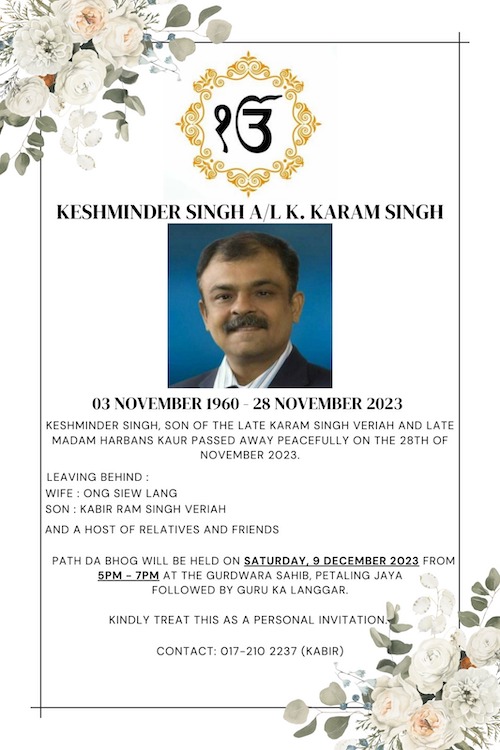
Keshminder Singh, son of the late Karam Singh Veriah and the late Madam Harbans Kaur, passed away peacefully on the 28th of November 2023.
Wife: Ong Siew Lang
Children: Kabir Ram Singh Veriah
and a host of relatives
Path da Bhog: 9 December 2023 (Saturday), from 5pm to 7pm, at Gurdwara Sahib Petaling Jaya, followed by Guru ka Langgar.
KINDLY TREAT THIS AS A PERSONAL INVITATION.
Contact: Kabir 017 – 210 2237
| Entry: 28 Nov 2023; Updated: 6 Dec 2023 | Source: Family
ASIA SAMACHAR is an online newspaper for Sikhs / Punjabis in Southeast Asia and beyond. When you leave a comment at the bottom of this article, it takes time to appear as it is moderated by human being. Unless it is offensive or libelous, it should appear. You can also comment at Facebook, Twitter, and Instagram. You can reach us via WhatsApp +6017-335-1399 or email: asia.samachar@gmail.com. For obituary announcements, click here
In this article, I reflect on how I developed an interest in and inspiration for media and how, against all the odds, I was able to become a TV presenter. My story is one of a Sikh female and her struggle against deep rooted gender stereotypes within first-generation Sikh families that settled in the UK during the 1960s. From my birth in 1962 to my early 20s, like many other Punjabi Sikh girls of my generation, my life was very much structured around limited expectations. Though things have changed now, looking back, in some senses, it does feel to me that I managed nothing short of achieving the impossible!
Like most other Punjabi Sikh girls of my generation, growing up in the UK in the 1960s was a mix of life mostly revolving around school during the week and participating in family and community events during the weekend. And because I grew up in a very religious family, I can recall many Gursikhs coming to our house for kirtan programmes and Akhand Paths. Like any other typical family, there was conflict at home and plenty of sibling rivalry and it didn’t help that I was the youngest!
Life at home was very different from school, meaning that I grew up navigating between cultures. Along with Punjabi girls, I also had black friends, though I was never able to allow those friendships to infringe on my home and work life, which was in the family business. To be honest, I was living a double life, which resulted in lots of code-switching. At school, I would mostly speak English and interact with people from a wide variety of cultures, but at home, it felt like another world. Though I spoke in English with my siblings, Punjabi language, Punjabi food, and Punjabi dress were the norm, which included having to keep my head covered at all times!
I did value the close-knit structure at home, which made me feel secure and ‘looked after’. However, as I began to develop my thoughts about who and what I was and wanted to be, I also felt home life was restrictive and controlling. Though no two Punjabi families are alike, I do think my experience of ‘care’ and ‘control’ is something that many girls like me will have experienced.
Culture and tradition had a powerful effect on our lives, and though I now have a completely different view of the role of girls in Punjabi Sikh families seemed normal. The expectations of boys/men as the wage earners and girls/women being responsible for the domestic sphere, to cook, clean, and serve, seemed ‘natural’ at the time. However, I can remember questioning and resisting the control that was being imposed on me, though this didn’t lead to any significant change at the time.
When I got married, there was some change and I able to exercise more control over my life. However, the gender role expectations didn’t disappear altogether, and in some sense my struggle has been ongoing. Let me explain. Most people are taught that gender is fixed, and that human nature determines what roles women and men can adopt. However, as we have seen in the past 30 years, many of those traditional stereotypes have been shattered, and we can see women and girls doing many roles that once were considered for men, and vice versa. We see men in caring, catering, and cleaning roles, which were once considered the responsibility of females.
Another dimension of the shaping of gender roles, particularly within the Punjabi feudal culture that I was subject to from birth, was that girls are a form of property which is to be nurtured and eventually passed onto her future in-laws after marriage. At the time, I was ignorant about this. Still, on reflection, I now realize that, though I was loved and cared for, as a girl child I was also seen as a burden, and the ultimate responsibility for my parents was to make sure I could be successfully married off. Then I would be the responsibility of my husband and in-laws, and the cycle would continue with the birth of my children. I am pleased to say that I was able to break the cycle in my family and raise my children to develop their own minds and life choices. I am pleased to say that in rejecting feudal traditions, far from losing my ‘izzat’ or ‘self-respect’, I believe my children have brought great honour to me and my family.
Some might be thinking, what does this exploration of my upbringing and gender attitudes have to do with me and my journey into the media? Put quite simply, in all honesty, for the first 40 years of my life, if anybody had even suggested that I might one day be doing live TV and writing columns on a wide range of difficult subjects (e.g. family violence, abuse, racism, fake godmen, etc.) that the Punjab Sikh community traditionally chooses to bury, ignore, or deny, I would have said they were making fun of me!
As I reflect on my life and try to understand how I have almost managed to achieve the impossible, I think I can identify several factors. Some of these relate to my personality and inner instinct to struggle, which I feel I always had; others relate to specific moments in my life that on reflection I can now say were transformative. But perhaps the biggest challenge for me has been to overcome what is known as ‘imposter syndrome’, which affects many people, especially women such as me, who enter spaces that were traditionally seen to be for white males. Put very simply, imposter syndrome is the belief that you are less capable than those around you, that your success is the result of luck or other external factors and that you will be discovered as a fraudster.
One of the effects of imposter syndrome is to feel a sense of threat. Research suggests that humans respond to threats in three ways: fight, flight or freeze. From a young age, I identified as a fighter, earning me the label of ‘the difficult one’ from my father. Others, too, have commented on my determination and courage to stand up for myself. Indeed, I know that for some women, my refusal to be a ‘good girl’, i.e. to be a passive victim, has been troubling. Why, because when you have experienced oppression for so many years, I accept it can be and emotionally threatening to face up to reality. Though I am a fighter, this does not mean I don’t experience the other emotions as well. Indeed, especially when I entered the media space, I can remember occasions when, during a live show, feeling fear and a real sense of wanting to get up and leave. Thankfully, over the years, I managed to cope with my emotions and use them in a positive way.
Things have now changed, but my time few girls were allowed to leave home and go off to university, which meant I left school at 16 and worked as a supervisor and trainer in my dad’s factory. Around this time in my life I was went to live in Punjab for 6 months in my parents’ house in Jallandhar City, during which I was able to reconnect with my Punjabi roots. One of the important developments, which would later play an important role in building my confidence to go into media, was that I had learnt to speak and write Punjabi confidently. I am often asked, given I am British born and bred, how have I managed to speak such fluent Punjab? and this experience was one of the main reasons. To this day, I am very proud of my roots and a love my Punjabi mother tongue.
Though I did eventually manage to go to college after my marriage, if I am honest, I still do have a slight imposter syndrome when it comes to interacting with highly educated people. I guess those psychological scars from my early life, of feeling inadequate, will never disappear, though I have now learned to not let this hold me back in my ambition.
My first transformative moment was around the age of 26. I had been married now for around 3 years, and most of my time was taken up with caring for my two children, who were born one year apart. However, I had always expressed a desire to restart my education, though my confidence levels were very low. Anyhow, my partner was very encouraging, and I began to attend workshops on personal and self-development, which were fantastic as they enabled me to learn and interact with and from others who had similar experiences and aspirations. Indeed, my desire to learn and develop my creative side was such that I also enrolled onto courses in fashion, life drawing, painting and sculpture.
With these experiences, I was discovering all kinds of hidden talents, but it was in the field of counselling that I really discovered my true interest was in people and society. It was on one such course, where I had to do a live role-play counselling another person to enable them to speak about their problems. What made it even more nerve-racking was that the interview was being recorded on camera be reviewed by the whole class afterwards. I was terrified! To my surprise, I managed to do the exercise and got really good feedback from the tutors and fellow students. However, I still doubted my performance and felt the students and tutor were just trying to be kind; I could not even believe the person on the video was me!
I now realize these were the effects of suffering from imposter syndrome, which can affect you in many ways. For me, there were two fears I remember most of all; one was the fear of failure and the second was that everybody else was so much better than me, which wasn’t true! As I have developed, I have come to accept that many such fears that we have about ourselves are irrational, but they come from somewhere. And for me, it was those childhood experiences where gender stereotypes meant that as well as being held back from my education, I had few role models.
This leads me to another transformative moment, which was more like a period in my life. This is where I began to read and learn about the struggles of black women and two in particular. The first was African American writer, Audre Lorde who, like me, had grown-up in a traditional and strict family. She had a mixed relationship with both her parents from a young age, who, were busy running their family business, and hence had very little time for her. From struggling at school, Audre Lorde became a great scholar and feminist activist, and it was one of her many quotes from an article she wrote called The Transformation of Silence into Language and Action” that changed my approach to life. The quote is, “My silences had not protected me. Your silence will not protect you.” And through these simple but powerful words, I stopped feeling guilty about speaking out. I now realized I had a voice and that through speaking out I could empower both myself and others.
The second person was another African-American woman whose influence on me was such that for the first time I began to dream about becoming a presenter. I am talking about Oprah Winfrey who, despite a troubling upbringing full of poverty, violence, and abuse, managed to become the most famous TV presenter in the world. What impressed me about Oprah was her style of interviewing, which was almost a mix of therapy and journalism. It was her ability to create empathy that made it easy for the guests to open up and to discuss very sensitive issues. It was almost as if at the time, she was doing counselling in front of a live studio audience and millions watching on TV.
Another transformative movement for me was when I completed my Professional Diploma in Counselling. As well as building my confidence as a thinker and writer, I learned so much about human communication which helped me to further make sense of my own life and the behaviour of many people in the community. One theory that really changed my perspective was Freud’s theory of childhood experiences and the development of three “ego states,” which can be seen as the ‘Parent’, ‘Adult’, and ‘Child’. What I learned in life often we act as a Parent, which is to give orders and be aggressive, or a Child, which is to take orders and be passive. The healthy ego state is the Adult, which represents assertive behaviours.
Reflecting on my own family and community relationships, but also watching Indian/Punjabi TV channels, I realized that most of the interactions were parent/child, which was leading to poor communication and destructive behaviours and slanging matches. So, I began to develop assertive communication, which had a very powerful and positive effect. I would later take this learning into my media work. I have always felt that the role of the presenter should never be to put the guest down but to enable them to feel valued. And when you have aggressive guests, you should avoid the trap of responding in the same way, but try to be assertive.
Whilst through my experience as a professional counsellor I was able to develop confidence to work with small groups and in one-to-one situations in a private setting, entering the media was quite different. The most daunting thing was that suddenly I felt like I was being watched by thousands of people. Further still, especially in the studio, because you were speaking into a camera, this was completely a new thing for me. It took time for me to adjust to speaking to a ‘dead object’ rather than a living person. I managed to overcome this by imagining the people who would be watching and now I find it quite easy to be intimate with the camera.
Against the backdrop of my learning, my partner Gurnam Singh began to present a live TV debate show called Panth Time on the newly established Sikh Channel based in the UK in 2009. I used to go with him to the various outside broadcasts and just sit passively in the audience. After a few programs I felt rather useless and decided either to become actively involved or stop attending. I remember expressing my frustration to Gurnam and he suggested that I might want to take on the role of the person with the roving microphone. My importer syndrome immediately kicked in and my initial response was no, I can’t do that! To be honest, the prospect of being in front of the camera was a frightening.
Anyway, being the fighter I am, I decided to go for it. This initially involved approaching audience members behind the scenes and off camera to encourage them to participate. However, this role developed into me engaging in dialogue with the audience members during the show. This increased involvement and growing confidence enabled me to both face an audience and the camera to the point where I began to identify as a co-presenter.
Fast forward to 2012, we had a new CEO at the Sikh Channel, the late Gurdeep Singh, who came up with the idea of a new family-orientated show which we called ‘The Sikh Café’ jointly hosted by me and Gurnam. At first, I was hesitant, but we proceeded, and I caught the bug! Soon after Gurnam and I moved to Akaal Channel where we began a new show called the 1 Show Live, which ran non-stop for 10 years. I recall the CEO of Akaal Channel, Amerik Kooner, who brought us on to the channel, that we were the Punjabi equivalent of the ‘Richard and Judy’, who were a famous husband and wife chat show presenters on mainstream UK TV.
Earlier this year we moved to the Punjab Broadcasting Channel SKY775 (click here for Facebook), and I am pleased to say that we have continued with the 1 Show Live, which has now become widely recognised as a show that transcends generations and takes on difficult issues that others are not prepared to discuss. I must say, the channel has made me feel welcome and supported, but most of free to express my opinions without interfering, which, I must be honest, hasn’t always been the case!
Given my previous imposter syndrome and general fear of facing the public, somewhat ironically, I seem to have developed a particular liking for live TV over recorded programs. I think the reason is that I get a greater adrenaline rush with live TV, and I feel much more alert. The problem for me with recorded shows that it doesn’t feel real, and you can become overly concerned about mistakes. On live TV, for sure one can make mistakes, but this is the beauty of it; the audience sees you are a real person who is not trying to be perfect. If I am honest, the imposter syndrome is still there, but once the countdown begins, my fears melt away and the adrenalin takes overt when I hear the words 3,2,1, ‘action’!
Manjit Kaur, a UK-based therapist and counsellor, is a presenter at the 1 Show Live at Panjab Broadcasting Channel, UK. She can be contacted via email at manjitkaur1show@gmail.com
ASIA SAMACHAR is an online newspaper for Sikhs / Punjabis in Southeast Asia and beyond. When you leave a comment at the bottom of this article, it takes time to appear as it is moderated by human being. Unless it is offensive or libelous, it should appear. You can also comment at Facebook, Twitter, and Instagram. You can reach us via WhatsApp +6017-335-1399 or email: asia.samachar@gmail.com. For obituary announcements, click here
Mandalay gurdwara celebrates Guru Nanak’s 554th birthday on 27 Nov 2023 – Photo: Rajeev SIngh / Asia Samachar
By Asia Samachar | Myanmar |
Sikhs in Myanmar celebrated 554th birth of Guru Nanak with programmes at various gurdwaras. Here are scenes at Gurdwara Sahib Mandalay on 26 Nov 2023, as shared by Asia Samachar reader Rajeev Singh. More photos and videos at Asia Samachar Facebook & Instagram
FOR DISCUSSION ON GURU NANAK’S BIRTHDAY, CLICK HERE
Mandalay gurdwara celebrates Guru Nanak’s 554th birthday on 27 Nov 2023 – Photo: Rajeev SIngh / Asia Samachar
ASIA SAMACHAR is an online newspaper for Sikhs / Punjabis in Southeast Asia and beyond. When you leave a comment at the bottom of this article, it takes time to appear as it is moderated by human being. Unless it is offensive or libelous, it should appear. You can also comment at Facebook, Twitter, and Instagram. You can reach us via WhatsApp +6017-335-1399 or email: asia.samachar@gmail.com. For obituary announcements, click here
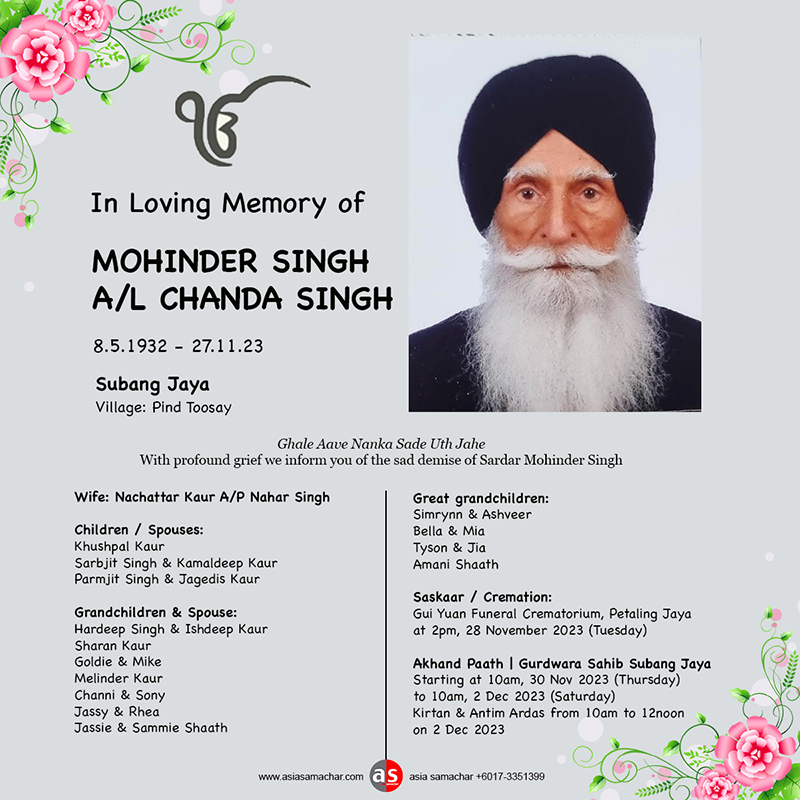
Great grandchildren: Simrynn & Ashveer Bella & Mia Tyson & Jia Amani Shaath
Saskaar / Cremation: 2pm, 28 November 2023 (Tuesday) at Gui Yuan Funeral Crematorium, Petaling Jaya
Akhand Paath | Gurdwara Sahib Subang Jaya Starting at 10am, 30 Nov 2023 (Thursday) to 10am, 2 Dec 2023 (Saturday) Kirtan & Antim Ardas from 10am to 12noon on 2 Dec 2023
ASIA SAMACHAR is an online newspaper for Sikhs / Punjabis in Southeast Asia and beyond. When you leave a comment at the bottom of this article, it takes time to appear as it is moderated by human being. Unless it is offensive or libelous, it should appear. You can also comment at Facebook, Twitter, and Instagram. You can reach us via WhatsApp +6017-335-1399 or email: asia.samachar@gmail.com. For obituary announcements, click here
ASIA SAMACHAR is an online newspaper for Sikhs / Punjabis in Southeast Asia and beyond. When you leave a comment at the bottom of this article, it takes time to appear as it is moderated by human being. Unless it is offensive or libelous, it should appear. You can also comment at Facebook, Twitter, and Instagram. You can reach us via WhatsApp +6017-335-1399 or email: asia.samachar@gmail.com. For obituary announcements, click here
Eminent Sikh scholar Bhai Gurdas Ji – a contemporary of Guru Arjun Dev ji, and in whose hand the first copy of Granth Sahib as narrated by the fifth Guru was written – describes the coming of Guru Nanak Paatshah in the following verses:
Satgur Nanak Pargetiya Mitee Dhund Jug Chanan Hoa Jio Kar Suraj Nikelya, Tarey Chupey Andher Paloa.
Bhai ji says the advent of Guru Nanak’s spritituality was like the rising of the morning sun whose rays cut through the mist of dawn and lighted the skies, within which brightness, the mighty stars disappeared together with the darkness within which these stars reigned.
In spiritual terms Bhai ji is saying that Guru Nanak’s spirituality is one of enlightenment. It is an enlightenment that is as bright as the rising sun. It is an enlightenment that cuts through the mist of the existing (even if much bigger and older) spiritualties of ritual and superstition. It is a spirituality that is meant for the entirety of mankind.
Some 400 years later, one of India’s most illuminated minds – Sir Ullama Mohamad Iqbal, PhD (Ludwig, Germany) – the son of a Kashmiri Brahmin who converted to Islam and the author of India’s national song Tarana-e-Hind – writes in his Urdu language book Bang-e-dra regarding the coming of the spirituality of enlightenment as follows:
Butkdaa Fir Baad Mudat Sey Roshan Hua Nuur-e Ibrahim Se Aazar Kaa Ghar Roshan Hua
Once again, after an age, the Temple became radiant. Once again, the house of God shone with the glory of God.
Shama-e Huq Se Jo Munavar Hai Ye Voh Mehfil Na Thee Barshey Rehmat Hue Lekin Zamee Kabil Na Thee.
The enlightenment manifested itself but the audience was not one which prized illumination – it was blind.
The rain of mercy poured from the heavens, but the land was not one which cherished rains – it was utterly barren.
Aaah Budkismat Rahey Awaaze Huq Se Bekhabar Ghafil Aapney Ful Kee Sheereene Sey Hota Hai Sazar.
Poor wretched people – they never did awaken to the call of Truth. Just like a mighty tree that is dead to the awareness of the sweetness of its own fruit.
Ullama Dr Iqbal’s lament is a painful, but accurate depiction of the Sikh psyche in relation to knowing and understanding Guru Nanak. Put plainly: the Sikh psyche is blind to the enlightenment of Guru Nanak and the Sikh heart is barren to the blessings of Guru Nanak.
Put even more plainly, the Sikh heart and mind is incapable of appreciating Guru Nanak. Put even more plainly – the coming of Guru Nanak is a waste to the people of India. Dr Iqbal captures this waste in the following verse:
Hind Ko Lekin Khyalee Falsafey Pur Naaz Thaa.
But the people of India were content to hold on, with (false) pride to their empty and imaginary spiritualities.
Powerful words. Equally powerful a slap to the spiritual face of Sikhs of Guru Nanak. Powerful but true. Necessary even.
WHAT WE KNOW
For how much does the average Sikh know about Guru Nanak? Much of what we know is narrated through some 2,000 odd largely concocted stories that we euphemistically call Sakhis, and are repeated by our clergy – parcharaks, preachers, kirtanias, dhadees as well as our writers and historians. The source of these so called sakhis is NOT the writings of Guru Nanak.
The origin of these sakhis are a variety of books called Janam Sakhis – the oldest being composed in 1733 by Dya Raam (writer) and illustrated with pictures by Alam Chand Raj (painter / artist). This Janam Sakhi – also called the B40 Janam Sakhi, (after its Accession Number assigned by the India Office Library in London) is thus written 264 years AFTER Guru Nanak’s advent.
The most popular Janam Sakhi amongst Sikhs is Bhai Bala’s Janam Sakhi – purportedly narrated by Guru Nanak’s Hindu companion Bala. Bhai Bala is a fictitious character. He did not exist. Guru Nanak’s companion was Mardana. How many Sikhs know of this basic untruth – that their entire story of Guru Nanak is narrated by a non-existent character, and written by an anti-Sikh individual?
Viewed collectively, these Janam Sakhis paint Guru Nanak as: a mystic, a miracle performer, a faith healer, a magician, a purveyor of superstitious beliefs, a practitioner of super-natural powers, a recluse, an ascetic, an unproductive child, a neglecting father, demanding blind faith and so much more.
Snakes come over to shade him as he slept while his cows ate the fields of others. His father slaps him for wasting his hard-earned money. In the wink of an eye he brings back to life fields eaten by his cows. Elsewhere he drowns in a river and comes back to life three days later. He brings dead people back to life, and stops a mountain of a stone hurled at him with his palm, depression engraved in stone. He flies over the mountains to meet Yogis and Sidhs residing there. He orders his son to hang out clothes to dry in the middle of the night and tells his disciple Bhai Lehna to eat a corpse.
This is the Guru Nanak that Sikhs seem to know. The non-existant one, of course.
This is perhaps what Dr Iqbal meant when he said “Hind Ke Lekin Khyalee Falsafey Pur Naaz Thaa”. We wanted to stick to our “khayalee” beliefs and reject Guru Nanak’s real, practical and absolute enlightenment. To make our khyalee beliefs acceptable, we wanted to paint and portray Guru Nanak himself to be a practitioner and purveyor of our wrong beliefs.
So instead of wanting to stand in the divine enlightenment that was Guru Nanak, we pulled the Guru into the shadows of our own “khyalee” darkness. For this is exactly what the authors of much of 2,000 sakhis have succeeded in doing.
At its most basic level, the Janam Sakhis changed Guru Nanak’s birth date from Vesakh 1469 to Kathik 1469. In accordance with the Vedic believers who were complicit in changing the date, Vesakh is the month of celebration fit for events belonging to the upper Brahmin classes, while Kathik is the month fit for the celebration of the lesser castes. In the minds of the Janam Sakhi writers, Guru Nanak’s parkash could not be allowed to sit in Vesakh because he was not a Brahmin. They falsely determined Kathik Dee Puranmashi as the specific day for Guru Nanak’s birthday. In accordance to Vedic beliefs of auspiciousness – this day is the MOST inauspicious.
Sikhs have no such beliefs about auspiciousness or otherwise of man-made constructs, but Sikhs ought to object to the distortion, and REVERT to the reality.
Guru Gobind Singh, the tenth Guru knew of Guru Nanak’s birth in Vesakh, which is why he too chose Vesakh 1699 to create the Khalsa. It was supposed to be one complete circle. It was supposed to stamp the completion of Guru Nanak’s Sikhi. When Sikhs celebrate Vesakhi – they would celebrate BOTH – the birth of their FOUNDER Guru Nanak and their OWN birth as Khalsas. Sikhs obviously did so, until the Sakhi writers infiltrated into the Sikh psyche almost in total and changed Guru Nanak’s birth date to Kathik.
Guru Nanak wrote a great deal of banee – all of which is contained within the Guru Granth Sahib Ji. Nine hundred and forty-seven shabds and saloks of his are contained in the Guru Granth Sahib. How many of these shabds have Sikhs read? How many have we understood? How many have we shared with the rest of humanity – for whom Guru Nanak’s spirituality was intended. How many do our ragis, –parcharaks, dadhees and kirtanias preach – without resorting to some half-cooked sakhi to distort its meaning? How many have we attempted to apply his banee in our lives? These 947 shabads are the real Guru Nanak. These 947 shabads are the divine enlightenment of Guru Nanak and the Godly rain of blessings that he brought.
Will we continue to be blind and barren so as to ignore these 947 shabds that tell us of the real Guru Nanak and instead link with what are mostly half baked, half cooked, patently false, semi-false stories called sakhis that are plagiarized/stolen from others – especially from the bigger stars (Tarey Chupey) that Bhai Gurdas ji is talking about?
Let us just take one verse of Guru Nanak:
ਹੁਕਮਿ ਰਜਾਈ ਚਲਣਾ ਨਾਨਕ ਲਿਖਿਆ ਨਾਲਿ ॥ ੧ ॥
Hukum Rajayee Chalna, Nanak Likhiya Naal.
It is on page 1 of the Guru Granth Sahib. It captures the essence of Guru Nanak’s enlightenment for all of humanity – Hukam. Guru Nanak’s Sikhi is about Hukam – about attempting to know and understand the Will of the Creator; about wanting to abide by (chalna) and live one’s life within the confines of this will; about wanting to be part and parcel of this will (likhiyanaal), and about making the will of the Creator as the object of our spiritual life (rajayee).
Should one apply the message of just this one SINGLE verse of Guru Nanak, 90 percent of the sakhis of the Janam Sakhis would crumble because they show Guru Nanak going against the Will of the Creator. How can a Guru tell us Sikhs to know, understand, and abide by the Hukam of the Creator, while he himself destructed the Hukam at every step of the way, in every sakhi?
FOR DISCUSSION ON GURU NANAK’S BIRTHDAY, CLICK HERE
If we had read the Banee of Guru Nanak, we would know that his companion is Mardana who is placed in the SGGS by Guru Nanak at three places. We would know that Bala did not exist because in the 947 shabads (and 40 Vaars of Bhai Gurdas ji), Bala is not mentioned even once.
We Sikhs need to cure the blindness that Islamic luminary Dr Iqbal is pointing out for us. The cure is within the enlightenment of Guru Nanak’s 947 shabads and the rest of Gurbani. We also need to transform our barren hearts and souls so that we can contain the blessing that Guru Nanak brought for us. The way to irrigate these barren hearts and souls is again to connect with the messages of Gurbanee.
IS THERE HOPE?
Is there hope for us Sikhs? What hope can there be when Sikhs cannot even get the birth date of their founder right. What hope can there be when Sikhs have more faith in the non-existant Bhai Bala who falsified Guru Nanak’s birth date to Kathik, than they have in Bhai Gurdas who tells us it was in Vaisakh? What hope can there be when educated but foolish Sikhs tell us that the birthdate does not matter, what matters is that we follow his messages. What hope can there be when it is clear as daylight that his messages are not being followed.
The year 2024 will celebrate the 555th birth anniversary of Guru Nanak our Guru. One can almost hear the soul of the Guru cry out from the pages of the GGS: Enough of darkness and baren-ness; come to the enlightenment that Guru Nanak is:
Gurbanee Es Jug Mein Chanan, Karam Vasei Mun Aiye.
Gurbani is the enlightenment (Chanan) within which the divine blessings (Karam) will fill the heart of the enlightened.
It is up to us Sikhs if we will celebrate the 555th birthday as enlightened persons. It is up to us if we will continue with our blindess and resort to barren and meaningless ways of lighing 555 lamps, presenting 555 roses to the SGGS, doing 555 Akhand Paths, affixing 555 diamonds to the palkee, or having 555 helicopters fly over the Darbar Sahib or Nankana Sahib to rain flowers from 555 different varieties. The list for barren ways is long, varied, wasteful meaningless and endless. Most of all, it is not what Guru Nanak would want.
Sikh thinker, writer and parcharak Karminder Singh Dhillon, PhD (Boston), is a retired Malaysian civil servant. He is the editor-in-chief of The Sikh Bulletin and author of The Hijacking of Sikhi. This essay is a revised version of the essay that first appeared in The Sikh Bulletin, USA Vol 1 2019.The author can be contacted at dhillon99@gmail.com.
ASIA SAMACHAR is an online newspaper for Sikhs / Punjabis in Southeast Asia and beyond. When you leave a comment at the bottom of this article, it takes time to appear as it is moderated by human being. Unless it is offensive or libelous, it should appear. You can also comment at Facebook, Twitter, and Instagram. You can reach us via WhatsApp +6017-335-1399 or email: asia.samachar@gmail.com. For obituary announcements, click here
Oxford Union Debate 23-11-23 | Lord Singh of Wimbledon – Opposing the Motion – ‘This House Believes That God Is A Delusion’
By Indarjit Singh | Opinion |
Madam President, Ladies and Gentlemen.
What strikes me most about the motion before the House, and the arguments made for it, is the arrogant assumption, that because some do not understand or agree with what religions say about God, the idea of God must be a delusion.
In opposing the motion, I do however have some sympathy for those unhappy with the way God is described in Abrahamic religious texts, and how this has been used to divide what Sikhs see as our one human family.
God, the creative force behind all that exists, is shown in Abrahamic texts as a sort of elderly male with superhuman powers, who also has very human failings of jealousy, anger, and favouritism. God is shown to benevolently overlook the misdeeds of some, while, vindictively punishing those not favoured by him, consigning them to, everlasting suffering in the blistering heat of Hell. Some texts take this further, suggesting that skin burnt by the heat will re-grow, and be burnt again to inflict further continuing punishment. The reward for those God favours, is everlasting bliss in a place called heaven-where Muslims men enjoy some added extras.
Members of the Abrahamic faiths, and their various subsects, each claim that they are God’s favourites, the chosen people, leading to horrendous conflict and unbelievable atrocities between sister faiths as seen in Gaza and other parts of the Middle East today. When asked to comment on God creating man in his own image, the philosopher Voltaire wryly commented – it is we who have created God in our image.
The portrayal of God as a being who inflicts dire punishment for supposed bad behaviour, was used in a more superstitious past, as what Conrad describes as ‘a constables handbook’ to scare people to lawful and responsible behaviour, but is widely ignored today.
This view of God is a million miles removed from the Sikh concept of God being the name given to the unknowable creative force behind all that exits. Some here today, will bristle at my suggestion that some things are beyond our understanding. They will argue, that if they cannot understand the idea of God as a creative force beyond our comprehension, the very idea of God is a delusion. The renowned scientist Isaac Newton was more modest when he said, ‘my achievements are no more than playing with a few pebbles on the shore, while a vast ocean of knowledge lies before me undiscovered’. The scientist JB Haldane put it even more succinctly when he said, ‘the universe is not only more complex than we suppose, but more complex than we can suppose’.
The teachings of Guru Nanak on our inability to fully understand the nature of God, the creator or creative force behind all that exists, are in line with the views of these famous scientists.
In the opening lines of the Sikh scriptures, Guru Nanak, the founder of the Sikh faith, writes:
There is one God
The creator of all that exists,
The ultimate truth and reality
Beyond emotions of fear and enmity
Beyond time, birth, gender, or human frailty
For Sikhs the aim of life is not to seek salvation, but simply to live in harmony with what we call hukam, or ‘the will of God’. Sikh teachings require honest living, standing up against injustice, rejecting all notions of race or religious superiority, recognising gender equality and, in the closing words of our daily prayer, ‘working for the wellbeing of all humanity’.
Shakespeare also recognised the importance of living in consonance with what Sikhs call the will of God. in Julius Caesar, he refers to what Sikhs call hukam as a tide, saying:
There is a tide in the affairs of men.
Which taken at the flood leads onto fortune
Omitted, all the voyages of their lives.
Are bound in shallows and miseries.
Sikhism does not believe in afterlife punishment or reward, but simply in our responsibility to leave the world a better place for our having lived.
Coming back to the motion before this House, I again quote Shakespeare, with Hamlet reminding Horatio, that ‘there are more things in heaven and earth that are dreamt of in your philosophy’.
Unless like the clever Mr Toad, you believe, we know all there is to be known; and are prepared to forget the unbreakable scientific link between cause and effect, and irrationally believe in the absurdity, that at first there was nothing, and then suddenly, without cause, it all exploded to create infinite time space and matter, we have to accept the existence of a power or force beyond our comprehension that Sikhs refer to as God.
I therefore urge you to vote against the motion that God, the creative force behind all that exists is a delusion.
ABOUT THE AUTHOR: Indarjit Singh, who carries the UK title The Lord Singh of Wimbledon CBE, is a Crossbench Life peer sitting in the House of Lords since 12 October 2011. He is an active member of the Sikh community, including campaigning vigorously since 1984 for those responsible for this genocide against Sikhs to be brought to justice. He writes this note as the director of the Network of Sikh Organisations UK. This article was published here
This is the personal opinion of the writer or publication and does not necessarily represent the views of the Asia Samachar.
ASIA SAMACHAR is an online newspaper for Sikhs / Punjabis in Southeast Asia and beyond. When you leave a comment at the bottom of this article, it takes time to appear as it is moderated by human being. Unless it is offensive or libelous, it should appear. You can also comment at Facebook, Twitter, and Instagram. You can reach us via WhatsApp +6017-335-1399 or email: asia.samachar@gmail.com. For obituary announcements, click here
Guru Nanak’s birthday celebration at Gurdwara Sahib Bayan Baru – Photo: GSBB
By Asia Samachar | Malaysia |
The Sikh Sanggat of Bayan Baru commemorated with gusto the 554th anniversary of Guru Nanak’s birthday, joining Sikhs from around the world.
As with most gurdwaras, the local Sikhs are organising an Akhand Path, the continuous reading of the Sikh scripture Sri Guru Granth Sahib (SGGS). Their akhand path at Gurdwara Sahib Bayan Baru ends tomorrow (Nov 27).
Today, the local Sikhs also held a community outreach event at Batu Grace Ashram in Kulum, Kedah.
FOR DISCUSSION ON GURU NANAK’S BIRTHDAY, CLICK HERE
ASIA SAMACHAR is an online newspaper for Sikhs / Punjabis in Southeast Asia and beyond. When you leave a comment at the bottom of this article, it takes time to appear as it is moderated by human being. Unless it is offensive or libelous, it should appear. You can also comment at Facebook, Twitter, and Instagram. You can reach us via WhatsApp +6017-335-1399 or email: asia.samachar@gmail.com. For obituary announcements, click here
The incidents of violence against Sikh women in Panjab after 1984, perpetrated by the Indian police, are widely acknowledged. Those entrusted with enforcing the law became the ones responsible for the violence. Numerous Sikh women endured beatings and torture in police stations.
On International Day for the Elimination of Violence against Women, Khalsa Aid International reflects on and pay tribute to these women, recognising their bravery and strength.
ASIA SAMACHAR is an online newspaper for Sikhs / Punjabis in Southeast Asia and beyond. When you leave a comment at the bottom of this article, it takes time to appear as it is moderated by human being. Unless it is offensive or libelous, it should appear. You can also comment at Facebook, Twitter, and Instagram. You can reach us via WhatsApp +6017-335-1399 or email: asia.samachar@gmail.com. For obituary announcements, click here
Jasvinder Singh (left) and members of the Sanggat at the Langgar Hall of the Setia City Darbar
By Asia Samachar | Malaysia |
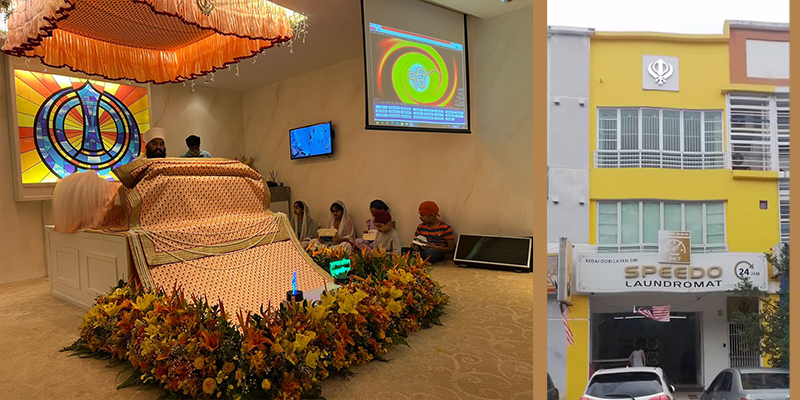
Setia City Darbar, a gurdwara servicing the some 100 Sikh families in the Selangor town of Bandar Setia Alam, is celebrating its 10th anniversary.
The gurdwara, based in a three-storey walk-up shoplot, opened its doors on Nov 24, 2013 with the arrival of the Sri Guru Granth Sahib Ji from Gurdwara Sahib Pulapol. It occupies the top two floors.
They have a dedicated Granthi who does daily prakash and semaphti, morning simran sessions from 3am to 4am on Mondays to Fridays, followed by daily morning prayer until 6am.
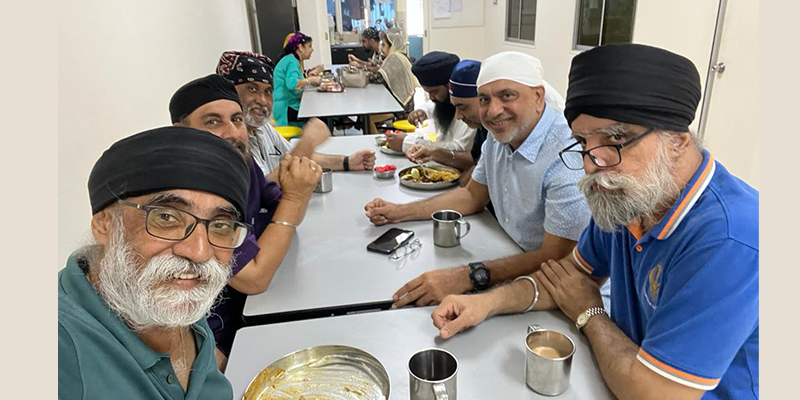
They also conduct a weekly Satsang gathering on Sundays (6pm to 7.30pm) followed by Guru ka Langgar. They have an Istri Satsang on the first Wednesday of the month.
Setia City Darbar runs the Punjabi Education Centre (PEC) with 20 students and two teachers. They also run Gurmukhi santhia classes on Wednesdays and waja/tabla classes on Sundays.
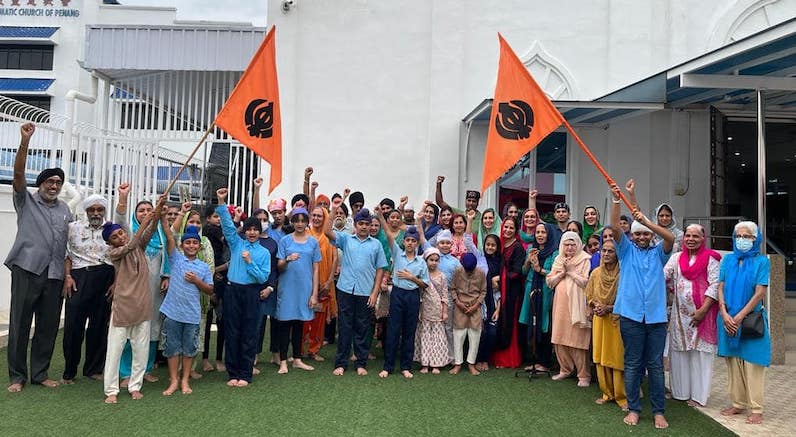
To celebrate the gurdwara’s establishment and the Guru Nanak’s 554th birthday commemoration, Setia City Darbar has been running daily progammes since Nov 19. The grand programme will held tomorrow (Sunday, Nov 26, 2023).
Setia City Darbar management committee is presently led by Jasvinder Singh, a retired operations director of a multinational firm.
Address: Setia City Darbar, No 34-1Jalan Indah Y U13/Y, Setia 40170, Setia Alam, 40170 Shah Alam, Selangor.
Setia City Darbar, located in a three-storey shoplot, celebrates 10th anniversary in 2023
ASIA SAMACHAR is an online newspaper for Sikhs / Punjabis in Southeast Asia and beyond. When you leave a comment at the bottom of this article, it takes time to appear as it is moderated by human being. Unless it is offensive or libelous, it should appear. You can also comment at Facebook, Twitter, and Instagram. You can reach us via WhatsApp +6017-335-1399 or email: asia.samachar@gmail.com. For obituary announcements, click here