Baljeet Kaur Grewal – Photo: Samruk-Kazyna event in Astana, Kazakhstan
By Asia Samachar | Malaysia |
High flying investment and strategy expert Baljeet Kaur Grewal takes on her first directorship at a Malaysian public listed company.
Pavilion Real Estate Investment Trust, one of the largest retail concentrated REIT in Malaysia, has tapped her as an independent and non-executive director, according to its announcement at Bursa Malaysia on Sept 14.
She is a senior investment banking and strategy professional with experiences interalia in investment banking, direct investment portfolio management, Islamic finance and credit research, according to the announcement.
She had worked at Deutsche Morgan Grenfell and ABN AMRO Bank Asia before joining Maybank Investment Bank, Malaysia (Aseambankers) in 2002 as the capital market research (fixed income) head. Four years later, she appointed as the Managing Directors & Vice Chairman of KFH Research Ltd, a subsidiary of Kuwait Finance House.
In 2015, she served as an advisory and finance specialist (West Asian Economic Mission) for Asian Development Bank (ADB) in Turkey and appointed as the Managing Director, Strategy & Portfolio Investments / Samruk-Kazyna Sovereign Wealth Fund of Kazakhstan.
She also served as member of the management board and a non-independent director of KazMunayGas National Oil Company, Kazakhstan.
Baljeet has studied Executive Masters in Business Administration (EMBA) from the University of Cambridge and BA International Economics (1st Class Hons) from University of Hertfordshire.
Pavillion REIT’s assets are located in the heart of the golden triangle of Kuala Lumpur. Its principal investment policy is to invest in income producing real estate used predominantly for retail purposes (including mixed-use developments with a retail component) in Malaysia and other countries within the Asia-Pacific region, according to information at its website.
ASIA SAMACHAR is an online newspaper for Sikhs / Punjabis in Southeast Asia and beyond.Facebook | WhatsApp +6017-335-1399 | Email: editor@asiasamachar.com | Twitter | Instagram | Obituary announcements, click here
Guru Arjan Sahib devised a superb method to curate an anthology that harmonized societal elements in a brilliant framework. The term editor comes from Latin, implying the one who puts forth, brings forth, produces, or publishes. In this context, Guru Arjan Sahib was also the editor and not its current restrictive meaning of a person who edits or makes changes. Guru Arjan Sahib was a perfect-genius. He was a compiler and editor, musician and musicologist, planner and organizer, curator and publisher, author and poet, composer and instrumentalist, producer and director, and much, much more. The Guru is also the lover of the Beloved and the Beloved of us seekers-lovers.
Guru Arjan Sahib (1563-1606) is beyond the mark of excellence.
At age 18, what traits and characteristics does one exhibit to be anointed as the leader of a nation? Guru Arjan Sahib was declared the fifth Sovereign in the line of Guru Nanak Sahib, the founder of the Sikh faith.
At age 28, what methods and resources does one galvanize to inaugurate the center for all people? Guru Arjan Sahib was the architect of Sri Harimandar Sahib (popularly the Golden Temple) in the middle of a pool in the city of Amritsar in the Panjab and developed the city and its markets.
At age 41, what vision and skills does one possess to publish an anthology that becomes the global source of eternal wisdom? Guru Arjan Sahib envisioned and completed the first recension of Guru Granth Sahib, the textual source the Sikhs call their Guru.
At age 43, what love and justice paradigm does one live to be martyred by the state? Guru Arjan Sahib was tortured to death by the Mughal emperor for disrupting the political and religious hegemony.
In Guru Granth Sahib itself, Guru Arjan Sahib is described by a Bhatt (bard) as Divine-like: “Mathura says there is no difference, Guru Arjan is the manifestation of Hari — All-Pervasive, 1-Light, Fear-Eliminator, 1Force” (1408).
GURU ARJAN SAHIB ENVISIONED AND PUBLISHED THE GURU GRANTH SAHIB. WHY?
Sikhi was gaining adherents. The infinite wisdom of the Sabad was transforming the masses. The people understood the Sabad and were becoming reverential toward it. They began to experience the 1 via Nam, Identification with the 1. Counterfeit Sabads started during Guru Amamdas Sahib’s reign and started to gain currency during the reign of Guru Arjan Sahib. Guru Arjan Sahib’s brother Prithi Chand and his gifted son Miharban wrote sabads under the signature of “Nanak,” too.
GURU ARJAN SAHIB COMPILED AND EDITED THE GURU GRANTH SAHIB. HOW?
The Sabad compositions were assigned to thirty-one rags or musical modes as well the folk tunes and rhythm. Singing was the recommended mode to harmonize with the verses in the Sabad fully. A combination of season, time, sentiment, flavor, taste, atmosphere, aesthetics, emotions, and moods transports the seeker to feel the 1Force; this is not possible without singing. The contributor arranged poetic genres and forms filled with imagery in a numerical structure and format. The language of love-songs was many, for there were no barriers or restrictions by region, religion, or status. A new Gurmukhi script was employed to capture the experience that is full, dynamic, sensuous, intimate, and profound. Guru Nanak Sahib introduced Gurmukhi letters, organized into Gurmukhi script by Guru Angad Sahib. No one knows what to call this language, no label is possible, but it has elements of Hindustani, Panjabi, Braj, Sanskrit, Arabic, Persian, Prakrit, and Apbransh. It is the language of love, scripted to provide wisdom-centeredness via metaphors, smilies, and symbols that everyday people understand and relate to.
In brief, Guru Granth Sahib as a large volume can be understood by its format-arrangement: the compilation and the methodology. Without understanding the compilation-methodology, its form-system cannot be fathomed.
GURU ARJAN SAHIB CURATED AND CONTRIBUTED TO THE GURU GRANTH SAHIB. WHAT?
The voluminous constitution of 1430 pages involved sustained labor of love and rigorous intellectual discipline. The selection of poetic, personal experiences of the 1, the songs of love with the 1 by Hindu and Muslim divine-lovers, was a monumental task. The vast eons of knowledge material lay before the Guru that was not selected. The love-songs the world needs must have personal intimacy, not an abstraction. This was not a mixing of Hindu and Muslim; it was a new understanding of the 1. Guru Arjan Sahib’s personal extraordinary experience of the 1 grace the work he carried out without any complexity or fear. The selection of the four Gurus who narrated the unnarratable narrative of the 1, fifteen Hindu and Muslim truth-exemplars of medieval South Asia, ten bards from the region trained in eulogies, and three contemporary Sikhs who documented the Guru’s message for all times formed the anthology.
The inquiring mind wonders why there are no women contributors. No one really knows. What is known unquestionably is that the Sabad’s voice is feminine, the great relationships to explore love are via mother and feminine-friends, and the protagonist is a bride in pangs of separation.
16 September is the Gugaddi Divas of Guru Arjan Sahib; the day Guruship was enthroned to the Guru in 1581. How can busy householders celebrate that amazing and beautiful memory? The perfect-genius of the Guru Arjan Sahib in Guru Granth Sahib (185) graces us:
When I opened to see the ancestral treasure, then my mind was filled with enrichment.
Are we ready to witness the treasure?
Harinder Singh is the Senior Fellow at the Sikh Research Institute. He holds a BS in Aerospace Engineering from Wichita State University, an MS in Engineering Management from the University of Kansas, and an MPhil from Punjab University in the linguistics of the Guru Granth Sahib. This article is an abridged version of the original published here.
ASIA SAMACHAR is an online newspaper for Sikhs / Punjabis in Southeast Asia and beyond.Facebook | WhatsApp +6017-335-1399 | Email: editor@asiasamachar.com | Twitter | Instagram | Obituary announcements, click here
The AARP Bulletin ran an article Titled “The New Truth About Aging” in the June 2022 issue, where they discussed about the Life Stages. In that article the very first sentence on life stages read “Midlife Crisis, Move Over.” In that article they talked how the attitudes about longevity, relationships, well-being, and wealth have shifted over time. There they asked is 60 the new 40. This started the exploration on the various life stages. I discovered that Guru Nanak Dev Ji, had defined the ten stages of human life, each a decade long. What impressed me about the 10 stages was that each stage was a decade long and the reality shared there could be experienced even today in real life.
Dhas baalatan bees ravan teesaa kaa sundhar kahaavai. Chaaleesee pur hoi pachaasee pag khisai saThee ke boddepaa aavai. Satar kaa matiheen aseehaan kaa viauhaar na paavai. Navai kaa sihajaasanee mool na jaanai ap bal || Dda(n)ddolim ddooddim ddiTh mai naanak jag dhooe kaa dhavalahar. 3 (SGGS, Pg. No. 138)
Translation:
First ten (years are spent) in childhood, twenty in playfulness, and at thirty is called beautiful (handsome). At forty, the completeness occurs; at fifty, the foot falters; at sixty, the old age sets in. At seventy, the intellect takes a hit; at eighty, the ability to take care of self is impaired. At ninety, becomes bedridden, incapacitated, unable to take care of self without assistance. Nanak: I searched, I searched, and I found that this world is a mansion of smoke (visible one moment and then gone next moment).
Let us try to understand what Guru Ji is saying about each of these 10 stages of life:
Childhood – First decade of human life is spent in childhood – exploring everything but being nurtured, taken care of, protected, and provided for by the family.
Adolescence – In this stage by playing with toys, friends and family at home and school the child learns to gain independence, confidence, finds a sense of identity, and prepares to face the world.
Early Adulthood – In this stage the adolescent has developed into a young adult; full of vigor, sees his/her own beauty (a kind of a little narcissistic). S/he is now physically and mentally ready to explore the world, and also form intimate and loving relationships outside the family.
Full Bloom– The development of physical strength and mental capabilities are at its peak. The person raises a family, becomes a productive member of society. Apparently, forty is the average mid-point of life and its peak. If the lifespan is like a parabolic curve, then Forties is its peak. A confirmation for it emerges from the data on the average age of researchers of Nobel laurates which is 44.1. It indicates that they had started their research in their field when they were in this stage of their lives. Although they may have been awarded their Nobel prize at a much later age.
Foot Faltering – This is the stage which has been commonly termed as ‘over the hill’. At this stage the slow, and irreversible decline towards old age sets in. The stride is missing a beat of the youth and the person starts slowing down.
Old age Sets in – It is not surprising that the age of sixties has been designated as retirement age. Although the governments are trying to raise the retirement age for its economic boost. At this stage some degree of assistance becomes necessary to care of the self.
Cognitive Impairment – At this stage one finds that forgetting details has become second nature, memory impairment is noticeable. Most folks with dementia, Alzheimer, and Parkinson disease are from the age group of seventies. This stage is also termed as becoming senile.
Becoming Disabled – At this stage one experiences frailty, inability to take care of oneself without assistance from others. One is not able to take part in certain activities of life, this becomes a new and an altered reality in life. Now the life’s essentials are reading glasses, dentures, hearing aids, walker/walking cane, and medicines etc.
Bedridden – In this stage health issues, dementia, infirmity from old age and bone fractures pushes the person to the periphery of the society. The person needs help with personal chores becoming dependent, almost like a newborn.
Realization that Life is a dream –Guru Ji has termed this stage as ‘mansion of smoke’ implying that the transitory nature of life is like smoke, which does not last for long. At this stage one reflects back at the events of their lives, realizing that those are like dreams, confirming the transitory nature of life. Just as we discover that our memory and reflective ability are substantially limited within dreams, a similar reality is also experienced in life as well.
The ten stages as defined by Guru Nanak Ji are shared here in the tabular form here.
Ten Stage in Life – Source: Bhupinder Singh
The English Terms used here in translation to describe the life stages have been picked from the commonly used words and in prevalent parlance, so these are not literal translation of the terms used by Guru Ji. The scientific world has accepted the 8 Stages as defined by Erik Erikson of Germany in 1950. He was a developmental Psychologist, who is best known for his theory of psychosocial development. The first four stages defined by him are covered in the first stage by Guru Ji. His fifth stage can be more or less can be equated to Guru Ji’s stage 2. His sixth stage is covered by Guru Ji’s division in stages 3 and 4. Erikson’s seventh stage can be related to stages 5, and 6 plus 7 partially. Erikson’s last stage 8 envelopes everything over the age of 65, while Guru Ji has covered it in three stages of 8, 9, 10 fully and 7 partially. As Erikson was 48 when he shared his work that implies that his stage 8 termed as Older Adulthood was not borne out of personal experience. I feel that there would have been 3 to 4 additions if it was actually experienced by him like his childhood stages. On a side note, it appears that his theory was developed when he was in his forties. Generally, the society lumps these stages together, being labeled as ‘seniors’ or ‘the elderly’. The implications of these terms are unreverential, but a gentle reminder of having become redundant. Lest we forget we all are going to witness it firsthand ourselves, only if we manage to live that long.
Based on the above usage of terms for the 10 stages, today I would personally belong to stage 8: implying Bedridden. If someone attempted to apply that term to me, I would not find that amusing. But here is a caveat, I will not be in a denial mode either. Because I have actually only experienced 25%, and yet to experience the remaining 75% of that stage, so I don’t have any basis to take a stand. Based on the data the life expectancy is around 80. In addition, the remaining two stages are like a black box – unknown. So, I cannot take a victory lap too early. There is no denying that my physical strength, mental agility, vigor, and my memory have seen a decline from their prime. In any case, the remaining two stages, namely 9 and 10 are scarier options, yet only very few make it to these stages. In spite of their loathsome welcome, only very few get to actually experience it. Guru Tegh Bahadur Ji has painted that picture in these words:
“Sii-r kameyo pagh daghmaghe, nai-nn jyot te hee-n. Kaho Nanak eh bidh ba-hee, ta-oo na Har ras lee-n. 47.” (SGGS, 1428)
Translation: Oh Brother! In old age the head shakes, the feet stagger, the eyes lose sight, despite this condition the man does not absorb himself in the taste of God’s Naam.
Guru Ji has rightly pointed out above that I have “na Har ras lee-n”. Really true, that I have not tasted the Divine nectar. But then where do I look for scour now? The only alternative, I see for myself is to run to my Guru Ji seeking help as:
ਬਾਝੁ ਗੁਰੂ ਡੁਬਾ ਸੰਸਾਰੁ ॥੨॥
“Baajh guroo ddubaa sa(n)saar. 2.” (SGGS, 138)
Translation: Without the Guru, the world is drowning. ||2||
The life of Guru Amardas provides us hope and inspiration. Bhai Amardas came to Guru Angad at age around 62, and in 12 years with his dedication, service, and commitment, had won over Guru Ji’s heart. At 73, Guru Angad Ji anointed him as the successor, and he successfully led the community of followers. Guru Amardas lived till a rigorous life till the age of 95, without any old age impairment. He contributed 907 hymns to Sri Guru Granth Sahib. He set up Masand system of preacher/ representatives and assigned them different territories for preaching and also set up set up a city of Goindval. His own sayings fills me with hope:
“Gurmukh budde kadhe naahee jin(h)aa a(n)tar surat giaan. Sadhaa sadhaa har gun raveh a(n)tar sahaj dhiaan.” (SGGS, 1418)
Translation: The Gurmukhs never grow old as within them is intuitive understanding and spiritual wisdom. They chant the Praises of the Lord, forever and ever; deep within, they intuitively meditate on the Lord.
His personal life, experiences as shared above are my only inspiration and hope. Guru JI, I have not climbed up on the spirituality ladder nor chant God’s praises, still I have come to seek your sanctuary. My only hope is in protection by the Guru and mercy of God. My Guru has also told me about the merciful and benevolent nature of God in these words:
ਨਾਨਕ ਸਾਹਿਬੁ ਸਦਾ ਦਇਆਲੁ ॥੨॥
“Nanak saahib sadhaa dayal. 2.” (SGGS, 268)
Translation: O Nanak, our Lord and Master is merciful forever. ||2||
As I have nothing else in my repertoire, so please bless me with the spiritual wisdom and mediation on the Lord. Knowing that you are very compassionate I have set my eyes on you:
“Eih sareer jajaree hai is no jar pahuchai aae. Gur raakhe se ubare hor mar ja(n)mai aavai jaae.” (SGGS, 584)
Translation: This (human) body is decreptitude (breaks upon sudden impact like an earthen pot); death is ready to strike it dead in (the vulnerable) old age. Only those who are protected by the Guru are saved, while others die, to be reincarnated as they continue coming and going.
May Guru Ji’s guidance and mercy of God save us from the cycles of births and deaths so that we don’t have to go through these different stages of life again. Although, the old age is debilitating, it incapacitates us of our physical strength, making us dependent, but we have hope in mental and spiritual fortitude which Guru can bless us with. It is not dependent on the chronological age, nor loses its potency with age. That fortitude enables us to handle even the trying times with poise and without a complaint. Guru Amardas has painted the picture in these words:
“Oi sadhaa ana(n)dh bibek raheh dhukh sukh ek samaan. Tinaa nadharee iko aaiaa sabh aatam raam pachhaan. 44.” (SGGS, 1418)
Translation: They dwell forever in blissful knowledge of the Lord; they look upon pain and pleasure as one and the same. They see the One Lord in all, and realize the Lord, the Supreme Soul of all. ||44||
References:
SGPC, Sankehp-Jeeewan Sri Guru Amardas Ji tae Goindval Sahib dae Gurudwarae. SGPC
Khosla Anju. The Life & Teachings of Guru Amardas. Singh Brothers
What to Know About Erikson’s 8 Stages of Development. https://www.webmd.com/children/what-to-know-eriksons-8-stages-development
Bhupinder ‘Bo’ Singh, Houston. Born in Bhamo, Myanmar, he now lives in Houston, US, where he runs a manufacturing company formed with his son. A mechanical engineer by training, he has authored a number of books, including Connecting with the Master – A collection of essays on topics related to Sikhism (2006) and In Bully’s Eyes – An Illustrated Children’s book on Bullying(2019).
ASIA SAMACHAR is an online newspaper for Sikhs / Punjabis in Southeast Asia and beyond.Facebook | WhatsApp +6017-335-1399 | Email: editor@asiasamachar.com | Twitter | Instagram | Obituary announcements, click here
An unpretentious, steadfast journalist who was unexpectedly thrust into the spotlight when he created a window into one of the world’s most high-profile corruption and money-laundering trials has been made a top editor at an English newspaper at Malaysia.
Sharanjit Singh Tara Singh was appointed the executive editor of the New Straits Times (NST) as part of a recent editorial reshuffle at the 177-year old newspaper, now under the Media Prima Bhd stable. He will oversee the entire spectrum of the NST’s content and digital operations.
Sharanjit, who hails from Alor Star, Kedah, began his journalism journey in 1996 when he enrolled in the NST training scheme by chance, resulting in a career spanning more than two-and-a-half decades with stints as the bureau chief in Kedah, Perlis, Melaka and Penang and a string of awards including the highly coveted MPI best investigative journalist award.
A newsman to the core, Sharanjit has covered global events ranging from the UN General Assembly to the uprising in Thailand, insurgency in Pattani and Tsunami in Aceh.
More recently, however, he quietly amassed a following through his coverage of the trial of the nation’s ex-PM Najib Razak where his daily reporting brought to life the daily shenanigans of the key protagonists. One could almost imagine being a fly on the wall during this much touted and eagerly followed court proceedings that was meticulously covered by Sharanjit.
Sharanjit takes all of this in his stride despite having formed strong friendships with those who fought valiantly for justice in the Federal Court.
Sharanjit is a man from humble beginnings who is rejuvenated by nature and traveling the road less traveled. His secret passion is his small garden patch on his balcony which he tends with much love and affection.
In the reshuffle, Farrah Naz Karim was appointed as group editor while Najmuddin Najib was made associate editor for content and digital. Both Sharanjit and Najmuddin were NST’s senior news editors.
ASIA SAMACHAR is an online newspaper for Sikhs / Punjabis in Southeast Asia and beyond.Facebook | WhatsApp +6017-335-1399 | Email: editor@asiasamachar.com | Twitter | Instagram | Obituary announcements, click here
Left: The Crown in view as the Queen Elizabeth’s coffin was carried to Palace of Westminster (Photo: The Royal Family). Right: Maharaja Duleep Singh’s simple tombstone (Photo: Ian Burt)
By Gary Hara | Opinion |
In a few days, Britain’s longest-reigning Monarch’s earthly remains will be laid to rest on the grounds of Windsor Castle, in an elaborate ceremony befitting her royal status. As many across the world mourn, my thoughts turned to another royal whose final resting place is in the same country, but one whom not many may know about.
Duleep Singh was the youngest of Maharaja Ranjit Singh’s sons. Ranjit Singh ruled over the mighty kingdom of Punjab, one of the richest and most powerful states in India. He was a brilliant and powerful leader, so much so that the ever ambitious East India Company didn’t dare to attempt to quarrel with them in their quest for expansion in the resource-rich Indian subcontinent.
In 1839, the great king died, and not soon thereafter, mayhem ensued. After after a series of assassinations and betrayals, all of his heirs lost their lives.
All but one, that is: Prince Duleep Singh, his youngest son.
In 1843, he was crowned the Maharaja of Punjab, with his mother ruling as Queen Regent on his behalf.
He was 5 years old.
Seeing opportunity in the instability of Punjab, the British fought two successful wars against the the young Maharaja, the eventual outcome of which was the annexation of the kingdom and the removal of Maharaja Duleep Singh as its sovereign. Separated from his mother, who was exiled to Nepal, the young king became a prisoner of the British. Eventually, Duleep Singh was put into the care of a Christian missionary.
He was 10 years old.
Under close watch by the British, access to young Duleep Singh was strictly controlled and monitored. Cut off from his people, language and his culture, he was completely alone, with strangers. He was made to study Christianity, and converted shortly before being exiled to England.
He was 15 years old.
In England, Queen Victoria became quite fond of the young king. He lived the life of an English gentleman, and was commonly known as “The Black Prince” by the upper echelons of British society. In a grand ceremony, the Kohinoor Diamond, considered the largest diamond to ever be discovered, was presented to Queen Victoria by the young Maharaja as a gift. Many argue this was all just a show, for Duleep Singh really had no choice – he was essentially a captive of the British and was dependent on them. Tragically, this beautiful treasure was then cut down to make it more appeasing to European standards. A portion of this magnificent jewel now sits in the late Queen Mother’s crown – the crown that will soon be worn by England’s new Queen Consort.
Maharaja Duleep Singh was given a generous allowance by Queen Victoria, and eventually provided an estate in Suffolk. There, the Maharaja lived with his family, having multiple children.
Unfortunately, none of his lineage survive today.
Despite living a life of relative luxury, something in Duleep Singh still longed for his former life. He made several attempts at re-connecting with his exiled mother, all which were denied by the British. Eventually, when she was no longer deemed a threat, the British allowed Duleep Singh to travel to Nepal to bring his mother back to England.
Duleep Singh attempted to return to India multiple times, all of which were also thwarted by the British. Throughout his lifetime, he was only allowed two strict visits to the land of his birth, the first being to transit to retrieve his mother from Nepal, and the second being to return her ashes after her death. On both occasions, he was not permitted to enter Punjab, the land of his forefathers.
He tried desperately to take back his kingdom, but it was all in vain. Whereas the Queen passed surrounded by family and the world’s best physicians, he died a lonely death in a rundown hotel in Paris.
He was 55 years old.
Whereas Queen Elizabeth’s final resting place will be on the grounds of one of her mighty castles, Maharaja Duleep Singh, the ruler of a once mighty kingdom is buried in the small cemetery of Elveden Church, hidden in the English countryside – thousands of miles from his true home.
Whereas his father and other great royals throughout history have elaborate mausoleums and temples to commemorate their final resting places, he has a simple tombstone.
Whereas the world mourns the loss of a Queen, very few were impacted by or even aware of his death.
On a visit to England in 2018, I had the great privilege of visiting the graveyard at Elveden Church to pay my respects. As I stood before Maharaja Duleep Singh’s grave, I couldn’t help but think of the tragic life this man had lived. He was a king, my king, and the rightful heir to a mighty empire, yet here he was, buried so many thousands of miles from where he truly belonged.
As the world mourns the passing of Queen Elizabeth II, I can’t shake the thought of that lonely tombstone in the English countryside.
This young king was failed by so many people. He became a pawn and lived a life of lies, all by no choice of his own.To put it simply, it’s sad, it’s unfair and it’s tragic – but it’s also a part of our history, and makes us who we are today.
As we watch and perhaps even participate in the events, tributes and memorials that will be taking place in the coming days, I think it’s also important to take a moment to say a prayer for and pay tribute to our last Maharaja as well, because if we forget him, we forget a part of ourselves.
Gary Hara is an aspiring author from Canada who aims to share the rich history of Punjab, the land of his forefathers, with the world. He was born and raised in Surrey, Canada
ASIA SAMACHAR is an online newspaper for Sikhs / Punjabis in Southeast Asia and beyond.Facebook | WhatsApp +6017-335-1399 | Email: editor@asiasamachar.com | Twitter | Instagram | Obituary announcements, click here
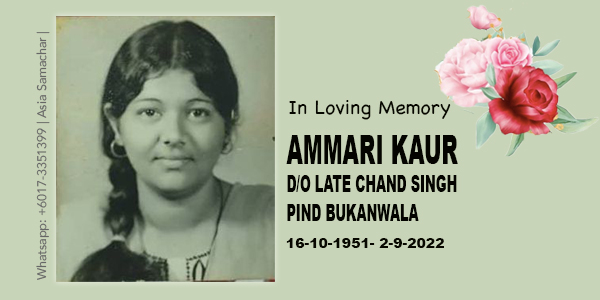
Passed away peacefully in Canada Toronto on 2nd of September 2022
Saskar / Cremation done in Canada Toronto on Tuesday 13th of September 2022 by brother Sukhdev Singh and sister in law Sukhdeep Kaur
Leaving behind: Sisters, Brothers, Sister in law’s, Brother in laws, Nieces and Nephews, Grandchildren.
Will be deeply missed by everyone in family
Special message from nieces and nephews.
“We are as lucky as we can be, the world’s greatest Aunty belongs to us”
We all love you❤️
Sahej Path Da Bhog be held at Gurdwara Sahib Subang Jaya on 25th September 2022 (Sunday), from 10am to 11.30am followed by Guru ka langar.
Kindly treat this as a personal invitation from the family.
For any further information please contact:
Pritam Kaur 0122736545 Jaswinder Kaur 0162334258
| Entry: 15 Sept 2022 | Source: Family
ASIA SAMACHAR is an online newspaper for Sikhs / Punjabis in Southeast Asia and beyond. Facebook | WhatsApp +6017-335-1399 | Email: asia.samachar@gmail.com | Twitter | Instagram | Obituary announcements, click here
Dr. Gunisha Kaur, an assistant professor of anesthesiology and a human rights researcher, has been selected as an Emerging Leaders in Health and Medicine (ELHM) Scholar by the US-based National Academy of Medicine.
She is one of 10 ELHM Scholars chosen this year.
Dr Gunisha is an assistant professor of anesthesiology at Weill Cornell Medicine and medical director of the Weill Cornell Center for Human Rights.
Established in 2016, the ELHM program annually selects early- and mid-career professionals with demonstrated leadership and professional achievement in biomedical science, population health, health care and related fields. While continuing to work at their primary institutions, scholars serve a three-year term, benefitting from mentorship, collaboration and innovation opportunities with their class and NAM members and leaders across various fields.
“This opportunity will help raise awareness about our trailblazing clinical research into improving outcomes for displaced and vulnerable populations. At the same time, I’m looking forward to mentorship and engagement with others who have broken barriers and invented new ways to improve human health,” she was quoted in a statement published at the Weill Cornell Medicine Newsroom.
Dr Gunisha, who is also founding director of the Weill Cornell Medicine Human Rights Impact Lab, noted she’s grateful to her nominator, Dr. James Eisenach, professor of anesthesiology at Wake Forest University School of Medicine and president of the Foundation for Anesthesia Education and Research, the foundation that provided her first research grant.
Dr Gunisha’s work focuses on refugee health research, using her training in neuroscience research and anesthesiology, which requires knowledge about all systems in the body. She conducts clinical studies on issues facing migrants, refugees and asylum seekers, including chronic pain in torture survivors, mental health in displaced children and the trafficking of young women and girls in refugee camps.
Her lab is exploring two areas of inquiry: ways to change trauma outcomes by incorporating advanced health care technologies and digital applications to improve diagnoses, and the development of individualized treatment plans for forcibly displaced persons.
“Our research has shown that better diagnoses and access to care can dramatically alter the life trajectories of persecuted individuals that arrive at our borders,” she said. “Raising awareness will build the field so we can help many more in this growing population.”
ASIA SAMACHAR is an online newspaper for Sikhs / Punjabis in Southeast Asia and beyond.Facebook | WhatsApp +6017-335-1399 | Email: editor@asiasamachar.com | Twitter | Instagram | Obituary announcements, click here
From a cotton soft touch, to the gentle smile. Thru thick and thin, our iron lady defeated it all. From a loving daughter to the cycle of a loving grandma, she wore a cape and and became our hero. May your cape now lead you to the gates of heaven and always shower your blessings on us.
| Entry: 14 Sept 2022 | Source: Family
ASIA SAMACHAR is an online newspaper for Sikhs / Punjabis in Southeast Asia and beyond. Facebook | WhatsApp +6017-335-1399 | Email: asia.samachar@gmail.com | Twitter | Instagram | Obituary announcements, click here
Son of the Late Mr Jasbir Singh Chall s/o Sadu Singh and Mdm Devindar Kaur d/o Dulla Singh, and brother of Ms Baneesha Lacombe
Passed away on 11th September 2022, leaving behind his beloved mother, sister and brother-In-law, uncles, aunts, nephews, cousins and relatives, friends and colleagues
A rare talent, a compassionate human being, Taken Too Soon He will be deeply missed and fondly remembered by all.
Cortege will depart at from residence No. 20, Jalan Tunku, Bukit Tunku, KL at 1:00pm on Thursday 15th September 2022, for Cremation at 2:00pm at the Nirwana Crematorium, Jalan Pusaka 21/1, Off Persiaran Jubli Perak, Shah Alam
Sahej Path Da Bhog will be held at Gurdwara Sahib Petaling Jaya on Sunday, 18th September 2022 from 6:00pm to 8:00pm followed by Guru Ka Langgar.
Please treat this as a personal invitation.
For any further information, please contact Balram at 017-3321845
| Entry: 13 Sept 2022 | Source: Family
ASIA SAMACHAR is an online newspaper for Sikhs / Punjabis in Southeast Asia and beyond. Facebook | WhatsApp +6017-335-1399 | Email: asia.samachar@gmail.com | Twitter | Instagram | Obituary announcements, click here
Virandeep Singh must have made an impression in his first outing at Nepal’s professional cricket league that he has been tapped again this year.
Virandeep has been drafted to play for Kathmandu Kantipur in Nepal’s inaugural T20 franchise cricket league hosted by the Cricket Association of Nepal (CAN). It is set to take place from Sept 24 to Oct 22, 2022.
He will be playing alongside the local squad in addition to Thisara Perera, DS Weerakkody , Kamindu Mendis, and Dhanahjaya De Silva according to a note on Malaysian Cricket Association’s social media page.
“Malaysian Cricket is proud of Virandeep Singh. These global leagues will only accelerate his growth in cricket creating a brighter future that will work hand in hand with his commitment to the sport,” it added.
In 2019, Virandeep made history as the first Malaysian cricket player to make it into the professional league when he joined Chitwan Tigers for the 4th Edition of the Everest Premier League 2021, Nepal’s biggest T20 cricket tourney.
ASIA SAMACHAR is an online newspaper for Sikhs / Punjabis in Southeast Asia and beyond.Facebook | WhatsApp +6017-335-1399 | Email: editor@asiasamachar.com | Twitter | Instagram | Obituary announcements, click here