Manjit Kaur with her son Attar Singh – Photo: Express & Star
By Nathan RoweWalsall | Express & Star | Canada |
A mother of three from Walsall is set to graduate at the same time as her son after achieving a First Class Degree.
Manjit Kaur, 47, is the Leisure Operations and Projects Manager at Walsall Council’s Central Library and Archives.
She passed her Chartered Manager Degree Apprenticeship with Chartered Manager status having achieved a Distinction after studying at the University of Wolverhampton for three years part-time.
She recently attended her graduation ceremony at The Grand Theatre in Wolverhampton with her family, while her son is also due to graduate this week.
Manjit said: “I didn’t have many aspirations and I started working straight away after my A-Levels.
“When I came into this post, one of the employment conditions was to be working towards a degree or a relevant qualification so that was my foot in the door and luckily my employer was offering the Degree Apprenticeship route.
“I wasn’t sure what to expect coming back into studying after 20 years but I started to use what I was learning in my modules quite quickly – from aspects of marketing and HR through to managing people through change.
“It was all really useful as we were relaunching the building after a refurbishment project.
“To complete my degree at the same time as my children is a real achievement for me, but also to achieve this during the pandemic, while juggling work and family life, is something I’m very proud of and it was amazing to finally graduate and pick up my award.”
Manjit’s Degree Apprenticeship was funded by her employer of 21 years, Walsall Council, through the Apprenticeship Levy.
Read the full story, ‘Mother graduates in same week as her son with First Class Degree’ (Express & Star, 23 July 2022), here.
ASIA SAMACHAR is an online newspaper for Sikhs / Punjabis in Southeast Asia and beyond.Facebook | WhatsApp +6017-335-1399 | Email: asia.samachar@gmail.com | Twitter | Instagram | Obituary announcements, click here
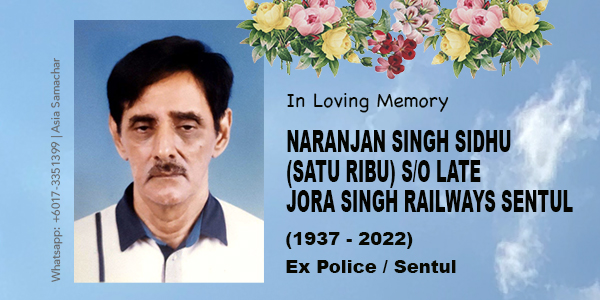
In loving memory of a beloved and caring husband, father, grandfather and great grandfather.
“Death leaves a heartache no one can heal, LOVE leaves a memory no one can steal.”
1st Barsi Path Da Bhog will be held at Gurdwara Sahib Buntong (Jalan Bombay, Guntong, Ipoh, Perak) on Sunday, 31 July 2022.
6.30am to 8am Asa-di-Vaar, 10am to 12 noon Kirtan Darbar, Sahej Path Da Bhog followed by Guru Ka Langgar.
Please treat this as a personal invitation from the family.
Contact: Terloke Singh @ 016-526 1670
| Entry: 25 July 2022 | Source: Family
ASIA SAMACHAR is an online newspaper for Sikhs / Punjabis in Southeast Asia and beyond.Facebook | WhatsApp +6017-335-1399 | Email: asia.samachar@gmail.com | Twfffitter | Instagram | Obituary announcements, click here
1st year Barsi: 30th July 2022, Saturday, from 10am to 12pm, at Gurdwara Sahib Petaling Jaya
Contact: 016 686 1901 Salvin
Our mother, who is the the pillar of our family, a strong woman indeed, who is a fighter and an angel who has always smiled no matter how much of difficulty she faced. Our mother, Dilget Kaur is no longer with us, I am very sad to say she has left us to join the Almighty. She fought and gave her all. Please stay strong everyone because we all know how much she loved us and will continue to do so in her after life.
Rab rakha.
| Entry: 25 July 2022 | Source: Family
ASIA SAMACHAR is an online newspaper for Sikhs / Punjabis in Southeast Asia and beyond.Facebook | WhatsApp +6017-335-1399 | Email: asia.samachar@gmail.com | Twfffitter | Instagram | Obituary announcements, click here
Path da Bhog: 31st July 2022 (Sunday), from 9.30am to 12pm, at Gurdwara Sahib Selayang Baru
Contact: 016 686 1901 Salvin
Our Father, who is the the pillar of our family, a strong man indeed, who is a fighter and an angel who has always smiled no matter how much of difficulty he faced. Our father, Gurpahl Singh Randhawa is no longer with us, I am very sad to say he has left us to join the Almighty. He fought and gave his all. Please stay strong everyone because we all know how much he loved us and will continue to do so in his after life.
Rab rakha.
| Entry: 25 July 2022 | Source: Family
ASIA SAMACHAR is an online newspaper for Sikhs / Punjabis in Southeast Asia and beyond.Facebook | WhatsApp +6017-335-1399 | Email: asia.samachar@gmail.com | Twfffitter | Instagram | Obituary announcements, click here
Kirtan at Darbar Sahib Amritsar – Photograb from live video
By Rishpal Singh Sidhu | Opinion |
The singing of kirtan (from Sanskrit kirti, meaning to praise, celebrate, glorify) is a commonly accepted practice of Sikh worship in our gurdwaras today as a means of expressing our devotion to the Divine by singing His praises. Its accompaniment by music and melody is said to facilitate concentration and serenity as it is recited. But, besides hearing, are we really listening and, more importantly, comprehending and imbibing the true and real meaning of the shabad that is being recited? How effectively is the message and meaning conveyed to reach the listener through clearly enunciated text?
Kirtan’s early origins can be traced back to Vedic chants that linked music to heighten the spiritual impact of these chants and recitations on listeners. Namdev (1270-1350AD), whose lifetime predates Guru Nanak, was a Hindu poet and saint known for his devotional songs (bhajan kirtans) rendered in music and some of his hymns are included in our Guru Granth Sahib, as are the 134 shabads (hymns) of Sufi mystic Baba Farid or Shaikh Farid (1173-1265AD) whose lifetime also predated Guru Nanak. “The recollection that Namdev and Kabir met is uncommon, and nearly all hagiographers, biographers, and scholars agree that while Kabir’s exact lifespan dates are hard to determine, it is not likely that they coincided with those of Namdev. In most other hagiographies, and implied in songs attributed to Kabir, Namdev is clearly a historical and intellectual predecessor to Kabir, not a contemporary.”1
Guru Nanak consistently promoted and extolled the bliss of kirtan in raising consciousness of the Divine.
ਰਾਗ ਰਤਨ ਪਰੀਆ ਪਰਵਾਰ ॥ ਤਿਸੁ ਵਿਚਿ ਉਪਜੈ ਅੰਮ੍ਰਿਤੁ ਸਾਰ ॥ The divine crystalline harmonies, their consorts, and their celestial families from them, the essence of Ambrosial Nectar is produced. (SGGS, p.351)
ਬਿਨੁ ਗੁਰ ਭਗਤਿ ਨਾਹੀ ਸੁਖੁ ਥੀਆ ॥੪॥ Without devotional worship to the Guru, there is no peace. ||4|| (SGGS, p.832)
In the rendition of hymns composed by himself, Guru Nanak was often accompanied by his Muslim companion Bhai Mardana on the rabab or rebeck. However, whilst acknowledging the enhancing role of music in kirtan, Guru Nanak cautioned “against the voluptuous indulgence in music…false are such songs, musical measures, and the many rhythmic beats as bind one to the three modes of Maya,resulting in one’s alienation from God.”2 Hand gestures, clapping, and dancing are proscribed.
ਰਾਗ ਨਾਦ ਸਬਦਿ ਸੋਹਣੇ ਜਾ ਲਾਗੈ ਸਹਜਿ ਧਿਆਨੁ ॥ ਰਾਗ ਨਾਦ ਛੋਡਿ ਹਰਿ ਸੇਵੀਐ ਤਾ ਦਰਗਹ ਪਾਈਐ ਮਾਨੁ ॥ ਪਾਖੰਡਿ ਭਗਤਿ ਨ ਹੋਵਈ ਪਾਰਬ੍ਰਹਮੁ ਨ ਪਾਇਆ ਜਾਇ ॥ The melody and music, and the Word of the Shabad are beautiful, when one focuses his meditation on the celestial Lord. So leave behind the melody and music, and serve the Lord; then, you shall obtain honor in the Court of the Lord. Through hypocrisy, devotional worship does not come, and the Supreme Lord God is not found. (SGGS, p.849)
“Shabad kīrtan is a five-hundred-year-old tradition, having started with the songs of the founder of the Sikh faith, Guru Nanak. Its journey over these five centuries has included many new developments — new melodic modes, musical forms, styles, musicians and performance contexts — but also loss and recovery of tradition.”3 The Sikh Gurus that came after Guru Nanak were no less accomplished and in some of their hymns they “have described themselves as “bards of the Lord.”4 Guru Arjan Dev was an accomplished musicologist who introduced and popularized the use of the saranda (stringed folk musical instrument similar to lutes or fiddles). It is played with a bow and has between ten and thirty strings for Sikh devotional music. Guru Arjan Dev has also been credited in creating the jori (percussion instrument made up of two drums and oftentimes confused with the tabla which produces a sharper sound, and which is also played differently from the tabla with a soft motion open hand). He also encouraged lay Sikhs to train as kirtan singers. Other musical instruments created by our Gurus include the taus (stringed instrument, from taus in Persian, meaning peacock) designed by Guru Hargobind Singh, and the dilruba (from the Persian word meaning that which ravishes or steals the heart), also a stringed instrument allegedly created by Guru Gobind Singh as a smaller and portable form of the taus. The dilruba gained prominence in the 1960s through its use by the Beatles during their psychedelic phase.
The entire contents of our Guru Granth Sahib can be sung in shabad kirtan, together with the compositions of Guru Gobind Singh, Bhai Gurdas, and Bhai Nand Lal. The Guru Granth Sahib is organized according to 31 ragas or musical measures, with some variations. Within a raga, there are prescribed ways of ascending and descending the scale, as well as specific melodic phrases that can be performed during improvisation.5
The Sikh Rehat Maryada defines kirtan as “singing the scriptural compositions in traditional music measures (ragas), and that in the congregation, kirtan only of Gurbani (Guru Granth’s or Guru Gobind Singh’s hymns) and, for its elaboration, of the compositions of Bhai Gurdas and Bhai Nand Lal, may be performed, and that only a line from the hymn should be made a refrain.6 For Sikhs, the Gurbani constitutes our Gurus utterances of divine truth and the source of moral and spiritual instruction.
A kirtania or kirtankar is a term often used to describe a single musician or vocalist who performs kirtan in singing sacred Sikh scriptures or shabads from the Guru Granth Sahib. Often, it is the kirtania jatha or ragi jatha ensemble,referred to as a group of three musicians comprising a lead singer who plays the harmonium (known as the vaja orbaja), a companion also on the harmonium, and a jori player that now perform kirtan in our gurdwaras on religious and festive occasions. This ensemble may also sometimes include additional singers playing traditional string instruments such as the taus, tanpura (long-necked plucked string instrument with four gut strings), saranda (three main gut strings and around 30 sympathetic strings), as well as cymbals and chimta (tongs fitted with jingling metallic discs).
Though originally produced in the West more than two centuries ago but not patented and called the harmonium until 1840, its use was widely accepted in Indian music in the late 19th century. The Shiromani Gurdwara Parbandhak Committee (SGPC) has plans requiring all Gurmat Kirtan to be performed at the Golden Temple using “Tanti Saaj” (string devices similar to the taus, dilruba, rabab, dhad and sarangi utilized in kirtan for better reflection of past historical Sikh heritage). The ‘hazuri raagis’ (hymn singers) who currently perform at the Golden Temple using their harmoniums have expressed concern over their job prospects. To placate concerns, SGPC President Harjinder Singh Dhami noted that the use of the harmonium has prevailed for well over a century at Sikh shrines, including the Golden Temple, and that it may well continue to be used in conjunction with the “Tanti Saaj’ in performing kirtan.7
Occasionally, some kirtania combine discourse with their kirtan performance. In this context, questions have occasionally been raised in the past and will doubtless continue to be raised in the future regarding the abilities of some kirtania to correctly explicate the meaning of a particular shabad or shabads. Also, a number of Sikh bodies have been known to organize Rainsabaaee (night long kirtan sessions) and Anhad Kirtan sessions catering to the aesthetic and spiritual needs of their congregations.
Whether the sangat is really listening to the kirtan in our gurdwaras is a vexed question. The expression ‘in one ear and out the other’ succinctly expresses the difference between hearing and listening. Equally, we are also sometimes reminded ‘you might be hearing me, but you are not really listening to what I am saying.’ It is not uncommon for our minds to drift to other thoughts in the darbar hall and we end up not truly listening. Hearing is a passive, involuntary, physical, and physiological sensory process that does not require deep and focused attention. In contrast, listening is active, voluntary, and intentional, and involves mental effort and concentration to make sense of what we are hearing. From an information studies perspective, this sense-making is critical for both our present and future generations as it seeks both, to absorb and comprehend the true and real meaning of the words and sounds that we are hearing with thoughtful attention, seeking to internalize and understand what is being sung, and possibly also including developing an emotional response and affinity to the content of what is being sung. Much more can and needs to be done in this important area. Peace and quiet also needs to prevail in our darbar halls to truly appreciate shabad kirtan, and for some this may well be a tall order!
Research has confirmed the beneficial effects of listening to music in reducing anxiety, blood pressure, and pain, as well as improving memory and mental alertness. Expounding the meaning of the shabad and listening to the soothful singing of kirtan in our gurdwaras to the accompaniment of music may well facilitate understanding, concentration, and serenity, though the primary focus remains on imbibing the true meaning of the shabad/Gurbani/scriptural text. “Musical embellishment and ornamentation are permitted, but what is of real essence is Gurbani or scriptural text. Technical virtuosity for its own sake will have little meaning.”8
References
Novetzke, C. L. Religion and public memory; A cultural history of Saint Namdev in India. New York. Columbia University Press, 2013, p.59.
Singh, H. Editor-in-Chief. The Encyclopaedia of Sikhism. 2d ed. Vol 2. Punjabi University Press, 2001. p.517.
Kaur, Inderjit N. (2011). Sikh Shabad Kirtan and Gurmat Sangit: What’s in a name? California, Santa Cruz, JPS 18: 1 & 2, p.251.
Singh, H. Editor-in-Chief. The Encyclopaedia of Sikhism. 2d ed. Vol 2. Punjabi University Press, 2001. p.517.
Rhythm and Raga: Learn the basics of Indian music.
Sikh Reht Maryada; The Code of Sikh Conduct & Conventions. English version. Amritsar, Dharam Parchar Committee, Shiromani Gurdwara Parbandhak Committee, 2000.
SGPC: No plans to section out harmonium for now. Tribune Information Service, 28 May 2022.
Singh, H. Editor-in-Chief. The Encyclopaedia of Sikhism. 2d ed. Vol 2. Punjabi University Press, 2001. p.517.
SGGS translation by Dr. Sant Singh Khalsa
Rishpal Singh Sidhu is a semi-retired casual academic at the School of Information and Communication Studies, Charles Sturt University, Australia. He has a passion for research, writing, and teaching. He is the compiler and editor of the book, Singapore’s early Sikh pioneers; Origins, Settlement, Contributions and Institutions, published by the Central Sikh Gurdwara Board in Singapore in 2017. He is currently based in Sydney, Australia.
* This is the opinion of the writer, organisation or publication and does not necessarily represent the views of Asia Samachar.
ASIA SAMACHAR is an online newspaper for Sikhs / Punjabis in Southeast Asia and beyond.Facebook | WhatsApp +6017-335-1399 | Email: editor@asiasamachar.com | Twitter | Instagram | Obituary announcements, click here |
DALJIT KAUR D/O LATE KEHAR SINGH & W/O LATE MASTER DIDAR SINGH
Village: Marhana, Punjab
20.11.1933 – 22.7.2022
Husband: Late Master Didar Singh
Children: Dr Amrik Singh / Ms Surinder Kaur Ms Ranjit Kaur Ms Paramjit Kaur / Late Mr Ajit Singh Mr Indarpal Singh / Prof Dr. Devinder Kaur Ms Rajvinder Kaur / ACP Balveer Singh , AMN, PPP
Grandchildren: Mr Jasvinder Singh / Ms Simren Kaur Mr Kelvinder Singh Ms Roopinder Kaur Mr Jasbir Singh / Ms Hema Kaur Dr Manpreet Kaur Mr Jagdish Singh Mr Sukhvir Singh
Great granddaughter: Ms Anaysha Kaur
Path da Bhog: 30th July 2022 (Saturday), from 9:30 am – 12:00 noon, at Gurdwara Sahib Muar
Contact: Dr Amrik Singh – 012 7175 424 Ms Rajvinder Kaur – 012 3520 821 Ms Ranjit Kaur – 012 3345 206
Our beloved Mother, Nani & Dadi will forever be remembered for her beaming smile, warm hugs and comforting aura. A huge loss to us all, but a lifetime of memories to cherish forever. We love and miss you dearly
| Entry: 25 July 2022 | Source: Family
ASIA SAMACHAR is an online newspaper for Sikhs / Punjabis in Southeast Asia and beyond.Facebook | WhatsApp +6017-335-1399 | Email: asia.samachar@gmail.com | Twfffitter | Instagram | Obituary announcements, click here
Air Force ROTC Cadet Gursharan Virk, third from left, takes part in Detachment 255’s color guard ceremony at a football game at the University of Iowa in 2021. Virk is the first Sikh ROTC cadet to be granted religious accommodations by the Air Force in observation of his faith. The accommodations include wear of a turban and facial hair. – Photo: Courtesy via USAF website
By Asia Samachar | United States |
The United States Air Force has granted religious accommodations for the first Sikh cadet joining the Reserve Officer Training Corps (ROTC).
Cadet Gursharan Virk, a sophomore information assurance major at Detachment 255 at the University of Iowa, is now allowed to wear Sikhism ceremonial accessories and abide by the religion’s grooming standards, which includes wearing a turban, necklace and bracelet, while having an uncut beard, in observation of his faith, reports the USAF official website.
While not a religious leader, Virk does adhere to Sikh religious rules such as not shaving and wearing his turban in place of typical military headwear. Desiring to continue observing his religious beliefs while serving, Virk submitted an official request for religious accommodation to Air Education and Training Command’s Manpower, Personnel and Services office, which was approved in December 2021.
“Air force ROTC is in the business of discovering, developing and showcasing talent,” said Headquarters AFROTC commander Col. Corey Ramsby. “Cadet Virk is just the latest example of the shift in our culture that has allowed us to open that aperture wider than we ever have before.”
But the battle to be able to serve the uniform force while observing the tenets of the Sikh faith is far from over.
In April, a US Marine artillery Captain Sukhbir Singh Toor and three other Sikhs sued the Marine Corps in U.S. District Court for the District of Columbia, for the corps’s refusal to grant a religious waiver, claiming that it was arbitrary and discriminatory, and violates the constitutional right to free exercise of their religion.
The lawsuit that would allow Sikh recruits to keep beards and wear turbans in boot camp could take “years” to resolve, a federal judge said earlier this month. “These parties here, joined in an effort that will not be resolved for years,” U.S. District Judge Richard Leon said. “That’s the practical reality.”
On his part, Virk was reported to have struggled for a few semesters to get medically cleared for ROTC, with most of his medical documents still in India. He was born in the United States but lived in India until his junior year in high school, moving back to the states in 2018, the report added.
Regarded as a leader within the detachment, Virk’s performance as a cadet has resonated with his AFROTC leadership team. He has been selected to go to AFROTC Field Training at Maxwell Air Force Base this summer, a critical step to commissioning as an officer.
“Cadet Virk has stood out from day one with his attitude. He always maintains a cheery disposition, is eager to learn and grow and pushes those around him as far as moral is concerned,” Capt. Amanda Anderson-Gonzalez, a recruiting and admissions officer for Det. 255 was quoted in the report. “When he makes mistakes, he owns them, works hard to correct them and doesn’t make the same mistake again. He is kind, encouraging, involved on campus and highly involved with the detachment. He has always maintained professionalism and throws himself into everything he does, earning him a spot firmly in the top 10 percent of our detachment.”
Virk’s desire to serve in the military stems from his father, who retired as a colonel from the Indian army.
“Living that military lifestyle has always been something that I loved,” Virk said. “I have seen him in a number of leadership positions, and he has been one of my biggest influencers of what a good leader looks like. I remember him telling me that whatever you do in life, always take care of the people you lead and never let them down.”
“Historically, the motive behind wearing the turban was that if anyone needed help and they saw someone wearing a turban in a crowd, they knew that they would be helped by that Sikh,” Virk explained. “Knowing this, Sikhs consider the turban their crown and wear it with pride. Thus, being able to take that age-old heritage and pride into the Air Force with me while also being able to work toward my dream of being a pilot means the world to me.”
ASIA SAMACHAR is an online newspaper for Sikhs / Punjabis in Southeast Asia and beyond.Facebook | WhatsApp +6017-335-1399 | Email: asia.samachar@gmail.com | Twitter | Instagram | Obituary announcements, click here
Police guard the front of the Sikh Temple of Wisconsin where at least one gunman fired upon people at a service on Aug., 5, 2012 Oak Creek, Wis. At least six people were killed when a shooter, who was later shot dead by a police officer, opened fire on congregants in the Milwaukee suburb. – Photo: Denver Post
By Nikki Singh | Denver Post | United States |
To live in the United States is to live with the fear that a mass shooting could, at any point, take our lives or the lives of the ones we love. Sadly, as recent disasters have shown, no place is safe — from schools to supermarkets, concerts to office buildings, and newsrooms to festivals.
Sikh communities in Colorado and across the country are preparing to mourn and commemorate such an act of violence that invaded a house of worship. But then, we will turn our grief to action to fight for a better tomorrow.
On August 5, 2012, the Sikh Temple of Wisconsin was attacked by a white supremacist gunman. His hateful rampage ultimately resulted in the deaths of seven members of the small, tight-knit community of Sikhs in the city of Oak Creek; too many others were left with life-altering injuries, psychological trauma, and the absence of family, friends, and community members.
The waves of shock and pain that follow mass shootings like the one in Oak Creek have been felt by far too many Americans. Additionally, we must acknowledge that marginalized communities — including Sikhs, who despite belonging to the world’s fifth-largest organized religion, are often misunderstood by our neighbors — continue to bear the brunt of this violence. Buffalo, Atlanta, El Paso, Pittsburgh, Poway, Charleston, and others all offer irrefutable proof that white supremacy remains a clear and present threat across America.
To be sure, we must take time to mourn after such tragedies. I remember after the Oak Creek shooting, when my local Sikh community hosted a vigil at Colorado Singh Sabha, a gurdwara (Sikh house of worship) in Commerce City. Similar events were held from coast to coast, as local communities displayed incredible resilience, especially considering that the burden of explaining who Sikhs were, how we worship, and why we may have been targeted fell on us in our time of grief.
But action must follow that grief. Ten years ago, there was a concerted effort to ensure that the FBI started tracking anti-Sikh hate crimes and bias incidents. Harpreet Singh Saini, then an 18-year-old young man whose mother was killed by the Oak Creek shooter, testified before the Senate and pleaded for his mother to be given “the dignity of being a statistic.” The FBI ultimately began tracking anti-Sikh hate and ever since, we’ve watched the number of hate crimes and bias incidents steadily increase.
Today, Congress can take action to honor those lost in Oak Creek and other communities across the country. To address continuing hate crimes and bias incidents, the Justice for Victims of Hate Crimes Act would fix a loophole that limits the ability of the federal government to prosecute such crimes. The Nonprofit Security Grant Program Improvement Act would make more resources available to gurdwaras and other houses of worship that want to apply for funding to improve their safety and security measures. And the Domestic Terrorism Prevention Act would ensure that our government is focused on white supremacy and other homegrown extremism, which is precisely the ideology that continues to target, harm, and kill marginalized communities like the one in Oak Creek.
The situation has only grown more dire in the decade since Oak Creek: more attacks, further polarization in our politics, and increasing influence from white supremacists — whether they are gunmen, media figures, or even elected officials. But I retain hope for the future, because a new generation of activists and allies is rising to take on this challenge.
So I ask of you what so many communities have asked in the aftermath of tragedy: Join us in grief and remembrance for those who we lost. Pause and consider how you would feel, or what you would do, if someone came to your own house of worship with hate in their heart. And then, turn that empathy to action and join us as we attempt to make real and lasting change.
The opinion piece was published by Denver Post on 23 July 2022. Nikki Singh serves as the senior manager of policy and advocacy at the Sikh Coalition, the nation’s largest Sikh civil rights and advocacy organization.
ASIA SAMACHAR is an online newspaper for Sikhs / Punjabis in Southeast Asia and beyond.Facebook | WhatsApp +6017-335-1399 | Email: asia.samachar@gmail.com | Twitter | Instagram | Obituary announcements, click here
Deeply missed by wife Satya Devi Dass d/o Durga Dass (Kuala Pilah) and daughter Reena and a host of relatives and friends.
You can pay last respects on 26 July 2022 (Tuesday), from 4.30pm to 6pm, at the residence.
Address: No 3/273, Jalan Udang Kepai, Taman Sri Segambut, Kuala Lumpur
Cortege leaves residence at 12pm, 27 July 2022 (Wednesday)
Saskar / Cremation: 2pm, 27 July 2022 (Wednesday) at Nirvana Crematorium Shah Alam.
Akand Path commences at 5pm on 28 July 2022 (Thursday) until 5pm 30 July 2022 (Saturday) at Gurdwara Sahib Sentul, Kuala Lumpur
Contact: 014 – 661 8905 / 012 – 686 7428
| Entry: 24 July 2022 | Source: Family
ASIA SAMACHAR is an online newspaper for Sikhs / Punjabis in Southeast Asia and beyond.Facebook | WhatsApp +6017-335-1399 | Email: asia.samachar@gmail.com | Twfffitter | Instagram | Obituary announcements, click here
Brothers & Sisters, Nieces & Nephews, Relatives and Friends.
Last respects can be paid at our residence at No 36, Jalan Maju 25/94, Taman Sri Muda, 40400 Shah Alam at 11am
Saskaar / Cremation: 2pm, 25 July 2022 (Monday) at Jalan Bukit Kubur, Klang
For more details, kindly contact:
Harvinder 016-215 4707
Baldev 016-225 6981
Jega 012-376 2359
| Entry: 24 July 2022 | Source: Family
ASIA SAMACHAR is an online newspaper for Sikhs / Punjabis in Southeast Asia and beyond.Facebook | WhatsApp +6017-335-1399 | Email: asia.samachar@gmail.com | Twfffitter | Instagram | Obituary announcements, click here