A number of former national footballers from Malaysia, Singapore and Brunei took the field in Kluang, Johor, on Sunday (20 March) in the memory of former national captain Serbegeth Singh who died while cycling on Jan 12.
They came to Kluang as Shebby, as he waspopularly known, lived with with his extended family in Mengkibol Estate in Kluang, Johor. Among others, his father and grandfather had reared cows and they did jaga, the Malay word for watchmen, the town.
The match was organised by a non -governmental organisation (NGO) called The Friendship Circle, reported Bernama. Among them were Mohd Noh Yaacob, Hassan Miskam and Salehan Mat Som.
Before the match, a free football clinic was also held at the Kluang Stadium to identify young talents in the district.
Born in Kluang on Aug 20, 1960, his sporting talents were discovered by the late Abdul Shatar Khan, a former Malaysian youth coach.
Serbegeth started his football career as a defender for Johor in the late 1970s and made his impact in the M-League after moving to Kuala Lumour. Described as a rock in the KL central defence, Shebby played a key role in the legendary KL team that won the Malaysia Cup three years in a row from 1987-89.
On the national front, he first represented Harimau Malaya – Malaysia’s national football team – in the President’s Cup in South Korea in 1982. It was a beginning to a long career that saw him picking up 61 caps.
ASIA SAMACHAR is an online newspaper for Sikhs / Punjabis in Southeast Asia and beyond.Facebook | WhatsApp +6017-335-1399 | Email: asia.samachar@gmail.com | Twitter | Instagram | Obituary announcements, click here
Jeyha Chiri Likheya, Teyha Hukam Kamahey As His Decree Is Issued, So Is His Command Obeyed Ghaley Aavey Nanka, Sadhey Utthi Jahey Those Who Are Sent, Come, O’ Nanak; When They Are Called Back, They Depart and Go
We are saddened to announce the passing of Mata Sandok Kaur, on the 22nd March, 2022 (Tuesday). A strong willed and hardworking matriarch of the family, who will be deeply missed by family and friends.
Path da Bhog: 3 April 2022 (Sunday), 10 am – 12 noon, at Wadda Gurdwara Sahib, Ipoh, followed by Antim Ardaas and Guru Ka Langgar. Please adhere to the Covid-19 SOP requirements.
Contact:
Joginder Singh 016-5975911
Harvendhar Singh 016-6150617
| Entry: 24 March 2022 | Source: Family
ASIA SAMACHAR is an online newspaper for Sikhs / Punjabis in Southeast Asia and beyond.Facebook | WhatsApp +6017-335-1399 | Email: asia.samachar@gmail.com | Twitter | Instagram | Obituary announcements, click here |
Harpal Singh Cheema after winning a MLA seat in the 2022 Punjab state elections – Photo: Personal Facebook
By Prabhjot Paul Singh | Panjab Politics |
It has been a mixed start – more cautious and less controversial – for new Chief Minister Bhagwant Singh Mann and his Aam Adhmi Party (AAP) government. The new government has gone through the initial Constitutional and ritualistic formalities by following the parliamentary and conventional practices.
Swearing in of the Chief Minister Bhagwant Mann at Khatkar Kalan, the native village of Shaheed-e-Azam Bhagat Singh, was perhaps the first and the only deviation from the existing practice of holding the solemn ceremony mostly at Raj Bhavan or rarely at a public place, like a stadium.
Rest of the Constitutional mandates, including swearing in of members of the Council of Ministers, oath taking by members of new Vidhan Sabha, election of Speaker, and subsequently the opening session of the Legislature where Vote on Account and Interim Budget for first three months of the new financial year were all gone through by the laid down procedures.
Another deviation, if at all, was to defer debate on the Governor’s address till the next session of the Assembly. The reason given was shortage of time as well as to give time to nearly 80 per cent members making their debut in legislative politics to go through the address and come prepared for debate on it after a break.
The next session will, in all probability, be held in June to pass the full budget for 2022-2023. The new Finance Minister Harpal Singh Cheema needs to sit with the senior functionaries of his department and other heads to decide allocations in consonance with the promises the ruling party has made to the electors of Punjab.
In between, members will meet by the end of the month to complete the formality of electing five new members of Rajya Sabha. The process of nomination has already been completed.
It is the filling of Rajya Sabha seats that has evoked criticism of the Opposition parties. The criticism, unanimous and vociferous, veered around naming of “outsiders” as representatives of the State in the Upper House of Parliament. Called the House of “Elders”, Rajya Sabha members from Punjab have traditionally been senior members of major political parties, especially of Congress, Shiromani Akali Dal, and Bharatiya Janata Party.
This time, AAP, with a landslide mandate, has chosen faces that are mostly new to Parliamentary politics. Two businessmen, two political strategists and a cricketer will now represent the State in the House of “Elders”.
These nominations bring to focus the role representatives of Punjab had been playing in both the Houses of Parliament – Lok Sabha and Rajya Sabha.
Punjab has the distinction of sending several top political leaders, including Inder Kumar Gujral (who rose to be the Prime Minister of the country), besides several Union Ministers holding important portfolios like Defence, Home and Agriculture. These personal accolades apart, the State has generally remained without Statesmen leaders like Kapur Singh who remained steady and firm on demands and issues of the State.
While Inder Kumar Gujral is credited with waiving a part of the debt the State incurred in its fight against terrorism, other major demands, including autonomy to States, for which Punjab witnessed long spells of agitations, both peaceful and armed, were generally swept under the carpet.
Over the years, or to be precise after Independence, the State has lost control not only of its new capital Chandigarh (that it built after losing Lahore to Pakistan), but also control on its river waters, power projects like Bhakra and Beas dams and institutes like Panjab University, Punjab Engineering College and the Postgraduate Institute of Medical Education and Research.
Going by the record of both Lok Sabha and Rajya Sabha, the pitch for these long-standing demands appears to have been lost. Compromises, generally for power, were made and to fight Centre for backing out of its commitments, including transfer of Chandigarh to Punjab in mid 80s, none of its representatives, both in Lok Sabha and Rajya Sabha, ever made a sincerely noticeable effort. Even the sacrifice of Darshan Singh Pheruman in support of these demands was ignored.
No doubt Punjab is an agricultural State, but it does not mean that it does not need industry for its overall economic development. When militancy was at its peak, several incentives, including industrialization, were promised. But none of these promises, including development of Sri Goindwal Sahib, as an industrial hub in the border belt were kept. Instead, the State witnessed a flight of industry to neighboring hilly States of Himachal Pradesh and Uttarakhand in general. Even at that time, the pitch of the protest raised by Punjab MPs was so frivolous as to be audible elsewhere.
No one will support outsiders to represent the State in Parliament. The million-rupee question is “Are our political parties and their bigwigs acting at the behest of the State or are just appeasing a section of their loyalists at the cost of the State?”
Answers may generate an animated debate about the practices followed in the past viz a viz recent action of the first-time ruling group. Whatever be the outcome, the State needs a government that works for finding solutions to its vexed and long-standing demands besides attending to its conjugal problems.
Prabhjot Singh is a veteran journalist with over three decades of experience covering a wide spectrum of subjects and stories. He has covered Punjab and Sikh affairs for more than three decades besides covering seven Olympics and several major sporting events and hosting TV shows. For more in-depth analysis please visit probingeye.com or follow him on Twitter.com/probingeye
ASIA SAMACHAR is an online newspaper for Sikhs / Punjabis in Southeast Asia and beyond.Facebook | WhatsApp +6017-335-1399 | Email: editor@asiasamachar.com | Twitter | Instagram | Obituary announcements, click here
It took two years of persistent efforts for Ravleen Kaur (Social Service Worker ’18) to help a young woman finally escape her abuser and build a new life, away from the sordid underworld of human trafficking. With Ravleen’s support, not only did the 19-year-old, displaced from another city, find a house and a nurturing environment to live in, she also returned to school to complete her education.
She is one of the many victims of sexual abuse and human trafficking rescued by Ravleen, who works as Manager, Anti-Human Trafficking Program, at SAVIS of Halton – a not-for-profit organization with the avowed objective of turning around the lives of sexual violence survivors. “On average, it takes a woman seven attempts to leave her abuser. It’s a long process and even then, she will require years of counselling to address the trauma of her abuse,” says Ravleen. (SAVIS: Sexual Assault and Violence Intervention Services).
The silencing of abused women
Hard work, but to Ravleen, each victim she helps is a win for women the world over who experience sexual abuse and trafficking. Each success is also a small victory for her own younger sister, who experienced assault at the age of 12. That horrific experience brought home to Ravleen the silencing of abused women around her, and the scale of gender-based violence, with little justice for victims in societies built on patriarchal laws.
Born to Indian parents in the United Arab Emirates, where she lived until she was 16, Ravleen witnessed first-hand the gender disparity leading to oppression of women and their inability to escape from the cycle of abuse and sexual violence. “In many instances, a woman needs eyewitnesses to prove that she’s been raped. The law makes it impossible for a rape victim to get justice,” she says. She also saw some of her teenaged friends sent to jail for something as innocuous as holding hands with a male friend. In India, where she spent three years as a high school student, brutal rapes and violence against women were all too common. Refusing to be a bystander, Ravleen decided to build a career that would address atrocities against women.
“I was very focused. I wanted to help survivors of sexual violence and human trafficking because of my own experiences. There were multiple instances within my own family structure where women were not allowed to have a voice. That’s not something I wanted to be a part of. I can’t say I was a rebel, but I definitely couldn’t stand it,” she says.
Sheridan helps in meeting career goals
Soon after high school, Ravleen came to Canada to study in the Women and Gender Parity program at the University of Toronto. She also took up Criminology as a second major to understand the issues around gender and sexuality, as well as crime and the administration of justice. Even as she pursued her degree, she was aware that the path to her career goals really lay in Sheridan’s Social Service Worker program. “There was no hands-on experience at UofT. I had all the academic knowledge I needed but I lacked practical skills that would allow me to work in the field,” she recalls.
Ravleen joined Sheridan’s Social Service Worker program after completing her double major from UofT and in the second year, she did her practicum at SAVIS, where she had already been volunteering. SAVIS hired her as soon as she graduated in 2018. “I started off as a Sheridan student at SAVIS in 2016, went on to be a Crisis Worker, and then a Case Manager, Team Lead, and finally the manager of both the human trafficking program and the public education program,” she says. She now manages the human trafficking program exclusively.
Compared to many other countries, women are better protected in Canada but they are still vulnerable to sexual violence and human trafficking. Ravleen says students, especially newcomers to Canada, can be an easy target for traffickers.
“Life in Canada is very hard for newcomers who are often in need of money and emotional support. They don’t even realize they are being manipulated by individuals, who initially shower them with expensive gifts but later call in those favours, or use compromising photographs and videos to push the women into sex trafficking,” she says.
Creating awareness among students
To create awareness among students, Ravleen works with a team of public educators who reach out to students in schools, colleges and universities. “We let them know that they are not alone and that they have a voice. Our job is not to tell someone what they’re going through, but to guide them into recognizing what’s happening to them and that it’s illegal. We are a feminist, anti-oppressive, anti-racist, very non-directive space,” she says.
While she works hard here in Canada and recently got her permanent residency, Ravleen has not forgotten what brought her here as an international student, or the goal she set for herself following her own traumatic experiences in a different part of the world. She wants to return to India and start a not-for-profit organization to help survivors of sexual and physical abuse.
“I’m making a difference here but this is an issue that is so widespread that I need to be doing more. It feels as if I’m never doing enough,” she says.” My journey doesn’t end here. It has just started.”
Read the original story, ‘Alumna brings hope to sexual assault, abuse survivors’ (11 March 2022, Sheridan College Newsroom), here.
ASIA SAMACHAR is an online newspaper for Sikhs / Punjabis in Southeast Asia and beyond.Facebook | WhatsApp +6017-335-1399 | Email: asia.samachar@gmail.com | Twitter | Instagram | Obituary announcements, click here
With grief, we the family of Sardar Pertap Singh s/o Sundar Singh, wish to inform that our loving Bapuji left to be with Waheguru on 23 March 2022.
Dearly missed by:
Wife: Surjit Kaur A/P Hajit Singh
Children & Spouses:
Capt. Paramjit Singh (Ex MAS / Asiana Airlines) & Pn Jagdish Kaur (SKSJ)
Balwinder Kaur & Late Gian Singh (Shah Alam)
Bopinderjit Singh (San Francisco / Melbourne) & Sharran Kaur
Harjinder Kaur & SM Harchand Singh (Shah Alam Polis)
Sukhbinder Kaur & Sadu Singh (Subang Jaya)
Narinder Kaur & Late Malkit Singh (Kelana Jaya)
Beloved grandchildren and great grandchildren.
Cremation / Saskaar: 12pm, 24 March (Thursday) at the Shamshan Bhoomi Hall, Jalan Loke Yew Crematorium, Kuala Lumpur.
Cortege will leave the residence No.13, Jalan Sanggul 5, Bandar Puteri Klang at 10am.
For those who wish to pay their last respects, you may do so from 11am – 12pm on 24 March 2022 followed by cremation at 12pm for family & close friends at Shamshan Bhoomi, Jalan Loke Yew Crematorium KL.
Path da Bhog: 3rd April 2022 (Sunday) from 10am – 12pm, Gurdwara Sahib Petaling Jaya
Contact:
Capt Paramjit – 0123795777
Sadu Singh – 0133613077
Marchand Singh – 0126669830
| Entry: 23 March 2022 | Source: Family
ASIA SAMACHAR is an online newspaper for Sikhs / Punjabis in Southeast Asia and beyond.Facebook | WhatsApp +6017-335-1399 | Email: asia.samachar@gmail.com | Twitter | Instagram | Obituary announcements, click here |
In loving memory of Sardar Nerphia Singh s/o Gurdit Singh, we are saddened to announce his passing peacefully in the morning of 23rd March 2022 (Wednesday).
Brothers, Sisters, In laws, Nephews & Nieces and host of relatives and friends
Saskaar / Cremation: 4pm, 25th March (Friday) 2022 at Mandai Crematorium (Hall No.1). Due to Covid restrictions only 50 pax allowed.
Path da Bhog: 2nd April 2022 (Saturday), from 10.30am to 12.30pm, at Gurdwara Sri Guru Singh Sabha
Due to Covid restrictions only Fully Vaccinated allowed.
Contact:
Ragi 98590980
Pemmy 90254239
| Entry: 23 March 2022 | Source: Family
ASIA SAMACHAR is an online newspaper for Sikhs / Punjabis in Southeast Asia and beyond.Facebook | WhatsApp +6017-335-1399 | Email: asia.samachar@gmail.com | Twitter | Instagram | Obituary announcements, click here |
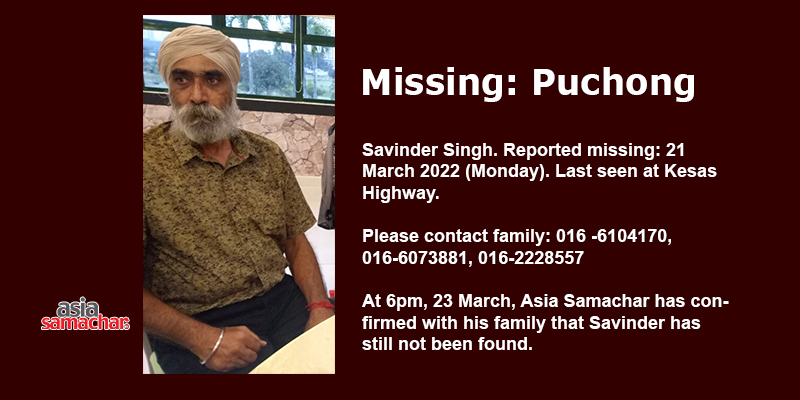
Savinder Singh has been reported missing since leaving his house in Puchong, Selangor, in the evening of 21 March 2022. He was last seen at the Kesas Highway.
At 6pm on 23 March, his family has confirmed that he has still not been found. “He has experienced short term memory loss at times,” his son told Asia Samachar.
If seen, please contact the family at 016 -6104170, 016-6073881 or 016-2228557.
Watch this space. We will update on his search status as we get updates from the family.
UPDATE: Savinder was found on Thursday (24 March) morning in Pulau Indah, Klang. He was fine other than some blisters on the feet, his son told Asia Samachar.
ASIA SAMACHAR is an online newspaper for Sikhs / Punjabis in Southeast Asia and beyond.Facebook | WhatsApp +6017-335-1399 | Email: asia.samachar@gmail.com | Twitter | Instagram | Obituary announcements, click here
KUALA LUMPUR, March 22 — A woman who was unilaterally converted to Islam when she was a child but grew up a Buddhist failed to get the High Court to restore her religious status legally today.
High Court judge Datuk Noorin Badaruddin said it was inappropriate for the civil courts to determine the validity of the conversion of any person, especially whether a person is a Muslim or not, as the matter fell under the jurisdiction of Shariah courts, and cited Article 121 of Federal Constitution to justify her decision.
Noorin also cited documentary evidence submitted in court over the course of hearing on the woman’s legal challenge and pointed out that the administrative procedure for those seeking to leave Islam has to go through the Islamic courts.
“One cannot unilaterally on her own accord, renounce the religion of Islam.
“As much as the applicant has the right to profess and practise the religion of her choice, she is for that matter not deprieved of legal remedy which is available for her to seek her release from Islam.
“The proper channel is the Shariah Court where under Section 61(3)(b)(x) of the Adminstration of the Religion of Islam (State of Selangor) Enactment 2003, the Shariah (High) Court is accorded with the jurisdiction to declare any person being no longer a Muslim.
“Thereafter she can proceed with the request to remove her name from the Registrar of Mualaf and make application to change her name and remove the word Islam from her IC.
“As such, the application by the applicant is dismissed with no order to cost,” the judge said when delivering her judgment of the judicial review via video conference.
Noorin also pointed out that both the woman and her mother did not challenge the conversion to Islam by her biological father at the material time when the applicant was a child.
The judge said the case was compounded by the fact that the applicant did not challenge the conversion after she reached age 18.
In her ruling, Noorin said the woman had been using an identity card with the word “Islam” since 1992 when she was a teenager.
Another identity card, also bearing the word “Islam”, was issued to her when she attained the age of maturity.
“It becomes more detrimental when the applicant herself never challenged the conversion by using the proper and correct legal recourse seeking for her declaration that the conversion is void and illegal when she attained age of 18.
“The challenge was mounted only recently when she was almost 40 years old.
“In best emphasis, it is not this court that can declare the applicant is a Buddhist when the documentary evidence shows she was converted at age of 10.
“The fact remains and I must emphasise, the mother never challenged the applicant conversion at the very material time,” Noorin added.
The woman was represented by Shamsher Singh Thind while senior federal counsel Ahmad Hanir Hambaly @ Arwi appeared for the National Registration Department (NRD) and lawyer Datuk Kamaruzaman Muhammad Arif for the Selangor Islamic Religious Council (Mais).
Now aged 42, the woman, whose name is withheld to protect her privacy, was born in Singapore in 1980 to an ethnic Chinese couple who were both of the Buddhist faith back then.
Read the full story, ‘Civil court tells Malaysian woman unilaterally converted as a minor to go to Shariah Court to remove Islam from MyKad’ (22 March 2022, The Malay Mail), here.
ASIA SAMACHAR is an online newspaper for Sikhs / Punjabis in Southeast Asia and beyond.Facebook | WhatsApp +6017-335-1399 | Email: editor@asiasamachar.com | Twitter | Instagram | Obituary announcements, click here
(Grandaughter of Late Mr Chain Singh Gahir and Late Mdm Jit Kaur)
Passed away peacefully on 20/3/2022.
Path Da Bhog: 3 April 2022 (Sunday), from 10.00 am – 12.00 noon, at Gurdwara Sahib Buntong, Ipoh Perak. Guru Ka Langgar will be served thereafter.
The family expresses its sincere appreciation & heartfelt thanks to relatives & friends for their condolences, prayers & support during their recent bereavement.
Contact
Mr. Balbir Singh Gahir 019 – 5725239
Mr. Pal Singh Gahir 012 – 5239805
Ms. Majinder Kaur 010 – 5375342
| Entry: 23 March 2022 | Source: Family
ASIA SAMACHAR is an online newspaper for Sikhs / Punjabis in Southeast Asia and beyond.Facebook | WhatsApp +6017-335-1399 | Email: editor@asiasamachar.com | Twitter | Instagram | Obituary announcements, click here |
Whether in life or leadership, I believe that it is useful to have some form of guidance on what behaviours are appropriate and what are not; guidance on what it is to have a life well lived. Many years ago, while working on an undergraduate assignment, I came across the following quote from the Greek philosopher Socrates: “Are you not ashamed of your eagerness to possess as much wealth, reputation and honours as possible, while you do not care for nor give thought to wisdom and truth, or the best possible state of your soul?” Today, I am again reminded of this quote as I watch individuals and leaders who do not seem to have any behavioural moorings, and appear to be driven solely by the desire to attain, by whatever means, exactly those things that Socrates warns against. Truth and wisdom appear to have no meaning to these individuals.
To me there is no question that values play an important role in the paths we choose in life. The fact that I have spent much of my professional life in a central bank, where a core pillar is gaining public trust and undertaking policies that improve general public welfare, has served to deepen my conviction on the role of values in leadership. The risks to organisations of leaders lacking ethical anchors run beyond the obvious reputational and financial risks of corporate scandals, to include the corrosion of their relationships with their employees, customers and the communities they operate in. If the leaders are themselves lacking an ethical compass, how can they credibly create an organisational climate that encourages the type of ethical behaviour implied by the ESG goals that many organisations profess to uphold?
As leaders, there are skills that we need to manage well whatever business responsibilities we carry – things that one learns through formal learning, in business schools and through experience. But, if that is all we have, our leadership can still be rudderless. We see these in the excesses committed by many people in leadership positions and how easily they are led astray from their responsibilities. Without a sound values system that one is personally committed to, one’s life and leadership will be diminished for lack of that moral compass. Conversely, a proper values system can guide a leader on behaviours that are appropriate and those that should be avoided. It can provide positive meaning and purpose to one’s life and leadership.
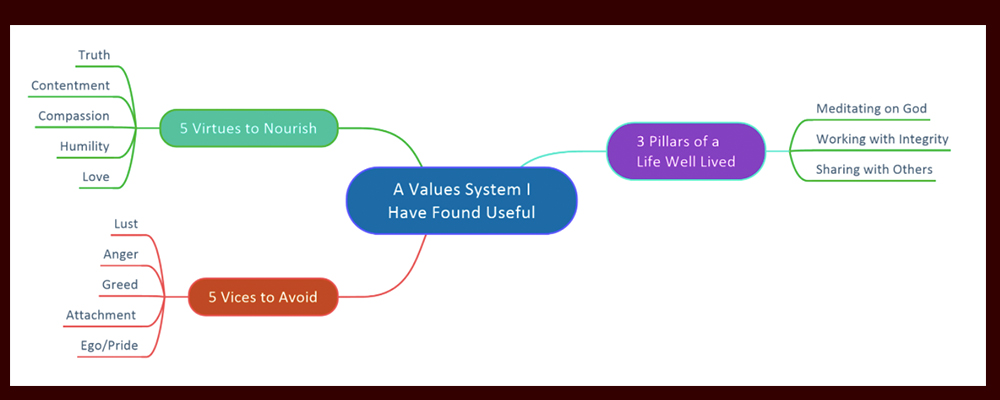
Values systems do not need to be complex, although I do remember seeing one with a list of 50 virtues. It is better to keep it simple. Here is an example of a values system that I have personally found useful. It is derived from my faith of Sikhism.
I will describe very briefly my understanding of each component of this values system and how it has a role in life and leadership.
A. 3 PILLARS OF A LIFE WELL LIVED
MEDITATING ON GOD – Spirituality allows leaders to understand that there is a higher purpose to their leadership than just their personal wants and needs.
WORKING WITH INTEGRITY – Earning a livelihood through one’s own personal and honest effort and not by trying to find easy and unethical ways to acquire wealth. Not resorting to things like fraud, theft and corruption.
SHARING WITH OTHERS – Charity towards those who are less fortunate.
B. 5 VIRTUES TO NOURISH
TRUTH – A core pillar of leadership is trust and integrity. A habitual liar goes against the very core of leadership integrity. Conversely, a leadership based on truth provides a strong moral foundation for its integrity.
CONTENTMENT – Don’t be so obsessed with what you don’t have that you become blind to what you do have. This is not about being complacent. It is about your outlook to life and how you channel your competitive spirit, and importantly, how you deal with failures. The advantage of contentment is that it allows you to be ambitious without resorting to unethical or illegal means.
COMPASSION – Empathy and concern for others. Truly compassionate leaders have a transformational effect on organisations and societies they serve.
HUMILITY – This virtue makes great leaders. It is also a great antidote to the vice of egoism. Having a sense of humility allows you to recognize that your success is based on the contributions of many others.
LOVE – Love for your institution; love for the people who work for you; love for your customers.
C. 5 VICES TO WATCH OUT FOR AND AVOID
LUST: With power comes temptation. There are many leaders who have fallen under the charms of this vice, undermining their leadership legacy.
ANGER: Everyone gets angry sometimes. But as a leader, you have to manage it and be careful about how you express it. An angry rant could make others lose trust in you, and that trust would be hard to rebuild.
GREED: Seed of unethical behaviour and corruption. Powerful leaders can be a source of great good but that often doesn’t happen because they have fallen prey to this vice. The contentment virtue is an antidote.
ATTACHMENT: Becoming too attached to your position, power, status and titles can make it difficult to do without them, leading some to resort to unethical means to obtain or retain these.
EGO/PRIDE: I have seen even accomplished leaders fall prey to this vice. It can be the crack in a leader’s resilience, and open them up to being manipulated by those who know how to play on their ego. Highly egoistic leaders may also not be good to the long-term health of an organisation because they risk being in an echo chamber, hearing only what people think they want to hear, affecting the quality of their judgement and decisions. Their subordinates are also not able to perform at their full potential for fear of clashing with their leader’s ego. Maintaining a sense of humility helps in keeping one’s ego under control.
I realise that there is a risk with making explicit the values system that I have sought guidance from, in that there would be some who would be quick to point out instances where I have failed to live up to those values. However, perfection is not the goal and failure is part of learning and growing. The benefit of having a values system such as the one I have described here is that it provides an anchor for your behaviour and actions. You may at times fail to live up to those values but when you do, you are aware of it, and you know that there is a better you. That self-awareness, over time, guides and strengthens your leadership.
In sharing this, I make no claim to great leadership or having a leadership legacy; only that I have struggled for a substantial part of my professional life with leadership, its responsibilities, and what it takes to be a good leader. I do believe that a good values system can lead to a positive transformation of one’s leadership and allow one to discharge one’s responsibilities with integrity. But for that to happen, these values must not be something that you put on the wall, but rather must be imbedded deep in your mind and conscience through constant reflection. Leadership is not easy but it does not have to be bad.
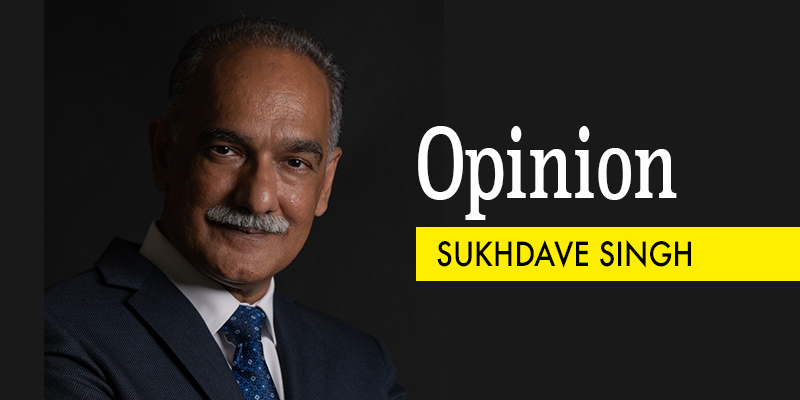
Sukhdave Singh is a former deputy governor of Central Bank of Malaysia and a former independent director of Malaysian sovereign wealth fund Khazanah Nasional Bhd. The article was published by Sukhdave on his LinkedIn page (link) and is reproduced here with his permission.
* This is the opinion of the writer, organisation or publication and does not necessarily represent the views of Asia Samachar.
ASIA SAMACHAR is an online newspaper for Sikhs / Punjabis in Southeast Asia and beyond.Facebook | WhatsApp +6017-335-1399 | Email: editor@asiasamachar.com | Twitter | Instagram | Obituary announcements, click here |