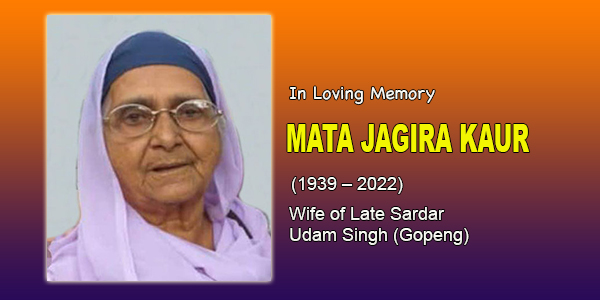
Grandchildren: Sharyljit Kaur, Dr. Calvindev Singh, Dr. Jasveen Kaur, Simran Kaur / Bhuvan Gandhi, Dr. Veeranjit Singh / Dr. Navjot Brar, Rasdeep Kaur / Peter Tseros, Doya Amrita Bhawer, Owindeep Singh, Tavishapreet Kaur, Herlyn Kaur, Ashlyn Kaur, Emerlyn Kaur, Raj Raamjit Singh
Greatgrandchild: Sarika Kaur
Prayers on 13 March 2022 (Sunday), from 7am – 11.45am, at Wadda Gurdwara Sahib Penang.
Programme: Asa di Vaar, Sukhmani Sahib, Kirtan, Sahej Path da Bhog, Ardass followed by Hukamnama
Contact:
Dr. Amrick Singh (016-4659085)
Jasbir Kaur (012-4386737)
Gurdeep Kaur (012-4870217)
| Entry: 7 March 2022 | Source: Family
ASIA SAMACHAR is an online newspaper for Sikhs / Punjabis in Southeast Asia and beyond.Facebook | WhatsApp +6017-335-1399 | Email: editor@asiasamachar.com | Twitter | Instagram | Obituary announcements, click here |
A mother who was our pillar of strength. A beautiful soul that always stood by us. Maaji (Jagiro) has returned Home, dearly missed and will forever be cherished by the family.
Will be missed by the Children, Grandchildren and Great-Grandchildren
Sri Akhand Path Sahib from 10-12 March 2022 at Gurdwara Sahib Gopeng, Perak
Path da Bhog: 12 March 2022 (Saturday), from 10:30am onwards, at Gurdwara Sahib Gopeng, Perak
Contact:
Makhan Singh: 016 – 502 9581
Charanjeet Kaur: 016 – 434 5586
| Entry: 7 March 2022 | Source: Family
ASIA SAMACHAR is an online newspaper for Sikhs / Punjabis in Southeast Asia and beyond.Facebook | WhatsApp +6017-335-1399 | Email: editor@asiasamachar.com | Twitter | Instagram | Obituary announcements, click here |
This satirical print is captioned “Sikhs prefer Chinese with Queues”, suggesting that Chinese criminals were easier to catch and handle when their queues were intact. The image depicts one such scene, supposedly in Singapore, of a Sikh policeman handling a group of Chinese wrongdoers by their queues, amid a sea of diverse onlookers on a busy street.
(Click here for original source. The Roots website has been established by Singapore’s National Heritage Board strives to preserve and catalogue the elements of that unique inheritance, and to present them to the public in an engaging and accessible format.)
ASIA SAMACHAR is an online newspaper for Sikhs / Punjabis in Southeast Asia and beyond.Facebook | WhatsApp +6017-335-1399 | Email: editor@asiasamachar.com | Twitter | Instagram | Obituary announcements, click here
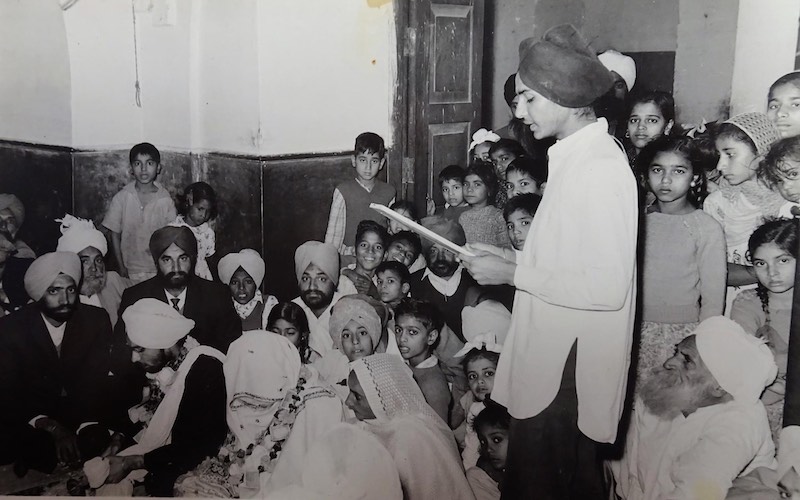
In good old days, during marriage ceremony, a ‘sikhiya’ (ਸਿੱਖਿਆ) was read (in the form of a poem) by brother or any other relative of the bride. I had the privilege of reading ਸਿੱਖਿਆ for my elder sister Jaswant Kaur. (I had prepared this ਸਿੱਖਿਆ by copying and editing some other ਸਿੱਖਿਆ; ਨਕਲ ਮਾਰ ਕੇ).
ASIA SAMACHAR is an online newspaper for Sikhs / Punjabis in Southeast Asia and beyond.Facebook | WhatsApp +6017-335-1399 | Email: editor@asiasamachar.com | Twitter | Instagram | Obituary announcements, click here
Sukhdeep Kaur mentors children about their rights, showing them how to use the internet, improving their social skills and confidence levels in Takipur Village, Punjab.
Kaur used to do odd jobs to make ends meet. Her father suffers from drug addiction and does not work. Being the eldest child, it was her responsibility to take care of her family. But it wasn’t easy. At one point they were in a serious financial crisis. She was working at a petrol pump in Chandigarh but had to quit as she met with an accident. Around the same time, her uncle got incarcerated on charges of murder. So, there was no one to look after the family.
Despite these challenges, she was determined to improve her life. She works for RoundGlass Foundation and mentor children at the Digital Community Center (DCC).
Kaur says, “Initially, I didn’t have the required skills and lacked confidence, but I soon learned the ropes by observing other teachers. My confidence level also improved as did my spoken Punjabi and English. From someone who was painfully shy even to speak in front of children, now I was interacting with Panchayat members and getting things done for the DCC. Recently, I was promoted to Block Changemaker and I now support 10 Digital Community Centers.”
Initially she joined the community as her family was going through a severe financial crisis. “But today my driving force is the joy I find in serving my community. It also gives me immense confidence, and I feel proud to be making a difference to people around me with our initiatives,” she says.
Talking about the roadblocks she says, “When I started working, my brother used to stop me from going to work. He didn’t approve of me going door-to-door or inviting children to the Center, but I managed to convince him.”
Adding, “Getting help from the Panchayat was also difficult initially because the Sarpanch and other members didn’t take me seriously. Technology was another challenge. But I learned as much as I could by watching others. Today, after seeing my work and enthusiasm, they appreciate and support me.”
Sukhdeep Kaur is a 25-year-old from Takipur village in Punjab. As narrated to Prerana Langa of RoundGlass foundation. SheThePeople, an India-based channel for women, aims to share stories of women breaking new grounds. Read the full story, ‘How This 25-Year-Old Is Teaching Kids To Use The Internet In A Punjab Village’ (She The People, 4March 2022), here.
ASIA SAMACHAR is an online newspaper for Sikhs / Punjabis in Southeast Asia and beyond.Facebook | WhatsApp +6017-335-1399 | Email: editor@asiasamachar.com | Twitter | Instagram | Obituary announcements, click here
The next time you step foot into the Malwa region of Panjab, think before you drink its water. Eighty per cent of groundwater in the region – the largest region of the Indian state of Punjab, both geographically and politically – is unfit for drinking and irrigation.
Although there is no exact figure in any recent study, experts are unanimous that the chemical contamination of the groundwater is posing a great health risk to the people living there and it is also putting children at risk of a blood disorder, reports Tribune News Service.
A study of 2018, which was commissioned by the Centre’s Department of Science and Technology, had found concentration of calcium, magnesium, sodium, nitrate and flourine higher than the permissible limits, rendering 80.3 per cent groundwater of Malwa unsuitable for drinking, the report added.
“We are monitoring the water quality in seven districts of the region and we have found that some areas have more content of uranium, and some have high content of fluoride or other heavy metals in the groundwater,” according to Prof Dr VK Garg, a dean at Bathinda-based Central University of Punjab.
Garg, the dean of the School of Environment And Earth Sciences, said it had been proven that the metals in the groundwater were affecting the health of people. The presence of 1 mg fluoride in 1 litre of water can make the teeth colour yellow and 4 mg fluoride in 1 litre water can affect bones, he said.
Bathinda is one of the districts under the Malwa belt. Other districts include Faridkot, Moga, Patiala, Malerkotla and Ludhiana.
Malwa constitutes nearly six out of 10 of the state’s assembly seats (69 out of 117). It is also home to bulk of farmer suicides, with one study estimating that 97% of Punjab’s farmer suicides, largely owing to financial pressures post 1990, took place in the Malwa region.
Prof Dr Bhupinder Singh Virk of Punjabi University in his study on “The Problem of Drinking Water in the Malwa region of Punjab” has stated that Punjab, a pioneer of green revolution today, was facing an acute problem of drinking water due to water pollution.
The report quoted him as saying: “During the study, it has come to light that there are different factors responsible for the problem. In Bathinda, we found fly ash of thermal plants, pesticides, weedicides, chemical fertilisers used by farmers, untreated water discharged by industries in seasonal rivulets of this area”.
ASIA SAMACHAR is an online newspaper for Sikhs / Punjabis in Southeast Asia and beyond.Facebook | WhatsApp +6017-335-1399 | Email: editor@asiasamachar.com | Twitter | Instagram | Obituary announcements, click here
Magic happens when this young woman picks up the taus, a traditional stringed instrument very much associated with kirtan, the Sikh devotional music. Rich and reverberating sounds emerge as Nikita Asha Kaur negotiates the instrument.
This young Malaysian student, who has been enthralled with music ever since she was walking, began picking up the taus last year. Taus means ‘peacock’ in Persian, reflected by the fact that the instrument is carved in the shape of a peacock. It is played with a bow and has moveable frets like the sitar.
Not long too after, the 15-year-old Nikita had the opportunity to put her test her taus skills when she took part in the Malaysian Instrumental Traditional Competition, organised by the education ministry. And, girl, did she shine! She emerged first runners up at the state level competition, making her one of the Federal Territory representatives to the national level traditional secondary school instrumental competition held in Johor in September 2021. Here, she obtained fourth placing at out of 22 entries.
“I love the variety of sounds a taus can create. I feel contented when I’m able to play such beautiful pieces and shabads on my taus,” Nikita tells Asia Samachar.
But it has been a long journey, one that is, naturally, far from over.
At the age of 3, Nikita’s parents noticed her talent and inclination towards music. Her mother, Jagjit Kaur, who is a Form 6 teacher, enrolled her for piano music lessons. She also picked up violon. From here, her interest developed further for kirtan. She started having keen passion and interest to sing Gurbani Shabads and play the traditional harmonium.
She then started gurmat sangeet lessons at the Sri Guru Granth Sahib Gurmat Sangeet Academy in Sentul, Kuala Lumpur. Under the guidance of Parampreet Singh, whom students call Master Ji, she picked up the taus, dilruba and harmonium.
Her journey into stringed traditional instruments started off with the dilruba in 2019. By February 2021, she started playing the taus, practicing 8-10 hours weekly. Two months before the competition, she started her serious practice.
“Masterji carefully selected the solo piece to be presented at the state and national level,” said Jagjit. “His tireless efforts and faith in her have also contributed to her amazing success in playing the taus.”
The Kuala Lumpur music school began with 20 students and today has 300 students around the Klang Valley. The academy is managed by Chamkaur Singh. On the teaching front, Paramjeet is flanked by Amarjeet Singh and Jaspreet Singh. Students are trained in their vocal techniques and complete blend of ancient and modern musical instruments such as the rebab, tabla, dilruba, taus, esraj and sur mandal tanpura.
But Nikita is not all about music alone. The A-lister in school also plays chess. She also diligently attends twice-a-week prayer gatherings (Satsang) with her parents at a gurdwara in Kuala Lumpur. Here, she is a key member in prayer meets, helping out with the service and also playing the taus.
Taus
T H E I N T E R V I E W
Do you enjoy playing all these instruments?
Yes, I definitely enjoy playing these instruments. Playing instruments help me focus better in everything that I do, and it also creates a sense of achievement! Regularly playing an instrument teaches me discipline, responsibility and perseverance to accomplish anything in life. I feel good about mastering a certain piece.
Which is your favourite instrument and any?
My favourite instrument is the taus! Playing the taus requires tremendous amount of skills, patience and resilience. I love the variety of sounds a taus can create. I feel contented when I’m able to play such beautiful pieces and shabads on my taus.
Nikita Asha Kaur strumming the rebab – Photo: Supplied
How do you deal with the endless training sessions, which can be stressful?
It’s actually not stressful at all! I always prepare beforehand, hence I never get stressed with the amount of training sessions. Besides, I really enjoy music. Playing the taus is enjoyable and I am able to express my emotions through the sound and besides, I get to make many friends during rehearsals for gurdwara performances.
What are your ambitions?
I want to become a corporate lawyer in the future, and I am working my way towards it.
Is there any instrument that you wish you could play? Why?
I really wish I could play the flute. The flute is an extremely diverse and versatile instrument that is included in almost all types of ensembles, which is not the case of some instruments. The flute is one of the oldest instruments around. It is a perfect way to unwind and simple instrument to carry around.
ASIA SAMACHAR is an online newspaper for Sikhs / Punjabis in Southeast Asia and beyond.Facebook | WhatsApp +6017-335-1399 | Email: editor@asiasamachar.com | Twitter | Instagram | Obituary announcements, click here
A new statue and entrance gate is to be built in Derby to honour a legendary Sikh hero.
Derby City Council planners have approved plans for what will be a transformation to the entrance at the Ramgarhia Gurdwara place of worship on St Thomas Road, Normanton.
The area will soon feature a statue of Sikh leader Maharaja Jassa Singh Ramgarhia riding a horse in battle.
He was a prominent Sikh leader during the 18th century. He lived between 1723 and 1803, bravely helping Sikhs to both survive and protect the land from its enemies.
A planning application was made ahead of 2023 where Sikhs will be celebrating the achievements of the leaders of the 18th Century – particularly Maharaja Jassa Singh Ramgarhia, with the year marking his 300th birthday. This means that work on creating the new structure is likely to start in the near future.
As well as the statue, a new commemorative entrance gate titled “Ramgarhia Gate” will be built and a new boundary wall to the Gurdwara.
The management of the Ramgarhia Gurdwara, who applied for planning permission, say the new statue and grand entrance will “add to the diversity and cultural value of Derby City”.
Planning documents on behalf of the applicant by SREAR read: “In 2023 the Sikh community will be celebrating the achievements of the Leaders of the 18th Century who helped Sikhs to both survive and protect the land of Panjab, India from invading forces.
“There is a strong Sikh population in Derby and it is planning to commemorate that period of time and specifically one leader, Maharaja Jassa Singh Ramgarhia.
“They wish to erect both a monument and a statue in honour of the brave Sikhs of that period.
“2023 also coincides with the 300th birth celebrations of Maharaja Jassa Singh Ramgarhia and hence the occasion is a once-in-a-lifetime event with unparalleled significance.”
Read full story, ‘New statue of Sikh hero to be built in Derby’ (Derby Telegraph, 3 March 2022), here.
ASIA SAMACHAR is an online newspaper for Sikhs / Punjabis in Southeast Asia and beyond.Facebook | WhatsApp +6017-335-1399 | Email: editor@asiasamachar.com | Twitter | Instagram | Obituary announcements, click here
Manit Ghogar has been pursuing non-stop automotive-tech related ventures ever since he returned to Thailand after completing his tertiary education in the United States (US).
Once back into the bosom of Bangkok, he joined automotive marketplace Carro in 2017. This were early days for the business which has now morphed into Southeast Asia’s largest used car marketplace, and the first automotive unicorn in the region – a company with a valuation of $1 billion or more.
Two years ago, he was tapped to lead Genie Thailand which operates the group’s insurance and finance businesses, serving as the Chief Executive Officer of both Genie Insurance (Thailand) Public Co Ltd and Genie Finance (Thailand) Co Ltd.
How does he manage to keep up with the pace? Well, Manit, 28, feels lucky to have been raised in a family that has always emphasized the value of consistency and persistence, with the elders in his family serving as a very good example for him to follow.
“Now in their late 80s, both my grandparents continue to work with the same earnestness as they did many decades ago, setting a clear but silent precedent about work and responsibility for the rest of the family,” Manit tells Asia Samachar in an email interview. “We live in a joint family, and the tone set up by the elders has played an important role in keeping the family united, humble and successful.”
The son of Amarjit Singh Ghogar and Anjana Ghogar, Manit goes around spotting a neatly tied turban. Sikh males, and some females, as well, wear the turban as an article of their faith. Does it hinder his stride in the Thai corporate world? No, he said.
“The only difference is that you are an ambassador for other turban wearing Sikhs in a corporate society where Sikhs are not the majority. For this reason, wearing a turban carries a significant responsibility,” he said. . Manit Ghogar has been with the group since their start and has played a pivotal role in helping both Carro and Genie setup and penetrate the Thailand market.
Carro, whose business vehicle is registered as Trusty Cars Pte. Ltd, provides a full-stack service for all aspects of car ownership and uses AI-powered technology to transform the car buying and selling experience. It aims to challenge the traditional way of buying and selling cars through proprietary pricing algorithm and AI-enabled capabilities.
Founded in 2015, Carro facilitates about US$1billion annualised run-rate GMV. Carro group of companies include Genie, myTukar and Jualo. As of June 2021, Carro has raised over US$400 million in equity from SoftBank Vision Fund 2, EDBI, Mitsubishi Corporation, MS&AD Ventures, Insignia Ventures Partners and B Capital Group, according to information at its website.
T H E I N T E R V I E W
Tell us more about yourself?
I was born and bred in Bangkok, Thailand. I spent the first 18 years of my life here, after which I moved to the USA. I spent most of my time abroad at Northeastern University in Boston, studying Finance and Information Systems. During my time there, I got the opportunity to work in different industries, including proprietary trading, payments and venture capital, with each experience being in a different city – Boston, New York and Bangalore, respectively. The culmination of my experiences abroad created a strong interest in technology businesses within the financial services sector, and the role it could play in improving lives and societies, especially in developing nations like my own, Thailand.
Tell us about your immediate family?
My grandparents immigrated to Thailand around 80 years ago. Like many Sikh families at the time, they were forced to reinvent themselves in a culture very foreign to their own. The humble beginnings coupled with less than favorable conditions created a strong sense of tenacity that has served them until today. Now in their late 80s, both my grandparents continue to work with the same earnestness as they did many decades ago, setting a clear but silent precedent about work and responsibility for the rest of the family. We live in a joint family, and the tone set up by the elders has played an important role in keeping the family united, humble and successful. My parents, similarly, have led simple lives. My father a businessman, and my mother, a teacher, have collectively placed a high importance on education, discipline and diligence, values that were put at the forefront of the family’s upbringing.
You joined Genie, part of Carro Group, in July 2017. How did this come about?
I joined Carro Group in Thailand in 2017 after returning from the USA. At present, Carro is Southeast Asia’s largest used car marketplace, but back then was just a young startup with early operations in Singapore, Indonesia and Thailand. I served as the CEO of Carro Thailand for over three years. As part of our journey to build out an end-to-end marketplace for our customers, we invested in a licensed insurance company, today known as Genie Insurance (Thailand) Public Co Ltd. We also established Genie Service Co Ltd, a BOT licensed multi-finance company to offer automotive loans. About two years ago, I got the opportunity to head Genie Thailand, which operates both the insurance and finance businesses.
As the Group CEO of Genie Service and Genie Insurance (Thailand) Public Co., Ltd, what were your main challenges?
As the CEO of Genie Service and Genie Insurance (Thailand) Public Co Ltd, some of the main challenges that I faced included growing the businesses in highly regulated environments. Understanding the unique set of regulations each company had to operate with and all the bureaucracy attached to these industries took a lot of time. Genie Insurance, being a public company, also presented a unique set of challenges. The company is subject to an enhanced level of scrutiny by auditors, regulators and shareholders, a level of practice that is not the norm for most private companies. Navigating through the scrutiny and red tape, as well as developing the necessary relationships with the government in order to grow our businesses were demanding. However, over time, this became a very rewarding experience and one equipped with invaluable lessons.
Can you share some of your achievements over the past four years?
I think that being part of a company that had the grit and mettle to dominate an industry throughout an entire region in a matter of 6 years has been an incredible achievement on the company’s part. Being part of this journey allowed me, with the help of a great team both locally and regionally, to play my part in growing the business into a dominant position in Thailand. This growth, both locally and across the region has allowed us to raise close to US$600 million from some of the most prestigious investors around the world, paving way for us to invest and grow into ancillary markets and continue to serve our customers every step of the way. Making consistent and daily strides towards changing user behavior and inching towards achieving our vision is in itself an incredible achievement, and one that in no way could have been accomplished alone.
Manit and his paternal grandfather Balbir Singh Ghogar
You studied finance and economics. Why did you pursue this degree?
I spent my first two years at university exploring different fields of study. This was one of the many liberties of studying at an American university. I pursued coursework in Economics, Math, Information Systems, and Finance for a long time before having to settle on a degree. I eventually decided on a dual degree in Finance and Information Systems as it offered a favorable combination of theory and application. The degree provided inroads into an industry that I at the time knew very little about, but quickly developed passion for. The opportunity to work within the industry at companies like Mastercard and Eze Software Group, whilst pursuing coursework were one of the key reasons I decided to pursue this degree.
Are you involved in any volunteer work? Please elaborate.
I am currently a member of Northeastern’s Young Global Leaders program. The program comprises 100 graduates who advise the university leadership and help strengthen Northeastern’s footprint globally. One important aspect of this program includes investing university resources into various charitable causes each year. The causes are handpicked by the program’s selection committee and resources crowd funded across the university’s student body. Leveraging the university’s global network to deploy resources towards these causes provides us with a platform to ensure meaningful impact, more so than any of us can achieve on our own.
You’re a Sikh, with a turban, involved in top management in the Thai corporate world. How are you received in the corporate world? Does the fact that you wear a turban make a difference?
In terms of how one is received, I don’t think the turban makes much of a difference. I think the work you do is what people remember you for. The only difference is that you are an ambassador for other turban wearing Sikhs in a corporate society where Sikhs are not the majority. For this reason, wearing a turban carries a significant responsibility. If you practice integrity and honest work, the effects will be felt by other Sikhs. If you practice less honest work, the same will be true.
Are there many other Sikhs in top management in the Thai corporate world?
There are a growing number of Sikhs in corporate management positions in Thailand. This has created a small but growing community amongst us. Being in different industries within a common corporate environment has formed a healthy platform for us to share our challenges, learn from one another and extend a helping hand where we can. I believe this has played a crucial role in helping Sikhs grow within their careers and attract others into the realm of corporate Thailand, a career choice that was less common less than a dozen years ago.
Do you encourage younger Thai Sikhs to enter into the corporate world? How and why?
I definitely encourage it. It is a formidable environment to navigate through, but it is one that is conducive to holistic growth and development. I think mentorship plays a vital role in the making of career choices, as well as in the growth of those careers. I think it is important for younger Thai Sikhs to find the right mentors and partners for their journeys, and to build a trusted group of advisors as they climb the rungs of the corporate ladder.
What are you passionate about?
I continue to be passionate about starting and growing companies. Learning about new businesses, industries and technologies has helped fuel this passion.
ASIA SAMACHAR is an online newspaper for Sikhs / Punjabis in Southeast Asia and beyond.Facebook | WhatsApp +6017-335-1399 | Email: editor@asiasamachar.com | Twitter | Instagram | Obituary announcements, click here
Indian PM Narendra Modi inaugurates the first phase of the Kashi Vishwanath Corridor project, connecting the temple town’s two iconic landmarks Kashi Vishwanath temple and Ganga ghats, on 13 December 2021 – Photo: Modi Facebook page
By Karminder Singh Dhillon | The Sikh Bulletin |
On 13 December 13 2021, at the inauguration of the Kashi Vishwanath Dhaam corridor in Benares, Indian Prime Minister Narendra Modi said that the Panj Pyare of the Khalsa Panth were sent by Guru Gobind Singh to the Hindu holy city to gain knowledge of the Sanatan Dharma.
Now, either that was a lie or it was the truth.
SGPC spokesperson Kulwinder Singh Ramdas took four days to make up his mind. In a statement released on December 17, he said Modi’s assertion was “devoid of facts, (made) with illusory intentions and lack of knowledge about the Sikh faith.”
So Modi’s claim was a lie. But if it was, it was our lie.
The lie about Guru Gobind Singh sending 5 Sikhs to Benares is found within the plethora of corrupted, distorted and tainted body of writings composed by Nirmlas over a period of 200 years beginning 1765. This plethora is what we so proudly but recklessly label as “classical Sikh literature.” Nirmla writer Gyani Gyan Singh has written that Guru Gobind Singh sent five hand-picked Sikhs to Benares to learn Sanskrit and classical Hindu literature. He claimed that after they returned to Anandpur, they were honoured with the title Nirmla (Sanskrit for ‘unsullied’).
Based on such a claim in our own literature, Modi was speaking the truth. And it was our truth – as contained within our own literature.
The SGPC representative may well have said that Nirmla Gyani Gyan Singh’s assertion was as “devoid of facts, (made) with illusory intentions and lack of knowledge about the Sikh faith” as was Modi’s. But he didn’t have what it takes to speak such a truth.
The four days that Kulwinder Singh took to respond to Modi were probably used to ponder over how to best slam Modi for telling a lie that was after all our own lie. The SGPC achieved this feat through the propagation of yet another lie. He said “the five Sikhs sent to Kashi were totally different from the Panj Pyaras who offered their heads at the time of the formation of the Khalsa at Sri Anandpur Sahib.”
So, according to the SGPC, Modi was right in saying that Guru Gobind Singh sent 5 Sikhs to Benares to study Sanskrit and all else that came along with it. He was right because he was merely repeating what Nirmla Gyani Gyan Singh had written and what Sikh clergy, writers, thinkers and leaders had unthinkingly propagated for the past 200 years. What Modi got wrong was about which five were sent. One could argue that if it was all about “which five”, then it was a small error that could be easily rectified.
The SGPC spokesperson then went on to make it easy for PM Modi to rectify a lie which was actually our own lie to begin with. SGPC did so by providing a cooked-up rationale. It said in its December 17 statement that “factual information about Sikh history related to Kashi was that, at Paonta Sahib, when Pandit Raghunath refused to teach “Dev Bhasha” Sanskrit to some “Sikh students” belonging to the so-called “Shudra” class, Guru Gobind Singh sent five Sikhs belonging to different castes to Kashi to learn Sanskrit.” Modi would indeed be pleased to note that the SGPC was referring to Sanskrit as “Dev Bhasha” – the language of the gods.
This concocted rationale is also taken from our “classical literature” that says Gobind Singh had to resort to sending the 5 Sikhs to Kanshi as no Sanskrit scholar wanted to teach Sanskrit to Shudras. So the tenth Guru sent some Sikhs dressed in upper-caste attire to Benares, where they covertly became scholars of Indian theology and philosophy.
What a whitewash. Effectively then, the SGPC engaged in a deliberate attempt to conceal our own lie in order to protect our own reputation. According to the SGPC, Guru Gobind Singh’s decision to send the 5 Sikhs to Benares was actually the best thing that happened in the name of equality of the castes. Because Pandit Ragunathan said Sanskrit was not for the lower castes – the tenth Guru sent 5 Sikhs from 5 different castes disguised as Brahmins to Benares. Now all that is left for the SGPC to explain is what was the need to camouflage these 5 Sikhs from different castes in upper-caste attire. After all, a good deed done with stealth and disguise hardly counts as a good deed anymore.
We know that five Sikhs from five different castes is the narrative of our Panj Pyaras. Perhaps the SGPC is giving Modi the wordings for his apology to the Sikh world – in case the PM was thinking about it. It could go something like this.
“The SGPC and I agree that five Sikhs were indeed sent to Benares by Guru Gobind Singh. The five were sent to learn “Dev Bhasha” and “Snatan Dharma.” Our only issue is which five. Given that both the Five Pyaras and the Five Benarsis were of 5 different castes, confusion was inevitable but entirely unintended. No one should take offence over such a genuine error.”
The SGPC then called for a ban on the book Sri Kashi Vishwanath Dham Ka Gauravshali Itihas (The Glorious History of Kashi Vishwanath Dham) that contained the assertion that Modi made and that was launched by Modi on December 13.
But given that Modi’s lie is actually our own truth, and the Prime Minister’s truth our own lie; shouldn’t the SGPC be calling for a ban on our own books that contain this same lie – or at least make a call to expunge such concocted tales from our “classical literature.”
This is the conundrum that results when our own lies are repeated long enough to become the truths of others. And when these truths of others (which are our own lies) come back to haunt us, we end up looking foolish in making ridiculous demands for apologies and bans of books. We look foolish because these books are merely regurgitating our lies – lies that we ourselves held on to for centuries. We also end up concocting fake justifications and rationales (equality of castes in this case) to further justify our original lies.
The truth simply is that Guru Gobind Singh sent no Sikh to Benares for any purpose whatsoever. The most basic reason for that is that the entirety of Sikh spirituality stood as an anti-thesis to all that Benares stood for. If Guru Nanak went to Benares it was to tell the clergy of their hypocritical ways. He went there to remind them of the injunction against them as contained within the SGGS.
ਓਇ ਹਿਰ ਕੇਸੰਤ ਨ ਆਖੀਅਿਹ ਬਾਨਾਰਿਸ ਕੇਠਗ ॥ ੧ ॥
Oye Har Kay Sant Na Akhiyeh Benaras Kay Thugg. SGGS 476.
Meaning: Call them not “sants” of the Omnipresent Creator (as they call themselves) – these conmen of Benares.
THE TRUTH OF IT ALL
The Nirmlas were Brahmins from Benares who descended into Sikh Gurdwaras and institutions disguised as Sikhs beginning 1765 in the aftermath of the destruction of Darbar Sahib by Durani. They ended up taking over control of our Gurdwaras and institutions from the Udasis who had done the same for some 62 years after the fall of Banda Singh Bahadur in 1718. All this while the real Sikhs were busy fighting for survival in the jungles of Punjab, deserts of Rajasthan and the hills of Jammu and Kashmir.
The Nirmlas – given their Benares education, origin and backing – were inherently superior in intellect, capacity, numbers as well as spiritual prowess (albeit Vedic) to actually replace the Udasis as the primary Hijackers of the Sikh psyche.
The Nirmlas would make for a superior breed of hijackers of Sikh spirituality. The reason why they called themselves Nirmley was to fool the Sikhs into believing that they were indeed the pure Khalsas. And that the rest were un-Nirml – either incomplete, impure, or of lower order.
The story of Guru Gobind Singh sending 5 Sikhs to Benares to start the Nirmla tradition is what I call the Big Nirmla Bluff. In my book The Hijacking of Sikhi the fakery of this story is exposed over a mere 9 pages.
THE BIG NIRMLA BLUFF
The Nirmlas concocted a historical cum philosophical lie to establish their legitimacy amongst Sikhs. They created a fake narrative that Guru Gobind Singh ordered five Sikhs to become and remain celibate. He then ordered them to go to Kashi (Benares now) to study Sanskrit and the spirituality of the Vedas disguised as Brahmins.
In The Hijacking of Sikhi, I provide 8 reasons why this story is fake. I further provide appropriate verses from within the SGGS that reject the spiritual parameters of Benares. Here is just one from page 491 of the SGGS.
Gujri Mehla 3. Na Kashi Mutt Upjey Na Kashi Mutt Jaye. Satgur Mileyey Mutt Upjey Ta Eh Sohi Paye.
Meaning: Enlightenment Is Neither Gained nor Lost in Kashi. I Obtained Such Understanding from The Creator-Connecting Guru Shabd.
The practical injunction of this verse is rather straightforward: Going to Kashi or otherwise is of no consequence to one’s enlightenment. Enlightenment is not a function of one’s location. It is a state of mind that emanated from within the messages of the shabd.
Guru Gobind Singh would thus have to be unaware of such injunctions within the SGGS to have sent 5 Sikhs to Benares to study spirituality – and then come back to spread that version to Sikhs.
As for the sending them to study Sanskrit at Benares, we can consider the following facts. First, in addition to being proficient in Brij and Farsi, Guru Gobind Singh ji was a Sanskrit scholar; in the tradition of Guru Nanak and Guru Arjun ji. The SGGS contains compositions and entire Banis of Guru Nanak and Guru Arjun ji in Sanskrit as well as its precursor language Prakrit; titled Salok Seheskrtiti Mehla 1 and Mehla 5. (SGGS 1353 – 1361). Sikhs were thus already exposed to Sanskrit in the spiritual context.
Second, Guru Gobind Singh ji had Sanskrit scholars in his Darbar. Kirpa Raam Duut was a top-notch Sanskrit scholar with Guru ji. He was tasked with teaching Sanskrit to Sikhs. Sikhs in Punjab were well versed in Sanskrit. Jhajju Jheevar in Pajokhra Village for example was a Sanskrit scholar. For someone considered to be of a “low caste Jheevar” to become a Sanskrit scholar meant that large number of Sikhs across all sections of society had a working knowledge of Sanskrit. It is thus inconceivable that any of our Gurus had to send Sikhs to Benares to study a language.
It is thus patently clear that the story is concocted by Nirmla author Gyani Gyan Singh to provide a fake Guru-ordained stamp of approval not just to the Nirmla way of life – celibacy included – but to accord legitimacy to the Nirmla movement and their Hijacking conspiracy as a whole.
FACING OUR OWN LIES
The first thing our own lies did was to destruct our own truths. The truths of Gurbani pertaining to the irrelevance, triviality, and insignificance of Benares in Sikh spirituality were the first casualties of the fabrications such as the Big Nirmla Bluff. The consequences of which can be found in incidences such as the following.
In 1839, Maharaja Ranjit Singh covered the spires of the new Kashi Vishwanath temple at Benares with gold. The Maharajas of Nabha and Kapurthla donated generously towards the founding of a Sanskrit College in 1911 and Pandit Madan Mohan Malaviya, founder of Benares Hindu University got “Sant” Attar Singh of Mastuanna to inaugurate this Benarsi college.
The second thing our own lies do is that they become the truths of others. In the hands of “others” who view Sikhs and Sikhi through the lens of antagonism – such “truths” come back to haunt us badly.
The solution is to sieve out our lies, discard our falsehoods, and disown the untruths that fill our so called classical literature and pollute our psyches. These are the lies that fill the pages of our Janm Sakhis. These are the falsehoods that blacken the pages of Sooraj Parkash, Bhagat Maal, Gurbilas Patshahi 6, Bachitar Natak (Dasam Granth), Sarab Loh, some 35 other primary classical texts and hundreds more derivative ones.
One can only hope that the day will never come when the 404 tales of sexual debauchery as contained within the Chritropakhyan chapter of the Dasam Granth will become the truths of others. Imagine these Charitars being turned into a movie titled 404 Shades of Grey. If such happens, one of the credits will read “adapted from the Sikh Scripture as composed by Guru Gobind Singh.”
We need to disown our own lies before they become the truths of others – only to be weaponized against us.
We need to discard the lie that the DG is a Sikh Scripture, that the DG is scripture at all. We need to shed the untruth that the DG was composed by any Sikh let alone a Guru. We need to disown the lies that are our Janm Sakhis. We need to clean out the falsehoods that decorate the pages of our so called classical texts such as the Sooraj Parkash, Bhagat Maal, Gurbilas Patshahi 6, Rehatnamas, etc.
The episode of December 13 involving the highest office in India is yet another clear indication of things to come on this path of slippery slope pertaining to our own lies. Its not just a case of our lies becoming the truths of others, but our lies being weaponized by the highest and most powerful of entities.
Sikh thinker, writer and parcharak Karminder Singh Dhillon, PhD (Boston), is a retired Malaysian civil servant. He is the joint-editor of The Sikh Bulletin and author of The Hijacking of Sikhi. This article appeared as the editorial of The Sikh Bulletin issue of 2022 Issue 1 (January – March 2022). He can be contacted at dhillon99@gmail.com.
ASIA SAMACHAR is an online newspaper for Sikhs / Punjabis in Southeast Asia and beyond.Facebook | WhatsApp +6017-335-1399 | Email: editor@asiasamachar.com | Twitter | Instagram | Obituary announcements, click here