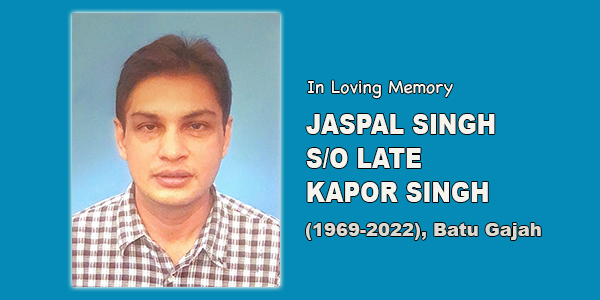
Brothers: Avtar Singh ( Koni) Gurdev Singh ( Dev) Late Manjit Singh (Betti) Late Hardial Singh (Harri) Late Manmohan Singh (Mon)
Funeral / Saskaar: 2pm, 5 Feb 2022 ( Saturday) at Sikh Creamatorium Batu Gajah, Perak. Cortege will leave residence No.39, Kampung Baru Bemban, 31000, Batu Gajah, Perak
Contact:
Jasvin – 016 518 9402
Pardeep – 014 367 5118
Until We Meet Again
Those special moments of you will bring us a smile.
If only we could have you back for just a little while, then we could sit and talk again
You always meant so much to us and will always do
The fact that you’re no longer here will always cause us pain but we know Guru Mahraj has placed you much better place near Him.
You’re forever in our hearts till we meet again.
| Entry: 4 Feb 2022 | Source: Family
ASIA SAMACHAR is an online newspaper for Sikhs / Punjabis in Southeast Asia and beyond.Facebook | WhatsApp +6017-335-1399 | Email: editor@asiasamachar.com | Twitter | Instagram | Obituary announcements, click here |
Brave, honest and sobering piece by my good friend Gurmukh Singh. He refers to a prediction by Khushwant Singh that the Sikh Panth would be virtually finished by the end of the 20th Century. Though his prediction did not materialise, it is correct to say that the Panth is in a state of existential crisis. This might sound surprising given the vast networks of marble-clad Gurdwaras, not only in Panjab but across India and the world. But, using computer science language, it’s a case of, ‘our hardware’ appears to be in good shape, but our ‘software’ is outdated and riddled with viruses!
As Gurmukh Singh rightly notes, “Sikh parcharaks lack the education and missionary zeal to respond to the falsehood about Sikhi being spread by non-Sikh preachers often in Sikhi sarup! Meanwhile, vast Sikh resources are being wasted on marble-clad, gold-plated Gurdwaras as Sikh heritage buildings and artefacts are being neglected or destroyed”.
So the question we face is, what is to be done? There are two different mechanisms, both of which have proven to be effective in reviving Sikhi. As we saw with the historic kirsani (farmer) movement, the first is that we simply wait for the next state-sponsored attack, and we react accordingly! The problem with this is that such periods of successful struggle or ‘sangarsh’ are often followed by decades of conflict and decline.
The other mechanism, as was so powerfully demonstrated by the Singh Sabha Movement of the early 20th Century, is to develop a turbocharged education strategy to research and teach Sikhi through identifying the clear and timeless principles and applying these to the global challenges of our time; crime, poverty, discrimination, inequality, justice, environmental degradation, racism and other forms of oppression, hunger, all kinds of violence, corruption and ignorance.
This is a tall order because the present tekhedar’s (incumbents) of our Panth have very little interest in upsetting a very successful financial model, which feeds the Sikh masses all kinds of superstitious, ritualistic faith, and in return, keeps the money flowing into the gholaks (collection).
So, part of the strategy must be to either dislodge the Pujari’s, which, given most Sikh preachers, directly or indirectly, are on their payroll, will prove to be a difficult task. The other option is to take a lead from the Singh Sabha scholars, and that is to bypass the ‘Pujari’s’ and, through modern communication methods, social media, university spaces, and other community spaces, put forward a Gurbani centred progressive rethinking of Sikhi for the contemporary age. That does not mean disposing of traditional Sikh literature, but it does mean new and more critically informed readings of it.
I think intellectuals such as Gurmukh Singh and others, along with progressive publishing houses, such as Asia Samachar, can lead the way, but we must expand the intellectual base to avoid even intellectuals becoming the modern-day Pujari’s.
Gurnam Singh is an academic activist dedicated to human rights, liberty, equality, social and environmental justice. He is an Associate Professor of Sociology at University of Warwick, UK. He can be contacted at Gurnam.singh.1@warwick.ac.uk
* This is the opinion of the writer and does not necessarily represent the views of Asia Samachar.
ASIA SAMACHAR is an online newspaper for Sikhs / Punjabis in Southeast Asia and beyond.Facebook | WhatsApp +6017-335-1399 | Email: editor@asiasamachar.com | Twitter | Instagram | Obituary announcements, click here |
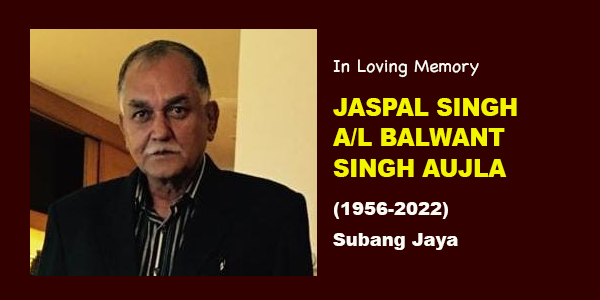
Saskaar / Funeral details: 04 February 2022 (Friday). Arrival at Jalan Loke Yew Crematorium, Kuala Lumpur, at 2.30pm. Last respects along with Japji Sahib and Chaupai Sahib path from 2.30pm to 4.00pm. Saskaar (cremation) at 4.00pm.
Due to ongoing COVID-19 pandemic, we urge all family members and friends to adhere to SOPs when paying final respects.
Path da Bhog: 12 February 2022
(Saturday), from 10am to 12pm, at Gurdwara Sahib Subang.
For further details, please contact:
Jasroop Kaur (daughter) 016 294 5760
Jesjit Singh (son in law) 014 920 0937
| Entry: 4 Feb 2022 | Source: Family
ASIA SAMACHAR is an online newspaper for Sikhs / Punjabis in Southeast Asia and beyond.Facebook | WhatsApp +6017-335-1399 | Email: editor@asiasamachar.com | Twitter | Instagram | Obituary announcements, click here |
Chip Long (left) and Arpinder Kaur – Photo: Chip Long LinkedIn page
By Asia Samachar | United States |
Meet a fine first officer in Arpinder Kaur who joined American Airlines in January 2019. And here is what a senior colleague had to say.
Chip Long, a vice president for flight operations at American Airlines, made this entry at his LinkedIn page: “One of the favorite things about my job is when I get to step out from behind the desk and jump into the flight deck with pilots like First Officer Arpinder Kaur. Just a few months after completing IOE she showcased not only her professionalism, but also the top-notch training she received from our ground and sim instructors as well as cka. With pilots like Arpinder at the helm, the future looks bright at @AmericanAirlines!”
Arpinder, who has a Bachelor of Science (BS) in Management Information Systems from George Mason University, joined American Airlines as a first officer.Prior to this, she spent close to 12 years at Envoy Air Inc, a wholly owned subsidiary of American Airlines Group, according to her LinkedIn profile.
ASIA SAMACHAR is an online newspaper for Sikhs / Punjabis in Southeast Asia and beyond.Facebook | WhatsApp +6017-335-1399 | Email: editor@asiasamachar.com | Twitter | Instagram | Obituary announcements, click here
Harmit Singh Malik: Fred Hutchinson Cancer Research Center professor and associate director
By Asia Samachar | United States |
Genetics Society of America (GSA) has named evolutionary biologist Dr. Harmit Singh Malik as one of its top prize winners.
Dr Harmit won the Edward Novitski Prize for extraordinary creativity and intellectual ingenuity in genetics research.
Dr Harmit is a professor and associate director for the Basic Sciences Division at the US-based Fred Hutchinson Cancer Research Center.
Here, he studies genetic conflict, the competition between genes and proteins with opposing functions that drives evolutionary change. His research could have implications for a range of diseases, from HIV to cancer. As part of this work, his team developed an approach for identifying genes that divide one species from another, which could help solve the riddle of how new species evolve, according to his profile at the centre’s website.
He also studies the evolutionary processes that drive our body’s interactions with viruses, including contemporary scourges like HIV as well as ancient viruses whose fossils litter our genome. With Hutch colleagues, he has characterized the rapidly evolving interface between proteins on human cells and viruses that make us sick. This work has highlighted surprising deviations from “textbook” models of these interactions, and it is revealing gene variants that could influence our susceptibility to infection.
What did he do to deserve the GSA award? The citation states: Recognizing innovative studies at the interface of evolution and chromosome biology, developing the concept of centromere-drive, and contributions to understanding genetic conflict wherein competition between genes with opposing functions drives evolutionary change.
Harmit Singh Malik – Photo: Fred Hutchinson
“I am incredibly humbled by this award, especially as I have been inspired by Ed Novitski’s formative work on genetic conflicts,” Dr Harmit said in a report at Fred Hutch website. “This is an individual award, which would never have happened were it not for the creative geneticists who have trained me and trained with me.”
GSA is an international society of more than 5,000 scientists committed to deepening our understanding of the living world through genetics. Founded in 1931, GSA is the professional membership organisation for scientific researchers and educators in the field of genetics. Its members work to advance knowledge in the basic mechanisms of inheritance, from the molecular to the population level.
Established in memory of pioneering geneticist Dr. Edward Novitski, the prize recognizes a single experimental accomplishment or a significant and exceptionally creative body of work that solves a difficult problem in genetics.
“Harmit’s work requires a multi-disciplinary approach and he nimbly moves between organisms and techniques to address whatever mechanism is at the root of a genetic conflict,” Basic Sciences Director, fellow HHMI Investigator and previous Novitski Prize winner Dr Sue Biggins, was quoted in the same Fred Hutch article.
With fellow Hutch geneticist Dr. Michael Emerman, Malik pioneered the field of paleovirology. He pioneered the idea of “evolutionary echoes” — the traces of long-past viral infections that left their mark in a species’ anti-viral genes — to infer the evolutionary influence of ancient, extinct viruses.
University of Pennsylvania geneticist Dr. Mia Levin, who trained with the Sikh biologist, has this to say about him: “Talking science with Harmit is invigorating and joyful in part because of his openness, his authenticity, and his humility. He is a perpetual student, making these conversations feel like one of collaborative discovery. These interactions help you see the gold that you are sitting on and give you the confidence to tell the world about it.”
Dr Harmit obtained a Ph.D. in Biology from University of Rochester in 1999 and a B.Tech. in Chemical Engineering from the Bombay-based Indian Institute of Technology in 1993.
Dr. Harmit Singh Malik in his lab at Fred Hutch – Photo: Robert Hood / Fred Hutch
ASIA SAMACHAR is an online newspaper for Sikhs / Punjabis in Southeast Asia and beyond.Facebook | WhatsApp +6017-335-1399 | Email: editor@asiasamachar.com | Twitter | Instagram | Obituary announcements, click here
Madam Gurmit Kaur d/o Bhajan Singh and wife of Late Sukhdev Singh Dhaliwal, Seremban (ex Ministry of Defence, Batu Cantonment)
16.1.1943 – 28.1.2022
Village: Purrain, Dist. Ludhiana, Punjab
Bibi was a pillar of strength for our family, a source of support and guidance, to her siblings and immediate family members. She will be always remembered for her positive outlook towards life, her silent strong demeanour and courage. Bibiji (to us) and Panji (to her students) led an exemplary Gursikh life that will continue to inspire us to be true Gursikhs.
She showered her love to all, with words of encouragement when needed.
Bibi, you will always be our inspiration for all that you had achieved despite the adversities you faced in your life. Thank you for being that beautiful part of us. We are forever grateful to you.
Dearly missed and forever cherished by her children:-
Aftar Singh (ex Star Publications) and spouse, Karamjit Kaur (Ministry of Edu)
Daljit Singh (ex Petronas) and spouse Saminder Kaur (Ministry of Edu)
Rajinder Kaur (S. Rajinder & Co) and spouse Harmendar Singh Khosa (ex-Perodua)
Surinder Kaur and spouse Sourjan Singh (BASF), Kuantan
Also missed by Grandchildren and mother, Sardarni Harnam Kaur and her siblings in Singapore
Sahej Path Da Bhog: 13 Feb 2022(Sunday), from 9.30 am – 12.00 pm, at Gurdwara Sahib Rawang, Selangor
Contact numbers:
Harmendar Singh – 016 6685900
Rajinder Kaur – 016 6685800
| Entry: 28 Jan 2022; Update: 3 Feb 2022 | Source: Family
ASIA SAMACHAR is an online newspaper for Sikhs / Punjabis in Southeast Asia and beyond.Facebook | WhatsApp +6017-335-1399 | Email: editor@asiasamachar.com | Twitter | Instagram | Obituary announcements, click here |
In 1953 late S Khushwant Singh predicted, “By the end of the century, the Sikhs themselves will have passed into oblivion”. (Preface to The Sikhs, 1953). Whilst Khushwant Singh misjudged the historical resilience of the Sikh Qaum to survive, he was right to point to the challenges which lay ahead.
I am reminded of that prediction on reading “Challenges of the year 2022”, the editorial of the January issue of The Sikh Review, Kolkata, India, by S. Partap Singh, DIG Retd. Although, he concludes on a positive note, the article is a stark reminder of the state of the Panth today. That should be a matter of concern for the global Sikh community.
The article lists the challenges faced by the Sikhs since 1947. They were forced to migrate from West to East Punjab followed by Sikh migration from Burma (now Myanmar) in 1959. Sikh farmers have been displaced within their own country, India.
S Partap Singh reminds us of the massive exodus of Sikhs in 1984 and genocide of the Sikhs which followed with “migrations to Europe, North America, and Canada seeking political asylum for the safety and security of their lives due to oppression, killings of youth in fake encounters, and kidnapping for ransom by police forces in Punjab…..The horrors of those dark days (third Ghallughara) are still fresh in the minds of victim families and the general public.”
It is refreshing that S. Partap Singh, an ex-senior police officer himself, does not mince his words when referring to state terrorism in Panjab following the “third Ghallughara” (holocaust) in 1984.
On the social front, while Sikhi is opposed to the oppressive caste system, the practice continues as an influence of the Hindu milieu the Sikhs live in, or, the baggage carried over from their Hindu ancestry. Yet, rejection of caste was Guru Nanak Sahib’s first act of rebellion against this discriminatory evil in human society. The result is that the lower castes are lured away from Sikhi by gurudoms, derawadis and Christian missionaries.
Conversions to Christianity in Punjab have increased massively in recent years. Sikh parcharaks lack the education and missionary zeal to respond to the falsehood about Sikhi being spread by non-Sikh preachers often in Sikhi sarup! Meanwhile, vast Sikh resources are being wasted on marble-clad, gold-plated Gurdwaras as Sikh heritage buildings and artefacts are being neglected or destroyed. Neglect of duty by the politicised office-holders of the great Sikh institutions is central to the present sad state of Panthic affairs.
We are warned that if the current decline in the Sikh population in Punjab from 59 percent to around 53 percent continues, “Sikhs may become a minority in their own homeland, Punjab, within the next ten years.”
Yet, Sikh history and the recent success of the popular India-wide farmers protest led by Panjabi Sikh farmers reminds us that the Sikh qaum has a remarkable capacity to regroup, revive and survive to defy predictions of extinction. The Sikhs derive their strength from their inherited egalitarian Sikhi values of sewa, sharing and Sarbat da bhalaa. These values have received much global media attention during the prolonged but successful farmers’ protest against the black farm laws rushed through the Indian Parliament.
Quite instinctively, wherever the Sikhs live, they stand up for the downtrodden, the poorest and the most disadvantaged groups in need. While their support is unconditional, that is how, by own example, Sikhs attract converts and not necessarily by sending out missionaries to actively seek converts. Sikhi values are in their genes. In fact, that is how the Panjabis, Sikh and non-Sikh, live in the Name of the Gurus.
Historical evidence of Sikh survival after Ghallugharas gives hope even if external and internal challenges seem overwhelming sometimes.
Let the Sikhi spirit of Chardhi Kalaa prevail in Year 2022.
Gurmukh Singh OBE, a retired UK senior civil servant, chairs the Advisory Board of The Sikh Missionary Society UK. Email: sewauk2005@yahoo.co.uk. Click here for more details on the author.
* This is the opinion of the writer, organisation or publication and does not necessarily represent the views of Asia Samachar.
ASIA SAMACHAR is an online newspaper for Sikhs / Punjabis in Southeast Asia and beyond.Facebook | WhatsApp +6017-335-1399 | Email: editor@asiasamachar.com | Twitter | Instagram | Obituary announcements, click here
ASIA SAMACHAR is an online newspaper for Sikhs / Punjabis in Southeast Asia and beyond.Facebook | WhatsApp +6017-335-1399 | Email: editor@asiasamachar.com | Twitter | Instagram | Obituary announcements, click here
Experienced insurance broker Jasminder Kaur has been appointed as the chief executive officer (CEO) of MP Honan Insurance Brokers Sdn Bhd, effective today (1 Feb).
She has been tasked to lead the integration of the Honan brand and drive its strategic growth.
MP Honan Insurance Brokers was a result of the joint venture of Honan Insurance Group Asia and MP Insurance Brokers. Honan is an Australia-based insurance brokerage while MP Insurance Brokers was established in Malaysia.
“Jasmin brings with her a wealth of knowledge and more than 25 years of experience in the industry. She will be an excellent steward for Honan in Malaysia as we continue our strategic growth in Asia-Pacific,” said Honan managing director of Honan Asia Eliza White.
Previously, she spent more than nine years at Aon Risk Solutions where she was the executive vice president (chief broking officer & head financial specialties) and earlier as a vice president and head for financial lines practise at CIMB Insurance Brokers Sdn Bhd for more than four years.
Over the last 25 years, she has been involved in providing insurance broking services excellence with a unique blend of specialisation in financial specialties risk solutions for various industry verticals especially financial institutions, oil and gas, manufacturers and healthcare. This includes managing complex claims.
She has led product innovation milestones in Malaysia particularly for transactional risks (M&A’s and IPOs), financial lines risks, credit risks, cyber risks and medical malpractice risks, according to her LinkedIn profile.
Jasminder has a LL.B (Hons) in Law from University of Wolverhampton.
ASIA SAMACHAR is an online newspaper for Sikhs / Punjabis in Southeast Asia and beyond.Facebook | WhatsApp +6017-335-1399 | Email: editor@asiasamachar.com | Twitter | Instagram | Obituary announcements, click here
Mdm Karam Kaur Randhawa / Mr Pram Singh (Seremban)
Also missed by Grandchildren and Great-Grandchildren
Path da Bhog: 12 February 2022 (Saturday), 9.30am onwards, at Gurdwara Sahib Seremban. Guru Ka Laggar will be served thereafter.
Contact: Prem – 016 6516920 Pram – 012 2503006
| Entry: 31 Jan 2022; Updated: 3 Feb 2022 | Source: Family
ASIA SAMACHAR is an online newspaper for Sikhs / Punjabis in Southeast Asia and beyond.Facebook | WhatsApp +6017-335-1399 | Email: editor@asiasamachar.com | Twitter | Instagram | Obituary announcements, click here |