When the freedom convoy was rolling into Canada’s capital this week, Arshdeep Singh Kang was more than 4,440 kilometres away in Los Angeles making a delivery.
The 30-year-old long-haul trucker followed the news of the convoy on his phone during rest stops, but he certainly had no desire to be part of it.
“I don’t believe in the issues they are raising,” Mr. Kang said. “I know there are some South Asian people who support this convoy, but I couldn’t see any of my people in the videos of the convoy.”
According to the 2016 census, South Asians comprise 18 per cent of all Canadian truckers. In major cities such as Vancouver and Toronto, they make up more than half the industry’s work force.
And yet many drivers such as Mr. Kang have no stake in the protest in Ottawa, even though its supporters have dubbed it a “truckers’ movement.”
Jagroop Singh, the president of the Ontario Aggregate Trucking Association, said, “Nobody invited me or any South Asian truckers I know. In fact, we don’t even know who the organizers of this protest are. Nobody asked us if we agree with their demands.”
The convoy may have started as a protest against vaccine mandates, which some truckers say threaten their livelihoods, but it has now embraced several issues. It has drawn support from far-right and extremist groups, with one vlogger even saying he hoped it would become “Canada’s Jan. 6” – a reference to the deadly storming of the U.S. Capitol last year by a mob of Donald Trump supporters and right-wing groups. Many Ottawa residents and journalists have reported seeing Confederate flags in the convoy.
Read the full story, ‘Almost one in five Canadian truckers is South Asian, but many don’t see themselves represented in the trucker convoy’ (The Globe and Mail, 29 Jan 2022), here.
ASIA SAMACHAR is an online newspaper for Sikhs / Punjabis in Southeast Asia and beyond.Facebook | WhatsApp +6017-335-1399 | Email: editor@asiasamachar.com | Twitter | Instagram | Obituary announcements, click here
NEW RELEASE:Bhul Ta Ni Gaye (Have We Not Forgotten?), commemorating the four sons of Guru Gobind Singh. It celebrates the valour of the sahibzades. A new religious song (dharmik geet) by Arvinder Singh Raina and Bhupinder Singh Rai.
[TAKE NOTE OF ASIA SAMACHAR OFFICIAL WHATSAPP NUMBER: +6017-3351399. You can contact us to provide news alerts, community updates or obituary announcements. Stay in chardi kalaa]
ASIA SAMACHAR is an online newspaper for Sikhs / Punjabis in Southeast Asia and beyond.Facebook | WhatsApp +6017-335-1399 | Email: editor@asiasamachar.com | Twitter | Instagram | Obituary announcements, click here |
My father was a bit of a marketing wiz, but with a difference. He lived his life by Sikh values and was married to them in everything he did. Which meant that he also applied them to promoting his fledgling business, and stuck to them as he became increasingly successful.
Early on, I got involved in an annual project which was always launched in the late summer. Salesmen representing calendar printers would arrive at his place of business and leave behind a stack of albums of calendar samples, thousands of them. I soon gravitated to the task of perusing the entire collection and helping select a handful so that we could order our calendars and have them ready for distribution in time for the New Year.
Since these calendars consisted of a single sheet with a 12-paged flap attached at the bottom of each, my father did not like the idea of a common image for all of them. Our customers came from a full range of religious backgrounds and, being Sikh, he wanted to honour them by presenting them with an image that each could relate to and would cherish.
So, my chore was to come up with eight different images, and each would be ordered in numbers roughly matching their respective percentages in the local population.
Thus an image was selected for Hindus – e.g., of a cute, blue-skinned baby Krishna, gamboling with a couple of calves and overturned pots of butter. 2000 copies were ordered.
1000 copies with an Islamic icon would be the next one depicting, for example, a view of the revered Kaaba in Mecca. 500 copies of a picture of one of the Gurus or a matching historical event for our Sikh clientele. 200 copies of either Jesus or Mary with baby Jesus, to take but two examples, for our Christian customers. 100 copies each for Buddhists (usually with Buddha), Jains (Mahavira), and Zoroastrians (Farouhar).
The 8th selection, also 2000 copies, was the most challenging. Because it was the most sought after. The customers would ask for a religious one and then beg for a second one, which would invariably be this secular one which showcased a scene from nature.
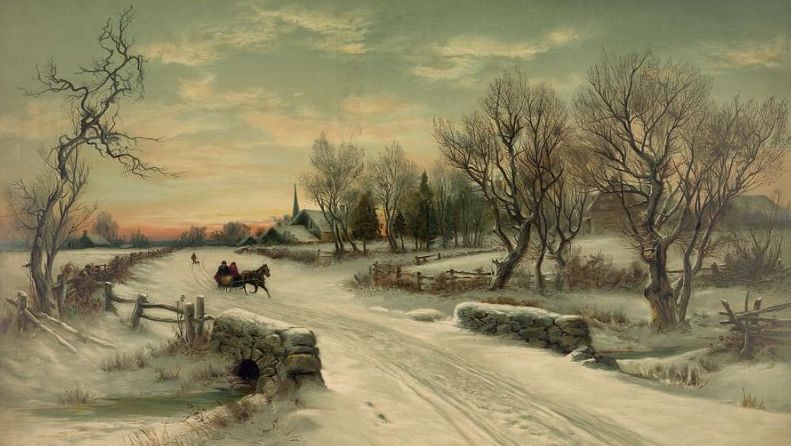
We tried to stick to a similar scenic view each year. The challenge was to find one slightly different each time but equally appealing. It was therefore no coincidence that the subject was always of a snow-covered, forested, rural landscape. You cannot imagine how pleasing it was, the sight of a home partially buried in snow, the warmth of electric lights oozing out of its windows, and a horse-drawn buggy parked amidst the soft shadows of the surrounding trees, to us all who lived in the sun-baked Gangetic plains.
Lo and behold, after all these years, I live today in Canada and make my home in a real-life scene – especially in these long, wintry days and nights – straight out of one of those very calendars, complete with horse-drawn Mennonite buggies that ride by outside my window at all times of the day.
T. Sher Singh is a writer, editor and publisher at sikhchic.com. The Sikh media portal, now undergoing a major overhaul to bring it up-to-date with the latest gadgets, aims to be up by Spring.
ASIA SAMACHAR is an online newspaper for Sikhs / Punjabis in Southeast Asia and beyond.Facebook | WhatsApp +6017-335-1399 | Email: editor@asiasamachar.com | Twitter | Instagram | Obituary announcements, click here
Can Hukam (ਹੁਕਮ) and haumai (ਹਉਮੈ) coexist alongside across the spectrum of our personal lives? It has rightly been said that the first (birth) and last (death) pages of the book of our lives have already been written and are divinely preordained. The death of a family member is often condoled as God’s will or Hukam, requiring us to submit to and accept God’s will. What does our Sikh faith tell us about these two concepts, and do we at least need a modicum of haumai to develop our skills whatever they may be in order to achieve recognition and success in our careers and personal lives?
Etymologically, the word Hukam is derived from the Arabic hukum meaning command or divine order. In Sikhism, if it can at all be precisely defined, Hukam represents God’s divine will and the goal of living and achieving inner peace in accordance with this will at all times regardless of our personal circumstances. Horowitz (2007) asserts that there is shared meaning “between the Islamic and Sikh conceptions of God’s Hukam and that Kabir is the first figure to use the (word) Hukam in a syncretic manner, blending it with popular Hindu notions such as karma and samsara, while preserving much of the original Islamic meaning”, and further suggests that Kabir “is an ideal figure to bridge the gap between Hukam in the Quran and Hukam in the Sri Guru Granth Sahib (SGGS).”1 For Kabir, Hukam represented a way of knowing and seeing God in all things, acting in accordance with God’s will, and a means of liberation and ending the cycle of samsara (rebirth).
Guru Nanak clearly extended the concept, meaning, and understanding of the word Hukam, and the many verses of the Japji Sahib clearly express its breadth and depth, and all-embracing and encompassing nature. In the Japji Sahib, Guru Nanak also refers to the notion of Hukam to emphasize the mysterious hand of God that is behind the functioning of the universe and the daily life of human beings. In his compositions, Guru Nanak also clearly indicated that God is judging our actions, and liberation can only be attained when we follow the Hukam. More importantly, if we are to overcome haumai (ego) then we must follow the Hukam of God. “The doctrine of Hukam plays an important role in understanding the mystery of human existence within the universe.”2 This concept features extensively in our bani to elaborate the nature of creation, the universe, and human life. Apart from the Sikh Gurus and some of Kabir’s compositions that are included in the SGGS, the compositions of other Sufi saints such as Bhikkan and Shaikh Farid make no mention of this concept. We are told that Hukam pre-existed before creation and will continue to exist long beyond creation.
The concept of Hukam can also be viewed from four interrelated dimensions.3 The first dimension is that of creation, where we take birth in the world according to God’s Hukam.
ਹੁਕਮੈ ਅੰਦਰਿ ਨਿੰਮਿਆ ਪਿਆਰੇ ਹੁਕਮੈ ਉਦਰ ਮਝਾਰਿ ॥
By His Command, we are conceived, O Beloved, and by His Command, we grow in the womb. (SGGS, p.636) (SGGS translations by Dr Sant Singh Khalsa)
ਹੁਕਮੈ ਅੰਦਰਿ ਜੰਮਿਆ ਪਿਆਰੇ ਊਧਉ ਸਿਰ ਕੈ ਭਾਰਿ ॥
By His Command, we are born, O Beloved, head-first, and upside-down. (SGGS, p.636)
The second dimension is the role of Hukam in our daily lives in that it determines our health, wealth, well-being, and our individual course of life. The third dimension is the role of Hukam as it relates to our individual fate, the role of ego in our actions, and whether we are reborn or achieve mukti (spiritual liberation) and are reunited with Waheguru.
ਆਇਆ ਲਿਖਿ ਲੈ ਜਾਵਣਾ ਪਿਆਰੇ ਹੁਕਮੀ ਹੁਕਮੁ ਪਛਾਣੁ ॥ We come into the world, and we depart, with our destiny written and pre-ordained, O Beloved; realize the Command of the Commander. (SGGS, p.636)
ਹੁਕਮੇ ਗਣਤ ਗਣਾਈਐ ਪਿਆਰੇ ਹੁਕਮੇ ਹਉਮੈ ਦੋਇ ॥
By His Command, some accounts are accounted for, O Beloved; by His Command, some suffer in egotism and duality. (SGGS, p.636)
ਹੁਕਮੇ ਭਵੈ ਭਵਾਈਐ ਪਿਆਰੇ ਅਵਗਣਿ ਮੁਠੀ ਰੋਇ ॥
By His Command, one wanders in reincarnation, O Beloved; deceived by sins and demerits, he cries out in his suffering. (SGGS, p.636)
The fourth dimension refers to God’s immanence and omnipotence. None of us is beyond Hukam for God is both the creator and sustainer.
The terms Hukam and bhana (ਭਾਣਾ, sometimes also spelt bhanna) are often used synonymously although there appears to be a subtle difference between these two concepts. We are told that bhana (Divine Will) finds expression through Hukam (Divine Law of nature), and all our actions in life, our pains and pleasures, are subject to bhana.
ਭਾਣੈ ਦੁਖੁ ਸੁਖੁ ਭੋਗੀਐ ਭਾਣੈ ਕਰਮ ਕਰੇਇ ॥
In the Lord’s Will, pain and pleasure are experienced; in the Lord’s Will, actions are performed. (SGGS, p.963)
Life and death, the diversity of plant and animal life, the solar system, riches and poverty, pleasure, grief and pain, all operate under and are subject to Hukam. “Whatever life brings to us or takes away from us is part of Hukam or bhaana. Even a minuscule understanding of hukam suspends judgement. While it is difficult to fully understand Hukam, accepting it as the Creator’s plan brings peace and comfort in our lives. We learn to (go with the) flow rather than resist, surrender rather than question, and accept Hukam with grace no matter what unfolds.”4
ਹੁਕਮੈ ਅੰਦਰਿ ਸਭੁ ਕੋ ਬਾਹਰਿ ਹੁਕਮ ਨ ਕੋਇ ॥ Everyone is subject to His Command; no one is beyond His Command. (SGGS, p.1)
ਨਾਨਕ ਹੁਕਮੈ ਜੇ ਬੁਝੈ ਤ ਹਉਮੈ ਕਹੈ ਨ ਕੋਇ ॥੨॥ O Nanak, one who understands His Command, does not speak in ego. ||2| (SGGS, p.1)
The martyrdoms of the fifth Guru, Guru Arjan as well as the ninth Guru, Guru Tegh Bahadur, are perceived as Hukam to which they submitted to without question. Guru Arjan as he was being tortured to death said
ਤੇਰਾ ਕੀਆ ਮੀਠਾ ਲਾਗੈ ॥
(SGGS, p.394)
“Guru Nanak’s concepts of the Sabad (Shabad), the Nam (Naam), the Guru, and the Hukam carrry us beyond anything that the works of earlier Sants offer in any explicit form. It is Sant thought expanded and re-interpreted. The result is a new synthesis, a synthesis which is cast within the pattern of Sant belief, but which nevertheless possesses a significant originality and, in contrast with its Sant background, a unique claity.”5 The total and complete understanding of Hukam is beyond Man’s grasp. Nanak, if anyone comprehends the Hukam, his haumai is purged. In understanding Hukam, the self is destroyed. When haumai is purged, Truth is obtained.”6
Hukam is also said to include the daily practice of randomly opening a page in the SGGS to receive God’s guidance on how to handle a certain situation, seek an answer to a question, or as more general guidance for the day. The verse appearing at the top left of the SGGS page is to be meditated upon throughout the day. This verse is known as a hukamnama, meaning that it is God’s command to mediate upon the shabad of the Guru. The Gurus that came after Guru Arjan, Guru Hargobind and Guru Tegh Bahadur issued hukumnamas as socio-political edicts to their distant congregations with specific instructions.
Haumai is a combination of the words Hau (ਹਉ) meaning “I” and Mai (ਮੈ) meaning “me”. It is the concept of ego or self-centeredness. There is no denying the existence of ego and our inclination to act by our ego, and in doing so we are unable to fully comprehend the nature of God and Hukam. Haumai is the source and manifestation of the five sins and vices of kaam,krodh,lobh,ahankar and moh. It leads to and is responsible for pride, arrogance, vanity, self-centeredness, narcissism, and selfishness. In contrast, practicing truthfulness and truthful living, compassion and patience, contentment, humility and self-control, love, wisdom, and courage in the face of adversity can lead to a lessening and moderation of haumai. Not only does haumai exist at the individual level, but it also exists at a community level. At an individual level, it can sometimes also hide a lack of self-esteem and inferiority. Haumai is primordial ego. It clouds our thinking and actions, and we need to be constantly vigilant in subduing and keeping it in check to avoid getting caught in the cycle of samsara (rebirth). Psychoanalyst Sigmund Freud postulated that there are three components to our personality namely, the id, ego, and superego. The id works to satisfy our basic urges, needs, and desires with little consideration for others. The ego is the realistic part and has a moderating influence, mediating between the desires of the id and the superego, while the superego acts as a moral conscience. Freud’s views of personality are not entirely without controversy.
We are not saints, and it could justifiably be argued that haumai is a constant in our lives. Some amongst us exhibit haumai early as we advance in our life and achieve success in our chosen careers. Likewise, some amongst us may undergo a spiritual experience in our later and twilight years and see a reduction in our haumai. Haumai can be controlled and subdued through listening to the shabad and meditating on God’s name (Naam), Simran, and Seva (selfless service). Exhibiting haumai makes as manmukh while turning away from haumai and engaging in righteous deeds makes us gurmukh. Nimrata (ਨਿਮ੍ਰਤਾ) is the practice of humility and benevolence, and is a virtue in Sikhism.
Hukam is Divine Will or order and cannot be completely described or understood. Hukam dictates and determines our karma and karma operates according to God’s command. It is our dharma (duty) to submit to God’s will. Nature obeys Hukam and so should Man. Our Gurus have emphasized that we cannot completely understand divine mysteries and that they are only a drop in the ocean or like a tiny fish in the ocean. The doctrine of Hukam raises a fundamental question. As human beings, are we helpless creatures in this world? The Sikh Gurus have emphatically rejected this notion and have taught that all human beings have been endowed with the facility to create their own destiny. They have also reiterated in their teachings that falsehood or evil will ultimately be destroyed, and truth will prevail. Haumai is an obstacle to our spiritual progress.
Ultimately, this begs the question of whether it is possible to simultaneously follow the two paths of Hukam and haumai? Unquestionably, and in summation, the short answer might well be yes, but in what context and to what clearly visible degree? We do need a modicum of haumai to advance and achieve success in our working lives and careers, but with a strong and clear caveat that its display and practice does not adversely hurt, harm, or consciously or unconsciously, disadvantage our fellow beings. This must and needs to be avoided at all costs.
References
1.Horowitz, M. (2007). (Dis)continuity between Sikhism and Islam; The development of Hukam across religions. Graduate theses and dissertations. http://scholarcommons.usf.edu/etd/2223, pp. 1-2.
2.Kalsi, S.S. (2005). Sikhism. Chelsea House Publishers. p.49.
3. Horowitz, M. (2007). (Dis)continuity between Sikhism and Islam; The development of Hukam across religions. Graduate theses and dissertations. http://scholarcommons.usf.edu/etd/2223, pp. 38-44.
4. Kaur, J. (2020). Home of the beloved; Sacred spiritual concepts. Cupertino, California. p. 38.
5. McLeod, W.H. (1999). Guru Nanak and the Sikh religion. Oxford University Press. p.161.
6. Ibid., p.200.
7. SGGS translations by Dr Sant Singh Khalsa
Rishpal Singh Sidhu is a semi-retired casual academic at the School of Information and Communication Studies, Charles Sturt University, Australia. He has a passion for research, writing, and teaching. He is the compiler and editor of the book, Singapore’s early Sikh pioneers; Origins, Settlement, Contributions and Institutions, published by the Central Sikh Gurdwara Board in Singapore in 2017. He is currently based in Sydney, Australia.
* This is the opinion of the writer, organisation or publication and does not necessarily represent the views of Asia Samachar.
ASIA SAMACHAR is an online newspaper for Sikhs / Punjabis in Southeast Asia and beyond.Facebook | WhatsApp +6017-335-1399 | Email: editor@asiasamachar.com | Twitter | Instagram | Obituary announcements, click here |
Parents: Late Sardar Mukhtiar Singh Cheema & Late Madam Punjab Kaur
Dearly missed and forever cherished by his Siblings, Sisters-in-law, Brothers-in-law, Nephews, Nieces, Grand-Nephews, Grand-Nieces, and a host of Relatives and Friends.
Siblings / Spouse
Jalar Singh Cheema / Gurmit Kaur (Klang)
Sukhdave Singh Cheema / Lucy Bong (Klang)
Gurmail Kaur Cheema / Jagar Singh (Port Dickson)
Tej Kaur Cheema / Munjit Singh Gill (Shah Alam)
Harmail Kaur Cheema / Late Bhagwant Singh (Shah Alam)
Manjit Kaur Cheema / Late Umbar Singh @ Amar (PDRM)
Surjit Kaur Cheema / Harbajan Singh (Port Klang)
Rangit Kaur Cheema / Tirlochan Singh (Cheras)
Sehaj Path Da Bhog / Antim Ardaas: 13 Feb 2022 (Sunday), from 9.30am to 12.00 noon, at Gurdwara Sahib Klang
For further information kindly contact Jalar Singh Cheema 012 313 1800
| Entry: 30 Jan 2022; Updated: 10 Feb 2022 | Source: Family
ASIA SAMACHAR is an online newspaper for Sikhs / Punjabis in Southeast Asia and beyond.Facebook | WhatsApp +6017-335-1399 | Email: editor@asiasamachar.com | Twitter | Instagram | Obituary announcements, click here |
Baba Iqbal Singh, who oversees a string of education outfits from their headquarter in Baru Sahib, Himachal Pradesh, passed away today. He was 96.
Some describe him as the chief executive of the largest Sikh NGO in the world for the 129 schools, two universities, nursing college and drug rehabilitation centres under his care.
“With deep personal sadness, but monumental pride in the goodness of of humanity, we announce Baba Iqbal’s passing,” commented one of the many volunteers in his outfit.
Iqbal, the president of the Kalgidhar Trust, was recently recently conferred Padma Shri awards on the eve India’s Republic Day 2022 for his contribution in the field of social work. This is the fourth-highest civilian award of the Republic of India.
Iqbal retired as the director of agriculture in the Himachal Pradesh government in 1986 and the very year started Akal Academy, a school on the foothills of Baru Sahib in the Indian state.
The school which had five students at the beginning, is today a chain of 129 CBSE affiliated English medium schools. He also set up two private universities which now have around around 70,000 rural students, according to information at the institution’s website.
In 2013, the Kalgidhar Trust established Akal Academy, Himachal’s first International Baccalaureate (IB) authorised residential school at its headquarters in Baru Sahib.
In 2018, he was conferred the title of ‘Shiromani Panth Ratan’ (Crowning Jewel of the Sikh cause) by by Takht Patna Sahib jathedar Giani Iqbal Singh.
ASIA SAMACHAR is an online newspaper for Sikhs / Punjabis in Southeast Asia and beyond.Facebook | WhatsApp +6017-335-1399 | Email: editor@asiasamachar.com | Twitter | Instagram | Obituary announcements, click here
Growing up in New Delhi, India, I do not think I can recall a time when I did not know of the Gurudwara. There was one on the same block as my home—where I lived for the first eighteen years of my life. Its crystal-white dome, the echoes of the evening Rehras and the taste of the fresh kadha prasad are memories I associate with home and peace.
Since then, I have not been so lucky to have one so close to where I lived, but I have found many worldwide. Each is different, yet so similar. It is hard to define gurudwaras (also spelt: gurdwara) in one big umbrella. They vary stylistically so often, from the more traditional structures from 19th century Punjab to basements in brownstones in the West. Different in form but same in function and character.
Gurudwaras around the world are not characteristically defined like churches or mosques with distinct architectural features like the Gothic buttress or the Ogee arch, which stylistically distinguish and better define such structures. Instead, they are defined by function—the langar, the community culture and most of all, the open door. As an architect, I always saw them as civic spaces, as spaces where one is free to gather and assemble regardless of where one comes from. But this definition is incomplete at best. The gurudwara is, first and foremost, a place of worship. Therein lies a question then.
To answer this underlying question and expand my understanding of the gurudwara, I reached out to Dr. Devinder Pal Singh, a renowned academic and the director at the Center for Understanding Sikhism in Mississauga, Canada. His research on Sikh Studies and culture is unparalleled. What follows is our conversation in the form of an interview wherein he discusses the complexities and simplicities of the Gurudwara and its role in Sikhism, North America and the world at large.
T H E I N T E R V I E W
What is the role of the gurudwara for the Sikh community?
Gurudwaras have crucial importance to the religious, social, and political life of the Sikhs. They have performed a critical part in developing the Sikh religious traditions and shaping Sikh history. Since its inception, the role of a gurudwara (initially called Dharamsal) for the Sikh community has been manifold. First, it is where the Sikhs assemble for worship and prayer. There are three main functions carried out in all public Gurdwaras. One is Kirtan – the singing of hymns from the Guru Granth Sahib; another is Katha – the reading of the Guru Granth Sahib and explanations. The third primary function is Langar (free community kitchen) for all visitors.
Along with these primary functions, Gurdwaras around the world also serve the Sikh community in many other ways including, libraries of Sikh literature, museums of historical artifacts, schools to teach children Gurmukhi, the script of the Sikh scriptures, training centers for martial arts (e.g., Gatka, Judo, Karate etc.), and charitable works. In addition, various ceremonies (e. g., naming of a child, marriage, funeral etc.) are performed at Gurudwaras. Finally, gurudwaras also act as assembly places for the Sikhs to reflect upon and take appropriate decisions about the community’s critical social, religious, and political issues.
What is the role of the gurudwara for communities outside Sikhism?
People of all faiths are welcome at a gurudwara. Initially, a gurudwara was a place where Sikhs could go to hear the human Gurus speak. Generally, there are four doors for the entrance to the sanctum sanctorum in a Gurdwara. It suggests that everyone is welcome, regardless of one’s status, occupation, gender, religion, caste, color or creed.
At the time of community and national emergency, Gurudwaras act as shelter/refuge for the people. For instance, during the devastating fire that almost engulfed the town of Fort McMurray, Alberta, in 2016, the Sikh community came together to collect 1 million dollars in food and clothing for those affected by the fires. In addition, nine semi-trucks full of food and clothing were sent to the victims by the gurdwara leaders in the spirit of Seva (selfless voluntary service) and Sarbat da Bhalla (well-being of all people).
Another way that the Sikhs have manifested their service ethic to the society is through the tradition of Langar (the community kitchen) in the Gurdwara, where free warm meals are served to all visitors, without any distinction of religion, race, ethnicity, gender, or economic status. Currently, the Sikhs have taken the Langar outside of the gurudwaras. Now, they serve meals in other venues, even at the places where people are suffering from natural and manmade disasters. For instance, United Sikhs and the Yangon Sikh Gurdwara served Langar to thousands of Myanmar cyclone survivors in 2008. During 2010, United Sikhs’ volunteers served Langar to survivors of the earthquake in Haiti. The Sikhs also served Langar to flood-hit victims in Kerala (2018), Chennai, Tamil Nadu (2018), Uttara Khand (2018), Assam (2019), and Bihar (2021) in India.
Through its Langar Aid project, Khalsa Aid International, UK serves the homeless, vulnerable, and those struggling with poverty in the UK. They also work internationally to provide humanitarian aid in disaster and war zones. For instance, in 2015, it set up a free bakery near the war zone to feed fleeing Syrians.
The inclusiveness and Oneness of all humankind are much renowned Sikh doctrines. Sikhs took these concepts beyond the Sikh community by helping and serving others without discrimination. Consequently, now even Muslims, Hindus, Christians, and many others donate towards Langar, and do it because this is what Oneness looked like and felt like.
How do you think Gurudwaras responded to the pandemic?
It is difficult to outline all activities taken up by the worldwide Gurudwaras to combat the Corona pandemic. But I hope a few would suffice. For instance, a few media reports are as follows:
In March 2020, when the New York mayor’s office approached the Sikh Center in New York, USA, for assistance, the Sikh Center handed out tens of thousands of food packages to various federal agencies in the region for distribution among the needy. Besides, during the pandemic, Sikh volunteers delivered thousands of meals to vulnerable populations, including homebound seniors and those unable to afford meals, in New York, California and Washington state, USA.
Gurudwaras in Melbourne and Adelaide cities of Australia started a free tiffin service for those in isolation during the pandemic. The needy persons can even order food by telephone, which is delivered to their doorstep by Sikh volunteers (March 2020).
In Canada, many gurudwaras launched a food-delivery service for free, with the help of local restaurants and Sikh families to help the needy persons (May 2020).
In the UK, the Midland Langar Sewa Society served hot meals to the homeless in Birmingham, and its teams reached out to those who had isolated themselves, throughout the UK. Many other gurudwaras in countries like New Zealand, South Africa, Germany, etc., are also involved in similar exercises.
Various Gurudwaras of the Lucknow, Mahanagar, Aishbagh, Gomti Nagar and Alambagh cities in Uttar Pradesh, India, had launched ‘oxygen langar’ for patients requiring oxygen during home quarantine. In addition, Lucknow Gurudwara Management Committee provided two hearses for taking covid positive bodies to the cremation ground free of cost. This service was for free and for all. Moreover, the committee ensured that the poor utilized its services more (May 2021).
Several Gurudwaras worldwide opened their door to establish Covid 19 vaccination center at their premises to provide easy access to the service to the community and others. For instance, the vaccine clinic at Surrey Sikh temple in British Columbia, Canada, successfully delivered vaccination services to all people (May 2021).
As another example, I would like to add that during the first wave of Covid in India, Bangla Sahib Gurdwara, New Delhi, India fed 75,000 people every day. At the time of the second wave of corona pandemic, Guru Harkishan Institute of Medical Sciences and Research, located on Bangla Sahib’s premises, started a free-of-cost 100-bed dialysis center for all without any consideration of caste, colour, creed or class (July 2021).
In your personal life, what role does the gurudwara play?
In my personal life, gurudwara plays a crucial role as a beacon of light. It provides help in rejuvenating my faith, providing temporal and spiritual guidance, and a feeling of community fellowship. Gurdwara also plays a crucial role in linking me to an extraordinary Sikh heritage, full of selfless service and sacrifice to humanity. Several of my life affairs (naming ceremony of my children, marriage, funeral, prayer, thanksgiving ceremonies etc. of my family) have been settled at the gurudwara.
Historically, how do you think the gurudwara has evolved in the North American context?
As of 2020, there are 24 countries in North America. Among them, the United States is the biggest one by population while Canada is the largest country by area. Areawide, the four main countries of North America are the USA, Canada, Mexico, and Greenland. The Sikh population is about 0.7 million in the USA, 0.5 million in Canada, and only 8,000 in Mexico. In contrast, no figures are available for the Sikh population in Greenland.
The first Sikh community entered the United States via the West Coast during the 1890s. At present, there are more than 300 gurdwaras in the United States, situated in big cities like Los Angeles and small rural farming towns alike. Gurdwara Sahib Stockton, located in Stockton, California, is renowned for being the first gurdwara in the United States. The Pacific Coast Khalsa Diwan Society founded the gurdwara in 1912. It was also called ‘Gadari Babeyan da Gurdwara‘ (the gurdwara founded by the members of the Hindustan Gadar Party.)
Gurdwara Rakab Ganj located near Parliament House in New Delhi – Photo: Ekam Singh
The first Sikh immigrants came to Canada in 1904 and established themselves in British Columbia. They created the Vancouver Khalsa Diwan Society in 1906. Under its leadership, Sikhs built their first Gurdwara in 1908 in the city of Golden, British Columbia, Canada. By 1920, several other gurdwaras had been established in various cities, e.g., Victoria, New Westminster, Golden, Abbotsford, Nanaimo, Fraser Mills and Paldi. An independent, elected executive board controlled each. At present, there are over 150 Gurudwaras in Canada, managed by local management committees.
There are about 8,000 Sikhs in Mexico and only one gurdwara in Mexico City. In 1976, S. Arjan Singh, a granthi from India, came to Mexico City to look after it. There is almost no Sikh population in Greenland, so there is no Gurudwara.
From the architectural point of view, Gurdwaras in USA and Canada have evolved from a simple single room structure to magnificent structures with elaborate detailing and decoration. In addition, most cities now have several gurdwaras, each reflecting slightly different religious views, social or political opinions, or caste backgrounds. Sikhs now have access to a complete set of public observances through them. For most communities, Sunday services are available there, followed by langar provided by members of the Sangat (congregation).
Worship in the gurdwara includes reading scriptures, meditation, prayer, and singing hymns. Anyone who follows the conventions for entering a gurdwara can participate and avail of the services. Though a few Canadian congregations have integrated chairs and tables, but worshippers mostly sit on carpets. In addition, various Gurpurabs and traditional Sikh calendrical celebrations, e.g., Vaisakhi etc., are celebrated in Gurdwaras. Sikhism gives particular importance to family life, philanthropy, service and defence of the faith. Traditionally, service has been expounded as service to the religion and the community. However, this service perception is slowly incorporating a broader perspective of North American social issues. However, one component of the traditional Gurudwara system missing in North America Gurudwaras is the lack of sarovars (water tanks) in their proximity and thereby they fail to care for marine life and Nature.
Many Sikhs wish to teach their children their culture and religion. So, many Gurdwaras offer classes teaching religious precepts and Punjabi language to children; some second-generation Sikhs speak Punjabi but need to be formally taught the Gurmukhi script in order to read Sri Guru Granth Sahib. In addition, national and regional conferences to discuss Sikh issues are often held in various cities, and informal contacts between regional Gurdwara managements are usually maintained. However, the primary organizational basis of North American Sikhism is the local gurdwara association, and some North American Sikhs also maintain solid religious ties with India.
Since the last many years, there have been several attempts to establish an integrated national Sikh religious organization within Canada and USA; however, this aim has not been achieved yet. Nevertheless, with its strong community institutions, group consciousness, and ready adaptation to new technologies, Sikhism has grown in North America, especially Canada and the USA, despite the pressures of assimilation and secularization.
How do you think the building itself or the architecture speaks to you as someone who studies Sikhism?
As a Sikh, Gurdwara building or architecture, for instance, Harmandir Sahib, Keshgarh Sahib and Anandgarh Sahib etc., speaks to me on two levels, i.e., Temporal and Spiritual.
On the temporal level, massive columns, portals, inner structures, bukharchas (3 or 4 paneled projecting windows in a row) on the projecting base, and chhatns (kiosks) on the parapet remind me of Rajput architecture. But, on the other hand, the dome, arches, minarets, and underground cellars resemble Mughal architectural style. However, gurdwaras also display the innately eclectic nature of their architectural design. They possess several distinct features and bring forward an identifiable picture of a style that can indeed be called Sikh Architecture.
For instance, compared to Hindu temples, Gurudwaras are more spacious, with the addition of adjoining divan asthan (assembly halls), where necessary, e.g., Manji Sahib Diwan Hall in Hari Mandir Sahib. Moreover, often, they have an entrance from all four sides. They are also not oriented to any particular direction like the Muslim mosques. Guru ka Langar (community kitchen and dining hall) is an essential adjunct to a gurdwara, and most gurdwaras have sarovars (bathing tanks) in the vicinity. A gurdwara is recognizable from afar by the Nishan sahib, the Sikh pennant in yellow or blue flying atop a high flag post. Gurdwaras are often devoid of any sculptured images in or around them.
Basically, any gurdwara’s building need not conform to any specific architectural design. The only essential and established requirement is the installation of the Guru Granth Sahib in a building under a canopy, on a higher platform, relative to the floor, where the devotees sit. But in time, many gurdwaras came to have structures of a particular design imitating the pattern of Harmandar Sahib, Amritsar.
Based on their plan form, Gurudwara buildings can be classified into four primary shapes: the rectangular, the square, the cruciform and the octagonal. However, cruciform is rarely used. One specific example of cruciform structure is Gurdwara Nanakjhira at Bidar in Karnataka, India. On the other hand, the famous Gurdwara Baba Atal in Amritsar is octagonal. Many gurdwaras have an octagonal sanctum sanctorum within their rectangular or square hall. An open or covered circumambulate passage usually runs around the sanctum.
Gurdwaras buildings vary in height too. These can be one to nine storeys high. However, these buildings are often topped by a dome. Moreover, many gurdwaras have basements below the ground floor, for instance, Bhora Sahib at Anandpur Sahib and Gurudwara Guru Tegh Bahadur Ji, near Harmandir Sahib at Amritsar.
A recurrent element of gurdwara design is the preferred use of two-storey height with an all-around gallery at mid-height, leaving the center of the ground floor covered only by the top roof or the dome. As a rule, the dome is the crowning feature of a gurdwara. Even flat-roofed, rectangular gurudwara buildings often have a decorative dome over the spot where Guru Granth Sahib is installed. Many times, a small single-room shrine is topped by palki, a palanquin-like roof derived from the Bengal style of architecture. Generally, the dome is ribbed or fluted. Various dome shapes often mark our shrines. These shapes include hemispherical, oblong, conical or three-quarters of a sphere. The more frequently used dome shape is spherical. The dome starts from a floral base and has an inverted lotus symbol top from which rises the kalash (the ornate finial).
Dukhniwaran Sahib, Gurdwara Sahib Rakab Ganj, New Delhi – Photo: Ekam Singh
Gurdwaras domes are usually painted in white or many times in gold. Domes of some important gurdwaras are often covered with gold-plated copper sheets. In contrast, domes of many other gurudwaras are lined with marble slabs or white or colored porcelain pieces. Besides the large central dome, there are often four other cupolas, one at each corner and several small solid domes embellishing the parapet. An ornate finial, the Kalash, invariably tops the dome. It shoots up in the form of a cylindrical construction, usually with some spheroids and concentric discs culminating in a small canopy with pendants hanging at the outer rim. The Kalash is traditionally made of brass or gilded copper. However, recently the use of steel or gilded khanda (double-edged sword) as pinnacle has come into vogue.
A Gurudwara’s interior is often beautified using gachch or stucco work, tuknor fixing of mirror pieces, jaratkari or inlay work, mohrakashi or filigree, latticework or stone grills, and fresco painting. These techniques produce beautiful designs and friezes based on vine, plant, flower, bird, and animal motifs. Marvelous examples of such work can be seen in the Harmandir Sahib. The most significant number of frescoes have been painted on the first-floor walls of Baba Atal. It is important to note that Gurdwaras are not ornamented with depictions of God. They don’t have ritualistic objects inside like the kind one may find in Catholic cathedrals or Jewish synagogues. The Guru Granth Sahib, the home of the eternal guru, is all that Sikhs require.
Each Gurdwara contains a deorhi (entrance gateway) too. The deorhi is usually an impressive structure and large, and it often serves as an office. A unique aspect of Sikh architecture is the contribution and participation of the common persons in raising or building a gurudwara.
On the spiritual level, a Gurdwara is where I can join a holy congregation (Sadh Sangat) in communal worship. The four doors of the Sanctum Sanctorum at Harmandir Sahib, Amritsar and similarly of many Gurudwaras worldwide make me aware that people from all directions (North, South, East, and West) and all the Varnas of Hinduism (Brahmin, Kshatriyas, Vaish and Shudar) are equally welcome at Gurudwaras. It helps me realize the importance of the Sikh values of universal fellowship and equality.
Another aspect of spiritual significance for me is the depiction of lotus symbolism in Sikh art and architecture. For example, Harmandir Sahib floating in the middle of a pool is the personification of the lotus flower. A fully bloomed and open lotus flower represents full enlightenment and self-awareness. As mentioned earlier, most of the Gurdwaras are adorned by domes.
A dome symbolizes an unopened bud of a lotus flower. The unopened bud is symbolic of a folded soul that can unfold and open itself to the divine truth. Even the architecture of the buildings in and around Harmandir Sahib and the tops of the pillars in the parikrama (walkway) around the Harmandir Sahib have symbolic lotus leaves decorating them. The lotus flower’s opening petals symbolize the potential for the soul to expand and blossom into beauty and divinity. They represent the surrender of the mind to the power above. They embody openness and submissiveness even as the roots are mired in the muddy waters of worldliness and sin.
Another aspect of Gurudwara that rejuvenates my spiritual life is the Pangat and Langar traditions in Gurudwara. Langar hall is a regular part of a Gurudwara building. The activities at langar hall promote the Sikh values of Pangat (sitting at the same level in a row), selfless voluntary service, Sangat (universal fellowship), and equality for all.
Which is your favorite gurudwara in New York or North America?
In my opinion, all gurudwaras, wherever the teachings of Sri Guru Granth Sahib are preached, are equally important. However, some gurudwaras are more famous due to their historical association with the life events and activities of Sikh Gurus and Sikh martyrs. I do not have a personal preference for any Gurudwara in New York or North America. The essential criteria for deciding which gurudwara I should visit are the availability of quality spiritual and temporal services at a Gurudwara, its easy accessibility, and its nearness to my location.
How does the gurudwara embody Sikh values?
Gurdwaras embodies the Sikh values of universal fellowship, equality for all and selfless service to others through its various institutions such as Sangat (Holy congregation), Pangat (sitting at a level in a row or a group) and Langar (community kitchen). Seva (Selfless Service) is central to the Sikh faith. It is part of Guru Nanak’s central message. The contemporary Sikh community is keeping this tradition alive by helping people at disaster sites worldwide and serving Langar in the scores of gurudwaras located worldwide. Through the pandemic, Sikhs have been seen to host oxygen langar, feed millions of migrants, distribute food through deliveries, drive-through set-ups and Seva trucks (July 2021).
From the architectural point of view, the four doors of Sanctum Sanctorum at Harmandir Sahib, Amritsar and many Gurudwaras worldwide signify that people from all directions, all Varnas of Hinduism, all races, and all nations are welcome at Gurudwaras. Thereby the Sikh value of equality for all is embodied.
The Sikh Gurus showed the world how to appreciate the interdependence of living beings and their environment. They also displayed the way to nurture this interrelationship. All their constructions adhered to this principle. Thereby, they built many Gurudwaras surrounded by large pools, which supported marine life, especially fish. It was/is a sign of living in harmony with the environment rather than in conflict. The seventh Sikh Guru, Guru Har Rai developed Kiratpur Sahib as a town of parks and gardens. Kiratpur, being located on the banks of a tributary of the Sutlej River, he planted flowers and fruit-bearing trees all over the area. It created a healthful environment, attracting beautiful birds to the town and turning it into an idyllic place to live in.
Though respect and love for the environment and Nature are common to almost all religions, the naming of sacred shrines (Gurdwaras) after trees is exclusive to the Sikh religion. There are about 60 Gurdwaras named after 19 species of trees. In addition, many tree species are preserved in several Gurudwaras all over India.
How does the gurudwara embody civic values?
Gurudwaras play a vital role in teaching civic and moral values to the adherents of Sikhism and pilgrims.
Solidarity is the first and essential civic value because it depends on the concretion of social relations. Solidarity consists of providing support to the person in need, essentially in a time of difficulty. In any town’s gurudwara, any traveler can find food and a place to rest their tired limbs for a night or even longer.
Cooperation is another civic value embodied in Gurudwaras through the organizations of its various activities, be it organizing a holy congregation, Langar activity, Gurpurab celebrations, Nagar Kirtan event, or any other philanthropic activity. All these activities are taken up and completed with the cooperation of the volunteers.
Education is commonly viewed as driving moral and ethical perspectives and actions. In general, better educated citizens are more tolerant of minority ethnic and religious groups, and other marginalized groups. They are more dedicated to civil liberties, and more likely to oppose government repression. Through various discourses and scriptural teachings, Gurudwaras play a critical role in educating people about the crucial issues related to an individual’s social, cultural, and spiritual life. In addition, visitors to the Gurudwaras are often made aware of the common heritage of the community through lectures, presentations, and exhibitions.
The civic values such as justice for all, freedom of thought and expression, equality, inclusiveness, tolerance, mutual assistance, participation, truth, patriotism, human rights, the rule of law, self-restraint, respect for others and voluntary service are much propagated through the sermons and various other activities (e.g., Gurmat Camps etc.) taken up at the gurdwaras for the benefits of Sikh community and society in general.
Ekam Singh, an M. Arch. candidate at Brooklyn, New York-based Pratt Institute, can be reached at ekamsinghsahni.com
ASIA SAMACHAR is an online newspaper for Sikhs / Punjabis in Southeast Asia and beyond.Facebook | WhatsApp +6017-335-1399 | Email: editor@asiasamachar.com | Twitter | Instagram | Obituary announcements, click here
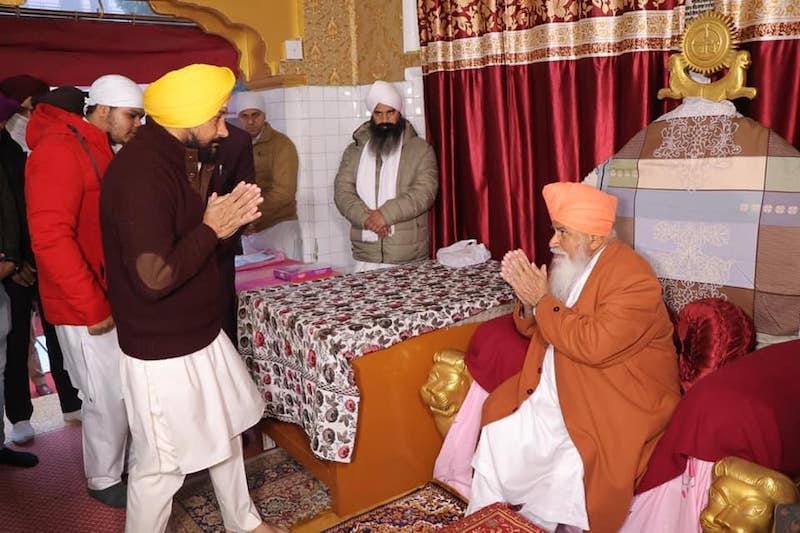
Punjab chief minister Charanjit Singh Channi (left) pays obeisance to Dera Sachkhand Ballan head, who goes by the name Satguru Swami Niranjan Dass, on 26 January 2022. The Ravidassia shrine is in Jalandhar, Punjab. – Photo: GuruRavidassGuruJi.com
By Paramjit S. Judge | Opinion |
It has become a trend to talk about religious deras in the context of the politics of Punjab. This fad has caught on to such an extent that many media outlets regularly write and comment on how the heads of certain deras influence voters to support particular parties. Much of this so-called influence seems overstated and reflects a misunderstanding of the role of deras. In reality, the latent implication of this talk about dera influence is that the people of Punjab are so politically naive as devotees and so ignorant of political realities that they follow their religious leaders, even those who can boast of a mere few thousand followers.
The issue of deras in Punjab politics has never been analysed from an altogether different perspective: the obvious question should be whether the deras need political patronage for their sustenance.
To understand deras and politics, we need to make sense of the political economy of religion, from which they are inseparable. Most deras in India have allegiance to one or another religious tradition in Hinduism and Sikhism, although, in Islam too, Sufi saints have similar meeting places. Further, when combined with major religious centres, deras become a multi-billion economy that primarily draws its wealth from the offerings and donations of devotees and followers. As a result, deras accumulate tremendous unrecorded wealth through which they expand, adding more and more chunks of land to their kitty. Their wealth fosters within deras certain profane—in contradistinction to the sacred construction of their religious tradition—needs, which keep growing ever-higher, forcing dera chiefs to take an interest in politics.
It is essential to know how to understand the deras of Punjab within the framework of electoral politics. Note that Punjab has around 10,000 deras, but experts mention mostly mention only four when it comes to their influence on elections: the Dera Sacha Sauda headquartered at Sirsa (Haryana), the Radha Soami Satsang based in Beas, the Dera Sachkhand Ballan near Jalandhar, and the Bhaniarawala Dera of Ropar. The Dera Sacha Sauda and Radha Soami Satsang are eclectic in terms of their religious calling, in the sense that their preachings tend to syncretise Sikh and Hindu religious traditions. As a result, their followers include people belonging to both communities and all caste groups. On the other hand, the Dera Sachkhand Ballan has an exclusive following from the Chamar caste.
Read the full article, ‘Myth of Decisive Influence of Deras in Punjab Politics’ (NewsClick, 28 Jan 2022), here.
The author was a professor of sociology at Guru Nanak Dev University, Amritsar, and is a former president of the Indian Sociological Society. The views are personal
ASIA SAMACHAR is an online newspaper for Sikhs / Punjabis in Southeast Asia and beyond.Facebook | WhatsApp +6017-335-1399 | Email: editor@asiasamachar.com | Twitter | Instagram | Obituary announcements, click here
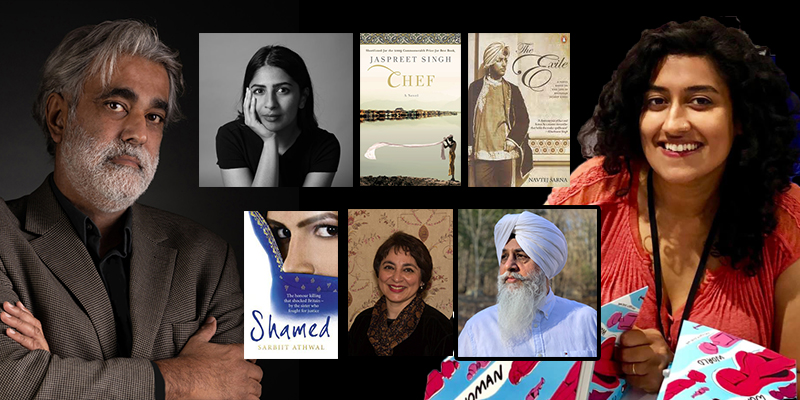
I have scores more of names like these. Do you recognize any or many of them? I suspect you don’t. They are all published Sikh writers in English, some are on bestseller lists, others are accomplished authors, and others are making their way up.
Juxtapose the fact that many of us Sikhs don’t even recognize most of them, against our constant complaint that our stories are not being told adequately to the world! The refrain I hear almost every day is – when will we tell people across the globe about 1947 or 1984? Or about the historical Farmer’s Movement that ended only a few weeks ago with reverberating results.
Well, we don’t have any dearth of talented and skilled story-tellers amidst us, trust me. Fiction. Non-fiction. Essayists. Poets. Short story writers. Biographies and Autobiographies. History. Memoirists. Plays. Children’s literature.
But I am sad to say that we have failed to support them. If their books don’t sell, publishers will not publish their books again. And our stories will then only be heard from those who do not know them well enough or have no interest in telling them honestly and accurately.
So, here’s my first New Year’s resolution this January. I have promised myself that I will buy at least one book by a Sikh author every month. That doesn’t mean that I won’t buy or read books by other authors or those in the Punjabi language, for example. The more the merrier, but no matter what, I’ll add at least one Sikh author to my home library each month.
A caveat: I don’t have to like or agree with the content of these books. It is the collection of points-of-view, especially from diverse and divergent perspectives, that’ll help present the Sikh world-view with integrity and all its complexities.
Imagine. If all the readers alone of this column will join me in this project, it’ll bring a sea-change to our stories out there that so urgently need to be told … in quantity and quality. It requires so little from us. We don’t have to look for best-sellers. Simply: if it is a new or unknown or emerging Sikh writer, let’s support them. Go home and read them. And share them with your friends and family. Better still, buy more copies of the ones you like and gift them.
A Happy, Safe & Healthy New Year to you and your loved ones.
T. Sher Singh is a writer, editor and publisher at sikhchic.com. The Sikh media portal, now undergoing a major overhaul to bring it up-to-date with the latest gadgets, aims to be up by Spring. This article first appeared at his LinkedIn page
ASIA SAMACHAR is an online newspaper for Sikhs / Punjabis in Southeast Asia and beyond.Facebook | WhatsApp +6017-335-1399 | Email: editor@asiasamachar.com | Twitter | Instagram | Obituary announcements, click here