Writers usually provide translations when quoting Gurbani. This is to aid readers not well versed in Gurmukhi or Gurmat. I would be lost without the English translation!
But are we told whence they come from?
If the translation is not our own, but taken from elsewhere, we should attribute the source. But this is not widely practiced at this point of time, except when writing papers for research journals.
Why does this matter?
Well, translation plays a critical role for many of us to understand Gurmat. Many are unable to decipher Gurbani independent of translations. We rely heavily on them to help us make sense of Gurbani. Majority of the present day translations are in Panjabi, Hindi or English.
When we inject translations into our writing; we should credit the translator. This serves at least two purposes. One, attribution. In research and writing, attribution is an essential rule. You inform your readers as to the source of the information or statement. Second, honesty. We should declare the source of the translation. If it is not our own, we state the source.
FOR MORE ARTICLES ON GURBANI TRANSLATIONS, CLICK HERE
If the Gurbani translation shapes heavily the way a writer understands Gurbani, then attribution matters all the more. Translations are not value-free. They are influenced by the worldview of the translator or translators. This worldview, in turn, impacts directly how a verse from the Guru Granth is presented. Things can get lost in translation. A comparison of available translations will attest to this. They do differ, especially when you compare the earlier work with the more recent ones. Here is one example of a new kid on the block when it comes to Gurbani translation.
If you’re attempting to discuss a topic anchoring on Gurbani, translation then plays a critical role. I’ve seen lengthy articles, purportedly discussing some issue at hand, peppered with Gurbani and its English translation plucked without attributing its original source. If you take away the English translations, some of the articles end up hollow. It’s well and fine if the writer had studied the Guru Granth, and subsequently placed before us verses which he or she had deliberated (vichaar). But what if the writer merely did a word search and pulled out verses based on the English translation matches? Say, I want to write on death. I punch ‘death’ into one of the many available online Gurbani search engines. Walla! In an instant, I got more 1,200 results for my search. I cherry pick a dozen or so verses and weave them into an article. In today’s copy and paste culture, that is very much a possible scenario.
But if the writer provides his own translation, then he is adding value to the article. An article with a single Gurbani verse accurately translated and well explained is worth its weight in gold.
So, the next time we quote Gurbani, let us attribute the source for the translation. This may just prod us to better understand the Guru Granth.
Hb Singh is a Kuala Lumpur-based journalist with some experience in dealing with Sikh organisations, both from within and outside.
* This is the opinion of the writer, organisation or publication and does not necessarily represent the views of Asia Samachar.
ASIA SAMACHAR is an online newspaper for Sikhs / Punjabis in Southeast Asia and beyond.Facebook | WhatsApp +6017-335-1399 | Email: editor@asiasamachar.com | Twitter | Instagram | Obituary announcements, click here |
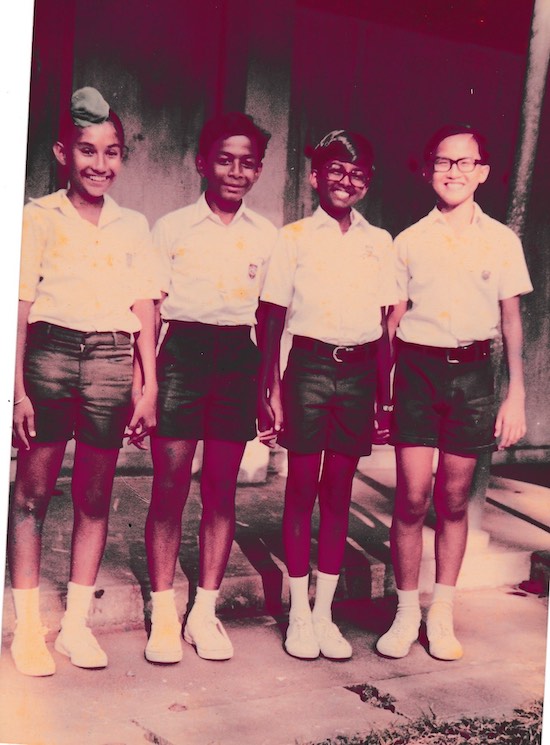
Malaysian-based trainer Tejwinder Singh shared a photo of him and three classmates taken just over four decades ago to depict the Malaysia in which he grew up.
It was tagged to the Malaysia Day celebration on Sept 16. This is the day when the Federation of Malaya joined Singapore, Sabah and Sarawak to form Malaysia in 1963. Singapore subsequently left the new federation two years later.
“This is a photograph with my classmates, Murshidee, Soma and Khai Ming from the year 1980. We had our ‘muhibah’ spirit then, now and forever! SELAMAT HARI MALAYSIA!,” he wrote in an entry at his personal Linkedin page.
“We still keep in touch by WhatsApp, noisy chatrooms, still like little boys,” Tejwinder remarked in response to a comment. “When I was young, used to stay in the police barracks, we were like a big family, whatever race, lots of respect – beautiful.”
He also shared the following poem with the photo.
MALAYSIAN SWEET DREAM
Sweet dreams are made of this Who am I to disagree I travel around our beautiful country Everybody’s looking to live in harmony
All of them want to believe you All of them want to get respected by you All of them want to befriend you All of them want to trust you
Hold your head up, we are proud of you Hold your head up, we adore you Hold your head up, moving on Hold your head up, moving strong.
ASIA SAMACHAR is an online newspaper for Sikhs / Punjabis in Southeast Asia and beyond.Facebook | WhatsApp +6017-335-1399 | Email: editor@asiasamachar.com | Twitter | Instagram | Obituary announcements, click here |
International communications consultancy Hume Brophy has appointed Malminderjit Singh as its regional content lead and senior account director for its Southeast Asia operations.
Malminderjit, who has more than 15 years of experience in media, communications and public policy, was most recently the digital news editor at Channel News Asia (CNA). Among others, he was previously a journalist at The Business Times and an executive director at the Singapore Indian Chamber of Commerce and Industry (SICCI).
In his new role, the announcement said Malminderjit will support the firm’s Asian offices and global leadership by spearheading and implementing new content strategies and products for Hume Brophy’s clients and its internal branding. He will also draw on his vast experience in public policy, academia and strategic communications, including as an opinions editor, to position clients as thought leaders in their respective fields.
With an in-depth knowledge of media know-how, public policy and digital media, Malminderjit will enhance Hume Brophy’s offerings to clients across the globe, it added.
On the community front, Malminderjit has played an active role for many years now. In November 2020, he was appointed as chairman of the Sikh Advisory Board (SAB), a conduit between the Singapore government and the estimated 12,000 strong Sikh community.
ASIA SAMACHAR is an online newspaper for Sikhs / Punjabis in Southeast Asia and beyond.Facebook | WhatsApp +6017-335-1399 | Email: editor@asiasamachar.com | Twitter | Instagram | Obituary announcements, click here |
Spouse: Jagjit Kaur Kahlon d/o Late Hardev Singh Kahlon
Son: Laganpreet Singh Sidhu
All Family and Friends.
You will be remembered as a loving husband, a nurturing father, and a wonderful brother in law, brother and uncle. You were the pillar of our family and we take comfort in knowing that you have found your rightful place in heaven.
For enquiries, please contact: Sarbjit Singh (012-5656676) or Jagjit Singh (019-6998055)
We are eternally grateful to our family and friends for sharing our grief. Thank you for the support and prayers.
| Entry: 17 Sept 2021 | Source: Family |
ASIA SAMACHAR is an online newspaper for Sikhs / Punjabis in Southeast Asia and beyond.Facebook | WhatsApp +6017-335-1399 | Email: editor@asiasamachar.com | Twitter | Instagram | Obituary announcements, click here |
Political leader Jagmeet Singh is the ‘closest thing’ to a present day Robin Hood for Canadians preparing to vote in a snap national polls on Monday (Sept 20).
The leader of the New Democratic Party (NDP), a social-democratic federal political party trying to break the hold of two larger parties, has been splashed on the cover of a Canadian weekly.
“In this year’s Canadian election, the closest thing to Robin Hood is NDP Leader Jagmeet Singh, who’s the politician most eager to take from the rich. And in his world, there are two Sheriffs of Nottingham protecting the oligarchs — Liberal Leader Justin Trudeau and Conservative Leader Erin O’Toole,” reads the article in The Georgia Straight. The dashing Jagmeet was on the cover page.
The Georgia Straight is a free Canadian weekly news and entertainment newspaper published in a large ‘tabloid’ format in Vancouver, British Columbia, by the Vancouver Free Press Publishing Corp.
Prime Minister Trudeau called for the general elections two years early in an attempt to seek a fresh mandate for his handling of the Covid-19 pandemic. He was leading a minority government.
The article pulled up a quote of what told Jagmeet told reporters on September 11 during a campaign stop in Vancouver Granville.
“One of the key problems that we’re highlighting—whether it’s with the climate crisis, whether it’s with a rigged economy, or whether it’s with housing—we’re saying really clearly, ‘The billionaires are making out like bandits.’ Whether that’s in the housing market or the biggest polluters or in the economy: those at the very top continue to exploit the system, and Liberals and Conservatives have let them do it.”
“Our offer to Canadians, what makes us really different is, we’re going to take them on directly,” Singh continued. “We’re the only party that’s said we’re going to tax the billionaires. We’re going to take on the superwealthy. And we’re going to make sure companies like Amazon start paying their fair share.”
With Singh’s oft-stated mantras about taxing the ultrarich and the billionaires, he has positioned himself outside the boundaries of traditional Liberal-Conservative thinking, the report said.
In addressing these issues, the article said that Jagmeet has demonstrated his Robin Hood approach through various policy prescriptions, including a one percent wealth tax on those with assets of $10 million or more. This, he claims, would generate about $13 billion per year in revenue by the fifth year of an NDP federal government.
Also under a federal NDP government, people earning more than $210,000 in annual income would face a top marginal tax rate of 35 percent, up from 33 percent. It’s not a huge hike, but enough to send a signal that this NDP is more inclined to pluck the wealthier geese to a greater degree than either Trudeau or O’Toole, the report added.
In addition, it said Jagmeet has proposed boosting capital-gains taxes on investors in the stock market by lifting the inclusion rate from 50 percent to 75 percent. This means that investors would have to multiply any gain by this amount to determine their taxable capital gain. It’s a move that the NDP says will generate more than $10 billion per year in the final two years of its five-year fiscal plan.
ASIA SAMACHAR is an online newspaper for Sikhs / Punjabis in Southeast Asia and beyond.Facebook | WhatsApp +6017-335-1399 | Email: editor@asiasamachar.com | Twitter | Instagram | Obituary announcements, click here |
Life is a journey, people come and go, but the emptiness you leave in our lives is unbearable. You were a fighter, the pillar of strength of the family.
You leave us with all the beautiful memories. Your love is still our guide, although we cannot see you, you’re always at our side. Our iron lady…
Till we meet again……
* In light of the current MCO and SOPs, the cremation will be a private affair.
We thank you for your kind understanding.
For enquiries, please contact: Perdip Singh at 012-672 5880
We are eternally grateful to our family , relatives and friends for sharing our grief. Thank you for the support and prayers.
| Entry: 17 Sept 2021 | Source: Family
ASIA SAMACHAR is an online newspaper for Sikhs / Punjabis in Southeast Asia and beyond.Facebook | WhatsApp +6017-335-1399 | Email: editor@asiasamachar.com | Twitter | Instagram | Obituary announcements, click here |
“Do you want to play a game”, the supercomputer WOPR asks in the movie WarGames, on the verge of starting a thermonuclear war destroying the world. The movie was about a hacker who unwittingly accesses a United States military supercomputer (WOPR) programmed to predict and execute nuclear war against the Soviet Union.
I was 10, and instantly fell in love with the idea, while watching the movie, that being a hacker would be a really cool thing. My uncle had afforded a personal computer way back in the 80s, and I was already in love with playing computer games on it. I could see myself as the teenager in the movie playing computer games that never looked different to what I was playing in my uncle’s house.
My heart was set to being a computer whizz.
Then, in 1992, with my own 486 PC my father had bought for me to pick up new skills and use this new phenomenon known as the internet, the movie Sneakers came out. It turbocharged my hacker dream. I was hooked onto the notion of taking control of complex systems owned by governments and corporations that many of us couldn’t trust those days.
The Matrix came out in the year 1999. I was 24 years old and had just graduated with a degree in Computer Sciences. It had struck a chord with many, including myself, for the ultra cool portrayal of a hero raging and rebelling against the machines designed to harvest energy from our minds.
The protagonist or hero, Neo, was an accomplished hacker who could see past the virtual reality he was living in all his life. This romantic notion resonated with me, having learned and getting pretty good at programming software code during my uni days. Being a hacker was the ultimate notion, in my mind, to rebel against Big Brother (or organizations exercising total control over our lives) breaking into systems and stealing the rich for the poor.
Although I did become a programmer, I never got to becoming a hacker, unfortunately. But there was the joy of creation, from lines of code written, appearing as something attractive on the computer screen. As I matured, the rebel in me died a natural death.
But the Matrix trilogy also resonated with my spiritual beliefs. That we are living in some virtual reality, unbeknownst to us what true reality is. That there is this pervasive force that keeps us and our bodies together, the spark that is life. And if we can harness looking past the veil of untruthfulness, we can bend some laws of nature. Our mind can be a powerful weapon, if we conquer it with peace and one-mindedness. Conquer our mind, and we can conquer the world. These ideas were all prevalent in the movies, and fortified the spiritual beliefs that had begun to permeate in my mind when I started exploring the mysticism of the Sikh spirituality.
What stayed with me from all these movies – shaping my vision of who I wanted to grow up to be – was the idea that our humanity would, or should, always prevail over how technology slowly becomes entrenched in our lives. Technology, naturally, improves our lives. Yet, it also makes us all too dependent on it. Every facet of our lives today, whether we like it or not, is held hostage to the use of technology. Life would be a living hell without technology. Yet, we try our very best to remain humane, to cherish our relationships with our close ones, and to remain spiritual however we can. We try to do all this despite technology. We are also raging against the machines, just like Neo in the movies.
Some of us choose to take the red pill, to unlearn things about ourselves and to challenge ourselves to be better humans, to be better to each other. Some of us choose to keep taking the blue pill, stay the same, consume everything in our path, taking for granted how short our lives are.
I can’t wait for the next installment of The Matrix series coming out in December this year. To fall in love again with those spiritual messages that I saw decades ago. To relive the inspirational feelings again.
Jagdesh Singh, a Kuala Lumpur-based executive with a US multinational company, is a father of three girls who are as opinionated as their mother
* This is the opinion of the writer, organisation or publication and does not necessarily represent the views of Asia Samachar.
ASIA SAMACHAR is an online newspaper for Sikhs / Punjabis in Southeast Asia and beyond.Facebook | WhatsApp +6017-335-1399 | Email: editor@asiasamachar.com | Twitter | Instagram | Obituary announcements, click here |
Malaysian student Sahana Kaur is all passionate about climate actions, human rights, and sustainable development. Her passion and deep involvement has earned her a seat at a three-day youth climate change conference in Milan this month.
Sahana, 17, will join another another Malaysian student, Mogesh Sababathy, 23, at Youth4Climate: Driving Ambition which begins on Sept 28. The event is hosted by Britain in partnership with Italy.
When asked why she is involved in climate-related activities, Sahana told Asia Samachar: “I think it’s important for people to get involved in climate action today because the policies and decisions made now are going to have long-lasting implications. Besides holding institutions accountable for climate-related progress, I think that getting involved in climate action also helps push forward adaptation to climate change on a grassroots level.”
She means it when she says that people should get involved. Sahana is a member of Dewan Muda Malaysia in the Ministry of Energy and Climate Change and the Malaysian Youth Delegation. She is also involved with Amnesty International Malaysia where she serves as the chair of the Youth Committee and the youth representative to the Global Assembly.
At the 2021 UNFCCC May-June Climate Conference, she spoke at bilaterals between climate negotiators and YOUNGO (the UNFCCC’s children and youth constituency). She also delivered an intervention about Article 6 of the Paris Agreement on behalf of YOUNGO.
In July this year, she co-organized YOUNGO’s 2021 Action for Climate Empowerment Youth Forum, which brought together over 740 youth virtually, reached 130 countries, and produced policy-based outputs to feed into the new ACE Work Programme to be negotiated at COP26.
Sahana, now preparing for the A-levels examination, is a recipient of the Diana Award and the EARCOS Global Citizenship Award.
The Milan conference, which starts on Sept 28, is a prelude to the United Nations Conference of Parties Climate Change Conference (COP26) in Glasgow in November.
ASIA SAMACHAR is an online newspaper for Sikhs / Punjabis in Southeast Asia and beyond.Facebook | WhatsApp +6017-335-1399 | Email: editor@asiasamachar.com | Twitter | Instagram | Obituary announcements, click here |
Husband: Late Sdr Rangit Singh (Pindh Bhai Ke Feffre), Klang
Children: Nerinder Kaur
Son in Law: Sathiswaranji
And Family members
Funeral Details: 16 Sept 2021 (Thursday). Arrival at Jalan Loke Yew Crematorium, Kuala Lumpur. at 1pm. Last respects and Japji Sahib path at 1pm to 2.30pm. Saskaar / Cremation at 2.30pm
Due to the current MCO and prevailing SOPs, we have to comply with a restricted number of attendees.
Path da Bhog: 25th September 2021 @ Gurdwara Sahib Selayang Baru 9am to 11.30pm
Contact:
Harjit Singh Thunda 011 – 1627 9054
Nerinder Kaur (Daughter) 012 – 222 2413
| Entry: 16 Sept 2021 | Source: Family
ASIA SAMACHAR is an online newspaper for Sikhs / Punjabis in Southeast Asia and beyond.Facebook | WhatsApp +6017-335-1399 | Email: editor@asiasamachar.com | Twitter | Instagram | Obituary announcements, click here |
J. Levine Judaica midtown Manhattan 30th Street store closed in June 2019. The store, which Levine calls the oldest Jewish bookstore in the country and was the last of its ilk in Midtown, did not fall victim to soaring rents but to two other powerful trends: assimilation and the growing prevalence of online sales, reported The Online Jewish Week – Photo: Levine Facebook page
By I.J. Singh | Opinion |
This essay is a revised version of one written some years ago. The Big Apple – New York City’s Manhattan – now has a brand new gurduara; I think it is the first community space for Sikhs in the city. My regret is that, having spent many decades in it, it happened after I moved out of the city.
Just two blocks from it stands a musty old building, with its best days behind it, with the modest logo: J. Levine Co. 1890, Judaica.
I entered and a whole new world opened.
Years ago, the New York Times (November 25, 1991) noted: “J. Levine & Company is not the typical old-fashioned religious bookstore. The showroom has marbled floors, polished chrome and glass cases with blue neon trim. On display are hand-painted mezuzahs, Batman and Ninja Turtle yarmulkes, and gold and silver menorahs.”
It’s a place where they still love books. Arts Judaica for all your Jewish needs. Danny Levine, the fourth-generation scion of the family now manages this richly embellished labor of love that claims to house the world’s largest collection of Judaic books and paraphernalia.
“I’ve found that people are looking today for presentation or atmosphere,” said the owner. “His sales,” he said, “had doubled over the last three years and went up 10 percent in one year.” The store also carries religious articles and furniture for synagogues and operates a successful mail-order service. Apparently, diversification has made the store recession-proof.
The store is chock full of books on a variety of topics from the Jewish perspective. Themes range the gamut, from serious theology and cook books to gay and lesbian Jew, to intermarriage in Soviet Jewry, humor and photography. A new book on or about Judaism or Jewish life is published every month or less.
The many “Christian Book & Gift” shops that dot the landscape of this country and continent are the Christian counterparts to J. Levine, the place for the Jewish world of arts.
Walk into any Christian book store; the kindness and smiles of the staff will overwhelm you. Piped in music greets you and soothes the soul; the aura instantaneously awakens the senses and transports you into a different universe with pleasant aromas that waft in to welcome you.
What better greeting for a visitor?
There are books and religious gift-items galore. Everything is tastefully displayed such that even “window shopping” becomes both pleasant and instructive. The plethora of medallions and artifacts can become preachy but one can find books on the variety of human experience and issues that confront us in life – from drug addiction, psychosocial and sexual issues to bioethical concerns or the history and interpretation of Christian doctrines like the import of Crucifixion. The staff is most helpful and knowledgeable. I briefly encountered such lasting ruminations not so long ago.
Now for a very different experience. Amidst a brutal winter, I was in India at a conference for a week. At my request the sponsors arranged my stay in the YMCA – right in the shadow of the historic Bangla Sahib Gurduara in Delhi. I wanted the proximity of the gurduara to be refreshing, energizing and available; Bangla sahib was barely a five-minute walk from the Y.
What caught me was the stark contrast in energy, attitude and worldview exemplified by the two adjoining centers – the Christian YMCA and the Sikh Gurduara Bangla Sahib. Keep in mind that my observations are a few years old.
Half a dozen YMCA or YWCA buildings abut the entrance to Bangla Sahib. Every Christian edifice displayed huge, larger than life billboards that you couldn’t miss if you tried. They advertised services – from the religious with cake and bake sales (I was there during the Xmas season) to books and lessons in sewing for women, ESL (English as a second language) classes, tutorials in mathematics and science, driving lessons and instruction in tennis, golf, swimming and self-defense; even computer skills could be learned for a nominal sum. Signs touted a safe modestly priced residence for single working women, irrespective of religion, caught in the din and hyper-madness of the big city.
And the books, both fiction and non-fiction, ranged from poetry to cooking and, of course, a large choice on or about Christianity; they were not just modestly priced but cheap, like 3 or 4 for a hundred Rupees — about two for a dollar.
Who wouldn’t be attracted? To get customers a business has to first catch and hold the eye; religion is no different. And then the seller works on building loyalty and repeat business.
In contrast, Bangla Sahib had a special strongbox on display and a larger-than-life sign to solicit donations for gold plating of the building. True, that this may have been there only for a few weeks or so. There were billboards nearby within the gurduara premises – for prayer services at various deraas or other gurduaras for warding off evil spirits and bad omens. Heaven only knows what they have to with Sikhi.
There were a few private business stalls just outside the gurduara perimeter hawking CD’s of hymns, breviaries (gutkas), patkas, kirpans, karras and other paraphernalia of a Sikh life. The space was small and crowded, the merchandize not attractively or openly displayed but piled on top of each other – only the sales staff could handle it; they alone knew where to find something. One had to know exactly what to want and ask for; there was no room to sit or browse. It is as if “window shopping” is an alien idea. User friendly these stalls are not.
As large and rich as it is Bangla Sahib has no bookshop in or near it but another massive historical gurduara nearby – Rakabganj — does. So, I trekked out to that. It’s also the headquarters of the Delhi Sikh Gurdwara Management Committee (DSGMC) — an eye-catching, expensively constructed monument fashioned largely in marble and granite.
No signs directed me to the bookshop which is in the basement and reached via a wide swirling and majestic marble staircase. I don’t know the amount of space allocated to the book shop in square feet but it is beyond impressive.
Books were stacked in one huge hall in several spacious aisles. But the lighting was so dim that reading seemed both difficult and unwelcome. Books were in cloth-wrapped bundles with a couple of copies from each bundle sitting atop of each package. I failed to detect any order to their display – by author, title or topic. One would be lucky to find something one is looking for.
In summary, the bookshop was housed in a poorly lit basement, with no cataloging. Pick a book and stroll around and you just won’t remember where to put it back or pick another copy.
Only one man seemed to know where any and every book could be found, and that is a credit to his phenomenal memory and dedication. But pity the poor visitor if he saw a book somewhere and now wanted to revisit that area again.
On content I would rate the shop near a ten on a scale from one to ten but in being user friendly I would be falling off the chart on the other end.
I wish this bookshop was in a busy public space where Sikhs and non-Sikhs congregate or travel about and, even more importantly, if it could become user friendly in presentation and organization. To start even minimal cataloguing and signage, a few comfortable chairs and good lighting would do wonders.
There is no functioning lending library in Bangla Sahib, Rakabganj or any other gurduara anywhere in this wide world that I know of. Dear readers, before you take umbrage at my angst keep in mind that the operative idea here is “functioning lending library.”
Parenthetically, I have to add that both these historic gurduaras do have a functioning and busy medical clinic. I also heard of a multi-million dollars plan for a huge state of the art medical facility near Rakabganj. I celebrate this much needed facility in today’s India.
North America boasts of over 200 gurduaras but I have yet to see one with a functioning library or a book shop. Yes, many gurduaras have a collection of books that remain uncatalogued and behind closed doors inaccessible to everyone except for an hour or two on Sundays. In time, most books slowly but surely disappear. And I wonder who selects the books; there appears to be little thinking directing their acquisition.
I am aware of only one facility that I would dub half-way decent book shop for Sikh literature and artifacts in North America and that is the Sachha Sauda in downtown Toronto – not attached physically to any gurduara.
Once again, because it has many books and other paraphernalia – the contents rate an “A” but not always the presentation. In user friendliness it pales. One has to cover one’s head to walk in and remove one’s shoes, even though it is a bookshop and not a gurduara.
Because of its location it can and does attract people off the street as any shop should — mostly Sikhs but a fair number of non-Sikhs, too. Unfortunately, its organization and lay out does not encourage the casual and the curious to walk in and just thumb through what is available. Window shopping is not the norm. Sachha Sauda, our one-of-a-kind book shop in North America, like J. Levine, has a healthy mail order business as well.
Mind you, and I want to emphasize this, with Sachha Sauda we have come a long way forward. It’s just that we have a longer way to go. My brief negative notations about it here are not meant to disparage or diminish it but to propel it further forward.
Keep in mind that just about every town in North America has a Christian bookstore. Also, don’t forget that every two-bit town in this country has a secular book shop, and a lending library; practically all of them have a section on religion where Christian and Jewish literature is easily found. One can also find a book or two on Hinduism and Islam, with a growing collection on Buddhism, but it is as if Sikhism doesn’t even exist.
The story of most public libraries is similar. They may stock a few books on Sikhism that are mostly dated or poor representations of Sikhi. We have, at times, undertaken to donate and deliver collections of often poorly chosen books to libraries. They were gratefully accepted and then a year or two later, junked. Why? Simply because they were taking valuable shelf space and showed no evidence of usage. No one ever took them out. Frankly our community does not make for habitual readers.
Considering that in my house books seem to grow like crab grass I should have heeded the dubious axiom that “books like friends should be few and well chosen.” But I never have. Ergo, I thirst for the Minerva Book Shop in Shimla, India that whetted my appetite for books over 60 years ago, and sometimes I think longingly of the musty smells of the Strand in New York City that boasts of eight miles of books.
My mind went to a pithy and brief comment by Danny Levine, the manager of the 121 years old J. Levine Company with which I started this column today: “I want the store to be the Henri Bendel of Judaica,” he said. “People should feel, wow, this is Judaism at its best.”
What a wonderful idea!
Exactly as I envision how Sachha Sauda and the Rakabgunj Book Shop might be transformed with a bit of imagination and a modicum of effort – and soon. And then may they clone rapidly all over the world.
But should we not be working on awakening the love of books first? And where does that start except in a family and school? And secular schools are not going to encourage the reading of and about Sikhi, nor should we expect them to.
The easiest way to teach the love of reading is to show that you have that love of reading within you. The most difficult, almost impossible, task is to try to teach what one does not know, does not do, or does not value.
Forget not, words come in books and that Sikhi is a way of life for which the Word is the eternal living Guru.
I.J. Singh is a New York based writer and speaker on Sikhism in the Diaspora, and a Professor of Anatomy. Email: ijsingh99@gmail.com.
* This is the opinion of the writer, organisation or publication and does not necessarily represent the views of Asia Samachar.
ASIA SAMACHAR is an online newspaper for Sikhs / Punjabis in Southeast Asia and beyond.Facebook | WhatsApp +6017-335-1399 | Email: editor@asiasamachar.com | Twitter | Instagram | Obituary announcements, click here |

























 By Asia Samachar| Singapore |