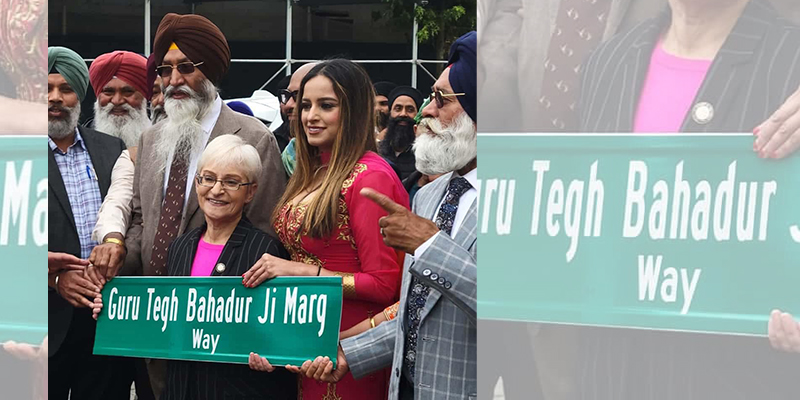
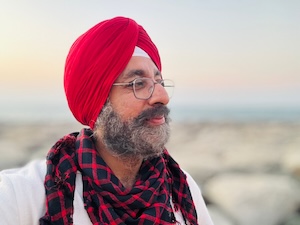
A South Richmond Hill street in New York has been named Guru Tegh Bahadur Ji Marg
By Asia Samachar | United States |
South Richmond Hill, a New York neighborhood known as Little Guyana for its large Indo-Caribbean American, has named a street in honor of Guru Tegh Bahadur Ji — the 9th Guru of the Sikhs, a saint-warrior who gave his life to defend religious freedom.
“His martyrdom is one of history’s greatest acts of courage in the face of persecution.
“Proud to stand with our Sikh community at the 114th Sikh Temple as we unveiled Guru Tegh Bahadur Ji Marg. Special thank you to Council Member Lynn Schulman and all our community leaders who made this historic moment possible,” says Jeniffer Rajkumar, the New York state assemblywoman for District 38, in a social media update.
ASIA SAMACHAR is an online newspaper for Sikhs / Punjabis in Southeast Asia and beyond. You can leave your comments at our website, Facebook, Twitter, and Instagram. We will delete comments we deem offensive or potentially libelous. You can reach us via WhatsApp +6017-335-1399 or email: asia.samachar@gmail.com. For obituary announcements, click here
ASIA SAMACHAR is an online newspaper for Sikhs / Punjabis in Southeast Asia and beyond. You can leave your comments at our website, Facebook, Twitter, and Instagram. We will delete comments we deem offensive or potentially libelous. You can reach us via WhatsApp +6017-335-1399 or email: asia.samachar@gmail.com. For obituary announcements, click here
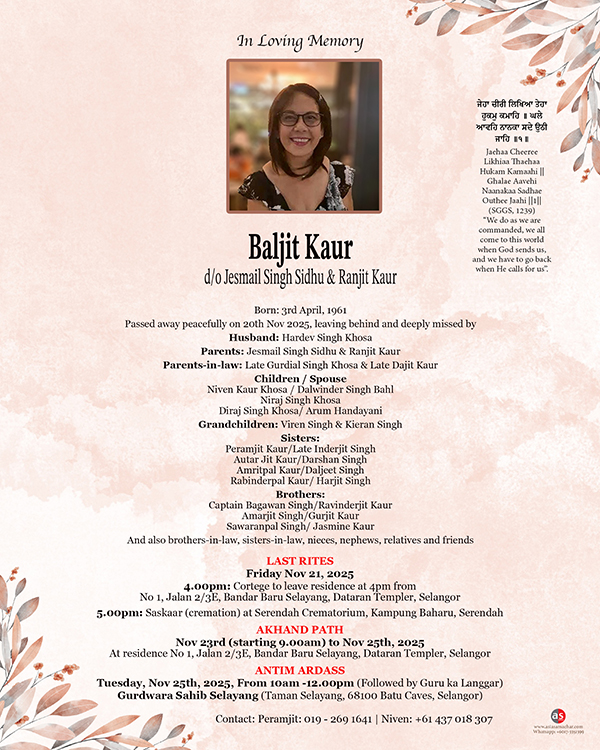
And also brothers-in-law, sisters-in-law, nieces, nephews, relatives and friends
LAST RITES Friday Nov 21, 2025 4.00pm: Cortege to leave residence at 4pm from No 1, Jalan 2/3E, Bandar Baru Selayang, Dataran Templer, Selangor 5.00pm: Saskaar (cremation) at Serendah Crematorium, Kampung Baharu, Serendah
AKHAND PATH Nov 23rd (9.00am) to Nov 25th, 2025 At residence No 1, Jalan 2/3E, Bandar Baru Selayang, Dataran Templer, Selangor
ANTIM ARDAS: Gurdwara Sahib Selayang Taman Selayang, 68100 Batu Caves, Selangor Tuesday, Nov 25th, 2025, From 10am -12.00pm Followed by Guru ka Langgar
ASIA SAMACHAR is an online newspaper for Sikhs / Punjabis in Southeast Asia and beyond. You can leave your comments at our website, Facebook, Twitter, and Instagram. We will delete comments we deem offensive or potentially libelous. You can reach us via WhatsApp +6017-335-1399 or email: asia.samachar@gmail.com. For obituary announcements, click here
A special screening of a documentary capturing the making of this series will be held in Kuala Lumpur, alongside two talks by the Sikh filmmaker, at a leadership seminar on Saturday, 22 November 2025 (8:30am–12:30pm).
By Asia Samachar | Malaysia |
You may have heard of the monumental work of Amardeep Singh’s 24-episode Guru Nanak docuseries. How did it take shape? What were the lessons learnt?
A special screening of a documentary capturing those moments will be held alongside two talks by the Sikh filmmaker at a leadership seminar on Saturday (22 Nov 2025, 8.30am to 12.30pm) in Kuala Lumpur.
Amardeep is the creator of the acclaimed docuseries “Allegory: A Tapestry of Guru Nanak’s Travels.”
Amardeep’s first book and sequel capturing Sikh legacy in Pakistan –
Photo / Sarjit Kaur
Earlier, he brought alive, compelling images and heart-warming stories in two books –‘LOST HERITAGE The Sikh Legacy in Pakistan and THE QUEST CONTINUES: LOST HERITAGE The Sikh Legacy in Pakistan’.
Now, Malaysians will get to view a yet-to-be released documentary on his travels, entitled UNFOLDING IDENTITY, RECLAIMING HERITAGE.
The 35-minute film draws from the creative process of the making of the Guru Nanak docuseries entitled ‘Allegory, A Tapestry of Guru Nanak’s Travels’, a dive deep into Guru Nanak’s profound message of the Oneness of Creation — an insight that transcends boundaries of religion, geography and identity. This presentation was delivered in March 2025 at the Royal Ontario Museum, Toronto, Canada.
At the one-day event in Kuala Lumpur, Amardeep will present two talks: Guru Nanak – An Embodiment of Oneness as well as Think Like a Sage, Act Like a Leader.
Fascinating Find: Amardeep Singh and his team at a railway station with a name almost identical to Bhai Mardana, the constant travel companion of Guru Nanak (Episode 14). The Maradana Railway Station, located in a suburb of Colombo, is one of the primary railway hubs in the country. – Photo: Photograb from Episode 14 of the Allegory: A Tapestry of Guru Nanak’s Travels
WISDOM TO LEADERSHIP
22 Nov 2025 (8.30am to 12.30pm)
Venue: Asia Pacific University, KL
Join the visionary filmmaker behind the award-winning Guru Nanak docuseries, whose storytelling has captivated global audiences.
2. Hear from the trailblazing author who, over a decade ago, carried out the first-ever pioneering documentation of Sikh heritage sites across Pakistan.
3. Engage with the thought-leader invited by Harvard University to share fresh insights on modern leadership models drawn from the timeless wisdom of Indic Saints.
* Session 1: Guru Nanak – An Embodiment of Oneness * Session 2: Think Like a Sage, Act Like a Leader
ASIA SAMACHAR is an online newspaper for Sikhs / Punjabis in Southeast Asia and beyond. You can leave your comments at our website, Facebook, Twitter, and Instagram. We will delete comments we deem offensive or potentially libelous. You can reach us via WhatsApp +6017-335-1399 or email: asia.samachar@gmail.com. For obituary announcements, click here
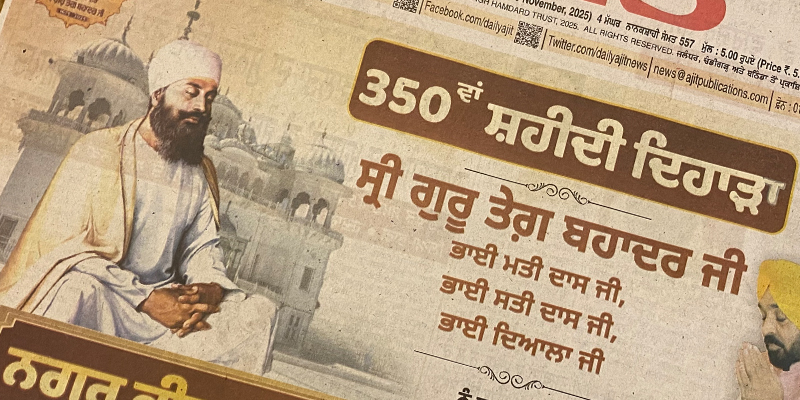
An advertisement in a Panjab newspaper by the state government to commemorate the 350th Shaheedi Divas of Guru Tegh Bahadur – Photo: Asia Samachar
By Gurmukh Singh | Opinion |
ਧਰਮ ਹੇਤ ਸਾਕਾ ਜਿਨਿ ਕੀਆ
For the righteous cause, He performed the epic deed (Guru Gobind Singh, Bachittar Natak)
A martyrdom to stabilize the world (Bhai Gurdas Singh II, Vaar 41 Pauri 23)
Guru Tegh Bahadur made the supreme sacrifice for dharam, the righteous cause to save and stabilize the world. The wearers of tilak and janju (paste-mark and sacred thread), the Hindus, were saved in the process as willed by Waheguru. That means that saving of the Hindu religion was a consequence of the Guru upholding the dharmic principle.
Saving Hindu religion was not the prime objective of the great deed in the Age of Kalyug (ਕੀਨੋ ਬਡੋ ਕਲੂਮਹਿ ਸਾਕਾ। ) The prime objective of Guru Tegh Bahadur was to save dharam. Otherwise, the janju or janeu had been rejected by Guru Nanak Sahib as a symbol of the oppressive high/low caste system. Through this episode, Guru Tegh Bahadur defended not just Hinduism but all religions. He defended the principle that all had the right to practise their religion and way of life.
Together with evidence from Bhatt Vahis and Assamese Buranjis and other sources, the true story of the Shaheedi and the role of the Brahmins and Ulema (Muslim clergy) of northern India begin to emerge.
Assamese Buranjis are ancient historical records from Ahom kingdom in Assam. These records show that Guru Tegh Bahadur had a large following and his Darbar was stately. From these and Persian sources, Indian text book historians (NCERT types) drew their highly biased conclusions about the reasons for the arrest and martyrdom of Guru Ji.
Probably the best researched publication is by Prof. Fauja Singh in 1975 (see footnote). The Buranjis refer to the complaints by the Muslim ulema and Brahmin priests to the Mughal emperor against the preaching tours of Guru Tegh Bahadur which started in 1656, 10 years before His Guruship.
Prof. Fauja Singh writes: According to it [Buranji] orthodox Brahmins and illemas were feeling greatly upset over the powerful impact of the Guru’s teachings on the people at large and they complained to the Emperor that he was vitiating the whole atmosphere.
Following these complaints, the Emperor commissioned Alam Khan Pathan to arrest him, which he did on 8 November 1665 (Katik Sudi II, 1772, Bhat Vahi). That was the first arrest. The Buranji account refers to 30,000 Nanakpanthi Sipahis assembled with the Guru. Obviously, there are some inaccuracies in this account, which may be explained by the long distance which intervened between the place of recording and that of actual happening. Still the basic idea of this account cannot be ruled out.
Thus, contrary to traditional understanding, the life-style of Guru Ji was saintly, yet stately. Like his Father-Guru, Hargobind, he was a trained saint-warrior. He took care of weapons as a matter of daily routine and kept up his interest in horse-riding and hunting.
The Brahmins, despite their earlier complaints about the preaching tours of Guru Ji, were desperate. They were well aware of the great influence of Guru Nanak, the Guru of the Hindus and the Pir of the Muslims. Guru Nanak, Guru Har Gobind and Guru Har Rai, had visited the valley of Kashmir and there were Sikh sangats in the area. Thus, Kashmiri Brahmins linked to Guru-Ghar, led the deputation to seek protection from Guru Tegh Bahadur.
The above are some pointers to further research as we commemorate 350th Shaheedi Divas of Guru Tegh Bahadur.
** Guru Tegh Bahadur Martyr and Teacher, PU, 1975 pages 35,36)
Gurmukh Singh OBE, a retired UK senior civil servant, chairs the Advisory Board of The Sikh Missionary Society UK. Email: sewauk2005@yahoo.co.uk. Click here for more details on the author.The article first appeared at Panjab Times, UK
* This is the opinion of the writer, organisation or publication and does not necessarily represent the views of Asia Samachar.
ASIA SAMACHAR is an online newspaper for Sikhs / Punjabis in Southeast Asia and beyond. You can leave your comments at our website, Facebook, Twitter, and Instagram. We will delete comments we deem offensive or potentially libelous. You can reach us via WhatsApp +6017-335-1399 or email: asia.samachar@gmail.com.
University of Warwick students tying turbans for fellow students at their Langgar event
By Gurnam Singh | Opinion |
According to Sikh doctrine, to place food in the mouth of a hungry person is to serve the Divine itself (“ਗ਼ਰੀਬ ਦਾ ਮੁਹ, ਗੁਰੂ ਕੀ ਗੋਲਕ।”).
The most powerful material expression of this principle is the Langar, or free community kitchen, which stands as a defining institution of Sikh Gurdwaras across the world. Its most extraordinary manifestation is found at the Darbar Sahib in Amritsar, Punjab, where an estimated 100,000 people from all faiths and none are fed around the clock each day. The meal is always vegetarian, always free, and prepared entirely through voluntary labour and donations. It is service as devotion, and devotion as service.
On a far smaller scale, but in the same spirit, we recently held the second annual Langar on Campus at the University of Warwick, organised by the Sikh Society and supported by Langar Aid, an international NGO committed to serving the homeless, the vulnerable and those living in poverty across the UK. One might reasonably ask whether students and staff at a prestigious university are in need of food aid. But to frame Langar merely as the distribution of free food is to misunderstand its purpose entirely.
Although deeply embedded in Sikh tradition, Langar’s roots extend back into the Sufi traditions of Islam. The very word ‘Langar’ comes from Persian, meaning “anchor” or “resting place.” Historical sources show that free kitchens were maintained in Sufi centres, Khanqahs, as early as the 12th and 13th centuries. As Kathleen Seidel notes in her essay Serving the Guest: A Sufi Cookbook, travelling Sufis often relied on the hospitality of communities for shelter and sustenance. In response, networks of Khanqahs evolved into community kitchens and hostels offering food and refuge to all regardless of faith, background or status.
With the arrival of Guru Nanak in Punjab, this ethos was expanded and institutionalised. The foundational story of Sacha Sauda (“The True Bargain”) captures the heart of the Langar tradition. Given twenty rupees by his father to turn a profit, the young Nanak instead encountered a group of hungry sadhus. Convinced that feeding the hungry was the highest form of gain, he used all the money to buy, cook and serve them a complete meal. Returning home empty-handed, he explained that the true bargain was one that served humanity. In that moment, Guru Nanak replaced the logic of commerce with the logic of compassion, turning charity, equality and collective service into the central pillars of a new social vision.
Langar, then, is far more than a charitable meal. It is a living expression of an egalitarian, socially conscious and ecologically grounded worldview. It invites us to imagine and to practise a radically different social order in which food, dignity and community are not privileges but fundamental rights.
Imagine a world where Langar’s principles replace the logic of scarcity and competition, a world where equality is practiced daily at the food table. In this light, Langar becomes a practical utopian vision where the human right to food is actively implemented. Although Sikh teachings enshrined this principle in the 15th century, global recognition of the right to food only emerged in the mid-20th century, notably in the 1948 UDHR and later in the 1966 ICESCR.
Extending beyond the practical act of serving free food, the Langar is also a political and ethical project that proposes a world in which service replaces competition, generosity replaces greed, and the barriers of race, religion, caste, ethnicity, gender, ability, sexuality and economic status simply dissolve in the act of eating together. At a time defined by global warming, ecological crisis and the catastrophic consequences of unchecked consumption, Langar offers not only a spiritual ideal but an urgently relevant social model. It counters the extractive mindset that has driven the planet to its limits, replacing it with a culture of sufficiency, responsibility and interdependence.
At its core, Langar reminds us that food is a fundamental human right and hunger a profound social injustice rather than an inescapable reality. It underscores that scarcity is too often manufactured through political decisions and entrenched patterns of inequality, rather than arising from any true lack of resources. Langar also reveals that sustainability is not a distant ideal, but a discipline cultivated through simple daily practices: cooking in fellowship, sharing generously, minimising waste, and stewarding collective resources with intention and care. In its gentle yet powerful way, Langar challenges the logic of disposability and overconsumption that fuels environmental degradation as well as social inequity.
Most importantly, Langar demonstrates that community is forged not through the accumulation of personal wealth, declarations or doctrines, but through practical actions of shared labour, wealth, humility, and love. In a warming world where climate disasters fracture societies and intensify inequality, the Langar hall stands as a living model of resilience, compassion, and human solidarity. It teaches us that the path forward lies not in isolation or accumulation, but in mutual support, whether material, social, or spiritual, that we consciously extend to one another.
And while Langar promotes a vision of society grounded in mutual care, such a vision ultimately requires each of us to overturn the vice of personal greed and dishonest earning in favour of the virtue of collective welfare. Bhai Gurdas, whose writings (the Vaaran) are regarded as the most authoritative interpretation of Sikh teachings articulates this ethical imperative with clarity by proclaiming that “Through righteous work and living, one should earn, and from one’s earnings, one should feed and sustain others as an act of service.” (“ਕਿਰਤਿ ਵਿਰਤਿ ਕਰਿ ਧਰਮ ਦੀ ਖਟਿ ਖਵਾਲਨੁ ਕਾਰਿ ਕਰੇਹੀ।”)
Gurnam Singh is an academic activist dedicated to human rights, liberty, equality, social and environmental justice. He is an Associate Professor of Sociology at University of Warwick, UK. He can be contacted at Gurnam.singh.1@warwick.ac.uk
* This is the opinion of the writer and does not necessarily represent the views of Asia Samachar.
ASIA SAMACHAR is an online newspaper for Sikhs / Punjabis in Southeast Asia and beyond. You can leave your comments at our website, Facebook, Twitter, and Instagram. We will delete comments we deem offensive or potentially libelous. You can reach us via WhatsApp +6017-335-1399 or email: asia.samachar@gmail.com. For obituary announcements, click here
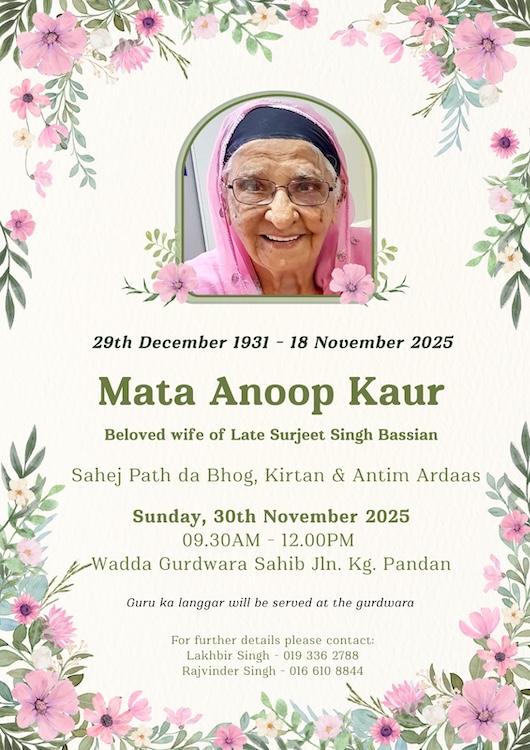
With heavy hearts, we announce the passing of our beloved
MATA ANOOP KAUR
29.12.1931 – 18.11. 2025
Beloved wife of Late Surjeet Singh Bassian
Children & Spouses Lakhbir Singh & Jasbir Kaur Hardeep Kaur & Neil Davis Manmohan Kaur (Moni) & Late Jaswinder Singh Karamjit Kaur (Kamay) Carer – Mabel Moga Grandchildren and Great Grandchildren
SAHEJ PATH DA BHOG, KIRTAN & ANTIM ARDAAS Sunday, 30th November 2025 From 09.30AM – 12.00PM Wadda Gurdwara Sahib Jalan Kampung Pandan, KL Guru ka Langgar will be served at the Gurdwara
For further details please contact: Lakhbir Singh – 019 336 2788 Rajvinder Singh – 016 610 8844
| Entry: 19 Nov 2025; Updated: 23 Nov 2025 | Source: Family
ASIA SAMACHAR is an online newspaper for Sikhs / Punjabis in Southeast Asia and beyond. You can leave your comments at our website, Facebook, Twitter, and Instagram. We will delete comments we deem offensive or potentially libelous. You can reach us via WhatsApp +6017-335-1399 or email: asia.samachar@gmail.com. For obituary announcements, click here
ASIA SAMACHAR is an online newspaper for Sikhs / Punjabis in Southeast Asia and beyond. You can leave your comments at our website, Facebook, Twitter, and Instagram. We will delete comments we deem offensive or potentially libelous. You can reach us via WhatsApp +6017-335-1399 or email: asia.samachar@gmail.com. For obituary announcements, click here
Nearly half of the state’s voters are women and Bihar – which has seen a steady increase in their numbers over the years – recorded its highest female voter turnout in history at 71.6% this year. Both alliances had offered financial assistance schemes to woo women, reported BBC. – Photo: Nitish Kumar Facebook
By Harmeet Shah Singh | Opinion |
India’s Bihar has delivered a result that looks regional but speaks far beyond its borders.
Patna, the birthplace of Guru Gobind Singh Sahib, sits at the centre of the present-day eastern state that has chosen a coalition built on widening support.
Analysts often dwell on Bihar’s caste blocks. These patterns still matter, but the verdict mirrors a wider shift.
The political right is redrawing democratic maps across continents.
President Donald Trump’s resurgence in the United States. The pull of Nigel Farage and Tommy Robinson on British policy under Prime Minister Keir Starmer. Prime Minister Narendra Modi’s Bharatiya Janata Party and its National Democratic Alliance shaping India’s political climate. Different countries. Same direction of travel.
Social media once promised openness. It instead forged sharper identities and rewarded leaders who thrive in polarised environments.
Public sentiment now moves like a firm current. It draws people toward nationalism and muscle.
Rahul Gandhi in India and Zohran Mamdani in New York represent contrasting models of political presence. One seeks acceptance through moderation. The other represents a different latitude of politics. Neither model alone can navigate the rising tide of majoritarian power. They answer to local constituencies. Supremacist politics, however, listens to a wider frequency.
Bihar reflects this unambiguously. Voters credited new roads, reliable power, construction-led jobs and a sense of identity that stretched beyond caste.
They sensed an upward shift, however minimal, and reinforced the leadership that delivered it.
Across the world, majorities tend to consolidate when they perceive movement in their favour. Bihar shows it in real time.
Lessons from Bihar
Voters responded to what they could see and touch. They recalled a Bihar where electricity faded a few miles from Patna and roads failed without warning. They now travel on improved highways, witness new power plants and see the first signs of industry after decades of drift.
Therefore, they back the structure they could see taking shape, rather than short-lived slogans about vote theft, caste counts or anti-capitalist attacks on establishment-aligned tycoons. When people sense even modest improvement, they guard the engine that creates it. This instinct repeats itself across democracies.
American voters back leaders who promise fortresses and revival. British voters respond to nationalism framed as recovery. Indian voters support a blend of pride and central authority. Bihar fits that global script.
Sikhs in This Climate
For Sikhs, this moment demands careful reading. The political right governs or influences many places where Sikhs live or seek to build futures. It shapes immigration, policing, national security and public perception. A careless act in one country or region can spark consequences in another. The world now operates like a single acoustic chamber.
The episode in the United States earlier this year exposed the scale of this challenge. Trump’s action against undocumented immigrants became a show of force.
Visibly identifiable Sikhs were filmed without turbans, handcuffed, and flown to Amritsar on a military aircraft. The images were stark. But the wider Sikh community in the United States did not respond with the force it often shows on civil liberties in India. Sikh lawmakers and activists across the Anglosphere stayed restrained.
Communities often retreat when they fear political cost. Many may not feel immediate empathy for new migrants labelled Fresh Off the Boat. Others may worry that speaking out invites the attention they hope to avoid. These choices reflect the pressures of the political moment.
The Price of Selective Caution
But caution, when selective, creates a dilemma. When a community exercises restraint during a moment of public humiliation, it cannot then use reckless rhetoric in other theatres.
Words travel quickly. They cast long shadows. A statement made in one city can unsettle conditions in another.
Authorities, political actors and media outlets track such moments closely. The consequences often fall on families far removed from the original event.
This is the responsibility facing visible minorities, Sikhs included. It is a call for strategic thoughtfulness, and not silence. Communities must judge when to speak and how to shape their argument.
The political right studies minority behaviour with precision. It uses misjudged reactions as material for its own narratives. This pattern now shapes the era we inhabit.
Bihar’s vote confirms that majoritarian consolidation will endure. It is not a passing phase.
As majority communities organise around ideas of order, identity and protection, minorities must refine their instincts. They need disciplined communication. They need to limit internal noise. They need to avoid steps that create risk for another Sikh a continent away who shares their appearance or articles of faith.
A New Vigilance
Influencers, organisers and digital voices carry significant weight. Their words move fast. Their messages can alter sentiment far beyond their intended audience.
Responsibility should feel like awareness, not constraint. This is the reality of the age.
Bihar’s result is part of a wider story. Major identities are hardening across continents. These shifts are shaping the rules under which minorities now navigate public life.
Sikhs have endured intense pressure in history. Their strength is intact. What this moment requires is judgement suited to the times.
Navigating the supremacist right calls for steadiness and foresight. It calls for the courage to measure one’s own voice. And this is the task of our time.
Harmeet Shah Singh is a career journalist currently serving as Communications and Advocacy Director at UNITED SIKHS (UK), a charity registered in England and Wales.
* This is the opinion of the writer and does not necessarily represent the views of Asia Samachar.
ASIA SAMACHAR is an online newspaper for Sikhs / Punjabis in Southeast Asia and beyond. You can leave your comments at our website, Facebook, Twitter, and Instagram. We will delete comments we deem offensive or potentially libelous. You can reach us via WhatsApp +6017-335-1399 or email: asia.samachar@gmail.com. For obituary announcements, click here
Newcomer Gurveen Kaur Chadha decisively defeated the incumbent and other contestants to become the Westmount City Councillor in District 4.
Gurveen won with 487 (52.59%) votes, leaving incumbent and veteran councillor Conrad Peart who garnered only 291 (31.43%). Trailing them were Massimo Mazza with 87 (9.40%) votes and Lynda Lyness came in fourth with 61 (6.59%) votes.
“I know how policy gets built and how strategy is implemented. Now I’m ready to work for the community where I grew up,” Gurveen said in a statement published on her campaign website.
Gurveen was born and raised in Westmount, located on the Island of Montreal in Quebec, Canada.
She studied public policy at Harvard and Dartmouth and has built a career that bridges public policy and the private sector.
In Ottawa, she was Director of Policy to Marc Garneau, Canada’s Minister of Transport, leading policy development and managing complex issues at the national level.
In business, she has led strategy and operations at companies like Shopify and Jobber, and she also co-founded the olive oil shop, Olives en folie, that was on Victoria Ave.
ASIA SAMACHAR is an online newspaper for Sikhs / Punjabis in Southeast Asia and beyond. You can leave your comments at our website, Facebook, Twitter, and Instagram. We will delete comments we deem offensive or potentially libelous. You can reach us via WhatsApp +6017-335-1399 or email: asia.samachar@gmail.com. For obituary announcements, click here