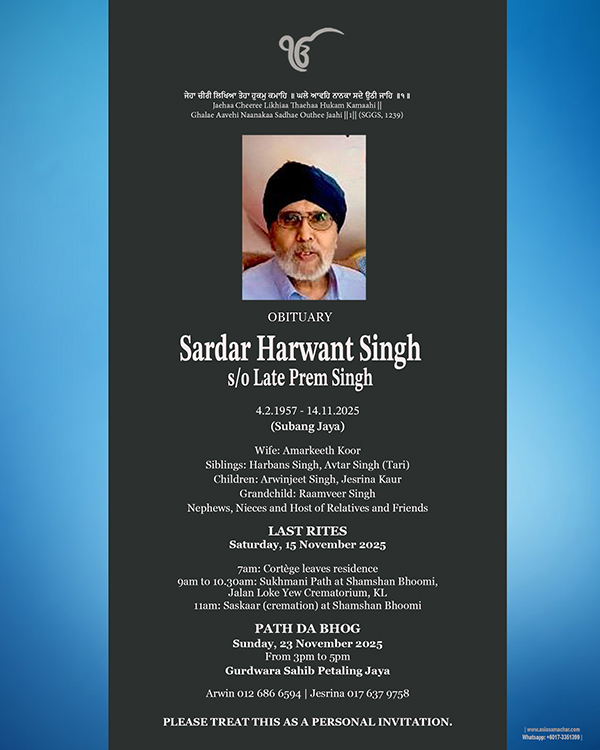
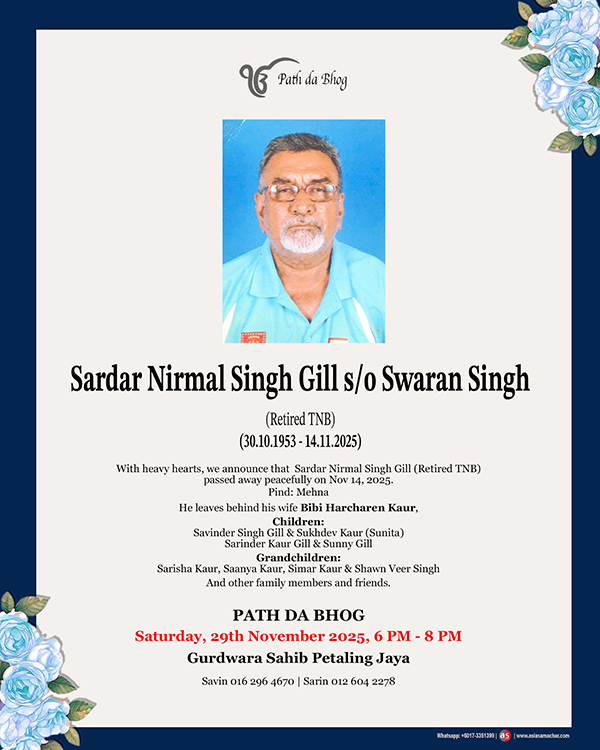
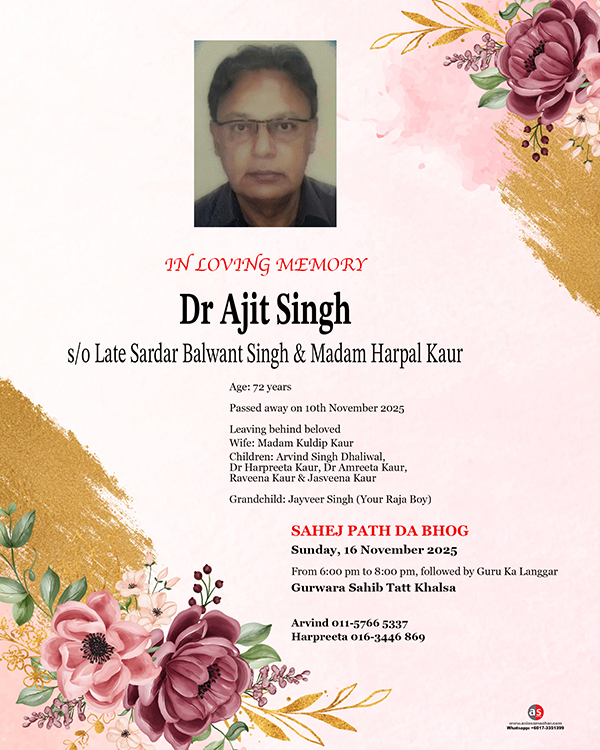
Wife: Amarkeeth Koor Siblings: Harbans Singh, Avtar Singh (Tari) Children: Arwinjeet Singh, Jesrina Kaur Grandchild: Raamveer Singh Nephews, Nieces and Host of Relatives and Friends
LAST RITES Saturday, 15 November 2025
7am: Cortège leaves residence 9am to 10.30am: Sukhmani Path at Shamshan Bhoomi, Jalan Loke Yew Crematorium, KL 11am: Saskaar (cremation) at Shamshan Bhoomi
PATH DA BHOG Sunday, 23 November 2025 From 3pm to 5pm Gurdwara Sahib Petaling Jaya
ASIA SAMACHAR is an online newspaper for Sikhs / Punjabis in Southeast Asia and beyond. You can leave your comments at our website, Facebook, Twitter, and Instagram. We will delete comments we deem offensive or potentially libelous. You can reach us via WhatsApp +6017-335-1399 or email: asia.samachar@gmail.com. For obituary announcements, click here
| Entry: 14 Nov 2025; Updated: 27 Nov 2025 | Source: Family
ASIA SAMACHAR is an online newspaper for Sikhs / Punjabis in Southeast Asia and beyond. You can leave your comments at our website, Facebook, Twitter, and Instagram. We will delete comments we deem offensive or potentially libelous. You can reach us via WhatsApp +6017-335-1399 or email: asia.samachar@gmail.com. For obituary announcements, click here
The Oxford interfaith summit helped Manjit Kaur confront her own assumptions and deepen her understanding of sexuality, faith, and compassion.
She reflects on the silence and prejudice toward LGBT+ people within Punjabi Sikh culture, rooted in taboo and patriarchal attitudes.
Hearing real stories of pain, rejection, and resilience from LGBT+ people of faith moved her to recognise the urgent need for empathy and change.
She calls on Sikh leaders and families to support LGBT+ individuals, emphasising that diversity is natural and aligned with Sikh principles of equality.
She concludes that confronting hate is a moral duty and commits to breaking the silence and advocating for LGBT+ dignity and rights.
Manjit Kaur at the ‘Global Interfaith Commission on LGBT+ Lives’ summer residential symposium at Regent’s Park College, Oxford University, in July 2025
By Manjit Kaur | Opinion |
Earlier this year, I had the profound honour of spending a week at Regent’s Park College, Oxford University, attending the ‘Global Interfaith Commission on LGBT+ Lives’ summer residential symposium. The Global Interfaith Commission on LGBT+ Lives, launched in 2020 with the support of the UK Foreign, Commonwealth & Development Office , was founded by the Ozanne Foundation. The faith leadership initiative was launched in 2024 with the expressed aim to bring influential members from all religious traditions from across the world to engage in open, honest dialogue about sexuality and gender.
Faith ‘leaders’ from all the different religions from across the world were invited to face some of the most complex and sensitive questions of our time: how can religious communities embrace and affirm LGBT+ people while remaining true to their faith? The programme offered a confidential space for participants to learn from leading academics from various fields about the nature of human sexuality and how myths and misconceptions have and are impacting on the human experience in negative ways.
For me, a Sikh woman raised in Britain’s Punjabi community, this experience was transformative. It was not just an academic exercise but a deeply personal journey into empathy, honesty and the moral responsibilities that faith leadership has in addressing this issue and our failings to do so. This short piece, as well as offering my personal reflections, also seeks to be a challenge the whole Sikh community, but especially those in leadership roles to take the issue of LGTB + human rights more seriously.
Breaking the Silence
Engaging with global perspectives was enlightening, but it also forced me to confront some painful truths closer to home: my own community’s silence on the rights and needs of LGTB + people.
In Punjabi Sikh culture, feudal and patriarchal attitudes still linger. Talking about sexuality remains a taboo in most Sikh spaces. Growing up, I heard homosexuality spoken of in whispered tones, often in cruel or insulting language. The subject was swept under the carpet, as though pretending it didn’t exist would make it go away.
As a child, I couldn’t comprehend the hostility I sometimes saw LGBT+ people treated as “odd,” “dirty,” or somehow “less than human.” I had no vocabulary to challenge it. In school, and even within my community, the topic was avoided entirely. That silence shaped my understanding. This led me to grow up believing that being lesbian or gay was not normal and that it represented sinful behaviour and bad choices.
Even as I prepared to attend the Oxford summit, I felt nervous. Would people in my community misunderstand my intentions? Would they see my participation as controversial? Yet, beneath that fear was a stronger determination to listen, to learn, and to bridge divides. Because silence, I have realised, helps no one.
Seeing Humanity First
Thankfully, my nerves soon disappeared as we progressed through each presentation and the small group work which provided a really space to explore our own thoughts and feelings. Through the dialogue, not only did I learn some many new things about the issue of human sexuality, but also the challenges and positive change from all the different faith perspectives.
The Oxford summit gave me the space and courage to truly listen. It reminded me of a training session I attended years ago, where a participant was an openly lesbian woman. At the time, I felt uneasy, shaped by prejudices I didn’t even realise I held. But as the day went on, I saw that she was just like anyone else: kind, loving and deeply human. That small moment planted a seed in my heart, and the Oxford experience helped it grow.
At the symposium, we heard first-hand stories from LGBT+ people of faith from across the world. They spoke of rejection, of being told they could “reverse” who they were, of being exiled from their families and communities. We also heard stories of love and acceptance and reminders that compassion can change everything.
In hearing some of the painful stories of rejection and worse, I felt tearful and ashamed of how our communities can treat people, often their own close family members, in such a cruel way. How narrow-minded have we become? We need to change.
These were not just academic debates about belief; they were real human stories of suffering in silence. And once you see in someone’s eyes their pain, their commitment to faith and their need to belong and right to exist without fear, it becomes impossible to remain neutral and not to be moved.
Faith, Family, and the Future
In 2025, though much of the legislation has changed and technically LGTB + people have their rights protected, in truth many within the Sikh community (and others) still struggle to accept difference. We speak of unity and equality, yet we often fail to practise them. We still label people as “outsiders,” “deviant” or “wrong” because they do not conform to labels.
But the world is changing. Our children are growing up in a global, diverse, interconnected world. Many young Sikhs, like young people everywhere, are far more open-minded. They know that love is love. The question is: will we, as parents, elders and faith leaders, support them or shame them? And sadly, given the much higher levels of self-harm and even suicide, especially amongst young LGTB + people, we need to realise this is not just about human dignity, but life and death!
Instead of acting with care and concern, we end up asking “Is this right or wrong?” But perhaps we should ask, “Would I reject my own child for simply being who they are?”
No one chooses their sexuality; all the research points to this being part of human nature, and this is reflected across the animal kingdom. Nobody choses who they love. No one should live in fear or hide who they are. We, as a community, have the power to make that fear disappear, not with grand declarations, but with simple words: “It’s okay. I’m here for you.”
I am deeply proud of the LGBT+ Sikhs who continue to serve their communities with dignity and faith, some of whom I met during the Oxford summit. Their courage to live truthfully, while trusting in God, inspires me. This is not “evil.” This is not “dirty.” It is human life … and it is sacred.
From Reflection to Action
One of the conditions of participating in the Oxford symposium was that, as a community opinion former, I would use what I had learned to create positive change. Now, I am determined to be more proactive: to speak publicly, to open dialogue and to challenge silence.
Human sexuality is not simply a black and white phenomenon. For sure most people will come to adopt a heterosexual life, but we must acknowledge that, according to current research, as many as 10% of Sikhs will be LGTB +, a figure reflected globally across humanity. That is not a “fringe.” It is part of who we are. If we as Sikhs of the Guru truly believe what we ask for in our daily prayer, namely, “sarbat da bhalla” or “prosperity and blessings for all”, then it must include everyone, not just those who fit a narrow definition of what might be regarded as ‘normal’.
When it comes to human diversity, there is no normal. All human beings, male or female, gay or straight, were created by the divine creative force (God). We all belong to the same species and therefore, in one sense, we are all biologically the same in that we are distinct from other animals. But we all different, each human being on this planet is both physically and emotionally unique, and some those unique differences change over time as we develop as human beings, from childhood, to adult hood and eventually old age.
Writing this article is my first step. I know criticism may come. But truth requires courage. Silence is no longer an option.
The Moral Duty to Confront Hate
Hate is among the most destructive of human emotions. It poisons not only relationships and communities, but also the very soul of those who allow hate to shape their lives. Thankfully, in my experience most people are not hateful; they are simply misinformed, fearful or trapped in cultural conditioning.
Our duty, as faith leaders and as human beings, is to confront hate wherever it arises but to do so with compassion. Victims of hate need solidarity; perpetrators also need help in the form of education and empathy. But we must never allow the small minority who spread hate to silence the majority who prefer the path of love.
While Punjabi culture reflects the context of its times on a whole range of matters, because our Guru chose to confront hateful and discriminatory practices, Gurbani offers a vision of acceptance and love. It speaks of equality, of the divine presence in all beings, and of unconditional love. These teachings leave no room for discrimination. From this foundation, I feel completely justified and duty bound to stand for the rights of LGBT+ people to live free from fear and oppression, and to live with dignity.
Manjit Kaur, is a presenter at Britain-based Panjab Broadcasting Channel and a columnist for Asia Samachar. She can be contacted via email at manjitkaur1show@gmail.com
ASIA SAMACHAR is an online newspaper for Sikhs / Punjabis in Southeast Asia and beyond. You can leave your comments at our website, Facebook, Twitter, and Instagram. We will delete comments we deem offensive or potentially libelous. You can reach us via WhatsApp +6017-335-1399 or email: asia.samachar@gmail.com. For obituary announcements, click here
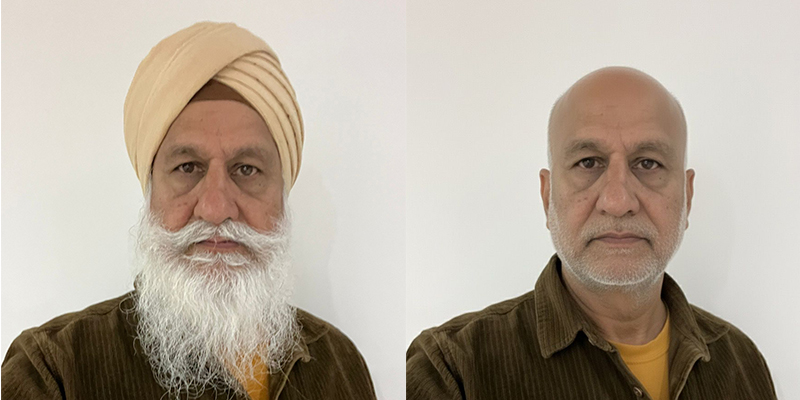
Two images of Gurnam Singh. One shows his authentic self with turban, uncut hair and beard; the other is generated by artificial intelligence, depicting him without them.
By Gurnam Singh | Opinion |
Our physical appearance is often the first thing people notice about us, yet for many Sikhs, the turban, uncut hair and beard are far more than outward symbols. They represent a deep spiritual attachment with the Guru, an expression of dignity and a visible declaration of faith.
Recently, I undertook a small personal experiment that revealed just how deeply these symbols have become part of who I am.
Above are two images of me. One shows my authentic self with turban, uncut hair and beard and the other, generated by artificial intelligence, depicting me without them. Out of simple curiosity, I wanted to see how I might react to being clean-shaven, without actually being ‘clean-shaven’!
Though the facial features in the AI-generated image are technically identical, I was shocked when I first saw it. I simply could not recognise myself. The person in that image felt alien; as though the essence of who I am had been stripped away. That moment of discomfort revealed something profound: just how deeply my kesh (uncut hair) has become intertwined with my identity.
When I showed the two images to my wife of 40 years, Manjit, her reaction mirrored my own. She too felt a sense of dissonance, saying she could not associate that clean-shaven face with the person she has known and loved for decades. That response confirmed for me that my Sikh identity, symbolised by the turban and beard, is not merely about appearance, but a reflection of something inward, spiritual and deeply personal.
My Journey into Sikh Identity
To understand why my turban, uncut hair and beard have played such an important role in shaping who I am today, I must share a little of my backstory.
I am now 66 years old. I have kept my kesh since the age of 18, when I made the conscious decision to embrace the full Sikh way of life and take initiation into the Khalsa through the ceremony known as ‘Khande di Pahul’.
At first, the transition was not easy. Most of my friends were clean-shaven, and adopting the turban and beard in the UK during the late 1970s came with its challenges. I encountered a new form of racial prejudice that I had not experienced before. Suddenly, my identity was not just about being South Asian or Punjabi; I was visibly Sikh, a ‘rag head’, and that visibility carried social consequences.
Yet, as my friendship circles changed and my inner resolve strengthened, I grew increasingly comfortable and confident in my new identity. I also found those around me beginning to give me the kind of respect that I didn’t have previously; it was as if I was now being taken seriously by both relatives and old friends.
Over time, what had once made me feel different or excluded became a powerful source of self-assurance and pride.
From Inferiority to Empowerment
Growing up in a Britain marked by casual racism, I had internalised a sense of inferiority. I carried feelings of self-doubt and self-loathing that affected my academic performance and self-esteem. But when I entered university at 18, newly committed to my Sikh identity, something remarkable happened.
Contrary to the fears of some friends and relatives, who were worried that adopting a full Sikh appearance might make me withdrawn or isolated, I found myself expanding my social and intellectual horizons. My turban and beard became symbols of discipline, resilience and moral clarity. Rather than holding me back, they propelled me forward.
Within just five years of keeping my turban and kesh, I had become proficient in Gurmukhi, learnt Raag Kirtan and Tabla to a level where I could perform in the Gurdwara, and even trained in Gatka, the Sikh martial art. I went on to teach others, establishing gatka akharas in three different cities.
Academically, too, my trajectory transformed. From struggling to pass my O Levels and A Levels, I went on to complete my undergraduate studies, two post graduate professional qualifications in Social Work and Training Management, and a Master of Science degree. By my early-thirties, I had embarked on a PhD at the University of Warwick and a full time academic career.
Looking back, I have no doubt that embracing a ‘full’ Sikh identity played a pivotal role in this transformation. It gave me the confidence, discipline and spiritual grounding to excel and flourish — not in spite of my distinct identity, but because of it.
Closing Reflections
The above reflections are personal and in no way intended to imply that those Sikhs who have chosen to cut their hair are in any way inferior. Indeed, my journey into and through Sikhi has taught me not to judge others on the basis of appearance.
However, for me and my own self-identity, my turban and beard are not simply symbols of faith or heritage; they are integral parts of my being. They connect me to my history, my community, and my sense of purpose.
The AI image experiment was a small but profound reminder of that truth. It revealed that identity is not just about how others see us; it’s about how we see ourselves, and what we come to embody through our lived experiences.
In a world increasingly obsessed with appearance and conformity, I am grateful for the gift of kesh, which is a reminder of authenticity, humility, and courage. For me, keeping my turban and beard is not just a matter of tradition; it is a declaration of who I am and what I stand for.
Gurnam Singh is an academic activist dedicated to human rights, liberty, equality, social and environmental justice. He is an Associate Professor of Sociology at University of Warwick, UK. He can be contacted at Gurnam.singh.1@warwick.ac.uk
* This is the opinion of the writer and does not necessarily represent the views of Asia Samachar.
ASIA SAMACHAR is an online newspaper for Sikhs / Punjabis in Southeast Asia and beyond. You can leave your comments at our website, Facebook, Twitter, and Instagram. We will delete comments we deem offensive or potentially libelous. You can reach us via WhatsApp +6017-335-1399 or email: asia.samachar@gmail.com. For obituary announcements, click here
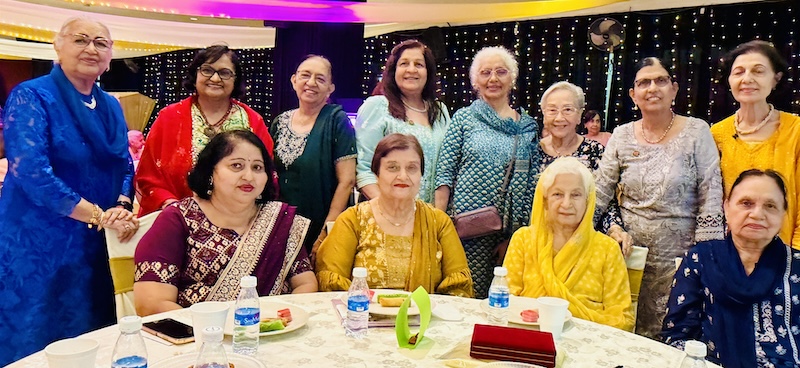
EKTA Hi-Team 2025: A picture of poise pride Punjabi spirit – Photo: Pola Singh / Asia Samachar
By Pola Singh | Malaysia |
If joy had a sound, it would be the laughter echoing through a gurdwara hall in Kuala Lumpur recently which came alive with music, movement and memories as EKTA Club of Kuala Lumpur & Selangor, in collaboration with Tatt Khalsa Diwan, hosted a heartwarming Hi-Tea event themed “Celebrating the Seniors in Our Lives.”
The event at Wisma Tatt Khalsa on 2 November 2025, from 2pm to 5.30pm, wasn’t just another afternoon gathering—it was a tribute to the pillars of our community. With over 100,000 Sikhs in Malaysia, and nearly a third being seniors, it was high time we honoured their legacy with a celebration befitting their contributions. And what a celebration it was!
The crowd? A radiant mix of Sikh mums, aunties, grandmas, sister-in-laws and friends—each one a story, a smile, a spark. Many were aged 75 and above, attending free of charge, while others gladly paid RM60 to be part of this unforgettable experience.
Heart and Humour
The 3.5-hour programme flew by in a whirl of activities that kept spirits high and hearts full:
Yoga Laughter Therapy by Sarjit Kaur reminded us that laughter truly is the best medicine. Watching seniors giggle and stretch with abandon was a gentle nudge to embrace joy, no matter our age.
Fashion Show – Ten graceful ladies took to the stage with poise and flair, proving that style and confidence don’t retire. Their catwalks were less about competition and more about celebration—of self, of sisterhood, of sass!
Geet & Gidha – The rhythmic claps and expressive movements of this traditional Punjabi folk dance brought the room to life. Seniors joined in with gusto, singing and dancing in a beautiful display of cultural pride and communal joy.
Makan & Minum – A sumptuous spread of Punjabi cuisine awaited, and the queue for high tea became a corridor of conversations. Old friends reunited, new friendships blossomed, and the aroma of spices mingled with laughter.
Even those with limited mobility came, determined to soak in the camaraderie. Their presence was a testament to the power of community and the importance of inclusion.
EKTA Hi-Team 2025: Celebrating the seniors in our lives – with style, soul, and smiles – Photo: Pola Singh / Asia Samachar
The hall buzzed with photo ops and video clips—capturing not just faces, but feelings. If the walls of Wisma Tatt Khalsa could speak, they’d tell tales of rekindled friendships, shared memories, and the sheer joy of being seen and celebrated.
Behind the Scenes
The event’s success was no accident. It was the result of tireless planning by a powerhouse committee: Paramjeet Dhillion (Chairperson), Jagdish, Sukhdev, Charan Sandhu, Manjit and Amarjeet. Their dedication ensured every detail sparkled—from the programme flow to the food trays; executing every detail of the event, bringing their laptops and working over numerous cha meetups.
EKTA President Kuldip Kaur lent her unwavering support, embodying the club’s mission to make a difference with heart and purpose. Her mission is not completed until a senior citizens activity centre is set up.
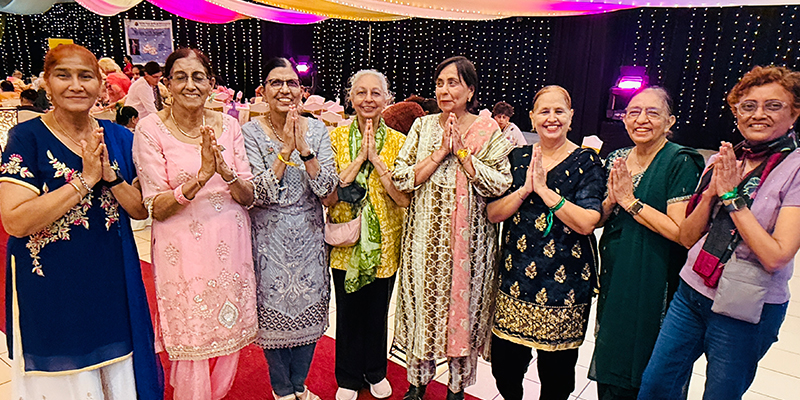
EKTA hit tea 2025: The Women Who Made It Happen – Photo: Pola Singh / Asia Samachar
And what a difference these spirited ladies have made—this being their 10th year of service to the community!
More Than an Event—A Movement
EKTA Club has long been a beacon of empowerment. From raising RM550,000 to establish the first Sikh Senior Citizens’ Activity Centre in the Klang Valley, to honouring outstanding Sikh women and organising youth workshops, their impact is felt across generations.
This Hi-Tea was another jewel in their crown—a reminder that seniors aren’t just our past, but our present and future. Their wisdom, warmth, and wit deserve celebration, not just once a year, but every day.
As for me, I was there to produce a video of this magical afternoon. The warm reception I received, and the kind words from attendees who read my articles, touched me deeply. Writing about seniors—about their lives, their laughter, their legacies—is my way of honouring them. And on this day, they honoured me back.
So to those who missed it: your friends will tell you. The photos will show you. And next year, we hope you’ll join us. Because when seniors gather, magic happens.
Watch this space—EKTA’s dynamic and spirited ladies are just getting started. Syabas and well done.
Dr Pola Singh, who retired as Maritime Institute of Malaysia director-general in 2011, is also the author of ‘Uphill — The Journey of a Sikh-Chinese Kampung Boy
ASIA SAMACHAR is an online newspaper for Sikhs / Punjabis in Southeast Asia and beyond. You can leave your comments at our website, Facebook, Twitter, and Instagram. We will delete comments we deem offensive or potentially libelous. You can reach us via WhatsApp +6017-335-1399 or email: asia.samachar@gmail.com. For obituary announcements, click here
The opening ceremony of Gurdwara Sahib Guru Nanak Shah Alam on 11 Dec 2015 – PHOTO SIKH INSIDE
By Asia Samachar | Malaysia |
Gurdwara Sahib Guru Nanak Shah Alam will be holding a Grand Kirtan Darbar and Akhand Path, from Aug 8 to 14, 2025, to commemorate the shaheedi dehara (martyrdom) of Guru Tegh Bahadur as well as the 10th anniversary of the gurdwara.
“Let us gather as one sangat to remember the supreme sacrifice of Guru Teg Bahadur Ji and to celebrate this milestone of our Gurdwara with kirtan, paath and heartfelt ardas,” the organising team said in a note shared with the Sanggat.
ASIA SAMACHAR is an online newspaper for Sikhs / Punjabis in Southeast Asia and beyond. You can leave your comments at our website, Facebook, Twitter, and Instagram. We will delete comments we deem offensive or potentially libelous. You can reach us via WhatsApp +6017-335-1399 or email: asia.samachar@gmail.com. For obituary announcements, click here
| Entry: 11 Nov 2025; Updated 12 Nov 2025 | Source: Family
ASIA SAMACHAR is an online newspaper for Sikhs / Punjabis in Southeast Asia and beyond. You can leave your comments at our website, Facebook, Twitter, and Instagram. We will delete comments we deem offensive or potentially libelous. You can reach us via WhatsApp +6017-335-1399 or email: asia.samachar@gmail.com. For obituary announcements, click here
Just look at these numbers. By the end of 2024, the fund had allocated close to RM1 million to over 100 students.
The fund offered more than just financial relief—it provided hope, dignity and opportunity. Every ringgit disbursed was in the form of an interest-free loan, easing the burden of tuition and related costs without adding the weight of debt.
In the first nine months of 2025 alone, MSEAF extended RM210,408 to 22 students, continuing its mission to make higher education attainable for those who might otherwise be left behind.
For many, the fund represented not just assistance, but a bridge between hardship and possibility—a community’s way of lifting its own through compassion and collective responsibility.
Since 1951, MSEAF has been helping Sikh students in Malaysia take the next step in their education—with zero-interest loans and a whole lot of community care.
This isn’t just financial aid. It’s a movement. A way for Sikh youth to rise, learn and lead—without being held back by money. Whether you’re aiming for university, college, or a professional course, MSEAF is here to say: we’ve got your back.
From One Parent to Another
When the pandemic struck, that bridge became a lifeline. One parent shared how losing a long-held job nearly derailed her son’s education.
“When Covid-19 hit, I lost my job of 20 years. My son had just started college, and we had already used up most of our savings just to keep the household going. I didn’t know where to turn.”
Despite receiving some support from PTPTN, it wasn’t enough to cover all the costs. PTPTN, or the National Higher Education Fund Corporation, is a Malaysian government body that provides education loans to students pursuing higher education in local institutions.
That’s when he discovered MSEAF.
“A Sikh brother told me about it. Honestly, I had never heard of it before—but what I found was incredible. It was a community fund offering interest-free loans with no strings attached.”
MSEAF in Sentul, Kuala Lumpur
Thanks to MSEAF, his son’s college fees were covered, and he graduated in November 2024.
“Yes, it’s a loan and I’m repaying it, but the peace of mind it gave us—knowing we didn’t have to go to a bank or take on high-interest debt—was priceless.”
For this family, MSEAF didn’t just pay bills; it restored a sense of stability and pride.
Student Testimony: From Struggle to Strength
For one student, MSEAF was the turning point that kept his academic journey alive.
“I didn’t grow up in a wealthy home, and school wasn’t easy. But things changed when I entered Form 4—I started to push myself harder.”
His perseverance paid off. After years of improvement, he was accepted into Monash University. However, financial pressure forced him to drop out.
“It broke me,” he admitted. “I worked odd jobs for six months before finding a place at Raffles University. That’s when I found MSEAF.”
The fund’s support meant he could focus fully on his studies and side projects.
“It made all the difference,” he said. “It wasn’t just money—it was motivation, knowing someone believed in me.”
A Parent’s Gratitude
Another parent echoed that sentiment with heartfelt thanks.
“To the management and staff of MSEAF—thank you for being a lifeline during one of the most difficult times in my life. When I couldn’t afford my son’s education, your support arrived swiftly and with compassion.”
She described the process as simple and respectful.
“I’m a retired B40 parent with no steady income, and I feared my situation might complicate things. But your team guided me with care and clarity. The funds were released exactly as promised, allowing my son to continue his studies without delay.”
That assistance, she said, changed not only her son’s future but her own outlook on life. “Thank you for restoring hope with dignity.”
The Heart of the Fund
MSEAF’s impact reaches far beyond numbers. It represents a shared belief in education as the most powerful tool for upliftment—a belief sustained by the generosity of donors and the integrity of its management. Every student supported becomes a torchbearer for the next, proving that community care can create lasting change.
From parents rebuilding their lives to students rediscovering their potential, the fund continues to stand as a quiet force for good. Its message is simple yet profound: when one Sikh rises, the whole community rises together.
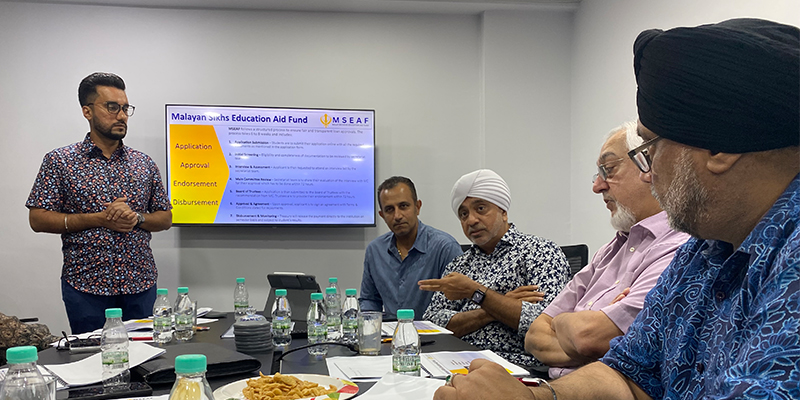
Manraj Singh (let) and team members briefing the fund’s trustees – Photo: Asia Samachar
SOME MESSAGES FROM MSEAF
Our Purpose
MSEAF’s mission is to uplift the Sikh community through education, especially students from lower-income (what is termed as B40 in Malaysia) families.
Education should open doors, not close them. That’s why MSEAF exists—to make sure every Sikh youth has the chance to grow, learn and lead without worrying about the cost.
We focus on:
Providing financial aid loans for deserving students Encouraging academic excellence while reducing financial pressure Offering career guidance and mentorship Building a strong, knowledgeable Sikh community that contributes to society
What We Provide
Loan amounts vary depending on the level of study:
Up to RM15,000 for certificate programs Up to RM30,000 for diploma programs Up to RM50,000 for degree programs
The Impact
Interest-free Loans
By the end of 2024, 103 students had received a total of RM975,692 in interest-free loans covering tuition and related costs.
From January to September 2025, a total of RM210,408 was disbursed for 22 students.
During this period, students made repayments of RM147,848, helping sustain the fund for future applicants.
On average, MSEAF distributes RM23,378 every month – a reflection of both rising demand and the fund’s unwavering commitment to educational access.
17 new applicants have applied for loans estimating RM492,185 which is in the process.
Why MSEAF Matters—And Why It’s Here for You”
Interest-free support: No hidden fees, no profit—just help when it’s needed most. Community-powered: Funded by Sikh donors who believe in education and upliftment. Guidance included: Applicants aren’t left alone—MSEAF walks with you through the process. Sustainable impact: Repaid loans go back into the fund, helping the next student rise.
Contact us:
Malayan Sikhs Education Aid Fund D7-3A-2, Bangunan Perdagangan, D7, 800 Jalan Sentul, 51000 Sentul, Kuala Lumpur Tel: +6019-4091918 Email: apply@mseaf.com Website: www.mseaf.my
ASIA SAMACHAR is an online newspaper for Sikhs / Punjabis in Southeast Asia and beyond. You can leave your comments at our website, Facebook, Twitter, and Instagram. We will delete comments we deem offensive or potentially libelous. You can reach us via WhatsApp +6017-335-1399 or email: asia.samachar@gmail.com. For obituary announcements, click here
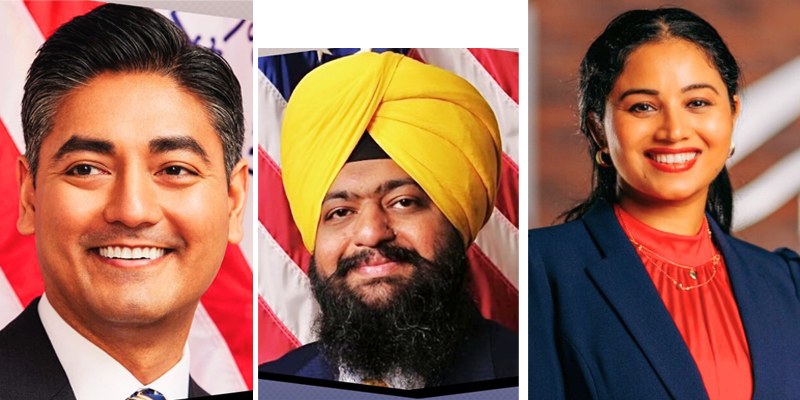
US local election winners (L-R): Cincinatti mayor Aftab Pureval, Norwich mayor Swaranjit Singh Khalsa and Satwinder Kaur for Kent Council
By Asia Samachar | United States |
Two Sikhs were elected as mayors, and at least five others won seats in state assemblies and local councils in recent local elections across the United States.
Aftab Pureval was re-elected as the Mayor of Cincinnati, Ohio, while Swaranjit Singh Khalsa won the race for Mayor of Norwich, Connecticut.
Aftab, the son of a Punjabi father and a Tibetan refugee mother, made history in 2021 as Cincinnati’s first Asian American mayor. This will be his second term as mayor of Cincinnati, the third-most populous city in Ohio, with a population of more than 309,000.
The 43-year-old attorney and politician defeated Pastor and coffee shop owner Cory Bowman, the half-brother of Vice President JD Vance, by a wide margin, securing 78% of the vote in the November 4 elections.
In Norwich, Swaranjit made history as the first Sikh to be elected mayor of the city, which has a population of just over 40,000.
The 40-year-old businessman and real estate professional moved to the United States in 2007 after his family fled the anti-Sikh violence of 1984 in India.
“I’m grateful to God, our country, and our community for allowing me this opportunity. This victory belongs not to me, but to everyone who gave the priceless gift of their belief and encouragement. It is a testament to the enduring power of the American Dream—and to the millions who still have faith in it,” Swaranjit said in a Facebook post.
Balvir Singh was re-elected to the State Assembly from District 7 (Burlington, New Jersey), while Ravi Singh Bhalla was elected to the New Jersey Assembly from the 32nd District (Jersey City and Hoboken).
Ravi, a civil rights lawyer and politician, has served as the 39th Mayor of Hoboken, New Jersey, since 2018. In 2017, he was elected as New Jersey’s first Sikh mayor.
Also elected were Kim Singh (Mason City Council, Mason, Ohio) and Satwinder Kaur (Kent City Council Position No. 2, Kent, Washington), while JJ Singh was re-elected as a delegate in the Virginia House of Delegates (26th District, Virginia).
ASIA SAMACHAR is an online newspaper for Sikhs / Punjabis in Southeast Asia and beyond. You can leave your comments at our website, Facebook, Twitter, and Instagram. We will delete comments we deem offensive or potentially libelous. You can reach us via WhatsApp +6017-335-1399 or email: asia.samachar@gmail.com. For obituary announcements, click here
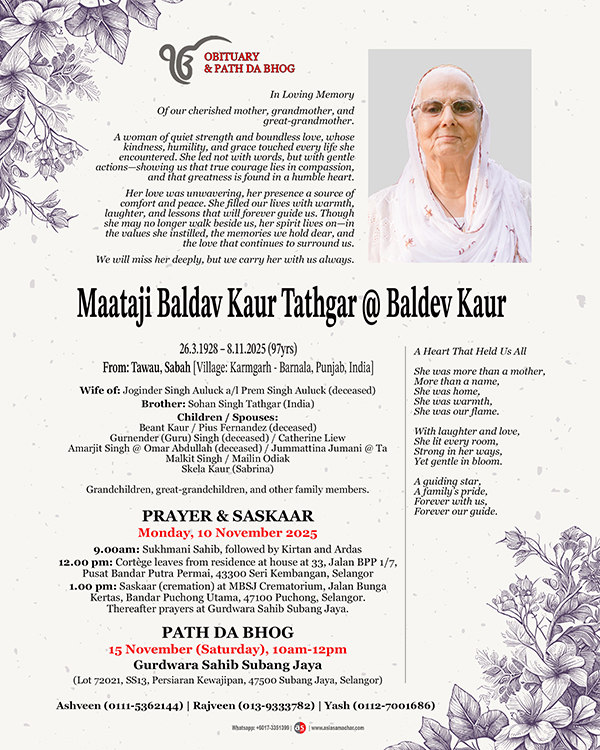
In Loving Memory Of our cherished mother, grandmother, and great-grandmother. A woman of quiet strength and boundless love, whose kindness, humility, and grace touched every life she encountered. She led not with words, but with gentle actions—showing us that true courage lies in compassion, and that greatness is found in a humble heart. Her love was unwavering, her presence a source of comfort and peace. She filled our lives with warmth, laughter, and lessons that will forever guide us. Though she may no longer walk beside us, her spirit lives on—in the values she instilled, the memories we hold dear, and the love that continues to surround us. We will miss her deeply, but we carry her with us always.
Children / Spouses: Beant Kaur / Pius Fernandez (deceased) Gurnender (Guru) Singh (deceased) / Catherine Liew Amarjit Singh @ Omar Abdullah (deceased) / Jummattina Jumani @ Ta Malkit Singh / Mailin Odiak Skela Kaur (Sabrina)
Grandchildren, great-grandchildren, and other family members.
PRAYER & SASKAAR Monday, 10 November 2025 9.00am: Sukhmani Sahib, followed by Kirtan and Ardas 12.00 pm: Cortège leaves from residence at house at 33, Jalan BPP 1/7, Pusat Bandar Putra Permai, 43300 Seri Kembangan, Selangor 1.00 pm: Saskaar (cremation) at MBSJ Crematorium, Jalan Bunga Kertas, Bandar Puchong Utama, 47100 Puchong, Selangor. Thereafter prayers at Gurdwara Sahib Subang Jaya.
PATH DA PHOG Gurdwara Sahib Subang Jaya (Lot 72021, SS13, Persiaran Kewajipan, 47500 Subang Jaya, Selangor, Malaysia) 15 November (Saturday), 10am-12pm
ASIA SAMACHAR is an online newspaper for Sikhs / Punjabis in Southeast Asia and beyond. You can leave your comments at our website, Facebook, Twitter, and Instagram. We will delete comments we deem offensive or potentially libelous. You can reach us via WhatsApp +6017-335-1399 or email: asia.samachar@gmail.com. For obituary announcements, click here