ASIA SAMACHAR is an online newspaper for Sikhs / Punjabis in Southeast Asia and beyond. You can leave your comments at our website, Facebook, Twitter, and Instagram. We will delete comments we deem offensive or potentially libelous. You can reach us via WhatsApp +6017-335-1399 or email: asia.samachar@gmail.com. For obituary announcements, click here
Dr Rasvinder Singh all set for his appearance at Delhi historical gurdwaras
By Asia Samachar | India |
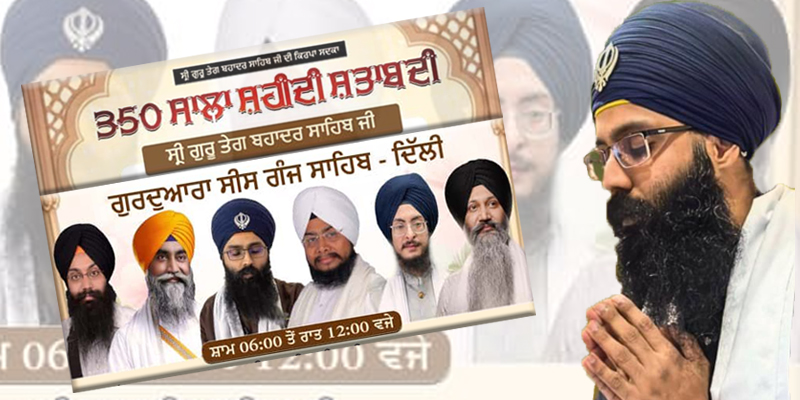
A Malaysian medical doctor has been invited to deliver sermons at historical gurdwaras in Delhi — a rare honour for a Malaysian Sikh parcharak (preacher).
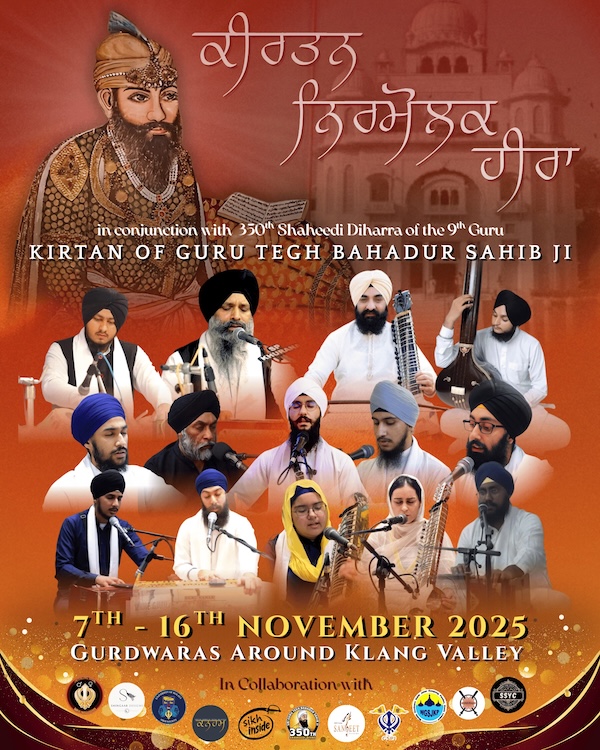
Dr Rasvinder Singh will be conducting katha (Sikh sermons) at three of Delhi’s prominent historical gurdwaras — Rakab Ganj Sahib, Bangla Sahib and Sis Ganj Sahib — over four days starting 10 November. The programmes are being held in conjunction with the 350th martyrdom commemoration of Guru Tegh Bahadur, the ninth Sikh Guru.
“I was initially surprised. Growing up in Malaysia, we are accustomed to parcharaks and ragis visiting us every now and then, but to be invited from Malaysia to Delhi’s historical gurdwaras for this blessed opportunity was just unheard of till date,” Dr Rasvinder told Asia Samachar when asked about the invitation.
His kirtan and katha tour in Delhi has already begun. The first session was held today (7 Nov) at Gurdwara Bala Sahib, followed by another at Sis Ganj Sahib tomorrow (8 Nov) from 8pm to 9pm (India time).
Dr Rasvinder, 36, is no stranger to delivering kirtan and katha in Malaysia and neighbouring countries. He is a regular at gurdwaras and often appears alongside his wife, Dr Aarvinder Kaur, who is also a medical doctor.
Born in Penang in 1989, Dr Rasvinder spent his childhood in the northern Malaysian state before pursuing medical studies. His parents, Ragbeer Singh and Baljit Kaur, are retired and reside in Bukit Mertajam, Penang. Ragbeer previously worked at Penang Port, while his mother served in the accounting department of a private firm.
He received the invitation to speak in Delhi about three months ago.
“It was a pleasant surprise, as India already has a huge number of parcharaks and ragis doing sewa. Hence, to be invited specifically, I feel immensely grateful and humbled for this opportunity to represent Malaysia and Southeast Asia on a global Sikh platform — a testament that Sikhi is flourishing outside India.
“It is also quite challenging for someone like me, employed with the Ministry of Health and currently pursuing my Masters, to dedicate time for parchar and kirtan. Hopefully, I’ll be able to devote more time in the future. My wife, Dr Aarvinder Kaur, is undoubtedly my backbone and pillar in all the sewas we are able to do locally and abroad,” he said.
ASIA SAMACHAR is an online newspaper for Sikhs / Punjabis in Southeast Asia and beyond. You can leave your comments at our website, Facebook, Twitter, and Instagram. We will delete comments we deem offensive or potentially libelous. You can reach us via WhatsApp +6017-335-1399 or email: asia.samachar@gmail.com. For obituary announcements, click here
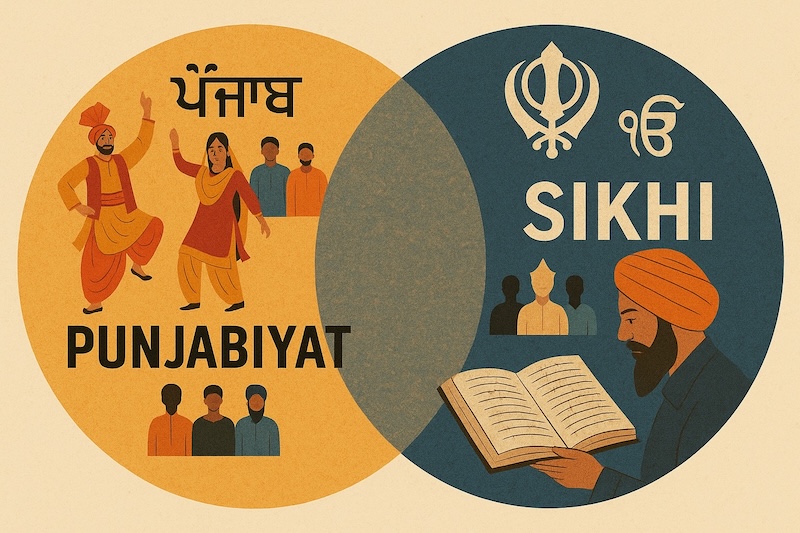
Punjabiyat vs. Sikhi – Shared Roots, Different Paths Punjabiyat refers to the broad, pluralistic cultural identity of the Punjabi people—spanning language, land, folklore, and shared traditions across religions. Sikhi (Sikhism), although born within this context, is a spiritual, ethical, and universal rearticulation of that culture rooted in the teachings of the Sikh Gurus.
Culture as Living, Evolving Identity Culture is defined as a holistic blend of language, customs, arts, ethics, and way of life. Punjabiyat reflects a dynamic and evolving identity shaped by history, migrations, conquests, and social memory, not a static tradition.
Sikhism – Reformist Yet Rooted Sikhi emerged in 15th-century Punjab, absorbing influences from Bhakti and Sufi traditions while challenging casteism, ritualism, patriarchy, and material ego in Punjabi culture. It emphasizes Oneness (Ik Onkar), honest living, devotion, and selfless service.
Folklore as Spiritual Foundation Punjabi folk tales like Heer Ranjha and heroes like Dulla Bhatti reflect deep cultural values of love, sacrifice, and resistance to injustice—prefiguring the moral and spiritual ethos that Sikhism later formalized.
Miri-Piri – Blending Spirituality and Sovereignty With the founding of the Khalsa in 1699 by Guru Gobind Singh, Sikhi united temporal responsibility (Miri) and spiritual authority (Piri). Under Maharaja Ranjit Singh, this synthesis created an inclusive Sikh rule rooted in justice and pluralism.
Core Divergences Between Punjabiyat and Sikhi Punjabiyat is cultural, ethnic, pluralistic while Sikhi is spiritual, ethical, universal. Punjabiyat is about caste hierarchy, patriarchy, folk religion while Sikhi rejects caste and gender inequality; promotes equality.
Contemporary Identity – Harmony and Tension Today, especially in the diaspora, Sikhs navigate between cultural Punjabi identity (language, music, food) and religious Sikh identity (turban, discipline, ethics). Sikhi encourages being rooted in culture while transcending it through universal moral values.
Sikhi v Punjabiyat
By Gurnam Singh | Opinion |
This article explores the complex relationship between the shared evolving cultural identity of the Panjabi people, commonly referred to as Punjabiyat, which incorporates a wide range of religious and ethnic groups, and Sikhi culture, which can be exclusively associated with Sikh philosophy, beliefs and practices. Although both are deeply intertwined, their principles, orientations, and objectives differ significantly. The paper examines their convergence in language, tradition, and regional identity, while contrasting their ethical, spiritual, and socio-cultural worldviews. Drawing upon historical, literary, and theological sources, it argues that while Panjabi culture provided the sociocultural context for the birth of Sikhi, Sikhism represents a transformative, universal, and ethically demanding rearticulation of that context.
What do we mean by culture?
The term culture derives from the Latin colere, meaning “to cultivate” or “to till,” a metaphor for nurturing both land and mind. Edward Burnett Tylor’s seminal definition in Primitive Culture (1871) describes it as “that complex whole which includes knowledge, belief, art, morals, law, custom, and any other capabilities and habits acquired by man as a member of society” (Tylor, 1871). Culture, therefore, encompasses both intellectual refinement and the tangible patterns of collective life associated with rules, rituals, diet/cuisine, music, art, dress, and language.
In this framework, ‘Panjabi culture’ refers to the ethnolinguistic and historical traditions of the Punjab region geographically located in North Western part of the Indian Subcontinent, bounded by the Himalayan Mountains to the North and East and the deserts of Rajasthan in the South and Afghanistan in the West. Sikh culture on the other hand, refers to a set of moral, spiritual, and social principles primarily rooted in the teachings of the Sikh Gurus and Bhagats, enshrined in the Guru Granth Sahib and the Sikh Rehit Maryada/Code of Conduct (SGPC, 1950), but also incorporating Sikh traditions and history.
Punjabiyat: The Cultural Identity of the Panjab
According to Singh (2012) there is an inherent paradox in the idea of Punjabiyat. Rooted in culture, language, geography, Punjabiyat is something tangible. However, shifting across politics, ideology, and memory, this very same idea is quite elusive. However, one should not be overly concerned with this as it simply reflects how cultural identities operate as living, contested spaces rather than static essences.
In its broadest sense, Punjabiyat refers to the composite cultural identity of the people of Punjab that transcends religious and national boundaries. It encompasses the Punjabi language (written in Gurmukhi in India and Shahmukhi in Pakistan), shared folk traditions such as Bhangra, Giddha, and the Kisse (folk romances), as well as a rich culinary heritage and festivals including Lohri, Vaisakhi, Eid, and Holi. Beyond these expressions of culture, Punjabiyat embodies an enduring ethos of conviviality, hospitality, and generosity, alongside a deeply rooted collective spirit of resistance to oppression.
Khushwant Singh (2004) argues that the region’s position as the “gateway to India” exposed it to successive waves of conquest and migration, from the Harappan and Vedic civilizations through Islamic and British empires, producing a rich syncretic culture. As he notes, the ‘blood of many conquering races came to mingle, and many non-indigenous languages, such as, Arabic, Persian, Pushto, and Turkish, came to be spoken in the land. Thus, too, was the animism of the aboriginal subjected to the Vedantic, Jain, and Buddhist religions of the Aryans, and to the Islamic faith of the Arabs, Turks, Mongols, Persians, and Afghans. Out of this mixture of blood and speech were born the Punjabi people and their language.’
The Punjabi cultural identity is historically tied to agrarian life. The material culture of Punjabiyat is best exemplified by its agricultural prosperity, a legacy partially carried by the “Green Revolution” in Indian Punjab. This connection to the land generates a cultural pride in hard, manual labour and a sense of territorial ownership, often expressed through poetry and folk songs that idealize the fields and the life of the kisan (farmer). This material foundation of Punjabi identity, of hard work, distinguishes it from the purely spiritual focus, though earning an honest living is often expressed as a noble virtue within the folk traditions.
The Emergence of Sikhi in the land of the five rivers.
Sikhi arose in 15th-century Punjab, a time marked by religious pluralism and social stratification. Guru Nanak Dev Ji’s teachings drew upon existing Bhakti and Sufi currents but introduced a radically monotheistic and egalitarian worldview. The central tenets of Ik Onkar (Oneness of God), Naam Japna (meditation on the Divine Name), Kirat Karni (honest labour), and Seva (selfless service), formed the ethical foundation of the Sikh way of life.
Bhai Gurdas (Vaar 1, Pauri 45) described Guru Nanak as one who “established the authority of his doctrines and started a new path, devoid of impurity.” Sikhi, thus, represented both a continuation and a critique of Panjabi culture and traditions, embracing its devotional fervour while rejecting its casteism, ritualism, and patriarchal hierarchies.
The philosophical depth of Sikhi lies in its concept of Hukam (Divine Will/Order) and the distinction between Manmukh (self-centred person) and Gurmukh (Guru-oriented person). Panjabi culture, by nature, is rooted in worldly/temporal concerns and social tradition, sometimes reflecting the Manmukh tendency towards ego (Haumai), social status, and ritual display. Sikhi, conversely, pushes the individual toward the Gurmukh ideal, prioritising spiritual discipline, social justice, and transcendence of the temporal structures of Punjabi society. This distinction is the engine of the enduring tension between the two.
Influence of Folk Traditions in Punjabi and Sikh Culture
Punjabi and Sikh culture have been deeply shaped by the region’s rich folk traditions, oral storytelling, and heroic ballads. These stories, often composed and transmitted by poets, minstrels, and Sufis, reflect the moral imagination and spiritual yearnings of the Punjabi people. Two enduring figures of this tradition, Heer Ranjha and Dulla Bhatti, more than any other, embody the region’s characteristic blend of romance, rebellion, and devotion.
Heer Ranjha, immortalized by the eighteenth-century Sufi poet Waris Shah, stands as a profound expression of Punjab’s emotional and mystical landscape. Waris Shah, a Muslim poet from the heart of Punjab, reinterpreted this traditional love story through a lens of divine longing and moral insight. Although composed within an Islamic Sufi framework, Heer Ranjha transcended religious boundaries, becoming beloved among Muslims, Hindus, and Sikhs alike.
Its central themes of selfless love, spiritual devotion, and resistance to social injustice, resonate deeply with Sikh ideals. The figure of Ranjha, who renounces worldly attachments and endures suffering for love, reflects the archetype of the spiritual seeker, the bhakta or faqir, devoted to truth above convention. This spiritual undercurrent was not lost on later interpreters. Professor Puran Singh, for example, famously described Ranjha as a “Sikh of the Guru.” In his view, Ranjha’s humility, compassion, and inner purity prefigure the qualities that the Sikh Gurus later cultivated among their followers.
Through such characters, Punjabi folklore expresses a collective spiritual yearning, a culture awaiting the message of Guru Nanak, as Bhai Gurdas puts it: “Sunnee pukar dataar prabh, Guru Nanak jagg mahe pathaiya” (Hearing the world’s cry, the Lord sent Guru Nanak into it.) In this sense, the story of Heer Ranjha is not merely a romance, but a reflection of Punjab’s anticipation of spiritual renewal, a longing for divine truth embodied in Guru Nanak’s advent.
Another enduring figure of Punjabi folklore is Rai Abdullah Khan Bhatti, popularly known as Dulla Bhatti who is often compared to England’s Robin Hood. A sixteenth-century folk hero, Dulla Bhatti symbolized resistance against oppression and the protection of the vulnerable. He led a revolt and guerrilla campaign against the Mughal Emperor Akbar’s harsh land revenue system, defending the rights of peasants and safeguarding the honour of village women.
Dulla Bhatti came from a family of rural chiefs (zamindars), and his rebellion was fuelled by personal loss: both his father, Farid Khan, and his grandfather, Sandal (or Bijli), were executed for opposing Mughal policies. Eventually captured and executed in Lahore in 1599, Dulla Bhatti’s martyrdom was immortalized by the contemporary Sufi poet Shah Hussain, who witnessed his death and wrote: “Kahē Hussain faqīr sāīṅ dā, takht na milde maṅgiāṅ” (Says Hussain, the Faqir of the Lord, Thrones are not gained by merely asking).
Dulla Bhatti’s defiance exemplifies Punjab’s enduring ethos of moral courage and justice, values that would later find powerful spiritual expression in Sikhi. His life overlapped with that of Guru Arjan Dev Ji (1563–1606), and scholars have noted that the political turbulence of the era, shaped by figures like Dulla Bhatti, may have influenced both Mughal policy and the Gurus’ engagement with the state.
Taken together, the tales of Heer Ranjha and Dulla Bhatti illuminate the moral and emotional soil from which Sikhism arose. They reveal a Punjab already alive with a yearning for divine love, social justice, and liberation from tyranny. Folk heroes and lovers became the mirrors of the collective soul, expressing the same hunger for truth and compassion that find fulfilment in the teachings of Sikhi.
Historical Interplay: The Synthesis of Miri and Piri
The 17th and 18th centuries witnessed the consolidation of Sikh identity through the creation of the Khalsa by Guru Gobind Singh Ji in 1699. This marked the formation of a disciplined, self-governing community that embodied both spiritual devotion (Piri) and temporal sovereignty (Miri). The institution of the ‘Khande di Pahul initiation ceremony by Guru Gobind Singh and the Panj Kakar (Five Ks) provided a distinct, visible, and collective identity that separated the Sikh from the broader Panjabi populace.
During Maharaja Ranjit Singh’s reign (1799–1839), Sikh rule over Punjab exemplified a synthesis of Panjabi pluralism and Sikh ethics. His administration emphasized merit over birth, religious tolerance (employing Hindu, Muslim, and European officers), and literacy in both Gurmukhi and Shahmukhi scripts. The construction and restoration of major shrines, such as the Harmandir Sahib, symbolized the integration of cultural pride and spiritual purpose (Singh, K., 2004). This period is the clearest historical example of Sikhi providing a unifying political framework for the diverse elements of Punjabiyat.
Literary, Philosophical, and Socio-Economic aspects of Sikhi.
As geographic entity located in the northwestern part of the Indian subcontinents Panjab, the land of five rivers that flow down from the Himalayan mountains, has existed for millions of years, according to Puran Singh, it is not until the 15th Century with the emergence of Sikhi, that the idea of Punjabiyat takes hold. As he famously proclaimed “Punjab vasda Gura(n) de naa te” – “Punjab lives on the names of the Gurus” (Singh, 1920).
For Singh, the Panjabi identity and character as uniquely receptive to the Sikh spiritual message. He described the “simple, austere life of incessant labour” of the Punjabi peasant as fertile ground for the Gurus’ teachings, stating: “the pleasure that comes from eating grain is the same pleasure that comes with Naam”, an affirmation of the spiritual in the everyday. His work elevates the Panjabi folk spirit from a mere regional culture to a pre-Sikh spiritual disposition.
The Guru Granth Sahib embodies the linguistic and ethical synthesis of Punjab. Written primarily in Sant Bhasha (a composite language drawing heavily on Punjabi dialects), it includes compositions by Hindu Bhaktas (e.g., Kabir, Ravidas) and Sufi saints, demonstrating its universalist reach while being regionally rooted. Its references to Punjab’s rivers, flora, cities, and historical events (e.g., the “Babur Vani” lamenting the Mughal invasions) situate Sikhi within the lived reality of medieval Punjab while asserting its transcendence beyond time and geography.
Sikhi’s emphasis on Kirat Karni (honest, dignified labour) and the rejection of the Hindu caste system had a profound, measurable effect on the community’s socio-economic status. Historical analyses show that many of the lower castes (e.g., Jatt farmers, previously a non-elite group) who embraced Sikhi and joined the Khalsa gained social mobility and military influence, radically disrupting the traditional caste-based social stratification of Punjabiyat. This ethical mandate for economic agency and social equality represents one of the most powerful points of divergence from the inherited social structure of Panjabi culture.
Key Differences, Tensions, and Contemporary Realities
While Sikhi (Sikhism) originated within the socio-cultural milieu of Punjabi society, it emerged as a reformist movement seeking to challenge and transform many of its prevailing social and religious practices. Punjabi culture, which encompasses an ethnically, regionally, and linguistically defined population of approximately 160 million people, is primarily characterized by its pluralistic religious landscape, incorporating Hindu, Muslim, and diverse folk traditions. In contrast, Sikhi is founded on spiritual and ethical principles that emphasize universality and transcend ethnic boundaries, with a global adherent base of roughly 30 million.
Theologically, Sikhi articulates a distinct orientation centred on Ik Onkar, the oneness of all existence, distinguishing itself from both the syncretic tendencies and ritual pluralism of Punjabi culture. Where Punjabi religiosity often integrates regional and folk elements, Sikhi advances a monotheistic and egalitarian vision that rejects ritualism, idolatry, and superstition. Its focus is instead directed toward meditation, moral discipline, and the comprehension of Gurbani (sacred scripture).
In the social domain, Punjabi society has historically been organized along caste-based hierarchies (biradari or jati), which remain evident in contemporary marriage practices and social affiliations. Sikhi, by contrast, explicitly repudiates caste and patriarchal structures, emphasizing the inherent equality and dignity of all individuals. This egalitarian ethos extends to gender relations as well. Whereas Punjabi culture has often been marked by patriarchal norms that confine women to domestic roles, Sikh teachings uphold the equality of men and women, underscored by the prominent participation of women in early Sikh history and in religious life.
The divergence between the two traditions is also apparent in attitudes toward substance use. In Punjabi folk culture, particularly among jatt communities, the consumption of alcohol and tobacco is often socially normalized and even valorised, though it remains a source of internal cultural tension. In contrast, Sikhi categorically condemns intoxicants as impediments to spiritual discipline. The Rehat Maryada—the Sikh code of conduct—explicitly prohibits the use of tobacco, alcohol, and other intoxicating substances, reinforcing the faith’s emphasis on self-control and purity of mind and body.
Thus, although Sikhi emerged within the cultural and historical framework of Punjabi society, it articulates a reformist and universalist vision that transcends regional identity. By reconfiguring concepts of spirituality, social equality, and moral discipline, Sikhi represents both a continuation and a profound transformation of the Punjabi cultural context from which it arose.
These contrasts reveal that while Panjabi culture forms the vessel, Sikhi represents its moral and spiritual refinement. The tension is evident today in the diaspora, where younger generations often face a choice between retaining the cultural markers of Punjabiyat (e.g., language, food) and adhering to the doctrinal requirements of Sikhi (e.g., wearing the dastar/turban, avoiding intoxicants).
Conclusion
Panjabi and Sikh cultures have historically existed in a dynamic relationship of mutual influence and creative tension. Punjabiyat provides the linguistic, geographic, and social matrix from which Sikhi emerged; Sikhi, in turn, offers an ethical, universalist, and transformative reinterpretation of that very matrix. This interplay produces a continual dialogue between the cultural self, rooted in time, place, and community and the spiritual self, grounded in timeless moral vision of Sikhi.
From its humble beginnings with the arrival of Guru Nanak in what was then known as Rai Bhoi Di Talwandi and today known as Nankana Sahib in West Punjab, over five centuries ago, the Punjabi Sikh identity has expanded far beyond the plains of Punjab. Across the Global South, from Argentina, South Africa, and New Zeeland to the farthest reaches of the Global North, including Alaska, Scotland, Norway, Russia, and Japan, Sikhs have left an indelible mark. Wherever they have settled, Sikhs have retained their Punjabi heritage while also demonstrating a remarkable capacity to integrate and contribute to the local cultures in which they live. To be Sikh, therefore, is not merely to belong to Punjabiyat, but to engage meaningfully with the diverse indigenous cultures of the wider world.
This ability to sustain a sense of being while continually embarking on a journey of becoming lies at the heart of Sikh identity. Despite their relatively small numbers globally, Sikhs have successfully navigated the pressures of cultural assimilation through a steadfast attachment to the universal spiritual teachings of the Gurus. The modern Sikh embodies the synthesis of cultural heritage, adaptation, and spiritual ideal. This a living testament to a tradition that remains both rooted and evolving. It is this ongoing capacity to harmonize change with continuity that defines the enduring essence of Sikh identity.
Singh, P. (2012). Globalisation and Punjabi identity: Resistance, relocation and reinvention (yet again!). Journal of Punjab Studies, 19(2), 153-172.
Puran Singh (1920) The Spirit of the Sikh; The Book of the Ten Masters. Lahore: Sant Singh & Sons.
Shiromani Gurdwara Parbandhak Committee (SGPC) 1950, Sikh Rehat Maryada: The Code of Sikh Conduct and Conventions, SGPC, Amritsar.
Singh, K. (2004) A History of the Sikhs: Vol. 1 (1469–1839). 2nd edn. Oxford: Oxford University Press.
Tylor, E. B. (1871) Primitive Culture: Researches into the Development of Mythology, Philosophy, Religion, Art, and Custom. London: John Murray.
Waris Shah (1766) Heer Ranjha. Lahore: Manuscript Tradition.
Gurnam Singh is an academic activist dedicated to human rights, liberty, equality, social and environmental justice. He is an Associate Professor of Sociology at University of Warwick, UK. He can be contacted at Gurnam.singh.1@warwick.ac.uk
* This is the opinion of the writer and does not necessarily represent the views of Asia Samachar.
ASIA SAMACHAR is an online newspaper for Sikhs / Punjabis in Southeast Asia and beyond. You can leave your comments at our website, Facebook, Twitter, and Instagram. We will delete comments we deem offensive or potentially libelous. You can reach us via WhatsApp +6017-335-1399 or email: asia.samachar@gmail.com. For obituary announcements, click here
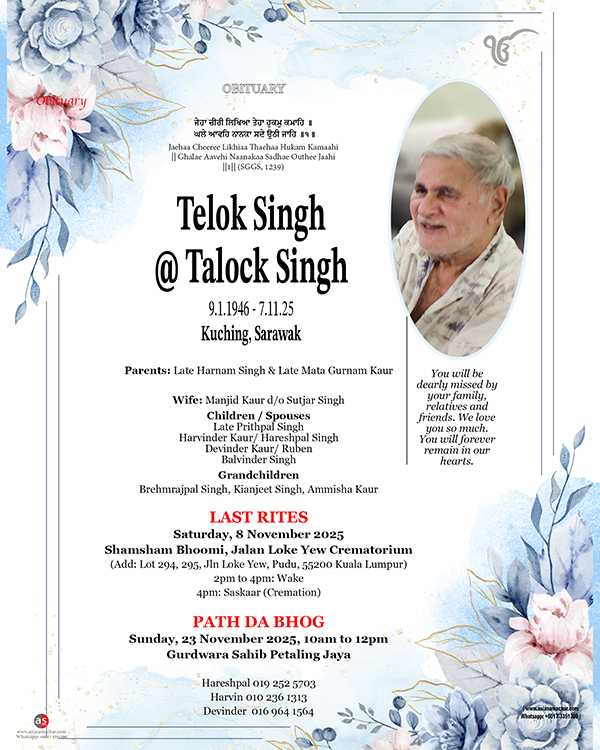
LAST RITES Saturday, 8 November 2025 Shamsham Bhoomi, Jalan Loke Yew Crematorium (Add: Lot 294, 295, Jln Loke Yew, Pudu, 55200 Kuala Lumpur) 2pm to 4pm: Wake 4pm: Saskaar (Cremation)
PATH DA BHOG Sunday, 23 November 2025, 10am to 12pm Gurdwara Sahib Petaling Jaya
You will be dearly missed by your family, relatives and friends. We love you so much. You will forever remain in our hearts.
ASIA SAMACHAR is an online newspaper for Sikhs / Punjabis in Southeast Asia and beyond. You can leave your comments at our website, Facebook, Twitter, and Instagram. We will delete comments we deem offensive or potentially libelous. You can reach us via WhatsApp +6017-335-1399 or email: asia.samachar@gmail.com. For obituary announcements, click here
Communication for the Sikh community must move beyond reaction and validation—it must proactively shape thought and protect truth.
In an age dominated by artificial intelligence, rapid information flow, and manipulated narratives, owning intellectual property becomes essential to preserving identity.
Sikh contributions to humanity are vast, but without narrative ownership, their meaning risks being redefined by external voices.
Inspired by Guru Nanak Sahib’s principle of deep listening, communication must be deliberate—rooted in observation, authenticity, and intellectual discipline.
UNITED SIKHS (UK) is laying the foundation for this transformation, urging investment in storytelling, research, media, and thought leadership to secure Sikh legacy for future generations.
By Harmeet Shah Singh | Opinion |
Community communications is neither reaction nor a search for validation. It is the disciplined shaping of understanding before others define it.
The Sikh community has long exceeded its numerical strength in service and sacrifice. That same resolve must now guide how it expresses itself in a rapidly changing world where technology dictates perception.
Artificial intelligence (AI) has redrawn the boundaries of influence. Information moves faster than reasoning, and attention has become a resource to be mined. The ability to frame thought, build ideas, and protect their ownership is now as vital as the ability to speak.
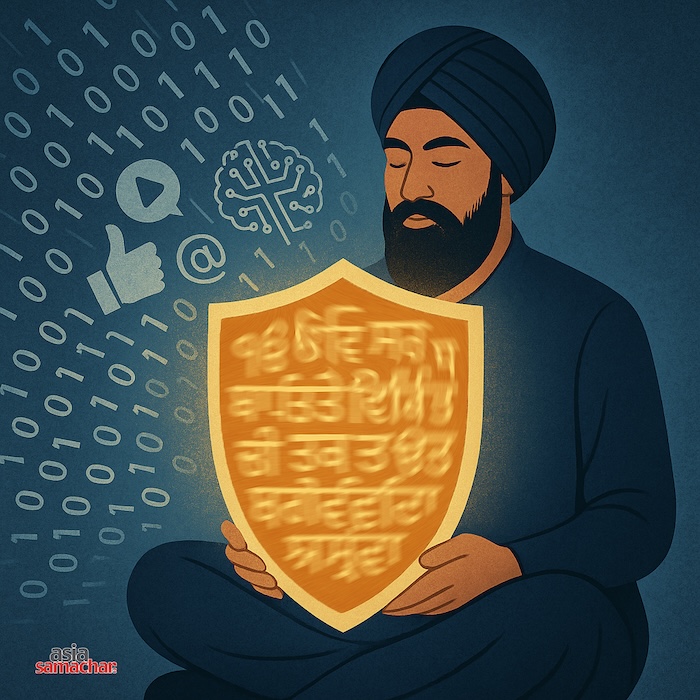
Communication must therefore become both shield and seed, defending the community’s truth while cultivating its intellectual assets.
The Age of Unquestioned Content
Each moment brings a new wave of digital material. Video clips, altered images and AI-generated commentary circulate as reality. The more one consumes, the less time there is to reflect. Human reasoning is finite, but the algorithm’s appetite for reaction is endless.
Even among the well-informed, the tendency to accept what appears on screen as authentic has become widespread. This is a crisis of comprehension. When everything appears certain, discernment fades.
The ability to think critically, to verify before believing, is eroding.
Anyone with technical skill can design narratives that travel across continents within seconds. What used to be studied debate has turned into digital hypnosis.
Visibility Without Voice
Sikhs have built enduring institutions: gurdwaras that welcome, kitchens that feed and networks that serve. These are living examples of spiritual discipline. But the world now measures presence not by deed but by data. Without intellectual ownership of how Sikh ideas are presented, our stories risk being retold without our participation.
The turban and the beard carry centuries of meaning. They declare dignity and conviction. But meaning can be lost when description comes from outside. The Sikh community must now invest in intellectual properties that define its ideas, history and creative output. Highly-produced films, think tanks, digital libraries and credible media properties can serve as the foundations of that ownership.
Without such development, influence becomes borrowed. A community with deep philosophy cannot remain a passive consumer of narratives shaped by others. It must create its own library of thought and make it accessible to future generations.
Listening as Method
Guru Nanak Sahib, through the Suniye pauris in Japji Sahib, presented listening as the first act of understanding. Listening strengthens perception and nurtures awareness. It teaches the mind to recognise truth and hold it with steadiness.
In communications, that same principle becomes a method. Listening to how the community is represented, to what is misunderstood, and to what remains unsaid allows us to build narratives that educate and connect.
Communication must become both shield and seed, defending the community’s truth while cultivating its intellectual assets. – Harmeet Singh Shah
Listening refines message, ensures authenticity, and brings intellectual order to emotional subjects.
When communication grows from attentive observation, it no longer reacts. It defines.
The Role of UNITED SIKHS (UK)
UNITED SIKHS (UK) stands in a position of global credibility. Its humanitarian work has built trust. The next step is to strengthen how it communicates that work and the ideas behind it. Under Chair Mejindarpal Kaur, the organisation has already initiated, through baby steps, a communications framework that reflects Sikh philosophy through professional rigour.
This effort has to be comprehensive: media engagement, training, research and creative production. It focuses on encouraging development of intellectual properties that carry long-term value.
Each documentary, archive or print/visual publication becomes a contribution to global thought.
With more than 25 years in journalism, including with CNN International and the India Today Group, I have witnessed how narratives move institutions and nations. In the modern world, ownership of thought defines influence.
A community that controls its intellectual assets controls its legacy.
Building a Living Legacy
We can lead this transformation by creating a central communications division dedicated to research, storytelling, and intellectual property development. This includes structured publication of community knowledge, and credible online repositories. Such assets ensure that Sikh ideas remain accessible, referenced, and respected in the global conversation.
Guru Nanak Sahib engaged the world through dialogue that combined insight and compassion. His voice travelled through listening, reflection, and reason. The same qualities must now shape Sikh communications.
The Shield of Thought
Communication is not reaction or validation. It is the shield that guards a community’s truth and the workshop where its ideas are forged.
In an age defined by artificial intelligence and rapid manipulation, intellectual property is defence, memory, and continuity.
For Sikhs, this moment calls for investment in thought itself. By creating, documenting, and owning its ideas, the community ensures that its voice will remain distinct, authentic and enduring long after algorithms change their tune.
Harmeet Shah Singh is a career journalist currently serving as Communications and Advocacy Director at UNITED SIKHS (UK), a charity registered in England and Wales.
* This is the opinion of the writer and does not necessarily represent the views of Asia Samachar.
ASIA SAMACHAR is an online newspaper for Sikhs / Punjabis in Southeast Asia and beyond. You can leave your comments at our website, Facebook, Twitter, and Instagram. We will delete comments we deem offensive or potentially libelous. You can reach us via WhatsApp +6017-335-1399 or email: asia.samachar@gmail.com. For obituary announcements, click here
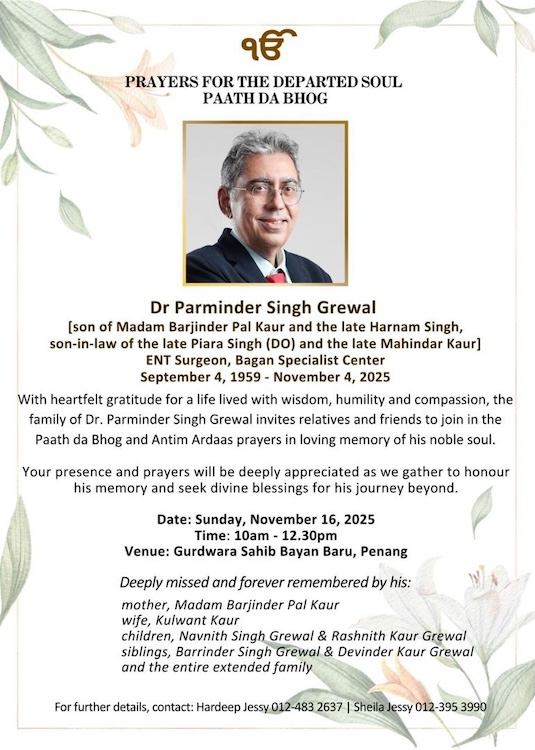
Dr Parminder Singh Grewal was a man of many talents – an avid bird-watcher, a gifted artist, a passionate badminton enthusiast and coach, a dedicated ENT surgeon, and an inspiring mentor to many.
His medical career took him from Kuching, Sibu, Kuala Lumpur, Klang, Penang and eventually to Bagan Specialist Centre, Butterworth – a place he dedicated over 30 years of his life to. Dr. Parminder was known for the gentle care, professionalism and compassion he showered upon every patient and colleague.
These past few days have seen an outpouring of love and grief from so many people — young and old, from every background and walk of life. Even the soya bean seller he visited for his regular “tau chui” came to pay his respects. That says everything about who he was — kind, relatable, generous in spirit, and deeply loved.
With heartfelt gratitude for a life lived with wisdom, humility and compassion, the family of Dr. Parminder Singh Grewal invites relatives and friends to join in the Paath da Bhog and Antim Ardaas prayers in loving memory of his noble soul.
Your presence and prayers will be deeply appreciated as we gather to honour his memory and seek divine blessings for his journey beyond.
Date: Sunday, November 16, 2025 Time: 10am – 12.30pm Venue: Gurdwara Sahib Bayan Baru, Penang
Deeply missed and forever remembered by his: mother, Madam Barjinder Pal Kaur wife, Kulwant Kaur children, Navnith Singh Grewal & Rashnith Kaur Grewal siblings, Barrinder Singh Grewal & Devinder Kaur Grewal and the entire extended family
For further details, contact: Hardeep Jessy 012-483 2637 | Sheila Jessy 012-395 3990
| Entry: 5 Nov 2025; Updated: 10 Nov 2025 | Source: Family
ASIA SAMACHAR is an online newspaper for Sikhs / Punjabis in Southeast Asia and beyond. You can leave your comments at our website, Facebook, Twitter, and Instagram. We will delete comments we deem offensive or potentially libelous. You can reach us via WhatsApp +6017-335-1399 or email: asia.samachar@gmail.com. For obituary announcements, click here
Prof Balbir Singh flanked by daughters Jasminder Kaur Khaira (left) and Sarina Kaur Khaira. Right: Receiving the award from Sarawak head of state Dr Wan Junaidi Tuanku Jaafar
By Asia Samachar | Malaysia |
Professor Balbir Singh, an expert in field of malaria research, has been appointed as Emeritus Professor by Universiti Malaysia Sarawak (UNIMAS).
When asked to pin point one contribution that makes him proud, he told Asia Samachar: “Our discovery that a monkey malaria parasite is being transmitted to humans makes me proudest, not only because all the work was done by Malaysians in Sarawak, but that it put Sarawak and Malaysia on the world map for malaria research.”
Eight years ago, Balbir was one of the six recipients of the Merdeka Award 2017, a prestigious Malaysian national-level award that honours outstanding effort and role in living the “Merdeka” spirit.
The 70-year-old scientist was born on 30 March 1955 in Segamat, Johor. His father Mohan Singh Khaira was a school headmaster and his mother Harjit Kaur Sandhu a home maker.
“My parents, who always emphasised on the importance of education, would have been so proud of me if they were still alive. Am honoured that UNIMAS has recognised my contributions by conferring this award,” he added.
The university also appointed Emerisu Professors were Dr Mary Jane Cardosa and Dr Khairuddin Ab Hamid. They each received the honor from Sarawak head of state Dr Wan Junaidi Tuanku Jaafar who is the university’s chancellor.
Speaking to reporters, Balbir said: “When we began our work in Kapit, we never expected our discovery to gain international recognition. At the time, it was widely believed that malaria could only be transmitted from human to human.
“But we discovered a monkey malaria parasite that could be transmitted to humans through mosquitoes. This finding proved that malaria is a zoonotic disease, which makes control efforts much more challenging.”
Dr Balbir said he felt fortunate to have spent his career pursuing work that he truly loved.
“Do something you genuinely love, not something your parents tell you to do….To the younger generation, you must have passion for what you do. Choose something you enjoy, and you’ll never feel pressured because you’ll find joy in it. I’m lucky to be paid for doing something I love,” he was quoted in Borneo Post.
Prof Balbir Singh with his daughters Jasminder Kaur Khaira (left) and Sarina Kaur Khaira as well siblings Jasbir Kaur Khaira and Gurbinder Singh Khaira
Dr Balbir obtained his BSc, MSc and PhD degrees from the University of Liverpool. He started working on malaria at the Liverpool School of Tropical Medicine in 1984, initially as a Postdoctoral Research Assistant and then as a Beit Medical Fellow, with short working stints in Malawi and Thailand.
He joined Universiti Sains Malaysia in 1992 and moved to UNIMAS in 1999, together with Dr Janet Cox-Singh to kick-start lab-based research in the Faculty of Medicine & Health Sciences. He was made the founding director of the Malaria Research Centre, one of the first two centres of research excellence of UNIMAS in 2006, in recognition of the research they had both spearheaded.
Dr Balbir’s research team have made several key discoveries highlighting knowlesi malaria as a potentially fatal zoonotic disease that is prevalent in Southeast Asia. His research has been funded by international funding agencies, including the Wellcome Trust, and he has published in leading journals including The Lancet, Clinical Infectious Diseases and Emerging Infectious Diseases. His work has been highly cited, with 7,080 citations and an h-index of 43, according to Web of Science.
Based on citations in Scopus, he was ranked by Stanford University as among the World’s Top 2% Scientists in 2020 and 2024.
He was elected as a Fellow of the Academy of Sciences Malaysia, received the Top Research Scientists Malaysia 2012 award and the Merdeka Award for his pioneering work on knowlesi malaria.
He served as local secretary for Malaysia for the Royal Society of Tropical Medicine and Hygiene for 13 years, as a commissioner for The Lancet Commission on Malaria Eradication and twice as an advisor to the WHO on zoonotic malaria.
ASIA SAMACHAR is an online newspaper for Sikhs / Punjabis in Southeast Asia and beyond. You can leave your comments at our website, Facebook, Twitter, and Instagram. We will delete comments we deem offensive or potentially libelous. You can reach us via WhatsApp +6017-335-1399 or email: asia.samachar@gmail.com. For obituary announcements, click here
ASIA SAMACHAR is an online newspaper for Sikhs / Punjabis in Southeast Asia and beyond. You can leave your comments at our website, Facebook, Twitter, and Instagram. We will delete comments we deem offensive or potentially libelous. You can reach us via WhatsApp +6017-335-1399 or email: asia.samachar@gmail.com. For obituary announcements, click here
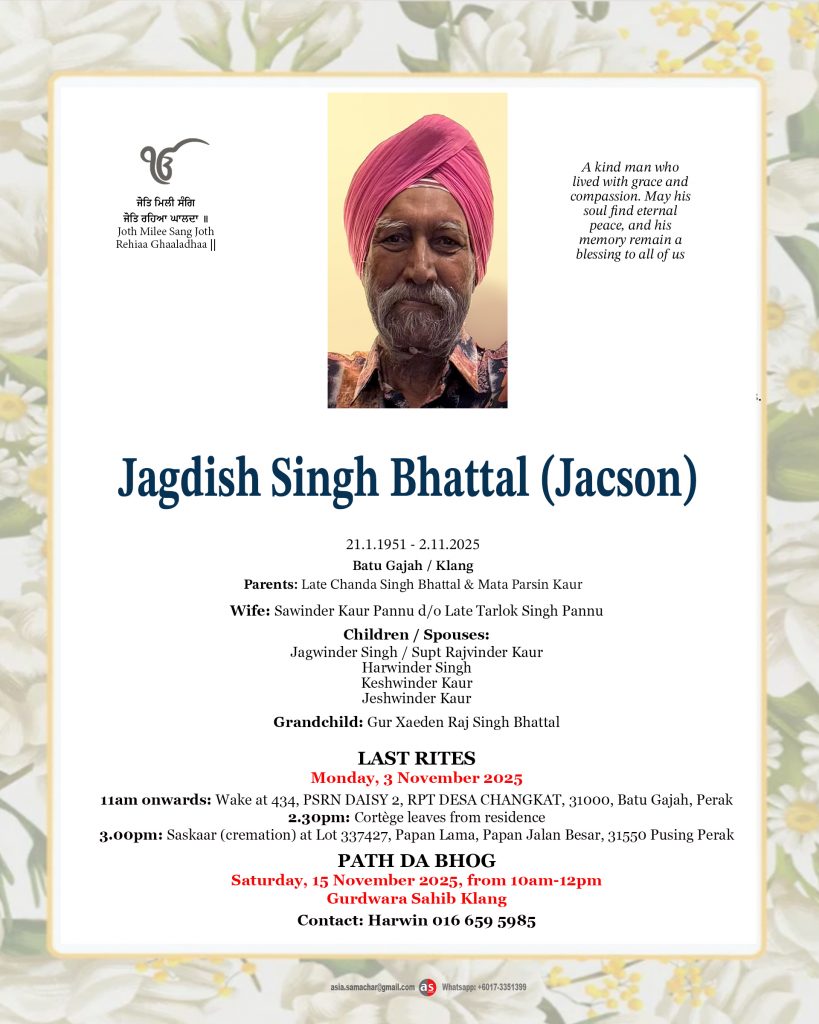
11am onwards: Wake at 434, PSRN DAISY 2, RPT DESA CHANGKAT, 31000, Batu Gajah, Perak 2.30pm: Cortège leaves from residence 3.00pm: Saskaar (cremation) at Lot 337427, Papan Lama, Papan Jalan Besar, 31550 Pusing Perak
PATH DA BHOG Saturday, 15 November 2025, from 10am-12pm Gurdwara Sahib Klang
ASIA SAMACHAR is an online newspaper for Sikhs / Punjabis in Southeast Asia and beyond. You can leave your comments at our website, Facebook, Twitter, and Instagram. We will delete comments we deem offensive or potentially libelous. You can reach us via WhatsApp +6017-335-1399 or email: asia.samachar@gmail.com. For obituary announcements, click here
This is where Nanak lives — not in the past, but in presence.
There is a moment before thought arises, a stillness so pure that the universe feels like a single breath. In that breath, there is no you and me, no distance between the creator and creation. Only a quiet, shimmering truth:
Ik Onkar. One Source. One Light. One pulse behind every heartbeat.
This is where Nanak lives — not in the past, but in presence.
Ik Onkar is not an idea. It is an experience. A dissolving. A remembering.
It is the moment your heart bows to itself and realises: I was never separate.
Oneness Is Not Learned — It Is Revealed We spend a lifetime accumulating knowledge, opinions, identities. Yet the moment we sit quietly, like a child rediscovering wonder, something ancient begins to unfold inside us. A softness. A knowing. A recognition so intimate that no prayer book could contain it.
Ik Onkar is not shouted, it is heard. Not in temples alone, but beneath your ribs, in the quiet prayer your breath recites even without your permission.
Ik Onkar is what you feel when you look at a flower and forget your name for a second. When a dog rests his head on your lap and time melts. When sunlight lands gently on your face and your eyes close as though bowing to the warmth. In those ordinary miracles, you meet God. Not above. Not beyond. But here. Inside everything. Including you.
Where Oneness Walks — Guru Ram Das Ji
If Guru Nanak gave us the vision of Oneness, Guru Ram Das Ji gifted humanity the experience of that Oneness in tenderness. Nanak revealed the infinite. Ram Das made it touchable.
Guru Ram Das Ji is not merely remembered for building Amritsar; He built a city of healing in the human heart. His sacred bani is a river that washes away ego without force, restoring innocence like morning dew returning to a leaf. He is humility in royal form. Compassion wearing a crown yet kneeling before creation.
When I whisper, Dhan Dhan Guru Ram Das Ji I do not call out to a distant Guru. I awaken the fragrance of grace already planted within me.
A grace that says:
Where you are wounded, I bring balm. Where you feel small, I lift you. Where you fear you walk alone, I walk before you.
It is through Ram Das that I understand Nanak not as theology, but as love.
The Miracle of Seeing God in Everyone
True Oneness does not sit in prayer rooms — it walks in the street, it smiles at strangers, it forgives before apologies arrive.
Ik Onkar means: “Every face I meet is another form of the One.” And some days, this knowing arrives easily — like sunlight finding your skin. Other days, the ego resists, clinging to separateness, judgment, old wounds. But even then, grace is patient. To see God in saints is simple. To see God in those who misunderstand us — that is where Oneness becomes practice.
Guru Ram Das Ji teaches:
Love does not choose. Grace does not discriminate.
Wherever there is a heart that hurts, there is the doorway to God.
Oneness in the Smallest Moments
I have seen Ik Onkar in mighty mountains, yes — but I have equally seen it in the gentle wag of Happy’s tail,in the kindness of a stranger opening a door, in the quiet moments when my wife’s eyes soften again after years of distance and silence.
These are not small things. These are miracles disguised as everyday life.
The universe does not always announce grace with thunder. Sometimes, it enters like Guru Ram Das — quiet, healing, unstoppable.
How Oneness Feels
When Ik Onkar enters your awareness, you do not float away —you arrive.
Fully.
Here.
Now.
Your breath deepens.
The heart opens as if it recognises itself in every direction.
Nothing is missing.
Nothing is broken.
Everything is as it must be.
This is not detachment from life —it is falling in love with life so deeply that separation becomes impossible.
Returning to the One
So, I sit. Not as a seeker.
But as one being found, again and again, by the same Light that breathed me into existence.
I whisper softly:
Ik Onkar… Satnam… Dhan Dhan Guru Ram Das Ji…
And I feel creation bow back.
In that exchange, I understand:
I am not chanting to the Divine.
I am chanting as the Divine remembering Itself.
There is no ending to this journey because there was never a beginning.
The One has always been. And the One will always be.
Nanak is the river.
Ram Das is the sweetness of its water.
And we —we are droplets learning again that we are sea.
When you remember Ik Onkar, you do not escape the world — you embrace it more fully.
Every bird song is kirtan.
Every breeze is hukam.
Every heartbeat is a prayer.
And every moment is an invitation:
Come back to Oneness. Come home to the Guru within.
When we see All As One, we do not become saints —we become human again.
ASIA SAMACHAR is an online newspaper for Sikhs / Punjabis in Southeast Asia and beyond. You can leave your comments at our website, Facebook, Twitter, and Instagram. We will delete comments we deem offensive or potentially libelous. You can reach us via WhatsApp +6017-335-1399 or email: asia.samachar@gmail.com. For obituary announcements, click here