



















Here are 7 key points from this article
- Punjabiyat vs. Sikhi – Shared Roots, Different Paths
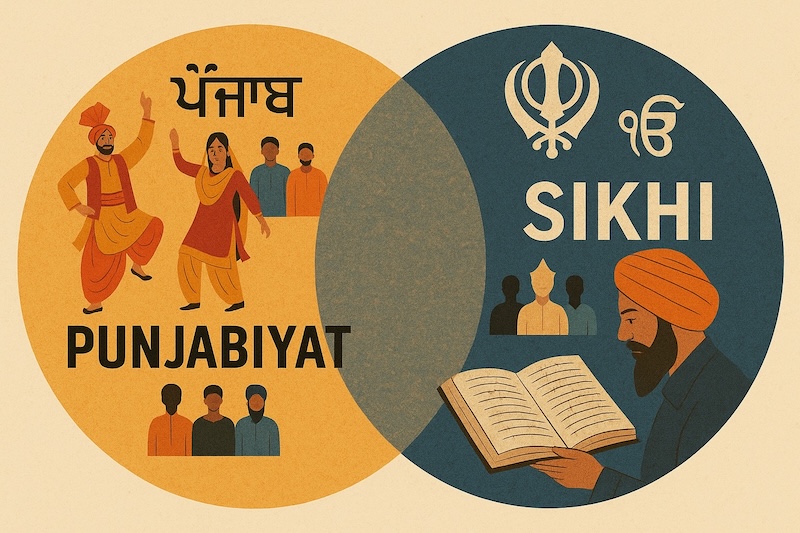
Punjabiyat refers to the broad, pluralistic cultural identity of the Punjabi people—spanning language, land, folklore, and shared traditions across religions. Sikhi (Sikhism), although born within this context, is a spiritual, ethical, and universal rearticulation of that culture rooted in the teachings of the Sikh Gurus. - Culture as Living, Evolving Identity
Culture is defined as a holistic blend of language, customs, arts, ethics, and way of life. Punjabiyat reflects a dynamic and evolving identity shaped by history, migrations, conquests, and social memory, not a static tradition. - Sikhism – Reformist Yet Rooted
Sikhi emerged in 15th-century Punjab, absorbing influences from Bhakti and Sufi traditions while challenging casteism, ritualism, patriarchy, and material ego in Punjabi culture. It emphasizes Oneness (Ik Onkar), honest living, devotion, and selfless service. - Folklore as Spiritual Foundation
Punjabi folk tales like Heer Ranjha and heroes like Dulla Bhatti reflect deep cultural values of love, sacrifice, and resistance to injustice—prefiguring the moral and spiritual ethos that Sikhism later formalized. - Miri-Piri – Blending Spirituality and Sovereignty
With the founding of the Khalsa in 1699 by Guru Gobind Singh, Sikhi united temporal responsibility (Miri) and spiritual authority (Piri). Under Maharaja Ranjit Singh, this synthesis created an inclusive Sikh rule rooted in justice and pluralism. - Core Divergences Between Punjabiyat and Sikhi
Punjabiyat is cultural, ethnic, pluralistic while Sikhi is spiritual, ethical, universal. Punjabiyat is about caste hierarchy, patriarchy, folk religion while Sikhi rejects caste and gender inequality; promotes equality. - Contemporary Identity – Harmony and Tension
Today, especially in the diaspora, Sikhs navigate between cultural Punjabi identity (language, music, food) and religious Sikh identity (turban, discipline, ethics). Sikhi encourages being rooted in culture while transcending it through universal moral values.
By Gurnam Singh | Opinion |
This article explores the complex relationship between the shared evolving cultural identity of the Panjabi people, commonly referred to as Punjabiyat, which incorporates a wide range of religious and ethnic groups, and Sikhi culture, which can be exclusively associated with Sikh philosophy, beliefs and practices. Although both are deeply intertwined, their principles, orientations, and objectives differ significantly. The paper examines their convergence in language, tradition, and regional identity, while contrasting their ethical, spiritual, and socio-cultural worldviews. Drawing upon historical, literary, and theological sources, it argues that while Panjabi culture provided the sociocultural context for the birth of Sikhi, Sikhism represents a transformative, universal, and ethically demanding rearticulation of that context.
What do we mean by culture?
The term culture derives from the Latin colere, meaning “to cultivate” or “to till,” a metaphor for nurturing both land and mind. Edward Burnett Tylor’s seminal definition in Primitive Culture (1871) describes it as “that complex whole which includes knowledge, belief, art, morals, law, custom, and any other capabilities and habits acquired by man as a member of society” (Tylor, 1871). Culture, therefore, encompasses both intellectual refinement and the tangible patterns of collective life associated with rules, rituals, diet/cuisine, music, art, dress, and language.
In this framework, ‘Panjabi culture’ refers to the ethnolinguistic and historical traditions of the Punjab region geographically located in North Western part of the Indian Subcontinent, bounded by the Himalayan Mountains to the North and East and the deserts of Rajasthan in the South and Afghanistan in the West. Sikh culture on the other hand, refers to a set of moral, spiritual, and social principles primarily rooted in the teachings of the Sikh Gurus and Bhagats, enshrined in the Guru Granth Sahib and the Sikh Rehit Maryada/Code of Conduct (SGPC, 1950), but also incorporating Sikh traditions and history.
Punjabiyat: The Cultural Identity of the Panjab
According to Singh (2012) there is an inherent paradox in the idea of Punjabiyat. Rooted in culture, language, geography, Punjabiyat is something tangible. However, shifting across politics, ideology, and memory, this very same idea is quite elusive. However, one should not be overly concerned with this as it simply reflects how cultural identities operate as living, contested spaces rather than static essences.
In its broadest sense, Punjabiyat refers to the composite cultural identity of the people of Punjab that transcends religious and national boundaries. It encompasses the Punjabi language (written in Gurmukhi in India and Shahmukhi in Pakistan), shared folk traditions such as Bhangra, Giddha, and the Kisse (folk romances), as well as a rich culinary heritage and festivals including Lohri, Vaisakhi, Eid, and Holi. Beyond these expressions of culture, Punjabiyat embodies an enduring ethos of conviviality, hospitality, and generosity, alongside a deeply rooted collective spirit of resistance to oppression.
Khushwant Singh (2004) argues that the region’s position as the “gateway to India” exposed it to successive waves of conquest and migration, from the Harappan and Vedic civilizations through Islamic and British empires, producing a rich syncretic culture. As he notes, the ‘blood of many conquering races came to mingle, and many non-indigenous languages, such as, Arabic, Persian, Pushto, and Turkish, came to be spoken in the land. Thus, too, was the animism of the aboriginal subjected to the Vedantic, Jain, and Buddhist religions of the Aryans, and to the Islamic faith of the Arabs, Turks, Mongols, Persians, and Afghans. Out of this mixture of blood and speech were born the Punjabi people and their language.’
The Punjabi cultural identity is historically tied to agrarian life. The material culture of Punjabiyat is best exemplified by its agricultural prosperity, a legacy partially carried by the “Green Revolution” in Indian Punjab. This connection to the land generates a cultural pride in hard, manual labour and a sense of territorial ownership, often expressed through poetry and folk songs that idealize the fields and the life of the kisan (farmer). This material foundation of Punjabi identity, of hard work, distinguishes it from the purely spiritual focus, though earning an honest living is often expressed as a noble virtue within the folk traditions.
The Emergence of Sikhi in the land of the five rivers.
Sikhi arose in 15th-century Punjab, a time marked by religious pluralism and social stratification. Guru Nanak Dev Ji’s teachings drew upon existing Bhakti and Sufi currents but introduced a radically monotheistic and egalitarian worldview. The central tenets of Ik Onkar (Oneness of God), Naam Japna (meditation on the Divine Name), Kirat Karni (honest labour), and Seva (selfless service), formed the ethical foundation of the Sikh way of life.
Bhai Gurdas (Vaar 1, Pauri 45) described Guru Nanak as one who “established the authority of his doctrines and started a new path, devoid of impurity.” Sikhi, thus, represented both a continuation and a critique of Panjabi culture and traditions, embracing its devotional fervour while rejecting its casteism, ritualism, and patriarchal hierarchies.
The philosophical depth of Sikhi lies in its concept of Hukam (Divine Will/Order) and the distinction between Manmukh (self-centred person) and Gurmukh (Guru-oriented person). Panjabi culture, by nature, is rooted in worldly/temporal concerns and social tradition, sometimes reflecting the Manmukh tendency towards ego (Haumai), social status, and ritual display. Sikhi, conversely, pushes the individual toward the Gurmukh ideal, prioritising spiritual discipline, social justice, and transcendence of the temporal structures of Punjabi society. This distinction is the engine of the enduring tension between the two.
Influence of Folk Traditions in Punjabi and Sikh Culture
Punjabi and Sikh culture have been deeply shaped by the region’s rich folk traditions, oral storytelling, and heroic ballads. These stories, often composed and transmitted by poets, minstrels, and Sufis, reflect the moral imagination and spiritual yearnings of the Punjabi people. Two enduring figures of this tradition, Heer Ranjha and Dulla Bhatti, more than any other, embody the region’s characteristic blend of romance, rebellion, and devotion.
Heer Ranjha, immortalized by the eighteenth-century Sufi poet Waris Shah, stands as a profound expression of Punjab’s emotional and mystical landscape. Waris Shah, a Muslim poet from the heart of Punjab, reinterpreted this traditional love story through a lens of divine longing and moral insight. Although composed within an Islamic Sufi framework, Heer Ranjha transcended religious boundaries, becoming beloved among Muslims, Hindus, and Sikhs alike.
Its central themes of selfless love, spiritual devotion, and resistance to social injustice, resonate deeply with Sikh ideals. The figure of Ranjha, who renounces worldly attachments and endures suffering for love, reflects the archetype of the spiritual seeker, the bhakta or faqir, devoted to truth above convention. This spiritual undercurrent was not lost on later interpreters. Professor Puran Singh, for example, famously described Ranjha as a “Sikh of the Guru.” In his view, Ranjha’s humility, compassion, and inner purity prefigure the qualities that the Sikh Gurus later cultivated among their followers.
Through such characters, Punjabi folklore expresses a collective spiritual yearning, a culture awaiting the message of Guru Nanak, as Bhai Gurdas puts it: “Sunnee pukar dataar prabh, Guru Nanak jagg mahe pathaiya” (Hearing the world’s cry, the Lord sent Guru Nanak into it.) In this sense, the story of Heer Ranjha is not merely a romance, but a reflection of Punjab’s anticipation of spiritual renewal, a longing for divine truth embodied in Guru Nanak’s advent.
Another enduring figure of Punjabi folklore is Rai Abdullah Khan Bhatti, popularly known as Dulla Bhatti who is often compared to England’s Robin Hood. A sixteenth-century folk hero, Dulla Bhatti symbolized resistance against oppression and the protection of the vulnerable. He led a revolt and guerrilla campaign against the Mughal Emperor Akbar’s harsh land revenue system, defending the rights of peasants and safeguarding the honour of village women.
Dulla Bhatti came from a family of rural chiefs (zamindars), and his rebellion was fuelled by personal loss: both his father, Farid Khan, and his grandfather, Sandal (or Bijli), were executed for opposing Mughal policies. Eventually captured and executed in Lahore in 1599, Dulla Bhatti’s martyrdom was immortalized by the contemporary Sufi poet Shah Hussain, who witnessed his death and wrote: “Kahē Hussain faqīr sāīṅ dā, takht na milde maṅgiāṅ” (Says Hussain, the Faqir of the Lord, Thrones are not gained by merely asking).
Dulla Bhatti’s defiance exemplifies Punjab’s enduring ethos of moral courage and justice, values that would later find powerful spiritual expression in Sikhi. His life overlapped with that of Guru Arjan Dev Ji (1563–1606), and scholars have noted that the political turbulence of the era, shaped by figures like Dulla Bhatti, may have influenced both Mughal policy and the Gurus’ engagement with the state.
Taken together, the tales of Heer Ranjha and Dulla Bhatti illuminate the moral and emotional soil from which Sikhism arose. They reveal a Punjab already alive with a yearning for divine love, social justice, and liberation from tyranny. Folk heroes and lovers became the mirrors of the collective soul, expressing the same hunger for truth and compassion that find fulfilment in the teachings of Sikhi.
Historical Interplay: The Synthesis of Miri and Piri
The 17th and 18th centuries witnessed the consolidation of Sikh identity through the creation of the Khalsa by Guru Gobind Singh Ji in 1699. This marked the formation of a disciplined, self-governing community that embodied both spiritual devotion (Piri) and temporal sovereignty (Miri). The institution of the ‘Khande di Pahul initiation ceremony by Guru Gobind Singh and the Panj Kakar (Five Ks) provided a distinct, visible, and collective identity that separated the Sikh from the broader Panjabi populace.
During Maharaja Ranjit Singh’s reign (1799–1839), Sikh rule over Punjab exemplified a synthesis of Panjabi pluralism and Sikh ethics. His administration emphasized merit over birth, religious tolerance (employing Hindu, Muslim, and European officers), and literacy in both Gurmukhi and Shahmukhi scripts. The construction and restoration of major shrines, such as the Harmandir Sahib, symbolized the integration of cultural pride and spiritual purpose (Singh, K., 2004). This period is the clearest historical example of Sikhi providing a unifying political framework for the diverse elements of Punjabiyat.
Literary, Philosophical, and Socio-Economic aspects of Sikhi.
As geographic entity located in the northwestern part of the Indian subcontinents Panjab, the land of five rivers that flow down from the Himalayan mountains, has existed for millions of years, according to Puran Singh, it is not until the 15th Century with the emergence of Sikhi, that the idea of Punjabiyat takes hold. As he famously proclaimed “Punjab vasda Gura(n) de naa te” – “Punjab lives on the names of the Gurus” (Singh, 1920).
For Singh, the Panjabi identity and character as uniquely receptive to the Sikh spiritual message. He described the “simple, austere life of incessant labour” of the Punjabi peasant as fertile ground for the Gurus’ teachings, stating: “the pleasure that comes from eating grain is the same pleasure that comes with Naam”, an affirmation of the spiritual in the everyday. His work elevates the Panjabi folk spirit from a mere regional culture to a pre-Sikh spiritual disposition.
The Guru Granth Sahib embodies the linguistic and ethical synthesis of Punjab. Written primarily in Sant Bhasha (a composite language drawing heavily on Punjabi dialects), it includes compositions by Hindu Bhaktas (e.g., Kabir, Ravidas) and Sufi saints, demonstrating its universalist reach while being regionally rooted. Its references to Punjab’s rivers, flora, cities, and historical events (e.g., the “Babur Vani” lamenting the Mughal invasions) situate Sikhi within the lived reality of medieval Punjab while asserting its transcendence beyond time and geography.
Sikhi’s emphasis on Kirat Karni (honest, dignified labour) and the rejection of the Hindu caste system had a profound, measurable effect on the community’s socio-economic status. Historical analyses show that many of the lower castes (e.g., Jatt farmers, previously a non-elite group) who embraced Sikhi and joined the Khalsa gained social mobility and military influence, radically disrupting the traditional caste-based social stratification of Punjabiyat. This ethical mandate for economic agency and social equality represents one of the most powerful points of divergence from the inherited social structure of Panjabi culture.
Key Differences, Tensions, and Contemporary Realities
While Sikhi (Sikhism) originated within the socio-cultural milieu of Punjabi society, it emerged as a reformist movement seeking to challenge and transform many of its prevailing social and religious practices. Punjabi culture, which encompasses an ethnically, regionally, and linguistically defined population of approximately 160 million people, is primarily characterized by its pluralistic religious landscape, incorporating Hindu, Muslim, and diverse folk traditions. In contrast, Sikhi is founded on spiritual and ethical principles that emphasize universality and transcend ethnic boundaries, with a global adherent base of roughly 30 million.
Theologically, Sikhi articulates a distinct orientation centred on Ik Onkar, the oneness of all existence, distinguishing itself from both the syncretic tendencies and ritual pluralism of Punjabi culture. Where Punjabi religiosity often integrates regional and folk elements, Sikhi advances a monotheistic and egalitarian vision that rejects ritualism, idolatry, and superstition. Its focus is instead directed toward meditation, moral discipline, and the comprehension of Gurbani (sacred scripture).
In the social domain, Punjabi society has historically been organized along caste-based hierarchies (biradari or jati), which remain evident in contemporary marriage practices and social affiliations. Sikhi, by contrast, explicitly repudiates caste and patriarchal structures, emphasizing the inherent equality and dignity of all individuals. This egalitarian ethos extends to gender relations as well. Whereas Punjabi culture has often been marked by patriarchal norms that confine women to domestic roles, Sikh teachings uphold the equality of men and women, underscored by the prominent participation of women in early Sikh history and in religious life.
The divergence between the two traditions is also apparent in attitudes toward substance use. In Punjabi folk culture, particularly among jatt communities, the consumption of alcohol and tobacco is often socially normalized and even valorised, though it remains a source of internal cultural tension. In contrast, Sikhi categorically condemns intoxicants as impediments to spiritual discipline. The Rehat Maryada—the Sikh code of conduct—explicitly prohibits the use of tobacco, alcohol, and other intoxicating substances, reinforcing the faith’s emphasis on self-control and purity of mind and body.
Thus, although Sikhi emerged within the cultural and historical framework of Punjabi society, it articulates a reformist and universalist vision that transcends regional identity. By reconfiguring concepts of spirituality, social equality, and moral discipline, Sikhi represents both a continuation and a profound transformation of the Punjabi cultural context from which it arose.
These contrasts reveal that while Panjabi culture forms the vessel, Sikhi represents its moral and spiritual refinement. The tension is evident today in the diaspora, where younger generations often face a choice between retaining the cultural markers of Punjabiyat (e.g., language, food) and adhering to the doctrinal requirements of Sikhi (e.g., wearing the dastar/turban, avoiding intoxicants).
Conclusion
Panjabi and Sikh cultures have historically existed in a dynamic relationship of mutual influence and creative tension. Punjabiyat provides the linguistic, geographic, and social matrix from which Sikhi emerged; Sikhi, in turn, offers an ethical, universalist, and transformative reinterpretation of that very matrix. This interplay produces a continual dialogue between the cultural self, rooted in time, place, and community and the spiritual self, grounded in timeless moral vision of Sikhi.
From its humble beginnings with the arrival of Guru Nanak in what was then known as Rai Bhoi Di Talwandi and today known as Nankana Sahib in West Punjab, over five centuries ago, the Punjabi Sikh identity has expanded far beyond the plains of Punjab. Across the Global South, from Argentina, South Africa, and New Zeeland to the farthest reaches of the Global North, including Alaska, Scotland, Norway, Russia, and Japan, Sikhs have left an indelible mark. Wherever they have settled, Sikhs have retained their Punjabi heritage while also demonstrating a remarkable capacity to integrate and contribute to the local cultures in which they live. To be Sikh, therefore, is not merely to belong to Punjabiyat, but to engage meaningfully with the diverse indigenous cultures of the wider world.
This ability to sustain a sense of being while continually embarking on a journey of becoming lies at the heart of Sikh identity. Despite their relatively small numbers globally, Sikhs have successfully navigated the pressures of cultural assimilation through a steadfast attachment to the universal spiritual teachings of the Gurus. The modern Sikh embodies the synthesis of cultural heritage, adaptation, and spiritual ideal. This a living testament to a tradition that remains both rooted and evolving. It is this ongoing capacity to harmonize change with continuity that defines the enduring essence of Sikh identity.
References:
- Bhai Gurdas (n.d.) Vaaran Bhai Gurdas Ji, Vaar 1, Pauri 45.
- Singh, P. (2012). Globalisation and Punjabi identity: Resistance, relocation and reinvention (yet again!). Journal of Punjab Studies, 19(2), 153-172.
- Puran Singh (1920) The Spirit of the Sikh; The Book of the Ten Masters. Lahore: Sant Singh & Sons.
- Shiromani Gurdwara Parbandhak Committee (SGPC) 1950, Sikh Rehat Maryada: The Code of Sikh Conduct and Conventions, SGPC, Amritsar.
- Singh, K. (2004) A History of the Sikhs: Vol. 1 (1469–1839). 2nd edn. Oxford: Oxford University Press.
- Tylor, E. B. (1871) Primitive Culture: Researches into the Development of Mythology, Philosophy, Religion, Art, and Custom. London: John Murray.
- Waris Shah (1766) Heer Ranjha. Lahore: Manuscript Tradition.

Gurnam Singh is an academic activist dedicated to human rights, liberty, equality, social and environmental justice. He is an Associate Professor of Sociology at University of Warwick, UK. He can be contacted at Gurnam.singh.1@warwick.ac.uk
* This is the opinion of the writer and does not necessarily represent the views of Asia Samachar.
RELATED STORY:
The Demise of the Akali Dal and the Badal Dynasty: What Next for the Panth? (Asia Samachar, 5 Aug 2024)
ASIA SAMACHAR is an online newspaper for Sikhs / Punjabis in Southeast Asia and beyond. You can leave your comments at our website, Facebook, Twitter, and Instagram. We will delete comments we deem offensive or potentially libelous. You can reach us via WhatsApp +6017-335-1399 or email: asia.samachar@gmail.com. For obituary announcements, click here