Ek Oangkar is Guru Nanak’s depiction of the Creator and captures the core essence of Sikhi.
“It’s innovative, marvelously concise and strikingly original,” says Sikh thinker Dr Karminder Singh. “It captures the spiritual genius and devotion of Guru Nanak. Never before has so much divinity, so much spirituality and so much humanity been captured in so few syllabus…”
In this 15-minute video, he touches on Guru Nanak’s concept of God – God is within the creation.
In other words, God is not somewhere up there or out there; God is not separate from the creation. The discussion leads to three suggested consequences:
ASIA SAMACHAR is an online newspaper for Sikhs / Punjabis in Southeast Asia and beyond.Facebook | WhatsApp +6017-335-1399 | Email: editor@asiasamachar.com | Twitter | Instagram | Obituary announcements, click here |
The annual Khwaish Lecture by Young Sikh Association – Singapore (YSA) will look at the state of animal welfare in Singapore.
Conducted online, the 10th edition of the lecture will be held on Saturday (22 Aug).
An expert panel will share insights on animal welfare in Singapore, as well as their motivations for a career in this sector. They include Jessica Kwok, the group director of the Community Animal Management Division under the Animal & Veterinary Service (AVS).
Joining her will be Wildlife Reserves Singapore zoology director Dr Luis Carlos Neves and Society for the Prevention of Cruelty to Animals Singapore executive director Dr Jaipal Singh Gill.
The theme for this year’s lecture is ‘The State of Animal Welfare in Singapore’. Our expert panel will share insights on animal welfare in Singapore, as well as their motivations for a career in this sector.
ASIA SAMACHAR is an online newspaper for Sikhs / Punjabis in Southeast Asia and beyond.Facebook | WhatsApp +6017-335-1399 | Email: editor@asiasamachar.com | Twitter | Instagram | Obituary announcements, click here |
Map of Natural Panjab – Source: Harjinder Singh (Melbourne)
By Gurnam Singh | OPINION |
Race, nation, religion and ethnicity are not real in any objective sense; they are ideological constructs. That is not to say that ideology is not important and doesn’t impact our lives; to the contrary, the whole world is bedeviled by ideological forces. It may even be argued that ideology is a boon that fuels the human imagination to produce art, music, literature, culture and a sense of belonging. But it is this very same capacity to imagine that can also fuel violence in the name of group affiliations, based on any number of makers of difference linked primarily to race, caste, religion ethnicity and nationality.
Historic genocides, such as the Jewish holocaust in the 1940s, the murder of 1.5 million Armenians in Turkey in 1915, the horrific carnage in Panjab following partition in 1947, the Sikh genocide of 1984, and more recently, the terrible so-called ‘ethnic cleansing’ that took place following the collapse of Yugoslavia in the 1990s, are all examples of the way in which, through the manipulation of ideology and basic human fears, neighbours, can be turned on each other!
Closer to home, when we talk about Indians, Pakistanis, Bangladeshis, various stereotypes and tropes come instantly to mind, but we forget these nations are but three generations old. Before 1947 no such nations or states existed. Indeed, most of the nation-states that exist in the world today only came into existence less than 100 years ago.
Nations reside, as scholars such as Anthony Smith, Ernest Gellner and Benedict Anderson remind us, largely in the imagination. And as we have found in the collapse of empires, nation-states can be quite unstable entities and world history is littered with the remnants and memories of defunct states, large and small.
Whether it is the partition of India in 1947, the fall of the Soviet Union in the late 1980s, the disintegration of Yugoslavia in the 1990’s to influence from the United Nations, there have been many modern-day impetuses for the formation of new nations. While some nation-states emerged after a bloody conflict, others came into existence through peaceful agreements and transfers of power. One could argue that the withdrawal of the UK, popularly known as ‘Brexit’, from the European Union is one such contemporary example. But the key point is, the political map of the world is constantly in flux, and there can be no certainty about the future of states.
If we cannot be certain about the political determination of nation-states, then is there a way of establishing a more stable basis for talking about the world and the place of humanity? One way is to focus on geography and demography. In this regard, the map of natural Panjab offers a fascinatingly different perspective. As Panjab means land of the ‘five rivers’, this map is literally based on the physical, which can be scientifically and objectively determined, rather than the ideological, which, as argued above is open to contestation.
Another map of Panjab – Source: To be identified
And so, though the development of any culture is the product of complex social, historic political processes, arguably, some of the deeper aspects the culture – whether this is Panjab or another geographically distinct part of the world – can, as anthropologists have shown, be significantly determined by the natural environment. It is worth noting here that much of traditional poetry heavily draws on drama and expression produced by nature, as can be so expansively seen in the writings of the Panjabi Sufis and Gurus embodied in the Sikh scripture Guru Granth Sahib.
When, commentators talk about India and its geographical make-up, various terms are used, such as ‘the Indian-sub continent’, ‘Bharat‘, ‘Maha-Bharat‘ and South Asia. All these terms have a function, but rarely do commentators talk about the Panjab Region! This is surprising given the huge geographical spread (46 million square km), population (approaching 200 million), and biodiversity.
I do not know how long India, Pakistan or Bangladesh might last, but what I do know is that well after they have gone and new states have to come into being, the Panjab will prevail. Politics is important because it can have devastating impacts on people and the land. And so perhaps a solution to overcoming bigotry, racism, hate, toxic nationalism that arises from politics is for us to realise that the land and people who live on it are sovereign, i.e. nobody really has a right to claim either as theirs. And the role hence of whatever state is in place must be to protect, and not exploit and destroy, the only thing that can guarantee we have a future, that is our natural world.
[Gurnam Singh is an academic activist dedicated to human rights, liberty, equality, social and environmental justice. He is an Associate Professor of Sociology at University of Warwick, UK. He can be contacted at Gurnam.singh.1@warwick.ac.uk]
* This is the opinion of the writer and does not necessarily represent the views of Asia Samachar.
ASIA SAMACHAR is an online newspaper for Sikhs / Punjabis in Southeast Asia and beyond.Facebook | WhatsApp +6017-335-1399 | Email: editor@asiasamachar.com | Twitter | Instagram | Obituary announcements, click here |
I have often wondered if Sikhs suffer from binary thinking as, perhaps, indeed do the Indians generally. Leaving the person only two options. Generally if you are not with me you are against me!
The Dasam Granth is an example. It is either all ascribed to Guru Gobind Singh Ji or not at all. Either all is in, at par with Guru Granth Sahib Ji, or it should be condemned in its entirety. Even though dedicated scholars / researchers have clarified the contents quite critically many times.
If one is critical of the goings on in India you are anti-India. A Sikh is either pro-India, or even speaking up about atrocities against Sikhs, the Sikh rights, Sikhs as an identifiable distinct group, or any thoughts along those lines, makes a Sikh a Khalistani. If one is critical of the Hindutva agenda then one is anti-Hindu.
Above might be outstanding examples but I am sure one can ink of other issues along those lines. The present Taksal issue also falls in that category.
Yet, to me, for a thinking person to go into the binary thinking mode, requires a special effort, unless one is a politician or one wants to maintain one’s moral high ground to impress one’s following. Things are rarely black and white. In fact, I believe, there are more shades of grey, and those are the challenges. Binary thinking only helps to stifle robust discussion at best or help to polarise the community at worst.
However outstandingly brilliant one might be, one’s own thoughts stand untested if one is not prepared to listen to all that the other is saying (or trying to convey), with interest, [In fact one should welcome and be obliged for that], rather than selectively picking out what one likes or dislikes.
At the end of the day, it is about preparing a common platform to convince the (Sikh) masses out there, to move in a common direction, not just half a dozen (or perhaps a bit more!) intellectuals. That is the real challenge and binary thinking, in people (and their groups) that matter, to me, is one of the obstacles!
[Baldev Singh Dhaliwal JP-Ret’d British Telecom engineer settled in South Australia since 1986, and involved with community cohesion, Sikh welfare and advancement. He received the South Australia Governor’s Multicultural Award for 2011]
ASIA SAMACHAR is an online newspaper for Sikhs / Punjabis in Southeast Asia and beyond.Facebook | WhatsApp +6017-335-1399 | Email: editor@asiasamachar.com | Twitter | Instagram | Obituary announcements, click here |
PATH DA BHOG: 29 Aug 2020 (Saturday), 10am-12pm, at Gurdwara Sahib Gopeng | Malaysia
With profound grief and sorrow we regret to inform the sad demise of
SARJIT SINGH DHALIWAL (SITU)
S/O LATE BISHEN SINGH & LATE MDM KISHEN KAUR
At the age of 73
Departed peacefully for his heavenly abode on 16th August 2020,
Path Da Bhog: 29 Aug 2020 (Saturday), 10am-12pm, at Gurdwara Sahib Gopeng
Guru Ka Langgar will be served.
Deeply missed by wife, siblings, newphew, nieces.
| Entry: 18 Aug 2020 | Source: Family
ASIA SAMACHAR is an online newspaper for Sikhs / Punjabis in Southeast Asia and beyond.Facebook | WhatsApp +6017-335-1399 | Email: editor@asiasamachar.com | Twitter | Instagram | Obituary announcements, click here |
S-League stalwart chairman Jagjit Singh Sekhon passed away yesterday (17 Aug). He was a genuine Singapore Sikh hero to the core and seldom sought any form of publicity or remuneration.
He was popularly known as “JJ”. As founder, director and chairman of Nightingale Nursing Home, he was a legend of sorts. He was a gentleman larger than life and a man who has given so much to life – to the lives of many others, to be more precise.
Known lovingly to community members and the football fraternity, he was the simplest of Sikh gentlemen, always with the biggest heart to render help to multi-racial Singaporeans.
Jagjit, as I remember, grew up in the Potong Pasir poor heartlands. Born into a family which owned cattle, he too helped in grazing and cleaning them. What took up most of his time, however, was walking around the village, especially during floods, to see how what he could do to help his neighbours.
His kind-hearted commitment to this cause landed him the opportunity to serve as chairman of the welfare clinic in his neighbourhood. Service towards others featured very early in Jagjit’s life and it was here that he decided to embark on a career of a sincere care-giver.
GOING TO NURSING
Always coming to the heart of the matter, he recalled his hard-endured school days. He was candid when interviewed for the book Singapore at 50: 50 Sikhs and Their Contributions. “After Secondary Four, my father certified me unfit for higher education,” he said. However, he did pursue his higher education in a field of his choice and emerged with impressive results.
First, he attended a course as a Hospital Assistant at the Singapore General Hospital (SGH), which earned him recognition as a State Registered Nurse. He then trained in Psychiatric Nursing at Woodbridge Hospital (now, Institute of Mental Health) and went to Tan Tock Seng Hospital for training in Tuberculosis Nursing. Finally, he returned to SGH to complete a Ward Administration Course. This marked the beginning of two decades of service as an endearing nurse and earned him the title of Singapore’s home-grown nurse leader.
However, life as a nurse was no lap of luxury. Jagjit was assigned to the operation theatre where working hours were excruciating and 20-hour shifts were the norm. He added that the public kept the operating theatres so busy that he and his colleagues spent nights sleeping on the hospital grounds in their on-duty uniforms.
Analysing the situation before him, with the welfare of his colleagues in mind, Jagjit, together with other nurses, issued a notice of a pending strike to the Ministry of Health. It was only on the third day of the strike that then-Prime Minister Lee Kuan Yew, engaged the striking nurses. Jagjit came forward and asked the nurses to quieten down so that discussions could proceed and signalled to them to stop their agitation. Thereafter, Jagjit passed the floor to Mr Lee who told the nurses to prepare for arbitration.
Thus began six months of preparation of documents consisting of duty rosters, responsibilities, incidents and dissatisfactions of the nurses. Jagjit reportedly said: “We piled up all the papers and they were stacked higher than our tallest nurse who was six feet.” It turned out to be a happy resolution for the nurses who received pay revisions and clearer definitions of their responsibilities. Jagjit also helped win arbitration for recognition of nurses who continued to develop themselves professionally with courses so that better services could be rendered to patients. Monetary incentives were given to nurses who adopted life-long learning through professional upgrading.
Jagjit Singh handing over a cheque for funds collected for Nepal quake victims. Source: Singapore Sikh Community
BOLD IN BIG STRIKE
Looking back at the whole episode, Jagjit categorically stated: “I think the strike could have finished me off. The media was quite ruthless and the government could have put me behind bars. ‘Home’ could have been Changi Prison or St John’s Island. However, I am glad that the government engaged us fairly.” Jagjit’s role as the champion for nurses then witnessed a sea change in the way the nursing profession was viewed in Singapore.
While working as a stalwart nurse, Jagjit’s father fell ill and slipped into a coma. A day before passing on, his father reportedly told him: “I can hear all that you and the nurses are doing for me. When I go, do something useful.”
It was then that Jagjit decided to run his own nursing home. The entrepreneur in him established Nightingale Nursing Home in 1980 as Singapore’s first professionally operated nursing home with emphasis on care of the aged, chronic sick and convalescing. Two years later, he daringly introduced Singapore’s first ambulance service operated by nurses, which has now grown to a fleet of 20 ambulances in Singapore and three in Malaysia.
Not surprisingly, Jagjit has also extended his ambulance services for medical evacuation abroad in places such as Malaysia, Thailand and Indonesia for Singaporeans who meet with unfortunate incidents and need to be brought back to Singapore. This service is also extended to other nationalities who would like to seek medical treatment in Singapore.
On many occasions, big-hearted Jagjit had provided his medical services free of charge. Apart from offering complimentary ambulance service to the needy as well as accommodation at his nursing home to the destitute and those without families, Jagjit also allowed the use of his ambulance for national, community and charitable causes at no cost. At the same time, he also made generous donations to the Down Syndrome Association (Singapore) as well as other related organisations.
TRUE SIKH LEADER
Jagjit has also been active in serving the Sikh community. In his capacity as chairman of the Sikh Welfare Council (SIWEC), he made it his personal mission to visit every needy family supported by SIWEC so as to ensure that help rendered was congruent with the needs of the families. This groundwork also revealed that funding was grossly lacking. He decided to harness the resourcefulness of those within and outside the community to raise funds.
In 2015, he was elected as president of Khalsa Dharmak Sabha gurdwara. One aspect of his leadership that’s particularly striking was in how he galvanised every member of the congregation to do his or her part. For instance, he succeeded in achieving a win-win situation with the youth in the Sikh community by getting them to do their part with kitchen chores and cleanliness of the gurdwara premises. It’s now a common sight to see these youth at the gurdwara doing sewa (service).
As in the case with his service to the larger society via his professional portfolio, Jagjit also lend his support to various socio-educational and charitable causes within the Sikh community.
I significantly remember when Jagjit was the President of the Singapore Khalsa Association (SKA). He reached out to the other communities by opening up sporting events to non-Sikhs. In his effort to project the Sikh community’s name in the sporting arena, he even spearheaded support to Balestier Khalsa Football Club since its entry into the S-League. He was also the current Vice-Chairman and Treasurer of the club.
Jagjit’s message of service is so simple yet so profound: “Everyone can help everyone.”
What an extraordinary Sikh gentleman and community leader. I salute ‘J J’ for leaving a breath-taking name in the nursing industry and always standing up for the women and men in white.
ASIA SAMACHAR is an online newspaper for Sikhs / Punjabis in Southeast Asia and beyond.Facebook | WhatsApp +6017-335-1399 | Email: editor@asiasamachar.com | Twitter | Instagram | Obituary announcements, click here |
Vice president hopeful Kamala Harris has roped in Indian American Sabrina Singh as her press secretary.
The 32-year-old Singh comes armed with experience. She was the national press secretary for Cory Booker’s presidential campaign and then acted in the same capacity for Mike Bloomberg.
In 2016, she joined the Hillary Clinton’s presidential campaign as a regional communications director. Prior to that, she was the Deputy Communications Director for the Democratic National Committee.
She tweeted: “I’m so excited to join the #BidenHarris ticket as Press Secretary for @KamalaHarris! Can’t wait to get to work and win in November!”
“I started on the Hill as a staff assistant and realized I loved communications, so I left to become a press assistant at the DCCC during the 2012 cycle. It was my first job ever working in press and campaigns…,” she told the Politico in an interview last year.
Her new boss, Harris, herself was born to an Indian mother and a Jamacian father. Harris made history as the first black and Asian woman to become a US presidential running mate.
ASIA SAMACHAR is an online newspaper for Sikhs / Punjabis in Southeast Asia and beyond.Facebook | WhatsApp +6017-335-1399 | Email: editor@asiasamachar.com | Twitter | Instagram | Obituary announcements, click here |
and a host of cousins, nephews, nieces, relatives and friends.
Path da Bhog: 30 Aug 2020 (Sunday), 10am-12pm, followed by Guru Ka Langgar at Gurdwara Sahib Bandar Sunway
Please treat this as a personal invitation.
Contacts:
Lt. Col. (R) Harbans Singh 012 – 288 0929
Pargash 012 – 257 2383
| Entry: 17 Aug 2020; Updated: 26 Aug 2020 | Source: Family
ASIA SAMACHAR is an online newspaper for Sikhs / Punjabis in Southeast Asia and beyond.Facebook | WhatsApp +6017-335-1399 | Email: editor@asiasamachar.com | Twitter | Instagram | Obituary announcements, click here |
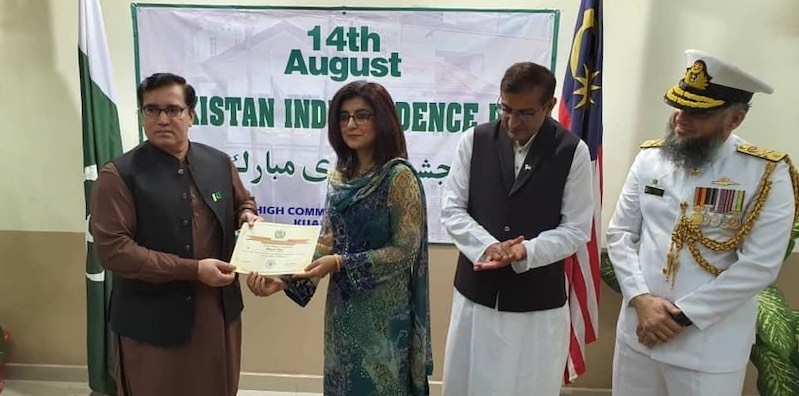
Pakistan high commissioner Amna Baloch (2nd from left) handing out the tahsini certificates – Photo: HC Facebook page
By Asia Samachar Team | MALAYSIA / SINGAPORE |
Pakistan honoured those lending a helping hand in the novel coronavirus battle while India held a virtual debate competition in Kuala Lumpur as both nations celebrated their respective 74th independence day.
In Kuala Lumpur, Pakistan high commissioner Amna Baloch handed tahsini certificates to people who performed prominent and exemplary services for the Pakistani community during the Covid-19 epidemic on Aug 14.
On the same day, her Singapore counterpart Farhana Asif led the flag hoisting ceremony at that mission.
On 15 Aug, Indian high commissioner to Kuala Lumpur Mridul Kumar led India’s celebration which included a virtual debate competition between students of Global Indian International School (GIIS) and Vikas International School. The event in Singapore was led by his counterpart P Kumaran.
ASIA SAMACHAR is an online newspaper for Sikhs / Punjabis in Southeast Asia and beyond.Facebook | WhatsApp +6017-335-1399 | Email: editor@asiasamachar.com | Twitter | Instagram | Obituary announcements, click here |
Damning report on Yogi Bhajan – Background photo of Yogi Bhajan taken from SSSC website
By Asia Samachar Team | UNITED STATES |
Yogi Bhajan, the famed US-based yoga master and self-styled Sikh leader of the Western hemisphere, was a sexual predator who had raped some of his followers.
In a damning investigative report released this week, the yoga teacher who died in 2004 was found ‘more likely than not’ to have ‘engaged in sexual battery, other sexual abuse specifically, exposing minors to pornography, sexual harassment, and unethical behavior’.
“After weighing all of the relevant information available to us, we have sufficient evidence to conclude it is more likely than not that Yogi Bhajan raped three women and that he directed one woman to have anal sex with a young man,” reads one of its multiple conclusions to a barrage of allegations levied against the teacher whose real name is Harbhajan Singh Puri.
In a wrap-up to one set of allegations, the report said: “After weighing all of the relevant information available to us, we have sufficient evidence to conclude it is more likely than not that Yogi Bhajan directed six Reporters to shave their pubic hair.”
The 72-page report, dated 10 Aug 2020, was undertaken by independent investigation organisation called An Olive Branch Associates LLC. It makes difficult reading, with graphic accounts of the sexual exploits of Yogi Bhajan who held himself up as a yoga master and a Sikh leader.
The report was commissioned by the Siri Singh Sahib Corporation (SSSC), the umbrella organisation for 3HO which promotes Kundalini Yoga, a yoga brand popularised by Yogi Bhajan. 3HO, which stands for the Healthy, Happy, Holy Organization, represents the ‘global Kundalini Yoga (as taught by Yogi Bhajan) community’, as stated today on its website.
For Sikhs globally, the closest image of 3HO is that if its followers, usually draped in flowing white Sikh dresses, with most of their women also donning turbans. Some famous names coming from this community are kirtan singer Snatam Kaur and long-time office bearer Shanti Kaur Khalsa who has conducted yoga and Sikh camps around the world.
“We share the report here unedited and in its entirety….The report is a difficult document to read,” says SSSC in a letter addressed to the Sikh Dharma, 3HO and KRI communities in the opening pages of the report.
It warned that the report contains graphic descriptions of sexual misconduct and strong language that may trigger readers.
Indeed, it does contain disturbing recollections of what transpired in the Yogi Bhajan fiefdom headquartered at Espanola in New Mexico, US. Below are just two of the lesser graphic accounts:
82: He [Yogi Bhajan] was rough. He bit my tongue, bit my nipples, left marks on my face from sucking, and pinched me. It was not fun.
77: Yogi Bhajan and I had regular sexual relations. It was painful — he bit my tongue and my lips were bruised. I tried to cover the bruises on my face with makeup. When it first happened to me, there was no conversation; just the act itself. Except that he told me to ’Just relax.’ At no time did he ask me if I wanted to have sex with him. I left Yogi Bhajan’s duty with my nervous system shattered.
The investigation, which commenced on 9 March, focused on “the alleged sexual misconduct by Yogi Bhajan and other related behaviours asserted to have created the circumstances that led to the alleged sexual misconduct”. They involved 299 individuals.
Despite years of hushed discussion on the alleged abuses, it is believed that the Yogi Bhajan’s legacy organisations were pushed over the top to initiate the investigation by the release of ‘Premka: White Bird in a Golden Cage (My Life with Yogi Bhajan)’, an explosive book by his former long-time staffer Pamela Sarah Dyson.
Among others, Pamela, who was then known as Premka Kaur Khalsa, alleges that Yogi Bhajan coerced her and other staff members. The book prompted other followers to voice their ‘me-too’ moments, as well.
When first announced, some quarters had questioned if the report will see the daylight, and if it would go deep enough to uncover the truth. To its credit, the SSSC has made it public, as promised.
DISTURBING FINDINGS
The report concluded that it was ‘more likely than not’ that Yogi Bhajan had:
engaged in touching of intimate parts (their breasts or his genitals) with nine Reporters without their consent.
two women, who were under the age of 18, watch pornography with him and that he showed pornography to one other who was not a minor.
used sexually offensive language with 17 Reporters.
directed six Reporters to shave their pubic hair.
propositioned and/or coached four Reporters
asked three Reporters to tell him about their sexual experiences with others and that they experienced these requests as inappropriate.
recurring sexual relationships with 12 Reporters 7 relationships that continued over the period from 1969 to close to his death in 2004.
seven women engage sexually with him simultaneously with other women
directed 11 women to have sex with other women
instituted practices that created an environment that was harmful to Reporters and that these practices facilitated his sexual misconduct and unethical behavior
employed a variety of methods to control his students including compartmentalization, quid pro quo, promises, threats, slander, phone calls, guarding, and/or telling women they were his wife
LEGACY ORGANISATION
However, the organisation left behind by Yogi Bhajan is clearly divided on the issue, by its own admission in the report.
“Just as these allegations have created strong differences of opinion within the community, they also have created those same differences within the SSSC Board. Not every board member views An Olive Branch’s process or report the same way,” SSSC said in the same letter.
The report rebuked the Yogi Bhajan legacy organisation on suppressing voices of dissent over the years.
“We offer a few additional questions for consideration: How could the voices of multiple women who allege sexual misconduct and abuse of power at the hands of Yogi Bhajan go unheeded for such a long time in a community rooted in compassion?
“Is such secrecy beneficial to the overall goals of 3HO/Sikh Dharma? Going forward, can the community rally around Yogi Bhajan’s own advice to ’Follow the teachings, not the teacher?’”, it said.
The heightened attention on Yogi Bhajan’s alleged sexual exploits has already impacted the Kundalini Yoga community globally, with some severing ties with SSSC or purging links to the founder. In the past, Yogi Bhajan’s photos would be prominently displayed and even used in some of their meditations.
SSSC is the member of each of the non-profit organisations and the shareholder of KIIT, which is the holding company for the US and Indian for-profit companies and of KIT Holding BV (KIT BV). KIT BV is the holding company for the European for-profit companies. As the member and shareholder, SSSC is the legal owner of these entities, according to information at its website.
Among its for-profit entities are Yogi Tea, contract security provider Akal Security, KIIT Renewable Energy LLC (KRE) and Kundalini Yoga class provider Yoga West operated by Raj Yog Takht, LLC.
On the non-profit side, it includes 3HO Foundation, 3HO Europe (dedicated to spreading Kundalini Yoga as taught by Yogi Bhajan in Europe), Kundalini Research Institute (KRI), Legacy of Yogiji ( LYF) Foundation, Amritsar-based international boarding school Miri Piri Academy, Sikh preaching vehicle Sikh Dharma International (SDI) and media portal Sikhnet.
LYF Foundation looks after Yogi Bhajan’s ‘heritage properties’ – Guru Ram Das Ashram in Los Angeles, Guru Ram Das Puri in New Mexico (venue for summer solstice, children’s camp and ladies camp) and Yogiji’s Espanola.
ASIA SAMACHAR is an online newspaper for Sikhs / Punjabis in Southeast Asia and beyond.Facebook | WhatsApp +6017-335-1399 | Email: editor@asiasamachar.com | Twitter | Instagram | Obituary announcements, click here |