
















UA-56202873-1
Page 468

Singapore ruling party is safe till 2030

Bilveer Singh – Phioto: Kopi
By Asia Samachar Team | SINGAPORE |

The present leaders running Singapore are expected to prevail when the nation goes to the national polls on 10 July, predicts political scientist Prof Bilveer Singh.

As the nation prepares for an election under the cover of novel coronavirus pandemic, he believes that a ‘strong leadership’ will likely be returned to power.

“I think we will be able to get our act together quickly and come out stronger… The ruling party is safe till 2030 from any major challenge,” he told Asia Samachar.

Bilveer is the deputy head of the NUS Department of Political Science and author of ‘Is the People’s Action Party Here to Stay?’ released last year. On the political front, he has also authored ‘Understanding Singapore’s Politics’ (2017) and ‘Politics and Governance in Singapore: An Introduction’ (2007).

While PAP is in an enviable position, Bilveer cautioned against overestimating the power of social media.

In an interview with a Singapore portal called Kopi, he explained that in times of crisis such as now Singaporean-style pragmatism will ensue.

“We would rather forgo time for check and balance, accountability and transparency if it means securing our bread and butter as quickly as possible,” he told the portal. He added that this was especially so in the climate of fear and unemployment which Covid-19 has created, with many living on government handouts during the circuit breaker.

So, what prompted the book, Is the PAP Here to Stay?, which was published last year?

“No political party has survived as long as the PAP and these are rare political creatures. The longest prior to the PAP was the BN/Alliance that collapsed in 2018. Hence the dying question whether the PAP would collapse soon. I have been interested in these types of political parties, all the more interesting that the PAP is today the longest governing party in non-communist Asean,” he told Asia Samachar in a response sometime in the middle of last year.

He then said that he had started writing the book in 2015 after the Workers’ Party got into trouble over its town council, but then somewhat lost interest. “Then PH came to power and my interest got rejuvenated,” he said.

PH refers to Pakatan Harapan which created history when it unseated the Barisan Nasional (BN) in a surprise victory in the 2018 polls and saw the return of Dr Mahathir Mohamad as the prime minister, with Anwar Ibrahim as the prime minister in-waiting. In February 2020, it imploded spectacularly, paving the way for a new set of political arrangement led by Muhyiddin Yassin.

BN’s fall naturally resonated in neighbouring Singapore.

On how long does he see PAP surviving the Singapore political landscape, Bilveer noted that the first prime minister Lee Kuan Yew had said in 2011 that one day the PAP will fall while former DPM Tharman Shanmugaratnam had said no political party has lasted more than 70 yrs in power. That puts the marker somewhere at 2029.

“I think, eventually, it will depend on the new PAP leaders getting their act and keeping unity, how well the opposition is united and public perception. I think the PAP will remain in dominance for another 10 years safely, after that the triangular dynamics of the PAP, Opposition and Electorate will determine the political future of Singapore,” he said in the same earlier response.
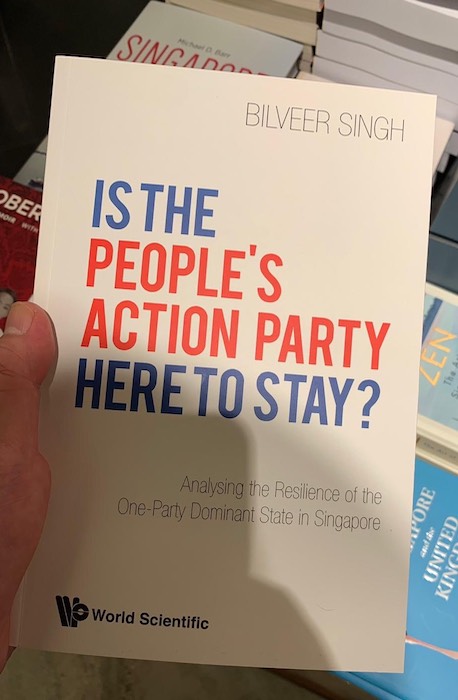
Since the publication the 302-page book on the PAP, Bilveer agreed to answer some questions, with the election looming in the back.

Q: From time the book was published, any major changes in the landscape in Spore politics?

Since the book, Is the PAP Here to Stay? was published in July 2019, three important developments have taken place:

a. The consolidation of the 4th Generation leadership under the current Deputy Prime Minister Heng Swee Keat.

b. The need of Singapore, a trading state, to respond to the worsening US-China trade war and as Singapore is a close trading partner to both, it has suffered in terms of a dip in trade with both and the world as a whole.

c. The most profound impact has come from COVID-19, where Singapore was first hit in Jan 23, 2020 and since then, it has affected every aspect of the republic, with lockdowns, called circuit breakers, in place. I think this has been a very frightening experience for all and the worst is yet to come, especially in terms of economic freefall and we will probably face the worst issues relating to unemployment, retrenchments, joblessness, under employment, etc, in turn having a political, economic, social-cultural and even foreign policy-defence-security impact as far as ties with the outside world is concern; it is going to be a dog eat dog world and as a small state, it will face severe limitations and challenges.

Q: Anything that you didn’t predict taking place?

Knowing the PAP, I was sure the 4G leaders would consolidate and emerge centre stage; but I think no one really expected the US-China trade war to escalate the level it did; and most profoundly, COVID-19 hit us and everyone like a bolt out of nowhere. Of all the unknown unknown, I think COVID-19 was the main one even though we had been through SARS and H1N1 and MERS, as well as being familiar with the Ebola threat. Yes, COVID-19 changed everything as no one was really prepared for its scale, gravity and impact.

Q: What was say was your most spot-on prediction?

A: I knew the GE was coming and I thought it would happen late last year; still, the GE was coming but no one thought it would happen in a COVID-19 terrain. This has been bad for the government as there is much unhappiness, but also good for the government as it was able to demonstrate how good it is as a crisis government and leader, all the more, with a deep pocket that has already forked out S$100 billion as part of its counter-COVID-19 measures.

It is always difficult to predict things in the social sciences, all the more, when the US is in a election year and you have an unpredictable leader like Donald Trump. We are entering a world of great uncertainties and where past models of responses may not be enough and may not apply.

I think we are at a generational crossroads; those who get it right will move forward well, those who don’t will pay a very high price. Hence, Singapore being small, a strong leadership, which will likely be returned to power on 10 July, Polling Day, a largely united people, a strong sense of urgency, discipline and survival, I think we will be able to get our act together quickly and come out stronger, with a people and the new leaders strongly in a political compact that will last, easily for 10 years. The ruling party is safe till 2030 from any major challenge.

RELATED STORY:

Bilveer Singh: Fast-paced, informative and entertaining NUS political scientis (Asia Samachar, 14 Aug 2016)

Harminder Pal raring to return to Singapore campaigning (Asia Samachar, 23 June 2020)


ASIA SAMACHAR is an online newspaper for Sikhs / Punjabis in Southeast Asia and beyond. Facebook | WhatsApp +6017-335-1399 | Email: editor@asiasamachar.com | Twitter | Instagram | Obituary announcements, click here |
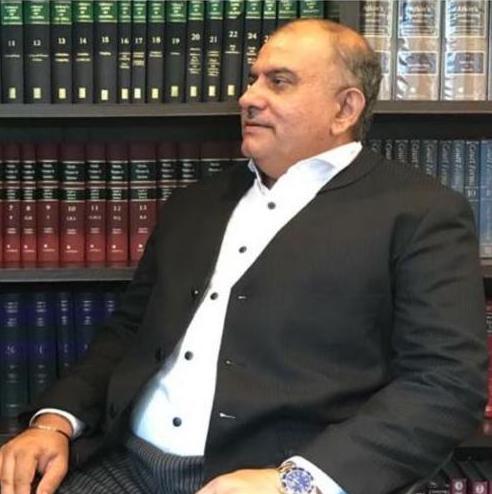
PM keeps Sikh lawyer on Malaysian anti-corruption panel

Baljit Singh Sidhu
By Asia Samachar Team | MALAYSIA |

A senior Sikh lawyer has been retained to serve on a Malaysian Anti-Corruption Commission (MACC) panel.

Baljit Singh Sidhu has been tapped again to serve on the agency’s Consultation and Prevention of Corruption Panel, known by its Malay acronym (PPPR).

A partner at Shukor Baljit and Partners, the seasoned criminal litigation lawyer first joined the panel in 2016. The following year, the then Prime Minister Mohd Najib Razak appointed him for another two-year term.

Baljit is the SSU Kelab Aman president and a member of the Football Association of Malaysia (FAM) disciplinary committee.

His letter of appointment, along with 11 others, was signed by Prime Minister Muhyiddin Mohd Yassin.

Members of the panel, chaired by former Public Service Department (JPA) director-general Borhan Dolah, serve from 1 June 2020 to 31 May 2022.

The other members are former mediamen Manja Ismail, Freddie Fernandez and Chamil Wariya, Institut Kefahaman Islam Malaysia (IKIM) DG Prof Dr. Azizan Baharuddin, Universiti Malaya economics professor Dr Edmund Terence Eric Boniface Gomez, Majlis Belia Malaysia president Jufitri Joha, Lembaga Penduduk dan Pembangunan Keluarga Negara former DG Dr Siti Norlasiah Ismail, Pertubuhan Ekonomi Wanita dan Kebajikan chairman Norita Che Ali, Persatuan Pengguna Islam Malaysia (PPIM) chief activist Nadzim Johan, Ketua Aktivis Persatuan Pengguna Islam Malaysia (PPIM) and Skop Productions Sdn Bhd Md Yusof Md Aslam.


RELATED STORY:

Sikh lawyer sits on Malaysian Anti-Corruption Commission panel (Asia Samachar, 20 Nov 2017)


ASIA SAMACHAR is an online newspaper for Sikhs / Punjabis in Southeast Asia and beyond. Facebook | WhatsApp +6017-335-1399 | Email: editor@asiasamachar.com | Twitter | Instagram | Obituary announcements, click here |

Environmentalism and Racism: connecting the local to the global

0
By Gurnam Singh | OPINION |

Against the backdrop of the cold-blooded killing of George Floyd, most public discussions about racism draw attention to acts of police brutality and hate crime. Additionally, we may talk about the ongoing injustices related to racism in goods, employment and services and institutional racism. Rarely do we think about environmental racism!

There are many wonderful people in the green moment and I personally have embraced environmental activism in my own politics. Saving the natural ecology of the planet and tackling climate change by moving towards renewable energies and sustainable models of growth is good for us all. It leads to a cleaner and greener world, and that is good for humans, animals and plants.

The big problem with the green movement is that protecting the ecology does not preclude the infiltration of far-right reactionary ideologues. Indeed, the origins of the modern ‘western’ environmental movement include some very dodgy characters and ulterior motives related to race purity and mythological ideas about a previously untouched pristine white landscapes.

All the data on climate change confirms that Indigenous people and people of colour and poor people are disproportionately affected, whilst having little responsibility for this state of affairs. But looking in the mainstream green movement, and the media more generally, they are often forgotten or excluded.

In a recent piece entitled The Environmental Movement Needs to Reckon with Its Racist History, Julian Brave NoiseCat – who is director narrative change at the Natural History Museum) – on 16 September 2019, argues that: “The environment is no longer a white sanctuary…“But an inconvenient truth remains: climate change does not answer to racism, politics, or even justice—at least not directly. Its only principles are chemistry and physics. And this might be its greatest cruelty. Power is grazing the fingertips of people of color for the first time. But as we finally start to grasp it and change an environmental movement rooted in a racist past, science may have other designs.”

When we talk about environmentalism we have to make a distinction between two different kinds of environmentalism. There is the everyday environmentalism of indigenous peoples whose lives as far as I can see are the embodiment of ecological living and therefore this kind of environmentalism is as old as the human species. Then we have modern environmentalism which is predominantly a Western idea that grew during the past 150 years or so in response to questions about land guardianship, demographics, (i)migration, industrialisation and leisure.

In truth, the founding fathers of Western environmentalism ranged from garden variety racists to fully-fledged eugenicists. For example, we have Henry David Thoreau, the American essayist, poet, and philosopher. He was a leading transcendentalist, naturalist and abolitionist whose writings inspired Mahatma Gandhi and Martin Luther King Jr., among others. But he also held troubling, but typical views about the inevitable demise of Native Americans. In his influential 1862 essay “Walking,” he wrote: “I think that the farmer displaces the Indian even because he redeems the meadow, and so makes himself stronger and in some respects more natural.”

Another figure is John Muir, a co-founder of the Sierra Club and disciple of Thoreau. The Sierra Club is an environmental organization that was founded in 1892, in San Francisco, California. It was one of the first large-scale environmental preservation organizations in the world and currently engages in lobbying politicians to promote environmentalist policies, currently promoting sustainable energy, mitigating global warming, and opposing the use of coal. Muir wrote about the indolence of Black “Sambos.” He described the Miwok, the Indigenous people of Yosemite, as “dirty” and “altogether hideous.” “They seem to have no right place in the landscape,”

Whilst there is a particular issue about the way in which in the West, eugenics has historically been associated with racial purity and white supremacy, the right-wing appropriation of environmentalism can also be seen in the East.

In India for instance, in a piece entitled ‘Purifying the Sacred: How Hindu Nationalism Reshapes Environmentalism in Contemporary India’ Owen Ellerkamp highlights how Hindutva ideologues are appropriating the environmental agenda. He suggests that this is done by the ‘transposition of the cultural, religious, and sacred onto physical geographies’, which he argues ‘ is practiced by humans everywhere. He goes onto argue that in the present moment, as India seeks to respond to the is own environmental catastrophe, ‘the preservation of “sacred geographies” is being presented by the Hindutva. ideologues as critical to the preservation of Hindu traditions. It is through ‘delineating Hindu nationalist histories and contemporary politics, that ‘environmental work politicizes the landscape through a Hindutva framework through the (re)imagination of Hindu pasts and futures through essentialist and fundamentalist lens.

The Black Lives Movement (#BLM), which was born to highlight and confront state brutality as was so horrifyingly demonstrated in the killing of George Floyd. It has now morphed into a wider struggle against ongoing legacies colonialism and white supremacy. It is important that the movement continues to evolve and for sure it will need to address environmental racism, which is manifest both in the way mercantile capitalism has sought to exploit people and the planet and also in white supremacist romanticisation of space and place.

And whilst the Black Lives Matter is rightly focussed on anti-black racism in the West, given the global dimension of climate disaster and the rise of oppressive nationalism across the world, it is important to connect the struggle for environmental justice with anti-racism on a global level. Indeed, one of the most encouraging features of the Black Lives Movement is its inclusive and international nature.


[Gurnam Singh is an academic activist dedicated to human rights, liberty, equality, social and environmental justice. He is an Associate Professor of Sociology at University of Warwick, UK. He can be contacted at Gurnam.singh.1@warwick.ac.uk]

* This is the opinion of the writer and does not necessarily represent the views of Asia Samachar.


RELATED STORY:

Time to flip some prevailing ideas (Asia Samachar, 24 April 2020)

Sohan Singh Bhakna: Founder of revolutionary Ghadr Party (Asia Samachar, 21 Jan 2019)

ASIA SAMACHAR is an online newspaper for Sikhs / Punjabis in Southeast Asia and beyond. Facebook | WhatsApp +6017-335-1399 | Email: editor@asiasamachar.com | Twitter | Instagram | Obituary announcements, click here |

What kind of a ruler was Maharaja Ranjit Singh?

1
Editor’s Pick | OPINION |

How do we see the rule and empire of Maharaja Ranjit Singh? For sure the misldars and Ranjit Singh were Sikhs, but can we call his confederacy Sikh Empire.

Lahore-based Panjab studies scholar Dr Khola Cheema discusses the issue at the Akaal Channel’s One Show moderated by Dr Gurnam Singh and Manjit Kaur.

She argues that Ranjit Singh, a.k.a. Shere Panjab, was first and foremost a Panjabi ruler and that is how we should see him. To support her argument she drew attention to the fact that Maharaja Ranjit Singh allowed men from different religions and races to serve in his army and his government in various positions of authority, and that his policies were based on respect for all communities, Hindu, Sikh and Muslim.

You can follow the discussion, mostly in Panjabi, here.

RELATED STORY:

Posthumous portrait of Maharajah Ranjit Singh (Asia Samachar, 29 June 2020)


ASIA SAMACHAR is an online newspaper for Sikhs / Punjabis in Southeast Asia and beyond. Facebook | WhatsApp +6017-335-1399 | Email: editor@asiasamachar.com | Twitter | Instagram | Obituary announcements, click here |

I’m separated, not desperate

0
Photo: Kajol in Hindi movie Helicopter Eela
By Ash | OPINION |

Initially, when I separated from my partner, I feigned I was in a happy marriage only to ward off all unwanted people poking their noses in my life.

I just went through a phase, and it made me realize that a woman’s marital status can have more ramifications than what we normally think. And that each ‘status’ comes with a tag based on which society judges the ‘nature’ of such women. And believe me, it takes a lot of courage and strength for single women to live in this world!

Haaye! She’s single! A married woman is considered reliable and safe to be with. She can be a best friend and even be introduced to her husband and brought home!

If she is separated, she is considered an evil or sex deprived woman. Letting your husband near her is dangerous. And be even more aware if she is a divorcee! You don’t need to think, you know she’s here to woo your husband. Such woman have to be kept out of your house!

A married woman may or may not be as attractive to everyone, depending on the stature of her husband. However, if she is separated, she is an easy target. Why don’t you try your luck? Oh and if she’s a divorcee, don’t even think about it, she is definitely available!

The author is a legal consultant, settled in Sharjah, United Arab Emirates, whose first love is and has always been her profession.

Read the full story, ‘Just Because I Am Separated, I Am Not A Desperate Or An ‘Easy’ Woman Looking To Woo All The Men I See!’ (WomensWeb, 28 June 2020), here.

RELATED STORY:

(Asia Samachar, x June 2020)


ASIA SAMACHAR is an online newspaper for Sikhs / Punjabis in Southeast Asia and beyond. Facebook | WhatsApp +6017-335-1399 | Email: editor@asiasamachar.com | Twitter | Instagram | Obituary announcements, click here |

Posthumous portrait of Maharajah Ranjit Singh

Editor’s Pick | BRITAIN A posthumous portrait of Maharajah Ranjit Singh (1780-1839), the founder of the Sikh Kingdom of the Punjab. Given by Maharajah Sher Singh (son and successor of Ranjit Singh) to Lord Ellenborough for presentation to Queen Victoria, January 1843. Artist: Imam Bakshs Lahori – Photo & Text: The Royal Collection Trust
RELATED STORY:

Maharaja Ranjit Singh named 20 world’s greatest leaders (Asia Samachar, 3 Jan 2020)


ASIA SAMACHAR is an online newspaper for Sikhs / Punjabis in Southeast Asia and beyond. Facebook | WhatsApp +6017-335-1399 | Email: editor@asiasamachar.com | Twitter | Instagram | Obituary announcements, click here |

Liverpool fan goes “semi-classical”

Gurmukh and his family dedicate their unique rendition of their club’s song to celebrate Liverpool’s Premier League win. Photo: Gurmukh Singh
By Asia Samachar Team | MALAYSIA |

Liverpool emerging as the Premier League champions after a three decade gap has got their fans hitting new highs. In Malaysia, a lawyer-kirtani celebrated the event with a “semi-classical” rendition of the the football club’s anthem ‘You’ll Never Walk Alone’.

And the event caught the attention of The Star, the nation’s largest English newspaper.

Gurmukh Singh, 54, recorded the song, posted the video on his Facebook page yesterday, and it has been a hit since!

“I had to do it. I’ve wanted to put a traditional Indian spin on this song for some time now, but never got around to it. What better time than now, right?” says Gurmukh, who has been supporting Liverpool since he was in Standard Five.

“I’m into spirituality and religion. But, I must say, witnessing Liverpool emerge as Premier League champs again after so long was right up there as a kind of spiritual experience. It’s an indescribable feeling,” he told The Star.

Gurmukh and his family-backed kirtan jatha (group) performed daily live online kirtan sessions during the recent Covid-19 partial lockdown in Malaysia.

You can read the full story here.


ASIA SAMACHAR is an online newspaper for Sikhs / Punjabis in Southeast Asia and beyond. Facebook | WhatsApp +6017-335-1399 | Email: editor@asiasamachar.com | Twitter | Instagram | Obituary announcements, click here |

Punjab Kaur (1937-2020), Tampin

SASKAAR / CREMATION:  2pm, 29 June 2020 (Monday), at Eternal Memorial Park, Mukim Selandar, Lot 411, Daerah Jasin, 77500 Selandar, Melaka. Cortège leaves  residence at 46, Taman Woon Estate, 73000 Tampin,  Negeri Sembilan, at 1pm. PATH DA BHOG: 11.45am, 5 July 2020 (Sunday) at Gurdwara Sahib Tampin | Malaysia
 ਘਲੇ ਆਵਹਿ ਨਾਨਕਾ ਸਦੇ ਉਠੀ ਜਾਹਿ ॥੧॥

PUNJAB KAUR D/O BALA SINGH

14.6.1937 – 28.6.2020

Village: Moga

Husband: Late Pritam Singh (Retired Station Master Tampin)

Children & Spouses:

Paramjit Kaur & Jaspal Singh

Manjit Kaur

Ranjit Singh & Pal Kaur

Sugvender Kaur

Selendar Kaur

Isher Kaur

Amarjit Singh & Sharanjit Kaur

Jasvender Kaur

Grandchildren: 

Jasminder Kaur

Simran Kaur & Vikram

Nirmaljit Kaur

Hargobind Singh

Jagdev Singh.

Saskaar / Cremation: 2pm, 29 June 2020 (Monday), at Eternal Memorial Park, Mukim Selandar, Lot 411, Daerah Jasin, 77500 Selandar, Melaka.

Cortège timing: Cortège leaves  residence at 46, Taman Woon Estate, 73000 Tampin,  Negeri Sembilan, at 1pm

Path da Bhog: 11.45am, 5 July 2020 (Sunday) at Gurdwara Sahib Tampin

Contact:

Amarjit 012-682 5751

Manjit 017-610 2230


| Entry: 28 June 2020 | Source: Family

ASIA SAMACHAR is an online newspaper for Sikhs / Punjabis in Southeast Asia and beyond. Facebook | WhatsApp +6017-335-1399 | Email: editor@asiasamachar.com | Twitter | Instagram | Obituary announcements, click here |

Karpal Singh, The Tiger of Jelutong lives on

The late Karpal Singh (centre) with Anwar Ibrahim
By Lara Ling | OPINION |

When Karpal Singh died in a car accident on 17 April 2014, his untimely death rocked the nation. A light went out in Malaysia that day. Malaysians from all walks of life deeply mourned the tragic passing of a great man and felt unspeakable loss, for few men were more well-loved than this one.

If Karpal were still alive, he would have turned 80 years old today. Despite the fact that he’s no longer around, his tireless contributions and heartfelt sacrifices for Malaysia are still felt up to this day.

He was a man of honour and integrity, a true hero of the people. He was uncommon for the common man. A friend to the oppressed and the marginalized, his heart always went out to the last, the lost, and the least.

Karpal fought tirelessly for the disabled. Being paralysed himself since 2005, he personally understood and experienced what it was like to live under a government that cared and provided so little for the disabled. He championed their rights to be treated equally, to be given opportunities just like everyone else.

Karpal fought relentlessly for our civil rights and democratic liberties. He stood up for the destitute and the downtrodden, for those who were helpless to defend themselves. Rich or poor, he took on court cases without choosing clients based on their financial ability. In many instances, he represented them on a pro bono basis.

Karpal fought tooth and nail against the abuse of political and judicial powers. Throughout his life, he fiercely battled against a legal system that often failed terribly at protecting the rights of ordinary Malaysians. Laws have changed because of him. In the literal sense of the word, he was a lawmaker.

Karpal also fought long and hard to abolish the death penalty. He took up numerous cases on capital punishment, saving many death row inmates from the hangman’s noose. Former International Federation for Human Rights (FIDH) president Karim Lahidji once said, “When Malaysia eventually abolishes the death penalty, much of the credit will have to be given to the courageous work of Karpal Singh.”

Amazingly, he never expected anything in return. Not fame, not power, not position, not recognition.

A legend and a political giant, he was fearless in fighting for justice, human rights, and democracy. Even in the face of intense persecution, he never wavered and always boldly stood up to injustice. And he paid dearly for it.

However, his sense of justice was so strong that nothing could stop him. Not detainment without trial, not fines, not prosecution, not systemic harassment by the then Barisan National government. Not even a debilitating car accident that robbed him of physical mobility and confined him to a wheelchair could break his spirit.

Even though the 73-year-old statesman suffered greatly for his principles, he was always undeterred. “We cannot be discouraged, as that’s exactly what our enemies would want.” In our current political climate, these words couldn’t ring more true. While deep darkness has fallen over our beloved motherland, let us be that light that shines bright especially when all around us is night.

Karpal never gave up. Neither should we. For that is what the great warrior would have wanted — for us to carry his hopes and dreams for a better Malaysia into the future. May his lifelong pursuit not be left unfinished.

For all the reasons above and many more, he will always have a very special place in our hearts. Thank you Karpal, for leaving us such a powerful legacy. You were committed to justice and equality, even until the very end.

Passionate and unbreakable, your life has truly been such an inspiration to all of us. We could never forget someone like you.

As you once poignantly said six years ago, “The fight goes on. You knock out one Karpal Singh, a hundred Karpal Singhs will rise.” Indeed, the Tiger lives on. Malaysia, rise for what is right! Happy birthday, Karpal!

* This article was written in tribute to Karpal Singh whose birthday is today.

**This is the personal opinion of the writer or publication and does not necessarily represent the views of Malay Mail.

The article, ‘Karpal Singh, The Tiger of Jelutong lives on — Lara Ling’ (The Malay Mail, 28 June 2020), first appeared here.

RELATED STORY:

Celebrating June 28 as Karpal Singh Day (Asia Samachar, 28 June 2020)


ASIA SAMACHAR is an online newspaper for Sikhs / Punjabis in Southeast Asia and beyond. Facebook | WhatsApp +6017-335-1399 | Email: editor@asiasamachar.com | Twitter | Instagram | Obituary announcements, click here |

Hakam Singh Tiwana (1954-2020), Ampang Jaya / Chenderiang

SASKAAR / CREMATION: Funeral took place on 23rd June 2020 at Jalan Loke Yew Crematorium, Kuala Lumpur. PATH DA BHOG: 5th July 2020 (Sunday) at residence.| Malaysia

HAKAM SINGH TIWANA A/L SHAMSHIR SINGH

(11.5.1954 – 21.6.2020)

(residing Ampang Jaya, Selangor/from Chenderiang, Perak)

Wife: Surender Kaur a/p Karam Singh

Children:

Amardeep Singh Tiwana

Nimraat Kaur Tiwana

Hasneeth Kaur Tiwana

Siblings / Spouses:

Rajinder Kaur / Dharam Singh (UK)

Baldev Kaur / Late Atar Singh

Late Sarban Singh / Jaswant Kaur

Dr Ranjit Kaur / Dr Gajan Singh

Sarjit Kaur

Surjan Singh / Manju Ohri (UK)

Jesbeer Kaur / Late Nirmal Singh

Jasbeer Singh / Sukhvir Kaur

Baljit Kaur / Mike Muston (UK)

Also remembered by nephews, nieces, grand-nephews, grand-nieces and a host of relatives and friends.

Saskaar / Cremation: Funeral took place on 23rd June 2020 at Jalan Loke Yew Crematorium, Kuala Lumpur.

Path da Bhog: 5th July 2020 (Sunday) at residence.

As it is still RMCO, the family will comply with the Standard Operating Procedure (SOP) for places of worship/residence. Only immediate family and relatives are encouraged to attend.

Contact:

60163322091 (Amrick Singh @ Ricky)

60125808230 (Amardeep Singh)


| Entry: 28 June 2020 | Source: Family

ASIA SAMACHAR is an online newspaper for Sikhs / Punjabis in Southeast Asia and beyond. Facebook | WhatsApp +6017-335-1399 | Email: editor@asiasamachar.com | Twitter | Instagram | Obituary announcements, click here |