ASIA SAMACHAR is an online newspaper for Sikhs / Punjabis in Southeast Asia and beyond. You can leave your comments at our website, Facebook, Twitter, and Instagram. We will delete comments we deem offensive or potentially libelous. You can reach us via WhatsApp +6017-335-1399 or email: asia.samachar@gmail.com. For obituary announcements, click here
Nearly half of the state’s voters are women and Bihar – which has seen a steady increase in their numbers over the years – recorded its highest female voter turnout in history at 71.6% this year. Both alliances had offered financial assistance schemes to woo women, reported BBC. – Photo: Nitish Kumar Facebook
By Harmeet Shah Singh | Opinion |
India’s Bihar has delivered a result that looks regional but speaks far beyond its borders.
Patna, the birthplace of Guru Gobind Singh Sahib, sits at the centre of the present-day eastern state that has chosen a coalition built on widening support.
Analysts often dwell on Bihar’s caste blocks. These patterns still matter, but the verdict mirrors a wider shift.
The political right is redrawing democratic maps across continents.
President Donald Trump’s resurgence in the United States. The pull of Nigel Farage and Tommy Robinson on British policy under Prime Minister Keir Starmer. Prime Minister Narendra Modi’s Bharatiya Janata Party and its National Democratic Alliance shaping India’s political climate. Different countries. Same direction of travel.
Social media once promised openness. It instead forged sharper identities and rewarded leaders who thrive in polarised environments.
Public sentiment now moves like a firm current. It draws people toward nationalism and muscle.
Rahul Gandhi in India and Zohran Mamdani in New York represent contrasting models of political presence. One seeks acceptance through moderation. The other represents a different latitude of politics. Neither model alone can navigate the rising tide of majoritarian power. They answer to local constituencies. Supremacist politics, however, listens to a wider frequency.
Bihar reflects this unambiguously. Voters credited new roads, reliable power, construction-led jobs and a sense of identity that stretched beyond caste.
They sensed an upward shift, however minimal, and reinforced the leadership that delivered it.
Across the world, majorities tend to consolidate when they perceive movement in their favour. Bihar shows it in real time.
Lessons from Bihar
Voters responded to what they could see and touch. They recalled a Bihar where electricity faded a few miles from Patna and roads failed without warning. They now travel on improved highways, witness new power plants and see the first signs of industry after decades of drift.
Therefore, they back the structure they could see taking shape, rather than short-lived slogans about vote theft, caste counts or anti-capitalist attacks on establishment-aligned tycoons. When people sense even modest improvement, they guard the engine that creates it. This instinct repeats itself across democracies.
American voters back leaders who promise fortresses and revival. British voters respond to nationalism framed as recovery. Indian voters support a blend of pride and central authority. Bihar fits that global script.
Sikhs in This Climate
For Sikhs, this moment demands careful reading. The political right governs or influences many places where Sikhs live or seek to build futures. It shapes immigration, policing, national security and public perception. A careless act in one country or region can spark consequences in another. The world now operates like a single acoustic chamber.
The episode in the United States earlier this year exposed the scale of this challenge. Trump’s action against undocumented immigrants became a show of force.
Visibly identifiable Sikhs were filmed without turbans, handcuffed, and flown to Amritsar on a military aircraft. The images were stark. But the wider Sikh community in the United States did not respond with the force it often shows on civil liberties in India. Sikh lawmakers and activists across the Anglosphere stayed restrained.
Communities often retreat when they fear political cost. Many may not feel immediate empathy for new migrants labelled Fresh Off the Boat. Others may worry that speaking out invites the attention they hope to avoid. These choices reflect the pressures of the political moment.
The Price of Selective Caution
But caution, when selective, creates a dilemma. When a community exercises restraint during a moment of public humiliation, it cannot then use reckless rhetoric in other theatres.
Words travel quickly. They cast long shadows. A statement made in one city can unsettle conditions in another.
Authorities, political actors and media outlets track such moments closely. The consequences often fall on families far removed from the original event.
This is the responsibility facing visible minorities, Sikhs included. It is a call for strategic thoughtfulness, and not silence. Communities must judge when to speak and how to shape their argument.
The political right studies minority behaviour with precision. It uses misjudged reactions as material for its own narratives. This pattern now shapes the era we inhabit.
Bihar’s vote confirms that majoritarian consolidation will endure. It is not a passing phase.
As majority communities organise around ideas of order, identity and protection, minorities must refine their instincts. They need disciplined communication. They need to limit internal noise. They need to avoid steps that create risk for another Sikh a continent away who shares their appearance or articles of faith.
A New Vigilance
Influencers, organisers and digital voices carry significant weight. Their words move fast. Their messages can alter sentiment far beyond their intended audience.
Responsibility should feel like awareness, not constraint. This is the reality of the age.
Bihar’s result is part of a wider story. Major identities are hardening across continents. These shifts are shaping the rules under which minorities now navigate public life.
Sikhs have endured intense pressure in history. Their strength is intact. What this moment requires is judgement suited to the times.
Navigating the supremacist right calls for steadiness and foresight. It calls for the courage to measure one’s own voice. And this is the task of our time.
Harmeet Shah Singh is a career journalist currently serving as Communications and Advocacy Director at UNITED SIKHS (UK), a charity registered in England and Wales.
* This is the opinion of the writer and does not necessarily represent the views of Asia Samachar.
ASIA SAMACHAR is an online newspaper for Sikhs / Punjabis in Southeast Asia and beyond. You can leave your comments at our website, Facebook, Twitter, and Instagram. We will delete comments we deem offensive or potentially libelous. You can reach us via WhatsApp +6017-335-1399 or email: asia.samachar@gmail.com. For obituary announcements, click here
Newcomer Gurveen Kaur Chadha decisively defeated the incumbent and other contestants to become the Westmount City Councillor in District 4.
Gurveen won with 487 (52.59%) votes, leaving incumbent and veteran councillor Conrad Peart who garnered only 291 (31.43%). Trailing them were Massimo Mazza with 87 (9.40%) votes and Lynda Lyness came in fourth with 61 (6.59%) votes.
“I know how policy gets built and how strategy is implemented. Now I’m ready to work for the community where I grew up,” Gurveen said in a statement published on her campaign website.
Gurveen was born and raised in Westmount, located on the Island of Montreal in Quebec, Canada.
She studied public policy at Harvard and Dartmouth and has built a career that bridges public policy and the private sector.
In Ottawa, she was Director of Policy to Marc Garneau, Canada’s Minister of Transport, leading policy development and managing complex issues at the national level.
In business, she has led strategy and operations at companies like Shopify and Jobber, and she also co-founded the olive oil shop, Olives en folie, that was on Victoria Ave.
ASIA SAMACHAR is an online newspaper for Sikhs / Punjabis in Southeast Asia and beyond. You can leave your comments at our website, Facebook, Twitter, and Instagram. We will delete comments we deem offensive or potentially libelous. You can reach us via WhatsApp +6017-335-1399 or email: asia.samachar@gmail.com. For obituary announcements, click here
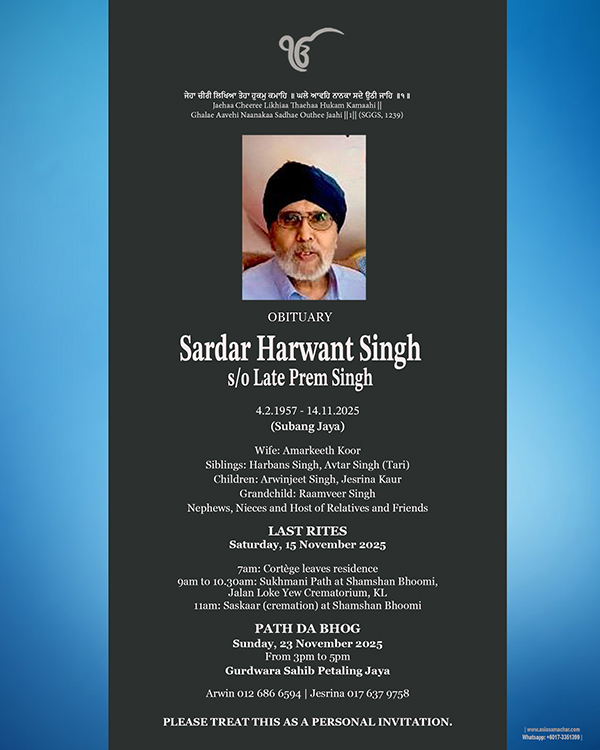
Wife: Amarkeeth Koor Siblings: Harbans Singh, Avtar Singh (Tari) Children: Arwinjeet Singh, Jesrina Kaur Grandchild: Raamveer Singh Nephews, Nieces and Host of Relatives and Friends
LAST RITES Saturday, 15 November 2025
7am: Cortège leaves residence 9am to 10.30am: Sukhmani Path at Shamshan Bhoomi, Jalan Loke Yew Crematorium, KL 11am: Saskaar (cremation) at Shamshan Bhoomi
PATH DA BHOG Sunday, 23 November 2025 From 3pm to 5pm Gurdwara Sahib Petaling Jaya
ASIA SAMACHAR is an online newspaper for Sikhs / Punjabis in Southeast Asia and beyond. You can leave your comments at our website, Facebook, Twitter, and Instagram. We will delete comments we deem offensive or potentially libelous. You can reach us via WhatsApp +6017-335-1399 or email: asia.samachar@gmail.com. For obituary announcements, click here
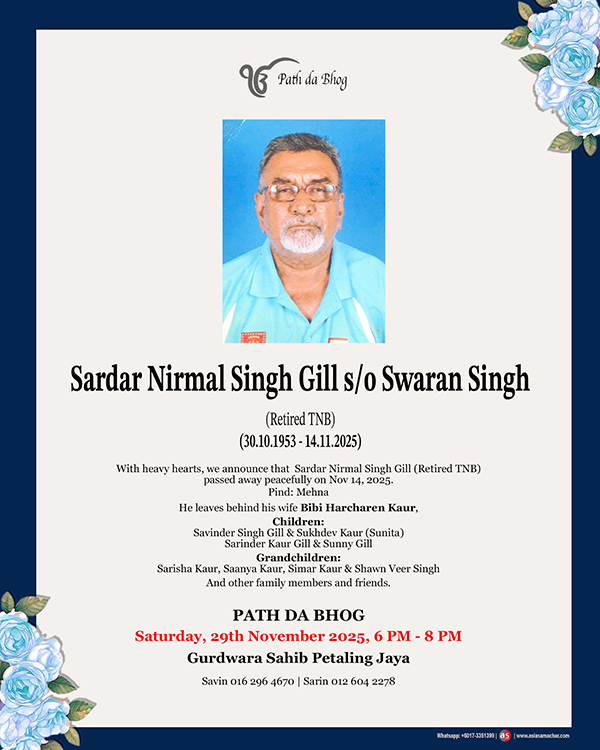
| Entry: 14 Nov 2025; Updated: 27 Nov 2025 | Source: Family
ASIA SAMACHAR is an online newspaper for Sikhs / Punjabis in Southeast Asia and beyond. You can leave your comments at our website, Facebook, Twitter, and Instagram. We will delete comments we deem offensive or potentially libelous. You can reach us via WhatsApp +6017-335-1399 or email: asia.samachar@gmail.com. For obituary announcements, click here
The Oxford interfaith summit helped Manjit Kaur confront her own assumptions and deepen her understanding of sexuality, faith, and compassion.
She reflects on the silence and prejudice toward LGBT+ people within Punjabi Sikh culture, rooted in taboo and patriarchal attitudes.
Hearing real stories of pain, rejection, and resilience from LGBT+ people of faith moved her to recognise the urgent need for empathy and change.
She calls on Sikh leaders and families to support LGBT+ individuals, emphasising that diversity is natural and aligned with Sikh principles of equality.
She concludes that confronting hate is a moral duty and commits to breaking the silence and advocating for LGBT+ dignity and rights.
Manjit Kaur at the ‘Global Interfaith Commission on LGBT+ Lives’ summer residential symposium at Regent’s Park College, Oxford University, in July 2025
By Manjit Kaur | Opinion |
Earlier this year, I had the profound honour of spending a week at Regent’s Park College, Oxford University, attending the ‘Global Interfaith Commission on LGBT+ Lives’ summer residential symposium. The Global Interfaith Commission on LGBT+ Lives, launched in 2020 with the support of the UK Foreign, Commonwealth & Development Office , was founded by the Ozanne Foundation. The faith leadership initiative was launched in 2024 with the expressed aim to bring influential members from all religious traditions from across the world to engage in open, honest dialogue about sexuality and gender.
Faith ‘leaders’ from all the different religions from across the world were invited to face some of the most complex and sensitive questions of our time: how can religious communities embrace and affirm LGBT+ people while remaining true to their faith? The programme offered a confidential space for participants to learn from leading academics from various fields about the nature of human sexuality and how myths and misconceptions have and are impacting on the human experience in negative ways.
For me, a Sikh woman raised in Britain’s Punjabi community, this experience was transformative. It was not just an academic exercise but a deeply personal journey into empathy, honesty and the moral responsibilities that faith leadership has in addressing this issue and our failings to do so. This short piece, as well as offering my personal reflections, also seeks to be a challenge the whole Sikh community, but especially those in leadership roles to take the issue of LGTB + human rights more seriously.
Breaking the Silence
Engaging with global perspectives was enlightening, but it also forced me to confront some painful truths closer to home: my own community’s silence on the rights and needs of LGTB + people.
In Punjabi Sikh culture, feudal and patriarchal attitudes still linger. Talking about sexuality remains a taboo in most Sikh spaces. Growing up, I heard homosexuality spoken of in whispered tones, often in cruel or insulting language. The subject was swept under the carpet, as though pretending it didn’t exist would make it go away.
As a child, I couldn’t comprehend the hostility I sometimes saw LGBT+ people treated as “odd,” “dirty,” or somehow “less than human.” I had no vocabulary to challenge it. In school, and even within my community, the topic was avoided entirely. That silence shaped my understanding. This led me to grow up believing that being lesbian or gay was not normal and that it represented sinful behaviour and bad choices.
Even as I prepared to attend the Oxford summit, I felt nervous. Would people in my community misunderstand my intentions? Would they see my participation as controversial? Yet, beneath that fear was a stronger determination to listen, to learn, and to bridge divides. Because silence, I have realised, helps no one.
Seeing Humanity First
Thankfully, my nerves soon disappeared as we progressed through each presentation and the small group work which provided a really space to explore our own thoughts and feelings. Through the dialogue, not only did I learn some many new things about the issue of human sexuality, but also the challenges and positive change from all the different faith perspectives.
The Oxford summit gave me the space and courage to truly listen. It reminded me of a training session I attended years ago, where a participant was an openly lesbian woman. At the time, I felt uneasy, shaped by prejudices I didn’t even realise I held. But as the day went on, I saw that she was just like anyone else: kind, loving and deeply human. That small moment planted a seed in my heart, and the Oxford experience helped it grow.
At the symposium, we heard first-hand stories from LGBT+ people of faith from across the world. They spoke of rejection, of being told they could “reverse” who they were, of being exiled from their families and communities. We also heard stories of love and acceptance and reminders that compassion can change everything.
In hearing some of the painful stories of rejection and worse, I felt tearful and ashamed of how our communities can treat people, often their own close family members, in such a cruel way. How narrow-minded have we become? We need to change.
These were not just academic debates about belief; they were real human stories of suffering in silence. And once you see in someone’s eyes their pain, their commitment to faith and their need to belong and right to exist without fear, it becomes impossible to remain neutral and not to be moved.
Faith, Family, and the Future
In 2025, though much of the legislation has changed and technically LGTB + people have their rights protected, in truth many within the Sikh community (and others) still struggle to accept difference. We speak of unity and equality, yet we often fail to practise them. We still label people as “outsiders,” “deviant” or “wrong” because they do not conform to labels.
But the world is changing. Our children are growing up in a global, diverse, interconnected world. Many young Sikhs, like young people everywhere, are far more open-minded. They know that love is love. The question is: will we, as parents, elders and faith leaders, support them or shame them? And sadly, given the much higher levels of self-harm and even suicide, especially amongst young LGTB + people, we need to realise this is not just about human dignity, but life and death!
Instead of acting with care and concern, we end up asking “Is this right or wrong?” But perhaps we should ask, “Would I reject my own child for simply being who they are?”
No one chooses their sexuality; all the research points to this being part of human nature, and this is reflected across the animal kingdom. Nobody choses who they love. No one should live in fear or hide who they are. We, as a community, have the power to make that fear disappear, not with grand declarations, but with simple words: “It’s okay. I’m here for you.”
I am deeply proud of the LGBT+ Sikhs who continue to serve their communities with dignity and faith, some of whom I met during the Oxford summit. Their courage to live truthfully, while trusting in God, inspires me. This is not “evil.” This is not “dirty.” It is human life … and it is sacred.
From Reflection to Action
One of the conditions of participating in the Oxford symposium was that, as a community opinion former, I would use what I had learned to create positive change. Now, I am determined to be more proactive: to speak publicly, to open dialogue and to challenge silence.
Human sexuality is not simply a black and white phenomenon. For sure most people will come to adopt a heterosexual life, but we must acknowledge that, according to current research, as many as 10% of Sikhs will be LGTB +, a figure reflected globally across humanity. That is not a “fringe.” It is part of who we are. If we as Sikhs of the Guru truly believe what we ask for in our daily prayer, namely, “sarbat da bhalla” or “prosperity and blessings for all”, then it must include everyone, not just those who fit a narrow definition of what might be regarded as ‘normal’.
When it comes to human diversity, there is no normal. All human beings, male or female, gay or straight, were created by the divine creative force (God). We all belong to the same species and therefore, in one sense, we are all biologically the same in that we are distinct from other animals. But we all different, each human being on this planet is both physically and emotionally unique, and some those unique differences change over time as we develop as human beings, from childhood, to adult hood and eventually old age.
Writing this article is my first step. I know criticism may come. But truth requires courage. Silence is no longer an option.
The Moral Duty to Confront Hate
Hate is among the most destructive of human emotions. It poisons not only relationships and communities, but also the very soul of those who allow hate to shape their lives. Thankfully, in my experience most people are not hateful; they are simply misinformed, fearful or trapped in cultural conditioning.
Our duty, as faith leaders and as human beings, is to confront hate wherever it arises but to do so with compassion. Victims of hate need solidarity; perpetrators also need help in the form of education and empathy. But we must never allow the small minority who spread hate to silence the majority who prefer the path of love.
While Punjabi culture reflects the context of its times on a whole range of matters, because our Guru chose to confront hateful and discriminatory practices, Gurbani offers a vision of acceptance and love. It speaks of equality, of the divine presence in all beings, and of unconditional love. These teachings leave no room for discrimination. From this foundation, I feel completely justified and duty bound to stand for the rights of LGBT+ people to live free from fear and oppression, and to live with dignity.
Manjit Kaur, is a presenter at Britain-based Panjab Broadcasting Channel and a columnist for Asia Samachar. She can be contacted via email at manjitkaur1show@gmail.com
ASIA SAMACHAR is an online newspaper for Sikhs / Punjabis in Southeast Asia and beyond. You can leave your comments at our website, Facebook, Twitter, and Instagram. We will delete comments we deem offensive or potentially libelous. You can reach us via WhatsApp +6017-335-1399 or email: asia.samachar@gmail.com. For obituary announcements, click here
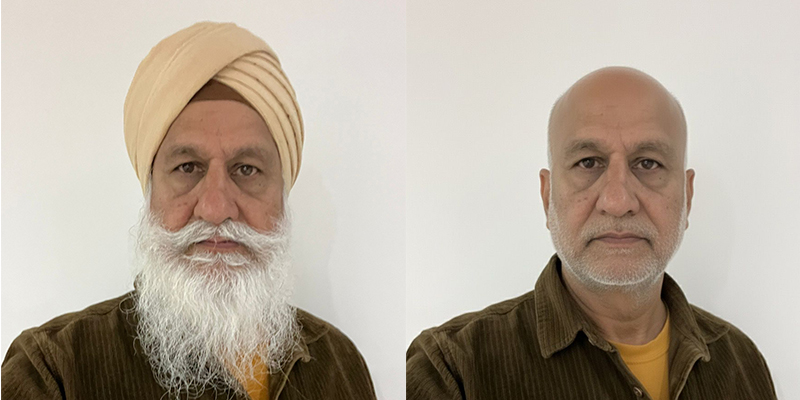
Two images of Gurnam Singh. One shows his authentic self with turban, uncut hair and beard; the other is generated by artificial intelligence, depicting him without them.
By Gurnam Singh | Opinion |
Our physical appearance is often the first thing people notice about us, yet for many Sikhs, the turban, uncut hair and beard are far more than outward symbols. They represent a deep spiritual attachment with the Guru, an expression of dignity and a visible declaration of faith.
Recently, I undertook a small personal experiment that revealed just how deeply these symbols have become part of who I am.
Above are two images of me. One shows my authentic self with turban, uncut hair and beard and the other, generated by artificial intelligence, depicting me without them. Out of simple curiosity, I wanted to see how I might react to being clean-shaven, without actually being ‘clean-shaven’!
Though the facial features in the AI-generated image are technically identical, I was shocked when I first saw it. I simply could not recognise myself. The person in that image felt alien; as though the essence of who I am had been stripped away. That moment of discomfort revealed something profound: just how deeply my kesh (uncut hair) has become intertwined with my identity.
When I showed the two images to my wife of 40 years, Manjit, her reaction mirrored my own. She too felt a sense of dissonance, saying she could not associate that clean-shaven face with the person she has known and loved for decades. That response confirmed for me that my Sikh identity, symbolised by the turban and beard, is not merely about appearance, but a reflection of something inward, spiritual and deeply personal.
My Journey into Sikh Identity
To understand why my turban, uncut hair and beard have played such an important role in shaping who I am today, I must share a little of my backstory.
I am now 66 years old. I have kept my kesh since the age of 18, when I made the conscious decision to embrace the full Sikh way of life and take initiation into the Khalsa through the ceremony known as ‘Khande di Pahul’.
At first, the transition was not easy. Most of my friends were clean-shaven, and adopting the turban and beard in the UK during the late 1970s came with its challenges. I encountered a new form of racial prejudice that I had not experienced before. Suddenly, my identity was not just about being South Asian or Punjabi; I was visibly Sikh, a ‘rag head’, and that visibility carried social consequences.
Yet, as my friendship circles changed and my inner resolve strengthened, I grew increasingly comfortable and confident in my new identity. I also found those around me beginning to give me the kind of respect that I didn’t have previously; it was as if I was now being taken seriously by both relatives and old friends.
Over time, what had once made me feel different or excluded became a powerful source of self-assurance and pride.
From Inferiority to Empowerment
Growing up in a Britain marked by casual racism, I had internalised a sense of inferiority. I carried feelings of self-doubt and self-loathing that affected my academic performance and self-esteem. But when I entered university at 18, newly committed to my Sikh identity, something remarkable happened.
Contrary to the fears of some friends and relatives, who were worried that adopting a full Sikh appearance might make me withdrawn or isolated, I found myself expanding my social and intellectual horizons. My turban and beard became symbols of discipline, resilience and moral clarity. Rather than holding me back, they propelled me forward.
Within just five years of keeping my turban and kesh, I had become proficient in Gurmukhi, learnt Raag Kirtan and Tabla to a level where I could perform in the Gurdwara, and even trained in Gatka, the Sikh martial art. I went on to teach others, establishing gatka akharas in three different cities.
Academically, too, my trajectory transformed. From struggling to pass my O Levels and A Levels, I went on to complete my undergraduate studies, two post graduate professional qualifications in Social Work and Training Management, and a Master of Science degree. By my early-thirties, I had embarked on a PhD at the University of Warwick and a full time academic career.
Looking back, I have no doubt that embracing a ‘full’ Sikh identity played a pivotal role in this transformation. It gave me the confidence, discipline and spiritual grounding to excel and flourish — not in spite of my distinct identity, but because of it.
Closing Reflections
The above reflections are personal and in no way intended to imply that those Sikhs who have chosen to cut their hair are in any way inferior. Indeed, my journey into and through Sikhi has taught me not to judge others on the basis of appearance.
However, for me and my own self-identity, my turban and beard are not simply symbols of faith or heritage; they are integral parts of my being. They connect me to my history, my community, and my sense of purpose.
The AI image experiment was a small but profound reminder of that truth. It revealed that identity is not just about how others see us; it’s about how we see ourselves, and what we come to embody through our lived experiences.
In a world increasingly obsessed with appearance and conformity, I am grateful for the gift of kesh, which is a reminder of authenticity, humility, and courage. For me, keeping my turban and beard is not just a matter of tradition; it is a declaration of who I am and what I stand for.
Gurnam Singh is an academic activist dedicated to human rights, liberty, equality, social and environmental justice. He is an Associate Professor of Sociology at University of Warwick, UK. He can be contacted at Gurnam.singh.1@warwick.ac.uk
* This is the opinion of the writer and does not necessarily represent the views of Asia Samachar.
ASIA SAMACHAR is an online newspaper for Sikhs / Punjabis in Southeast Asia and beyond. You can leave your comments at our website, Facebook, Twitter, and Instagram. We will delete comments we deem offensive or potentially libelous. You can reach us via WhatsApp +6017-335-1399 or email: asia.samachar@gmail.com. For obituary announcements, click here
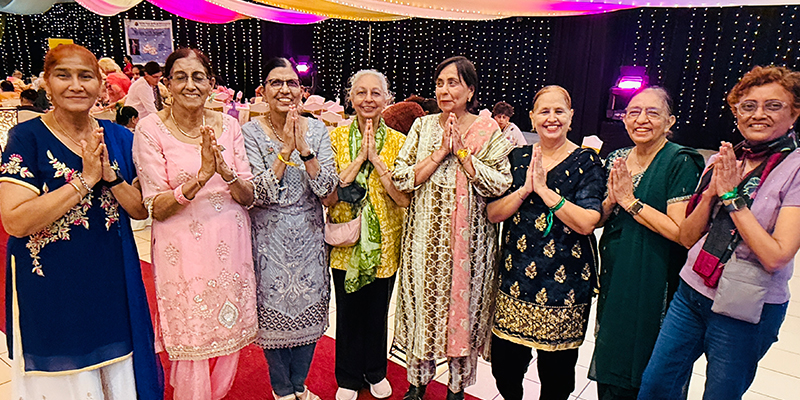
EKTA Hi-Team 2025: A picture of poise pride Punjabi spirit – Photo: Pola Singh / Asia Samachar
By Pola Singh | Malaysia |
If joy had a sound, it would be the laughter echoing through a gurdwara hall in Kuala Lumpur recently which came alive with music, movement and memories as EKTA Club of Kuala Lumpur & Selangor, in collaboration with Tatt Khalsa Diwan, hosted a heartwarming Hi-Tea event themed “Celebrating the Seniors in Our Lives.”
The event at Wisma Tatt Khalsa on 2 November 2025, from 2pm to 5.30pm, wasn’t just another afternoon gathering—it was a tribute to the pillars of our community. With over 100,000 Sikhs in Malaysia, and nearly a third being seniors, it was high time we honoured their legacy with a celebration befitting their contributions. And what a celebration it was!
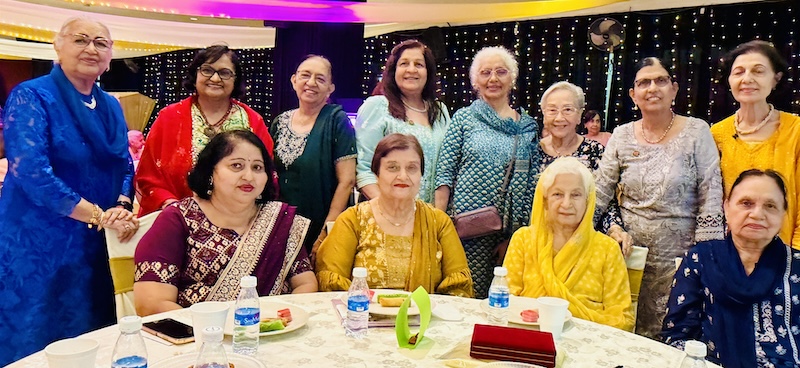
The crowd? A radiant mix of Sikh mums, aunties, grandmas, sister-in-laws and friends—each one a story, a smile, a spark. Many were aged 75 and above, attending free of charge, while others gladly paid RM60 to be part of this unforgettable experience.
Heart and Humour
The 3.5-hour programme flew by in a whirl of activities that kept spirits high and hearts full:
Yoga Laughter Therapy by Sarjit Kaur reminded us that laughter truly is the best medicine. Watching seniors giggle and stretch with abandon was a gentle nudge to embrace joy, no matter our age.
Fashion Show – Ten graceful ladies took to the stage with poise and flair, proving that style and confidence don’t retire. Their catwalks were less about competition and more about celebration—of self, of sisterhood, of sass!
Geet & Gidha – The rhythmic claps and expressive movements of this traditional Punjabi folk dance brought the room to life. Seniors joined in with gusto, singing and dancing in a beautiful display of cultural pride and communal joy.
Makan & Minum – A sumptuous spread of Punjabi cuisine awaited, and the queue for high tea became a corridor of conversations. Old friends reunited, new friendships blossomed, and the aroma of spices mingled with laughter.
Even those with limited mobility came, determined to soak in the camaraderie. Their presence was a testament to the power of community and the importance of inclusion.
EKTA Hi-Team 2025: Celebrating the seniors in our lives – with style, soul, and smiles – Photo: Pola Singh / Asia Samachar
The hall buzzed with photo ops and video clips—capturing not just faces, but feelings. If the walls of Wisma Tatt Khalsa could speak, they’d tell tales of rekindled friendships, shared memories, and the sheer joy of being seen and celebrated.
Behind the Scenes
The event’s success was no accident. It was the result of tireless planning by a powerhouse committee: Paramjeet Dhillion (Chairperson), Jagdish, Sukhdev, Charan Sandhu, Manjit and Amarjeet. Their dedication ensured every detail sparkled—from the programme flow to the food trays; executing every detail of the event, bringing their laptops and working over numerous cha meetups.
EKTA President Kuldip Kaur lent her unwavering support, embodying the club’s mission to make a difference with heart and purpose. Her mission is not completed until a senior citizens activity centre is set up.
EKTA hit tea 2025: The Women Who Made It Happen – Photo: Pola Singh / Asia Samachar
And what a difference these spirited ladies have made—this being their 10th year of service to the community!
More Than an Event—A Movement
EKTA Club has long been a beacon of empowerment. From raising RM550,000 to establish the first Sikh Senior Citizens’ Activity Centre in the Klang Valley, to honouring outstanding Sikh women and organising youth workshops, their impact is felt across generations.
This Hi-Tea was another jewel in their crown—a reminder that seniors aren’t just our past, but our present and future. Their wisdom, warmth, and wit deserve celebration, not just once a year, but every day.
As for me, I was there to produce a video of this magical afternoon. The warm reception I received, and the kind words from attendees who read my articles, touched me deeply. Writing about seniors—about their lives, their laughter, their legacies—is my way of honouring them. And on this day, they honoured me back.
So to those who missed it: your friends will tell you. The photos will show you. And next year, we hope you’ll join us. Because when seniors gather, magic happens.
Watch this space—EKTA’s dynamic and spirited ladies are just getting started. Syabas and well done.
Dr Pola Singh, who retired as Maritime Institute of Malaysia director-general in 2011, is also the author of ‘Uphill — The Journey of a Sikh-Chinese Kampung Boy
ASIA SAMACHAR is an online newspaper for Sikhs / Punjabis in Southeast Asia and beyond. You can leave your comments at our website, Facebook, Twitter, and Instagram. We will delete comments we deem offensive or potentially libelous. You can reach us via WhatsApp +6017-335-1399 or email: asia.samachar@gmail.com. For obituary announcements, click here
The opening ceremony of Gurdwara Sahib Guru Nanak Shah Alam on 11 Dec 2015 – PHOTO SIKH INSIDE
By Asia Samachar | Malaysia |
Gurdwara Sahib Guru Nanak Shah Alam will be holding a Grand Kirtan Darbar and Akhand Path, from Aug 8 to 14, 2025, to commemorate the shaheedi dehara (martyrdom) of Guru Tegh Bahadur as well as the 10th anniversary of the gurdwara.
“Let us gather as one sangat to remember the supreme sacrifice of Guru Teg Bahadur Ji and to celebrate this milestone of our Gurdwara with kirtan, paath and heartfelt ardas,” the organising team said in a note shared with the Sanggat.
ASIA SAMACHAR is an online newspaper for Sikhs / Punjabis in Southeast Asia and beyond. You can leave your comments at our website, Facebook, Twitter, and Instagram. We will delete comments we deem offensive or potentially libelous. You can reach us via WhatsApp +6017-335-1399 or email: asia.samachar@gmail.com. For obituary announcements, click here
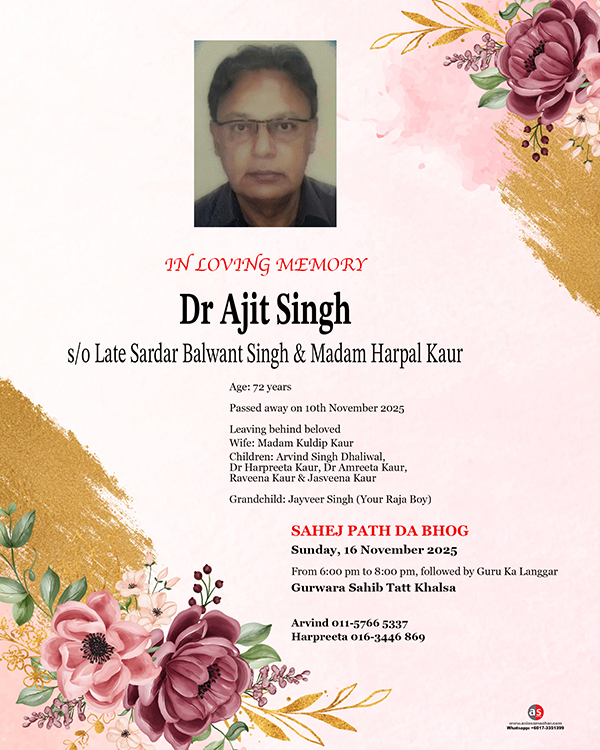
| Entry: 11 Nov 2025; Updated 12 Nov 2025 | Source: Family
ASIA SAMACHAR is an online newspaper for Sikhs / Punjabis in Southeast Asia and beyond. You can leave your comments at our website, Facebook, Twitter, and Instagram. We will delete comments we deem offensive or potentially libelous. You can reach us via WhatsApp +6017-335-1399 or email: asia.samachar@gmail.com. For obituary announcements, click here