1st BARSI: Kirtan and Path da Bhog on 28 March 2020 (Saturday) at Gurdwara Sahib Polis (High Street) Kuala Lumpur from 10am to 12pm, followed by Guru ka Langar| Malaysia — UPDATE NOTE FROM FAMILY: In light of recent developments, we have chosen to not open the barsi to public as we do not want to risk spread of Covid-19. We keep all of our friends and family in our prayers in these trying times (17 March 2020)
UPDATE NOTE FROM FAMILY: In light of recent developments, we have chosen to not open the barsi to public as we do not want to risk spread of Covid-19. We keep all of our friends and family in our prayers in these trying times (17 March 2020)
1st Barsi, In Loving Memory of
SGT (RTD) SARDAR JASBIR SINGH S/O LATE KARAM SINGH
formerly of Century Gardens, Johor Bahru.
Retired from Unit Forensik, Maktab PDRM Cheras RF67867
“Those we love dearly are never gone. They walk beside us, unseen, unheard, but always near. Forever loved, memories cherished, and deeply missed.
Forever remembered by
Wife: Harinder Kaur
Children:
Simran Singh – Parvin Cheema
Keeran Kaur – Elijah Pang (Canada)
Charan Singh
Brothers, Sisters, and a host of relatives and friends.
Please treat this as a personal invitation.
Far too soon you were taken, till we meet again in Heaven
Contact:
Harinder 017-3390519
Simran 012-6668125
Charan 012-5969486
| Entry: 14 March 2020 | Source: Family
ASIA SAMACHAR is an online newspaper for Sikhs / Punjabis in Southeast Asia and beyond.Facebook | WhatsApp +6017-335-1399 | Email: editor@asiasamachar.com | Twitter | Instagram | Obituary announcements, click here |
Darbar Sahib, Amritsar, photographed in February 2019. Popularly known as the Golden Temple. Photo by Saheb Singh
By Rishpal Singh Sidhu | OPINION |
The Golden Temple, also known as Harmandir Sahib or Darbar Sahib, is spiritually the most revered, sacred, and significant site in Sikhism. While there is no religious requirement or compulsion for Sikhs to go on a pilgrimage to visit historic Sikh sites, like Mecca is to the Muslims and the Vatican is to the Catholics, the many Sikhs who have visited the Golden Temple have always come away in awe and respect of its deep spiritual significance. Guru Arjan (English translation, as cited in Singh, 1998) said “there is nothing like it in all the three worlds. Harimandar is like the ship – means for the people to cross over the worldly ocean triumphantly. A new joy pervades here every day. A sight of it annuls all sins.” 1 Prof. Inder JitSingh wrote “it is sanctified by the blood of our martyrs. Sikh history lives and speaks to us through its bricks and mortar, and therein lies its significance to Sikhs and Sikhism throughout the world”.2 He also lamented the use of the moniker “Golden Temple”. The late Prof. W.H. McLeod voiced the same thought to this writer (personal communication, 2000).
This article attempts to etymologically examine the variant names and spellings used to describe the Golden Temple over the years, why it came to be called as such, and asserts the case for reversion to its original name of Harmandar or Darbar Sahib. It also seeks to consider how and why a gurdwara is uniquely different from a temple, and posits the case for a change in thinking. Not half in jest, Prof. Inder Jit Singh observed, “I smile to myself when I hear a Sikh refer to a gurdwara as our “temple” or ”church” in a non-Sikh gathering. He is trying a short-cut to communication but loses precision in the process. A gurdwara is definitely not a church or a temple, just as a synagogue is not one, nor is it a mosque. Now with so many gurdwaras around the world, it is time for the term ‘gurdwara’ to take its rightful place in the lexicon describing places of worship.” 3
There are currently a number of variant terms, phrases, and spellings attributed to addressing the Golden Temple before it came to be called by this name. Har Mandar (Temple of God), Harimandir, and also spelt as Harimandar. The term Harimandir is composed of two words Hari and Mandir (meaning temple or house) which various scholars translate either as a Temple of God, a Temple of Lord Vishnu, and Abode of Lord Vishnu. It has also been called Harmandir Sahib, literally meaning House of God; Sri Harmandir Sahib; Darbar Sahib meaning Abode of God, Exalted Holy Court, Exalted Court; and Sri Darbar Sahib.
Sahib is a term of Arabic and Turkish origins and means owner, holder, or master. Its usage has since passed on to several languages including Urdu, Hindi, Punjabi, Bengali, Gujarati, Pashto, and Marathi, and is akin to the way Mister (derived from the word master) and Mrs (derived from the word mistress) is used in the English language. The term Darbar refers to a court or hall of audience in Urdu from the Persian and is used to refer to a hall in a Sikh temple. Darbar Sahib refers to the main hall within a Sikh gurdwara. It means the Guru’s Court and is also used in reference to the central building at Harmandir Sahib, Amritsar. More importantly, Darbar Sahib is the hall where the Sri Granth Sahib is placed on a takhat or throne in a prominent central position in the hall in any gurdwara.
Harmandir Sahib appears to be the original name of the Golden Temple. According to Singha (2005), there are two other gurdwaras named Harmandir Sahib, namely the one in Kiratpur where Guru Hargobind spent his last few years and also one at Patna which is regarded as one of the five Takhats and is known as Takhat Shri Harimandir Ji Patna Sahib.4 This gurdwara was affected by the earthquake which hit Bihar in 1934. In its place today stands a four-storeys marble building completed in 1960, and one of its rare artefacts includes a copy of the Adi Granth bearing Guru Gobind Singh’s signature.
Likewise, a number of variant but not markedly too dissimilar spellings have been ascribed to the word gurdwara including gurudwara and gurooduaraa, and it can only be used to describe a building which houses the Guru Granth Sahib. Besides the Granth Sahib, the four other defining features of a gurdwara include the presence of the Nishan Sahib, pangat (free community kitchen), sangat (holy congregation) and golak or Guru Ki Golak (Sanskrit golak; Persian gholak) meaning the Guru’s own till or cash box used for receiving and keeping contributions of money for charitable purposes and for administration of the gurdwara. The word gurdwara is a compound word comprising Guru, meaning teacher, spiritual guide, and enlightener. The word Guru is also used to describe a preceptor giving personal religious instruction. The word dwara or duaar means doorway, gateway, portal, or abode. The word dua means blessings or benediction. Gurdwara also means the gateway through which the Guru can be reached.
This writer asserts that the epithet ‘temple’ is incorrectly used in describing the Golden Temple. In etymological terms, the word temple is derived from the Latin templum, used to describe a Roman structure dedicated for religious and spiritual activities including prayer and sacrifice and analogous rites. While there is more than a semantic difference in meaning between rituals and ceremonies, no sacrificial rites or sacraments take place in our gurdwaras. The sukhasan (sukh meaning comfort/pleasure/bliss, and asan meaning position or posture – collectively, it means posture of rest, peace, and tranquility) or ceremonial closing of Guru Ji’s saroop and placing in a special room or place can rightly be described as a rite or ritual, as can the prakaash (meaning light, radiance, awakening, enlightenment) ceremony of bringing Guru Ji’s saroop from the sachkhand (realm of truth) to the darbar hall for the day.
Notwithstanding its association with the religion of ancient Rome, the use of the word temple dates back much earlier to the 6th century BC. It has since acquired common usage in describing any house of worship for a number of religions including Hinduism, Buddhism, Jainism, Masonic, and Zoroastrians. In past times, only the priests were allowed to penetrate these buildings (not unlike the behavior of some of the corrupt masands and pujaris who at some point in its history jealously guarded the entrance to the Harmandar Sahib) which were usually associated with the dwelling places of a particular god or set of gods. In the New Testament the word temple acquires a symbolic meaning as evidenced by Paul’s epistles.
Don’t you know that you yourselves are God’s temple (I Corinthians III, 16)
We are the temple of the living God (II Corinthians VI, 16)
Do you not know that your body is a temple of the Holy Spirit (I Corinthians VI, 19)
Gurbani explains that we carry the divine within us and Guru Nanak has taught us that God is everywhere, in each living being.
Sikh writer and publisher of the influential Design journal Patwant Singh (2008) noted that “certain aspects of the siting, scale, design and construction of the Harmandir was strikingly at odds with the trends of those times. While the design and scale of the Renaissance buildings of that period in Europe – and other religious structures like mosques, temples, churches and cathedrals – were meant to reflect the power and wealth of a particular faith, or to glorify the monarchs and merchant princes who helped build them, the Harmandir was markedly different.” 5 More importantly, this single-storied structure “was built even lower than the surrounding land so that the modest size of the building would stress the faith’s enduring ability, strength and confidence, not through extravagant architectural statements or the grandeur of its buildings, but by allowing the appeal of that faith to irresistibly draw people to it as well as the nobility of the idea it enunciated that all human beings are equal in the eyes of God, not because of class or caste or the majesty of the buildings they build in his name, but because it is their God given right to be treated as equals.” 6
Darbar Sahib, Amritsar – ToonistBains
Hindu temples are closed on three sides and are usually built and open only towards the east or rising sun which is regarded as auspicious by followers of the Hindu faith. In contrast, the Harmandir Sahib was built to be open on all four sides, signifying that worship was open to all and was not concerned with sun worship. “The Granth Sahib is placed in the middle of the temple so that no man may seat himself in its place.” 7 In common with Hindu temples, the focus in our gurdwaras is also on the location and positioning of the inner sanctum such as to allow space for circumambulation. However, this is where the similarity sharply ends. Incense is not burned before the Granth Sahib in our gurdwaras, nor are cymbals tinkled, and bhajans sung, and nor is there a priestly order.
Following its capture by the Mughals in 1757, the Harmandir Sahib was desecrated and razed to the ground, and it was again attacked and razed to the ground in 1762 by Afghan invader Ahmad Shah Abdali, founder of the Durrani dynasty. Maharaja Ranjit Singh, founder of the Sikh Empire, took great interest in getting the Harmandir Sahib artistically decorated and he engaged the best artists and craftsmen from Chaniot in Pakistan to adorn the Harmandir Sahib. He is largely credited with rebuilding the Harmandir Sahib in marble and copper in 1809, and overlaying the sanctum with gold foil in 1830. Yar Mohammad Khan Mistri was the technical expert for carrying out this gold plating. 8 The dome and surrounding turrets are covered with gold plated cover copper sheets and this led to it acquiring the epithet ‘golden’ and being described as the Golden Temple by the Europeans.
“Some Sikh chieftains had also engaged skilled marble cutters and masons to shape and lay slabs on the parkarma, the circumambulatory walkway around the pool…After the walls of the Harmandir had been lined with marble panels, they were inlaid with a wide variety of animal and bird life and once in a while a human figure. As more sites of sublime significance were developed around the Harmandir, the complex came to be known as the Darbar Sahib. In time, the Harmandir too was identified as the Darbar Sahib, until the two became indistinguishable from each other, although the magnetic pull that the Harmandir proper exercises on the minds of the devout has not been equalled by any other building in the complex.” 9
Succeeding generations of Sikhs from within India and overseas have since lavished their munificence on enhancing both, the magnificence and adding technological improvements to this much beloved place of worship. There are unverified reports that the temple’s main dome is gilded with 750 kilograms of gold. In 2018, it was announced that the four domes at the entrance to the Harmandir Sahib would be renovated with 160 kilograms of pure 24 carat gold through kar seva (service and worship) and monies raised from voluntary contributions. 10
Regardless of whichever name it is called, the Harmandir Sahib today would be a front-runner to be declared a UNESCO World Heritage site. However, neither the Shiromani Gurdwara Parbandhak Committee (SGPC) nor the many Sikh community organizations in India and Sikh diaspora organizations overseas are in favour of the proposal as they fear that designating the Harmandir Sahib as a World Heritage Site would lead to a loss of control at institutional level, and that control would be transferred to the central (union) government of India. This is not necessarily an unfounded belief.
In its early years and up till 1906, the Harmandir Sahib housed murtis (images, statues or idols) of Hindu deities in common with other Hindu temples around the world. In sharp contrast to what takes place in our gurdwaras, the offering of light, flowers, water, fruit, and incense are essential rituals in Hindu temples. To the believers, the divine is visible in Hindu temples in the image of the deities, and the divine sees the worshipper. Hindu worship is primarily an individual rather than a communal activity, and this differs from Sikh belief which embraces both forms of prayer and worship. The foregoing practices are all very compelling reasons for not using the word ‘temple’ to describe our gurdwaras around the world.
The Harmandir Sahib has been in existence for more than 400 years and it is high time to question and abandon the use of both, the moniker ‘temple’ and the name Golden Temple and revert to its unique and original name Harmandir Sahib. The everlasting glitter of gold on its domes is but a defining architectural characteristic. Deeper still is our intrinsic belief and knowledge that the Harmandir Sahib serves as a permanent historical reminder of the deep and abiding faith in our religion.
NOTES
Singh, H. Editor-in-Chief. The Encyclopaedia of Sikhism. Vol 4. Punjabi University Patiala, p.242.
Singh, I.J. In his foreword to the late Retired Justice Dr. Choor Singh Sidhu’s book Sri Harmandir Sahib Amritsar; The Golden Temple of the Sikhs. Herts, United Kingdom, European Institute of Sikh Studies, 1999, p.xvi.
Singh, I.J. ‘A granthi…priest, rabbi and minister, Nishaan Nagaara, 2003, III, pp. 38-41.
Singha, H.S. The Encyclopedia of Sikhism. 2d ed. New Delhi, Hemkunt Publishers, 2005, p.97.
Singh, P. and Rai, J.M. Empire of the Sikhs; The Life and Times of Maharaja Ranjit Singh. New Delhi, Picus Books (An imprint of Hay House Publishers (India) Pvt Ltd, 2008, p.43.
Ibid, p.44.
Macauliffe, M.A. The Sikh religion; Its Gurus, sacred writings and authors. Amritsar, Satvic Media Pvt Ltd, (1909, reprint January 2009, vol 3, p.9.
Shankar, V.N. & Bhatnagar, R. The Golden Temple: A gift to humanity. Gurgaon, Haryana, India, Ranvir Bhatnagar Publications, 2004, p.27.
Singh, P. and Rai, J.M. Empire of the Sikhs; The life and times of Maharaja Ranjit Singh. New Delhi, Picus Books (An imprint of Hay House Publishers (India) Pvt Ltd, 2008, p.45.
Rishpal Singh Sidhu is a semi-retired library and information services professional based in Sydney, Australia. He has a passion for research, writing, and teaching. He is the editor of Singapore’s Early Sikh Pioneers: Origins, Settlement, Contributions and Institutions.
ASIA SAMACHAR is an online newspaper for Sikhs / Punjabis in Southeast Asia and beyond.Facebook | WhatsApp +6017-335-1399 | Email: editor@asiasamachar.com | Twitter | Instagram | Obituary announcements, click here |
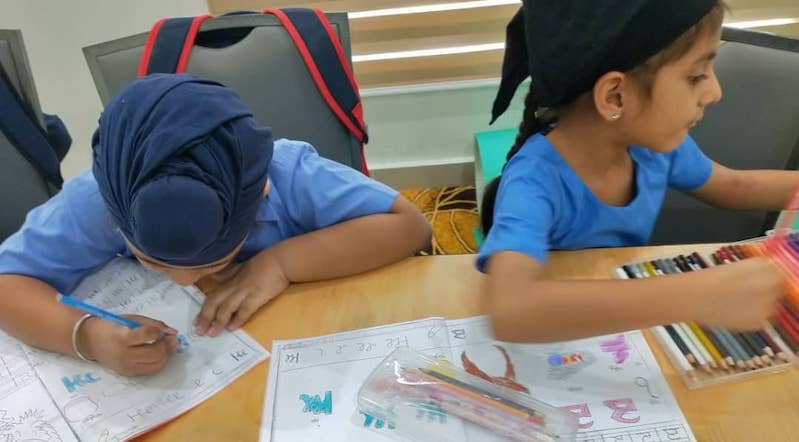
Studying Punjabi: Students at one of the PEC centres in Malaysia – Photo: Supplied
By Asia Samachar Team | MALAYSIA |
Most weekend Punjabi classes in Malaysia will most probably be cancelled for the rest of the month while some gurdwaras are starting to scrap regular programmes in the wake of the novel coronavirus fear.
The Punjabi Education Centres (PECs) nationwide, run by the Punjabi language arm of the Khalsa Diwan Malaysia (KDM), have been advised to cancel the remaining classes for March.
“The PECs can use their discretion if the need / situation warrants thereafter,” according to an advisory sent out to the 42 centres nationwide which cater to some 2,500 students. They attend regular weekend classes usually conducted at their nearest local gurdwaras.
This was in line with Malaysia’s health ministry’s directive to postpone all mass gatherings to minimise the spread of Covid-19. Public schools have cancelled sporting events and co-curriculum activities for March until further notice.
Gurdwaras in Malaysia have also started cancelling regular diwans but are leaving it individuals and families to decide on sponsored programmes.
In an update today, Kuala Lumpur-based Gurdwara Sahib Tatt Khalsa Diwan has announced that all gurdwara-sponsored congregational programmes, though daily prayers will proceed as usual and the darbar sahib (prayer hall) will remain open.
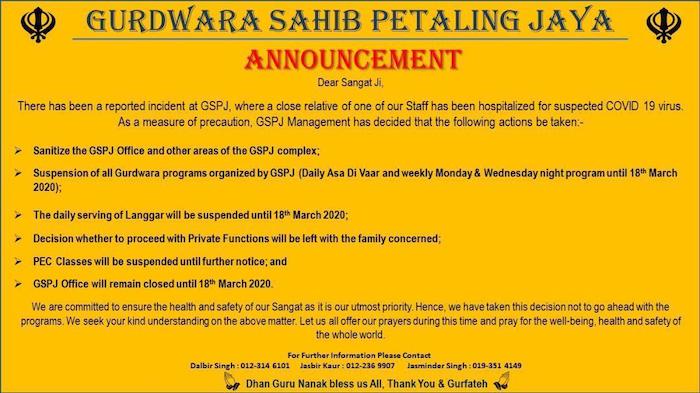
The Petaling Jaya gurdwara has cancelled all programmes until Wednesday (18 March) as a close relative of one of its staff was hospitalised for suspected Covid-19. See here.
Across the causeway in Singapore, gurdwaras are proceeding with programmes as usual, though they have instituted some screening measures. See here.
As the World Health Organisation (WHO) declares the Covid-19 outbreak a pandemic, governments around the world are beginning to put in place measures to contain the spread of the virus which does not yet have a vacine.
Medical teams and researchers around the world are racing to develop a vaccine for virus which has sickened more than 127,000, with health experts expecting a vaccine in 12 to 24 months time.
Gurwaras the world over will be faced with the decision as to whether they will proceed with programmes for Vaisakhi next month, which usually draws large crowds.
ASIA SAMACHAR is an online newspaper for Sikhs / Punjabis in Southeast Asia and beyond.Facebook | WhatsApp +6017-335-1399 | Email: editor@asiasamachar.com | Twitter | Instagram | Obituary announcements, click here |
Petaling Jaya gurdwara is suspending all programmes until Wednesday (18 March) as a close relative of one of its staff was hospitalised for suspected Covid-19.
The gurdwara, located next to the Tun Hussein Onn Eye Hospital, will also suspend daily serving of langgar (meals) which usually attracts a good crowd of foreign workers and students.
“Decision whether to proceed with private functions will be left with the familiy concerned,” according to a statement from the Gurdwara Sahib Petaling Jaya (GSPJ) released today.
The gurdwara will also sanitise the office and its gurdwara complex.
ASIA SAMACHAR is an online newspaper for Sikhs / Punjabis in Southeast Asia and beyond.Facebook | WhatsApp +6017-335-1399 | Email: editor@asiasamachar.com | Twitter | Instagram | Obituary announcements, click here |
Temperature checks at a Singapore gurdwara – Photo: CSGB
By Asia Samachar | SINGAPORE |
Singapore gurdwaras will proceed with their programmes, albeit with increased precautionary measures to battle the novel coronavirus, at a time when mosques are closed for a five-day cleanup and Catholic Church masses still suspended.
At least one gurdwara is looking at installing permanent infrastructure to live-stream its programmes for the benefit of members who are unable to participate physically, especially the elderly.
“The authorities have asked to stop senior-centric activities. In view of the Covid-19 situation, we are paying close attention to our elderly folks, especially those with underlying conditions.
“The live streaming will come in handy here them and those not well. We’ve had them on an ad-hoc basis in the past. Now, we’re looking at installing the infrastructure to make it a permanent feature,” Central Sikh gurdwara Board (CGSB) president Baljit Singh told Asia Samachar.
He said the live-streaming will also be useful for the Vaisakhi programmes, which are still on the table at the moment.
Last month, Singapore Khalsa Association (SKA) had announced the cancellation of the Vesakhi Mela 2020 which was scheduled for April 11-12.
Today marks the first day after the World Health Organisation (WHO) declared the COVID-19 outbreak a global pandemic.
Nine new COVID-19 cases were confirmed in Singapore today (12 March), including two people who attended a mass religious gathering at a mosque in Petaling Jaya, Malaysia. The latest confirmed cases bring Singapore’s total to 187, reports CNA.
In a drastic measure, Singapore Minister-in-charge of Muslim Affairs Masagos Zulkifli announced that all mosques will be closed for five days, beginning Friday, for cleaning so as to prevent the potential spread of the virus.
Two Singaporeans have contracted Covid-19 after attending the Jhor Qudamak Malaysia 2020 event at a mosque in Seri Petaling, Selangor. The event was reported to have attracted some 10,000 participants.
Masagos told a media briefing that 82 Singaporeans have been identified to have attended the event.
In another development, the Catholic Church in Singapore has decided to continue the suspension of masses at all its 32 churches, despite an earlier decision to bring them back.
“We are not helping the situation if we resume Masses at this time, simply because of the sheer numbers of Catholics packing in each service, and their fluidity in moving from one parish to another,” Singapore archbishop Reverend William Goh said in a letter.
“Furthermore, a large percentage of our parishioners belong to a vulnerable group – seniors with lower immunity.”
On 14 Feb, the church had announced the indefinite suspension of its mass, but then on 5 March decided to bring them back for mid-March.
In Malaysia, Minister for Religious Affairs Zulkifli Mohamad Al-Bakri said that the Friday prayers will proceed with some adjustments like shortened sermons.
Congregation members have also been advised to make ablutions at home and wear face masks, while the mosque committees are to provide hand sanitisers as part of preventive measures.
ASIA SAMACHAR is an online newspaper for Sikhs / Punjabis in Southeast Asia and beyond.Facebook | WhatsApp +6017-335-1399 | Email: editor@asiasamachar.com | Twitter | Instagram | Obituary announcements, click here |
Meeno Chawla with her parents on graduation day – Photo: Personal Facebook page
By Meeno Chawla | EXPERIENCE |
I came from Afghanistan in 1995 to England as an immigrant. The 1989 civil war in Afghanistan had a huge impact on the whole country but particularly for religious minorities. Afghanistan used to have a flourishing Afghan Sikh community but because of continuous marginalisation and discrimination, people left. My parents as well as many Afghan Sikhs left for a better life, which included opportunities and basic rights. Those who remain in Afghanistan continue to suffer and face difficulties through constant seclusion and fear.
Women in the Afghan Sikh community have traditionally been homemakers, and this was often reinforced in my childhood by members of the community. In Afghanistan there was a lack of educational and work opportunities for girls, especially those from religious minorities. I live with my parents; they have four daughters. I am the youngest and at my birth there were negative reactions from the community as sons were preferred due to passing on the family name. However, my parents have been extremely supportive with my studies and life choices; they have encouraged me to pursue a career at the Bar. My mother works in a fabric shop, where she reinforced the importance of being independent and pursuing a career despite the odds through hard work.
I chose a career in law as I want to use advocacy to engage in work that has a direct impact on the lives of others, because both my family and I personally have experienced being in a position of vulnerability and disempowerment. This is why I wish to pursue a career which involves representing people when their fundamental rights and liberties are at stake.
I wasn’t considered the brightest at school and was told by a teacher that I should ‘reconsider a career in law as I wasn’t clever enough,’ but I used this as my motivation to do well at school. During my summer holidays, I did work experience at two law firms to get an insight into the different areas of law and how law works in real-life.
I went on to study Law with Criminology at university. I went to networking events and did work experience at the Courts and mini pupillages to get a better understanding of the profession. I was a case manager on the Innocence Project at university. I worked on a case involving a potential miscarriage of justice for two years. This experience was the turning point for me, where I decided that I wanted to become a barrister and be a voice for those who don’t possess much knowledge of the legal system.
After graduation, I decided to volunteer at a charity, which helped people with their housing and debt claims. Later, I joined the Crown Prosecution Service, I was overwhelmed with the knowledge and the high pressure yet fast-paced environment, but I loved every moment of it and still enjoy my job today! I work closely with prosecution barristers in preparation of their cases and assist them in court. My work taught me how the Criminal Justice System works and that defendants need a Criminal Justice System which they can trust, and which ensures they are being represented. While working at the CPS, I was studying the Bar Professional Training Course part-time. I decided to study the course part-time because despite a scholarship from Middle Temple, I could not afford to pay the full-time fees. The late-night studying, doubts and stress were worth it because I got through it successfully.
In October 2019, I was called to the Bar of England and Wales as the first Afghan Sikh. This was a proud moment for me, my family and my community. I used to question whether I would fit in and soon realised my background is and will always be my strength. My secret weapons are perseverance, hard work and a passion to learn on this ongoing journey.
Equality and diversity are critical for the rule of law and professional legitimacy. Barristers represent everyone, and the Bar should be more representative of society. Given my background and unique life-experiences, I want to be part of that process and hope people will choose a career in law despite the odds against them.
The article, Women Against Adversity: “I’m the first Afghan Sikh to be called to the English Bar” (The Lawyer, 12 March 2020), first appeared here.
ASIA SAMACHAR is an online newspaper for Sikhs / Punjabis in Southeast Asia and beyond.Facebook | WhatsApp +6017-335-1399 | Email: editor@asiasamachar.com | Twitter | Instagram | Obituary announcements, click here |
KIRTAN | NEWLY RELEASED: Daughter and father kirtani team Amrita Kaur and Yadvinder Singh have released a 55-minute track on mool mantar. Music arranger/composer: Lovely Sharma; graphics and video: Navraj Sra; coordinator: Avtar Singh.
[TAKE NOTE OF ASIA SAMACHAR OFFICIAL WHATSAPP NUMBER: +6017-3351399. You can contact us to provide news alerts, community updates or obituary announcements. Stay in chardi kalaa]
ASIA SAMACHAR is an online newspaper for Sikhs / Punjabis in Southeast Asia and beyond.Facebook | WhatsApp +6017-335-1399 | Email: editor@asiasamachar.com | Twitter | Instagram | Obituary announcements, click here |
India has suspended all travel visas from tomorrow (13 March 2020) to 15 April in its most drastic measure yet to battle the novel coronavirus which has officially been declared a pandemic by the World Health Organisation (WHO).
This month-long suspension comes at a times when India usually gets a large number of tourists, including those taking advantage of the mild cold weather of Punjab in the north.
The revised travel advisory, dated 11 March, is a result of the high level group of ministers meeting and comes into effect from 1200 GMT on 13 March at the port of departure, according to a statement released by India’s Press Information Bureau (PIB). See here.
Pakistan has yet to issue any such measures at this point of time.
The India move also impacts those holding the so-called Overseas Citizenship of India (OCI) card whose visa free travel facility will also be ‘kept in abeyance’ till 15 April.
“I have a group of nine who were supposed to travel to India in a few days time for a pre-wedding shopping. The wedding is in August. I’m working out with the airlines to see if they can get a full refund for their tickets,” a Kuala Lumpur tour agent told Asia Samachar.
“This is a peak season. Many love travelling to India during this period.”
The latest measure also said that all incoming travellers, including Indian nationals, arriving from or having visited China, Italy, Iran, Republic of Korea, France, Spain and Germany after 15 February will be quarantined for a minimum of 14 days.
THE ANNOUNCEMENT IN FULL
Ministry of Health and Family Welfare
High level Group of Ministers reviews current status, and actions for prevention and management of COVID-19
Revised Travel Advisory issued
Posted On: 11 MAR 2020 10:18PM by PIB Delhi
The sixth meeting of the GoM was held at Nirman Bhawan today under the chairpersonship of Dr. Harsh Vardhan, Union Minister of Health & Family Welfare. Sh. Hardeep S. Puri, Minister of Civil Aviation, Dr. S. Jaishankar, Minister of External Affairs, Sh. Nityananda Rai, Minister of State for Home, Shri Mansukh Mandaviya, Minister of State (I/c), Ministry of Shipping, Chemicals and Fertilisers and Sh. Ashwini Kumar Choubey, Minister of State, Health & Family Welfare were present.
The recommendations of the Committee of Secretaries chaired by Cabinet Secretary were placed before GoM. After detailed deliberations on preventive measures, actions taken and preparedness for Novel Coronavirus Disease (COVID-19), the Group of Ministers took the following decisions:
All existing visas, except diplomatic, official, UN/International Organizations, employment, project visas, stand suspended till 15th April 2020. This will come into effect from 1200 GMT on 13th March 2020 at the port of departure.
Visa free travel facility granted to OCI card holders is kept in abeyance till April 15th 2020. This will come into effect from 1200 GMT on 13th March 2020 at the port of departure.
Any foreign national who intends to travel to India for compelling reason may contact the nearest Indian Mission.
All incoming travellers, including Indian nationals, arriving from or having visited China, Italy, Iran, Republic of Korea, France, Spain and Germany after 15th February, 2020 shall be quarantined for a minimum period of 14 days. This will come into effect from 1200 GMT on 13th March 2020 at the port of departure.
Incoming travellers, including Indian nationals, are advised to avoid non-essential travel and are informed that they can be quarantined for a minimum of 14 days on their arrival in India.
Indian nationals are strongly advised to avoid all non-essential travel abroad. On their return, they can be subjected to quarantine for a minimum of 14 days.
International traffic through land borders will be restricted to Designated check posts with robust screening facilities. These will be notified separately by M/o Home Affairs.
Provision for testing primarily for students/compassionate cases in Italy to be made and collection for samples to be organized accordingly. Those tested negative will be allowed to travel and will be quarantined on arrival in India for 14 days.
ASIA SAMACHAR is an online newspaper for Sikhs / Punjabis in Southeast Asia and beyond.Facebook | WhatsApp +6017-335-1399 | Email: editor@asiasamachar.com | Twitter | Instagram | Obituary announcements, click here |
Folks from Singapore, Malaysia, Thailand visiting India face a 14-day ‘self-imposed quarantine’ due to unabetted spread of the novel coronavirus.
Indian-bound travelers with travel history to these three Southeast Asia and nine other countries are ‘advised to undergo self-imposed quarantine for a period of 14
days from the date of their arrival’, according to the latest travel advisory from India.
“If such passengers are working in some organizations/institutions, their respective employers are advised to facilitate work from home during this period,” according to the document, dated 10 March 2020, issued by India’s Ministry of Health and Family Welfare.
It was also shared at the website of the Indian high commission in Kuala Lumpur. See here.
However, it was not clear whether it is compulsory for all travelers and what constitutes ‘self-imposed quarantine’.
The other countries affected are China, Hong Kong, South Korea, Japan, Italy, Iran, France, Spain and Germany.
A check at India’s Bureau of Immigration (BOI) website shows that these three countries do not appear in the Covid-19 travel and visa restrictions. See here.
Over a series of announcements, the Indian government has suspended visas and restricted travel from a number of countries to halt the spread of the Covid-19 virus, including China, Italy, Iran, Republic of Korea, Japan, France, Spain and Germany.
ASIA SAMACHAR is an online newspaper for Sikhs / Punjabis in Southeast Asia and beyond.Facebook | WhatsApp +6017-335-1399 | Email: editor@asiasamachar.com | Twitter | Instagram | Obituary announcements, click here |
The Malaysian Gurdwaras Council (MGC) has released identified some preventive measures for gurdwaras as the Covid-19 cases beyond 100 nationwide.
The council began sending out the ‘advisory flyer’ to all Malaysian gurdwaras today. A copy was emailed to Asia Samachar. See below.
As of today (11 March 2020), the Malaysian health ministry said it has recorded 20 new cases of the novel coronavirus, bringing the total number of cases to 149.
CORONAVlRUS — PREVENTIVE MEASURES
l. Utmost cleanliness to be observed in the preparation of “Parshad” and “Langgar”.
2. All volunteers who serve Karah Parshad Degh should wash their hands thoroughly with soap and water before doing the Sewa.
3. Absolute cleanliness to be observed in preparation of Langgar. All Sewadars should wash hands with soap and water before doing Sewa. Wherever possible, the Sewadars are to wear gloves when preparing Langgar.
4. Those serving Langgar should wash hands with soap and water before serving Langgar.
5. Committees should make available in Gurdwaras hand soap, sanitizers, surface disinfectants, hand towels, etc.
6. When washing dishes, wherever possible, thereafter, to rinse the dishes with a round of warm water (over 60 °C) to sterilize them. Alternatively, to use dishwashers on hot settings with dry heat.
7. Any extra food should be disposed safely and no bins should be left uncovered.
8. Common areas like Langgar hall, Kitchen and Toilets should be more frequently cleaned.
9. If possible, a thermometer to be made available for any Sanggat member to check his/her temperature. Staff and Granthis are encouraged to check their temperatures daily.
10. Those with symptoms like having cough, a body temperature of 38°C and above and difficulty in breathing should immediately seek medical treatment. Such Sanggat members are also advised to temporarily avoid going to the Gurdwara.
NOTE: Crisis preparedness and response centre hotline No:
03-88810200
03—88810600
03-88810700
ADVISORY BY: MALAYSIAN GURDWARAS COUNCIL
03-4050 2329
ASIA SAMACHAR is an online newspaper for Sikhs / Punjabis in Southeast Asia and beyond.Facebook | WhatsApp +6017-335-1399 | Email: editor@asiasamachar.com | Twitter | Instagram | Obituary announcements, click here |