Missing Person Report: Harcharan Singh from Petaling Jaya
[The person has been found. All is well, according to a reader who spoke to his family – Update: Sept 26, 2025; 4.15pm)
By Asia Samachar | Malaysia |
Police are seeking the cooperation of the public to locate an 82-year-old elderly man who has been reported missing after leaving his home in Section 11 here since Tuesday (Sept 23), reported a local Malaysian newspaper.
Petaling Jaya District Police Chief, Assistant Commissioner Shahrulnizam Ja’afar said that a report was received regarding the disappearance of Harcharan Singh Teja at 12:09 a.m. on Thursday.
“Based on information received, Harcharan Singh was last seen at around 10 a.m.
“The man is about 177 centimetres tall, weighs 90 kilograms, has light-brown (wheatish) skin, a prominent nose, and thick eyebrows and lips,” he said in a statement on Friday, according to Sinar Harian.
Anyone with information about the man can contact investigating officer Inspector Ngo Su Siao at 016-9231558 or the Petaling Jaya District Police Headquarters Operations Room at 03-79662222.
RELATED STORY:
(Asia Samachar, 25 Feb 2024)
ASIA SAMACHAR is an online newspaper for Sikhs / Punjabis in Southeast Asia and beyond. You can leave your comments at our website, Facebook, Twitter, and Instagram. We will delete comments we deem offensive or potentially libelous. You can reach us via WhatsApp +6017-335-1399 or email: asia.samachar@gmail.com. For obituary announcements, click here
A man of honour, love and dedication, he leaves behind a legacy of kindness and strength. His guidance and unconditional love will forever remain in our hearts.
ASIA SAMACHAR is an online newspaper for Sikhs / Punjabis in Southeast Asia and beyond. You can leave your comments at our website, Facebook, Twitter, and Instagram. We will delete comments we deem offensive or potentially libelous. You can reach us via WhatsApp +6017-335-1399 or email: asia.samachar@gmail.com. For obituary announcements, click here
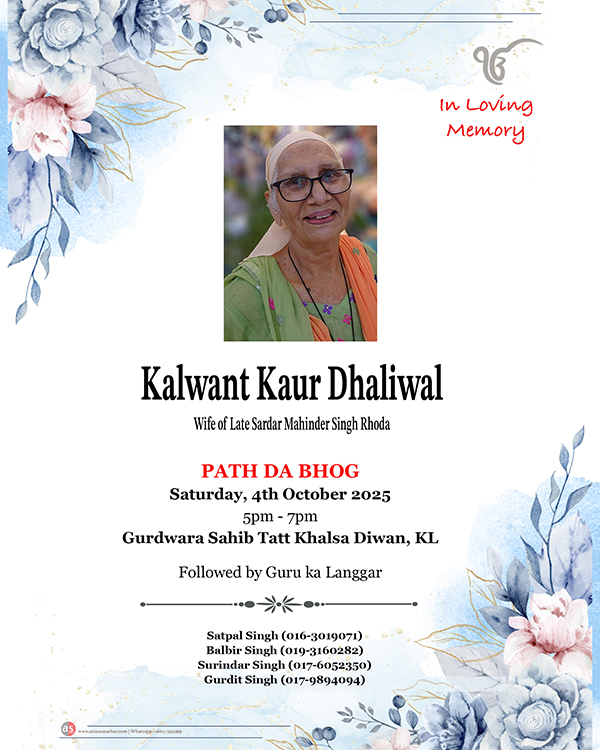
Mata Kalwant Kaur Dhaliwal wife of Late Sardar Mahinder Singh Rhoda
13.3.1939 to 25. 9.2025
(Village: Bilaspura)
We lovingly call you Bee, Maa, Mummy, Dadima, Nani. Never getting tired of calling out to you with those names of endearment. It is going to be very painful not to be able to call out to you anymore. You were the center of our world, you kept us all glued together. You leave us with a big void in our lives. Thank you for all your sacrifice, love and teachings. You will always be in our hearts.
Leaving behind your children / spouses: Mangeet Kaur / Surindar Singh (Taman Andalas) Late Manmohan Singh / Lakhwinder Kaur Kuldeep Kaur (Zurich, Switzerland) Balbir Singh Rhoda / Ravneet Kaur Amardeep Kaur / Dr. Surinder Singh
ASIA SAMACHAR is an online newspaper for Sikhs / Punjabis in Southeast Asia and beyond. You can leave your comments at our website, Facebook, Twitter, and Instagram. We will delete comments we deem offensive or potentially libelous. You can reach us via WhatsApp +6017-335-1399 or email: asia.samachar@gmail.com. For obituary announcements, click here
Panjabi cinema in 2025 has delivered one of its most exciting years to date, with several films making waves both in India and abroad.
From high-energy comedies to historic dramas, this year’s top releases have shown that Punjabi storytelling is reaching ever wider audiences.
Here are the top five Indian Punjabi movies of 2025 by combined India and overseas box office, their performances and what makes them stand out.
1)Sardaar Ji 3: A Global Sensation Without an Indian Release
Leading the charts is Sardaar Ji 3, a horror-comedy headlined by superstar Diljit Dosanjh. Remarkably, the film never released theatrically in India yet became the highest-grossing Panjabi film of 2025, thanks to an unprecedented overseas run. Media reports indicate it earned about ₹42.6 crore (US$4.8 million) in its first 10 days overseas, later surpassing ₹70 crore (US$7.9 million) internationally. Continuing the beloved franchise, the story follows a ghost-hunting protagonist who finds himself entangled in supernatural escapades with both humor and heart. The film’s witty script, lively music, and appeal to the Punjabi diaspora cemented its worldwide dominance.
2) Saunkan Saunkanay 2: Family Fun Meets Big Business
In second place is Saunkan Saunkanay 2, a comedy-drama featuring Ammy Virk, Sargun Mehta, and Nimrat Khaira. This sequel to the popular 2022 hit picks up the hilarious rivalry between co-wives and the ever-conflicted husband. Its balanced blend of family humor and emotional depth resonated strongly with audiences. The film earned an impressive ₹34.9 crore (US$3.9 million) globally (about ₹18.3 crore in India and ₹13.35 crore overseas), proving that well-crafted sequels can capture both critical and commercial success.
3)Sarbala Ji: Heartwarming Family Drama with a Wide Reach
Third on the list is Sarbala Ji, a touching family drama that has proven a sleeper success. With a worldwide gross of about ₹26.17 crore, including ₹10.49 crore net in India, the film explores intergenerational conflicts and the values of compassion and reconciliation. Word of mouth and strong overseas interest helped sustain its theatrical run. Sarbala Ji’s universal themes and grounded performances made it a favorite among both Indian audiences and the Punjabi diaspora abroad.
4)Guru Nanak Jahaz: A Historical Epic with Global Appeal
At number four is Guru Nanak Jahaz, a historical biopic dramatizing the Komagata Maru incident and the struggles of Punjabi revolutionaries seeking justice and dignity abroad. Beyond India, it achieved around US$1.37 million worldwide according to international box office trackers. The film’s powerful narrative of resistance and faith, combined with rich period detail, brought a lesser-known chapter of history to life. Audiences and critics alike praised its ability to fuse cinematic spectacle with an inspiring true story.
5)Akaal: The Unconquered – Valor on the Big Screen
Rounding out the top five is Akaal: The Unconquered, a stirring historical drama starring Gippy Grewal and Nimrat Khaira. With a domestic net of roughly ₹7.8 crore and a modest but significant overseas tally (around US$350,000), the film offers a cinematic tribute to Sikh warriors who stood undaunted against formidable odds in 19th-century Punjab. Its meticulously recreated battle sequences and soulful music earned praise, underscoring how historical sagas continue to captivate audiences when infused with authentic storytelling.
A Year of Variety, Global Reach
These top performers together reflect the growing range of Panjabi cinema. From laugh-out-loud domestic comedies to historically rich dramas and supernatural adventures, 2025 proved that Panjabi filmmakers can compete on the world stage. Importantly, their appeal extends well beyond Panjab, with huge international box office figures—particularly in Canada, the United Kingdom and North America—illustrating the strength of the Panjabi diaspora as a vital audience.
The phenomenal success of Sardaar Ji 3, which thrived overseas without an Indian theatrical release, underscores how global streaming platforms and diaspora theaters have reshaped Panjabi film economics. Many of these titles are expected to have long lives on OTT services, which will further amplify their reach and profitability. Producers are increasingly tailoring releases and marketing to both domestic and international viewers from day one.
Looking Ahead
As Panjabi cinema continues to expand in scope and ambition, the 2025 box office leaderboard sets a high bar for creativity and global impact. These five films span comedy, family drama, supernatural adventure, and historical epics. They demonstrate that Panjabi stories can resonate across cultures.
For audiences eager to explore the vibrant world of Panjabi films, this year’s top releases offer the perfect starting point, and signal even bigger things for the industry in the years to come.
ASIA SAMACHAR is an online newspaper for Sikhs / Punjabis in Southeast Asia and beyond. You can leave your comments at our website, Facebook, Twitter, and Instagram. We will delete comments we deem offensive or potentially libelous. You can reach us via WhatsApp +6017-335-1399 or email: asia.samachar@gmail.com. For obituary announcements, click here
Relief work post-flooding in Panjab – Photo: KhalsaAid video
By Asia Samachar | India |
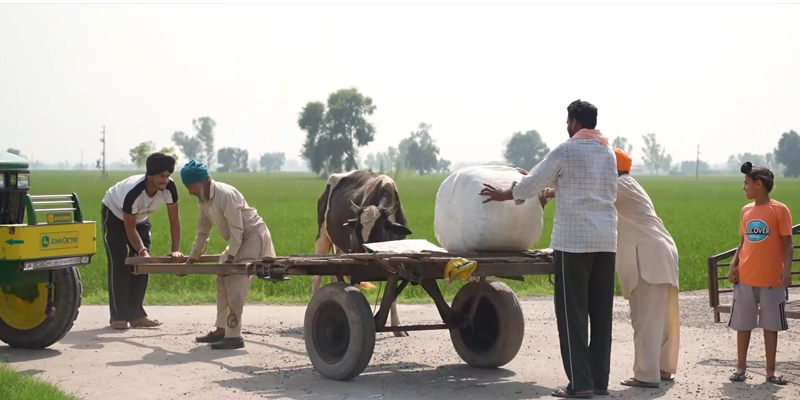
Heavy monsoon rains and flash floods have inundated vast swaths of farmland in India’s Panjab state, threatening the livelihoods of thousands of farmers and disrupting a key part of the global rice trade.
According to Al Jazeera, Gurvinder Singh, a 47-year-old farmer from Gurdaspur, took a million-rupee ($11,000) private loan to marry off his daughter and plant three acres of high-yield pearl Basmati rice. He expected to earn nearly one million rupees per acre from this season’s harvest. Instead, his paddy fields now lie submerged under layers of floodwater and silt.
“We are ruined,” Singh said, noting that the destroyed crop had been crucial to repaying debts.
Punjab, which produces about 40% of India’s US$6 billion Basmati exports, has suffered crop damage estimated at more than 450,000 acres—and experts warn the actual figure could be up to five times higher. Across the border in Pakistan’s Punjab province, which accounts for 90 percent of that country’s Basmati output, fields are also under water.
Agricultural economist Lakhwinder Singh told Al Jazeera that “the crop is completely spoiled, their machinery is submerged, and the farmers’ houses have washed away.” Analysts fear the losses will ripple through India’s agricultural economy and could influence food-grain trade policy, with warnings against lowering tariffs or increasing grain imports in response.
As farmers like Gurvinder Singh face the prospect of “restarting from scratch,” the floods highlight the growing vulnerability of South Asia’s vital rice sector to climate-driven extreme weather.
ASIA SAMACHAR is an online newspaper for Sikhs / Punjabis in Southeast Asia and beyond. You can leave your comments at our website, Facebook, Twitter, and Instagram. We will delete comments we deem offensive or potentially libelous. You can reach us via WhatsApp +6017-335-1399 or email: asia.samachar@gmail.com. For obituary announcements, click here
Book Name: MYSTIC ECHOES: Stories Rooted in Sikh Spiritual Realms Author: Dr. Devinder Pal Singh, Toronto ISBN-13: 9798284845394 Published: First Edition 2025 Price: US$9.99 (Paperback), Pages: 213 Publisher: Center for Understanding Sikhism, ON, Canada Book Reviewer: Prof. Hardev Singh Virk, SGGS World University, Fatehgarh Sahib (Pb.)
MYSTIC ECHOES: Stories Rooted in Sikh Spiritual Realms by Dr. Devinder Pal Singh
Dr. Devinder Pal (DP) Singh joined the Physics Department in 1983 as an Ad-hoc Lecturer to teach Physics and complete his doctorate degree in Physics (Acoustics). I found him as a dedicated teacher and researcher.
Upon moving to Canada as an immigrant, he initiated a new venture, the Center for Understanding Sikhism. A similar organization, the Institute for Understanding Sikhism, was established earlier by Dr. D. S. Chahal in Montreal. I was perplexed as to why a hardcore physicist was meddling in Sikhism.
My curiosity was satisfied after reviewing his book, Science and Sikhism: Conflict or Coherence. I started rating him as one of the greatest exponents of Sikhism (Sikhi) in the modern age.
The Foreword “A Sacred Mirror: Seeing Ourselves Through Sikh Narratives” has been written by Bhai Harbans Lal, Ph.D., D. Litt (Hons). I used this Foreword as my launching pad to understand the contents of Mystic Echoes.
THE TECHNIQUE
Bhai Lal appreciates the technique used by D. P. Singh: “It brings the living essence of Gurbani into our day-to-day existence. These are not abstract theological exercises, nor are they simply nostalgic tales of rural life. Instead, they are powerful spiritual parables, immersive narratives that reveal how the universal truths embedded in Sikh teachings manifest in the hearts, struggles, and transformations of everyday people.”
The author introduces his UNIQUE work in the Preface “Bridging the Temporal and the Timeless” as follows: “The stories in Mystic Echoes: Stories Rooted in Sikh Spiritual Realms emerge from the convergence of profound spiritual reflection, lived experience, and the enduring resonance of Sikh philosophy. They are not merely works of fiction, but narrative expressions of spiritual truths rooted in the teachings of the Sikh Gurus.”
Further, D. P. Singh explains the relevance and importance of chosen topics:
“Each story in Mystic Echoes is an attempt to explore a specific spiritual theme from within the Sikh tradition: Naam (Divine Name), Hukam (Divine Order), Haumai (Ego), Maya (Worldly Illusion), Raza (Divine Will), Sunn (Primal Void), Sahaj (Equilibrium), Bhaau and Bhae (Devotional Love and Reverent Fear), Nadar (Grace), Wismad (Wondrous Bliss), Anhad Naad (Unstruck Melody), Chautha Pad (Fourth State), Dasam Duar (Tenth Gate), Panj Tat (Five classical elements), and Daya (Compassion) among others.”
I would like to summarize the key points of the 20 Chapters in a few paragraphs, rather than discussing the contents of each Chapter.
In Chapter 2, “Echoes of Naam”, Manpreet asks his grandpa, “Babaji, why do you waste your time with all these rituals?”
The answer given by his grandpa, on page 23, did not clarify his doubts: “Words are never just words, beta,” Harnam replied, opening his eyes. “When your mother scolded you as a child, did those words not sting? When your teacher praised your work, did those words not lift your spirit? Words carry power, and the divine Name, Naam, carries the greatest power of all.”
Ultimately, grandpa gives his final opinion about Naam based on his personal experience: “Perhaps what you need is not an explanation,” Harnam said thoughtfully, “but an experience.”
In all Chapters, the author has used this technique to bring home the truth of Gurbani concepts. I used to listen to some prominent exegetes (kathakars) of Gurbani, including Sant Singh Maskeen.
They all use parables/stories to explain the meanings of Shabdas. D. P. Singh has perfected this technique by introducing parables to teach Gurbani concepts to the new generation, who are not frequent visitors to Sikh shrines called gurdwaras.
In my view, this technique will be useful only if the younger generation is tuned to Gurbani; otherwise, parables will be devoid of any meaning as a narrative.
MODERN INTERPRETATIONS
In Chapter 6, the author beautifully explains “Bhaau and Bhae: the subtle difference.” He wants to teach a lesson using a parable regarding the New Light Khalsa.
“They study Sikh philosophy but with modern interpretations. They believe some of our traditions are outdated and need revision to be relevant today.”
The arguments of Giani Ravinder Singh, supporter of New Light Khalsa, represent the approach of the new generation: “Ravinder spoke of bhaau (divine love) as the only necessary element of Sikh spirituality, dismissing bhae (divine fear) as a concept misunderstood and corrupted by traditional interpretations. The 5 Ks are symbolic, not literal requirements. The Gurus intended them as metaphors for spiritual qualities, not physical tokens.”
The author elaborates these concepts using a dialogue between grandpa Harjit and his grandson, Gurpreet, to convince him.
At the end of discussion, Gurpreet concludes: “I realized that understanding bhae (divine awe), actually deepens bhaau (divine love). They’re not opposing forces but complementary ones.”
The author tries to establish his technique of using parables to explain other important concepts of Gurbani—Hukam, Haumai, Maya, Raza, Sunn, Sahaj, Nadar, Wismad, Anhad Naad, Chautha Pad, Dasam Duar, Panj Tat, and Daya—among others.
In almost all chapters, the parable opens in some rural area of Punjab, and the author weaves a scenario of discussion, generally between the grandpa and the grandson, to bring home the truth. He integrates many short parables into a full-fledged story ascending from temporal to spiritual realms.
In Chapter 15, “The Unstruck Melody” (Anhad Naad), the author describes how Jograj Singh cures his grandson, Kamal, by using the melodious Anhad Naad emanating in the precincts of Harmandir Sahib in the ambrosial hours, during singing of celestial hymns of Gurbani.
Jograj explains its secret to Gagan, his granddaughter: “Our Guru Nanak Dev Ji spoke of it as the divine melody that resonates within all beings. Sometimes, when our earthly senses fail us, our soul’s hearing becomes more acute.”
The story concludes with Jograj telling the secret: “The unstruck sound speaks most clearly to those whose worldly attachments have been severed. Kamal’s grief took him to a place beyond ordinary consciousness, where the cosmic vibration could reach him directly.”
SACRED BALANCE
Chapter 17, “Sacred Balance”, opens with the story of a village in the Kangra Valley of Himachal Pradesh. Baba Harnam Singh, a devoted Sikh of the Guru, believes: “To harm nature is to harm the Divine presence within it.”
He leads a protest (morcha) against the Horizon Developments Company, which had been granted sanction by the local government to develop a residential colony in the forest area by cutting trees.
Ultimately, he won this morcha through his persistent efforts to save the environment, proclaiming: “Guru Nanak Dev Ji taught us that there is divine light in all creation. The same Creator that made us made every tree, every animal, every drop of water. When we protect nature, we honour that divine connection.”
At the end of the book, the author provides an elaborate Glossary to explain the meanings of Punjabi terms used in the text. All Chapters follow a similar pattern and style, which is unique to the author.
I consider it a new experiment in the exegesis of Gurbani. Its success or failure will depend on how Sikh institutions and Gurdwaras adopt such innovations in the future.
I also wish the author would reduce the length of these parables so that readers do not lose focus. D. P. Singh has developed remarkable confidence in using English as a medium of preaching, which surpasses my comprehension.
I wish him success in this new venture. In the present era, ruled by science and technology—with Echoes of Digital Dawn, another excellent publication of D. P. Singh—I believe he is a rising star on the horizon of Sikh spirituality, enshrined in the pages of Guru Granth Sahib, the living Guru of the Sikhs.
ASIA SAMACHAR is an online newspaper for Sikhs / Punjabis in Southeast Asia and beyond. You can leave your comments at our website, Facebook, Twitter, and Instagram. We will delete comments we deem offensive or potentially libelous. You can reach us via WhatsApp +6017-335-1399 or email: asia.samachar@gmail.com. For obituary announcements, click here
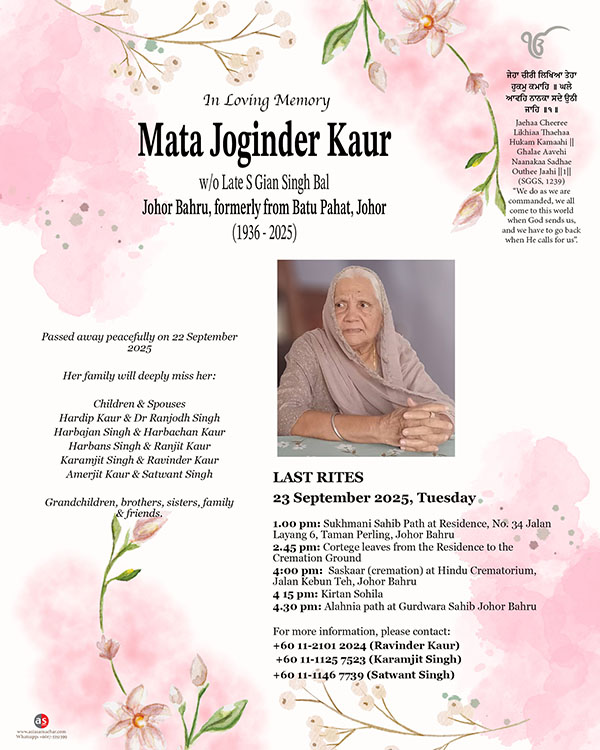
Grandchildren, brothers, sisters, family & friends.
LAST RITES 23 September 2025, Tuesday
1.00 pm: Sukhmani Sahib Path at Residence, No. 34 Jalan Layang 6, Taman Perling, Johor Bahru 2.45 pm: Cortege leaves from the Residence to the Cremation Ground 4:00 pm: Saskaar (cremation) at Hindu Crematorium, Jalan Kebun Teh, Johor Bahru 4 15 pm: Kirtan Sohila 4.30 pm: Alahnia path at Gurdwara Sahib Johor Bahru
ASIA SAMACHAR is an online newspaper for Sikhs / Punjabis in Southeast Asia and beyond. You can leave your comments at our website, Facebook, Twitter, and Instagram. We will delete comments we deem offensive or potentially libelous. You can reach us via WhatsApp +6017-335-1399 or email: asia.samachar@gmail.com. For obituary announcements, click here
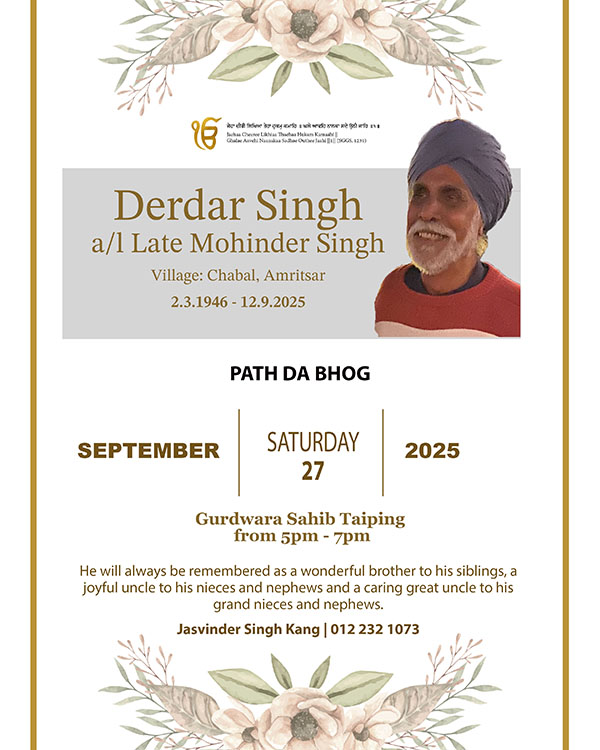
27 September 2025 at Gurdwara Sahib Taiping from 5pm – 7pm
Contact: Jasvinder Singh Kang (012 232 1073)
He will always be remembered as a wonderful brother to his siblings, a joyful uncle to his nieces and nephews and a caring great uncle to his grand nieces and nephews.
ASIA SAMACHAR is an online newspaper for Sikhs / Punjabis in Southeast Asia and beyond. You can leave your comments at our website, Facebook, Twitter, and Instagram. We will delete comments we deem offensive or potentially libelous. You can reach us via WhatsApp +6017-335-1399 or email: asia.samachar@gmail.com. For obituary announcements, click here
Wife of late Karnail Singh (formerly of Alor Star)
(1926 to 2025)
Returned peacefully to her heavenly abode on 20th September 2025
A daughter, sister, mother, grandmother and great grandmother who demonstrated true love, grit, devotion and conviction. She who exemplified over 99 years the ideal of living in the spirit of “Chardikala”
Her children and their spouses aspiring to her legacy: Late Dr Emolak Singh Randhawa and Ranjit Kaur (KL) Amar Kaur and Ragbir Singh Dhillon (Formerly Sungai Siput) Late Dharam Singh Randhawa (Alor Star) Harbans and Tim Woodley (London) Rashpal Dhillon (Sydney) Late Dr Harcharan Singh Randhawa (KL) Manjit Singh Randhawa and Raspal Kaur Dhillon (Singapore)
Dearly missed by her grandchildren : Ravita Kaur and Harvindar Singh (Kota Kemuning) Jesmit Kaur Dhillon Simran Dhillon and Samantha Amrit Dhillon and Erin Seetal Kaur and Vikram Prem Singh Parveen Kaur and Kunal Bhandare Kiron Kaur Rekha Kaur Amrita Kaur and Richie Morais
And great grandchildren, relatives and friends.
Saskar was held on 20th September 2025
AKHAND PATH Akand Path at Wadda Gurdwara Ipoh starts at 4.30pm on Thursday, 25th Sep with bhog at 4-6pm on Saturday, 27th September 2025.
ASIA SAMACHAR is an online newspaper for Sikhs / Punjabis in Southeast Asia and beyond. You can leave your comments at our website, Facebook, Twitter, and Instagram. We will delete comments we deem offensive or potentially libelous. You can reach us via WhatsApp +6017-335-1399 or email: asia.samachar@gmail.com. For obituary announcements, click here
na jayate mriyate va kadacin, nayam bhutva bhavita và na bhuyah ajo nityah sasvato ‘yam purano, na hanyate hanyamãne sarire
The soul is never born, nor does it ever die. Having once existed, it never ceases to be. It is unborn, eternal, ever-existing, and primeval. It is not destroyed when the body is destroyed.
SHRI SAT PALL SARNA
(Beloved husband of SMT. Vimal Sarna)
(1949 – 2025)
The family of the late Shri Sat Pall Sarna humbly invites family and friends to join them for the daily prayers and Atma Shanti Pooja (bhog) as we honour and cherish his memory.
Daily Recitation of Garuda Purana & Bhajans
Date: 215t – 27h September 2025 Time: 7.00 pm – 8.00 pm Venue: No 587/36, Jalan NGP 2/6, New Green Park, 48000, Rawang
Atma Shanti Pooja (Bhog)
Date: Monday, 29th September 2025 Time: 5.00 pm – 6.30 pm (Followed by Dinner) Venue: Shree Lakshmi Narayan Temple, Jalan Kasipillay, KL
“He was a great man who truly lived his life to the fullest. He embraced every moment with courage, kindness, and joy, leaving behind memories that will continue to inspire and uplift us. His legacy is not just in what he achieved, but in how deeply he touched the lives of those around him.”
For more information, please contact: Dilip Sarna: 012 225 8985 Satish Pall Sarna: 012 221 9767 Sanjay Sat Pall Sarna: 012 282 8485
ASIA SAMACHAR is an online newspaper for Sikhs / Punjabis in Southeast Asia and beyond. You can leave your comments at our website, Facebook, Twitter, and Instagram. We will delete comments we deem offensive or potentially libelous. You can reach us via WhatsApp +6017-335-1399 or email: asia.samachar@gmail.com. For obituary announcements, click here