UA-56202873-1
Page 558

Sikh student and his Aussie team eye US$1m start up prize

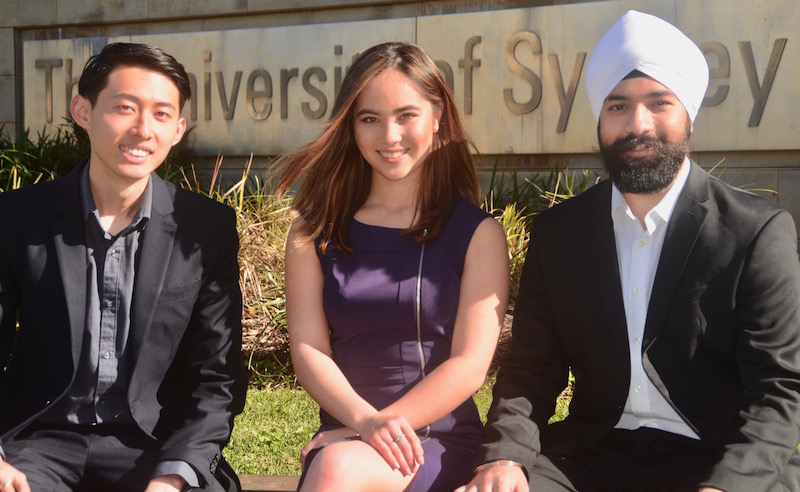
Budding Entrepreneurs: Brenth Elisa and Kirath all set for the London challenge – Photo: Supplied
By Asia Samachar Team | LONDON |

Singapore-born Kirath Singh is part of an Australian team that has made it to the London-stage of the Hult Prize, badged to be the biggest student social enterprise competition worldwide.

His team has advanced to be one of the world’s top 40 teams competing for the US$1 million prize.

After winning the Dubai round, Kirath, Brent Liang and Elisa Lillicrap from the University of Sydney Business School will spend the next five weeks in London developing their business, an app called Chance.io.

They will join some 100 top youth entrepreneurs around the world at the Ashridge Castle.

Born and raised in Singapore, Kirath is currently pursuing Advanced Computer Science and Finance.

Hult Prize is said to be the biggest student social enterprise competition worldwide. This year represents the 10th-year anniversary of the program with the challenge statement encouraging students to develop a business solution that tackles “10,000 youth unemployment in 10 years”, along UN Sustainable Development Goals.

The competition is held in three stages: regional, London Accelerator and UN Grand Pitch Round.

Selected out of 200,000 general application teams, each team competes with 40-60 teams at one of the 70 regional rounds around the world. The top team from each location is invited to spend five weeks in London to develop their business and prepare a pitch at the UN Headquarter for a $1 million seed funding from former US President Bill Clinton.

Coming out top from the Dubai Regional Round, Chance.io is the first Australian team in 10 years to have ever progressed to the castle accelerator.

The premise of Chance.io is to measure, analyse and develop soft skills for youth worldwide and connect them with employers. It is about allowing youth to upskill themselves and be more employable regardless of their socio-economic, religious, or racial background.

Asked about his appearance, Kirath told Asia Samachar: “The turban, beard, and roop (look) that I am blessed to have been gifted with has put me in the limelight. It is this roop that gives me the strength and courage to face all odds and succeed in bringing our idea to a global stage.”

So what’s next? Kirath and the team intend to bring the business to life.

As the competition progresses on a global level, the team hopes to inspire youth to be ambitious, and never fearful of the unknown.

“Youth worldwide deserve to have a chance to make a difference and change the world – especially those coming from a diverse background, a Sikh university student like myself,” he said.

Chance.io has kick launched a crowdfunding campaign. See link here.


RELATED STORY:

GoDaddy appoints Aman Bhutani as CEO (Asia Samachar, 4 Aug 2019)


ASIA SAMACHAR is an online newspaper for Sikhs / Punjabis in Southeast Asia and beyond. Facebook | WhatsApp +6017-335-1399 | Email: editor@asiasamachar.com | Twitter | Instagram | Obituary announcements, click here |

Sikh pipe band in splendour in Scotland

0
Sri Dasmesh Band in full splendour in Scotland – Photo: Jesmesh Photography/Jalebi Studio

The famed Malaysian pipe band, whose members are in Scotland for the up-coming World Pipe Band Championship in Glasgow, held a performance in Kenmore on Tuesday for the Highland Perthshire Sikh Heritage Trail.

Kenmore has a soft spot for Sikhs with its connections to Maharaja Duleep Singh, the last Sikh ruler of the Punjab. After being deposed, he lived in exile in Perthshire from 1855 to 1863.

The visit is being hosted by James Rattray, the chairman of the Clan Rattray Society, reports BBC.

“I was contacted by the pipe band as they believed the first Sikh pipe band was the XLV Rattray’s Sikhs, set up by my great grandfather in 1856.

“Because of our family connections with the Sikhs over 150 years, I was also involved in setting up the Scottish Sikh Heritage Trail,” he said.

The band’s pipe major Harvinder Singh said they had been keen to return to Scotland after taking part in the world pipe band championships three years ago.


RELATED STORY:

Sri Dasmesh emerge champs at South East Asian Pipe Band Championships (Asia Samachar, 5 June 2016)


ASIA SAMACHAR is an online newspaper for Sikhs / Punjabis in Southeast Asia and beyond. Facebook | WhatsApp +6017-335-1399 | Email: editor@asiasamachar.com | Twitter | Instagram | Obituary announcements, click here |

Time for Sikh women to join politics, urges lawmaker Ramkarpal

Ramkarpal Singh at the EKTA talk in Kuala Lumpur – Photo: Supplied
By Ajinder Kaur | MALAYSIA |

Lawyer and lawmaker Ramkarpal Singh has urged Malaysian Sikh women to join the political fraternity of the country.

While addressing a group of 50 ladies from the EKTA Club of Kuala Lumpur and Selangor at their business meeting in Kuala Lumpur last week, he said that there were many Sikh women who had the merit to contribute to Malaysian politics and serve the people.

 “I see a lot of familiar faces here today. Some of you are fiercer in the courts than those in Parliament,” he quipped, referring to some lawyers in the group.

Ramkarpal, the Bukit Gelugor Member of Parliament, said he had met many forward-thinking women who could make an impact and bring significant change; hence, there was no stopping these women to become the voice of other women and girls.

Ramkarpal rose into the political limelight when he won the Bukit Gelugor by-election in 2014 after the death of his father, the late Karpal Singh.

He retained the seat in the 2018 General Elections by a majority of 55,951 votes, the largest vote-majority in the state ever. On 18 July 2019, Ramkarpal was selected as chair of the Consideration of Bills Select Committee, a pertinent bipartisan committee which scrutinises bills at the Dewan Rakyat.

Women’s participation in politics has long been recognised as an important measure of the status of women in Malaysia and the trend in women running for political positions has seen a rise in recent years.

According to the World Economic Forum’s 2018 Political Empowerment Gender Gap Index, Malaysia ranks a dismal 131 out of 149 countries in strengthening women’s role and involvement in politics.

EKTA Club president Kuldip Kaur Gill said that many Sikh women have indeed stamped their mark in government agencies and corporate institutions.

“The next step forward is to make an impact in politics so that we are better represented, especially when it comes to decision making on policies that involve the female gender,” she added.

Kuldip recalled her growing up years in a political household in Seremban in the late-50s. Her dad, the late Gurnam Singh Gill, was the first state assemblyman for Rantau when he won the seat in 1959. He was a member of the opposition party Socialist Front and later served as president of the Seremban Town Council.

“I attended political ceramahs (rallies) in the padang (field) with my dad and we had many male politicians visit our home. Perhaps, more efforts should be made by political parties now to attract women members,” she said.

The EKTA Club is a registered NGO comprising of female Punjabi doctors, bankers, lawyers, academics, accountants, and homemakers. It provides a platform for its members to empower communities through welfare, medical, legal, youth development and lifelong learning outreach programmes.

Some of its initiatives include a free monthly legal advisory clinic at Gurdwara Sahib Sentul in Kuala Lumpur, women’s health and legal talks, medical first aid-CPR demonstrations, personal branding workshops and various contributions to underprivileged families.

[Ajinder Kaur is a member of EKTA Club]


RELATED STORY:

Malaysian pharmacist Harbans Dhillon going places (Asia Samachar, 24 June 2019)

UK elects first Sikh female MP, first turban-wearing Sikh MP (Asia Samachar, 10 June 2017)


ASIA SAMACHAR is an online newspaper for Sikhs / Punjabis in Southeast Asia and beyond. Facebook | WhatsApp +6017-335-1399 | Email: editor@asiasamachar.com | Twitter | Instagram | Obituary announcements, click here |

Sikh chartered accountant gets ringing endorsement with Singapore’s SkillsFuture Fellowship Award 2019

Singapore president Halimah Yacob presents the SkillsFuture Fellowship Award 2019 to Sarjit Singh – Photo: Supplied
By Asia Samachar Team | SINGAPORE |

Sarjit Singh is a true master of skills and mentor of the future talent. Todate, he has trained more than 5,000 people in the area of accounting, risk assurance and corporate governance advisory.

The Singapore-based chartered accountant received a ringing endorsement when he bagged the SkillsFutureFellowship Award 2019.

“Our actions must inspire others to dream more, learn more, do more and become more,” he told Asia Samachar in a message when contacted after winning the coveted Singapore award. “Small daily improvements over time lead to stunning results.”

“I truly enjoy mentoring and supporting everyone around me to achieve success in the way defined by them,” he said in an entry at his social media channel.

The award honours individuals as masters of skills and mentors of future talent, with a monetary award of S$10,000 to support their continued journey towards skills mastery.

#SkillsFuture is a national movement to provide Singaporeans with the opportunities to develop their fullest potential throughout life, regardless of their starting points.

The programme is tied to the Future Economy Council (FEC), a high-powered team chaired by deputy prime minister and finance minister Heng Swee Keat. It comprises eight other ministers as well as members from government, industry, unions, and educational and training institutions.

A former CFO of two large Singapore-based insurers, Sarjit is now a director at Ardent Business Advisory Pte Ltd, a firm established in 2008 by a team of qualified Chartered Accountants of Singapore. Ardent is a member of Kreston International, a global network of independent accounting firms.

He holds several industry appointments, including chairman of Singapore Accountancy Commission’s Learning and Assessment Committee, and member of Institute of Singapore Chartered Accountants (ISCA) Investigation and Disciplinary Panel.

In a congratulatory message, ISCA said: “Sarjit has been a trainer with ISCA Continuing Professional Education for many years, delighting course participants with his friendly, engaging style and equipping accounting professionals with future-ready skills.”

The over 5,000 people whom Sarjit trained were from ISCA, Monetary Authority of Singapore and Singapore Exchange Academy.

Sarjit and his wife Kiranjeet Kaur. – Photo: Supplied

RELATED STORIES:

Chartered accountant Sarjit Singh’s secret routine to set the tone for the day (Asia Samachar, 9 Sept 2018)

First Sikh accountant in Singapore (Asia Samachar, 9 April 2018)


[ASIA SAMACHAR is an online newspaper for Sikhs / Punjabis in Asia. How to reach us: Facebook message or WhatsApp +6017-335-1399. Our email: editor@asiasamachar.com. For obituary announcements, click here]

Sikhi a ‘new age’ religion?

1
Photo: Pixabay
By Gurnam Singh | UK | OPINION |

It has become very noticeable to me that a new trend has emerged to position Sikhi as a ‘new age’ religion.  At the centre of this is the assertion that peace and enlightenment are to be gained by emptying of the mind. Further, that somehow (social) learning or learning is the cause of suffering and falsehood.

Whilst generally I find the new age movement quite harmless, even likeable, there is a dangerous fallacy in such assertions. Simply put, it is the suggestion that somehow socialisation is necessarily a bad thing, that cultural experience has disrupted/soiled a pure routine soul, and that therefore our ‘worldly’ memories represent falsehood.

As far as I can see, a human being stripped of their memory is not an enlightened soul but a Zombie!! Yes, moments of reflection and meditation can help one to relax and process thoughts, but, do we really think sitting in solitary confinement and contemplating ‘God’ is the Sikh way?

My reading of Sikh teachings is that the way to the truth is reason, critical thinking and love for all of creation. If emptying the mind and withdrawing from the world was a way to enlightenment then why did Nanak criticise the Yogis in the mountains?

The image below depicts a dialogue that Guru Nanak had with the Sidh Yogis, who were claiming they had gained enlightenment and spiritual powers by renouncing worldly living, by moving to hills and jungles living in caves and wandering to different places and pilgrimages.

The dialogue is recorded by Nanak in the Guru Granth Sahib ji under the heading of ‘Sidh Gosht’. The Yogis impressed upon Nanak for him to join them if he were indeed seeking the divine. But Guru Nanak emphasized the need for practical social spirituality, living guided ethics, compassion and reflection.

For Nanak, the way of the householder is the highest way of all, and this was the path followed by him and all the 10 Gurus. This is the theme that runs all through Siddh Gosht and if you have never read it, I urge you to do so.


[Gurnam Singh is an academic activist dedicated to human rights, liberty, equality, social and environmental justice. He is a Visiting Fellow in Race and Education at University of Arts London and a Visiting Professor of Social Work at University of Chester as well as a presenter at UK-based Akaal channel. This views were shared on his Facebook page]


RELATED STORY:

Time for Sikh faith to lift the lid on sexual abuse (Asia Samachar, 23 July 2019)

Climate emergency – What would Nanak do?  (Asia Samachar, 16 July 2019)


ASIA SAMACHAR is an online newspaper for Sikhs / Punjabis in Southeast Asia and beyond. Facebook | WhatsApp +6017-335-1399 | Email: editor@asiasamachar.com | Twitter | Instagram | Obituary announcements, click here |

GoDaddy appoints Aman Bhutani as CEO

Aman Bhutani
By Asia Samachar Team | US |

Publicly-listed GoDaddy Inc has named ‘exceptional leader’ Aman Bhutani as the company’s new CEO, effective 4 Sept 2019.

Aman moves to the web hosting company from Expedia Group Inc where he was the president of Brand Expedia Group. He oversaw Expedia’s online travel businesses including Travelocity, Orbitz and the flagship Expedia brand.

“Aman brings a wealth of experience to GoDaddy – an extraordinary track record in growing a scaled business, deep expertise in product and engineering, and strong delivery across go-to-market,” said out-going CEO Scott Wagner in a statement. “Aman is an exceptional leader, and has created strong followings in every organization he’s led.”

In his earlier role as chief technology officer and senior vice president of engineering at Expedia, Bhutani led the vision and development of a single global technology platform designed to support multiple brands and partners, serving 90 million monthly unique visitors and driving more than $50 billion in annual gross bookings value.

Under his leadership, Brand Expedia grew revenue healthy double digits through a mixture of organic and inorganic growth.

“GoDaddy’s extraordinary focus on constantly innovating and improving for its entrepreneurs has built a devoted and rapidly growing customer base,” said Aman.

GoDaddy aims to empower everyday entrepreneurs around the world by providing all of the help and tools to succeed online. With 19 million customers worldwide, GoDaddy is the place people come to name their idea, build a professional website, attract customers and manage their work.

Aman, who is also a board member of the New York Times Company, has a BA in Economics from Delhi University and an MBA in General Management from Lanchester University.


RELATED STORY:

Veteran banker Malkit Singh joins Hong Leong Bank as CFO (Asia Samachar, 22 July 2019)


ASIA SAMACHAR is an online newspaper for Sikhs / Punjabis in Southeast Asia and beyond. Facebook | WhatsApp +6017-335-1399 | Email: editor@asiasamachar.com | Twitter | Instagram | Obituary announcements, click here |

Malaysian golf sensation Mehekpreet Kaur aims high

Mehekpreet Kaur Randhawa
By Audrey Vijaindren | NST | MALAYSIA |

ALOR STAR: While most children her age are glued to gizmos and gadgets with a bag of chips in hand, Mehekpreet Kaur Randhawa’s daily routine is slightly different.

The 8-year-old girl from Kedah, a rising star in golf, heads for the greens for training.

Ever since picking up the game less than a year ago, her weekly schedule involved a day’s training with her coach and an additional two days with her mum.

“But normally, about 10 days before a tournament, I train for about four hours daily and get to bed before 8pm.”

It all started when Mehek-preet’s was in Year One.

“My father (Sharanpal Singh Randhawa) wanted me to pick up a sport. As he plays hockey, I suggested that I would take up the sport. Instead, he told me to pick up an individual sport.

“He reasoned that if I played an individual sport, it was all on me. If I am good, I am good. But if I am not good, then I am not. Basically, I will have no one to blame if I failed.

“After thinking about it, I realised that it was true. My next option was golf, since my grandfather (Pritpal Singh) played the game too,” she said.

Now that she has started on the right foot, Mehekpreet hopes to make it into the big leagues by turning pro before 15.

Read the full story, ‘Golf sensation Mehekpreet aims high’ (NST, 3 Aug 2019), here.


RELATED STORY:

Young golfers at Malaysia-Singapore annual Sikh games (Asia Samachar, 25 June 2018)


ASIA SAMACHAR is an online newspaper for Sikhs / Punjabis in Southeast Asia and beyond. Facebook | WhatsApp +6017-335-1399 | Email: editor@asiasamachar.com | Twitter | Instagram | Obituary announcements, click here |

107th blood donation drive at Bangkok gurdwara

By Asia Samachar Team | BANGKOK |

Thai Sikhs are targetting some 200 people to turn up at its blood donation camp tomorrow (4 Aug 2019) at Gurdwara Sri Guru Singh Sabha .

The 107th camp blood donation camp organised by a band of Sikh volunteer will be held from 9.30am to 1pm at the gurdwara located at Chakkraphet Road in Khet Phra Nakhon.

It is organised in conjunction with the 550th birth anniversary of Guru Nanak, the founder of the Sikh faith.

The programme, organised with the Thai Red Cross Society, is supported by the Indian High Commission in Thailand. Asia Samachar is a media partner of the event.


RELATED STORY:

British Columbia assembly hears about blood donation drive in memory of 1984 anti-Sikh massacre (Asia Samachar, 4 Nov 2018)


ASIA SAMACHAR is an online newspaper for Sikhs / Punjabis in Southeast Asia and beyond. Facebook | WhatsApp +6017-335-1399 | Email: editor@asiasamachar.com | Twitter | Instagram | Obituary announcements, click here |

Why are Indians so shocked by the recent Amendment to India’s anti-terrorism law?

0
By Anmol Singh Hundal | OPINION |

The Indian Parliament recently passed an amendment to an anti-terrorism law known as the Unlawful Activities Prevention Act 1967 (or UAPA). The Indian media is making a big deal out of it because the law allows the Indian Union Government to arbitrarily declare an individual as a terrorist with the onus being on the individual that he is not one. Some are even calling this amendment “unconstitutional”.

I will argue the following in this article:

  1. The law was already bad enough without this Amendment.
  2. In the past many such (and even worse) laws have been passed by the Union Government and were used against specific minorities.
  3. The Indian Constitution does allow arbitrary arrest. Thus, this amendment is fully constitutional.

Introduction: What the leaders of the newly formed Republic of India called a “nation” was in fact a multi-ethnic, multi-lingual, multi-cultural empire that they wanted to forge into a nation. As such, one thing that Indian leaders are very nervous about is the unity and integrity of India and they are willing to use as much force as necessary to hold India together.

THE ORIGINAL UAPA 1967:

The original UAPA defined what were called “unlawful” and “terrorist” activities and also specified the punishment for individuals who commit those activities.
Unlawful Activities: These were defined in passage “o” of the Section 2 of UAPA 1967.

The following is a reproduction of that passage:

(o) “unlawful activity”, in relation to an individual or association, means any action taken by such individual or association (whether by committing an act or by words, either spoken or written, or by signs or by visible representation or otherwise), —

(i) which is intended, or supports any claim, to bring about, on any ground whatsoever, the cession of a part of the territory of India or the secession of a part of the territory of India from the Union, or which incites any individual or group of individuals to bring about such cession or secession; or

(ii) which disclaims, questions, disrupts or is intended to disrupt the sovereignty and territorial integrity of India; or

(iii) which causes or is intended to cause disaffection against India;

The punishment for an unlawful activity is described in Section 13 which is reproduced as follows:

13. Punishment for unlawful activities. —

(1) Whoever —

(a) takes part in or commits, or

(b) advocates, abets, advises or incites the commission of, any unlawful activity, shall be punishable with imprisonment for a term which may extend to seven years, and shall also be liable to fine.

(2) Whoever, in any way, assists any unlawful activity of any association declared unlawful under section 3, after the notification by which it has been so declared has become effective under sub-section (3) of that section, shall be punishable with imprisonment for a term which may extend to five years, or with fine, or with both.

(3) Nothing in this section shall apply to any treaty, agreement or convention entered into between the Government of India and the Government of any other country or to any negotiations therefor carried on by any person authorized in this behalf by the Government of India

According to that definition, even a verbal cry of “May Panjab be Sovereign” or “May Kashmir be Sovereign” by a common citizen would be considered an “unlawful activity” and could be punished by life imprisonment depending on the circumstances.

Terrorist Act: This was defined in Section 15 which is reproduced as follows (emphasis mine):

15 Terrorist act. — Whoever does any act with intent to threaten or likely to threaten the unity, integrity, security or ­sovereignty of India or with intent to strike terror or likely to strike terror in the people or any section of the people in India or in any foreign country, —

(a) by using bombs, dynamite or other explosive substances or inflammable substances or firearms or other lethal weapons or poisonous or noxious gases or other chemicals or by any other substances (whether biological radioactive, nuclear or otherwise) of a hazardous nature or by any other means of whatever nature to cause or likely to cause —

(i) death of, or injuries to, any person or persons; or
(ii) loss of, or damage to, or destruction of, property; or
(iii) disruption of any supplies or services essential to the life of the community in India or in any foreign country; or
(iv) damage or destruction of any property in India or in a foreign country used or intended to be used for the defence of India or in connection with any other purposes of the Government of India, any State Government or any of their agencies; or

(b) overawes by means of criminal force or the show of criminal force or attempts to do so or causes death of any public functionary or attempts to cause death of any public functionary; or

(c) detains, kidnaps or abducts any person and threatens to kill or injure such person or does any other act in order to compel the Government of India, any State Government or the Government of a foreign country or any other person to do or abstain from doing any act, commits a terrorist act. Explanation. — For the purpose of this section, public functionary means the constitutional authorities and any other functionary notified in the Official Gazette by the Central Government as a public functionary.]

Again, would a verbal cry of “May Panjab be Sovereign” be considered a terrorist act? Even though this definition places more emphasis on violent activities, according to the very first statement (“whoever does any act with intent to threaten or likely to threaten the unity … of India” commits a terrorist Act), the answer is yes. And the punishment for a terrorist act is no less severe than that for an “unlawful activity”. Now, what is this if not a violation of freedom of speech and conscience?

And UAPA is not the only such law, I can make the same argument by quoting passages from another draconian law known as the Terrorist and Disruptive Activities Act 1987 (or TADA)

THE PUNJAB DISTURBED AREAS ACT 1983:

If the provisions of the UAPA did not arouse your contempt, I promise you this one will. The UAPA only allows the State to label certain actions as “unlawful” and punish individuals for it. This one is a bit more efficient from the angle of the State as it allows State officials to just kill anyone they want. It also protects those State officials who commit such a murder from a subsequent court inquiry. The following is a reproduction of some passages of this law (emphasis mine)

4. Power to fire upon persons contravening certain orders. — Any Magistrate or Police Officer not below the rank of Sub-Inspector or Havildar in case of the Armed Branch of the Police may, if he is of opinion that it is necessary so to do for the maintenance of public order, after giving such due warning, as he may consider necessary, fire upon, or otherwise use force, even to the causing of death against any person who is acting in contravention of any law or order for the time being in force in the disturbed area, prohibiting the assembly of five or more persons or the carrying of weapons or of things capable of being used as weapons or of fire-arms, ammunition or explosive substances.

6. Protection of persons acting under sections 4 and 5. — No suit, prosecution or other legal proceedings shall be instituted except with the previous sanction of the 1 [Central Government] against any person in respect of anything done or purporting to be done in exercise of the powers conferred by sections 4 and 5.
The above passages are pretty clear and do not need further clarification. Welcome to India.


THE INDIAN CONSTITUTION:

You might wonder what the Indian Constitution says about this. Since India is advertised as the “world’s largest democracy”, its Constitution should guarantee its citizens some personal liberties. The answer is that we have been lied to from the very beginning. The Indian Constitution in fact does not guarantee any liberty to its citizens and people have been pointing this out since the day this Constitution was enacted.

Article 19: This Article is said to provide Indian citizens with their basic liberties but as we shall see it does the opposite. The following is a reproduction of Article 19:

19. (1) All citizens shall have the right —
(a) to freedom of speech and expression;
(b) to assemble peaceably and without arms; © to form associations or unions or co-operative societies;
(d) to move freely throughout the territory of India; (e) to reside and settle in any part of the territory of India; and
(g) to practise any profession, or to carry on any occupation, trade or business.

(2) Nothing in sub-clause (a) of clause (1) shall affect the operation of any existing law, or prevent the State from making any law, in so far as such law imposes reasonable restrictions on the exercise of the right conferred by the said sub-clause in the interests of the sovereignty and integrity of India, the security of the State, friendly relations with foreign States, public order, decency or morality, or in relation to contempt of court, defamation or incitement to an offence.

(3) Nothing in sub-clause (b) of the said clause shall affect the operation of any existing law in so far as it imposes, or prevent the State from making any law imposing, in the interests of the sovereignty and integrity of India or public order, reasonable restrictions on the exercise of the right conferred by the said sub-clause.

(4) Nothing in sub-clause © of the said clause shall affect the operation of any existing law in so far as it imposes, or prevent the State from making any law imposing, in the interests of the sovereignty and integrity of India or public order or morality, reasonable restrictions on the exercise of the right conferred by the said sub-clause.

(5) Nothing in sub-clauses (d) and (e) of the said clause shall affect the operation of any existing law in so far as it imposes, or prevent the State from making any law imposing, reasonable restrictions on the exercise of any of the rights conferred by the said sub-clauses either in the interests of the general public or for the protection of the interests of any Scheduled Tribe.

(6) Nothing in sub-clause (g) of the said clause shall affect the operation of any existing law in so far as it imposes, or prevent the State from making any law imposing, in the interests of the general public, reasonable restrictions on the exercise of the right conferred by the said sub-clause, and, in particular, nothing in the said sub-clause shall affect the operation of any existing law in so far as it relates to, or prevent the State from making any law relating to, —
(i) the professional or technical qualifications necessary for practising any profession or carrying on any occupation, trade or business, or
(ii) the carrying on by the State, or by a corporation owned or controlled by the State, of any trade, business, industry or service, whether to the exclusion, complete or partial, of citizens or otherwise.

Passage (1) seems to provide some liberties at first but then all of that is nulled by the subsequent passages. For freedom of speech in particular, nothing prevents the state to impose “reasonable restrictions” on speech in the interests of “morality”, “decency” and the unity and integrity of India.

Article 22: This Article is purported to prevent arbitrary arrest, but just like the case with Article 19, it does the opposite. The following is a reproduction of the Article:

22. (1) No person who is arrested shall be detained in custody without being informed, as soon as may be, of the grounds for such arrest nor shall he be denied the right to consult, and to be defended by, a legal practitioner of his choice.

(2) Every person who is arrested and detained in custody shall be produced before the nearest magistrate within a period of twenty-four hours of such arrest excluding the time necessary for the journey from the place of arrest to the court of the magistrate and no such person shall be detained in custody beyond the said period without the authority of a magistrate.

(3) Nothing in clauses (1) and (2) shall apply —
(a) to any person who for the time being is an enemy alien; or
(b) to any person who is arrested or detained under any law providing for preventive detention.

(4) No law providing for preventive detention shall authorise the detention of a person for a longer period than three months unless —

(a) an Advisory Board consisting of persons who are, or have been, or are qualified to be appointed as, Judges of a High Court has reported before the expiration of the said period of three months that there is in its opinion sufficient cause for such detention:
Provided that nothing in this sub-clause shall authorise the detention of any person beyond the maximum period prescribed by any law made by Parliament under sub-clause (b) of clause (7); or

(b) such person is detained in accordance with the provisions of any law made by Parliament under sub- clauses (a) and (b) of clause (7).

(5) When any person is detained in pursuance of an order made under any law providing for preventive detention, the authority making the order shall, as soon as may be, communicate to such person the grounds on which the order has been made and shall afford him the earliest opportunity of making a representation against the order.

(6) Nothing in clause (5) shall require the authority making any such order as is referred to in that clause to disclose facts which such authority considers to be against the public interest to disclose.

(7) Parliament may by law prescribe —
(a) the circumstances under which, and the class or classes of cases in which, a person may be detained for a period longer than three months under any law providing for preventive detention without obtaining the opinion of an Advisory Board in accordance with the provisions of sub-clause (a) of clause (4);
(b) the maximum period for which any person may in any class or classes of cases be detained under any law providing for preventive detention; and
(c) the procedure to be followed by an Advisory Board in an inquiry under sub-clause (a) of clause (4).

At first glance this Article seems to prevent the State from making arbitrary arrest and that is what passages (1) and (2) say. However, the subsequent passages allow for exception which allow the Parliament to make laws which allow to State to make arbitrary arrests. This was also pointed out by Shri HV Kamath, a member of the Constituent Assembly.

Again, we and the emergency provisions and article 22–I do not know how the latter found a place in the Fundamental Rights,–the right of a person to be detained without trial for three months or more. These provisions water down the principle embodied in the Preamble regarding individual liberty. They have fettered individual liberty.  – Shri HV Kamath (Constituent Assembly Debates Vol XI, 19th November 1949)

If the Constitution provides no rights to begin with, then how can we call laws that infringe the liberty of citizens as unconstitutional? It might be unjust, but it is constitutional.

Why was there not an outcry before?

As I have demonstrated previously, the Indian Parliament had in the past created laws that were even worse and segments of Indian population were made subject to them. Panjabis and Sikhs in particular were one of the victims. Much of the Sikh youth in the Panjab was decimated by the Indian State during the 80s when Panjabis lived in terror of the Indian State for about a decade. The perpetrators were rarely held accountable and even the few who were imprisoned by the Indian judiciary were granted pardons by the Union Government. The family members of the victims have accepted the fact that there would be no justice. Despite all this, there was no outcry for human rights or the “unconstitutionality” of these laws in the Indian Media or among Indian celebrities. What was the reason behind that?

The reason is that suppression of liberty is not the issue here. The issue here is that currently it is the Indian Right (BJP) in power and the Indian Left (INC) wants to present a narrative that the Right (in contrast to the Left) presents a threat to the so called “democratic foundations” of India. In reality however, both the Left and the Right stand for centralized dictatorial unaccountable rule at the expense of the freedom of the individual. Just remember that most of the suppression of personal liberty and mass murders of minorities took place when the Left was in power and the perpetrators still walk free.

Conclusion: The audience of the Indian Media (both Indian and Western) should be extremely careful because the sole purpose of the Indian Media is to deceive others and prevent them for focusing on real issues. Also, Indians should have empathy with those who lived under the terror of the Indian State and should stand for justice for the victims. Finally, Indians should know their Constitution and should understand that it is the source of all these draconian laws that strip them of their liberty and that they perceive as “unconstitutional”. If they cannot accept that, then honestly this is what they deserv

Anmol Singh Hundal is a US-based software engineer at Quora and author of The Constitution of India Simplified. The article was also published here.

* This is the opinion of the writer, organisation or publication and does not necessarily represent the views of Asia Samachar.


RELATED STORY:

Was Maharaja Ranjit Singh an Indian or a Panjabi? (Asia Samachar, 28 June 2019)

Will the BJP rewrite the Constitution of India now that it has won the 2019 elections? (Asia Samachar, 30 May 2019)


ASIA SAMACHAR is an online newspaper for Sikhs / Punjabis in Southeast Asia and beyond. Facebook | WhatsApp +6017-335-1399 | Email: editor@asiasamachar.com | Twitter | Instagram | Obituary announcements, click here |

Sarawak state RM3.5m booster to Kuching gurdwara development plans

0
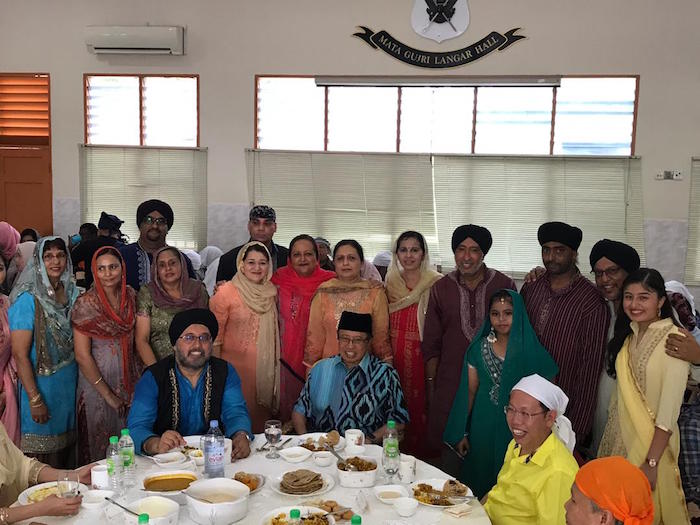
Sarawak CM Abang Johari (seated, wearing black songkok) having lunch with Kuching gurdwara officials and congregation – Photo: Supplied
By Asia Samachar Team | MALAYSIA |
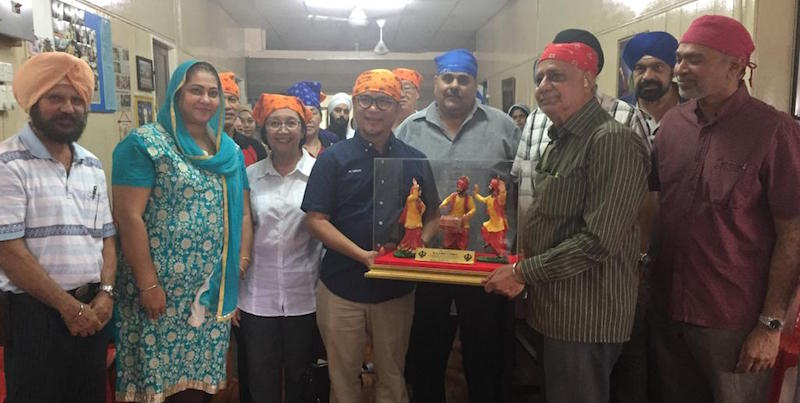

The Kuching gurdwara received a solid booster to its development plans with an injection of RM3.5 million from the Sarawak state government.

Sarawak Chief Minister Abang Johari Openg presented the cheque to Sarawak Sikh Temple Association (SSTA) at a function in Kuching today (3 Aug 2019).

“It is RM3.5 million, so we are giving you RM3.5 million just like what we have done for other religions through Unit for Other Religion (Unifor). I’m sure with the contribution from the government, you can proceed with your project and your vision for the future, particularly for the young Sikh community,” Abang Johari said in his speech.

SSTA manages the Gurdwara Sahib Kuching.

Abang Johari added: “For the Sikh community, this is not new to me because I also (used to) live in the kampung nearby. I saw the photograph of your first temple with the veranda, I used to pass through this road (back in the days) looking at the veranda and today we have this new the present building, and Dr Khaira wants to improve it with the new extension.”

When contacted, SSA president Dr Kalwinder Singh Khaira said the new building had been completed and they were waiting for approvals from the relevant authorities.

“Hopefully, we can start by year-end or next year,” he told Asia Samachar.

The proposed extension includes a floor for the Punjabi school, a multipurpose hall, a library, residential rooms and other amenities for the congregation and community.

In 2017, at a similar Vaisakhi related function organised by the SSTA, Abang Johari had announced that the Sarawak state government had allocated Sikhs in Kuching land adjacent to the gurdwara for its expansion, as well as another plot of land to build a new crematorium site.

In his speech then, he had said that SSTA could can still maintain the existing gurdwara as their heritage site as it is strategic and tourists.

Abang Johari (second left) presents the cheque to Dr Kalwinder. Seen are Dr Sim (third left) and Ngenang (third right).

Meanwhile, Sibu gurdwara also saw a pleasant development with the declaring open of the Sibu Sikh Temple Association’s gurdwara hostel.

Sarawak Education and Technological Research Assistant Minister Dr Annuar Rapaee, who is also Housing and Public Health Assistant Minister, was at hand to declare it open.

“This also helps other religions, particularly the development of churches and temples in the whole of Sarawak,” he said in his speech.

Sibu gurdwara hostel opening by Dr Annuar Rapaee

RELATED STORY:

Sarawak state gives Kuching gurdwara land for expansion, crematorium (Asia Samachar, 21 May 2017)

Sibu gurdwara builds hostel for outstation worshippers (Asia Samachar, 27 May 2019)


ASIA SAMACHAR is an online newspaper for Sikhs / Punjabis in Southeast Asia and beyond. Facebook | WhatsApp +6017-335-1399 | Email: editor@asiasamachar.com | Twitter | Instagram | Obituary announcements, click here |