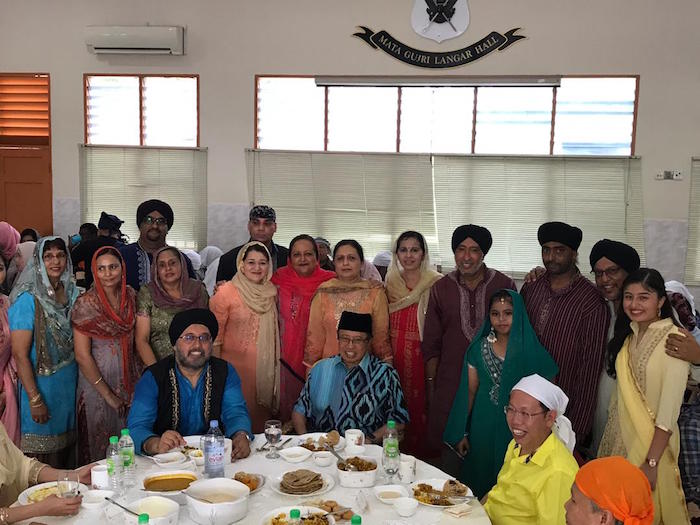
Sarawak CM Abang Johari (seated, wearing black songkok) having lunch with Kuching gurdwara officials and congregation – Photo: Supplied
By Asia Samachar Team | MALAYSIA |
The Kuching gurdwara received a solid booster to its development plans with an injection of RM3.5 million from the Sarawak state government.
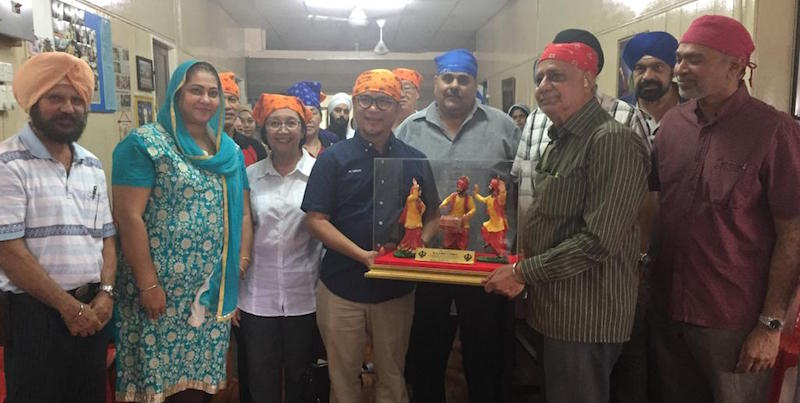
Sarawak Chief Minister Abang Johari Openg presented the cheque to Sarawak Sikh Temple Association (SSTA) at a function in Kuching today (3 Aug 2019).
“It is RM3.5 million, so we are giving you RM3.5 million just like what we have done for other religions through Unit for Other Religion (Unifor). I’m sure with the contribution from the government, you can proceed with your project and your vision for the future, particularly for the young Sikh community,” Abang Johari said in his speech.
SSTA manages the Gurdwara Sahib Kuching.
Abang Johari added: “For the Sikh community, this is not new to me because I also (used to) live in the kampung nearby. I saw the photograph of your first temple with the veranda, I used to pass through this road (back in the days) looking at the veranda and today we have this new the present building, and Dr Khaira wants to improve it with the new extension.”
When contacted, SSA president Dr Kalwinder Singh Khaira said the new building had been completed and they were waiting for approvals from the relevant authorities.
“Hopefully, we can start by year-end or next year,” he told Asia Samachar.
The proposed extension includes a floor for the Punjabi school, a multipurpose hall, a library, residential rooms and other amenities for the congregation and community.
In 2017, at a similar Vaisakhi related function organised by the SSTA, Abang Johari had announced that the Sarawak state government had allocated Sikhs in Kuching land adjacent to the gurdwara for its expansion, as well as another plot of land to build a new crematorium site.
In his speech then, he had said that SSTA could can still maintain the existing gurdwara as their heritage site as it is strategic and tourists.
Abang Johari (second left) presents the cheque to Dr Kalwinder. Seen are Dr Sim (third left) and Ngenang (third right).
Meanwhile, Sibu gurdwara also saw a pleasant development with the declaring open of the Sibu Sikh Temple Association’s gurdwara hostel.
Sarawak Education and Technological Research Assistant Minister Dr Annuar Rapaee, who is also Housing and Public Health Assistant Minister, was at hand to declare it open.
“This also helps other religions, particularly the development of churches and temples in the whole of Sarawak,” he said in his speech.
ASIA SAMACHAR is an online newspaper for Sikhs / Punjabis in Southeast Asia and beyond.Facebook | WhatsApp +6017-335-1399 | Email: editor@asiasamachar.com | Twitter | Instagram | Obituary announcements, click here |
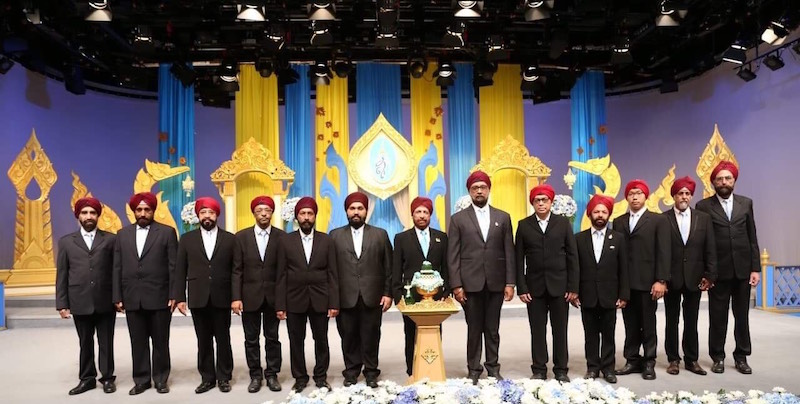
Thai Sikhs appear on Channel 5 to record birthday wishes for the King
By Asia Samachar Team | BANGKOK |
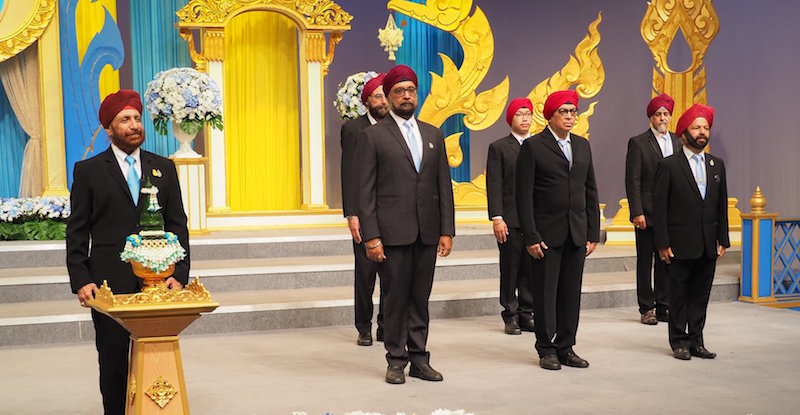
Sikhs took an active part in the various celebrations to mark the 67th birthday of the Thai King whose regal events ended on July 29.
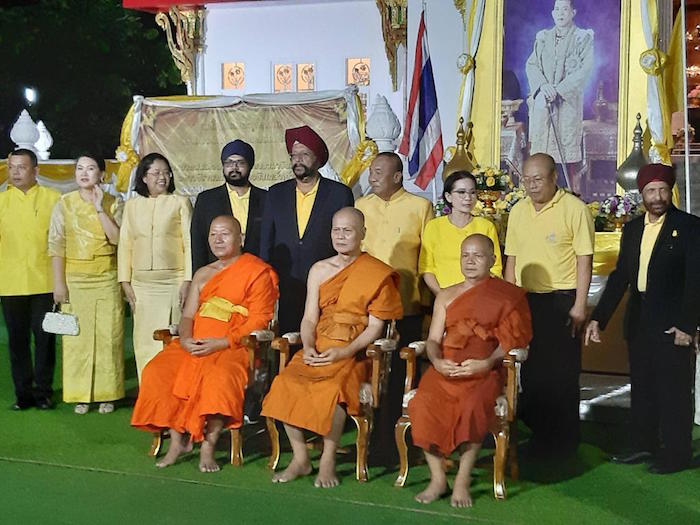
On 24 July, one of the events incorporated Buddhist, Christian, Muslim, Hindu and Sikh customs.
On the morning of His Majesty’s birthday, Thai Prime Minister Prayut Chan-o-cha led cabinet ministers, government officials and members of the public in offering alms to 568 monks and novices at Sanam Luang.
“We took part with love and vigour,” entrepreneur Lakhvinderpal Singh Kukreja, who also took part in some of the events, told Asia Samachar.
Born in 1952 as Prince Vajiralongkorn, he was proclaimed crown prince on December 28 in the year he turned 20, and was bestowed with the title of His Royal Highness Crown Prince Maha Vajiralongkorn by his King Rama IX.
The King took the reins after the passing of his father King Rama IX, obtaining the Roman numeral title of King Rama X, of the Chakri Dynasty, using the partial-length title of His Majesty King Maha Vajiralongkorn Phra Vajiraklaochaoyuhua. The monarch’s reign has been declared as retroactive by the previous government from October 13, 2016, the day King Bhumibol passed away.
Thai Sikhs at one of the many prayer events held in conjunction of the King’s birthdaySIKHS ON TV: Sikhs from various Thai organisations coming together to express the birthday greeting to His Majesty the King. From left: Bhagwant Singh, Mahinder Singh, Lakhwinder Singh, Jaswinder Singh, Pawan Singh, Darshan Singh Sachdev (President, President of Thai-Indian Peace Foundation), Pinderpal Madan, Baldev Singh, Darshan Singh Narang, Jome Singh, Rana Singh and Uttambir SinghSikhs present at Sanam Luang. L-R: Sahib Singh, Mahinder Singh, Darshan Singh and Satpal Singh
ASIA SAMACHAR is an online newspaper for Sikhs / Punjabis in Southeast Asia and beyond.Facebook | WhatsApp +6017-335-1399 | Email: editor@asiasamachar.com | Twitter | Instagram | Obituary announcements, click here |
PATH DA BHOG: 11 August 2019 (Sunday), 10am – 12.30noon, at Gurdwara Sahib Sungai Besi (Shapa), Kuala Lumpur| Malaysia
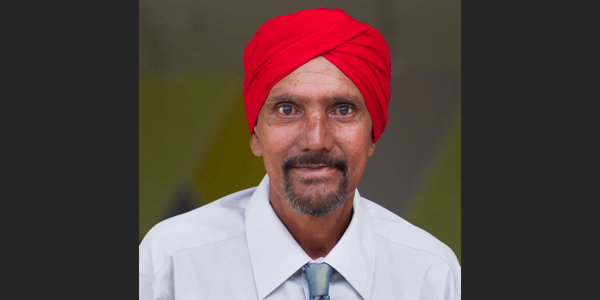
Jarnail Singh (1959-2019), Ex Air Force_b
JARNAIL SINGH (Ex Air Force) S/O LATE LAL SINGH DHALIWAL & LATE BISHAN KAUR
(2 March 1959 – 2 Aug 2019)
Goodbye Daddy, rest in peace
His heart was beating because he was wired. God saw him getting tired. God put his arms around him and said “come with me” As there is no cure meant to be.
With tearful eyes we watched him slowly fade away. Although we love him dearly, we couldn’t make him stay.
That day, a father’s heart stopped beating and loving hands were resting.
It broke our hearts somehow, But we know that he is at peace now.
Goodbye daddy, till we meet again. Bless us from above, till then.
Leaving behind his loving family
Wife: Palbi Kaur (Bali) d/o Late Sardara Singh Gill & Late Chinto Kaur (Air Panas)
Daughter: Amarjeet Kaur (Membi)
Daughter & Son In Law: Manjeet Kaur (Vinny) & Taranjeet Singh (Sonu)
Path da Bhog: 11 August 2019 (Sunday), 10am – 12.30noon, at Gurdwara Sahib Sungai Besi (Shapa), Kuala Lumpur
Contact: Arjan 012-6754214
| Entry: 2 Aug 2019; Updated: 2 Aug 2019 | Source: Family |
ASIA SAMACHAR is an online newspaper for Sikhs / Punjabis in Southeast Asia and beyond.Facebook | WhatsApp +6017-335-1399 | Email: editor@asiasamachar.com | Twitter | Instagram | Obituary announcements, click here |
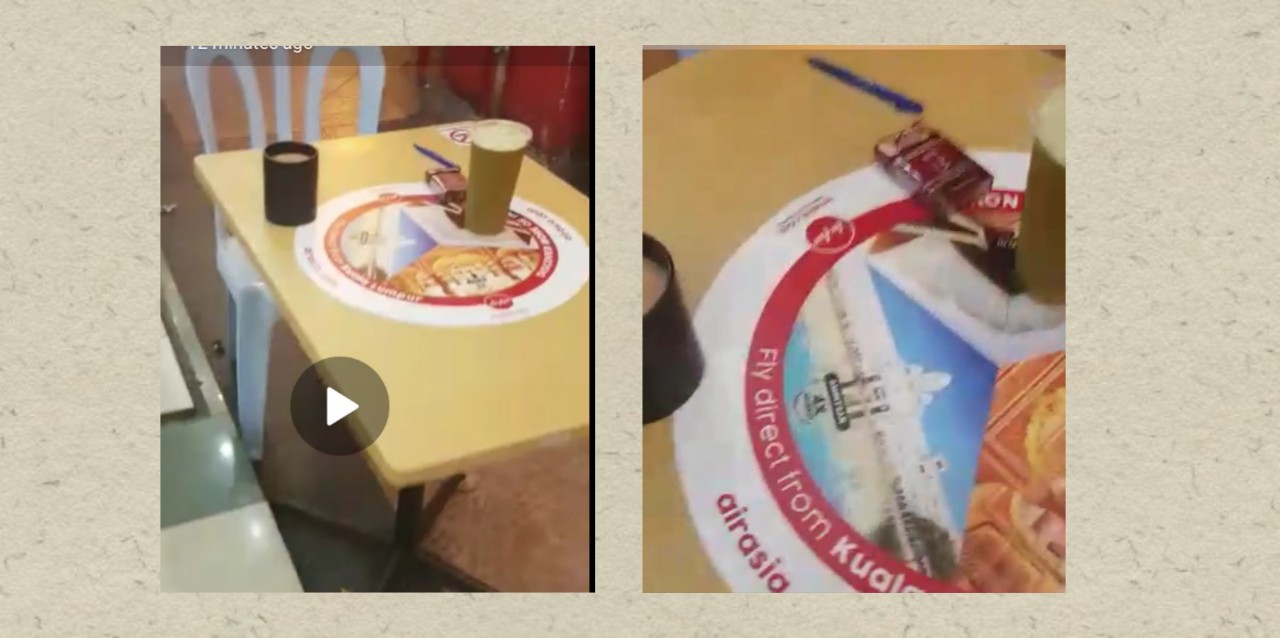
AirAsia table top stick-on posters depicting Darbar Sahib, Amritsar
By Asia Samachar Team | MALAYSIA |
Low-cost carrier AirAsia has pulled out dining table top stick-on advertisements that carried the photo of Amritsar’s Darbar Sahib, one of the most recognised Sikh place of worship, after receiving feedback from the Malaysian Sikh community.
In a statement sent to Asia Samachar, AirAsia said it had received community feedback regarding an advertising campaign promoting travel to India.
“We take community feedback very seriously and have taken immediate steps to remove the advertisements,” said AirAsia group chief commercial officer Karen Chan.
It is understood that the stick-on advertisement, earlier found at some restaurants in Johor, have been pulled out of circulation.
It carried a photo from the Darbar Sahib, popularly known as Golden Temple.
AirAsia launched its flights from Kuala Lumpur to Amritsar and Jaipur in 2018 via its long-haul flight affiliate AirAsia X.
ASIA SAMACHAR is an online newspaper for Sikhs / Punjabis in Southeast Asia and beyond.Facebook | WhatsApp +6017-335-1399 | Email: editor@asiasamachar.com | Twitter | Instagram | Obituary announcements, click here |
Mata Seeb Kaur passed away peacefully with her family by her side. She leaves children, grandchildren and great-grandchildren. Bibi has the most pleasant smile and was such a humble soul. We will miss you bibi ✨
Village: Kainaur, Ropar
Husband: Late Harcharan Singh (Pind: Khuberi, Ropar)
Path da Bhog: 11 Aug 2019 (Sunday), 10 am to 12 pm, at Gurdwara Sahib Taiping
Contact:
Pagbeer Singh 010-2141974
Upedesh Singh 012-9232260
Ravinder Singh 012-4597228
| Entry: 31 July 2019; Updated: 3 Aug 2019 | Source: Family |
ASIA SAMACHAR is an online newspaper for Sikhs / Punjabis in Southeast Asia and beyond.Facebook | WhatsApp +6017-335-1399 | Email: editor@asiasamachar.com | Twitter | Instagram | Obituary announcements, click here |
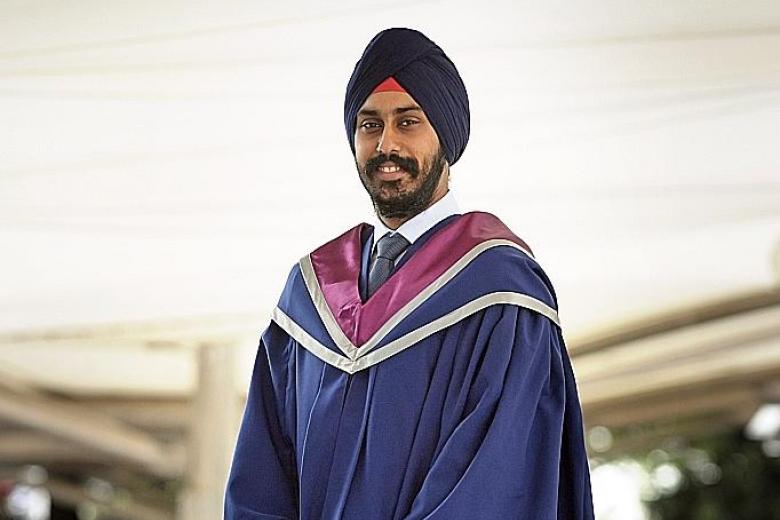
Ishwarpal Singh Grewal, who donned the Singapore national hockey jersey in the last three SEA Games, is well on his way to become a medical practitioner.
On Saturday (27 July 2019), the 26-year old national hockey player graduated on Saturday from Nanyang Technological University’s Lee Kong Chian School of Medicine with a degree in medicine and surgery.
“At the core of it, it is about helping people. My parents were always supportive of what I wanted to do, and my dad suggested that I check out medical school,” he told The New Paper.
Both Dr Ishwarpal and his brother Jaspal Singh, who is one year younger, have played for the national team.
Their late father Santokh Singh was a former journalist at The Straits Times and news editor at The New Paper.
Dr Ishwarpal is currently a houseman in Tan Tock Seng Hospital’s orthopaedic department, where he is responsible for patients in the ward when the senior doctors are away, according to the report.
Read full story, ‘National hockey player, son of late TNP news editor graduates as doc’ (TNP, 30 July 2019), here.
ASIA SAMACHAR is an online newspaper for Sikhs / Punjabis in Southeast Asia and beyond.Facebook | WhatsApp +6017-335-1399 | Email: editor@asiasamachar.com | Twitter | Instagram | Obituary announcements, click here |
“Put me back in my childhood Malay kampung-style wooden house on stilts with a leaky thatched roof, in Pokok Assam, Taiping, Malaysia and, as long as family is with me, and a small room for Baba Ji, I will say that, that is my dream home.”
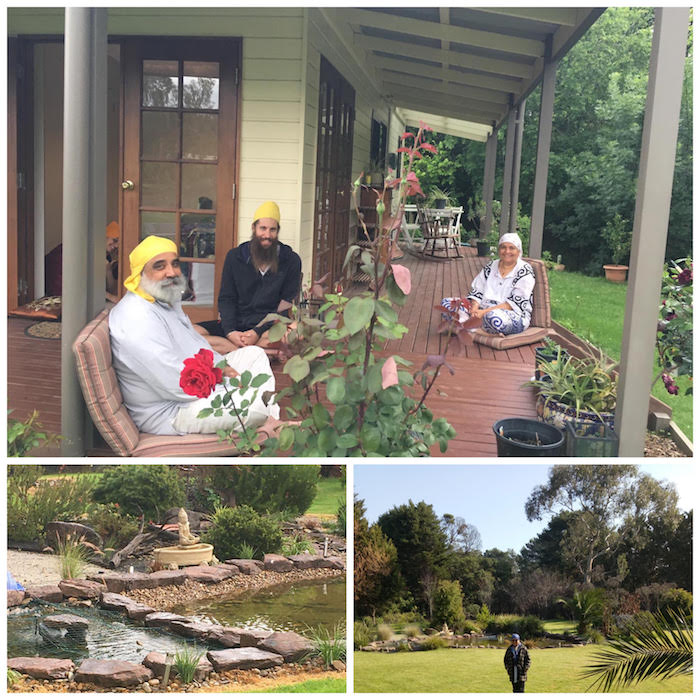
We are moving out of my ‘dream home’ after five years here in state Victoria, Australia. There are mixed feelings.
My oldest grandson Saffal was chest high when we came here. He now towers at least 5cm above me! My granddaughter Saahiel had just been in secondary school for a year. Now she is in university and has grown into a beautiful young woman.
My two younger grandsons were born while we stayed here. Ravi my youngest is now 3-years-old. We performed my second daughter’s Anand Karaj in these premises. Now her little boy Khiaan Singh is 4 years old!
It is a small plot of almost two acres in green open country with huge gum trees, with a creek running down one side of it which has ‘weeping willow’ trees on its banks.
Besides a main home of five bedrooms and a huge 90 foot ‘garage’ on one side when we came, we built a second smaller house in the plot for Nani and I and we also built a covered area (pergola) between the two houses so that the children could play under cover in bad weather within this beautiful greenery and the creek on one side. Yes, a dream ‘homestead’ you might say.
There was ample space for visitors who came for overnight, or a few days stay. We called it the ‘Sikh Retreat’. We even had overseas visitors who came to get-away-from-it-all for a few days. A friend stayed a month within a rather messy divorce. He needed privacy and time to reflect, compose himself, dwell in ‘naam’, as he planned his future. Such was the tranquility here.
Like many folks, all my life I chased a dream of the ideal homestead. I travelled from Malaysia, through UK, finally to reside in Australia and all the time I dreamed of that ideal house. But my dream has never been a palatial five-bedroom double storeyed brick building.
First, I wanted a shack by the sea. After the occurrence of the Indian Ocean tsunami which devastated Acheh, and besides numerous others after that, I dreamt of a small place in the mountains with grand views.
I have visited homes of non-Sikh friends on our sacred music tours globally and seen some very beautiful scenic small, mainly wooden homes. Most Sikh friends I have stayed with all round the globe seem to prefer huge houses of bricks.
Finally, I dreamt of a small farmlet with great views and enough space to raise some chickens mainly for eggs and perhaps some other pets, a vegetable plot and some fruit trees. I felt that was perhaps more practical and I wanted the rural quiet and tranquility. All I needed was access to an international airport as I am still a frequent traveller.
I visualised such a dream home for a quarter of a century as I pursued my other dream of being able to present kirtan and sacred music globally with my music group.
And then, it happened! Circumstances changed and the right space, about two acres, in country Victoria (Australia) appeared and it was within our means! It was the dream I had, manifesting!
I used to wonder why those who were in the money would want to build bigger and bigger houses when one should only build houses enough for one’s needs. But human nature is such that perhaps bigger is better, especially the prevailing Sikh nature.
I have visited our suburb in Ludhiana, Punjab and every few years the neighbours, on all sides break down smaller houses to put up bigger ones, leaving very little or no space for grass, trees or other vegetation. And a great many of the houses lie vacant because the owners live overseas. They visit perhaps once a year at best to stay for maybe a couple of weeks. Their future generations are never going to come and stay here. Why build these huge multi-storey houses?
A couple, friends of mine, with three daughters faced all sorts of obstacles to build a huge six-bedroom house. I wondered why they did that? Inevitably, all three daughters found their own lives and left, as was expected. Now he too has downsized to suburbia.
But then, I guess, like many of us, we have our ‘dream’ homes. We go through a great deal of wastage – of money, of material and time, for a dream, perhaps an illusion. ‘Jag rechena sabh chooth hai…’ (Life is an illusion…).
Even in Malaysia, I have some rich friends who, from very humble beginnings today live in palatial homes mainly for status. Husband and wife with a couple of kids in up to six bedroom houses. The off-springs now visit occasionally with their children, otherwise most of the house remains closed. I wonder whether they are happier in these large, mostly unused, houses? Are they really homes?
We stayed in our dream home for five years. We lovingly accumulated dogs, cats, aquarium and pond fish and even two tortoises. We experimented with sheep and even tried goats to keep the grass down! We resurrected a shallow disused pond and built it into a small lake with water lilies and other water plants, a water fountain and a miniature waterfall, with lights which we used to light up at night. It was heavenly!
Besides rosellas, parakeets, white cockatoos with their beautiful yellow plumes, black cockatoos, galahs, magpies, crows and other birds, we sometimes even have a flock of ibis with their long beaks descend to take a drink and fish in our pond for tadpoles and fish. (We introduced the local fish from the creek into our lake.) Kookaburras scare the kids with their loud screeching. We even have kangaroos running through our property occasionally. Rabbits and possums are common.
At night we have a symphony of frogs croaking to remind us that we are in rural surrounds. A cockerel crows early in the morning reminding us of Nitnem.
We kept chickens mainly for eggs and even had four white domestic ducks for their eggs until they were taken by foxes. The battle with the foxes is constant. Any slackness in our vigilance resulted in chickens and ducks being taken by them!
Our children experienced the ‘circle of life’ when the foxes used to take the chickens or sometimes grab rabbits right in front of their very eyes. They experienced two of our dogs dying. One was buried with a proper Ardaas mainly for closure for the children, and one had to be taken to the RSPCA crematorium. Tears were shed.
I even let them experience jhatka of one of our chickens, so that they understood that to eat meat, life has to be taken. I remembered my own experience as a 14-year-old being forced to commit jhatka by my venerable father behind High Street Police Sikh Gurdwara in Kuala Lumpur. “Or,” he told me, “if you can’t, then become a vaishnu (vegetarian)”!
We lovingly planted fruit trees like oranges, mandarins, lemons, apples, pears, persimmons, nashi pears, peaches, plums and also grew grape and passion fruit vines.
We grew our own chillies, even a curry leaves tree, tomatoes, vegetables, beautiful ‘keralay’ (bitter gourd) and ‘baingan’ (eggplants). Two different kinds of mint grew wild and we had home-grown and home-made mint chutney!
Our grandchildren played in the trees overhanging the creek and caught fish in the creek with butterfly nets or ‘chunian’ stolen from their mums and grandmother.
It was the ideal life that I had dreamt of for so many years.
But as time went by, I realised one thing. A dream is a dream until it materialises. Then realities take over.
The ‘down’ side of our dream home started manifesting. Two acres of gardening was difficult and getting gardeners defeats the purpose and in Australia is an expensive exercise.
I had my dream of building my ‘wooden house’ beside my daughter’s house. I designed it with my front room overlooking the garden and the creek with a Baba Ji’s room in a prominent position also looking out into the garden with a view of the trees in the distance. We built an upstairs with a wooden staircase, for a small studio where I could do recordings and also a library – a place to get away from the good wife when relations got a little strained! We had a decking all round our home where we could sit with a cup of tea and even eat out when the weather permitted.
But then keeping two homes clean became a problem and again, hiring cleaning help in Australia, is not cheap!
As we had opted for the countryside, even getting a loaf of bread or a bottle of milk became a massive operation involving dressing up and driving to the local shops, the nearest of which were a few kilometres away!
Leaving the premises or leaving them untended became next to impossible due to the pets we had. And watering the plants and huge garden especially in dry spells meant at least two hours of hand watering. We had not yet put in place a sprinkler system. So, someone had to be home all the time and the place needed constant attention!
Over the years the downside started outweighing the ‘dream’ factor. In previous abodes I could walk up to the shops for a cup of coffee or the odd meal or daily groceries. Here I was a prisoner to daily chores, and even filling up the holes in our very long gravel driveway became rather tedious. We also realised that the overhead costs did not justify the number of residents in the property.
Finally, came the ‘clincher thought’, to move. Was this the end for me? I had my dream come true and was I going to live out my life here? I did not like that thought especially for one who has lived in three different countries and never in one house for more than about 10 years. I realised that I was doomed to be a wanderer. I could not be tied down to one place. I was one of those who needed to know what was over the next horizon, physically, mentally and spiritually.
Home was not only where the heart was, but also where the family was. Home was not in a specific house or a special location. It was not in bricks and mortar. It was not a wooden house. It was not even green pastures with plants, trees and pets. It was where the family was and where I could have my Baba Ji.
‘Jithay jaye behay mera Satguru, so thaan suhava’.
‘Qar bahar tera bhervasa. Tu jan kay hain sang.’
A few years ago, while visiting my good friend S. Ranjit Singh Sidhu in my childhood town of Taiping (Perak, Malaysia), I met a childhood friend from my kampung Pokok Assam. We met after sixty years! His parents lived across the lane from us and we spent a few idyllic childhood years together in the 1950’s. He was my first friend when I gained my consciousness as a human.
Lawrence David stayed in Pokok Assam all his life. A staunch Christian, he married his childhood sweetheart Susan. He did well in his schooling and works in human resource management – now as a consultant after retirement. His children now living in Kuala Lumpur have tried very hard to get him and their mum to relocate to Kuala Lumpur but Lawrence says that a couple of days in KL are enough to drive him out and back to Taiping!
I envy him.
Put me back in my childhood Malay kampung-style wooden house on stilts with a thatched roof, in Pokok Assam, Taiping, Malaysia and as long as family is with me, and a small room for Baba Ji, I will say that, that is my ‘dream home’.
Malaysian-born Dya Singh, who now resides in Australia, is an accomplished musician and a roving Sikh preacher. The Dya Singh World Music Group performs full scale concerts on ‘music for the soul’ based on North Indian classical and semi-classical styles of music with hymns from mainly the Sikh, Hindu and Sufi ‘faiths’. He is also the author of SIKH-ING: Success and Happiness. He can be contacted at dyasingh@khalsa.com
* This is the opinion of the writer and does not necessarily represent the views of Asia Samachar.
ASIA SAMACHAR is an online newspaper for Sikhs / Punjabis in Southeast Asia and beyond.Facebook | WhatsApp +6017-335-1399 | Email: editor@asiasamachar.com | Twitter | Instagram | Obituary announcements, click here |
SASKAAR / CREMATION: 3.30pm, 29 July 2019 (Monday) at Jalan Loke Yew crematorium, Kuala Lumpur. Cortege leaves from Gurdwara Sahib Sentul at 2.45pm (Timing changed)| Malaysia
Paridam Singh (1955-2019), Sentul
PARIDAM SINGH S/O BACHAN SINGH BALIA
Village: Balia, Punjab
Born: 3 May 1955
Departed: 27 July 2019
Wife: Kamaljit Kaur
Children/Spouse:
Amarjit Kaur
Sukh Preet kaur / Jasvinder Singh
Jai Preet kaur
Grandchildren: Hans Veer Singh
Saskar/ Cremation: 3.30pm, 29 July 2019 (Monday) at Jalan Loke Yew crematorium, Kuala Lumpur (Timing changed)
Cortege timing: Cortege leaves from Gurdwara Sahib Sentul at 2.45pm, 29 July 2019 (Monday)
Contact:
Jai Preet 0162444607
Jai 0123917532
| Entry: 27 July 2019 | Source: Family |
ASIA SAMACHAR is an online newspaper for Sikhs / Punjabis in Southeast Asia and beyond.Facebook | WhatsApp +6017-335-1399 | Email: editor@asiasamachar.com | Twitter | Instagram | Obituary announcements, click here |
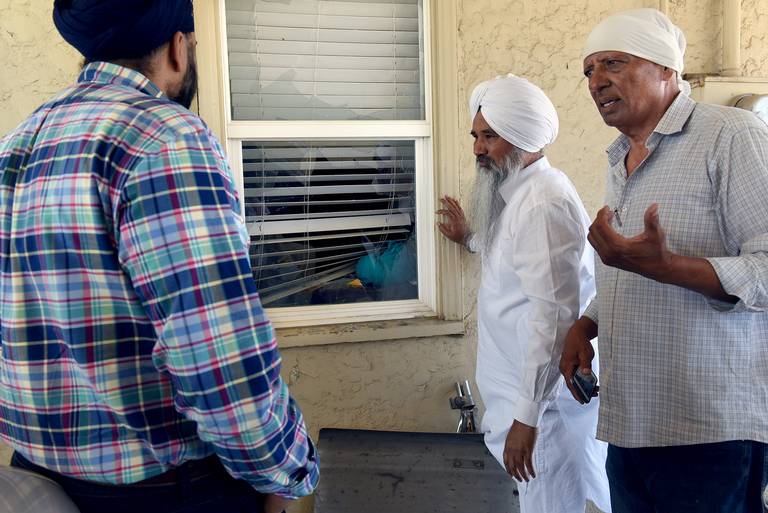
Windows were broken and a priest was punched Thursday evening July 25, 2019 at a house on the property of the Sikh Temple on Hatch Road in Hughson, Calif. Here, from left to right- Rajmeet Grewal, Amarjit Singh and Sukhmander Brar survey the damage. JOAN BARNETT LEE
By The Modesto Bee | CALIFORNIA, US |
An intruder at the Sikh Temple Modesto Ceres broke windows late Thursday at a priest’s home on temple grounds, punched the priest, shouted obscenities and told him to go back to his own country before fleeing, according to the priest and others associated with temple.
Amarjit Singh, with the help of temple members who translated some of his comments, said he was in his bedroom about 9:30 p.m. when the glass in two bedroom windows was broken. He said he lifted the blinds of one of the windows to look out and was punched in the neck before his attacker, who he said was wearing a mask, fled.
It was “country, country, country, go back, go back, country,” he said without the help of a translator. He said his attacker also yelled obscenities at him and had something in his hand to break the windows. Singh assumes the intruder ran off in the temple’s nearby overflow, dirt parking lot.
Singh is one of two head priests at the temple, which is at Santa Fe Avenue and East Hatch Road, near Hughson. Singh’s brother, Manjit, is the other head priest.
Modesto Councilman Mani Grewal, who is a member of the temple and has served as its secretary, considers this a hate crime and said it is part of pattern going back a decade or longer of attempts to harass and intimidate temple members, though this was the worst incident.
But U.S. Rep. Josh Harder, D-Turlock, issued a statement condemning the incident and calling it a hate crime.
“I stand with my friends in the Sikh community at this terrible time,” Harder said. “Every American – regardless of faith – should be able to practice their religion freely and without fear of violence. This disgusting attack is not representative of who we are, and we must find the person responsible.”
The Central Valley has one of the largest and oldest Sikh populations in the United States. The first Sikh temple, or gurdwara, in the United States opened in Stockton more than a century ago. There are an estimated 500,000 Sikhs in the United States and 25 million worldwide making it the fifth most popular religion. It originated in the 15th century in the Punjab region of India and Pakistan.
Read full story, ‘Priest at Sikh Temple near Hughson assaulted in apparent hate crime’, at The Modesto Bee (26 July 2019), here.
ASIA SAMACHAR is an online newspaper for Sikhs / Punjabis in Southeast Asia and beyond.Facebook | WhatsApp +6017-335-1399 | Email: editor@asiasamachar.com | Twitter | Instagram | Obituary announcements, click here |
The ecological message is an important theme of Sikh teachings enshrined in Sri Guru Granth Sahib (SGGS), the holy Scripture of the Sikhs.
Life on earth includes all life forms. They were evolved by nature over millions of years and co-exist interdependently in a finely balanced system. Guru Nanak Sahib (1469-1539), the founder of Sikhi (Sikhism), called this system Dharam Khand in his founding Bani or composition, Japji Sahib, the first holy composition in Guru Granth Sahib.
Dharam Khand is based on the law of cause and effect. That means we reap what we sow.
Dharam teaches us how to live responsible lives if we are to be saved from total disorder leading to chaos and destruction. The earth’s survival depends on the observance of dharam in all relationships. There are many references to this law in Japji Sahib further elaborated in Guru Granth Sahib.
By creating the earth, the Creator Being established it as the home of Dharam [Khand] – the sacred place where righteous conduct is to be practised. (SGGS p.1033)
Nights, days, weeks and seasons;
wind, water, fire and the nether regions
in the midst of these, He established the earth as a home for Dharma.
Upon it, He placed the various species of beings.
Their names are uncounted and endless.
By their deeds and their actions, they shall be judged.
God Himself is True, and True is His Court.
There, in perfect grace and ease, sit the self-elect, the self-realized Saints.
They receive the Mark of Grace from the Merciful Lord.
The ripe and the unripe, the good and the bad, shall there be judged.
O Nanak, when you go home, you will see this. ||34||
This is righteous living in the realm of Dharma.
(SGGS p 7)
In Sikhi, the purpose of human life on earth is to see and experience the Creator Being in nature (kudrat) and to serve both. Only then is a state of harmonious living achieved.
Guru Nanak saw the Creator in the diverse creation wherein He sits and watches over all with joy and satisfaction (chaao). Many passages in Guru Granth Sahib are devoted to nature, the environment, the wind and the rain, day and night, the changing seasons, and the rich diversity of life on earth. The Creator created the air, which, in turn, created water and brought life on earth. (SGGS p.19).
Gurbani brings us closer to nature. The concluding hymn of Japji Sahib teaches us that the air which gives life is the guru, the teacher, water is the father and the great earth is the mother. Day and night are the two nurses, in whose lap all the world is at play. (SGGS p 8)
Another beautiful example in Gurbani (the Guru’s Word) is of nature performing its own version of the Aarti ceremony before One Creator Being. Aarti is a Hindu religious ceremony of worship in which light is offered to one or more gods or goddesses while songs are sung in praise of the deity. Aarti means light which removes darkness and is linked to ancient Vedic fire rituals.
However, Guru Nanak offered his own version of Aarti worship to the One Creator Being, with a powerful ecological message:
The true Aarti is being sung by nature before the Creator of all. Thus:
The sky is the platter (thaal) used for the aarti, in which sun and moon are the lamps.
The stars in the constellations are the jewels
The wind, laden with sandal-wood fragrance, is the celestial fan
All the flowering fields, forests are the radiance!
This is Your true aarti by nature O’ My Lord, Destroyer of fear!
(SGGS p 663)
The whole creation is a celebration of nature (kudrat) in which resides the Creator Being.
Another holy composition, the Barah Maha composed by the Sikh Gurus mean “Twelve Months”. It is a wonderful poem reflecting the changes in nature during the year which interact with the human soul yearning for union with the One Creator Being.
These are just some examples from Guru Granth Sahib to show the essential unity of life-diversity in nature and the Creator of all. In other words, “If you do not see God in all creation, the finely balanced eco-system, then you do not see God at all!”
Today’s selfish consumerism and market driven economies are a threat to the global climate and the environment. Sikhi – Sikh thought and way of life – has a powerful message for humankind regarding ecological issues.
On this earth man is at the head of all species (SGGS p.374) but has forgotten his duty (dharam) to serve the Creator and His creation due to lust and greed
SUMMARY
The ecological message of Guru Nanak’s Jap ji and many other similar references in Sri Guru Granth Sahib can be summarised as follows:
The great earth, with its many life forms, is the “Dharam Khand”, the realm where balanced, responsible and righteous living should be practised.
This earth, together with the environment (wind and water) is the “dharamsaal” or “mandir” (place of worship) where human beings are placed at the head of all life forms. It is the dharam, the duty, of human beings not to desecrate this temple of God by disturbing the fine balance of nature by abusing the environment through selfish overuse of resources.
According to Sikhi, the purpose of human life is achieved by seeking complete harmony with Waheguru, the Wondrous Enlightener, the Giver of knowledge, while living the life of a householder. The Creator Being resides in nature and creates numerous diverse species. The air, the water and the earth are the givers of life and knowledge, and sustainers of life. The environment is the teacher, the water and the great mother earth the father and mother, the caring parents, who look after us.
Therefore, it is also our duty to serve these, our natural “parents” – the earth and the environment – and not to disturb the nature’s mechanisms developed over millions of years. Diversity must be preserved and respected according to the “Anekta meh ekta” (unity in diversity) principle of Sikhi now adopted as a universal maxim.
Every human being has a responsibility to selflessly serve the Lord’s creation and not to desecrate this temple of God, the great mother earth.
The ecological message of Sikhism is highly relevant today. It is time that this central theme of Sikh teachings, also becomes the main concern of all individuals and administrations at local, national and global levels.
Gurmukh Singh OBE, a retired UK senior civil servant, chairs the Advisory Board of The Sikh Missionary Society UK. Email: sewauk2005@yahoo.co.uk. The article first appeared at The Panjab Times, UK. See here.
* This is the opinion of the writer, organisation or publication and does not necessarily represent the views of Asia Samachar.
ASIA SAMACHAR is an online newspaper for Sikhs / Punjabis in Southeast Asia and beyond.Facebook | WhatsApp +6017-335-1399 | Email: editor@asiasamachar.com | Twitter | Instagram | Obituary announcements, click here |