















UA-56202873-1
Page 567

Terminology confusion amongst Sikhs

2

By Dya Singh | OPINION | 

I am always bemused and frustrated at times how we have problems with Sikh terminology and even have disagreeable arguments about it. I shall dive straight into some.

1. Our Fateh

Our formal ‘fateh’ is Waheguru Ji Ka Khalsa, Waheguru Ji Ki Fateh. Very good. A formidable statement. And those who go on stage or announce it on tv/radio programs have different ways of saying it and different lengths of time to say it in, and different emphasis points, because it is the moment the speaker wishes to establish his ‘presence’.

Some can be either very irritating or amusing! (Let us dabble in some introductions by speakers on gurdwara stages – the simple one being Paramsatkar Gururoop Sadh sangat … etc., Guru fateh saanji keeriyay etc. then the full fateh. I have actually clocked one speaker taking a full four minutes in completing his introduction, mainly extolling the virtues of sadh sangat and the lofty status of the fateh in very elegant flowy language! Especially because he had been given 10 minutes to speak which of course then never happens. He probably has by then forgotten what he wanted to say and needs time to get back on track inevitably going way over time!)

In private some say Sat Sri Akal and some get told off for saying Sat Sri Akal. (Oe puri fateh belah!) God forbid if he or she then turns around and says HELLO!

Sometimes when multiple speakers are answering a question say on a panel, all you keep hearing again and again is prominent full fatehs – “Waheguru Ji Ka Khalsa, Waheguru Ji Ki Fateh!” Normally without much other content. All the time is taken up with Waheguru Ji Ka Khalsa, Waheguru Ji Ki Fateh. My point is: Can we, sometimes, when it is appropriate to perhaps shorten like a westerner might say “Hello” before speaking or a quick Good Morning or Good Evening etc.?

How nice it would be if a Sikh speaker one day just said a quick “Gurfateh Ji” and moved on with what he or she really had to say! At Sikh youth camps and samelans we take it one step further – first the speaker says it and then the sangat repeats it! I once floated the idea of a half-fateh where you just raised one hand and just said ‘Fateh!’ to the consternation of the traditionalists. The kids loved it!

I know nothing is going to change, but I shall state my views anyway. Maybe the younger generation might read this!

2. Vesakhi Day

Bless us, we are divided about how to ‘say’ this most important of days in the Sikh calender. I have been told off for saying Happy Vesakhi (also spelt Vaisakhi) because it is Khalsa Sajena Devas! Or is it Utsav? Quite a mouthful! It is also Amrit Sanchar Devas. I am certain there are other names. Why don’t we all just call it Khalsa Day?

3. Asa Dhi Var or Asa Ki Var?

From time immemorial (my lifetime that is and before) I have, my father has, and every venerable Sikh sage I know, has called it Asa Dhi Var. Gutkas say Asa Dhi Var. Now we are being forced to call it Asa Ki Var. I almost had an unbelievable disagreeable disagreement with a very close friend because he became angry that I still call it Asa Dhi Var. I tried to defend my saying it, and he got angrier. I was wrong!

Some, I am very certain, bright scholar has discovered, that it is called Asa Ki Var in the Guru Granth Sahib index and must have made a big argument for changing saying it to Asa Ki Var. My contention is: that the Asa Dhi/Ki Var is not compiled as one unit in the Sri Guru Granth Sahib (SGGS). Someone, sometime, somewhere compiled it as one and called it Asa Dhi Var. I am used to Asa Dhi Var. So, what do I do? I now call it Asa Dhi/Ki Var to keep my friends happy, or perhaps rile them a little more. I just make mention the silliness that we have amongst us about such small matters.

4. Gurpurab

I have always been under the impression that Gurpurab is the birth celebration of any of our Guru Ji’s except for Guru Granth Sahib whose presentation is called Parkash Dehada, Parkash Devas or Parkash Purab. Now just to confuse matters Gurpurab is slowly being changed to GurParkash or Gurpurab Parkash and believe me there are other names being used, and Devas also becomes Dehada!

I am still a little uncertain what the 550th birthday bash of our beloved Baba Nanak is called and how many times that will change as one vidhvaan tries to outdo the next in naming this very auspicious day! Well, a very Happy 550th birthday my beloved Baba Nanak!

5. Varsi

There is strong opposition to the word Varsi (also spelt Barsi) from many mostly ‘dharam-dhe-thekedar’ type Sikhs (those who believe that they are exponents in Sikhism). WE DO NOT CELEBRATE VARSI’s! So, the more saner ones try to skirt the word by using others for the same thing, like Yaadgar Dhin, sorry Dehada or Devas, etc.

In Malaysia, we have a famous ‘Varsi’ – that of Malaysia’s celebrated Sant Baba Sohan Singh Ji. It is known throughout the Malaysian Sikh world affectionately as ‘Melaka Varsi’ or simply as ‘Sant Baba Sohan Singh Ji Varsi’. A recent Asia Samachar post proclaimed – The ‘Malacca Barsi’ which is now officially called the ‘Sant Baba Sohan Singh Ji Salaana Semagam’ … etc. I bet there are those who will not be happy with that and will hope that Baba Sohan Singh Ji’s name is removed from that altogether!

6. Nanak

Finally, I make reference to the many many prefixes and suffixes we use to pay respect to important personalities especially our Guru Ji’s. For example ‘Dhan dhan Paramsatkar, Jagdhi jyot, Hazra Hazur, Jahra Zahoor, desan Patshahian dhi Jyot, Sri Guru Granth Sahib Ji Maharaj! Sorry, I forgot to add the ‘Ji’ at the end!

I have had bitter complaints of referring to Baba Nanak as simply Nanak in some writings or even in workshops. There are those who expect me to at least write or say Sri Guru Nanak Sahib Ji every time I mention his venerable name. My respect for Nanak is just as much as anyone who calls him dhan dhan Sri Guru Nanak Sahib Ji Maharaj. In fact, I think I probably have a more intimate relationship with him than one who uses lofty formal prefixes and suffixes.

And There Are More

I am certain you can think of many more instances where we use different titles and prefixes and suffixes and make life more complicated. I love my grandchildren calling me ‘Nana!’ for example, rather than Nana Ji. I think I have a more intimate relationship when they cutely say ‘Nana’. I used to be called Veer Dya at ‘camps’ 40 years ago which changed to just Uncle and now to Nana. I thinnk I have a more intimate relationship with youngsters when they just call me Uncle or Nana. Yes, I called my father Bapu Ji and I will not go as far as some western families where mum, dad and even grandpa and grandma sometimes, are called by their first names!

I had four Mama Ji’s and one Mama. The four Mama Ji’s lived in India and I had a formal relationship with them. My one and only Mama lived in Malaysia – father of former Malaysian hockey player Awtar Grewal. He was very very close and I called him just Mama.

My maternal grandfather (Nana Ji) was called Bhaji by ‘everyone’ and I mean everyone in his village! The village idiot, the children, the panchayat, the officials, the police, the Granthi Sahib, his own wife my Nani, his children, his grandchildren, all called him Bhaji and a more gentle and friendly soul I am yet to meet. I was 20 when I first met him as he lived in Punjab and I went to Punjab for the first time when I was 20. When I met him, after childhood, I called him, affectionately, ‘Nana Ji’. He stopped me right there. With a big smile he said, “Kaka, sare mainu Bhaji sadh-dhe nay. Tu vi mainu Bhaji sadh.” (All call me Bhaji. You too call me Bhaji.) He did not need superfluous prefixes or suffixes to be known. Bhaji was famous not only in his village but in all nearby villages. So is Nanak. And remember, a rose by any other name, smells just the same.

Malaysian-born Dya Singh, who now resides in Australia, is an accomplished musician and a roving Sikh preacher. The Dya Singh World Music Group performs full scale concerts on ‘music for the soul’ based on North Indian classical and semi-classical styles of music with hymns from mainly the Sikh, Hindu and Sufi ‘faiths’. He is also the author of SIKH-ING: Success and Happiness. He can be contacted at dyasingh@khalsa.com

* This is the opinion of the writer and does not necessarily represent the views of Asia Samachar.


RELATED STORY:

Dya Singh revisits Kerala ayurveda journey – Part III (Asia Samachar, 13 June 2019)

Dya Singh revisits Kerala ayurveda journey (Asia Samachar, 26 May 2019)

Postcards from the Road: Delhi for Dastarbandhi (Asia Samachar, 18 Feb 2019)


ASIA SAMACHAR is an online newspaper for Sikhs / Punjabis in Southeast Asia and beyond. Facebook | WhatsApp +6017-335-1399 | Email: editor@asiasamachar.com | Twitter | Instagram | Obituary announcements, click here |

Malaysian pharmacist Harbans Dhillon going places

Harbans Dhillon (middle) talking about biosimilars and cancer drugs at San Francisco event – Photo: EKTA Facebook Page
By Asia Samachar Team | MALAYSIA |

Pharmacist and Sikh woman activist Harbans Dhillon is definitely going places sharing her expertise in biosimilars and cancer drugs.

Over the weekend (21-23 June 2019), the Ekta Club of Kuala Lumpur and Selangor vice president was in San Francisco to speak about Biosimilars Guidelines at an international event.

Harbans took part in the International Society of Oncology Pharmacy Practitioners (ISOPP) and Multinational Associations of Supportive Care in Cancer (MASCC) joint session on Biosimilars at the MASCC Annual Meeting on Supportive Care in Cancer 2019.

ISOPP will be holding a workshop on Biosimilars at the upcoming international symposium in October in London.

The main themes of this year’s MASCC’s Annual Meeting are “Digital Health”, “New Treatments, New Toxicities”, “Sexual Health”, “Cancer Survivorship” and “Meet the Experts” sessions.

Harbans, who retired as deputy director (professional) at University Malaya Medical Centre (UMCC), was the ISOPP president elect between 2014-2016. She was at one time also the chief pharmacist at UMCC.

Prior to his, she was in China for a workshop on safe handling of cytotoxic drugs organised by the Chinese Pharmaceutical Association. – With input from entry at EKTA Malaysia Facebook page


RELATED STORIES:

Professional Sikh women reaches out to Kuala Lumpur homeless (Asia Samachar, 4 April 2019)


ASIA SAMACHAR is an online newspaper for Sikhs / Punjabis in Southeast Asia and beyond. Facebook | WhatsApp +6017-335-1399 | Email: editor@asiasamachar.com | Twitter | Instagram | Obituary announcements, click here 

Moan Singh Sidhu (Moni) (1958-2019), Ex NSTP

PATH DA BHOG: 30 June 2019 (Sunday), 9.30am – 11.30am , at Gurdwara Sahib Tatt Khalsa, Kuala Lumpur | Malaysia
Moan Singh Sidhu (Moni) (1958-2019), Ex NSTP

MOAN SINGH SIDHU (MONI) (EX NSTP) S/O LATE RANJIT SINGH SIDHU

Village: Thaythar

Born: 27 March 1958

Departed: 18 June 2019

Wife: Harbhajan Kaur (Nisha) d/o Late Telok Singh

Children / Spouses: 

1. Gurpreet Kaur Sidhu / Balvinder Singh Gill

2. Deepak Singh Sidhu / Tarvin Kaur Bhal

3. Sangeta Kaur Sidhu

4. Sumeeta Kaur Sidhu

Grandchildren: Avleenn Kaur Gill & Manvihaan Singh Sidhu

Brother & Sister In Law:

Late Gordeyap Singh Sidhu (Sone) / Bhajan Kaur

Harchand Singh Sidhu (Shashi) / Pal Kaur

Sister & Brother In Law:

Manjit Kaur Sidhu/ Avthar Singh (Canada)

Malkit Kour Sidhu @ Melissa / Romeo Anthonysamy

Path da Bhog: 9.30am – 11.30am, 30 June 2019 (Sunday) , at Gurdwara Sahib Tatt Khalsa, Kuala Lumpur

Contact:  

Deepak  +60143336076

Shashi +60 11 1299 8280

Ramesh +60 13 330 2194


| Entry: 23 June 2019 | Source: Family |

ASIA SAMACHAR is an online newspaper for Sikhs / Punjabis in Southeast Asia and beyond. Facebook | WhatsApp +6017-335-1399 | Email: editor@asiasamachar.com | Twitter | Instagram | Obituary announcements, click here |

Indonesian Sikh youth team up with American Sikh diplomat to introduce Sikhism to local students

L-R: Prem, Gurdit and Chandeni – Photo: The @america Centre
By Asia Samachar Team | JAKARTA, INDONESIA |  

Some 100 students of a local Islamic state school (madrasah) had an opportunity to learn something about Sikhism from a recent engagement with three Sikhs in Jakarta.

Two Indonesian Sikh youth teamed up with an American Sikh diplomat from the U.S. Embassy in Jakarta to introduce Sikhism to the students at an event at @america, the U.S. Embassy’s American Center located in Jakarta on 20 June 2019.

Chandeni Rajinder Kaur, a student of business management at Pertamina University, and Prem Singh, a student of civil engineering at Tarumanaga University, joined Gurdit Singh, the deputy press attaché at U.S. Embassy Jakarta, in providing an interactive, bilingual (in English and Bahasa Indonesia) overview of the Sikh religious tradition to a group of inquisitive high school students.

The presentation began with a turban-tying demonstration led by a young, local Sikh volunteer.

While Gurdit introduced the audience to central precepts and practices of Sikhism in English, Chandeni and Prem reinforced this message in Bahasa Indonesia.

Gurdit also highlighted the history of Sikhs in the United States and their ongoing contributions to the U.S. in fields as varied as government, farming, aviation, education, and research and technology.

Likewise, the Indonesian Sikh youth underscored the vibrancy with which Sikhs practice their faith traditions in Indonesia and provided examples of renowned Indonesian Sikhs in fields ranging from government and civil service to sports.

Harbinderjit Singh Dillon, also known as Pak H.S. Dillon, one of the most well-known Indonesian Sikhs who has held important positions in Indonesian government and civil society, was present in the audience and instrumental to facilitating the partnership and discussions that resulted in this presentation.

After the presentation, students asked questions on a variety of topics, including the turban, the Five Ks, how Sikhs worship, what festivals they celebrate, the Sikh understanding of heaven and hell, as well as challenges experienced by the community in Indonesia and elsewhere.

Some of the presenters used resources prepared by the Sikh Coalition and offered information on textual and online sources available to advance understanding of the Sikh tradition.

HS Dhillon lends his support to event – Photo: The @america Centre

In addition to being students, both Prem and Chandeni are actively involved in teaching and mentoring young Indonesian Sikhs about different aspects of Sikhism, including kirtan.

Gurdit Singh has been a career foreign service officer at the U.S. Department of State for ten years. He has graduate degrees in comparative religion and sociology from Harvard University and the University of California, Santa Barbara, respectively.

He is the co-author of a comprehensive textbook on Punjabi published by Punjabi University, Patiala and the editor of Daddy’s Turban, a bilingual children’s book published by the Sikh Research Institute.

RELATED STORIES:

Balwant Singh Rahal: Indonesia loses an illustrious Sikh activist (Asia Samachar, 6 May 2019)


ASIA SAMACHAR is an online newspaper for Sikhs / Punjabis in Southeast Asia and beyond. Facebook | WhatsApp +6017-335-1399 | Email: editor@asiasamachar.com | Twitter | Instagram | Obituary announcements, click here 

Birds of a feather flock together

1
Photo: Asian Women Mean Business website
By Rupinder Kaur | OPINION | UK |

In Sikhi, we have the concept of ‘Sangat’. The word itself has its origins in the Sanskrit word ‘sangh’, which means company, fellowship and association. In Sikhi we believe that your spiritual journey is enlightened by keeping company with like-minded individuals. The same translates to the professional world and life in general. If you want to be successful seek out people you consider to be successful role models and spend time with them.

I remember reading David Walsh’s brilliant book 7 Deadly Sins: My Pursuit of Lance Armstrong, some years ago. I was immediately stuck by his depiction of the prevalence of doping in the cycling sport and how those individuals that refused to take part were alienated. It became acceptable and the norm to dope in cycling because ‘everyone’s doing it’ and cyclists felt that it was an appropriate action in their desire to win. The importance of peer group in all spheres of life cannot be underestimated – your thoughts, attitude, actions and ultimately your character is influenced greatly by who you most associate with.

Read any biographies or tips for successful entrepreneurs and they will be sure to mention that one of the reasons they are a success is because they have a strong support network. They have people in their life that they can rely on and trust. They have successful role models that they can look up to and shape themselves upon.

Build a network of supporters in your life. Think of them as your Business Sangat who will be there to support, challenge and push you towards achieving your goals. If you don’t have them in your life at the moment or need more of them think about joining a networking group and get out there to meet new people. Do not be afraid to ask people for such things – they will be honoured and want to help you.

Successful people surround themselves with a powerful and inspiring supporting team. Take a minute and think about the people you spend most of your time with. It is well documented that you become the AVERAGE of the FIVE people that you most spent time with.

So, take a moment and think about that:

• When you leave their company do you feel energised or drained?

• When you tell them your dreams and goals are they supporting? Or deflating?

• Are they projecting their own fears and insecurities on you?

It may not be possible to limit your time with such people (although I would strongly suggest you do) but asking these questions raises your awareness.

I want you to think about how you are going to interact with these people. It’s is absolutely possible to keep people in your heart but limit their influence in your life and recognise that not everyone will be supporting you or your dreams in the way you want- so go out and find those individuals that do!

Rupinder Kaur is founder of www.asianwomenmeanbusiness.com, an online and offline community that connects, champions and celebrates Asian women who are following their authentic purpose.

* This is the opinion of the writer, organisation or publication and does not necessarily represent the views of Asia Samachar.


RELATED STORIES:

Independent and positive women rock, says freelance journo Min Kaur (Asia Samachar, 13 March 2019)


ASIA SAMACHAR is an online newspaper for Sikhs / Punjabis in Southeast Asia and beyond. Facebook | WhatsApp +6017-335-1399 | Email: editor@asiasamachar.com | Twitter | Instagram | Obituary announcements, click here 

What happens when you sweep the floor at night

1

Check out a newly released short sketch entitled ‘If You Sweep At Night, Good Luck Will Be Swept Away‘.

Ashvinder Kaur, who loves performing, got to try out acting with a green screen in this video, which she describes as so much fun.

She was equally excited to discuss superstition in the video. She loves skit-based videos and looks forward to doing more along these lines.

Ashvinder, a chemist by day and an active Sikh volunteer, is based in Kuala Lumpur.


RELATED STORIES:

Bubbly Ash goes mental (Asia Samachar, 27 Jan 2017)


ASIA SAMACHAR is an online newspaper for Sikhs / Punjabis in Southeast Asia and beyond. Facebook | WhatsApp +6017-335-1399 | Email: editor@asiasamachar.com | Twitter | Instagram | Obituary announcements, click here 

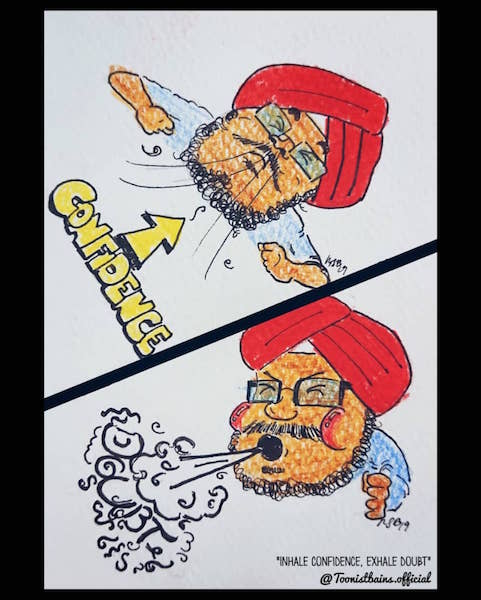
Inhale confidence. Exhale doubt – ToonistBains

0


ToonistBains
By ToonistBains | SKETCH |

Inhale confidence. Exhale doubt.

@Toonistbains.official


ASIA SAMACHAR is an online newspaper for Sikhs / Punjabis in Southeast Asia and beyond. Facebook | WhatsApp +6017-335-1399 | Email: editor@asiasamachar.com | Twitter | Instagram | Obituary announcements, click here |

What about a Malaysian gurdwara with Minangkabau look?

Minangkabau house: Photo: Lembaga Muzium Negeri Sembilan

By Dya Singh | OPINION | 

Very recently, aspiring futuristic architect Vishal Singh explained with models, the design of a gurdwara of the future. He incorporated all aspects of the spirit of a Sikh gurdwara different from halls of prayer of other religions. In other words, different from the looks of a church, mosque, Chinese temple or a mandir.

I did comment quickly under his column about a thoughtful exteriorisation of such a unique building. While he has gone to the lengths of even recommending what kind of material could be used, the one aspect which started me thinking was the exterior. What does it look like from the outside? What image does it reflect? How does it represent us Sikhs? I suggested a Malaysian style (Minangkabau, Malay house roof type, etc.).

I felt the impulse to elaborate a little further.

Sikhism, or rather the Sikh Quom (nation), is an emerging global socio/theosophical community. I will say unflinchingly that we do not have a geographical, physical ‘country’ any longer. It has been proven that almost 80 percent of our ‘heritage’ is now in Pakistan with the remains in Indian Punjab.

But, I find this a cause of celebration, not a thought for any anguished breast-beating. We thrive as a global community. Indian Punjab, and especially the continuing political climate therein, has proved, even after the fateful 1984 that we Sikhs are not really made out for governing ourselves. (Our gurdwara politics too appears to suggest that!) But we prosper and add value to any country we migrate to.

At times gone by every Sikh outside Punjab thought of ‘making money’ and retiring in Punjab. A great portion of their pay or moneys earned was sent back to Punjab. Overseas Sikhs have built huge houses in their villages – lying empty because they are still overseas or have died overseas! Hopefully we have now outgrown that. I believe Malaysian Sikhs truly have. We Sikhs generally are a creditable global community. Any country is proud to have us.

Our integration into any country is that we retain our Sikhi and hopefully Sikhi-seroop too and, within reason, we take on the ‘culture’ of the country we start staying in.

Under British Law we have also been accepted as an ‘ethnic’ community. That means, as long as we follow Sikhi, we are considered one ‘community’ with the same ethnic background. The Mandla Case comes to mind.

British Sikhs are now pushing to be considered ‘Sikh’ when it comes to stating ones ‘background’. We used to say ‘Indian’, but now we will be able to say ‘Sikh’ as our background.

We thrive and celebrate that we are now a genuine global community based on Sikh values. If we are born and brought up in India, we are Indian Sikhs. If we are born and brought up in Malaysia we are Malaysian Sikhs and so on.

I have a problem because I was born and brought up in Malaysia but for the last 40-odd years I have been living in Australia – am I a Malaysian Sikh or an Australian Sikh? I guess I too celebrate that fact and it does not matter because I am … first and foremost, a ‘SIKH’.

So, coming back to the exterior of a future Malaysian gurdwara, what about the National Gurdwara itself? Of which by the way, I have been accepted as a member (an NRM – Non-Residential Malaysian, just like NRI means Non-Residential Indian) member!

By the way, I have been told by some Malaysians that – “Ki lod hai, ek hor gurdwaray dhi, aje bas neheen?” Negative thinkers!

I believe that the Malaysian government has granted this land in Putrajaya especially for the Sikhs mainly to showcase the multicultural, multi-religious mix of Malaysian residents and it is our duty to build this gurdwara, as a showpiece of Sikhism in Malaysia and what Sikhs represent.

Sikhism is about inter-religious dialogue and harmony. We have so many aspects to suggest that we are welcoming of all peoples of all castes, all religions or ways of life – as long as they do not interfere in our way of living.

I will suggest that the exterior of this gurdwara should have a ‘Malaysian’ feel to it. A building showing that we are part and parcel of this country. What better way than to have a building which reflects Malaysian culture like a Minangkabau type of any high roof with steep inclines and curves at the ends – think Malaysian, building. Or think genuine, traditional Malay house in a kampong! I am certain someone like Vishal can visualise and design something along those lines.

Such a building will become a talking point not only nationally but internationally and hence a tourist destination. Just like the gurdwara in Dubai is a talking point globally, so will such a gurdwara in Malaysia.

And what will say that it is a Sikh place of worship? A Nishan Sahib in front does that.

Malaysian-born Dya Singh, who now resides in Australia, is an accomplished musician and a roving Sikh preacher. The Dya Singh World Music Group performs full scale concerts on ‘music for the soul’ based on North Indian classical and semi-classical styles of music with hymns from mainly the Sikh, Hindu and Sufi ‘faiths’. He is also the author of SIKH-ING: Success and Happiness. He can be contacted at dyasingh@khalsa.com

* This is the opinion of the writer and does not necessarily represent the views of Asia Samachar.


RELATED STORY:

Dya Singh revisits Kerala ayurveda journey – Part III (Asia Samachar, 13 June 2019)

The communal spirit that binds us all – Bringing everyone from everywhere together (Asia Samachar, 6 June 2019)

Putrajaya gurdwara in the making (Asia Samachar, 20 March 2019)


ASIA SAMACHAR is an online newspaper for Sikhs / Punjabis in Southeast Asia and beyond. Facebook | WhatsApp +6017-335-1399 | Email: editor@asiasamachar.com | Twitter | Instagram | Obituary announcements, click here |

Heineken launches alcohol-free beer in Malaysia

By Asia Samachar Team | MALAYSIA |

After hitting the markets in Singapore and Thailand, Heineken’s alcohol-free beer is now available in Malaysia.

The major producer of beer and stout producer Heineken has launched its non-alcoholic malt beverage to tap what it deems a growing consumer trends centred around health-conscious consumers.

Badged as Heineken 0.0, the drink will be imported from the Netherlands and comes in a new 250ml bottle pack size.

“We are selective of the innovations that are relevant to Malaysia and believe that Heineken 0.0 is primed for success,” Heineken Malaysia Bhd Managing Director Roland Bala told a press conference yesterday (21 July 2019).

Heineken 0.0 is an alcohol-free malt beverage brewed using natural ingredients, with 69
calories per bottle. Blue labeling on me bottle – a coulor often associated with non-alcoholic varieties.

The ‘beer’ starts out with traditional beer ingredients like water, malted barley and hop extract. Then its twice-brewed and fermented with Heineken’s A-yeast before alcohol is removed in a ‘natural’ process. The final step is to blend the beverage, according to an earlier report at BeverageDaily.


RELATED STORIES:

LETTER: Ban all festivals celebrating alcohol consumption (Asia Samachar, 22 Oct 2018)


ASIA SAMACHAR is an online newspaper for Sikhs / Punjabis in Southeast Asia and beyond. Facebook | WhatsApp +6017-335-1399 | Email: editor@asiasamachar.com | Twitter | Instagram | Obituary announcements, click here 

Bisant Kaur @ Pauline Kaur Sidhu (1942-2019), Petaling Jaya

SASKAAR / CREMATION: 2pm, 21 June 2019 (Friday), at Nirwana Memorial Shah Alam. Cortège leaves from 212A, Jalan BU 6/2, Bandar Utama, Damansara, Petaling Jaya at 1pm | Malaysia
Bisant Kaur @ Pauline Kaur Sidhu (1942-2019), Petaling Jaya

MDM BISANT KAUR @ PAULINE KAUR SIDHU

Village: Moga

Born: 29 May 1942

Departed: 20 June 2019

Husband: Late Sarjit Singh Sidhu

Children / Spouses:

  1. Sharon Kaur Sidhu / Kalwant Singh Sidhu

2. Dr Shanny Kaur Sidhu / Dr Inderjit Singh Maan

Grandchildren: Gavin Singh Sidhu, Rowena Kaur Sidhu, Nikhail Singh Maan, Rohail Singh Maan

Saskaar / Cremation: 2pm, 21 June 2019 (Friday), at Nirwana Memorial Shah Alam

Cortège timing: Cortège leaves from 212A, Jalan BU 6/2, Bandar Utama, Damansara, Petaling Jaya at 1pm

Path da Bhog: 29 June 2019 (Saturday), 5pm-7pm, at Gurdwara Sahib Petaling Jaya

MESSAGE FROM THE FAMILY: Battled bravely till the very end. A true fighter and loving mother and grandmother

FAREWELL, DEAR MUMMY

Somewhere in our hearts beneath our grief and pain,
Is a smile we still wear at the sound of your dear name.
The precious word is ‘Mummy’, she was our world, you see,
But now our hearts are breaking because she’s no longer here.
When we think of your kind heart all these loving years,
Our memories surround us and our sadness disappears.
We want to thank you, Mummy for teaching us so well,
To stand up for ourselves, because of you we excel.
And although you’ve left this earth and now you’ve taken flight,
You will always be in our hearts every morning, noon and night.

Contact:

Kalwant 017-8807078

Sharon 017-8840218

Dr Shanny 012-5888816

| Entry: 20 June 2019 | Source: Family |

ASIA SAMACHAR is an online newspaper for Sikhs / Punjabis in Southeast Asia and beyond. Facebook | WhatsApp +6017-335-1399 | Email: editor@asiasamachar.com | Twitter | Instagram | Obituary announcements, click here |