PAGE 1: Sikh Naujawan Sabha Malaysia reaffirms Sri Akaal Takht’s stand on Dasam Granth
SNSM Page 2
SNSM Page 3
SNSM Page 4
The newly appointed Sikh Naujawan Sabha Malaysia (SNSM) exco has issued a letter on the four-decade old organisation’s position on the divisive issue of Dasam Granth (DG).
The letter, dated 18 July and titled ‘Sikh Naujawan Sabha Malaysia reaffirms Sri Akaal Takht’s stand on Dasam Granth’, is being sent out to members.
When contacted, SNSM jathedar Dr Jasbir Singh confirmed the issuance of the letter.
Dr Jasbir was recently reelected as the jathedar, as the organisation’s chief. SNSM only elects the jathedar who then appoints an exco to run the outfit for a two-year term.
In the four-page letter, signed by Dr Jasbir on behalf of the exco, it described SNSM as a ‘unifying force in Malaysian history’ guided by the Sikh Rehat Maryada (SRM), the Sikh code of conduct.
“Over the years, misinterpretation of [SRM] has damaged the mutual cooperation and unity amongst our beautiful sanggat here,” the letter says.
“Many have denigrated the contents of Sri Guru Gobind Singh’s Bani while others have rushed to defend what has been given to us as our heritage and lagacy.
“The people who worked for years together for the common good of the panth now find themselves pitted in opposite camps writing unsavourable posts on social media. The situation has become painful and sad.”
The DG, an issue discussed at the AGM, has been a hot button on the social media for a segment of Sikhs. The debate has broken up friendships and even severed family ties for some.
While urging members to ‘understand the spirit’ of the letter, it is to be seen if the document mend the divide.
[ASIA SAMACHAR is an online newspaper for Sikhs / Punjabis in Asia. How to reach us: Facebook message or WhatsApp +6017-335-1399. Our email: editor@asiasamachar.com. For obituary announcements, click here]
Two Sikh musicians from the UK are on a great adventure to preserve the Sikh musical history and eventually produce a documentary on the fascinating story of the gurbani kirtan.
They intend to capture the knowledge and memories of the elder generation of the Sikh musical history as part of their PhD project.
But they need funding. As of today (20 July 2018), they are at about mid point of the £20,000 they intend to raise at crowfunding platform Crowdfunder. The campaign, entitled ‘Sikh Music Research & Documentary’, ends on 28 Aug 2018.
Kirit Singh and his music partner Jasdeep Singh intend to collect and immortalise one of the most vibrant and rich musical histories of South Asia.
Kirit is currently undertaking his PhD, titled ‘Kirtan and Kala: Patrons and Musicians of Gurbani Kirtan and Hindustani Music in Punjab, 1801 to 1947’, at School of Oriental and African Studies (SOAS) University, London, under the supervision of Prof Richard Widdess.
The study is the first of its kind to explore in detail the tradition of gurbani kirtan in relation to Hindustani music in the Punjab region, during the unique period in which both traditions came to enjoy significant patronage from the Sikh princes and aristocracy, according to the entry at the Crowdfunder page.
The study aims to document the outcome of the interactions and exchanges in such environments by drawing on written sources and oral histories. It will also focus on the major religious centres, such as Amritsar, which fostered a flourishing musical environment, it added.
On his part, Jasdeep was initiated into the Tabla and Jori by a leading maestro of the Benares and Punjab traditions, Ustad Sukhvinder Singh ‘Pinky’. His research interests lie in the gurbani kirtan tradition and, especially, the percussive aspects of the Jori, Pakhawaj and Tabla.
The funding will, among others, alow them to conduct two fieldwork trips to India and Pakistan respectively, to conduct the necessary archival and interview work for the project.
[ASIA SAMACHAR is an online newspaper for Sikhs / Punjabis in Asia. How to reach us: Facebook message or WhatsApp +6017-335-1399. Our email: editor@asiasamachar.com. For obituary announcements, click here]
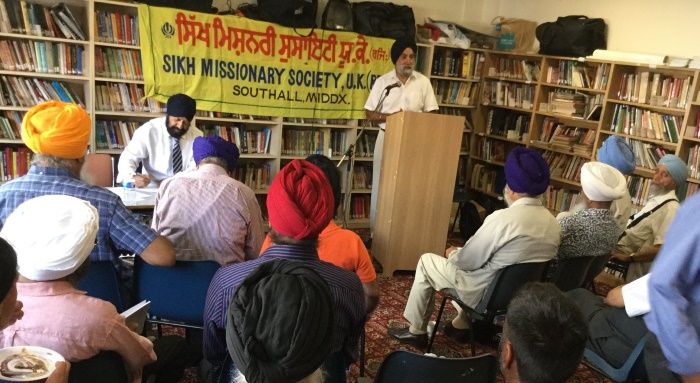
Gurmel Singh Kandola (seated, with tie) at the Sikh Missionary Society UK talk – Photo: SEWA UK
By Gurmukh Singh OBE |OPINION |
The above was one of the main questions at a presentation and discussion organised by the Sikh Missionary Society UK on 14 July, 2018, under the general heading State of the Panth: Learning from experience. This time the spotlight was on the personal experience and vision of Sardar Gurmel Singh Kandola MBE, ex-Secretary General of the Sikh Council UK.
The neutral environment of the Sikh Missionary Society UK, which has served our missionary/educational needs since 1969, and the presence of dedicated Society sevadars, was the right setting for such a presentation and discussion. [Most deservingly, S Gurmel Singh was honoured by the Society with a siropa and a plaque.]
Who has the right to represents the Sikhs? is a question which has caused much controversy and division in the community for decades. This unresolved issue has been exploited by politicians and governments. Recent communications relating to Sikh representations show how even middle ranking civil servants can decide who the Sikh representatives are! There are new boys on the block, more articulate, less conversant with Sikhi, minus full Sikh identity sometimes, and closer to the office-bound civil servants to give ready advice about Sikh/Sikhi issues. This advice, selectively or conveniently sought, can then become the basis for briefs to ministers and government policy. (The so called, Sikh surveys is a related topic for another time).
Column space does not allow a fuller discussion but I am content to summarise some points made at the Sikh Missionary Society event. Identifying as a Sikh means representing oneself and the whole Sikh community at the same time, the opinion of any Sikh individual becomes as valid as any other (Dr Jasjit Singh of Leeds University). According to Harmander Singh of Sikhs in England, the pertinent point is the question, who is a Sikh? He believes that the Sikh Reht Maryada is the Sikh Guide and clearly defines a Sikh. That is the first and the most important pre-condition for any claims to Sikh representation.
The other important pre-conditions relate to openness and accountability. There should be continual feedback to those represented and timely advice should be sought before returning to the talks or the negotiating table. S. Gurmel Singh quoted the historical example of S. Baldev Singh during the tripartite independence talks in 1947. The future of the Sikhs was decided by Baldev Singh acting almost on his own.
There are other issues about the nature of Sikh organisations claiming Sikh representation. Subject to their aims and objectives, are they inclusive or more like exclusive clubs? Do they promote teamworking which brings in diverse skills? Is there succession planning and effective delegation to ensure experience building and training of younger members. The mix of age groups, men-women balance, ease with which changes can be made at the top etc all these factors are relevant to any claims to community representation.
Today, when the Sikh community faces so many challenges to Sikh ideology, institutions and identity, above are the sort of questions we need to ask of those representing us. Otherwise, Sikh future will not be decided by Sikhs (as defined by the Sikh Reht Maryada).
Gurmukh Singh OBE, a retired UK senior civil servant, chairs the Advisory Board of The Sikh Missionary Society UK. Email: sewauk2005@yahoo.co.uk
* This is the opinion of the writer, organisation or publication and does not necessarily represent the views of Asia Samachar.
[ASIA SAMACHAR is an online newspaper for Sikhs / Punjabis in Asia. How to reach us: Facebook message or WhatsApp +6017-335-1399. Our email: editor@asiasamachar.com. For obituary announcements, click here]
PATH DA BHOG: 27 July 2018 (Friday), 10am to 12noon, at Gurdwara Sahib Johor Bahru| Malaysia
Gian Singh Bal (1926-2018), Johor Bahru, formerly Batu Pahat
SARDAR GIAN SINGH BAL A/L JASSA SINGH
(Johor Bahru, formerly from Batu Pahat)
Village: Satowal
Age: 92
Born: 12 May 1926
Departed: 11 July 2018
Wife: Sardarni Joginder Kaur
Children / Spouses:
1) Hardip Kaur / Dr Ranjodh Singh
2) Harbajan Singh / Harbachan Kaur
3) Harbans Singh / Ranjit Kaur
4) Karamjit Singh / Ravinder Kaur
5) Amerjit Kaur / Satwant Singh
Path Da Bhog: 27 July 2018 (Friday), 10am to 12noon, at Gurdwara Sahib Johor Bahru
MESSAGE FROM FAMILY: A wonderful man and a great father figure. A man dedicated to community service. A loving father & grandfather. He will be dearly missed, fondly remembered and forever cherished by all loved ones, grand children, relatives and friends.
Contact:
Amerjit / Satwant : 012 705 6504
Karamjit / Ravinder: 017 773 3970
| Entry: 20 July 2018 | Source: Family
[ASIA SAMACHAR is an online newspaper for Sikhs / Punjabis in Asia. How to reach us: Facebook message or WhatsApp +6017-335-1399. Our email: editor@asiasamachar.com. For obituary announcements, click here]
Charanjeev Singh and Danny Kwan from New Paradigm Capital Markets at the The Assets awards ceremony – Photo: Supplied
A sardar ji from Malaysia is making maves in the area of Islamic finance. An innovative financial solution in the area of sukuk, or Islamic bonds, by his team has won them yet another award.
Charanjeev Singh and Danny Kwan, the founding partners of New Paradigm Capital Markets Sdn Bhd, picked up the Best Structured Finance Sukuk by the Asset at The Asset Triple A Islamic Finance Awards 2018.
The award recognises their role as financial adviser and deal structurer for SkyWorld Capital Berhad’s RM1.0 billion sukuk programme.
“This recognition means an incredible amount to all of us at NewParadigm Capital Markets, as we are able to have an active part in the development of the Malaysian bond market,” Charanjeev Singh said in a statement.
Established in 2005, NewParadigm Capital Markets is an independent and privately-owned corporate finance advisory firm licensed by the Securities Commission of Malaysia. It is in the niche business of providing independent, unconflicted financial and strategic advice on capital raising, financings, recapitalisation & restructurings and mergers & acquisitions to a diverse client base.
The sukuk under consideration is said to be the first structured transaction in Malaysia involving unbilled sales and the first in the world to involve affordable housing, as well as the first Shariah compliant securitisation of progress billings and monetisation of progress billings in the market globally.
The transaction monetises future payments to be received from the sale of yet-to-be-completed development projects allowing the Issuer to more efficiently manage project development cash flows, according to the statement.
[ASIA SAMACHAR is an online newspaper for Sikhs / Punjabis in Asia. How to reach us: Facebook message or WhatsApp +6017-335-1399. Our email: editor@asiasamachar.com. For obituary announcements, click here]
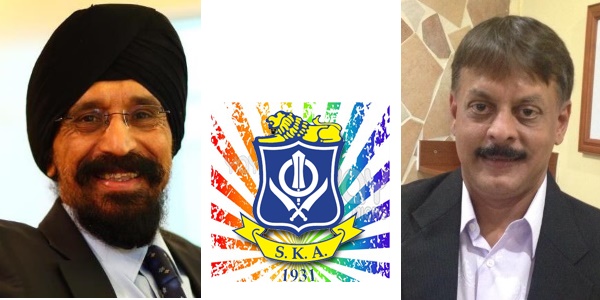
Hernaikh Singh (right) and team puts up a challenge against outgoing committee led by Mohinder Singh (left)
Something is brewing at Singapore Khalsa Association (SKA). Some quarters are apparently not entirely happy with the way things are going on at the 87 year old outfit that began as a sports club in 1931.
Come Sunday (22 July 2018), Mohinder Singh and his team will face a challenge for SKA’s leadership when members meet to elect a new set of committee for the next two years.
Senior civil servant Mohinder came on board as SKA president unopposed in 2016 to replace former army officer Lt. Col (Retd.) Charanjit Singh who had served the maximum of three two-year terms allowed under its constitution.
Mohinder, who retired as a senior policy-maker at the Land Transport Authority (LTA) and now an advisor to the LTA Academy, has offered to continue as president and has released the team lineup.
Leading the charge against him is Hernaikh Singh, a founder president of Young Sikh Association Singapore (YSA) and a senior associate director at the Institute of South Asian Studies at the National University of Singapore (NUS).
He has shared via the social media the lineup of his team.
“It is time for change. It is time to transform SKA based on the principles of accountability, inclusiveness and reliability,” Hernaikh wrote in a note on his personal Facebook page.
“We want SKA to be a vibrant, lively and member-focussed club. It has a lot to offer and the members deserve more. It has certainly failed to live up to expectations and it is time to change that.”
The SKA website has also displayed the names of those vying for the various positions at this Sunday’s AGM in a note from its general secretary Sukhbir Singh.
On his personal Facebook page, Mohinder’s had shared a SKA video on the opening of the new building, stating: “Our achievements could not have been summed up better!”
The completion of the renovation works to its iconic Tessensohn Road clubhouse was indeed a massive undertaking. On 30 Dec 2017, Singapore Deputy Prime Minister Tharman Shanmugaratnam inaugurated the spanking new headquarters that underwent a $12 million makeover.
When he took over the leadership reigns two years ago, Mohinder said the team would build upon the work done by the previous management committees to ensure that the SKA continues to remain relevant to the evolving needs of the Sikh community, including the role of the SKA building.
“We will aim to make it the social, cultural and sporting hub for the Sikh community. It should be an inviting venue for families, and a place for young and old,” he then tells Asia Samachar.
Sunday will tell if members feel Mohinder and his team are on the right track or they want to opt for winds of change.
[ASIA SAMACHAR is an online newspaper for Sikhs / Punjabis in Asia. How to reach us: Facebook message or WhatsApp +6017-335-1399. Our email: editor@asiasamachar.com. For obituary announcements, click here]
From left: Clarence, Muhamad Qamar, Ninderpal and Dr Charles – Photo: UTAR website
Ninderpal Singh Balwant Singh and a team of lecturers from University Tunku Abdul Rahman (UTAR) came back all smiles after attending a recent national conference.
The team from the university’s Kampar, Perak, campus had presented a paper on crisis management at the National Conference on The Sciences and Social Sciences 2018 (NACOSS III).
And to their delight the Academic International Dialogue (AID) awarded them the “Best Paper for Academic Award”.
The conference was held on 2 May 2018 at Universiti Sains Islam Malaysia (USIM).
The other team members were Faculty of Arts and Social Science (FAS) lecturers Clarence Anthony Puspanathan, Muhamad Qamar Rahman Md Isa and Ang Siew Mun @ Ang Pike Har, and Faculty of Business and Finance lecturer Dr Charles Ramendran S PR Subramaniam.
Their winning paper was titled “Tongue-In-Cheek: Crisis Management in Malaysia. A Consumer Relations Context”.
The paper highlighted the importance of the public relations (PR) department in managing crisis and its century. The paper discussed how the society today has developed a habit of sharing everything that one has experienced in real-time on social media platforms.
Hence, the paper looks into understanding how this habit, which is now seen as a norm among society, is able to cause harmful consequences for organisations when managing a crisis, according to a report at the UTAR website.
“It was an interesting topic and it came about by reviewing multiple crises, which were made public via social media. The responses made by the implicated organisation to the crisis differed from one company to another.
“We noticed that the response was made swiftly in addressing the issue without denying the existence of the crisis; saw a positive understanding of the stakeholders,” said Ninderpal.
The paper was awarded based on a blind review process and among the 52 papers that were shortlisted at the conference, the report added.
[ASIA SAMACHAR is an online newspaper for Sikhs / Punjabis in Asia. How to reach us: Facebook message or WhatsApp +6017-335-1399. Our email: editor@asiasamachar.com. For obituary announcements, click here]
PATH DA BHOG: 29 July 2018, 9am-12pm, at Gurdwara Sahib Teluk Intan| Malaysia
Karamjit Kaur Sandhu (1969-2018), Teluk Intan
KARAMJIT KAUR SANDHU D/O SARMUKH SINGH
Born: 23 February 1969
Departed: 17 July 2018
Husband: Salinder Singh Sandhu s/o Late Bachan Singh
Children:
Jasvinder Kaur Sandhu
Kasvinder Kaur Sandhu
Harjit Kaur Sandhu (Henna)
Saskaar / Cremation: 12.30pm, 18 July 2018 (Wednesday), at Sikh Crematory Taman Teluk Intan
Cortège timing: Cortege leaves Lot 17702, Batu 4, Jalan Changkat Jong, 36000 Teluk Intan, Perak, at 11am, 18 July 2018 (Wednesday)
Path Da Bhog: 29 July 2018, 9am-12pm, at Gurdwara Sahib Teluk Intan
Contact:
Salinder Singh Sandhu 016-426 8472
Kasvin 016-447 8084
Henna 016-539 6995
| Entry: 17 July 2018 | Source: Family
[ASIA SAMACHAR is an online newspaper for Sikhs / Punjabis in Asia. How to reach us: Facebook message or WhatsApp +6017-335-1399. Our email: editor@asiasamachar.com. For obituary announcements, click here]
I can still recall the overwhelming glow in our late Father’s eyes — ”Father” was the endeared we siblings addressed him as. It was always the very elation of his mood that blossomed when travel plans to our village Suropadda got confirmed. The ‘double-consciousness’ in him, a sourjoner loyal to both his host nation Singapore (Singapur), and the soil of origin, The Punjab formed an astounding reality for our entire family.
The excerpt above is taken from my informal correspondence with Mr Sarjit Singh Suropadda, the eldest child and son of Sardar Fauja Singh Suropadda. Mr Sarjit Singh informs that his Father arrived in Malaya around 1945 together with his brothers from Punjab via Calcutta. Mr Sarjit Singh was later born in November 1946 in the then Malayan Johor state.
Source: Daastaan 1918-2018 – Sri Guru Singh Sabha Singapore Centennial Celebration coffee table (page 27) / Sarjit Singh & Family
Photo above was taken when Mata Basant Kaur visited her sons in Singapore around 1950 and it shows: Standing from Left: Sardar Inder Singh, Sardar Chanan Singh, Sardar Fauja Singh, Sardar Dewan Singh and Sardar Sulakhan Singh. Seated From Left: Sardami Pritam Kaur (Mrs Fauja Singh), Sardami Bhan Kaur (Mrs Chanan Singh), Mata Basant Kaur Ji (Mrs Hukam Singh) and Sardami Dhan Kaur (Mrs Inder Singh).
ABOUT SUROPADDA
According to the Census in 2011, information with regards to the location code or village code of Suro Padda (Suropadda) village is 037790. Suro Padda village is located in the Baba Bakala Tehsil of Amritsar district in Punjab, India, renowned for The Golden Temple Sahib. It is situated 22km away from Sub-District headquarter Baba Bakala and 40km away from the district headquarters of Amritsar . As per 2009, Suro Padda forms the gram panchayat of Suro Padda village. (Source: Wikipedia).
The total geographical area of the village is 139 hectares. Suro Padda has a total population of 804 peoples. There ere about 172 houses in Suro Padda village. Batala is the nearest town to Sum Padda. In fact. another popular landmark town Mehta Chowk has also now grown in size; with its popularity accruing to the famous Mehta Sahib Gurduwara.
SARDAR HUKAM SINGH S/O SHER SINGH
Sardar Fauja Singh and his family’s lineage stems off from Sardar Hukam Singh, a proud father of seven strong and healthy sons in that historical era of India where daughters were socio-politically generalized as less favorable or even taboo!
As we can notice from the photo above, his five sons migrated to Malaya / Singapore. The remaining two, eldest Sardar Bhan Singh and the youngest Sardar Karam Singh, never left the shores of India. The only travel mode in those days was by sea taking about 15 days in total to reach Singapore after travelling from Amritsar by train to Calcutta. Historical fact suggests that the two most popular ships used for this long-hauled migration was the “Rajula and Santhia”.
Sardar Chanan Singh, being employed as Watchman, with Guthrie & Company in Singapore and carrying on part-time money lending, agreed to a unanimous decision in 1955 to go back to Suropadda. Before leaving, he handed over his money-lending business to his younger brother, Sulakhan Singh. He was to build houses for Sardar Fauja Singh, Inder Singh, Dewan Singh and himself and Sulakhan Singh (joint ownership).
The responsibility was adhered to with full effort, wit and passion by Sardar Chanan Singh. Four double-storey mansions with solid foundations and impressive structure were erected, with a common opened sited roofed verandah. These unprecedented Havelis were described as the pride of the Land and of far superior quality as compared to the typical houses in farmland Punjab during that period.
More remarking still, is the continued reality of a revolving psychosocial phenomenon that social scientists term as “Myth of Return”: The houses remain to exist in the same form they were built and maintained. When described, they crystallize in our minds as images of the tall and handsome brother, joining arms in one straight row to welcome all back home!
MYTH OF RETURN
While the standards and style of living in Singapore progressed across time, the Pind never took a backseat but remained as the ultimate destination of return. No compromises took place in the remittance of funds for urbanization of the agrarian scape, or maximizing yield from harvests. Thekka (land leasing) and so on.
All of them were busy earning a living those days either as Watchmen (Jagas) and that was when Standard Chartered Bank coined their TV advert as “Big Strong & Friendly” Sikh Doorman.
Some even did money-lending either full time or as a side-line to make ends meet until their children were of employment age. In fact my Dad and even his cousins started helping out their parents while still in secondary schools doing night duties at some locations while sitting under roadside lampposts doing their school homework or giving tuition to younger siblings. Those struggles and experiences still linger in their minds.
He says he cannot erase those precious memories of the then Ministry of Health in Palmer Road and those solid godowns belonging to Gian Singh / Hira Singh & Sons in Trafalgar Street. Landmarks like Trafalgar School, Mariners Club, CPF Building in Anson Road and Enggor Street are now extinct.
In 1984, covert participation in politics of the home of origin during the notorious post “Operation Blue Star” turmoil in Punjab had also significantly manifested in the daily lives of Sardar Fauja Singh and his “Pendu’ networks who mapped themselves as the representatives of the ‘Majha’ communities in the Sikh Diaspora.
The short narrative below best explains the sociality:
I would make a telefilm to best describe how there was never a day where Father would take his mind off our village while he rooted himself and us into the Singaporean identity. At a time where media access was remote or even absent, the Gurduwara as a community nucleus allowed updates of the respective regions and villages. “I will go soon and see” was the rhetoric each time, followed by long moments of silence and deep speculative thoughts about the village. Every activity stood still at home, the moment there was the briefest mention of Punjab on national TV News bulletins. We as children educated in English medium: automatically transformed ourselves into interpreters with the occasional cheek to harmonize any harmless report that we knew would stir anxiety and stress!
TODAY
Madam Pritam Kaur, wife of late Sardar Fauja Singh, continues to reside in Singapore at age 92 as the only remaining member from the sojourning Suropadda family of Seven Brothers. Even while suffering from severe dementia today, “Man Ji” recognizes fairly accurately black and white photos of her matrimonial village, Suropadda, with occasional tears of nostalgia formed from days as a teenage bride, to a trajectory of leaving the homeland (impacting contact with her own paternal family and siblings) to live in Police Quarters (Malaysia) and then in a kampung (Malay village) at Trafalgar Street, Tanjong Pagar, followed by resettlement to a towering Telok Blangah HDB [Housing Development Board] flat. Her vicarious memories often distorted by her dementia could be difficult to comprehend, but if patiently deciphered would unveil stories of her “Pind” and its fondest fragments such as her beloved pet cow, a protective snake, and how all her children looked like and behaved as toddlers.
The family’s initiative to contribute this article serves as a continued commitment to the historical allegiance as Majha patrons of Gurduwara Sri Guru Singh Sabha. This article also aims to textually archive a History endowed with priceless value and memoir.
We hope and pray that the indomitable Suropadda Spirit continues to evolve and revolve across their generations to come partaking continued Sewa.
[Author Jatinder Singh’s dad, Sarjit Singh Suropadda, was the co-chair of the SGSS100 Organising Committee and also chairman of the Radin Mas IRCC]
* This is the opinion of the writer, organisation or publication and does not necessarily represent the views of Asia Samachar.
[ASIA SAMACHAR is an online newspaper for Sikhs / Punjabis in Asia. How to reach us: Facebook message or WhatsApp +6017-335-1399. Our email: editor@asiasamachar.com. For obituary announcements, click here]
PATH DA BHOG: 10am-12pm, 22 July 2018 (Sunday) at Gurdwara Sahib Port Klang, Selangor
CONTACT: Suniljit Singh 014 624 7736
| Entry: 16 July 2018 | Source: Family
[ASIA SAMACHAR is an online newspaper for Sikhs / Punjabis in Asia. How to reach us: Facebook message or WhatsApp +6017-335-1399. Our email: editor@asiasamachar.com. For obituary announcements, click here]