Deputy Commissioner Nankana Sahib Waseem Hamid Sindhu personally supervising the clean up efforts at Kartarpur Gurdwara
By Asia Samachar | Pakistan |
Kartarpur Gurdwara has been restored after unprecedented floods brought 10 to 12 feet of water at its complex.
The efforts on the special directions of Punjab Chief Minister Maryam Nawaz Sharif will ensure that the historic gurdwara, associated with Guru Nanak, will be able to receive visitors.
In a briefing yesterday, Maryam said she appreciated the role of Deputy Commissioner Nankana Sahib Waseem Hamid Sindhu.
Under her directives, Suthra Punjab teams and officials from multiple government departments worked around the clock to drain water, clean the premises, and restore the Gurdwara’s sanctity. The Darshan Deori and all sections of the shrine have been thoroughly cleaned, while the expansive courtyard has been cleared and washed.
The Nankana Sahib DC personally supervised the operation on-site, ensuring that the work was completed in record time. The Gurdwara will be reopened for Sikh yatris (pilgrims) within three to four days, according to officials.
ASIA SAMACHAR is an online newspaper for Sikhs / Punjabis in Southeast Asia and beyond. You can leave your comments at our website, Facebook, Twitter, and Instagram. We will delete comments we deem offensive or potentially libelous. You can reach us via WhatsApp +6017-335-1399 or email: asia.samachar@gmail.com. For obituary announcements, click here
Main Manto Nahi Hoon: Suraiyya (Saima Noor) and Mehmal (Sajal Aly) present a tender Phuppo-Bhatiji bond on screen. Middle: Humayun Saeed (Manto)
By Raag & Reel | Movie Reviews |
Main Manto Nahi Hoon, ARY Digital’s July release, is a drama of grand ambition, blending cinematic direction by Nadeem Baig with strong performances and lavish aesthetics that elevate it beyond routine primetime television.
Penned by Khalil-ur-Rehman Qamar, the story follows two rival families led by Siraj (Asif Raza Mir) and Bin Yameen (Babar Ali), their feud spanning generations. Siraj’s sister Suraiyya (Saima Noor), weighed down by grief, delivers one of the drama’s most moving performances.
Siraj’s daughter Mehmal (Sajal Aly) dreams of studying beyond the confines of home, embodying the central conflict between rigid tradition and youthful aspiration.
Her tender bond with Suraiyya—whom she calls Phuppo—gives the drama heart, especially in lighter moments such as their amusing visit to a university dean.
Humayun Saeed surprises as Professor “Manto,” an eccentric academic whose quiet defiance captivates Mehmal. Sanam Saeed adds balance and modernity as Miss Maria, grounding the story with poise. Collectively, the cast often outshines the script, infusing authenticity where the writing falters.
And falter it does. Qamar’s heavy-handed style, dominated by monologues and outdated gender politics, risks suffocating the narrative. Characters sometimes feel like conduits for ideology rather than complex individuals. While the drama gestures toward progressiveness—with ambitious women and layered men—it simultaneously reinforces stereotypes Qamar is notorious for.
Yet, despite its contradictions, Main Manto Nahi Hoon is compelling. Its lush visuals, emotional pull, and stellar cast make it worth watching. Ultimately, its success will hinge on whether direction and performances can outshine the writer’s overbearing voice.
ASIA SAMACHAR is an online newspaper for Sikhs / Punjabis in Southeast Asia and beyond. You can leave your comments at our website, Facebook, Twitter, and Instagram. We will delete comments we deem offensive or potentially libelous. You can reach us via WhatsApp +6017-335-1399 or email: asia.samachar@gmail.com. For obituary announcements, click here
Gurbani is written almost entirely in poetic form or what in Panjabi is termed ‘kav roop ’/ ‘ਕਾਵਿ ਰੂਪ’. This is no accident. Across all the faith traditions, poetry has long been the chosen medium for conveying spiritual truths. From the mystical verses of Rumi in the Sufi tradition, to the Psalms of the Hebrew Bible, to the hymns of the Upanishads in ancient India, to the emotional rendition of the Quran, sacred poetry has been deployed to stir emotions and inspire devotion.
Broadly speaking, language can be divided into two forms: factual and expressive. Factual language is objective, aiming to communicate information neutrally and accurately. It deals with verifiable data, logical reasoning, and evidence, and is commonly used in fields such as science, law or journalism. Its purpose is to inform and to minimise personal bias.
Expressive language, by contrast, is subjective. It conveys subjective experiences, feelings, emotions, and insights, often through imagery and metaphor. This is the language of poetry and creative writing. It seek to evoke awareness rather than only impart knowledge. In short, one can say that factual writing is concerned with knowing, whereas expressive language is concerned with being.
For this reason, the Sikh Gurus and Bhagats chose poetry as the principal vessel of revelation. While Gurbani does contain references to people, events and places, it is not intended as a set of instructions. For instance, when Gurbani speaks of ‘offering one’s head to the Guru’, this is not a call for physical sacrifice but a poetic expression of humility and self-surrender.
Gurbani, therefore, is best understood as a living, creative and evocative force that stirs the soul towards awakening. Its purpose is not to establish dogma but to draw the seeker into the realisation of Ik Oankar, the oneness of all existence. This is not a theoretical concept but a lived experience of non-duality, in which all distinctions, between self and other, creator and creation, dissolve. Such realisation requires transcending the ego and the five vices of lust, anger, greed, attachment and pride.
The poetic form of Gurbani enables this transformation. Recurring metaphors, such as ‘bride and groom’, ‘light and darkness’, ‘intoxication and awakening’ etc, are not to be read literally. Rather, they serve as symbolic gateways into deeper truths, pointing the seeker beyond words towards inner search for meaning.
Sikh scholars often distinguish between two modes of interpretation: akri arth (ਆਕ੍ਰੀ ਅਰਥ), the literal or grammatical meaning of a verse, and bhav arth (ਭਾਵ ਅਰਥ), the interpretative sense that conveys its spiritual intent. While akri arth provides a necessary foundation, it cannot capture the fullness of meaning. This is where Bhav arth becomes necessary to uncover the essence of Gurbani, connecting verses to broader themes in Sikh theology, such as the nature of the Divine, the human condition, and the path to liberation.
To remain at the literal level is to miss this essence. Taken at face value or out of context, metaphors can appear contradictory or obscure, stripping Gurbani of its transformative power. At best, this leads to misunderstanding; at worst, it results in distortion.
Today, we see how literalist readings are too often exploited by self-proclaimed authorities – Sants, Gianis and Parcharaks (preachers) – who reduce Gurbani to sets of prescriptions and instructions. In doing so, they flatten its universality into dogma and use it as a tool for influence, power, control and ultimately money making. Sadly today, with notable exception’s, the ‘parchar’ in most Gurdwara’s has become reduced to ritualistic recitation of Gurbani and literal explanations often associated with all manner of rituals and miracle stories.
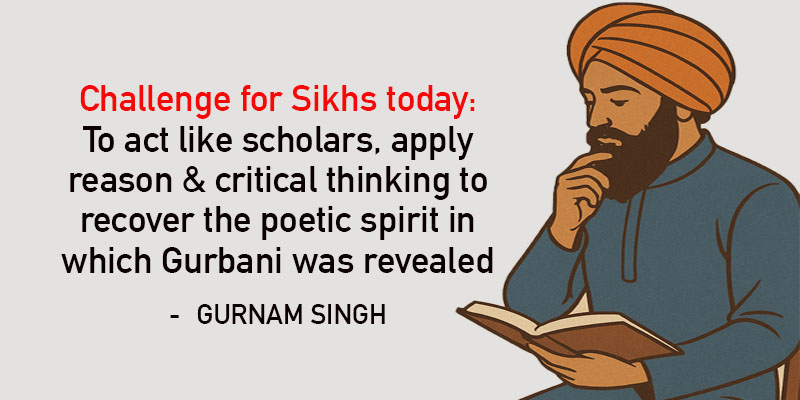
The challenge for Sikhs today is to live up to title given to us by our Gurus’s. That means we must act like scholars and to apply reason and critical thinking to recover the poetic spirit in which Gurbani was revealed. Poetry, by nature, resists being fixed to one interpretation. It invites creative thinking, imagination, openness, and a willingness to encounter truths beyond the grasp of physical reality. Gurbani, understood in this way, is not a text to be mastered intellectually but a living voice that speaks to the soul.
Only by entering into this poetic depth can we hope to realise the oneness of Ik Oankar, and to embody the humility, compassion, and freedom that arise when the ego is transcended.
Gurnam Singh is an academic activist dedicated to human rights, liberty, equality, social and environmental justice. He is an Associate Professor of Sociology at University of Warwick, UK. He can be contacted at Gurnam.singh.1@warwick.ac.uk
* This is the opinion of the writer and does not necessarily represent the views of Asia Samachar.
ASIA SAMACHAR is an online newspaper for Sikhs / Punjabis in Southeast Asia and beyond. You can leave your comments at our website, Facebook, Twitter, and Instagram. We will delete comments we deem offensive or potentially libelous. You can reach us via WhatsApp +6017-335-1399 or email: asia.samachar@gmail.com. For obituary announcements, click here
Harbhajan Singh at his home in Johor Bahru. Insert: In his elements during his drillmaster days – Photo: FMT
By Frankie D’Cruz | Malaysia | FMT |
They had not met in years. Time had turned one into Sarawak’s governor, the other into a man remembered for his unforgiving drill.
Now, head of state and drillmaster stood face to face again, a reunion charged with the weight of rank, memory, and respect.
Wan Junaidi Tuanku Jaafar and Harbhajan Singh — protégé and mentor — reunited in Kuala Lumpur recently.
It was more than handshakes. It was recognition. Wan Junaidi recalled the relentless drills that hardened cadets into officers. “Harbhajan made us into men,” he told his guests.
Harbhajan, 85, listened with quiet pride. After drilling a thousand trainees between 1962 and 1968, being remembered by a head of state was honour enough.
In his memoir, “A Policeman”, Wan Junaidi described his instructor as “ordinary and humble, fluent in English, very athletic, lean, mean-looking, tough and demanding.”
ASIA SAMACHAR is an online newspaper for Sikhs / Punjabis in Southeast Asia and beyond. You can leave your comments at our website, Facebook, Twitter, and Instagram. We will delete comments we deem offensive or potentially libelous. You can reach us via WhatsApp +6017-335-1399 or email: asia.samachar@gmail.com. For obituary announcements, click here
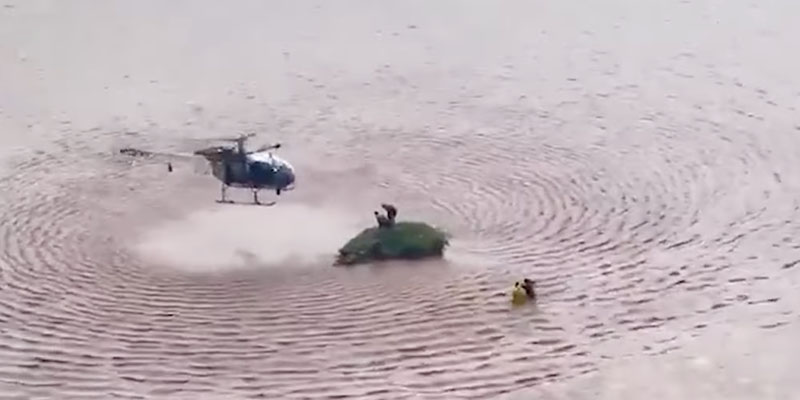
A Cheetah helicopter from India’s Army Aviation Units in a rescue mission in flooded Lassian in Gurdaspur, Panjab. – Photo: Screengrab from video released by the Indian Army
By Asia Samachar | Panjab |
The Army has stationed 20 helicopters in flood-devastated Panjab which is expecting more devastation as heavy rainfall in the catchment areas continues to swell the Sutlej, Beas, Ravi and Ujh rivers.
The Indian Army has deployed Army Aviation Helicopters for flood relief and rescue operations as part of its humanitarian assistance and disaster relief (HADR) efforts.
In one such incident on August 27, the Indian Army shared on its social media platforms on a rescue mission in Lassian in Gurdaspur, Panjab. In that operation, it said ‘a dare devil rescue effort’ was undertaken which consisted of multiple shuttles by three Cheetah helicopters of the Army Aviation Units.
The ‘heroic and timely action in the most extreme flying conditions’ led to the successful evacuation of 27 persons, it said.
In its report, The Indian Express said several columns of the Army have been continuing their relief efforts to reach out to people who have been marooned in villages. The Indian Air Force (IAF) has also continued to evacuate people in Dera Baba Nanak sector of Gurdaspur district through helicopters by winching them to safety from rooftops.
The IAF has also escalated its flood relief and rescue operations focusing primarily on the severely affected Jammu and Punjab regions.
Mi 17 and Chinook helicopters have conducted more than 55 sorties to extract stranded civilians, including personnel from the Indian Army and Border Security Force, from inundated areas in Dera Baba Nanak, Pathankot, and Akhnoor sectors, the report added.
It said the relief missions are being executed in close coordination with the Army, BSF, National Disaster Response Force, and local administration to ensure timely evacuation and distribution of supplies.
ASIA SAMACHAR is an online newspaper for Sikhs / Punjabis in Southeast Asia and beyond. You can leave your comments at our website, Facebook, Twitter, and Instagram. We will delete comments we deem offensive or potentially libelous. You can reach us via WhatsApp +6017-335-1399 or email: asia.samachar@gmail.com. For obituary announcements, click here
ASIA SAMACHAR is an online newspaper for Sikhs / Punjabis in Southeast Asia and beyond. You can leave your comments at our website, Facebook, Twitter, and Instagram. We will delete comments we deem offensive or potentially libelous. You can reach us via WhatsApp +6017-335-1399 or email: asia.samachar@gmail.com. For obituary announcements, click here
Dramatic new video shows the moments before a man waving a machete near Crypto.com Arena in downtown Los Angeles was fatally shot by police.
By Asia Samachar | United States |
Dramatic new video shows the moments before a man waving a machete near Crypto.com Arena in downtown Los Angeles, US, was fatally shot by police. The incident happened on July 13.
Officers responded to Figueroa Street and Olympic Boulevard just after 9 a.m. after receiving reports of a man in the middle of the street waving a machete, reported KABC.
The 911 callers said the man – identified as 35-year-old Gurpreet Singh – had stopped his car in the middle of the intersection, got out and was swinging the machete at people.
In video shared on the Los Angeles Police Department’s YouTube channel, at one point, Singh appeared to cut his tongue with the massive knife.
“Officers gave multiple commands for Singh to drop the weapon,” according to the report, quoting unnamed police communication. “However, he failed to comply. Singh then returned to his vehicle, retrieved a water bottle, and threw it at the officers.”
Singh then took off in his car, waving the machete outside the driver’s side window, according to police. Police said officers then initiated a brief pursuit in which Singh “drove erratically” and crashed with an officer’s vehicle. Singh stopped near Figueroa and 12th streets and charged at the officers with the machete, according to police. That’s when gunfire erupted, according to the report.
ASIA SAMACHAR is an online newspaper for Sikhs / Punjabis in Southeast Asia and beyond. You can leave your comments at our website, Facebook, Twitter, and Instagram. We will delete comments we deem offensive or potentially libelous. You can reach us via WhatsApp +6017-335-1399 or email: asia.samachar@gmail.com. For obituary announcements, click here
Santokh Singh (left) presenting a souvenir to Prime Minister Abdullah Ahmad Badawi on behalf of the KDM in 2008, flanked by (from left) Prof Chatter Singh, Dheer Singh and Dr Sarjit Singh – Photo: Awaaz 2007
By Santokh Singh Randhawa | Malaysia | Part 1 |
The arrival of the Punjabis to Malaya could be attributed to the fact that both Malaya and India were then under British rule.
The immediate cause of the arrival of the Punjabis, could be due to two factors, that is the unrest and war between the Chinese Clans of Ghee Hin and Hai San at the Tin Mine Areas of Larut and Matang near Taiping. The unrest was causing the British loss of revenue from the mines. The second was Captain Speedy, who was then Superintendent of Police in Penang.
Captain Speedy Tristram had earlier served in the region of Punjab in India and knew the ability and capability of the Punjabis in the field of armed forces and their loyalty and bravery in war. He proposed to the Authorities to bring in the Punjabis to contain the trouble at Taiping. In short, he went to Punjab (Lahore), and recruited 95 discharged para-military Punjabis and a handful of Pathans and on 29.9.1873, landed in Penang, Fort Cornwallis.
Wherever the Sikhs went, they brought along with them three things. One, their Sri Guru Granth Sahib ji; two, their language and three their culture. At one corner of Fort Cornwallis, the Sikhs were given a place to erect a small Gurdwara.
The para-military force proceeded to Taiping where they successfully contained the warring Chinese clans. They went on to build a Gurdwara at Taiping and incidentally, on 27.12.1903, established and registered the First ever Sikh Association in South-East-Asia, that is the Khalsa Diwan Mulkh Malaya (Khalsa Diwan Malaysia). Malaya was known as Mulkh Malaya to the Punjabis. For the next 50 years or so, this Association took care of Religion, Language, Culture and all political and communal affairs of the Punjabis in Malaya.
Soon, these paramilitary personnel began bringing in their families, relatives and friends. The Punjabi population began to grow. In the 1950s, it was estimated that there were over 300,000 Punjabis. Many returned before Malaya gained independence in 1957. Many migrated to other countries. Today it is estimated that there are about 110,000, scattered mainly in the Klang Valley, Selangor and Kinta Valley, Perak.
THE DIASPORA
The diaspora children needed education. Besides the official languages, English and Malay, they needed to master the Punjabi Language. Since the British needed the Punjabis in their armed forces, the British obliged opening up and providing facilities to learn the Punjabi Language. There were Vernacular Schools for the Chinese and Tamils. After 6 years of mother-tongue studies, the students moved to Government English Language Schools. There were Punjabi Language Vernacular Schools too. From the 1930s till early 1960s, there were 14 fully or partially aided such schools and over 70 private Punjabi Schools mostly attached to Gurdwaras.
In 1960, over 200 students sat for SRP (Form 3) Punjabi Paper and 97 students sat for SPM (Form 5) paper.
It is interesting to note that there was even a Boarding School set up by Khalsa Diwan in 1910 in Police Gurdwara at Kuala Kangsar, Perak. As the enrollment increased, it was shifted to Taiping. However, it closed in 1917.
Malaya gained independence in 1957. The Education Policy had a drastic change too. Punjabi Language, that was popular and solidly and eagerly supported by the British, was badly hit.
In 1964, under the Rahman-Talib Education Convention, the Punjabi language was dropped as an official Vernacular language. Thus began the decline.
First convocation of Panjabi teachers at the Grand Hotel Kampar on Aug 26, 2007 where 131 teachers received diplomas and 50 others received certificate of attendance – Photo: Awaaz 2007
Other factors that contributed to the decline was the decrease of the Punjabi Population, from over 300,000 to just over 100,000. Without the Government support, there were no Punjabi Language trained teachers. There were no graded and syllabus-orientated text books. There were no more special schools. No single structured body that governed the teaching and learning of the Language. Leaderless so to say. Above all, no funds. All went zero.
One fortunate factor retained by the Ministry of Education was that the Form 3 and 5 Government Examination Punjabi Papers were not abolished. Otherwise, it would have been a total “close shop”. The students sitting for these papers had to privately prepare themselves. I was one such student.
During the British period, the examinations were under the control of the Cambridge University of England. The Punjabi Paper was set by the Punjab University and sent to England and the Cambridge University then forwarded it to Malaysia.
THE DECLINE
Without the Government’s backing, the decline was a foregone conclusion and as a result in 1992, only 16 students sat for the Form 3 paper and 8 for the Form 5 paper.
There was another blow when in 1993 the Government decided to drop the Form 3 Punjabi paper, with the intention that eventually Form 5 paper would also be dropped.
This was an awakening call for the community. Khalsa Diwan Malaysia (KDM), Sikh Naujawan Sabha Malaysia (SNSM) and other societies protested. As a result, the Government restored the Form 3 paper in 1996 with a warning that if the numbers do not increase, it will not hesitate to drop it again.
Looking back, I remember that there have been seminars, conventions and discussions by various organisations all over Malaysia from 1964 onwards on how to overcome the decline of teaching and learning of the mother-tongue. There were many ideas and proposals, but they always ended without any solution as there were no “takers”, that is no one to “bell the cat” so to say. This gigantic problem needed a gigantic solution.
Punjabi language teacher course in Ipoh – Photo: PETM
I remember one such effort in 1988 by the then President of National Union of Teachers (NUT), S Gurnam Singh of Muar. He was also at that period, the Vice President of the International Federation of Free Teachers Union of Asia. He got funds from it to hold a seminar on the minority language i.e. Punjabi, focusing on its decline in Malaysia. This was held from 13 to 15 August 1988 at Genting Hotel at Genting Highlands. As an active member of the Union, I participated as a facilitator. All prominent Punjabi Leaders were invited to attend. Among them were Master Daljit Singh, Giani Inder Singh Gill, S Amar Singh BABT, Giani Mahinder Singh Sarur and Giani Mahinder Singh Chakravarti. High quality discussions were held and at the end, the same question remained…..who was to take up the challenge.
This Seminar left a long-lasting effect on me and it was here that I made up my mind, that I will take up the challenge to the revival of the teaching and learning of the Punjabi language in Malaysia.
When I retired in 1997, I had two options before me. One was to remain as Chief Executive Officer of Kota College in Ipoh (appointment immediately as I retired), OR, the second was to devote my remaining life to take up the challenge to revive the Punjabi language. I chose the second.
ASIA SAMACHAR is an online newspaper for Sikhs / Punjabis in Southeast Asia and beyond. You can leave your comments at our website, Facebook, Twitter, and Instagram. We will delete comments we deem offensive or potentially libelous. You can reach us via WhatsApp +6017-335-1399 or email: asia.samachar@gmail.com. For obituary announcements, click here
ASIA SAMACHAR is an online newspaper for Sikhs / Punjabis in Southeast Asia and beyond. You can leave your comments at our website, Facebook, Twitter, and Instagram. We will delete comments we deem offensive or potentially libelous. You can reach us via WhatsApp +6017-335-1399 or email: asia.samachar@gmail.com. For obituary announcements, click here
Raj and Nim on their wedding day (right). We’re now all living in our own house after moving in together in 2020 (Picture: Raj Singh Rainu)
By Raj Singh Rainu | Metro UK |
My wife Nim passed away from cancer shortly after our 10-year wedding anniversary in 2018.
She was 34 at the time and I was 33. I never imagined planning my wife’s funeral at that age. I said in my eulogy: ‘You never expect to be carrying your wife into the crematorium.’
Nim first started getting pain in her chest and stomach in March 2017, and after losing a lot of weight, her GP referred her to a consultant. At the end of January 2018, we finally got the results of her biopsy but it was the worst possible news.
We spoke about how she wanted the children to be brought up, how she never wanted them to forget her. We spoke about her funeral wishes and she didn’t have any preference.
…..
And then I met Parm in 2019. I’d started writing articles on LinkedIn about being a single, widowed dad and in one of them I’d written about the difficulty of taking my daughters to the bathroom on holiday. I wasn’t sure whether I should take all three of them into the ladies’ bathroom, or if I should leave two of them.
Parm messaged me, commenting on that article. She said I was amazing for what I was doing for the kids. She wanted a will because she was divorced and wanted to protect her assets so we arranged to meet.
It was a friendship first. She lived in Oxfordshire but was visiting a relative in the Midlands, so we decided to meet off the M40 motorway at a country pub. We hit it off immediately.
…..
I received a lot of backlash from certain people and online. Quite a few fake profiles were set up to troll me. These people disapproved of my relationship because apparently it was too soon. No one has lived my life and they have no idea what the kids and I have been through.
Today, these people talk to Naveen, Avaani and Veerun but don’t want anything to do with me. And that’s OK.
We’re now all living in our own house after moving in together in 2020. Parm has three girls, and I’ve got two girls and a boy. It’s absolutely manic but we love it.
ASIA SAMACHAR is an online newspaper for Sikhs / Punjabis in Southeast Asia and beyond. You can leave your comments at our website, Facebook, Twitter, and Instagram. We will delete comments we deem offensive or potentially libelous. You can reach us via WhatsApp +6017-335-1399 or email: asia.samachar@gmail.com. For obituary announcements, click here