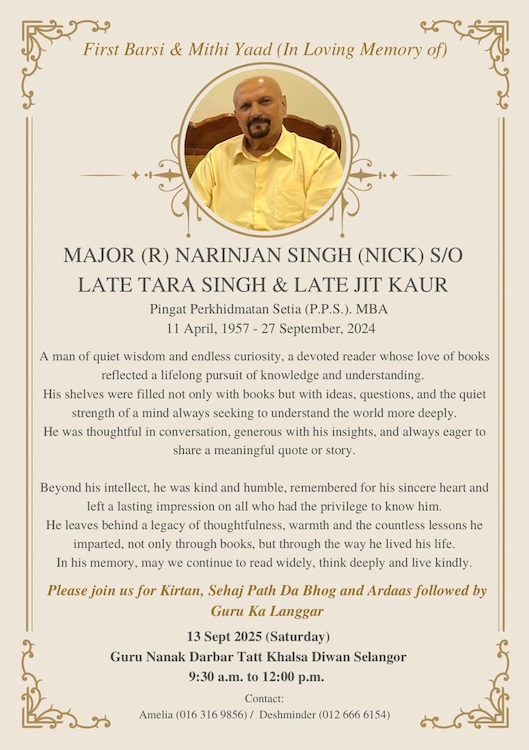
LAST RITES 4th September 2025 (Thursday) Shamshan Bhoomi, Jalan Loke Yew Crematorium 9.30 – 11.30am Wake At Shamshan Bhoomi, Jalan Loke Yew Crematorium, KL 11.30am: Saskar (Cremation) at Shamshan bhoomi
PATH DA BHOG 13th September (Saturday) 5.00 – 7.00pm Guru Nanak Darbar Tath Khalsa Diwan Gurdwara
ASIA SAMACHAR is an online newspaper for Sikhs / Punjabis in Southeast Asia and beyond. You can leave your comments at our website, Facebook, Twitter, and Instagram. We will delete comments we deem offensive or potentially libelous. You can reach us via WhatsApp +6017-335-1399 or email: asia.samachar@gmail.com. For obituary announcements, click here
SGGS condemns greed and material exploitation while promoting virtues such as contentment, humility, and selfless service (seva), all of which foster ecological balance and sustainability.
By Dr. Devinder Pal Singh| Opinion |
The concept of spiritual ecology in Sikh Dharma highlights the profound reverence for nature expressed in the Sri Guru Granth Sahib (SGGS), the central scripture of the Sikh faith. Rooted in the foundational belief of Ik Onkar, the Oneness of the Divine, Sikh teachings portray nature as a sacred manifestation of the Divine Will (Hukam). Key verses, such as “Pavan Guru, Pani Pita, Mata Dharat Mahat,” highlight the Earth, air, and water as revered life-givers and spiritual guides. SGGS condemns greed and material exploitation while promoting virtues such as contentment, humility, and selfless service (seva), all of which foster ecological balance and sustainability. The scripture celebrates biodiversity, seasonal rhythms, and the interconnectedness of all life forms, offering a holistic ecological worldview. The lives of the Sikh Gurus, particularly their agrarian lifestyles and environmental stewardship, exemplify these principles. In today’s era of climate crisis and ecological disruption, the teachings of SGGS offer a spiritually grounded and ethically compelling framework for environmental care. This spiritual ecology calls for a conscious, harmonious relationship with the Earth, one that integrates reverence, responsibility, and action, positioning Sikh Dharma as a vital contributor to contemporary environmental ethics and global sustainability efforts.
Introduction
In an age where environmental degradation and climate change threaten the balance of life on Earth, revisiting spiritual traditions for guidance and ethical wisdom becomes not only relevant but urgent. Among the world’s sacred texts, Sri Guru Granth Sahib (SGGS) [1-2], the eternal scripture of Sikh Dharma, offers a rich tapestry of teachings rooted in the sanctity, interconnectedness, and divine presence within nature. This spiritual ecology is not merely metaphorical but forms a foundational worldview in Sikh Dharma, where reverence for nature is intertwined with reverence for the Divine [3-5]. Through poetic metaphors, moral instructions, and spiritual principles, SGGS presents an ecological vision that can inform contemporary debates on sustainability and environmental ethics[6-7].
1. Nature as Manifestation of the Divine
The central tenet of Sikh theology is the belief in one, formless, all-pervading Divine (Ik Oankaar), present in every element of creation. Nature is not separate from God but a manifestation of the Divine Will (Hukam). As a result, the natural world is to be approached with reverence, not domination.
One of the most well-known verses reflecting this reverence is:
Pavan Guru, Pani Pita, Mata Dharat Mahat. Air is the Guru, Water is the Father, and Earth is the Great Mother. (Jap ji, SGGS, p. 8)
This verse from the Japji Sahib, the opening composition of SGGS, establishes a spiritual ecology where natural elements are ascribed familial and pedagogical roles. The air (pavan) is the guru that teaches life through breath and vitality. Water (pani) is likened to a nurturing father, essential for growth and sustenance. The Earth (dharat) is the great mother who births, feeds, and shelters all beings. This spiritual framework promotes a vision of nature not as an exploitable resource, but as a sacred family, deserving of love, gratitude, and protection.
2. Interconnectedness and Oneness
The philosophy of Ik Oankaar also underscores the interconnectedness of all life. SGGS frequently emphasizes that all beings and elements exist as part of a unified whole, established and sustained by divine order (Hukam).
In the midst of this world, do seva (selfless service), and you shall be given a place of honour in the Court of the Lord.” (M. 1, SGGS, p. 26)
This injunction to perform selfless service extends beyond human society to include service to the Earth and its ecosystems. Such a vision blurs the boundary between the spiritual and ecological. By serving others and living lightly on the Earth, one aligns with divine will and maintains cosmic balance.
This interconnected view challenges the anthropocentric model of modern industrial societies, which often places human needs above ecological systems. In contrast, Sikh Dharma views human beings as part of an intricate web of creation, wherein harming any part of the system is akin to harming oneself and one’s spiritual potential.
3. Condemnation of Greed and Material Exploitation
One of the root causes of environmental degradation is greed, an insatiable desire to consume, exploit, and dominate. SGGS strongly condemns greed (lobh) and attachment (moh) as spiritual vices that not only corrupt the soul but also destabilize ecological harmony.
Lab kuṫaa kooṛ choohṛaa.
Greed is a dog; falsehood is a filthy street-sweeper. (M. 1, SGGS, p. 15)
By equating greed with a dog that chases endlessly, the Guru draws attention to the dehumanizing and destructive nature of uncontrolled desire. This metaphor can be extended to modern consumerism, where constant economic growth and overexploitation of nature lead to pollution, climate change, and loss of biodiversity.
Sikh Dharma calls for santokh (contentment), a virtue that encourages individuals to live within their means, be grateful for what they have, and resist excessive consumption. This ethical stance has substantial ecological implications, promoting sustainable living and reduced environmental footprints.
4. Sacredness of Biodiversity
The SGGS abounds with references to animals, birds, rivers, forests, and seasons, portraying them not only as divine creations but also as spiritual metaphors. Every creature is seen as having a role in the divine play, and none is considered inferior or expendable.
Kʰand paṫaal asaⁿkʰ mæ gaṇaṫ na hoee.Ṫoo karṫaa govinḋ ṫuḋʰ sirjee ṫuḋʰæ goee.Lakʰ chaoraaseeh méḋnee ṫujʰ hee ṫé hoee. There are countless worlds and nether regions; I cannot calculate their number. You are the Creator, the Lord of the Universe; You create it, and You destroy it. The 8.4 million species of beings issued forth from You. (M. 3, SGGS, p. 1283)
Lakʰ chaoraaseeh janṫ upaaé.
God created 8.4 million species of beings. (M. 1, SGGS, p. 1190).
Baiaalees lakʰ jee jal mėh hoṫé…..
There are approximately 4.2 million species of beings in the water… (Bahagt Namdev, SGGS, p. 485)
Thus, SGGS points out that there are beings and creatures in the water and on the land, in the worlds and universes, and God has created them all. This universality affirms the sanctity of all life forms, from the smallest insect to the largest mammal, and calls for their protection. In modern terms, this can be seen as an endorsement of biodiversity conservation. Moreover, the lack of hierarchy in Sikh metaphysics means that all beings have intrinsic value, not just instrumental worth.
5. Seasonal Consciousness and Ecological Rhythms
The Barah Maha (Twelve Months), a poetic composition included in SGGS, beautifully illustrates the changing moods and spiritual meanings associated with each month of the Indian calendar. Written by Guru Nanak and Guru Arjan Dev, it reflects a deep ecological consciousness rooted in seasonal cycles and agricultural rhythms. For instance:
Saavaṇ sarsee kaamṇee charan kamal sio piaar. The month of Saawan is delightful; the soul-bride longs to meet her Husband Lord. (M. 5, SGGS, p. 134)
The Barah Maha not only celebrates nature’s beauty but also encourages mindfulness of natural rhythms. This mindfulness is crucial in an age where environmental imbalances are caused by a disregard for seasonal and ecological limits, manifesting in phenomena such as deforestation, soil depletion, and water scarcity.
6. Role of the Gurus as Environmental Stewards
The Sikh Gurus themselves exemplified simple, agrarian lifestyles, and many of their teachings arose in rural settings surrounded by forests, rivers, and fields. They encouraged tree planting, equitable use of water, and sustainable community life. Guru Nanak’s travels (udasis) often included references to mountains, rivers, and natural phenomena, highlighting their spiritual significance.
Guru Har Rai, the seventh Guru, was especially noted for his care for the environment and preservation of medicinal herbs. He maintained extensive gardens and encouraged care for all living beings. His legacy is a testament to the Sikh emphasis on living in balance with nature.
7. Water and Rivers: Symbols of Purity and Life
Water holds a sacred place in Sikh Dharma, not just in ritual, but also in symbolism and ecological value. SGGS frequently associates water with life, purification, and divine presence.
Pahilaa paaṇee jeeo hæ jiṫ hariaa sabʰ koé.
First, there is life in the water, by which everything else flourishes. (M. 1, SGGS, p. 472)
Water bodies, such as rivers, are not merely physical entities in Sikh thought; they are sacred spaces. Historical sites such as the Sarovar (water tank) at Sri Harmandir Sahib in Amritsar are designed to emphasize spiritual cleansing and ecological balance.
This reverence implies a duty to preserve water resources, avoid pollution, and ensure equitable access to water, issues that are central to modern environmental justice movements.
8. The Concept of Seva and Environmental Responsibility
Seva (selfless service) is a cornerstone of Sikh practice. While traditionally associated with helping others in community kitchens (langar) or volunteering at Gurdwaras, seva can also be extended to environmental stewardship.
Cleaning rivers, planting trees, promoting organic farming, and resisting industrial pollution are modern expressions of sevain an ecological context. Several Sikh organizations and Gurdwaras today engage in such eco-seva, inspired directly by the teachings of the SGGS and Guru-led traditions.
By expanding seva to include environmental care, Sikh Dharma bridges the gap between spiritual practice and ecological action.
9. Implications for Contemporary Environmentalism
In the contemporary context of climate change, habitat destruction, and mass extinction, the teachings of SGGS offer a transformative vision rooted in respect, balance, and divine interconnectedness. Unlike secular environmental ethics, which often rest on utilitarian or anthropocentric rationales, the Sikh worldview provides a spiritual imperative for ecological care.
This can be particularly effective in inspiring behaviourchange, fostering community-based environmental activism, and promoting long-term sustainability grounded in faith.
Organizations such as EcoSikh [8], established in 2009, have taken these teachings to global platforms, promoting awareness of Sikh ecological values and initiating tree-plantation drives, clean energy campaigns, and water conservation projects worldwide.
Conclusion
Sri Guru Granth Sahib offers a timeless ecological wisdom grounded in spiritual insight, moral responsibility, and reverence for nature. By portraying the Earth and its elements as sacred manifestations of the Divine, SGGS calls for a life of humility, balance, and selfless care. Its teachings challenge the exploitative attitudes that drive modern environmental crises and instead offer a spiritually enriched path of ecological harmony.
In a world increasingly disconnected from the rhythms of nature, Sikh Dharma’s spiritual ecology reminds us that environmental care is not only a social or scientific obligation, it is a sacred duty. Embracing these teachings can help foster a sustainable future, where humanity lives not above nature, but as a conscious part of it, imbued with awe, compassion, and reverence for all creation.
References
1. Sri Guru Granth Sahib (SGGS), published by S.G.P.C., Amritsar
2. Sahib Singh, Sri Guru Granth Darpan. Punjabi translation of Sri Guru Granth Sahib along with commentary and word meanings. https://gurugranthdarpan.net/darpan.html
3. D. P. Singh, Ecological Concerns in Sri Guru Granth Sahib, in “Harmony in Science and Sikh Religion,” Edited by Hardev Singh Virk, pub. by HSV, Mohali, 2012.
Dr. D. P. Singh, M.Sc., Ph.D. is Director, Center for Understanding Sikhism, Mississauga, Ontario, Canada. He is a physicist by training, a teacher by profession and a writer by choice. He specializes in writing on Science, Religion and Environmental topics. Currently, he is working as Director, CanBridge Learning & Educational Consultant to various educational institutions in Canada. Email: drdpsn@gmail.com
ASIA SAMACHAR is an online newspaper for Sikhs / Punjabis in Southeast Asia and beyond. You can leave your comments at our website, Facebook, Twitter, and Instagram. We will delete comments we deem offensive or potentially libelous. You can reach us via WhatsApp +6017-335-1399 or email: asia.samachar@gmail.com
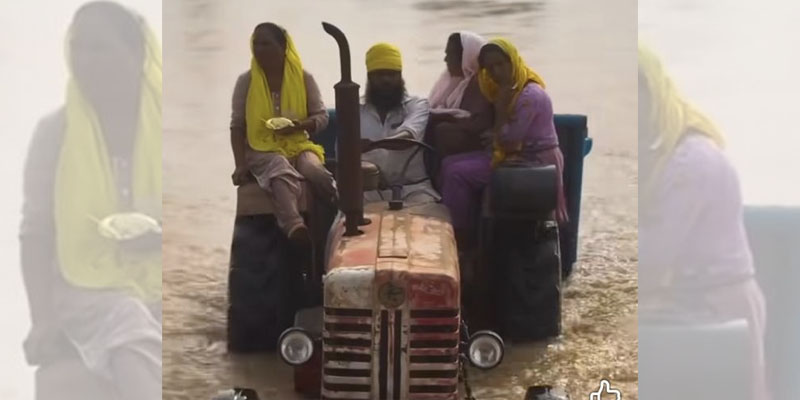
Despair of deluge: Heartbreaking scenes from Sultanpur, Panjab, as farmers despair as flood waters breach the embankment (bann) and destroy their hard-toiled crops
By Manjit Kaur | Opinion |
It is hard for me to write this. My heart is heavy with a pain that refuses to fade and my words feel weighed down by grief. For days, I have scrolled through images of my beloved Panjab drowning, families stranded, villages submerged, homes swept away, animals lost. These are not distant pictures; they are my people, my homeland, my roots. Even though I live in the UK, the cries of Panjab echo in me, and I feel as if I too am wading through those rising waters.
And yet, we are told this is a “natural disaster,” an act of God. That story is a convenient lie. Yes, the rains were heavy, but this catastrophe is not the work of nature. In truth, it is the work of people in power who chose greed and negligence over responsibility. Year after year, experts have warned about silted riverbeds, poor dam management and the reckless destruction of Panjab’s fragile ecosystems. Year after year, politicians have looked away, lining their pockets while villages and ordinary farmers are left vulnerable. This was not inevitable. It was preventable!
Why were dams allowed to fill to bursting point before waters were suddenly released? Why were forecasts ignored? Why were the poorest villages, not the urban centres of the powerful, sacrificed to the floods? The truth is ugly: lives were gambled away to protect vested interests. The government failed in its first and most basic duty which is to protect its people. To call this “nature’s fury” is to let guilty men wash their hands of blood.
The scale of devastation is staggering: at least 29 lives lost, more than 1,000 villages flooded, 300,000 acres of fertile farmland buried under silt, livestock swept away, infrastructure broken. Over 250,000 people are now left with nothing: no homes, no food, no clothing. These are not statistics; they are broken lives, people betrayed by those who should have safeguarded them.
EXTRAORDINARY HUMANITY
And yet, even amidst ruin, I see courage. Families who have lost everything still rush to help their neighbours. Villagers stripped to their bare essentials form groups to support one another. This is the true spirit of Panjab: ordinary people showing extraordinary humanity, while those in power hide behind excuses.
Where the state has abandoned its duty, others have stepped in. Khalsa Aid, United Sikhs, Sarbat Da Bhala Charitable Trust and countless volunteers are on the ground, doing the work of a government that has once again failed its people. Even celebrities like Diljit Dosanjh and Ammy Virk, and well know Kirtani’s like Jagjeet Singh Babiha, have committed resources and/or spoken out to raise awareness of the tragedy. But let us be vigilant. Too many use tragedy as a business opportunity. Donations must go only to trusted hands with a record of genuine service, not to opportunists exploiting suffering for money or fame.
This is not easy for me to write. The pain cuts deep, because this is the land of my grandparents, my parents, my family tree. They may not live anymore, but their spirit is alive in me. And when Panjab weeps, I weep. This is not just their loss; it is ours.
CRIME OF MEN
The truth must be said: the suffering of Panjab is not the wrath of nature or God, but the crime of men. Government officials, bureaucrats and politicians, all of whom are entrusted with stewardship, have betrayed the people for their own gain. Unless there is radical change in governance and a commitment to restore Panjab’s ravaged ecosystems, floods like these will come again, each time washing away more lives, and destroying more futures.
And yet, Panjab will rise again, not because of its rulers, but despite them. Its people, with courage and solidarity, will endure. But they should never have been left to drown in the first place.
Manjit Kaur, a UK-based therapist and counsellor, is a presenter at the 1 Show Live at Panjab Broadcasting Channel, UK. She can be contacted via email at manjitkaur1show@gmail.com
ASIA SAMACHAR is an online newspaper for Sikhs / Punjabis in Southeast Asia and beyond. You can leave your comments at our website, Facebook, Twitter, and Instagram. We will delete comments we deem offensive or potentially libelous. You can reach us via WhatsApp +6017-335-1399 or email: asia.samachar@gmail.com. For obituary announcements, click here
Front covers SNSM’s magazine The Sikh over the years
ByJagdesh Singh | Opinion |
My white beard deceives everyone. It’s not even salt and pepper like, it’s completely white now. In fact, I’ve been mistaken for a grandad when picking up my youngest daughter at her school and some have called my lovely wife my eldest daughter as we stood side by side. To say that this makes me feel old is a bloody understatement. Younger football players on the field and even referees started calling me ‘Uncle’ years before eventhough they were 7 or 8 years younger than me. Alas, I’m a big believer of growing old gracefully. Hence, I have no intention of dying my unshorn beard any other colour than its natural one.
But to say I’m old is also not entirely true. It’s subjective. I’m half a century old this year but that’s not considered old for many of my Gen X compatriots. We strongly believe we’re still young enough not be called ‘uncle’ or ‘auntie’ just yet. We’re fine with ‘Bro’ or ‘Sis’. Of course it would be utterly weird and cringey if my daughters’ friends call me ‘Bro’. I’m also glad my young adult daughters don’t think of me and my better half as being ancient. At least we know we’re not out-of-touch parents, me and my wife. This belief that we’re still relevant and can relate to their current struggles and concerns is held very dearly by the both of us. Whether this belief is entirely a fact or just the impression we’ve been given cleverly by our daughters, I’d rather not argue about that with myself. I’ll just assume the best of intentions for now.
As a younger volunteer for Sikh Naujawan Sabha Malaysia (SNSM) many moons back, around my late thirties, I’ve always had the perception that the leadership team looked a little older than the typical ‘naujawan’ (youth). They did seem old to me, even though they were probably 10 to 15 years older than me. I’ve questioned quietly if these older leaders could relate to the challenges, the needs and the wants of the youth that they were representing at the time. While those questions swirled around in conversations with other volunteers and friends during our ‘cha’ sessions, there was also the very strong silent acknowledgement that we were in good steady hands. The faces of these leaders have been around even before when we became volunteers. They’ve been there, and done most if not all. The familiarity of their presence helped to mask their biasness towards the older proven ideas of running an organization like Sabha.
Fresh ideas, keeping up with technology and in the later stages keeping up with social media, were apparent challenges for these ‘older’ leaders. But the seva for the Guru continued, so did the work required for Sabha to deliver its agenda of promoting the fundamentals of Sikhism and the Sikh lifestyle. Crises have come and gone with the leaders having managed to resolve and move on, most of the time through political manoeuvring and negotiations internally. But the seva and work continued as always. Our ideas evolved slowly and according to the leaders at helm, but never at the cost of Sabha having any identity crisis of sorts.
Today, my perspectives as a volunteer have also evolved according to my creeping age. Even though I don’t consider myself ’old’, I’m aware I’ve fallen into the same category of an ‘elder’ that I had branded the leaders of the past before. I’m now of the similar age as those that I had questioned about their relevance before. Do I consider myself out of touch? My pride and ego happen to wholeheartedly disagree.
“Of course I understand what the naujawan are thinking about!”, screams my mind. Much like how I really believe that I’m relevant and can relate to my young adult daughters, I draw my affirmations steadfastly. Whether this is a shared belief with the actual naujawan of Sabha whom I interact with during the annual Samelans, that is a valid question that I would need to survey with them and verify.
At this age, I also still believe that I can contribute in different ways, much like the steady hands that the elders provided in the past. I am confident I share this belief with my volunteer friends of the same age group. We’re more jaded, more matured, of lesser tempers, and we can share advice from our own mistakes made when we were younger.
One facet of being the elder steady hand is being the historian or at least giving historical context and background to why we do things the way we do it. Sabha is an organization that has been around for many decades, with some sevadars and volunteers who are already great-grandparents to the naujawan today. Sabha has gone through turmoil over the many years and over the many generations of leaders but have stayed true, in my opinion, to our identity and our mission. There’s a rich tapestry of history that needs to be learned from. It’s cliched but we do repeat our mistakes over the many years because we somehow never learn from our history. There needs to be a good balance of invigorating youth and matured patience, between the naujawan and the elders for us to carry on the good work of the past while forging our future. Whoever our leaders are going to be, I’m very confident all sevadars of all ages will still contribute our sweat and tears. After all, our Seva is for the Guru and for the success of Sabha, more than for any personality.
Much like me trying to come to terms about my age but yet still wanting to remain youthful, Sabha would need to strike that balance.
Jagdesh Singh, a Kuala Lumpur-based executive with a US multinational company, is a father of three girls who are as opinionated as their mother
* This is the opinion of the writer, organisation or publication and does not necessarily represent the views of Asia Samachar.
ASIA SAMACHAR is an online newspaper for Sikhs / Punjabis in Southeast Asia and beyond. You can leave your comments at our website, Facebook, Twitter, and Instagram. We will delete comments we deem offensive or potentially libelous. You can reach us via WhatsApp +6017-335-1399 or email: asia.samachar@gmail.com. For obitu
Fahadh Faasil and Vadivelu in a still from ‘Maareesan’
By Raag & Reel | Movie Reviews|
Director Sudheesh Shankar’s Mareesan begins like a straightforward crime drama but takes a major shift half-way through into unexpected emotional terrain.
The film, now playing on Netflix, opens with Daya (Fahadh Faasil), a thief fresh out of Palayamkottai prison, who slips back into his old ways almost instantly. A stolen bike and a house break-in later, he stumbles upon Velayudham (Vadivelu), mysteriously chained up inside. Velayudham promises Daya ₹25,000 if he sets him free, but what starts as a simple exchange spirals into something far more complicated.
At an ATM, Daya discovers that Velayudham’s account holds not thousands, but lakhs. Temptation takes over, and the story unfolds as Daya schemes to lay hands on the money, while the mystery of why Velayudham was imprisoned in the first place lingers in the background. Velayudham is also an Alzheimer’s patient.
Fahadh Faasil brings his usual intensity, grounding Daya as both cunning and vulnerable. Yet it is Vadivelu who steals the show—his performance is so textured that it dissolves the image of the familiar comedian, leaving only a fully realized character. Together, the duo anchors the film with a compelling, unpredictable energy.
Yuvan Shankar Raja’s score amplifies both tension and tenderness, while Kalaiselvan Sivaji’s cinematography captures the shifting moods of this journey-driven thriller. The supporting cast, however, fares unevenly—most serviceable, but Kovai Sarala’s turn as a police officer misses the mark.
The second half takes an unexpected narrative detour that may divide audiences. What begins as a taut thriller loosens into an emotional drama, a gamble that works in parts but risks losing those who came for edge-of-the-seat suspense.
Still, Mareesan stands out for its performances and its willingness to defy formula. It’s a feel-good traveling thriller wrapped in moral ambiguity—one that asks you to expect the unexpected.
Verdict: Worth the two-hours if you enjoy character-driven stories with emotional twists.
ASIA SAMACHAR is an online newspaper for Sikhs / Punjabis in Southeast Asia and beyond. You can leave your comments at our website, Facebook, Twitter, and Instagram. We will delete comments we deem offensive or potentially libelous. You can reach us via WhatsApp +6017-335-1399 or email: asia.samachar@gmail.com. For obituary announcements, click here
MAJOR (R) NARINJAN SINGH (NICK) S/O LATE TARA SINGH & LATE JIT KAUR
Pingat Perkhidmatan Setia (P.P.S.). MBA 11 April, 1957 – 27 September, 2024
A man of quiet wisdom and endless curiosity, a devoted reader whose love of books reflected a lifelong pursuit of knowledge and understanding. His shelves were filled not only with books but with ideas, questions, and the quiet strength of a mind always seeking to understand the world more deeply. He was thoughtful in conversation, generous with his insights, and always eager to share a meaningful quote or story.
Beyond his intellect, he was kind and humble, remembered for his sincere heart and left a lasting impression on all who had the privilege to know him. He leaves behind a legacy of thoughtfulness, warmth and the countless lessons he imparted, not only through books, but through the way he lived his life. In his memory, may we continue to read widely, think deeply and live kindly.
Please join us for Kirtan, Sehaj Path Da Bhog and Ardaas followed by Guru Ka Langgar
13 Sept 2025 (Saturday) Guru Nanak Darbar Tatt Khalsa Diwan Selangor 9:30 a.m. to 12:00 p.m.
ASIA SAMACHAR is an online newspaper for Sikhs / Punjabis in Southeast Asia and beyond. You can leave your comments at our website, Facebook, Twitter, and Instagram. We will delete comments we deem offensive or potentially libelous. You can reach us via WhatsApp +6017-335-1399 or email: asia.samachar@gmail.com. For obituary announcements, click here
Justice Venkatachaliah National Commission to Review the Working of the Constitution set up by the Indian government in year 2000, submitted its report on March 31, 2002. Recently, Sardar Tarlochan Singh, ex-MP and ex-Minorities Commissioner, wrote to Prime Minister Narendra Modi to get the Parliament to change part of Article 25 wording as recommended by the Commission to make it more acceptable to the Sikhs.
The relevant current wording of Article 25 which offends the Sikhs is as follows: Article 25: Freedom of conscience and free profession, practice and propagation of religion: (2) Nothing in this article shall affect the operation of any existing law or prevent the State from making any law (b) providing for social welfare and reform or the throwing open of Hindu religious institutions of a public character to all classes and sections of Hindus. Explanation II: In sub clause (b) reference to Hindus shall be construed as including a reference to persons professing the Sikh, Jaina or Buddhist religion, and the reference to Hindu religious institutions shall be construed accordingly.
The Sikhs argue that the current Explanation II shows the ignorance of the members of the Constituent Assembly about egalitarian Sikhi principles and traditions. The Commission recommendation of 2002 was, to quote: “A number of institutions of Sikhs and Buddhists suggested certain changes to Article 25(2). Explanation II to article 25 provides that reference to Hindus in sub-clause (b) of clause (2) should be construed as including reference to Sikhs etc. The Commission, without going into the larger issue on which the contention is based, is of the opinion that the purpose of the representations would be served if Explanation II to article 25 is omitted and sub-clause (b) of clause (2) of that article is reworded as follows:- (b) providing for social welfare and reform or the throwing open of Hindu, Sikh, Jaina or Buddhist religious institutions of a public character to all classes and sections of these religions.“
Sardar Tarlochan Singh believes that the second option is that this whole clause is removed but Schedule Caste will never agree because through this clause their entry in all Temples is granted.
The background was explained in my article of 2019. On 8 August 2005, the Supreme Court of India noted: The so-called minority communities like Sikhs and Jains were not treated as national minorities at the time of framing the Constitution. Sikhs and Jains, in fact, have throughout been treated as part of the wider Hindu community.
In July 2000, Punjab Chief Minister, Parkash Singh Badal, discussing the memorandum to be presented to the National Commission argued that Article 25 clubs Sikhs with Hindus, Jains and Buddhists so that it negates the growth of the Sikhs and the identity of Sikhism. That the resolution adopted in 1973 by SAD at Anandpur projected the concept for future centre state relations. Instead the promoters were projected as communal and secessionists.
The Sikh Core Group argued that this provision inadvertently introduces an element of sacrilege for Sikhism as if Sikh tenet of universal brotherhood is deficient in this regard and requires supplement of a constitutional provision. It is therefore obnoxious discrimination that Sikhs should require such an injunction through constitutional proviso while Muslims, Christians and Parsees are treated separately.
The Sikh Core Group recommended that Sikhism should be described as one among many religions of India, not as one part among the many parts of Hinduism. Most Sikhs would agree.
Gurmukh Singh OBE, a retired UK senior civil servant, chairs the Advisory Board of The Sikh Missionary Society UK. Email: sewauk2005@yahoo.co.uk. Click here for more details on the author.The article first appeared at Panjab Times, UK
* This is the opinion of the writer, organisation or publication and does not necessarily represent the views of Asia Samachar.
ASIA SAMACHAR is an online newspaper for Sikhs / Punjabis in Southeast Asia and beyond. You can leave your comments at our website, Facebook, Twitter, and Instagram. We will delete comments we deem offensive or potentially libelous. You can reach us via WhatsApp +6017-335-1399 or email: asia.samachar@gmail.com. For obituary announcements, click here
Entrepreneur Mandy K Gondaara has added another feather to her cap after being crowned Mrs. Earth Malaysia 2025 at the Supermodel Universe International Grand Gala Crowning Night held in Kuala Lumpur on August 23.
The 167cm tall Sikh trailblazer is the CEO of 9 Vibes Media and the Managing Director of F&B brand Dine & Delight.
Mandy holds an MBA with Distinction from the University of Glasgow Caledonian, Scotland, bagging the Best Student Award in Management and Human Resource Management.
On the personal front, Mandy is married to Joseph Ravindren, founder of an insurance loss adjustment firms with branches nationwide.
The newly crowned queen described her win as a platform to merge glamour with purpose, pledging to leverage her visibility to champion sustainability and inspire women to pursue excellence in every sphere of life.
ASIA SAMACHAR is an online newspaper for Sikhs / Punjabis in Southeast Asia and beyond. You can leave your comments at our website, Facebook, Twitter, and Instagram. We will delete comments we deem offensive or potentially libelous. You can reach us via WhatsApp +6017-335-1399 or email: asia.samachar@gmail.com. For obituary announcements, click here
Panjab is battling the worst floods since the 1988 devastation, with 300,000 acres of farmland already damaged and 1,018 villages under water.
As many as 11,300 people have been rescued and 4,700 evacuated from flooded homes and villages.
The Sutlej, Beas and Ravi rivers are in spate following heavy rain in their catchment areas in Himachal Pradesh and Jammu and Kashmir. Floodwaters have caused widespread destruction in Gurdaspur, Amritsar, Tarn Taran, Ferozepur, Pathankot, Fazilka, Kapurthala and Hoshiarpur districts, reported Tribune News Network.
The current floods have devastated Panjab on both sides of the India-Pakistan border.
Nearly half a million people have been displaced by flooding in eastern Pakistan after days of heavy rain swelled rivers, relief officials said, as they carried out a massive rescue operation.
Three transboundary rivers that cut through Punjab province, which borders India, have swollen to exceptionally high levels, affecting more than 2,300 villages, reported Al Jazeera.
On the Indian side, TNN reported that the state has suffered significant financial losses due to crop damage, with preliminary reports indicating that over 41,099 acres of farmland has been affected in the border district of Fazilka alone. Other districts like Ferozepur, Kapurthala, Pathankot, and Hoshiarpur have also reported thousands of hectares of damaged agri land, the report added.
In Chandigarh, Panjab’s water resources minister Barinder Kumar Goyal has criticised the central government holding it responsible for worsening the state’s worst flood disaster in the past 37 years.
Goyal told a press conference at Punjab Bhawan that the timely release of water by the Bhakra Beas Management Board (BBMB) in June, for which repeated requests were made, could have significantly reduced the damage caused by the floods, reported the Hindustan Times.
He highlighted a troubling contradiction, pointing out that while Haryana sent letters offering assistance, it simultaneously reduced its water share during this monsoon — from 7,900 cusecs to 6,250 cusecs — in order to protect its own canal systems, thus leaving Punjab to fend for itself.
Goyal alleged that a private company, “Level 19 Biz Private Limited,” which had been hired in 2024 to assess the structural strength of the Madhopur headworks gates, had incorrectly certified them to withstand up to 6.25 lakh cusecs of water. However, the gates failed under pressure, collapsing and leading to the tragic death of a department employee, according to the report.
ASIA SAMACHAR is an online newspaper for Sikhs / Punjabis in Southeast Asia and beyond. You can leave your comments at our website, Facebook, Twitter, and Instagram. We will delete comments we deem offensive or potentially libelous. You can reach us via WhatsApp +6017-335-1399 or email: asia.samachar@gmail.com. For obituary announcements, click here
Nearly half a million people have been displaced by flooding in eastern Pakistan after days of heavy rain swelled rivers, relief officials said, as they carried out a massive rescue operation.
Three transboundary rivers that cut through Punjab province, which borders India, have swollen to exceptionally high levels, affecting more than 2,300 villages, reportedAl Jazeera.
Nabeel Javed, the head of the Punjab government’s relief services, said on Saturday that 481,000 people stranded by the floods had been evacuated, along with 405,000 livestock.
Overall, more than 1.5 million people have been affected by the flooding, including in Lahore, the provincial capital and the country’s second-largest city.
“This is the biggest rescue operation in Punjab’s history,” Irfan Ali Khan, the head of the province’s disaster management agency, told a news conference.
ASIA SAMACHAR is an online newspaper for Sikhs / Punjabis in Southeast Asia and beyond. You can leave your comments at our website, Facebook, Twitter, and Instagram. We will delete comments we deem offensive or potentially libelous. You can reach us via WhatsApp +6017-335-1399 or email: asia.samachar@gmail.com. For obituary announcements, click here