High jumper Nauraj Singh Randhawa becomes second Sikh to win a gold medal at SEA Games in Singapore.
Malaysian high jump champion Nauraj Singh Randhawa has been chosen to read the athlete’s pledge at the Kuala Lumpur 2017 SEA Games (KL2017) that begins on Aug 19.
Youth and Sports Minister Khairy Jamaluddin said the selection of the 25-year-old athlete was based on Nauraj’s achievement in the sport.
“Nauraj is seen to be an outstanding athlete in the ‘Kita Juara’ program, where he had qualified for the ‘Podium Program’. Nauraj is an examplary athlete who started from the bottom and is capable of becoming a world class athlete….So, I gave the honour to Nauraj Singh,” Bernama quoted the minister.
In addition, Khairy said Nauraj was chosen as the athlete’s pledge reader because of his height which was 1.93 metres that could attract attention when the pledge was read at the KL2017 official opening ceremony on Aug 19 at the Bukit Jalil National Stadium.
“I chose Nauraj because he is tall, because when a tall person reads the pledge, people will be more attentive. The pledge will be read in English and his (Nauraj’s) English language is also good. So there will be no slip-up,” said Khairy.
Nauraj was the gold medal winner at the 2013 SEA Games in Myanmar and 2015 in Singapore.
The Johor-born athlete did a jump of 2.29m at the Singapore Open Athletics Championship which broke the national record made by Lee Hup Wei in 2008.
Nauraj was the only athletics athlete who qualified for the 2016 Rio Olympic Games on merit and occupied the 18th place in high-jump on his first appearance at the Games, the report added.
In an immediate response, Malaysian Gurdwara Council (MGC) and Coalition of Malaysian Sikh Organisation (CMSO) congratulated Naujraj on being selected to read the athlete’s pledge at the regional games.
In a text message, MGC president Jagir Singh: “The MGC welcomes the honour given by the Malaysian Government to Nauraj Singh to lead in reading the oath taking at the start of the SEA games 2017. Nauraj has done all proud. MGC thanks the Government for the confidence in Nauraj Singh and hopes all our Malaysian athletes will give their best for the country.”
In a separate message, CMSO chairman Dr Surendar Singh Cheema, who is himself involved in the SEA Games, said: “It’s a great honour to be selected amongst hundreds of athletes to read the oath taking in this regional game coinciding with 60 years of independence of our country. Keep bringing more glory for yourself, family,community and Malaysia.”
In a report yesterday, Asia Samachar highlighted that Dr Cheema, popularly known as SS Cheema, was given the task to chair the SEA Games Federation (SEAGF) Medical Committee.
He will be marshaling close to 2,000 officials to oversee all the medical services and doping checks for the regional games.
[ASIA SAMACHAR is an online newspaper for Sikhs in Southeast Asia and surrounding countries. We have a Facebook page, do give it a LIKE. Follow us on Twitter. Visit our website: www.asiasamachar.com]
[ASIA SAMACHAR is an online newspaper for Sikhs in Southeast Asia and surrounding countries. We have a Facebook page, do give it a LIKE. Follow us on Twitter. Visit our website: www.asiasamachar.com]
[The fastest way to reach Asia Samachar is by sending us a Facebook message. For obituary announcements, click here]
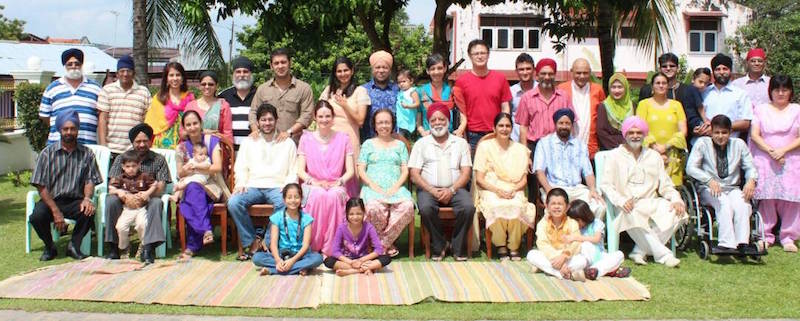
FAMILY: Jagdesh’s mum and dad, with the wider family – all mixed up – Photo / Supplied
My mother was a Chinese, with no specific faith attached to her as she grew up. She believed in the simple things in life. Do good onto others, never wish ill harm onto others and be contended with what life had to offer.
Madly in love, she married a dashing young engineer, who was to become my father in years to come. Because multiracial marriages was somewhat frowned upon in the good old days, by the older generation, they both signed the papers with a couple of witnesses and later had a nice small dinner gathering with close friends. No fancy ceremony, no traditional outlandish costumes and no lavishness. The old photographs suggest that it was a time of the birth of liberal and western thoughts, multiracial and inclusive.
She would later assimilate herself deeply into the Punjabi culture as her role as wife and mother grew. Sewa in the Gurudwara on a regular basis was her foray into the Sikh way of life. Inwardly, she had the basic qualities of a Sikh all nailed down. Kind, compassionate, steadfast, humane and humble. Happiness was a choice she chose, embodying chardee kala-ness until the last few months of her life.
So, her life turned out pretty well.
I’d say she was a testament towards the antithesis that mixed or multiracial marriages were impacting the dwindling number of Sikhs, as opined in another article. She was prove that that argument was clumsy.
Sikhism was never about being an exclusive race. It was never about the numbers game. It was never for an exclusive race as well. It was always about spiritual growth for anybody who can relate to it, and live it. Anybody from any background and from any race (a concept so old and tired that it is almost an illusive idea altogether). It never mattered if the number of Sikhs grew or dwindled, hence we never cared about converting others nor cared any less about those leaving Sikhism.
Apostasy is a borrowed idea from our Muslim brothers and sisters. You don’t have to be married to a Sikh to be a Sikh, and you don’t have to be divorced to stop being a Sikh. It’s entirely personal and entirely up to you. So, to say that a Sikh marrying a non-Sikh will decrease the number of Sikhs, is hogwash.
Some quarters within our Sikh community have raised concerns about non-baptized Sikhs getting married within the walls of a Gurudwara, with the Anand Karaj ceremony. The concern is that the ceremony in itself is meaningless if both the bride and the groom don’t intend to live out the advise and sermons prescribed in the Anand Karaj.
Sikh tradition has always had a hard stance against meaningless customs practiced for the sake of practicing. And so, some do take offence of non-practicing Sikhs making a mockery of the Anand Karaj ceremony by abandoning everything that was extolled in the ceremony itself. The Anand Karaj being just a ceremony for the sake of satisfying the show and nothing more.
But you could also argue that Punjabis, who majority are exclusively Sikhs by name, don’t really live the proper life of a Sikh. Why aren’t eyebrows raised for these Punjabis? Aren’t they making a mockery of the ceremony in itself? The short beard is shaven for the dinner reception, the turban taken off. These are allowed because traditions demand so. Then why aren’t they allowed for non-practicing Sikhs?
I can’t answer these questions for you. There are no silver bullets. But the fact remains, it really shouldn’t matter. Because it has never been about the numbers game. There is no dwindling of any sorts.
And to say otherwise, would be to go against one fundamental core tenet of Sikhism. And tenet is for us to be inclusive, to remove all classes of society like race and caste, to treat each human equally, with love and compassion. Not a mere statistic.
Jagdesh Singh, a Kuala Lumpur-based executive with a US multinational company, is a father of three girls who are as opinionated as their mother
* This is the opinion of the writer, organisation or publication and does not necessarily represent the views of Asia Samachar.
[ASIA SAMACHAR is an online newspaper for Sikhs in Southeast Asia and surrounding countries. We have a Facebook page, do give it a LIKE. Follow us on Twitter. Visit our website: www.asiasamachar.com]
| Public Service Announcement | Ipoh, Malaysia | 13 Aug 2017 | Asia Samachar |
Wadda Gurdwara Sahib Ipoh in Perak, Malaysia photo in May 2017 – Photo / Dindae Sheena
Wadda Gurdwara Sahib Ipoh.
Waheguru Ji Khalsa
Waheguru Ji Ki Fateh
Guru Piari Sangat Ji with the blessings of our Guru Ji and with the assistance of the Sangat the Darbar Sahib Renovations have been completed.
In conjunction with this the Darbar Sahib ‘Soft Opening Ceremony’ (Udhkathan) program will be held as below:
Wednesday 16th August
5.30pm – Ground Floor Darbar Sahib Semapti.
Move all Guru Ji’s’ Saroops to Upstairs Darbar.
6.15 – Rehraas / Kirtan / Katha.
7.30 – Sehaj Path Da Phog / Barah Maha / Ardaas.
Langgar sewa starts at 1.00pm.
Its a humble appeal to all sewadars, donors and the sanggat to be present for the thanks giving (Sukhrana Ardaas) on Wedneasday 16th of Aug.
Please assist to share this message with family, friends, acquaintances & members of the Sikh sanggat in your contact list.
Gurfateh
WGSI Parbandaks.
[ASIA SAMACHAR is an online newspaper for Sikhs in Southeast Asia and surrounding countries. We have a Facebook page, do give it a LIKE! Visit our website: www.asiasamachar.com]
A passion for sports and his vast experience in sports medicine has seen Dr Surendar Singh Cheema once again playing a key role in a major sporting event.
This time, he will be chairing the medicine and doping team for the Southeast Asia games that begins next week.
As the chairman of the SEA Games Federation (SEAGF) Medical Committee, he will be marshalling close to 2,000 officials to oversee all the medical services and doping checks for the regional games.
“It’s my passion. It began with hockey,” S S Cheema, as he is popularly known, told Asia Samachar.
The seasoned hand in managing medical sports and an active Sikh volunteer was the first secretary general for the Malaysian Hockey Confederation – the result of the amalgamation of both the men and women federations for the country.
Cheema’s involvement in the sports goes back to 1991 when he was first elected vice president of the Malaysian Singapore Sikh Sports Council (MSSSC) and vice president of the Malaysian Hockey Federation in 2002.
On the Sikh NGO front, he is the current chairman of the Malaysian Sikh Education Aid Fund (MSEAF) and the patron of MSSSC.
On the medical side, among others, he was the Medical Commissioner of the Commonwealth Games 1998 and doping control officer in charge for the World Cup Hockey 2002, both in Kuala Lumpur.
Asked why he is the right person for the job at the SEA Games, the 62-year old said: “It’s my experience as a player and a medical doctor. I’ve done sports medicine.”
In an interview with Bernama, he said: “Daily doping samplings will be sent to New Delhi. Fast-track results will be out within 48-hours upon New Delhi receiving them.”
[ASIA SAMACHAR is an online newspaper for Sikhs / Punjabis in Asia. How to reach us: Facebook message or WhatsApp +6017-335-1399. Our email: editor@asiasamachar.com. For obituary announcements, click here]
Arvinder Raina, a Punjab musician who is now based in Malaysia, has released a music video Saiyan which carries an upbeat tone.
Practicing music for two decades, Arvinder has a strong base in Hindustani classical music and has several music albums to his credit. Among others, he composed a music album with Bollywood superstar singer Sunidhi Chauhan.
[ASIA SAMACHAR is an online newspaper for Sikhs / Punjabis in Asia. How to reach us: Facebook message or WhatsApp +6017-335-1399. Our email: editor@asiasamachar.com. For obituary announcements, click here]
MyCC commissioner Jagjit Singh represented Malaysia at the Intergovernmental Group of Experts on Competition Law and Policy in July 20176 at Geneva, Switzerland – Photo / Supplied
It was a sureal experience for Jagjit Singh, a Johor Bahru-born son of a watchman, when he stepped into an international conference in Geneva, Switzerland.
Jagjit, a former judge appointed as a Malaysia Competition Commission (MyCC) commissioner in April this year, was humbled to represent Malaysia at a United Nations (UN) conference last month.
“As I was seated at the conference, I did reflect on my own personal journey. How fortunate for this Johor Bahru boy to be taking part in such an event,” he told Asia Samachar when met in Kuala Lumpur recently.
Jagjit represented MyCC at the Intergovernmental Group of Experts on Competition Law and Policy meeting, organised by the United Nations Conference on Trade and Development (UNCTAD), between July 5 and July 7.
Jagjit is the third of six siblings. His late father, Bant Singh, worked as a watchman at the Jabatan Kerja Raya (JKR), a government works agency, in Johor Bahru. Bant was born in Ramuwal in Moga, Punjab. His mother, Pritam Kaur, was a housewife. She was born in Jagroan, India.
While Jagjit is now based in Kuala Lumpur, his family is very much rooted in Johor Bahru, the state capital of Johor, and just a hop away from Singapore. Until their end, his parents lived in Johor Bahru, popularly called JB.
“God has been kind to my family. My parents brought us up the hard way. We went through difficult periods during our younger days. All these are Guru Ji’s blessings,” said Jagjit. “They were so proud when I was appointed magistrate in 1988.”
Two of his brothers – eldest brother and gynecologist Dr Jarnail Singh and fourth child Dr Harbans Singh – run private medical practices in Johor Bahru. Younger brother Jasbeer Singh retired as a JKR technician. His two sisters, Harbans Kaur and Rajinder Kaur, moved to the UK after their marriages.
Jagjit’s father was awarded the state medal, Pingat Ibrahim Sultan, by the Johor Sultan for his services to the state agency. “I drove him to the Palace on that day,” he said.
Jagjit holds a Bachelor in Laws (Hons) and Masters in Law from King’s College, London.
He retired last year from the government service after 38 years in the judicial and legal service. He had served as a magistrate, senior federal counsel, assistant parliamentary draftsman, deputy treasury solicitor, legal advisor to the Ministry of Health, Deputy Public Prosecutor and Sessions Court Judge in Kuantan, Seremban and Kuala Lumpur.
As a Sikh, he said he was proud to have drafted the “No Smoking” laws when he was the Legal Advisor to the Ministry of Health.
Smoking is highly frowned upon by Sikhs, counting as one of the four bajar kurehat or things to abstain when a Sikh takes the Khalsa initiation.
He is also the founding partner of Jagjit Ariff & Co and went on to make his mark as a criminal and preventive detention lawyer.
Jagjit has written two books, “Practical Approach to the Enforcement of Intellectual Property Rights” and “Civil Procedure.”
Upon his retirement, he was appointed as an independent director of Tokio Marine Insurans Bhd.
Jagjit was recently appointed as a member of the appeal board of the Football Association of Malaysia (FAM) now led by Johor crown prince Tunku Ismail Sultan Ibrahim, popularly referred to as Tunku Mahkota Johor (TMJ).
MyCC commissioner Jagjit Singh represented Malaysia at the Intergovernmental Group of Experts on Competition Law and Policy in July 20176 at Geneva, Switzerland – Photo / Supplied
ASIA SAMACHAR is an online newspaper for Sikhs / Punjabis in Southeast Asia and beyond.Facebook | WhatsApp +6017-335-1399 | Email: editor@asiasamachar.com | Twitter | Instagram | Obituary announcements, click here |
| Book Review | Malaysia | 12 Aug 2017 | Asia Samachar |
Book Title: SIKH-ING: Success and Happiness
Author: Dya Singh, World Music Group, Adelaide, Australia
Publisher: Sanbun Publishers, New Delhi
Year of Publication: 2016; Price: Rs. 395; Pages: 192 (Paperback).
SIKH-ING: Success and Happiness by Dya Singh – Photo / Asia Samachar
By Hardev Singh Virk
The title SIKH-ING of the book under review is as unique as its author Dya Singh, who is well known for his World Music Group and his concerts to preach Sikhi in a unique way. I wonder why he has used Sikh or Sikhi, a noun, in the form of a verb ‘Sikh-ing’ in the title of his book. I will like to call it: “Sikhi: A Guide to Success and Happiness”.
The author has clearly defined the motive and purpose of writing this book on page 9 as follows: “This book is for those who like to read something uplifting and inspirational and helps them on the path to success, fulfillment and happiness; those who know me as a Sikh musician and want to know what keeps me happy; those who feel down in life and need upliftment; those who want to know the basics of Sikh kirtan, etc. etc.” The author also claims that this book is meant for Sikh youth and non-Sikhs alike, who might wish to know the secrets about the Sikh way leading to success and happiness.
In his foreword, Dr Bhajan Singh of Singapore calls Dya Singh a World Traveller and a Messenger of the Truth. He further writes: “Dya Singh is sharing a profound message of a futuristic and universal Sikh value system, what he calls the ” best kept secret of this planet”.
The contents of book have been covered in 13 Chapters. In the opening Chapter, Dya Singh gives his background and goes on to define Happiness in a unique way: “Happiness is not the final reward, rather it is the engine that powers success, and even good behaviour and positive results.”
In Chapter 2, he writes: “I believe that Sikhism has plenty to offer in the quest for world peace and harmony between peoples from different parts of the world and of different religions.” The author laments that the Sikh community does not have a country of its own but he does not consider it as a handicap, rather he claims that Sikhs are the genuine ‘global citizens’ of the world today. Dya believes that the inspiration to write this book is given by a divine force (cosmic energy) whom he calls ‘Waheguru’ and he likes to say “Thanks Waheguru”.
Third Chapter is on ‘Mun’ (Mind) and ‘Muth’ (Intellect) and it is most difficult to comprehend for readers who are not familiar with Eastern thought and its ethos. Dya tries to clarify as follows: “The ‘mind’ is actually divided into ‘Mun’ and ‘Muth’. The mind as described in western terms is actually the ‘Muth’ – the intellect, and the other part of the mind is the ‘Mun’ – emotions, or feelings. It is the ‘Mun’ that affects the heart.” He lists the attributes of ‘Mun’ and ‘Muth’ in a tabulated form. He writes on page 29: “The doorway to the soul/spirit is through infinite ‘Mun’ because it feels, NOT the finite ‘Muth’ because the ‘Muth’ feeds on tangible proof. Then he tries to explain roles and functions of ‘Mun’ and ‘Muth’ on pages 33-34. Let me tell the author that there are many ‘twists’ due to these definitions. My examination of this entire text of the book reveals that author has taken liberty to use ‘Mun’ as ‘heart’, as ‘soul’ and also as ’emotional brain’. It may cause some confusion among Sikh and non-Sikh youths who are trained in the western system of education.
In Chapter 4, author defines his take on ‘God’ as ‘Good’: “God is the epitome of ‘love’ and ‘truth’. God is a universal consciousness, a cosmic library, so to speak, of universal intelligence. It is an energy source, which pervades all existence, and into which we, humans, can tap into, if we are open to that through mindful meditation, which we call simrin.” In fact, Mool Mantar provides a wholesome interpretation of author’s take on God. What is meditation? It is the time one spends in His company, awareness of His reality. For a Sikh, this is Nam Simrin. The author beautifully illustrates his findings with quotes from Sri Guru Granth Sahib: “Jo brahmanday, soi pinday jo khojai so pavai.” What is our relation with God? “As the seed of God, the soul (atma) is within us, we human beings are ‘Gods in embryo’ – a microcosm within a macrocosm.”
In Chapter 5, Dya Singh introduces the concept of Happiness based on his personal experiences of life. In Chapter 6, he introduces the Sikh way of Happiness as Santokh (contentment): “Contentment should not be a deterrent for one’s loftier aspirations. It should not be a consolation for non-attainment but a positive powerful force – a launch pad for further progress and success.” The Sikh way of Happiness is unique as given in SGGS: “Nanak Satgur bhetiyai, puri hovai jugt. Hesendheyan, khelendheyan, painendeyan, khevendheyan, vichai hovai mukt.” The author quotes research findings of Harvard: “If one is happy, one’s work is of a better quality”. Happiness produces greater wealth, not the other way around. To enjoy happiness, one must be carefree.
In Chapter 7, the author further elaborates the practice of Sikh way of Happiness which is based on three pillars of Chardhi Kala, Amritvela and Anand. He goes on to define Chardhi Kala as a mental state of ongoing optimism. According to author, Amritvela is that period just before the sun comes up (but in Sikh parlance it is one pehar (3 hours) before the sun rise). Anand is a state where there is no happiness, nor despair, nor sadness. It is a state of serene acceptance of Hukm, the Divine Law. Author quotes Gurbani to prove that it is joyful to be in the company of a Gurmukh who radiates ‘anand’.
In my view, Chapter 8 “Meditation Magic for Happiness” is the most important as the author elaborates three techniques of meditation, namely, Saas Simrin, Dhyan Simrin and Padh Yatra. Saas meditation, via breathing, is simple and effective for all generations. It helps to re-align the mind, body and spirit – the ultimate sense of wellbeing. The author has given tips to perform Saas meditation along with the hints for the ecstatic states to be experienced by the practitioner. From this description, one can easily conclude that the author has experienced these states himself during meditation. Classification of thought waves representing various states of mind are described under headings: Beeta, Alpha, Theeta and Delta. Theeta represents a deeper state of relaxation and is highly suitable for meditation. What is meditation? The reader will find all answers to his queries in this section on pages 93-94. For illustration, I shall like to cite the following:
i) Meditation is constant. It is a technique unique to each individual.
ii) Meditation is not separate from daily life. It is part and parcel of life.
iii) Meditation requires undivided attention to whatever we are saying, doing or thinking.
iv) True meditation does not depend on a particular posture or attitude.
v) Meditation reaches its climax when you can experience timelessness, i.e., eternal NOW.
The other two techniques, Dhyan Simrin and Padh Yatra ( Meditation while walking) also find a mention in this Chapter. Author narrates his experiences of both these modes of meditation for the benefit of readers.
Chapter 9 and 10 are devoted to “Mindful Visualization of Success and Happiness” and “The Five Vices & the Ultimate Path to Happiness”, respectively. The five vices listed in Sikhism are Kaam (lust), Krodh (anger), Lobh (greed), Moh (attachment) and Ahangkar (ego). The author has given the Sikh recipe based on Gurbani to conquer these vices. The purpose is not to kill these vices, which are essential for a human, but to keep them under full control through Sewa and Simrin. In Sikhism, “Sewa is an expression of our love for others. That love can only arise when we have contentment and humility”.
Chapter 11 presents author’s views on East versus West; he himself is a product of both cultures. The Western values are diametrically opposed to Eastern values. Hence the author concludes: “The absence of these Eastern virtues and Western excesses have brought us to brink of disaster, hence we need to become proactive to remedy the wrongs that we have committed in the past for the sake of future generations”. The author highlights the problems of Old Age, Living with Parents and Marriage in the West vis a vis East.
The author seems to be at his best in Chapter 12 “Detachment as a Tool for Happiness” while explaining the Sikh way of detachment. “To detach yourself from the reality aspect of this life, you need to find attachment to some higher purpose – a nobler ideal. What one needs is a mission in life which must be beyond our selfish personal interest. Internal detachment comes with time, spiritual contemplation, reflection, and a higher purpose”. According to author, the crux of the problem is: “Detachment is rather subtle to understand and even more difficult to practice”. He is conversant with the Sikh way of detachment as illustrated in SGGS by the example of Lotus flower: “Jeo jal meh kamal alpeto vartai, teo vichay greh udas”. What a unique definition by the author? “Detachment is a state of unattached involvement”.
In the Epilogue, author sums up his ideas: “My heroes have always been my ten Sikh Gurus”. I have discovered, for the first time in the Sikh literature, the new definitions of prayer and meditation: “Prayer is when you speak and Waheguru listens and meditation is when Waheguru speaks and you listen”.
There are 3 Supplementary Chapters after the Epilogue as useful introduction to Sikh History, Devotional Music as Meditation, and Naam Simrin, the essential trait in the life of a Sikh. The author writes: “Simrin is not an endless repetition but about self improvement.” Referring back to Chapter 8, he recommends the use of WAHEGURU, SATNAAM and MOOL MANTAR for Saas Simrin and refers to implications of Naam Simrin with reference to a meeting of Gurmukh Singh, author’s elder brother, with Bhai Randhir Singh of Akhand Keertan Jatha (AKJ). Glossary of Sikh-orientated words used in the book is a useful addition for comprehension of text for readers unfamiliar with Sikh lore.
Before I conclude, I must refer to some salient features of this book as follows: It is highly original in its approach and presentation; it is not a theoretical treatise but based on author’s practical experience; each chapter is followed by Exercise to put the ideas of author into practice; it derives its food for thought from Sri Guru Granth Sahib Jee; and it promotes Sikh way of life and Sikh Simrin at global level.
I wonder why author made a blunder in Supplementary Chapter I: “Guru Nanak Sahib, the founder of Sikhi was born in Kartarpur, now in Pakistan”. It shows that the Editor failed to correct this mistake as Guru Nanak was born in Rai Bhoi Di Talwandi, now called Nankana Sahib but he left his mortal frame in Kartarpur. This may be due to author’s oversight.
[Dr Hardev Singh Virk is a Visiting Professor at the SGGS World University, Fatehgarh Sahib, India. The review first appeared at Gurmat Learning Zone, the largest Sikh email-based discussion group. More on the reviewer here]
[ASIA SAMACHAR is an online newspaper for Sikhs in Southeast Asia and surrounding countries. We have a Facebook page, do give it a LIKE. Follow us on Twitter. Visit our website: www.asiasamachar.com]
What Darshan has put up here is an opinion matching with two generations that has passed.
Obviously many of us are failing to accept that the world is getting globalised and human mixture is rampant and is getting inevitable. We cannot anymore stop someone to like or love another from a different ethnic.
Some one in Perlis (a state in the north of Peninsular Malaysia) told me many years ago, after I had performed a kirtan and a discourse session, that it’s a shame to see people today avoiding the use of the surfix “Singh” and “Kaurs” after their name and are drifting away from Sikhi. My answer: The wisdom of Sri Guru Granth Sahib (SGGS) does not confine to us a small bunch of people.
Perhaps we are going through a phase to play a role of “keepers” and in actual fact the wisdom in SGGS is for the generations to come. This wisdom is suited for the mass who will have no cultural identity. The genetic study of these people would have many roots and ethnicity and that coming time is not for us to see. So why worry.
I added: “Just do what needs to be done, read and assimilate the wisdom to suit the purpose of your life.”
He was in denial. I did not want to say more.
Yes, today it is getting apparent that the wisdom of SGGS need not be confined to the gurdwara or the bunch of the so-called keepers only. It’s time for globalisation. In the coming of years the next generation is going to tear apart the details and logics of all religious books. They are going to condemn ideologies of fear and condone to logical view to attain “inner religion” and the state of inner meditation and spirituality.
This wisdom is what SGGS is focusing about. It speaks of no Lawful living, speaks about no future uncertainty, speaks about no return of messiah, no past people speaking to God. Not xenophobic in nature, etc. It purely speaks of NOW and the INNER and to see this same INNER in everyone we meet. It is also a book authenticated by the Gurus to say that any ordinary person, from any ethnic society, can raise to the epitome of spirituality, that the thought process in that state is consistent to nature and love. In that state caste, religion, mix-marriage worries are diminished.
We are surely making a mess by spreading this sort of fear as that of many alike Darshan. It’s time for us to readily accept mixture of ethnicity. We seem to make the same mistake again and again like the outcry of recent years to condemn celebrations like Holi, Lodi, Diwali, Rakhi, and many more, which is so much linked to culture not religion.
Like I wrote recently (it’s important I write these views here that is quite akin with this topic). Rakhi is a symbolic tie between a sister and a brother. It’s culture, not religion. Today many so called cultural matters has been linked to religion and many religious matters are being linked to culture. Today things are changing dramatically and at a high speed in front of our eyes. We should allow culture to be an independent entity and be out of religion. The Hindus may have their way. Why not let the Sikhs have it celebrated in their own way? Why not make it a Punjabi Culture to dedicate it to the Punjabi ethnic root?
We should take off the element of religion or pooja out of Rakhi celebration. Then take this day to be dedicated for an auspicious get together between a sister and a brother to further strengthen their ties between each other. A day to get blessings; a day to forgive and be forgiven of any omissions in life.
If this is how we the Sikhs are going to be in our forward outlook by restricting and abandoning cultural and social values, then we should stop celebrating father’s; mother’s; friendship and Valentine celebrations also. Confine to only “Gurpurab” and “Joti Jot”. Sikh faith believers will become a boring, stereotype bunch soon. Taking off any cultural joy can make life stale and sick. Religion alone is getting very boring for the next generation. It is going to be the system of the past generation soon.
I know many are going to bombard me for this. But let it be. Let’s make life joyful and rich in culture. We tend to link everything to religion like literature, language, and even music. Very unfortunate indeed.
Stupidly we seem to accept “Gatka” — an old fashion martial art. They wear armours, etc, which does not hold water in front of a gunshot. We seem to accept acrobats in the baana to break glasses and tubes on our head. All these can take place or be allowed in gurdwara compound. But “Lodi” or “Rakhi” cannot be celebrated at the gurdwara compounds. Why not take Lodi as a campfire get together at the gurdwara compound? Are we supposed to be only serious in gurdwara? Our Creator is not going to be pleased if we laugh and enjoy?
Years ago, in early 1990s, my wife and I developed ladybird books in Gurmukhi script, Meri Pehli Pustak, for children as a playbook here in Malaysia. I was condemned by many quarters. The language script was linked with religion. I was told not to let these books on floor and kids should not play in toilets, etc. I was disappointed. I stopped producing with a thought:”What a forward outlook this bunch of society have?”
Dato Dr Balwant Singh Bains runs Malaysia’s largest standalone physiotherapist centre and a physiotherapy college. He is a kirtan and Gurbani discourse enthusiast via Satsangi Malaysia. The views were first shared as a comment at the Asia Samachar website in response to Mixed Marriage Dilemma article by Darshan Singh
* This is the opinion of the writer, organisation or publication and does not necessarily represent the views of Asia Samachar.
[ASIA SAMACHAR is an online newspaper for Sikhs in Southeast Asia and surrounding countries. We have a Facebook page, do give it a LIKE. Follow us on Twitter. Visit our website: www.asiasamachar.com]
| Petaling Jaya, Malaysia | 11 Aug 2017 | Asia Samachar |
A Malaysian criminal lawyer just became a criminal after he was convicted for making a death threat against a fellow lawyer, reports The Star.
A. Suayri, 56, was found guilty of uttering the threat to lawyer Datuk Suraj Singh during a Selangor Bar event at the Lake View Club in Subang Jaya, Selangor at 11.35pm on May 24, 2014.
Magistrate Mohd Azali Ibrahim ruled that the defence had failed to raise reasonable doubt and sentenced him to nine months’ prison and a RM10,000 fine. Suayri risks being disbarred if he is jailed or fined, according to the English newspaper report.
DPP N. Sivashangari argued that it was unreasonable to stay the sentence on such a reason, as the accused knew that his sentencing was Friday and should have put his affairs in order beforehand.
The court stayed the sentence, but imposed additional conditions that a notice of appeal be filed immediately and the accused’s bail raised from RM1,500 to RM5,000.
[ASIA SAMACHAR is an online newspaper for Sikhs in Southeast Asia and surrounding countries. We have a Facebook page, do give it a LIKE. Follow us on Twitter. Visit our website: www.asiasamachar.com]
[The fastest way to reach Asia Samachar is by sending us a Facebook message. For obituary announcements, click here]























 By Dr Balwant Singh Bains
 A Malaysian criminal lawyer just became a criminal after he was convicted for making a death threat against a fellow lawyer, reports The Star.