























By Gurnam Singh | Opinion |
I was recently asked a question regarding the “acceptable” colour of a bride’s turban at an Akhand Kirtani Jatha (AKJ) wedding. Here is my response for those who are interested in this issue.
The short answer is that there is no universally prescribed colour. In many ways, it is a bit like asking, “How long is a piece of string?”
If we go by Gurbani, colour itself does not carry any particular religious significance in terms of rules or prescriptions. Rather, colours are often used symbolically to express spiritual ideas and the beauty of the Divine. Red, for example, appears frequently in Sikh scripture as a metaphor for love and union, particularly in relation to the soul-bride (suhagan) and the Divine Husband (Pati Parmeshar). At a cultural level, of course, red has long been associated with marriage across much of the Indian subcontinent, which is why it remains a popular bridal colour.
The more interesting aspect of your question relates to the historical and social meanings that particular colours have acquired within Sikh traditions. Over time, and especially through the influence of colonialism, reform movements, nationalism, and debates about Sikh identity, both the colour and style of turbans have taken on symbolic significance. We can see this, for example, in the longstanding discussions about the colour of the Nishan Sahib, as well as in the ways different Sikh groupings have come to be associated with particular colours.
Traditionally, Nihangs are most closely associated with blue and crimson, while Nirmala and some Sanatan traditions have often favoured white, cream, or saffron. These are not rigid rules, but they have become recognised markers of identity.
FOR MORE ARTICLES ON ANAND KARAJ OR SIKH WEDDING, GO HERE
As for the AKJ, black turbans have historically been quite distinctive and remain common among many of its members. This can be traced back to the 1921 Nankana Sahib Massacre, after which the black turban was adopted by Akali reformers as a symbol of mourning and anti-colonial resistance against British authorities in early 20th-century Punjab.
Prominent Sikh freedom fighter and founder of the AKJ, Bhai Randhir Singh, led the movement that wore the black turban while protesting against British brutality and fighting for shrine liberation. During this period, the AKJ emerged within a wider Singh Sabha-influenced understanding of Sikh identity in which colours such as blue, saffron, white, and black are often regarded as being associated with the Khalsa tradition and are mandated in the Sikh Rehit Maryada as Khalsa colours.
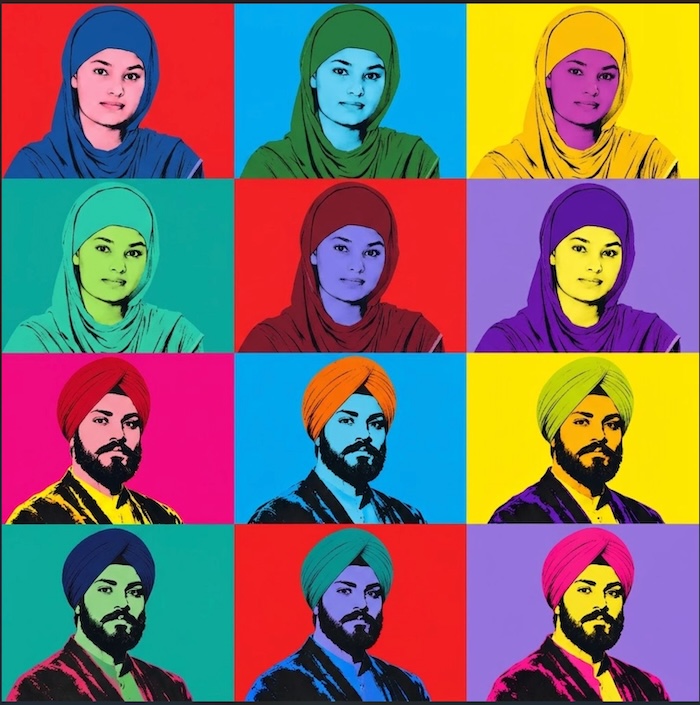
The picture has become even more diverse over the past twenty years or so. With the growth of global Sikh networks, social media, and increasing numbers of women choosing to wear the turban, colour has become much more a matter of personal choice and aesthetic preference. Many younger Sikh women select colours that complement their wedding attire or reflect their own tastes rather than the expectations of any particular group. Some traditionalists see this as a dilution of established norms, while others regard it as a healthy expression of confidence and individuality within Sikhi.
So, in practice, the answer depends on several factors: which AKJ faction one is dealing with, the local gurdwara culture, family expectations, and perhaps, above all, the confidence and support of the bride herself. I would not be surprised to see a bride wearing black, blue, cream, white, saffron, or even pink or red, depending on the context, though the latter is quite rare.
I realise this is something of an indeterminate answer, but I am not aware of any definitive guidance that prescribes a particular bridal turban colour. The reality is that practice tends to be shaped by a mixture of theology, culture, tradition, and personal preference.
Join the conversation on this story on Asia Samachar’s Facebook and Instagram pages.

Gurnam Singh is an academic activist dedicated to human rights, liberty, equality, social and environmental justice. He is a Professor of Sociology at University of Warwick, UK. He can be contacted at Gurnam.singh.1@warwick.ac.uk
* This is the opinion of the writer and does not necessarily represent the views of Asia Samachar.
RELATED STORY:
Anand Karaj: A marriage ceremony with a difference (Asia Samachar, 17 June 2023)
ASIA SAMACHAR is an online newspaper for Sikhs / Punjabis in Southeast Asia and beyond. You can leave your comments at our website, Facebook, Twitter, and Instagram. We will delete comments we deem offensive or potentially libelous. You can reach us via WhatsApp +6017-335-1399 or email: asia.samachar@gmail.com. For obituary announcements, click here





ust read Gurnam Singh’s piece on turban colours, and it really got me thinking about how we view this within our community. At the end of the day, when we talk about turban colours, it shouldn’t matter whether you are a man or a woman, or which traditional group you belong to. Things are evolving around the world, and people are choosing how to express themselves. Picking a specific colour or modern style doesn’t make you any less of a person, nor does it diminish your Sikh identity. You are just as valid and worthy as anyone else. I love seeing the younger generation wearing subtle pastel and calm tones; they look absolutely beautiful! Let’s stop putting people into rigid boxes and labeling them based on what colour they choose to wear. I also think it’s great when couples coordinate their turban colors with each other; it looks so modern, stylish, and sharp! Whether worn by girls, women, men, or boys, every style has its own cool, unique vibe. A colour is just a colour and all colours are part of the natural world. We waste so much time categorising and judgmentally labeling people for no real reason. We need to learn to accept everyone as they are, as long as people are treating each other with respect and living with good intentions. What are your thoughts?
Comments are closed.