














By Santokh Singh Randhawa | Malaysia | Part 1 |
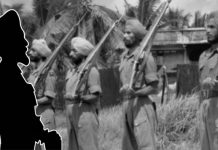
The arrival of the Punjabis to Malaya could be attributed to the fact that both Malaya and India were then under British rule.
The immediate cause of the arrival of the Punjabis, could be due to two factors, that is the unrest and war between the Chinese Clans of Ghee Hin and Hai San at the Tin Mine Areas of Larut and Matang near Taiping. The unrest was causing the British loss of revenue from the mines. The second was Captain Speedy, who was then Superintendent of Police in Penang.
Captain Speedy Tristram had earlier served in the region of Punjab in India and knew the ability and capability of the Punjabis in the field of armed forces and their loyalty and bravery in war. He proposed to the Authorities to bring in the Punjabis to contain the trouble at Taiping. In short, he went to Punjab (Lahore), and recruited 95 discharged para-military Punjabis and a handful of Pathans and on 29.9.1873, landed in Penang, Fort Cornwallis.
Wherever the Sikhs went, they brought along with them three things. One, their Sri Guru Granth Sahib ji; two, their language and three their culture. At one corner of Fort Cornwallis, the Sikhs were given a place to erect a small Gurdwara.
The para-military force proceeded to Taiping where they successfully contained the warring Chinese clans. They went on to build a Gurdwara at Taiping and incidentally, on 27.12.1903, established and registered the First ever Sikh Association in South-East-Asia, that is the Khalsa Diwan Mulkh Malaya (Khalsa Diwan Malaysia). Malaya was known as Mulkh Malaya to the Punjabis. For the next 50 years or so, this Association took care of Religion, Language, Culture and all political and communal affairs of the Punjabis in Malaya.
Soon, these paramilitary personnel began bringing in their families, relatives and friends. The Punjabi population began to grow. In the 1950s, it was estimated that there were over 300,000 Punjabis. Many returned before Malaya gained independence in 1957. Many migrated to other countries. Today it is estimated that there are about 110,000, scattered mainly in the Klang Valley, Selangor and Kinta Valley, Perak.
THE DIASPORA
The diaspora children needed education. Besides the official languages, English and Malay, they needed to master the Punjabi Language. Since the British needed the Punjabis in their armed forces, the British obliged opening up and providing facilities to learn the Punjabi Language. There were Vernacular Schools for the Chinese and Tamils. After 6 years of mother-tongue studies, the students moved to Government English Language Schools. There were Punjabi Language Vernacular Schools too. From the 1930s till early 1960s, there were 14 fully or partially aided such schools and over 70 private Punjabi Schools mostly attached to Gurdwaras.
In 1960, over 200 students sat for SRP (Form 3) Punjabi Paper and 97 students sat for SPM (Form 5) paper.
SEE ALSO: Abdullah first PM to provide financial aid for Panjabi language
It is interesting to note that there was even a Boarding School set up by Khalsa Diwan in 1910 in Police Gurdwara at Kuala Kangsar, Perak. As the enrollment increased, it was shifted to Taiping. However, it closed in 1917.
Malaya gained independence in 1957. The Education Policy had a drastic change too. Punjabi Language, that was popular and solidly and eagerly supported by the British, was badly hit.
In 1964, under the Rahman-Talib Education Convention, the Punjabi language was dropped as an official Vernacular language. Thus began the decline.

Other factors that contributed to the decline was the decrease of the Punjabi Population, from over 300,000 to just over 100,000. Without the Government support, there were no Punjabi Language trained teachers. There were no graded and syllabus-orientated text books. There were no more special schools. No single structured body that governed the teaching and learning of the Language. Leaderless so to say. Above all, no funds. All went zero.
One fortunate factor retained by the Ministry of Education was that the Form 3 and 5 Government Examination Punjabi Papers were not abolished. Otherwise, it would have been a total “close shop”. The students sitting for these papers had to privately prepare themselves. I was one such student.
During the British period, the examinations were under the control of the Cambridge University of England. The Punjabi Paper was set by the Punjab University and sent to England and the Cambridge University then forwarded it to Malaysia.
THE DECLINE
Without the Government’s backing, the decline was a foregone conclusion and as a result in 1992, only 16 students sat for the Form 3 paper and 8 for the Form 5 paper.
There was another blow when in 1993 the Government decided to drop the Form 3 Punjabi paper, with the intention that eventually Form 5 paper would also be dropped.
This was an awakening call for the community. Khalsa Diwan Malaysia (KDM), Sikh Naujawan Sabha Malaysia (SNSM) and other societies protested. As a result, the Government restored the Form 3 paper in 1996 with a warning that if the numbers do not increase, it will not hesitate to drop it again.
Looking back, I remember that there have been seminars, conventions and discussions by various organisations all over Malaysia from 1964 onwards on how to overcome the decline of teaching and learning of the mother-tongue. There were many ideas and proposals, but they always ended without any solution as there were no “takers”, that is no one to “bell the cat” so to say. This gigantic problem needed a gigantic solution.

I remember one such effort in 1988 by the then President of National Union of Teachers (NUT), S Gurnam Singh of Muar. He was also at that period, the Vice President of the International Federation of Free Teachers Union of Asia. He got funds from it to hold a seminar on the minority language i.e. Punjabi, focusing on its decline in Malaysia. This was held from 13 to 15 August 1988 at Genting Hotel at Genting Highlands. As an active member of the Union, I participated as a facilitator. All prominent Punjabi Leaders were invited to attend. Among them were Master Daljit Singh, Giani Inder Singh Gill, S Amar Singh BABT, Giani Mahinder Singh Sarur and Giani Mahinder Singh Chakravarti. High quality discussions were held and at the end, the same question remained…..who was to take up the challenge.
This Seminar left a long-lasting effect on me and it was here that I made up my mind, that I will take up the challenge to the revival of the teaching and learning of the Punjabi language in Malaysia.
When I retired in 1997, I had two options before me. One was to remain as Chief Executive Officer of Kota College in Ipoh (appointment immediately as I retired), OR, the second was to devote my remaining life to take up the challenge to revive the Punjabi language. I chose the second.
(To be continued)
RELATED STORY:
SPM seminar for Punjabi students in Malaysia (Asia Samachar, 6 May 2023)
Preserving a language against the odds: The story of Punjabi in Malaysia (Asia Samachar, 29 May 2025)
ASIA SAMACHAR is an online newspaper for Sikhs / Punjabis in Southeast Asia and beyond. You can leave your comments at our website, Facebook, Twitter, and Instagram. We will delete comments we deem offensive or potentially libelous. You can reach us via WhatsApp +6017-335-1399 or email: asia.samachar@gmail.com. For obituary announcements, click here




Please address this into our Malaysian history books which in year 60 and 70 there were mention a bit of how the British fought the world war one and two with recruiting sikh soldiers and police against the Japanese occupation.
Comments are closed.