





















By Sarabjeet Singh | Sikhi |
4) The Four Udasis (Journeys)
Very soon after the Kali Bein River incident, Guru Nanak resigned from his job and told his family that he must travel to share the message of Oneness and Truth. Mardana agreed to join, and for the next 20 years, they journeyed across places in India, Tibet, Sri Lanka, Mecca, Baghdad, and beyond, often by walking into lands where they knew no one and had to rely on strangers for food and shelter [17].
First Udasi (Eastward, c. 1499 – 1506)
Their first major journey took them to Kurukshetra, the place where Krishna delivered the Bhagavad Gita to the warrior, Arjuna. At that time, it was a solar eclipse, and thousands of pilgrims came to bathe in the sacred waters, believing that it would cleanse their sins. When Guru Nanak was asked by the people there why he wasn’t participating in this ritual bathing, he replied, “The real pilgrimage happens inside you. God isn’t hiding in the water. God is found in how you live.” [18].
After this, Guru Nanak and Mardana made their way to Haridwar, where there was a ritual in which pilgrims threw water to the east as an offering to honour their dead ancestors. Guru Nanak started throwing water in the west, and when the priests got upset and asked what he was doing, Guru Nanak replied, “I am watering my fields in Punjab. If your water can reach heaven, mine can reach my crops.” [19]. The point made here was obvious: the ritual without understanding is meaningless.
Ek Onkar: Guru Nanak’s Living Revelation of Oneness – Part 1
Ek Onkar: Guru Nanak’s Living Revelation of Oneness – Part 2
Ek Onkar: Guru Nanak’s Living Revelation of Oneness – Part 3
Then in Varanasi, the holiest Hindu city, Guru Nanak debated with scholars who were impressed by his knowledge but confused by his interpretation. When they discussed the purifying power of bathing in the Ganges River, Guru Nanak asked, “If the river purifies everyone who bathes in it, then what about all the fish who live there permanently? Are they the holiest creatures of all?” [20].
Then in Jagannath Puri, at the famous Jagannath Temple, Guru Nanak watched priests wave golden lamps before the Hindu deity, Jagannath, who was a form of Vishnu. Instead of being impressed, he composed a hymn on the spot, “The sky is the platter, the sun and moon are lamps, the stars are scattered pearls, the wind carries incense, and the forest offers flowers. This is real worship of God.” [21].
Second Udasi (Southward, c. 1506–1513)
In their second journey, Guru Nanak and Mardana travelled to Tamil Nadu, Andhra Pradesh, and Sri Lanka – regions unfamiliar to northern Indians due to the differences in languages, customs, and more. In Andhra Pradesh, the caste system was even more brutal than in the north, yet Guru Nanak deliberately ate food prepared by a Dalit family. A Dalit family was traditionally considered the lowest caste and was often referred to as the Untouchables. When he was criticised, he said, “God didn’t create high and low people, that is human invention.” [21]. In Sri Lanka, Guru Nanak met with a local king who asked him about the secret of good governance, and Guru Nanak told him, “A king should be like a tree – providing shade and shelter to everyone without favouritism. Justice should shine on everyone equally, just like the sun.” [22].
Third Udasi (Northward, c. 1514 – 1518)
This was possibly the most physically gruelling. Guru Nanak and Mardana headed north towards the Himalayas, which had some of the most challenging terrains with altitudes that were hard to breathe and blizzards that could kill. In Kashmir, they visited Buddhist monasteries, where monks had preserved ancient meditation techniques. The discussions were not short of challenging. These discussions were with people who had spent decades in mountain caves, surviving on almost nothing and completely dedicating themselves to transcending physical existence. One monastery they visited had monks who hadn’t spoken in years, communicating only by gestures and written notes [23].
But the most intense encounter was with the Nath yogis at places like Sumer Parbat. These yogis were ascetics who had sat in meditation for years, learned to control their body temperatures to sit naked in the snow, slow their heartbeats to near-death level, and go months without food. A siddha (Someone who was mastering these techniques) challenged Guru Nanak and said, “You speak of finding God while living as a householder but look at what I’ve achieved through complete renunciation. Can your married men with jobs reach this level of realization?” Guru Nanak replied with one of his most important teachings, “Brother, you’ve conquered your body, but have you conquered your pride? You’ve renounced the world, but you are still attached to your renunciation. A true yogi doesn’t need to prove anything to anyone, not even to himself.” [24].
Another siddha, at Mount Kailash, was demonstrating his powers by levitating several feet off the ground, and the crowd of pilgrims gasped with amazement, but Guru Nanak simply watched calmly and said, “That’s impressive. You can lift your body into the air, but can you lift someone who has fallen into despair? Can u raise the spirits of a widow without food for her children? That’s the miracle that the world actually needs.” [25].
So, in reality, these debates in these mountain retreats were different from anywhere else. These yogis weren’t interested in theological arguments or social reforms; they were focused on transcending human limitations entirely, and they saw Guru Nanak’s path of engaged spirituality as lesser than theirs. One particularly intense discussion lasted for about 3 days. A group of yogis argued that only through complete withdrawal from Maya (the Hindu idea of the illusion of reality), which included all worldly relationships and responsibilities. They believed that only through this renunciation could someone achieve liberation. They had scriptures and centuries of traditions backing them up, so they thought they were right, but Guru Nanak’s response was again extremely intelligent. He said, “What if Maya isn’t the enemy? What if the world is not to be escaped, but learned from? The householder who raises children with love, works honestly, and serves others may be doing more yoga than someone sitting alone thinking about how enlightened he is.” [25]. Some of the yogis started to nod along with him, which was significant as this idea that ordinary life could be a spiritual path was radical to their worldview of just complete renunciation.
But despite the philosophical debates, the challenges were brutal. At one point, Guru Nanak and Mardana got caught in a blizzard and nearly froze. This experience tested everything that Nanak believed about God being present in the world. He kept asking himself where God was in these mountains and why this was happening. The yogis pointed to this as proof that God can only be found in transcending the physical, that our physical body was some ways, a hindrance to our connection to God. But Guru Nanak found his answer in how he and Mardana took care of each other throughout all of this. The Divine wasn’t absent from the harsh mountain conditions, instead it was present in how they cared for each other, in strangers that shared food and shelter, and in survival through compassion. When they finally made it back to more hospitable regions, both men were fundamentally changed by this experience
Fourth Udasi (Westward, c. 1519–1524)
The fourth journey was probably the most significant. Both men headed to the west, into the heart of the Islamic world. This was very dangerous for a non-Muslim, as travelling into Muslim land could risk persecution. In Afghanistan, Guru Nanak debated with Muslim scholars, and in Baghdad, he engaged with some of the most learned theologians, who described heaven and hell as literal places where people go after death. Guru Nanak said, “Heaven and hell exist right here. Heaven is remembering God and serving others, while hell is being consumed by ego.” [26]. One of the most famous events in Guru Nanak’s life happened in Mecca, the holiest city of Muslims. Exhausted from his journey, he lay down to rest with his feet pointing towards the Kaaba. A group of pilgrims angrily woke up and told him to move his feet. Guru Nanak calmly replied, “Please point my feet in a direction where God is not”. According to the legend, when they turned his feet, the Kaaba itself moved — whether literal or symbolic, the message was clear: God isn’t confined to a place, God is everywhere [26].
5) Return to Punjab and Langar
After 20 years of continuous travel of meeting, and debating, Guru Nanak finally returned to Punjab around 1524. By then, he was over 50 years old, his beard was white, and his face was weathered – but instead of retiring, he started something completely new. He founded a town called Kartarpur on the banks of the Ravi River and created what we now know and recognise as the first Gurdwara, a Sikh holy place of worship [27]. Kartarpur wasn’t just a place to live; it was a living community of remembrance and practice of what he had been teaching. People of all castes, religions, genders, and backgrounds lived and worked together.
The whole community was built around 3 principles:
- Naam Japna (Remembrance of the Divine)
- Kirat Karni (Honest Labour)
- Vand Ke Chakna (Sharing with others) [28].
Possibly the most revolutionary was the institution of Langar – a free communal kitchen where all people, regardless of caste, religion, background, or gender, sat together and ate food. This was an explosive and radical venture, as things at that time were governed by complexity, ritual purity, and caste divisions. Brahmins, Dalits, Muslims, Hindus, the rich, and the poor all sat side by side and ate together [29].
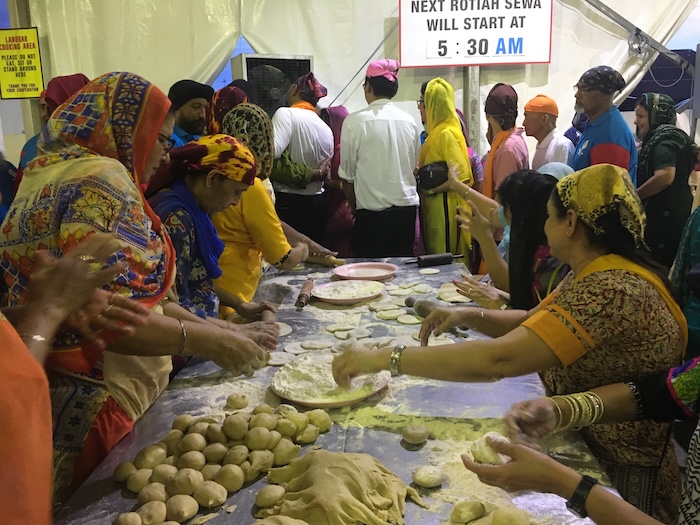
The movement of langar became so powerful that the Mughal Emperor at that time, Emperor Akbar, with his full royal entourage, decided to visit Kartarpur. He had expected the usual protocol: special treatment and a big reception. Instead, he was directed to the langar hall and was told that everyone, including himself, is to sit and eat together before meeting Guru Nanak. Emperor Akbar didn’t just tolerate this; he was moved by the humility and equality he witnessed. After eating, he met with Guru Nanak and mentioned how in his court, people argued over who got to sit closest to him, but here, people argued over who could serve others first [30]. Akbar offered to grant land and money to expand Kartarpur, but Guru Nanak declined, saying that the community would be self-sufficient [30].
Kartarpur had everything the community needed. The settlement was built around a courtyard where the morning and evening prayers took place. Some guesthouses offered simple rooms for visitors to stay. The Gurdwara itself was a modest structure – a simple building with white walls where the community would gather twice daily. What made it special wasn’t the architecture but its openness: anyone could participate, eat, and partake in the prayers together [31]. Kartarpur functioned like a regular community. People farmed and had jobs. Even Guru Nanak worked in the field, demonstrating that being a spiritual didn’t exempt one from honest labour.
As his time drew near, Guru Nanak would appoint Bhai Lehna, who later would be known as Guru Angad Dev Ji, the second Sikh Guru, as his successor, not his sons. This choice was based on devotion and service, not bloodline, which was another radical break from the norm and tradition. Guru Nanak Dev Ji was the living epitome of Oneness in action, where faith, labour, and equality were not just ideals but daily woven practices.
SEE MORE COMMENTS ON THIS ARTICLE AT ASIA SAMACHAR FACEBOOK AND INSTAGRAM
(TO BE CONTINUED)
ABOUT THE AUTHOR: Sarabjeet Singh is a full‑time Airman with the Republic of Singapore Air Force and a final‑year Electrical & Electronics Engineering student at Nanyang Technological University (NTU). His current research focuses on Guru Nanak’s message of Ek Onkar and the universal principle of Oneness
REFERENCES
- SikhiWiki. (n.d.). The Udasis of Guru Nanak. https://www.sikhiwiki.org/index.php/The_Udasis_of_Guru_Nanak
- Organiser. (2013, November 26). The Udasis of Guru Nanak. https://organiser.org/2013/11/26/53566/bharat/re6838e5c
- India TV News. (2025, November 5). Guru Nanak’s Udasis: The spiritual journeys that redrew South Asia’s religious boundaries. https://www.indiatvnews.com/news/india/guru-nanak-dev-birth-anniversary-udasis-spiritual-journeys-map-that-redrew-south-asia-religious-boundaries-gurpurab-2025-11-05-1015896
- Discover Sikhism. (n.d.). Guru Nanak in Varanasi. http://discoversikhism.com/sikh_gurus/guru_nanak_varanasi.html
- SikhNet. (n.d.). Aarti by Guru Nanak at Jagannath Puri. https://www.sikhnet.com/news/aarti-guru-nanak
- Discover Sikhism. (n.d.). Guru Nanak and caste equality. http://discoversikhism.com/sikh_gurus/guru_nanak_caste_equality.html
- SikhNet. (n.d.). Guru Nanak in Sri Lanka. https://www.sikhnet.com/news/guru-nanak-sri-lanka
- SikhiWiki. (n.d.). Guru Nanak in the Himalayas. https://www.sikhiwiki.org/index.php/Guru_Nanak_in_Himalayas
- SikhNet. (n.d.). Guru Nanak and the Nath Yogis. https://www.sikhnet.com/news/guru-nanak-nath-yogis
- Discover Sikhism. (n.d.). Guru Nanak in Mecca and Baghdad. https://www.discoversikhism.com/sikh_gurus/guru_nanak_mecca_baghdad.html
- SikhiWiki. (n.d.). Kartarpur: Guru Nanak’s final settlement. https://www.sikhiwiki.org/index.php/Kartarpur
- Discover Sikhism. (n.d.). Three pillars of Sikhism. http://discoversikhism.com/sikhism/three_pillars_of_sikhism.html
- Discover Sikhism. (n.d.). The origin of Langar. http://discoversikhism.com/sikh_gurus/guru_nanak_langar.html
- SikhNet. (n.d.). Emperor Akbar and the Guru’s Langar. https://www.sikhnet.com/stories/audio/emperor-akbar-and-gurus-langar
- Encyclopaedia Britannica. (n.d.). Guru Nanak. https://www.britannica.com/biography/Guru-Nanak
RELATED STORY:
Guru Nanak’s Concept of God (Asia Samachar, 28 April 2024)
Sikhi and the concept of God (Asia Samachar, 19 June 2022)
ASIA SAMACHAR is an online newspaper for Sikhs / Punjabis in Southeast Asia and beyond. You can leave your comments at our website, Facebook, Twitter, and Instagram. We will delete comments we deem offensive or potentially libelous. You can reach us via WhatsApp +6017-335-1399 or email: asia.samachar@gmail.com. For obituary announcements, click here