






















By Gurnam Singh | Opinion |
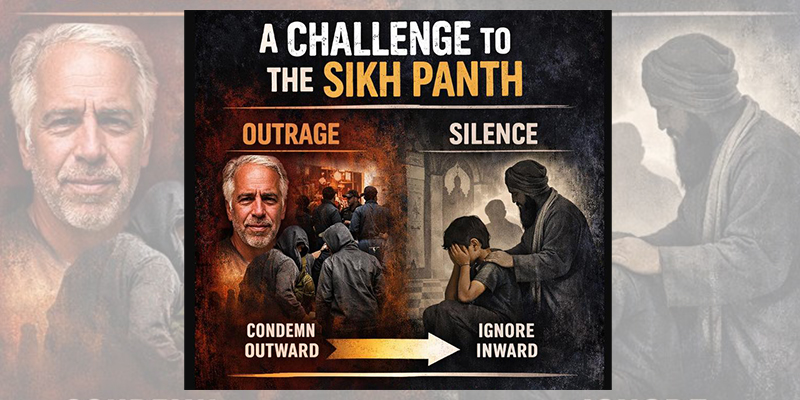
This article is a direct appeal to the worldwide Sikh Panth, especially to those of us who rightly take pride in a tradition that stands for social justice, moral courage and resistance to oppression in all its forms. We are often quick, and rightly so, to condemn sexual abuse when it is exposed among powerful individuals such as Jeffrey Epstein, or when it is framed through the lens of so-called “Pakistani Muslim grooming gangs”. Yet there is a deeply troubling silence when abuse is rooted within our own familial, religious and institutional spaces.
Most notably, this silence is evident when It concerns the systemic abuse that takes place in many deras or religious residential schools in Panjab India more generally. Though difficult to gather, survivor testimony, often years after the abuse, indicates that widespread sexual abuse of boys and girls. Most importantly, this is not isolated or accidental, but often organised, concealed and reproduced on a large scale. The consequences are devastating. Many survivors carry lifelong psychological, physical and emotional trauma, with their sense of self, trust and dignity profoundly damaged.
SEXUAL ABUSE: MORE STORIES ON THIS TOPIC HERE
These individuals, if they survive at all, sometimes end up as Granthis in Gurdwaras across the world and according to research up to 30% can end up perpetuating the very same abuse they experienced. Too often, unresolved trauma feeds further cycles of abuse, creating a self-perpetuating system of harm. These individuals’ victim can become future perpetrators and the cycle of abuse continues.
The Cover of Spirituality
What makes crimes against the most vulnerable members of the community especially painful is these are rationalised under the cover of spirituality in Sikh spaces. Survivors often report that the perpetrators deploy all kinds of perverted religious logic, which is a betrayal of Sikh principles themselves.
We are rightly disgusted by the behaviour of Epstein yet Sikhi demands that we apply the same moral outrage and determination to see justice for the victims when it involves our own community. If we exercise the right to speak against exploitation elsewhere, we also have the moral duty to examine evidence of abuse within our own religious and educational institutions, particularly where spiritual authority and community trust are involved, and to act. Failure to do so in an age where such abuse is increasingly difficult to cover-up is, as we have seen in the Roman Catholic Church is likely to lead to profoundly damaging moral authority, credibility and institutional stability.
SEE ALSO: Sexual abuse in Sikh Spaces: time to lift the lid!
SEE ALSO: Yogi Bhajan’s fall from grace. The ‘sexual abuse’ is just the just beginning
Beginning with widespread revelations in countries such as the United States, Ireland, Australia and Germany, investigations uncovered not only extensive child sexual abuse by clergy but also systematic cover-ups by senior church officials. Financially, the Church had to pay billions in settlements and compensation; socially, it faced declining attendance and trust in many regions.
Documented Cases in Dera and Faith-Linked Settings
Sexual abuse linked to dera institutions and religious authority claiming allegiance with Sikhi in Punjab and India is not mere speculation or manufactured moral panic by enemies of Sikhi. Though the actual number of reported cases is tiny, all indications are that these represent the tip of a large iceberg.
Nonetheless, courts and media reporting have documented serious cases involving women and children. However, because such offences are difficult to prove, often, just as was the case in the Epstein scandal, they either are not even reported, the victims are intimated and/or their silence is bought off, often with the complicity of politicians, wealthy individuals and even law enforcement and child welfare services whose have a legal duty to protect!
The broader Indian context reinforces the risks associated with charismatic religious leadership. For example, the conviction of Gurmeet Ram Rahim Singh, head of Dera Sacha Sauda, for raping female followers demonstrated how spiritual authority can be abused over extended periods. Former associates also alleged abuse connected to dera-run institutions, underscoring how hierarchical religious environments can suppress disclosure.
Evidence from Community Research
Beyond individual cases, community-specific research further underscores the scale of concern. A study conducted by Sikh Women’s Aid in 2021 found that over 30% of Sikh women surveyed reported experiencing sexual abuse, with nearly 70% of incidents occurring during childhood. The same study found that 8% of respondents reported abuse linked to religious or faith-based authority.
The research emphasised that shame, fear of reputational damage and cultural stigma significantly inhibit disclosure. Such barriers align with findings from the UK Independent Inquiry into Child Sexual Abuse (IICSA) in 2022, which concluded that religious organisations across faith traditions often failed to implement adequate safeguarding policies and sometimes prioritised institutional reputation over victim protection.
Taken together, these data suggest that abuse within Sikh and Punjabi contexts must be understood not merely as isolated incidents but as part of broader structural vulnerabilities involving authority, silence and inadequate safeguarding.
What is to be done?
If the Sikh Panth is to maintain moral authority and not end-up in the same position as the Roman Catholic Church, as well as looking outwards and learning from what happens elsewhere, we need to look inwards. As is far too familiar, when cases do get reported and victims and their families gain the courage to speak out, we must respond not defensively but act constructively, through transparent safeguarding standards, independent oversight, survivor support and a shift in mindset that places dignity above reputation.
As a friend and long-time Sikh activist noted on my Facebook page, “too often, we see a burst of noise for a few days – anger, social media posts, outrage — and then everything settles back into silence. That pattern helps no one. It gives the illusion of action while the underlying system remains untouched. If we are serious about protecting our children … then our response must be sustained, not emotional; structured, not reactive; Panthic, not factional; focused on prevention and safeguarding, not just condemnation.”
If we are serious about honouring the legacy of the Sikh Gurus, then silence is not neutrality but complicity. A tradition that once challenged some of the most powerful empires the world has seen cannot shrink from challenging its own institutions. The measure of our integrity lies not in what we condemn elsewhere, but in what we are willing to confront at home!

Gurnam Singh is an academic activist dedicated to human rights, liberty, equality, social and environmental justice. He is a Professor of Sociology at University of Warwick, UK. He can be contacted at Gurnam.singh.1@warwick.ac.uk
* This is the opinion of the writer and does not necessarily represent the views of Asia Samachar.
RELATED STORY:
The Demise of the Akali Dal and the Badal Dynasty: What Next for the Panth? (Asia Samachar, 5 Aug 2024)
ASIA SAMACHAR is an online newspaper for Sikhs / Punjabis in Southeast Asia and beyond. You can leave your comments at our website, Facebook, Twitter, and Instagram. We will delete comments we deem offensive or potentially libelous. You can reach us via WhatsApp +6017-335-1399 or email: asia.samachar@gmail.com. For obituary announcements, click here