























By Rishpal Singh Sidhu | Opinion |
This article is an examination of the principles and practices of lan
The phonetic Latin (English) spelling is frequently written as Guru ka Langar. In Punjabi, “Guru ka langar ” is spelt as ਗੁਰੂਕਾ ਲੰ
The physical institution of Guru ka langar was introduced and began with Guru Nanak as a deliberate social revolution to neutralise caste hierarchy and create a lived practice of equality. Everyone, regardless of caste, religion, gender, or status – sat together and ate simple food. This was considered a radical act in a society where caste dictated who could eat with whom. Each successive Guru expanded, formalised, and institutionalised this practice, and by the time of Guru Ram Das and Guru Arjan, langar had become a fully organised daily community kitchen, and is a model still followed worldwide by gurdwaras today.
Importance of Seva
The Sikh Rehat Maryada (SRM, ਰ
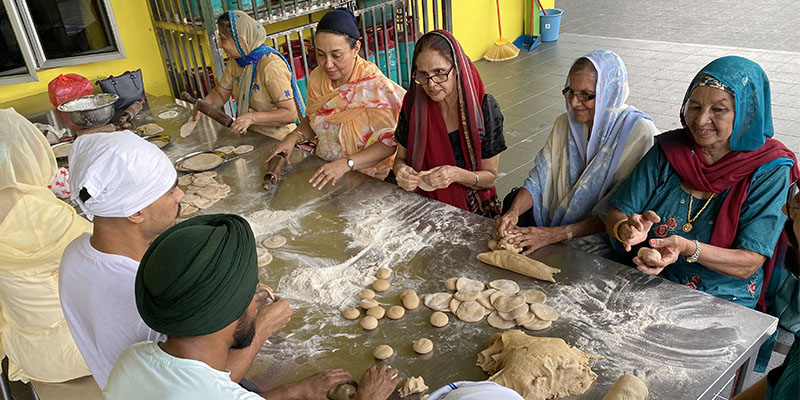
In Gurbani, seva often implies serving the wisdom of the Guru and treating humanitarian work as a form of devotion to God. Voluntary service takes many forms including sweeping floorsand dusting shoes of visitors to the gurdwara. It is a foundational practice and central pillar of Sikh life and trains Sikhs in humility, service, and equality. Serving in langar -cooking, preparing, serving, and cleaning up are regarded as the highest forms of service. While the SRM (Section Three, Chapter VIII, Article XII, Karhah Parshad (ਕੜਾਹ ਪ੍
Pangat
In langar, visitors to the gurdwara sit together on the floor in lines or rows called pangat (ਪੰਗਤ). This word traces its origins from the Sanskrit ‘pankti’ meaning a line, row, or group. In Sikh tradition, this basically refers to the practice of people sitting together in straight rows to share a communal meal (langar), emphasizing universal equality, humility, and community. There is no clause in the SRM that specifically requires a visitor to first pay obeisance in the darbar (from Persian, meaning “court,” “audience chamber,” or “hall of a ruler”) where the Guru Granth Sahib is kept before partaking langar. Langar is an

A noteworthy exception took place on how langar was served in gurdwaras around the world during the Covid19 pandemic. Communal sitting and dining (pangat) stopped but the core Sikh principles of seva, sarbat da bhala, and feeding all without discrimination remained unchanged. Across India and globally, gurdwaras rapidly redesigned langar operations to meet lockdown rules, food security needs, and publichealth requirements. Instead, meals were packed and/or collected or delivered to sangats, elderly people isolated at home, neighbourhood shelters, and migrant camps. Many gurdwaras adopted “langar on wheels” models—mobile vans delivering cooked meals to highneed areas. The scale of assistance was unprecedented, but the spirit remained unchanged: seva, equality, and feeding all who are hungry.

A major innovation took place during the second Covid wave in India, with some gurdwaras setting up oxygen langars—free oxygen beds, cylinders, and medical support. This extended the concept of langar from food to lifesaving aid. It has been reported that worldwide Sikh organisations distributed well over 3 million meals during the pandemic.
Akal Takht directives on Langar Discipline (Chairs, Tables, Pangat)
When the SRM was finalised in 1945, there was no mention of having langar served while sitting on chairs and at tables because the practice did not exist at that time. The first diaspora deviations appeared in the early 1980s and 1990s when gurdwaras in the United Kingdom, Canada, and the US began experimenting with chairs/tables for elderly congregations.
There were no formal Akal Takht rulings yet, but the SGPC committees began raising concerns about this practice. The Panch Singh Sahibans landmark ruling of 1998 declared that pangat is not merely a seating arrangement — it is both a spiritual discipline reflecting equality and humility, and a collective practice integral to langar’s purpose. It called pangat the Gurmat ki ri
Langar in the Guru Granth Sahib
The Guru Granth Sahib (GGS) does not describe the modern, physical practice of langar (community kitchen). It speaks only of spiritual langar, and the word langar appears once (GGS, 967), saying:
ਲੰਗਰੁ ਚਲੈ ਗੁਰ ਸਬਦਿ ਹਰਿ ਤੋਟਿ ਨ
Langar chalai gur sabad har
“The langar — the kitchen of the Guru’s Shabad — continues without shortage.” This is from Rāg Rāmkalī, in the Vār of Bhai Satta & Bhai Balwand. Sikh scholars interpret ShabadLangar as continuous, universal spiritual nourishment. The physical langar tradition expresses the same values: equality, humility, seva, and abundance.
Gurdwara committees’ debates on langar as takeaways
In earlier times there was no concept or consideration of takeaway. Langar was eaten on site.
Recent years have witnessed discussions and debates reflecting the tension between traditional discipline
Langar is a collective act, not an individualised meal. The spiritual discipline lies in sitting together and noting the food itself. Langar is part of sangat pangat discipline and seen as essential to egalitarian practice with no caste-based or status-based separation.
Some gurdwara management committees have taken principled and sometimes rigid stands on the practice of allowing taking langar home on the grounds that pangat is a spiritual discipline, langar
When is takeaway langar is acceptable?
Does allowing this action honour the Guru’s langar or reduce it to a takeaway meal? This practice is not formally prohibited by gurdwaras everywhere, but it sits in a grey zone where intent, context, and maryada matter. Taking lan
Gurdwaras as food banks and community kitchens
Recent years have seen gurdwaras in India, the UK, Canada, US, Australia, and Malaysia repeatedly stepping forward as community kitchens during forest wildfires, earthquakes, floods, landslides, and other natural disasters, providing largescale langar, shelter, medical aid, and volunteer manpower. This is not occasional, and it is a consistent pattern rooted in Sikh principles of seva (selfless service) and langar (free community kitchen). Their humanitarian efforts have been widely recognised and deeply appreciated by governments and the communities at large.

Some gurdwaras in these countries also increasingly operate as food banks and community kitchens serving meals to thousands of non-Sikhs, especially the poor, homeless, and needy on a weekly basis.
In this context, preparing langar inside the gurdwaras and explicitly taking and distributing food as takeaway packets outside the gurdwara is seen as an extension of seva and not a breach of maryada. More importantly, it is seen as sarbat da bhala (ਸਰਬੱਤ

Rishpal Singh Sidhu is a retired library and information services professional, now serving as a casual academic with the School of Information & Communication Studies, Charles Sturt University, Wagga Wagga, New South Wales, Australia. He can be reached at rishpal.sidhu@gmail.com
* This is the opinion of the writer, organisation or publication and does not necessarily represent the views of Asia Samachar.
RELATED STORIES:
Are these paintings of Sikh Gurus for real? (Asia Samachar, 22 July 2023)
ASIA SAMACHAR is an online newspaper for Sikhs / Punjabis in Southeast Asia and beyond. When you leave a comment at the bottom of this article, it takes time to appear as it is moderated by human being. Unless it is offensive or libelous, it should appear. You can also comment at Facebook, Twitter, and Instagram. You can reach us via WhatsApp +6017-335-1399 or email: asia.samachar@gmail.com. For obituary announcements, click here.





I is interesting to know what the Parbandhak Committee in Amritsar has decreed as right custom to partake in Langgar in a gurdwara.
I fail to understand how sitting on the floor eating Langgar enhances the quality of humility and equality, while sitting on chairs and having langgar diminishes. Everyone sits together, shoulder to shoulder, no matter caste creed or station in life, in both instances. One cannot be come a holier or ‘better’ Sikh by simply sitting on the floor while having Langgar.
Surely our revered Gurus preached a higher wisdom and faith in our beloved Gurbani.
Most temples outside India have probably done away with this custom.
Yet Sikhism seems to thrive and grow firmly outside India while Panjab show erosion of Sikh values and cultural identity.
Comments are closed.