A recent ariel view of Gurdwara Sahib Buntong, the Ipoh gurdwara first built in 1968
By Asia Samachar | Malaysia |
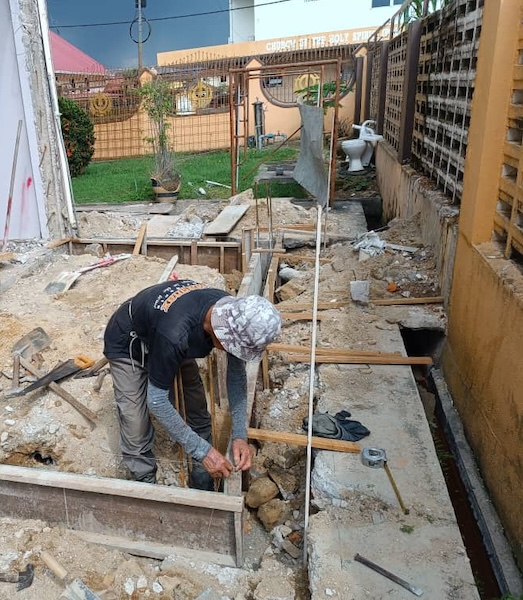
Gurdwara Sahib Buntong (GSB), one of the Kinta Valley gurdwaras in the Malaysian state of Perak, has started major renovations for its building which was built close to six decades ago.
The renovation will be carried out in three phases, with phase one including work on the Darbar Sahib, roof, female toilets and safety equipments.
“Our aim is to have a fully refurbished Gurdwara Sahib equipped with some modern facilities. The management committee requests you to be part of this meaningful project,” GSB secretary Jasbir Singh Nannuan told Asia Samachar.
“The roof is also not in a good condition,” added Jasbir on the gurdwara building which built in the 1968.
Buntong gurdwara phase one renovation underway (December 20254)
PROJECT DETAILS Phase 1 (Sept 2024 – Feb 2025) ✓ Darbar Sahib ✓ Palki Sahib ✓ Nishan Sahib Area ✓ 2nd Darbar & Sachkhand ✓ Roof of the Darbar Sahib ✓ Building painting ✓ Female Toilets ✓ GianiJi Room ✓ Visitors Rooms ✓ Entrance of Gurdwara ✓ Safety Equipment’s
Phase 2 (2025) ✓ Langgar Hall ✓ Cooking Area ✓ Storage Area ✓ Dish washing area ✓ Male Toilets ✓ OKU Facilities
Phase 3 (2025) ✓ Parking Area ✓ Surrounding area
For inquiries, contact Jasbir Singh Nannuan at +6016-5666796 or email at gsbuntong1058@gmail.com.
ASIA SAMACHAR is an online newspaper for Sikhs / Punjabis in Southeast Asia and beyond. You can leave your comments at our website, Facebook, Twitter, and Instagram. We will delete comments we deem offensive or potentially libelous. You can reach us via WhatsApp +6017-335-1399 or email: asia.samachar@gmail.com. For obituary announcements, click here
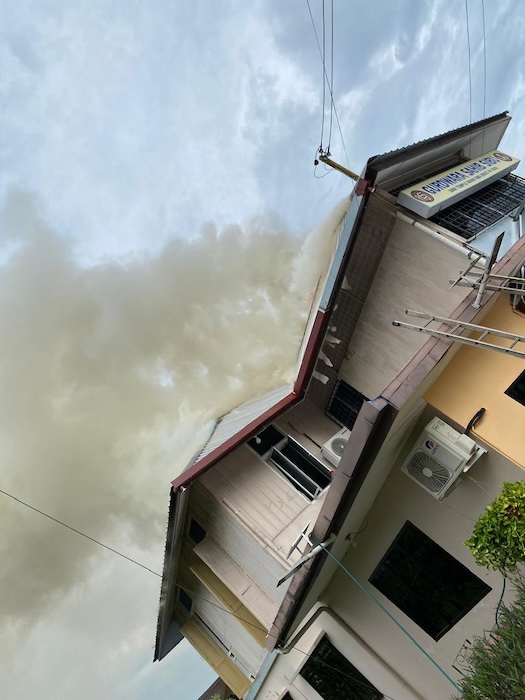
Fire at Gurdwara Sahib Sibu, Sarawak, on Dec 14, 2024
The Sibu gurdwara builiding was partially damaged, especially its roof, in a fire yesterday (Dec 14).
The 104-year-old gurdwara in Sarawak, rebuilt in the 1960s, has been sealed off temporarily, with its electricity supply disconnected.
“The roof has been badly damaged. The water must also have damaged the wooden flooring. We are waiting for the insurance adjuster to finish their investigation,” Jagjiwan Singh, the gurdwara caretaker and a local resident, told Asia Samachar.
Fire at Gurdwara Sahib Sibu, Sarawak, on Dec 14, 2024
No one was injured in the incident.
The gurdwara hosted an Anand Karaj (Sikh wedding) on Dec 7 and they had a Akhand Path (the continuous reading of the Guru Granth Sahib, usually over three days) in October.
ASIA SAMACHAR is an online newspaper for Sikhs / Punjabis in Southeast Asia and beyond. You can leave your comments at our website, Facebook, Twitter, and Instagram. We will delete comments we deem offensive or potentially libelous. You can reach us via WhatsApp +6017-335-1399 or email: asia.samachar@gmail.com. For obituary announcements, click here
As the global Sikh community takes part in seasonal festivities , they are also reminded of the epic events of December 1705.
A Facebook message from Dya Singh of Australia, provides a good summary: The month of December reminds the Sikhs of the siege of Anandpur Fort. It reminds them of the starving and dwindling number of Sikhs with Guru Gobind Singh Ji, the leaving of Anandpur following false promises by the Mughals and the Hill Rajas, the treacherous attack at Sirsa River and the separation of the family of Guru Ji, the betrayal of Mata Gujri by Gangu, the Kashmiri Brahmin, the torture and martyrdom of Shotay Sahibzaday, martyrdom of Mata Gujri the epic battle of Chamkaur the martyrdoms in battle of the Vadday Sahibzaday and the Sikhs. So, please remember this entire passage of our lofty history.
Next generations should continue to research and discover own great heritage, the treasure left behind by their ancestors (Peo daaday da khajaana), as they integrate with and contribute to the plural societies they live in.
Each month of the year in history records numerous Sikh martyrdoms over the last 500 years. Guru Arjan Dev started the Sikhi shaheedi tradition and will always be remembered as Shaheedan de Sirtaaj (Leader of Martyrs). He gave His life for the cause of the Panth of Guru Nanak. Guru Tegh Bahadur gave his life for the right of all to follow own chosen path. His martyrdom has no other parallel in the Abrahamic martyrdom traditions, while the concept of martyrdom is alien to the ancient Indic tradition.
During the closing chapters of the Guru history, sacrifices of living-martyr, Guru Gobind Singh, and the Four Sahibzaady, shocked and roused ordinary people to topple successive oppressive empires. The blood-stained history of the month of December is particularly moving. The month is especially remembered for the martyrdom of the four Sahibzaday. That requires reflection in the context of sarbans-daan by Guru Gobind Singh, regarded as a unique example of a living-martyr. He taught, how the mar-jeevra Khalsa should live a fully participative life but without attachment and not hesitate to make the ultimate sacrifice for the righteous cause.
Let us reflect on the meaning of sarbans daan. It means the end of the family line — no progeny or descendants. This was a willing sacrifice by Guru Gobind Singh while he offered a prayer of gratitude before the Timeless Being. Why? Because he believed that the mission with which he came to the world was nearing completion. His father, Guru Tegh Bahadur gave his life for religious freedom. His four sons gave their lives so that thousands of Khalsa children of the Guru would live to resist oppression and prosper (Jeevat kayee hazaar).
Next generation Sikhs have done well in many fields. It is most refreshing to see Sikhs like Ajaypal Singh Banga, newly appointed President of the World Bank, who have kept their proud Sikh identity while reaching for the stars.
It is for them to also contribute to their rich Sikh heritage. Because, the life of every Sikh man and woman, no-matter how high an achiever regarding worldly position, is but a very small time-window in the continuity and prosperity of the family of Guru Nanak-Guru Gobind Singh. To be identified and counted as a Sikh is not separatism but an essential part of the process of self-orientation in the wider plural society as a responsible citizen.
Gurmukh Singh OBE, a retired UK senior civil servant, chairs the Advisory Board of The Sikh Missionary Society UK. Email: sewauk2005@yahoo.co.uk. Click here for more details on the author.The article first appeared at Panjab Times, UK
* This is the opinion of the writer, organisation or publication and does not necessarily represent the views of Asia Samachar.
ASIA SAMACHAR is an online newspaper for Sikhs / Punjabis in Southeast Asia and beyond. You can leave your comments at our website, Facebook, Twitter, and Instagram. We will delete comments we deem offensive or potentially libelous. You can reach us via WhatsApp +6017-335-1399 or email: asia.samachar@gmail.com. For obituary announcements, click here
FINAL RITES: 14 Dec 2024 (Saturday) 2pm: Cortege leaves from residence 24, Jalan Omri, 84000 Muar Johor 3pm: Saskaar (cremation) at Batu 8, Jalan Bakri, Muar, Johor Followed by Alaahnia Paath and Arambh of Sri Sahej Paath at Gurdwara Sahib Muar Path
PATH DA BHOG: 12pm, 21 DEC 2024 (Saturday) Gurdwara Sahib Muar, Johor
ASIA SAMACHAR is an online newspaper for Sikhs / Punjabis in Southeast Asia and beyond. You can leave your comments at our website, Facebook, Twitter, and Instagram. We will delete comments we deem offensive or potentially libelous. You can reach us via WhatsApp +6017-335-1399 or email: asia.samachar@gmail.com. For obituary announcements, click here
Syria’s Bashar al-Assad – Photo: Website cover photo at SyriaGenocide.org
By Gurnam Singh | Opinion |
The sudden collapse of Bashar al-Assad’s brutal regime in Syria has been met with a mix of relief and trepidation. Few tears will be shed for the dictator who presided over 22 years of torture, mass imprisonment, and industrial-scale murder. His fall, however, serves as a stark reminder of the dangers posed by nationalism and the authoritarianism that often accompanies it—a pattern visible across the world.
Assad’s reign was an extension of his father Hafez al-Assad’s legacy, who ruled Syria with an iron fist for three decades. Like father, like son: the younger Assad inherited not only the title of president but also the apparatus of repression that had turned Syria into a police state. The transformation of a London-trained ophthalmologist, with a seemingly cosmopolitan outlook and a British-Syrian wife, into a dictator with blood-stained hands is a grim illustration of the adage: “Power corrupts, and absolute power corrupts absolutely.”
Bashar al-Assad cultivated an image of a secular, modern leader, a stark contrast to the Islamist extremism that had plagued the region. Through carefully managed public relations campaigns, he painted a picture of normalcy, even as his regime built its foundations on fear and violence. Behind the façade of the young, modern Assad family lay a government that systematically crushed dissent, silenced opposition, and turned Syria into a land of suffering for millions of its citizens.
One of the defining traits of authoritarian rulers like Assad is their detachment from reality. Isolated by sycophantic advisers and emboldened by inflated egos, they often overestimate their power and underestimate the resilience of their people. Reports suggest that even as rebel forces closed in on Damascus, Assad maintained his delusions of crushing the opposition. This disconnect underscores the peril of unchecked power: it fosters not only oppression but also catastrophic misjudgment.
The end of Assad’s rule is a moment of hope for Syrians who endured decades of repression, but history warns us to temper our expectations. While the messages coming from the ‘liberation’ forces and former Islamists appear to offer some hope, in truth, the fall of one dictator often creates a power vacuum, leaving the country vulnerable to further instability. The cycle of tyranny replacing tyranny is one of history’s cruelest lessons.
Nationalism has been a common denominator in the rise of authoritarian regimes. Whether rooted in ethnicity, religion, language, or race, nationalist rhetoric often promises liberation from oppression. Yet, as seen in the Middle East, it frequently leads to power struggles, civil wars, and the ascent of new tyrants.
In post-colonial states, this pattern has played out repeatedly. From the rise of Islamist regimes like Iran under Ayatollah Khomeini to the Taliban’s control in Afghanistan, nationalism has been a rallying cry that ultimately betrayed its ideals of freedom and justice. Even secular dictatorships, such as the communist regimes of the mid-20th century, have demonstrated the perils of authoritarian governance cloaked in the guise of liberation.
The dangers of the kinds of despotic nationalism are not confined to the Middle East. In South Asia, for instance, nationalism fueled by tribal, linguistic, caste, and religious identities has taken root in countries like India, Pakistan, and Sri Lanka. Despite their democratic frameworks, these nations are increasingly governed by authoritarian leaders who wield power ruthlessly. The world’s largest democracy, India, is grappling with the rise of Hindu nationalism, which critics argue undermines its secular foundations. Pakistan’s political instability, exacerbated by militant Islamism, and Bangladesh’s struggles with authoritarian governance further highlight the risks of nationalism devolving into despotism.
The fall of Bashar al-Assad serves as a stark warning: the collapse of a dictator does not guarantee the rise of democracy. To prevent history from repeating itself, the global community must remain vigilant against the twin forces of nationalism and authoritarianism. While the world celebrates the end of Assad’s regime, it must also prepare for the challenges that lie ahead in ensuring a just and democratic future for Syria and other nations trapped in the cycle of tyranny.
Gurnam Singh is an academic activist dedicated to human rights, liberty, equality, social and environmental justice. He is an Associate Professor of Sociology at University of Warwick, UK. He can be contacted at Gurnam.singh.1@warwick.ac.uk
* This is the opinion of the writer and does not necessarily represent the views of Asia Samachar.
ASIA SAMACHAR is an online newspaper for Sikhs / Punjabis in Southeast Asia and beyond. You can leave your comments at our website, Facebook, Twitter, and Instagram. We will delete comments we deem offensive or potentially libelous. You can reach us via WhatsApp +6017-335-1399 or email: asia.samachar@gmail.com. For obituary announcements, click here
Some 44 kilograms of gold is allegedly missing from the toshakhana of Takht Hazur Sahib, one of the five key takhts in the Sikh world.
That is not all. Gold ornaments, artefacts and antique pieces donated by the Sikh Sangat weighing 48 kilograms has been melted, allegedly without due process and authorisation. Some of the items, carrying historicval value if preserved, are now gone forever.
The reported embezzlement running into millions of rupees thoroughly exposes the Hazur Saheb Takht Prabandhak Committee and the matter has reached the Bombay High Court, reports World Sikh News (WSN).
Two Sikhs, Ranjeet Singh Gill and Rajendra Singh Pujari, petitioned the Bombay High Court (Aurangabad Bench) on the happenings at Sikh institution also known as Takht Sachkhand Sri Hazur Abchalnagar Sahib located Nanded in the state of Maharashtra, India.
The petition in the Mumbai High Court highlights how a vast quantity of gold and silver ornaments donated by Sikhs over decades was melted into gold biscuits without proper permissions or oversight, allegedly orchestrated by Gurudwara Board member Ravinder Singh Bungai, with the dubious assistance of jeweller Santosh Ramkishan Verma of Sarang Jewellers, according to WSN.
Advocate Wasif Shaikh told WSN: “The matter is now listed for 18 December after the court admonished the State for not filing the inquiry report in time. The court order says that this is the last opportunity provided to the state otherwise the Secretary will have to appear in person.”
The toshakhana was originally a Mughal place where princes store “gifts and emblems of honor that they received for their posterity … an archive of objects whose origin and receipt embodied his status and honor” The term is of Persian origin that literally translates as “treasure house”.
This is not the first such incident in India. The Aurangabad bench of the Bombay High Court has recently restrained till further orders the Tulja Bhavani Temple Trust at Tuljapur in Dharashiv district from carrying out further activities in view of Government Resolution (GR) of October 3 that permitted melting of nearly 204.5 kg of gold and 386 kg of silver ornaments offered by devotees between January 1, 2009 and June 10 this year, reported The Indian Express.
In the Takht Hazur incident, WSN reported that citing exhaustive documentation over the years, the petition has demanded that the inquiry report be made available to the court and that the accused Ravinder Singh Bungai be restrained from contesting any election to the Gurdwara Board till the inquiry is completed.
It noted that gold ornaments and other items from 1970 to 2020 were melted into bricks.
“For decades, the Sangat has entrusted the Gurudwara with heartfelt offerings of gold, silver, and precious stones, hoping to see their donations preserved as a testament to faith and service. There are historical artefacts from the times of Maharani Jindan and diamond-studded Chaur Saheb too.
“However, between October 2020 and May 2022, Ravinder Singh Bungai, an elected member of the Gurdwara Board, who officiated as secretary, with blatant disregard for the sentiments and rights of the Sikh community, took it upon himself to melt priceless ornaments into gold biscuits. This unilateral decision, cloaked in claims of removing impurities, defies the very ethos of Sikh governance, which prioritizes collective decision-making through the involvement of the Sangat.
“Shockingly, subsequent investigations revealed that even these biscuits were not of pure gold, raising suspicions of misappropriation and fraud,” added the report.
ASIA SAMACHAR is an online newspaper for Sikhs / Punjabis in Southeast Asia and beyond. You can leave your comments at our website, Facebook, Twitter, and Instagram. We will delete comments we deem offensive or potentially libelous. You can reach us via WhatsApp +6017-335-1399 or email: asia.samachar@gmail.com. For obituary announcements, click here
President-elect Donald Trump has nominated attorney Harmeet Kaur Dhillon as Assistant Attorney General for Civil Rights at the U.S. Department of Justice.
Harmeet, who has appeared a few times saying the Sikh prayer at past Republican national conventions, runs a lawe practice called Dhillon Law Group Inc.
Describing her as ‘one of the top’ election lawyers, Trump wrote on his Truth Social account: “Throughout her career, Harmeet has stood up consistently to protext our cherished Civil Liberties, inlcuding taking on Big Tech for censoring our Free Speech, representing Christians who were prevented from praying together during COVID, and suing corporations who use woke policies to discriminate against their workers.”
“Harmeet is a respected member of the Sikh religious community,” he added.
Harmeet is the former vice chairwoman of the California Republican Party, and a National Committeewoman of the Republican National Committee for California.
Born in Chandigarh, India, she emigrated with her parents to England and then to the Bronx, N.Y. Her father, an orthopedic surgeon, soon moved the family to rural Smithfield in central North Carolina.
Her husband, Sarvjit Singh Randhawa, passed away earlier this year after struggles with Parkinson’s Disease and cancer.
RELATED STORY:
(Asia Samachar, 2024)
ASIA SAMACHAR is an online newspaper for Sikhs / Punjabis in Southeast Asia and beyond. You can leave your comments at our website, Facebook, Twitter, and Instagram. We will delete comments we deem offensive or potentially libelous. You can reach us via WhatsApp +6017-335-1399 or email: asia.samachar@gmail.com. For obituary announcements, click here
Ten long years have passed, but your memory lives on in our hearts, guiding us with the warmth and light of Waheguru’s eternal grace.
10th BARSI PRAYERS
In Loving Memory Of
PRETAM KAUR D/O LATE GURCHARAN SINGH
Devoted Wife & Mother
Deeply missed and always remembered by:
Husband: LATE AVATAR SINGH S/O LATE DARSHAN SINGH, SHAH ALAM
Children / Spouses: Dr. Harjinder Singh (IPOH) / Dr. Paream Kaur (IPOH) Late Nareender Kaur (UK) / Dr. Paul Dolman (UK) Raveender Singh (S’PORE) / Sangeeta Palta (S’PORE)
Grandchildren: Ashvinder, Ashlynder, Armaan Dev, Mahaan & Pavan Dev
And brothers, sisters, in-laws, nephews, nieces, cousins & a host of relatives and friends.
Prayers to be held at Gurdwara Sahib Guru Nanak, Shah Alam on the 14th of December 2024 from 5:30 pm – 8:00 pm
Kindly Treat this as a personal invitation from the family.
ASIA SAMACHAR is an online newspaper for Sikhs / Punjabis in Southeast Asia and beyond. You can leave your comments at our website, Facebook, Twitter, and Instagram. We will delete comments we deem offensive or potentially libelous. You can reach us via WhatsApp +6017-335-1399 or email: asia.samachar@gmail.com. For obituary announcements, click here
ASIA SAMACHAR is an online newspaper for Sikhs / Punjabis in Southeast Asia and beyond. You can leave your comments at our website, Facebook, Twitter, and Instagram. We will delete comments we deem offensive or potentially libelous. You can reach us via WhatsApp +6017-335-1399 or email: asia.samachar@gmail.com. For obituary announcements, click here
ਸੁਣੋ (Listen): The Struggles of Female South Asian Students
By Balraj Singh Kahlon | Opinion |
In Canada, the numerous issues concerning Indian students have received ample coverage over the years. The most disquieting is the widespread sexual abuse of female students predominately from Punjab. After seeing no progress on the issue, advocates highlighted the problem by creating a documentary which provides firsthand accounts from survivors.
However, the film Listen is not only about the abuse faced by Indian students but another example of the widespread sexual exploitation of Punjabi girls and women.
In Punjab, a study led by Dr. Gian Singh highlighted the sexual exploitation of Punjab’s Dalit women farm labourers. Over 1,000 women were surveyed and only 25% reported not experiencing any sexual harassment. The remaining acknowledged experiencing sexual harassment or refused to answer.
Another study on child abuse found a relatively high prevalence of sexual abuse among Punjab’s vulnerable daughters who are impoverished, uneducated, or experiencing health problems or disabilities. The respected pediatrician Dr. Harshinder Kaur has also been raising the alarm about sexual violence and child sexual abuse for years. The doctor continues to sound the alarm about sexual violence in Punjab while we watch.
In the Gulf, poorly educated and economically disadvantaged Punjabi women are subject to labour and sex trafficking. These women are being targeted and brought under the Kafala system which gives local sponsors complete control over their employment and immigration status. These sponsors are essentially purchasing Punjab’s daughters while we watch.
In Italy, Punjabi migrant women farm labourers are being sexually exploited under the ‘Caporalato” system. Under this system, Capos (gang-masters) manage labourers on Italian farms. These Capos demand sexual favours from poor Punjabi women in exchange for work contracts and fair wages. These gangs are basically enslaving Punjabi women while we watch.
In the UK, a survey of over 600 Sikh Punjabi women found over 60% experienced domestic abuse and over 30% experienced child sexual abuse. Almost half of those who experienced sexual abuse did not tell anyone. Sikh Women’s Aid continues to survey women to call attention to sexual violence within the community while we watch.
In Canada, the film Because We Are Girls shed light on the problem of child sexual abuse. The non-profit Kaur Movement reported receiving thousands of emails from sexual abuse victims. While the Kaur Movement continues to hear from sexual abuse victims we just watch.
Sadly, not even gurdwaras can be considered safe. A Maryland Gurdwara continued to employ a granthi who pleaded guilty to sexually abusing a 12-year-old girl. The girl’s parents shared their regret pleading parents to be aware, trust your children, and eradicate the disease of sexual abuse. Yet the Kaur Movement reported receiving over 100 cases involving gurdwaras. The Sikh Women’s Aid survey report specified cases of UK gurdwara management committees allowing sexual abuse to perpetuate in gurdwaras. An uncomfortable truth is our apathy (or fear) has allowed sexual predators to use the Sikh faith as cover when preying on girls. Even more, the UK academic Gurnam Singh, stressed that if sexual abuse within Sikh institutions is not addressed, then many Sikhs will distance themselves from the Gurdwara and Sikhi.
Further, the wrestlers protesting against sexual harassment within the Wrestling Federation of India reveal that many leaders only virtue signal. For example, the farm union leaders stood in solidarity with protesting wrestlers, but they are silent on the sexual abuse of Dalit women farm labourers. The Akal Takht also offered support to protesting wrestlers but themselves repeatedly let off sexual predators. First, they pardoned Charanjit Singh Chadha for sexually harassing the Chief Khalsa Diwan school principal. Then they pardoned former Akali MLA Sucha Singh Langah for allegedly sexually exploiting a poor widow for years. Oddly, the Akal Takht forgives sexual abuse but condones supposed sacrilege being punished with death.
ADVOCACY
Ultimately, advocacy — whether it be street protests, reports, or documentaries — are all attempts to push lawmakers and community leaders to be a part of the solution. Unfortunately, the lack of leadership response to these cries reveals the extent to which the community is unbothered by the sexual abuse of Punjabi girls and women. Moreover, the absence of any meaningful action means that Sikh claims for helping the vulnerable and fighting injustice is becoming a mirage. Instead of standing against oppression, we now just watch.
It is difficult to reconcile the Sikh community’s inaction with the teachings of Guru Nanak, a person who pronounced that even talking negatively about women is wrong (SGGS, 473).
Fighting against sexual violence has demanded great effort for little progress. To date leaders have shown neither the courage nor capability to address the issue. The need is for people in power who put the feelings of those being abused above the feelings of those uncomfortable confronting the abuse. Otherwise, the stories of abuse and suffering will continue to echo.
“Today, millions of Punjab’s daughters a crying” wrote Amrita Pritam when alluding to the sexual violence during the 1947 partition. Today, many of Punjab’s daughters are still crying. Are we going to do something about it or just watch?
Balraj S. Kahlon is the Executive Producer of the film ਸੁਣੋ (Listen): The Struggles of Female South Asian Students.
ASIA SAMACHAR is an online newspaper for Sikhs / Punjabis in Southeast Asia and beyond. You can leave your comments at our website, Facebook, Twitter, and Instagram. We will delete comments we deem offensive or potentially libelous. You can reach us via WhatsApp +6017-335-1399 or email: asia.samachar@gmail.com. For obituary announcements, click here