Captain Suneel Singh Rekhraj wins Allstar Hero Award 2024, presented by AirAsia CEO Tony Fernandes
By Asia Samachar | Malaysia |
AirAsia’s Captain Suneel Singh Rekhraj was honored with the prestigious Allstar Hero Award in recognition of his outstanding team spirit and exemplary commitment to fostering collaboration and camaraderie among his crew.
The Malaysia-based pilot received the award from AirAsia’s CEO Tony Fernandes in a dazzling ceremony in Kuala Lumpur.
The award is granted to only 10 employees from across AirAsia subsidiaries, which employ approximately 20,000 staff members, making Captain Suneel the sole pilot to achieve the recognition.
Swelling with pride, Suneel’s mother Genny Kaur, reflected on his journey, stating: “Suneel comes from very humble beginnings, and I worked multiple jobs to support his dreams of flying.”
Coming from a single-parent household, Captain Suneel faced financial challenges and personal struggles as a teenager with ambitious dreams but limited resources to realise them.
His devoted wife, Dr Kiran Kaur Gill, shared her admiration, saying, “I have known Suneel for many years, and his dedication and determination towards flying have always stood out to me. My mother-in-law supported her son’s aspirations and made sacrifices for his flying education, which he excelled in.”
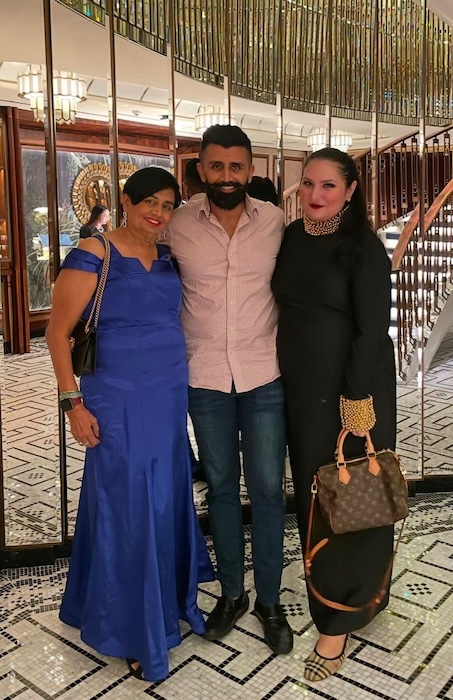
Captain Suneel Singh Rekhraj flanked by his mum Genny Kaur (left) and wife Dr Kiran Kaur Gill
Suneel began his journey with low-cost carrier AirAsia as a Second Officer in 2016.
“The pandemic presented significant challenges, and when Suneel was placed on furlough, it was a tough time. Thankfully, he was back in the skies once the borders reopened, and he’s never looked back since,” she said.
With his award in hand, Captain Suneel expressed his emotions, stating, “Every flight is special to me. I strive to give 100% in every aspect, from maintaining a polished appearance to ensuring the safety of my team and the aircraft. Providing exceptional service to AirAsia’s passengers is a source of great pride for me. The journey has been long, but I am thankful to the airline for offering me opportunities to grow and excel as both a pilot and as a person.”
Next time you fly with AirAsia, keep an eye out for Captain Suneel!
Captain Suneel Singh Rekhraj wins Allstar Hero Award 2024, presented by AirAsia CEO Tony Fernandes
ASIA SAMACHAR is an online newspaper for Sikhs / Punjabis in Southeast Asia and beyond. You can leave your comments at our website, Facebook, Twitter, and Instagram. We will delete comments we deem offensive or potentially libelous. You can reach us via WhatsApp +6017-335-1399 or email: asia.samachar@gmail.com. For obituary announcements, click here
TATT KHALSA DIWAN MALAYSIA (2025/2026). L-R: Ranmit Singh, Rejinder Singh, Sarjeet Singh, Amarinder Kaur and Amarjeet Kaur
By Asia Samachar | Malaysia |
Ranmit Singh has been elected unopposed to lead the Tatt Khalsa Diwan Malaysia management committee for the next two years (2025/2026).
Ranmit, a lawyer by profession, was part of a largely fresh team that ran with the slogan ‘Let’s come together for a change. Make Tatt Khalsa Great Again’. He served as the president in the outgoing team.
Women outnumbered men, making up seven out of the 12 members elected at Tatt Khalsa’s annual general meeting on Dec 1, 2024.
The two vice president slots went to Rejinder Singh and Sarjeet Singh, defeating Jasbir Singh, Harbans Singh and Gurdarshan Singh.
The new secretary is Amarinder Kaur who defeated the out-going secretary Hardev Kaur while Amarjeet Kaur won the treasurer’s position unopposed. (See full committee list below).
Among the key achievements of the out-going team were ramping up assistance to needy Sikhs families, providing temporary shelter to Indian nationals stranded in Malaysia during the Covid-19 period, settling a long running dispute with Panch Khalsa Diwan Malaya, air conditioning the Langgar hall and doubling up its income in the last few years.
Tatt Khalsa has close to 1,000 members, according to the president in a note to members.
WHAT TOOK PLACE
Ranmit said Tatt Khalsahad worked tirelessly to provide financial assistance and support to needy Sikhs, both locals and foreigners.
Ranmit Singh Gill. In the background is Gurdwara Sahib Tatt Khalsa
The Tatt Khalsa Family Aid Fund Committee has assisted 28 deserving families with monthly financial payments. One-off special aid payments were also given to needy Sikhs to assist with their medical bills and other financial difficulties. In FY2023, close to RM93,000 was disbursed, up from about RM87,000 in FY2022.
“We have also settled our long running dispute with Panch Khalsa amicably,” he said.
The issue revolved around a loan amounting to RM150,000 extended by Panch Khalsa to Tatt Khalsa. However, a previous management committee of Tatt Khalsa, led by Inder Singh Khosa, had argued that it was actually a donation, and not a loan. After attempts to refer the matter to arbitration failed, Panch Khalsa took the matter to the courts.
The long outstanding issue with Panch Khalsa was ‘amicable settled without prejudice’ in early March 2023 with a payment by Tat Khalsa the settle sum of RM75,000. In return and a goodwill gesture, Panch Khalsa has agreed to host/have Kirtan Darbars at Tatt Khalsa from time to time, according to its report to members.
In October, Ranmit said Tatt Khalsa pledged a total donation RM50,000, over the next five years, to the Malaysian Sikh Education Aid Fund (MSEAF) to assist students to pursue higher education as well as another donation to the Shamshan Bhoomi Parbandak Society which manages the crematorium at Jalan Loke Yew, Kuala Lumpur.
In another development, Ranmit updated the members that the next door market redevelopment was moving on track and the city council DBKL has ‘assured us all the hawkers will be relocated inside the market under Phase 3 starting next year’.
“Our application for Certificate of Fitness is also progressing well and hope to get the said CF by next year,” he said.
In 2021 and 2022, the gurdwara played a vital role in supporting local and foreign Sikhs affected by Covid-19.
FINANCIAL POSITION
On its financial performance, Tatt Khalsa’s income for the financial year (FY) 2023 was close to RM2.14 million, up 58% from 2022 (RM1.35 million) and more than double from RM928,670 in FY2021.
It incurred total payments of RM1.98 million in FY2023 (resulting in a surplus of RM160,760) compared to payment of RM1.38 million (2022) and RM774,756 (2021), with a small deficit of RM3,894 and a surplus of RM223,686 in FY2021 and FY2022, respectively.
The jump in FY2022 and FY2023 income was attributed to increase number of programmes as well as payments from the Indian High Commission for providing temporary shelter to Indian nationals who were waiting for their outward press and clearance during the Covid-19 period.
Dewan Rakyat deputy speaker Ramli Mohd Nor (seated, 2nd from left) visits Tatt Khalsa for Vaisakhi 2024. He is flanked by Tatt Khalsa Diwan Selangor VPs Gurdarshan Singh Chahal (white kurta) and Harbans Singh Kaleke, and other members – Photo: TKDS
The report noted that the commercial flights to India, suspended in mid-March 2022, were only resumed in April 2022, and most of the Indian nationals affected were able to return by the third quarter of 2023.
On the payment front, the report attributed the increase in FY2022 and FY2023 to three items.
First, the cost incurred for the preparation of langar as well as utilities expenses in tandem with the increase in the number of programmes held. Second, the cost incurred in renovating and refurbishing the third floor of the Wisma Tatt Khalsa, into dormitories to provide the temporary shelter, as well as the cost of providing the meals. Third, the cost incurred for the major repairs undertaken at both the Guru Nanak Darbar and the Wisma to address the problems of leaking roofs and water pipes.
Covid-19 testing at Wisma Tatt Khalsa. Insert: Testing process for general public, with Wisma Tatt Khalsa in the view
“As highlighted during the last Annual General Meeting in June 2022, both the buildings, the Guru Nanak Darbar as well as the Wisma Tatt Khalsa are now more than 30 years old, and there is a need to upgrade and to also focus on preventive maintenance at the premises.
“It was noted that the roof has been leaking due to the intensity of the rainfall, the lifts were breaking down more frequently, and the electricity costs has been on the rise as the air-conditioning system is old and needs to be changed to the cassette form,” according to its report.
ASIA SAMACHAR is an online newspaper for Sikhs / Punjabis in Southeast Asia and beyond. You can leave your comments at our website, Facebook, Twitter, and Instagram. We will delete comments we deem offensive or potentially libelous. You can reach us via WhatsApp +6017-335-1399 or email: asia.samachar@gmail.com. For obituary announcements, click here
With heavy hearts, we announce the passing of DSP (Retd) Shingara Singh Hazara Singh, who left for his heavenly abode on Sunday, December 8, 2024, at 7:16 AM.
A man of honor, courage, and service, DSP (Retd.( Shingara Singh dedicated his life to upholding justice and helping others. His unwavering commitment to duty and his deep love for his family and community will forever be cherished.
He leaves behind a legacy of integrity and kindness that will continue to inspire all who knew him. His absence creates an irreplaceable void in our lives, but his memories will remain eternal.
FINAL RITES Shamshan Bhoomi Hall (Jalan Loke Yew Crematorium, KL) 9 Dec 2024 (Monday) Last Respects: 2pm-3.30pm
PATH DA BHOG Gurdwara Sahib Petaling Jaya 15.12.2024 (Sunday), From 5pm to 7pm
“Those we love don’t go away; they walk beside us every day.”
Late wife: Pritam Kaur AP Kehar Singh
Children & Spouse: Late Ir. Parminder Singh Surinder Singh & Harcharan Jit Kaur Gurdish Kaur & Kuldip Singh
ASIA SAMACHAR is an online newspaper for Sikhs / Punjabis in Southeast Asia and beyond. You can leave your comments at our website, Facebook, Twitter, and Instagram. We will delete comments we deem offensive or potentially libelous. You can reach us via WhatsApp +6017-335-1399 or email: asia.samachar@gmail.com. For obituary announcements, click here
With winter now here on the shores of the UK, we can (hopefully) declare that this year’s wedding season has come to a close – respite from those weekend scrambles to leave the house early and to find matching pairs of socks (sans holes preferably!) This last year saw new levels of grandeur being set in South Asian weddings with the marriage of Anant Ambani whose nuptials spanned a number of months, drew global media attention, featured a who’s-who of business, politics and entertainment in attendance, and cost anywhere up to an estimated, eye-watering, billion dollars.
As Sikhs have criss-crossed the globe in recent decades, our cultural practices have evolved – shedding a few customs that are no longer deemed relevant, whilst gaining umpteen more elements perceived to be more relevant to our new, host countries. In our Year 1 Sikh Studies course, we have a class devoted to marriage in the Sikh way of life, where students are encouraged to explore and discuss their experiences of weddings to the backdrop of learning about the Anand Karaj. One such new innovation brought to my attention by a Canadian Sikh is the ‘Jersey Party’, an event where invitees are encouraged to attend wearing their favourite sports team’s shirt. Can’t see it catching on in the UK, although would quicken the inevitable uncle fight after a few drinks!
There is a lot to be appreciated in a Las Vegas wedding – something that my wife and I learnt as we weighed up forgoing the stress of a traditional desi event after our engagement. We were fortunate to have supportive parents who agreed to a simple, no-frills wedding in the end, which is exactly what is on offer to couples that wed in Las Vegas. What does this have to do with Sikhdom? The Anand Karaj ceremony as we know it today was formalised (not invented) in the nineteenth century by reformers as a direct response to the opulence and excesses seen in the Sikh Kingdom of the time. They centred the ceremony around Gurbani, relinquishing the baggage that took up people’s time and money, returning the notion of marriage as a part of our wider lives, not the be-all and end-all happening of our lifetime. Has the time come for re-introspection for Sikhs today?
People can spend their money whichever way they like, however the staggering and ever-increasing cost of weddings is becoming difficult to ignore. We need to balance this alongside ensuring we have strong Sikh institutions; research that the Sikh Education Council will shortly release showcases the dire financial situation of the majority of Sikh institutions in the UK, headlined by our finding that annual expenditure on Sikh weddings now far exceeds the total annual income of all Sikh organisations with charitable status. Is this a damning indictment of our commitment to the Panth today, or a representation of where our priorities now lie?
What do you think the Sikh ‘Vegas’ wedding should look like and would you have one?
ABOUT THE AUTHOR: Harwinder Singh is an educator and writer volunteering for the Sikh Education Council. The article first appeared at his LinkedIn account.
ASIA SAMACHAR is an online newspaper for Sikhs / Punjabis in Southeast Asia and beyond. You can leave your comments at our website, Facebook, Twitter, and Instagram. We will delete comments we deem offensive or potentially libelous. You can reach us via WhatsApp +6017-335-1399 or email: asia.samachar@gmail.com. For obituary announcements, click here
Grandchildren / Spouses: Dr Phevenpreet Kaur / Dr Jaswinderpal Singh Peven Kaur Calais Harkireth Singh Calais Chetenraj Singh Kirtana Kaur Gill Sahej Singh Gill Japna Kaur Sapna Kaur
FINAL RITES 8 December 2024 (Sunday) Shamshan Bhoomi Hall, Jalan Loke Yew Crematorium, KL (Lot 294, 295, Jln Loke Yew, Pudu, 55200 Kuala Lumpur, Wilayah Persekutuan Kuala Lumpur) 10am – 12 noon: Visitation 12 noon: Saskaar (cremation)
PATH DA BHOG 14th December 2024 (Saturday), From 6pm to 8pm Gurdwara Sahib Petaling Jaya
ASIA SAMACHAR is an online newspaper for Sikhs / Punjabis in Southeast Asia and beyond. You can leave your comments at our website, Facebook, Twitter, and Instagram. We will delete comments we deem offensive or potentially libelous. You can reach us via WhatsApp +6017-335-1399 or email: asia.samachar@gmail.com. For obituary announcements, click here
I identify as a Panjabi internationalist, a perspective deeply rooted in the land, its people, and its enduring legacy. The term Panjab, derived is from the Persian words “Panj” (five) and “Aab” (water), which literally translates as ‘Land of Five Rivers’. These rivers – Beas, Chenab, Jhelum, Ravi, and Sutlej – not only define the physical geography of Panjab but also its cultural and historical lifeblood. For me, being a Panjabi internationalist means transcending the artificial political boundaries imposed on the region and instead embracing the natural geography, shared history, and vibrant culture that have shaped the land and its people for centuries.
Panjab’s geography is central to its identity. The region’s fertile plains, nourished by its rivers, have made it a cradle of agriculture and human civilization for millennia. It is no coincidence that Panjab is often referred to as the breadbasket of South Asia. Beyond its agricultural abundance, the land has also served as a crossroads for trade, migration, and cultural exchange, linking Central Asia, South Asia, and the Middle East. This position as a geographic and cultural nexus has enriched Panjab but has also exposed it to repeated invasions and conquests, each leaving an indelible mark on its history and culture.
Culturally, Panjab is a mosaic of diversity. It has been home to a wide range of religious and cultural traditions, from ancient Hinduism and Buddhism to the rise of Sikhism and the spread of Islam. Sikhs, Muslims, Hindus, Christians, and others have coexisted in this region, sharing festivals, languages, and traditions that transcend individual faiths. The ethos of sarbat da bhala (well-being of all), a core tenet of Sikh philosophy, encapsulates this spirit of coexistence and collective humanity. Despite the tragic scars of Partition, Panjab’s cultural fabric continues to inspire unity in diversity.
The history of Panjab is one of remarkable resilience and defiance against oppression. From the teachings of the Sikh Gurus, who championed equality and justice, to the establishment of the Sikh Empire under Maharaja Ranjit Singh, Panjab has long been a land of resistance. During British colonial rule, Panjabis were at the forefront of the Indian independence movement, contributing leaders and martyrs who fought against imperial subjugation. In recent times, the farmer protests and ongoing struggles against majoritarian nationalism and Hindutva politics continue this legacy of defiance, reflecting a refusal to bow to injustice. This spirit of resistance, rooted in dignity and self-respect, is a source of immense pride and inspiration for me and countless Panjabis around the world.
A refugee train, 1947. Photo: Wikimedia Commons
However, Panjab’s unity has been repeatedly undermined by political and nationalistic forces. The Partition of 1947 was a devastating rupture that divided Panjab into two nations, India, Pakistan – and later, Bangladesh – leaving millions displaced, traumatized, and severed from their ancestral homes. This dismemberment was not merely a physical division but a profound cultural and emotional fracture. To this day, the artificial border cuts through families, communities, and shared histories. Within India, the Panjab has faced further division, with the creation of Haryana and Himachal Pradesh in 1966, reflecting the central government’s inability or unwillingness to fully acknowledge Panjab’s linguistic and cultural uniqueness.
Despite these divisions, the essence of Panjab endures. Its language, Panjabi, continues to be a powerful unifier. Rooted in the Gurmukhi script on the Indian side and Shahmukhi script in Pakistan, Panjabi remains a repository of the region’s collective memory, literature, and folklore. It carries within it the wisdom of Sufi poets like Baba Farid, Bulleh Shah, and Waris Shah, whose verses transcend religion and resonate with universal truths.
For me, the idea of Panjab transcends the shifting boundaries and political machinations that seek to fragment it. Panjab is not just a place but a living, breathing ethos—a celebration of diversity, resilience, and interconnectedness. While the rivers that gave Panjab its name may flow through divided lands today, they continue to nourish a shared identity. As new generations of Panjabis emerge, they inherit this legacy of coexistence, defiance, and creativity, ensuring that the spirit of Panjab remains vibrant and replenished. My pride in my Panjabi heritage is not merely nostalgic; it is a call to celebrate and preserve the unique beauty and strength of this land and its people.
Gurnam Singh is an academic activist dedicated to human rights, liberty, equality, social and environmental justice. He is an Associate Professor of Sociology at University of Warwick, UK. He can be contacted at Gurnam.singh.1@warwick.ac.uk
* This is the opinion of the writer and does not necessarily represent the views of Asia Samachar.
ASIA SAMACHAR is an online newspaper for Sikhs / Punjabis in Southeast Asia and beyond. You can leave your comments at our website, Facebook, Twitter, and Instagram. We will delete comments we deem off
Sanyukt Kisan Morcha in a farmers’ protest in December 2024 – Photo: Patiala Help Club
By Asia Samachar | India |
Indian farmers once again set out on their protest march in their quest to demand guaranteed crop prices, ala the succesful 2021 protests.
The march on Friday came to a halt just as it started when the Haryana police fired tear gas against hundreds of farmers near Shambhu, a border crossing between northern Punjab and Haryana states.
The protest, organised by the Samyukt Kisan Morcha (SKM), a group representing 12 farmers’ organizations, are bent on raising their issues in Parliament during the winter session.
The farmers are demanding a legal guarantee for minimum support prices for crops, farm debt waivers, pensions for farmers and laborers, and other issues, while urging the Uttar Pradesh government to meet their “genuine demands.” They have been protesting at the Shambhu border since February after their earlier march was halted.
A similar protest three years ago resulted in tens of thousands of farmers camping on the capital’s outskirts for more than a year, reported AP.
The government protects agricultural producers against any sharp fall in farm prices by announcing a minimum purchase price for certain essential crops at the beginning of the sowing season, taking into account the cost of production. But state agencies often buy only rice and wheat at the support level, and farmers want minimum purchase price for at least more than 20 essential crops, according to the report.
In 2021, Modi repealed a set of agricultural laws that the protesting farmers said would hurt their incomes. The withdrawal of the laws was seen as a major retreat by the government, which was shocked in January that year when tens of thousands of farmers stormed the historic Red Fort in New Delhi.
After withdrawing the laws, the government said it would set up a panel of farmers and government officials to find ways to ensure support prices for some essential farm produce.
Multiple meetings since then have made no progress and farmers accuse the government of not fulfilling that promise.
ASIA SAMACHAR is an online newspaper for Sikhs / Punjabis in Southeast Asia and beyond. You can leave your comments at our website, Facebook, Twitter, and Instagram. We will delete comments we deem offensive or potentially libelous. You can reach us via WhatsApp +6017-335-1399 or email: asia.samachar@gmail.com. For obituary announcements, click here
Punjabi Dalit women at the farmers’ protest in 2021 – Photo: Shhreya Sharma / Kaur Life
By Ajit Singh Liddar | The Sikh Bulletin |
Sacrilege (beadbi) is the physical or verbal attack on religious symbols, literature, places, religious leaders, prophets, Gurus, saints and pieties, etc. No one has the right to indulge in sacrilege of any kind of anything or anyone, be it pertaining to the religion of others or one’s own. It is with utmost sadness, that I mention that we Sikhs are the biggest perpetrators of this sacrilege. I list some of the acts of beadbi are given below.
Our Guru is neither the paper the Bani is written on nor the ink with which it is written but it is, what is written. Paper and ink can be destroyed, but the Bani – Shabd is immortal.
To understand the Bani, we must keep in mind the concept that the Bani is expressed in the spiritual essence and not its literal meanings, Bhav-arth and not the word-arth.
WE SIKHS HAVE ACCEPTED THAT:
1. Sikh Gurus ordained that all human beings are equal and be treated as such, i.e. no caste or class discrimination. Most Sikhs knowingly or unknowingly do not obey the Guru’s Hukam (Dictat) and keep on discriminating against the Dalits and other disadvantaged people of lower castes, treating them as sub-humans.
2. A recent Sikh phenomenon has created another upper-class caste among Sikhs, that of those who have partaken the Khande de Pahul. Most of them think and believe that they are higher in the hierarchy, and some of them claim a status closer to the Almighty. This goes against the concept of equality among humans. This, in my view, is a Beadbi.
3. The Guru Granth Sahib ordered us not to covet what belongs to others, be it property, or other possessions. How many Sikhs can honestly swear to the fact, that in their life, they have neither done that nor do it now, i.e. indulge in this practice? This is also a Beadbi.
4. Guru advised us the be honest, and humble and not lust and greedy for riches. How many Sikhs can attest to the fact that they are friends with the lowest of the low? I believe most of us find ourselves in the company of the rich and the powerful or trying to catch up to them. This is also a sacrilege.
5. Guru Granth Sahib says that we shun man-made customs, rituals, maryadas, and riti-rivaz. We are so engrossed in these fake practices that we do not even know that are following them. A critical look at any Gurudwara will give us a handful of examples of this Beadbi. Baba Nanak and Bhagat Kabir forbade and warned us against these rituals. We ignore their teachings and supersede them with our wisdom.
Just one example will suffice, in my hometown in Canada, a few years ago, a local fire brigade was called to put out a fire in the Gurudwara parking lot. The cause of the fire was the burning of ‘Rumalas of Guru Granth Sahib’. The management explained that they did not have a storage facility to keep large volumes of Rumalas. We know that the sangat tends to buy the most expensive ones in blind Shardha. What a waste, can we simply wait till the present ones are sufficiently worn out to replace them and advise the sangat not to bring the Rumalas on every occasion? To avoid this sacrilege would mean to stop wastage of sangat’s resources. Money could be used for the needy or other uses, i.e. education and health services.
6. According to the philosophy of Sikhi, all Sikhs must involve themselves in Kirat Karni, Naam Japna, and Vand Shakna. To not partake in Kirat Karni and become a free-loader, or a parasite to the welfare system of a country is also a Beadbi.
7. The Gurus started the tradition of langar for the needy i.e. hungry. Look at who is eating in the Langer Halls today? Everywhere in the world, you will find rich and well-fed people discussing the menu of langar. The needy all over the world are still sleeping with empty stomachs. Is this not a Beadbi?
Ajit Singh Liddar, PhD, is the author of ‘Ghadar Movement: Genesis & Inspiration. He can be contacted at ajitliddar@yahoo.ca. The article is courtesy ofThe Sikh Bulletin – December 2024 (Vol 26, No 5). Click here to retrieve archived copies of the bulletin.
ASIA SAMACHAR is an online newspaper for Sikhs / Punjabis in Southeast Asia and beyond. You can leave your comments at our website, Facebook, Twitter, and Instagram. We will delete comments we deem offensive or potentially libelous. You can reach us via WhatsApp +6017-335-1399 or email: asia.samachar@gmail.com. For obituary announcements, click here
FINAL RITES: Saturday, 7 December 2024 10am: Cortège leaves from residence at No 27, Jalan 12/2A, 46200 Petaling Jaya 11am: Saskaar (cremation) at Krematorium Jalan Kuari (318, Jalan Kuari, Kampung Cheras Baru, 56100 Kuala Lumpur)
PATH DA BHOG Thursday, 12 December 2024, at 5pm Gurdwara Sahib Petaling Jaya
ASIA SAMACHAR is an online newspaper for Sikhs / Punjabis in Southeast Asia and beyond. You can leave your comments at our website, Facebook, Twitter, and Instagram. We will delete comments we deem offensive or potentially libelous. You can reach us via WhatsApp +6017-335-1399 or email: asia.samachar@gmail.com. For obituary announcements, click here
Anthropologist and educator Dr Jaskiran Kaur Bhogal has been appointed to the newly-established Guru Nanak Stipendiary Research Fellowship at Wolfson College, University of Oxford, effective from February 2025.
The position was made possible by a fundraising campaign primarily among the Punjabi Sikh community in Britain, the university said in a statement.
Dr Bhogal has a BSc in Economics and an MSc and a PhD in anthropology from the LSE. Her research explores the ways in which Sikhs in Britain navigate the spiritual and temporal dimensions of religiosity; how Sikhs practice their faith both privately and in the public sphere, primarily by focusing on key sites such as the home, schooling, youth groups, community, and social groups.
Her research has laid a solid foundation for exploring the teachings of Guru Nanak and the legacy of the Punjab in Britain specifically, the statement added.
Dr Bhogal is going to research the preservation of intangible heritage, deeply rooted in the historical and spiritual context of Punjab, through childbirth, child-rearing, and homemaking practices, drawing upon traditions and the teachings of Guru Nanak Sahib.
The project will explore how the Sikh community maintains a connection to their spiritual and cultural heritage in a British diaspora context. She will explore how Sikh families create Sikh spaces within their homes and everyday lives, where the cultural and spiritual heritage of Punjab is preserved and transmitted across generations.
ASIA SAMACHAR is an online newspaper for Sikhs / Punjabis in Southeast Asia and beyond. You can leave your comments at our website, Facebook, Twitter, and Instagram. We will delete comments we deem offensive or potentially libelous. You can reach us via WhatsApp +6017-335-1399 or email: asia.samachar@gmail.com. For obituary announcements, click here