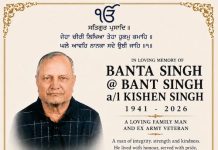
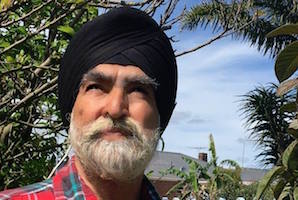
It is with deep sorrow that we, the family of Sardar Mehar Singh, announce the passing of our much cherished and beloved pillar of strength.
Wife: Madam Mendar Kaur d/o Mhan Singh
FINAL JOURNEY 30 November, 2024 (Saturday) – 1pm: Cortege leaves residence at No. 37, Jalan 14/60, 46100, Petaling Jaya , Selangor – 3pm: Cremation at Shamshan Bhoomi Hall, Loke Yew
ASIA SAMACHAR is an online newspaper for Sikhs / Punjabis in Southeast Asia and beyond. You can leave your comments at our website, Facebook, Twitter, and Instagram. We will delete comments we deem offensive or potentially libelous. You can reach us via WhatsApp +6017-335-1399 or email: asia.samachar@gmail.com. For obituary announcements, click here
Gandhi (left). Right: Sikh victim in 1984 carnage (Photo by Sondeep Shankar)
By Bhupinder ‘Bo’ Singh | Opinion |
Dear Gandhi Ji,
On October 03, 2024, all the newspapers, TV media, in India and around the world carried news of your birthday celebrations from the day before. In India, you being the father of the nation, it was a national holiday where your lasting legacy of “Ahimsa”, meaning nonviolence, was recalled. In fact, now your birthday is celebrated as the International Day of Non-Violence. Even The Wall Street Journal, out of New York, carried a picture of your birthday celebration in India on the front page. In the picture a child was attired like you, in a gesture of refreshing your core message of “Ahimsa.”
Suddenly, my thoughts flashed to 40 years ago. It was the last day of the month of your birth in 1984, and by evening in the capital of India the air was filled with smoke billowing all around, and an eerie silence gripping the capital.
There were targeted killings, burning properties and vehicles, looting, raping, burning by pouring kerosene and petrol. The police had suddenly disappeared from the scenes of crime, and if they happened to be there they either turned a blind eye or rooted for the perpetuators. What was being unleashed was unbelievable, and even the media coverage of such incidents was totally blacked out.
Your message of “Ahimsa” was being replaced with violence “Hinsa” in the capital as well as other major cities of the nation. The trains, airports, roads were not safe for venturing out. The houses, shops and businesses owned by Sikhs were being selectively burned and goods looted. The mobs had voters list where the faith of residents were available to target. With that information the houses of Sikhs were identified and marked with ‘X’ for killing, loot and plunder. Any attempts to stop the attackers was not just futile but dangerous, as it made the person attempting vulnerable to mob attack.
1984 carnage – Photo: Sondeep Shankar
The Sikhs, lauded as warriors, and protectors of the nation, had been reduced to victims, despised second class citizens, worthy of elimination. Your promise of February 21, 1931, to the Sikh community at Gurdwara Sis Ganj in Delhi had been very conveniently forgotten after August 15, 1947, but today they had become pariah in the month of your birth plus following month. You had assured Sikhs that their rights would be respected, and their aspirations would find fulfillment in an independent India, but on that day and days that followed, over 3,000 Sikhs lost their lives in Delhi. It was an open Sikh genocide with slogans filling the air “Khoon Ka Badla Khoon.”
Where you are the father of the nation, the violence, killing, raping, looting, pillaging were just not sanctioned, but also officially abetted. The pride of Sikh, the turban had become their own privation. The widows who lost their husbands, the kids who were orphaned during this carnage, are still languishing after 40 years, and paying the price. Till date these sufferers have not been able to rebuild their lives.
NO OFFICIAL APOLOGY
Forty years after the tragic event, there is no official apology, or an attempt to find the underlying cause of it, or punishment of the perpetuators has not been initiated. Even the complicity of the police in the atrocities, which is a grave issue, has also not received adequate investigation or punishments for dereliction of duties. Even the issue of Sikhs in the police forces being sent home from their duties has not been dealt with adequately. Many inquiry commissions have been appointed not to catch the perpetuators, but to wash those and give clean chit to elected and government officials glossing over their acts of omission. The call for reconciliation has fallen on deaf ears. The state machinery was unleashed not against an enemy in times of war, but against the citizens, duly abetted by elected officials.
1984 – Sketch by Devender Singh
Gandhi Ji! The father of the nation! Tell me how this could take place in your nation? You are the revered figure of the nation, where hardly any city exists without any street or road named after you plus with your statue on a pedestal greeting the visitors on the street. Your legacy has inspired others as Martin Luther King Jr., Nelson Mandela, Lech Walesa, and many others, but in that country is your legacy for lip service and show alone? That aspect bothers me even today. Additionally, there are numerous museums in India and even outside of India that promote your legacy, yet after 105 years of your birth anniversary, what we saw was an unbelievable trauma being unleashed, together with collective consciousness amnesia from the leaders professing to be following your teaching.
SHOWCASE THE TRAGIC STORIES
I am writing this letter to you Gandhi Ji to plead with you about the need of a museum to showcase, share the tragic stories and voices of these unfortunate victims. So that in future a carnage, a genocide of this nature and scale will not be perpetuated. In fact, this should be the place where we share how when the mockery of the lofty principles is made through their use for solely political gains, the results will be disastrous. This museum will become an essential extension to share the results of perpetuating “Hinsa” in the name of “Ahimsa.” Let us create such a legacy so that these brazen acts don’t get repeated.
If you were wondering where the inspiration for this letter came from, then I will tell you that it came from the letter that Amrita Pritram wrote to Waris Shah in 1948, to share the pains of partition. Now, in 1984, we again witnessed a similar carnage, the only chronological change was a change in position of number 4 and 8 in the year, but today the fate and position is Sikhs was turned upside down. I will end this letter with couplets from that famous letter “Ajj Aakhan Waris Shah Nu” with some changes by me (in UPPERCASE) as under:
“A million daughters weep today, to you Waris Shah GANDHI JI they turn their eyes.”
And
“Corpses entomb the fields ROADS today; the Chenab YAMUNA is flowing with blood.”
The cries and agony along with red Yamuna will make you turn from your Samdhi on its banks.
Bhupinder ‘Bo’ Singh, Houston. Born in Bhamo, Myanmar, he now lives in Houston, US, where he runs a manufacturing company formed with his son. A mechanical engineer by training, he has authored a number of books, including Connecting with the Master – A collection of essays on topics related to Sikhism (2006) and In Bully’s Eyes – An Illustrated Children’s book on Bullying (2019).
ASIA SAMACHAR is an online newspaper for Sikhs / Punjabis in Southeast Asia and beyond. You can leave your comments at our website, Facebook, Twitter, and Instagram. We will delete comments we deem offensive or potentially libelous. You can reach us via WhatsApp +6017-335-1399 or email: asia.samachar@gmail.com. For obituary announcements, click here
Popular sketches of Guru Nanak and Guru Gobind Singh. Source: Arora Art
By Paguman Singh | Sikhi |
Generally, anyone interested in the Sikhs, while reading the history of the ten Gurus in their physical forms, tends to assume that there is a difference in the Sikh way of life taught by the first Guru, Guru Nanak Sahib and the tenth Guru, Guru Gobind Singh. Some misunderstood notions has led to this assumption that Guru Nanak, the founder of the faith, was a pacifist while Guru Gobind Singh was militant who was involved in wars.
Paintings of Guru Gobind Singh Ji also portray him as a saint soldier, riding a horse while dressed in full fighting gear and a sword held in his hand. On the other hand, the painted portraits of Guru Nanak show a calm saint sitting cross legged with a lifted hand and open palm to signify peace and blessings. Any careful reader will immediately note that these cannot be used as foundations on which a difference can be established between the Gurus. Hence, this article is an attempt to draw anyone, with an open mind, to decide if there is any difference between the way of life, Sikhism, as preached and practiced by both Guru Nanak Sahib and Guru Gobind Singh.
The foundational belief of Sikh philosophy is that there is only one Creator (Ek Ongkar) and no other. All the Gurus preached and practiced the Sikh way of life based on this central truth. As the Creator resided in his creation, Guru Nanak established the principle of treating all human beings as equal irrespective of race, religion, ethnicity, occupation or place of residence which has been enshrined as the basic practice of Sikhism. Guru Nanak Sahib had Bhai Mardana, who was a Muslim minstrel, as his companion for a lengthy period of 42 years. Guru Gobind Singh on his part had Pir Budhu Shah and other Muslims who supported his efforts to create a honest and just society.
The acceptance of equality by Guru Gobind Singh can be witnessed from the Vasakhi 1699 event where followers from all castes and religions partook in the Amrit ceremony and the Panj Pyare ‘five beloved’ were from various castes and geographical regions.
You could see it even in battles. Guru Gobind Singh, while fighting injustice and persecution, was joined by Pir Budhu Shah, a Muslim leader, and his 500 followers. Guru Gobind Singh’s army provide injured soldiers in the battles medical and nutritional support without any discrimination. The universal acceptance of all humans into the fold of Sikhi by both Gurus indicates that Guru Gobind Singh Ji continued and stood strong on the principles established by Guru Nanak Sahib.
In the discussion with the Siddhas, Guru Nanak when asked who was his Guru. He clearly stated that the Shabad or Divine Knowledge was his Guru ਪਵਨ ਅਰੰਭੁ ਸਤਿਗੁਰ ਮਤਿ ਵੇਲਾ ॥ਸਬਦੁ ਗੁਰੂ ਸੁਰਤਿ ਧੁਨਿ ਚੇਲਾ ॥Sabadh Guroo Surath Dhhun Chaelaa || The Shabad is the Guru, upon whom I lovingly focus my consciousness; I am the chaylaa, the disciple.
ਰਾਮਕਲੀ ਗੋਸਟਿ (ਮਃ ੧) (੪੪):੨ – ਗੁਰੂ ਗ੍ਰੰਥ ਸਾਹਿਬ : ਅੰਗ ੯੪੩ Raag Raamkali Guru Nanak Dev “Air is the beginning (i.e. breath is the source of life) The time is for the wisdom of the True Guru (i.e. human life is time for following the teachings of the True Guru). The WORD is the Guru, focusing the mind (on the word) is the disciple. pg. 943 GGS.
THE GURU PRINCIPLE
The Guru principle enshrined in Gurbani is that the word or Gurbani is the Guru not the physical or body of the teacher. This is witnessed when Guru Nanak Sahib enthroned Bhai Lehna and named him Guru Angad and transferred all the Bani to him. Guru Nanak Sahib lived in physical form for a period of time after the transfer of guruship and all Sikhs only went to Guru Angad for blessings and religious direction. The process of appointing the next Guru from then on followed the same principle where guruship was synonymous with the transfer of Gurbani.
In Guru Granth Sahib this change is described by Bhai Satt and Balvand as follow ਜੋਤਿ ਓਹਾਜੁਗਤਿ ਸਾਇ ਸਹਿ ਕਾਇਆ ਫੇਰਿ ਪਲਟੀਐ ॥Joth Ouhaa Jugath Saae Sehi Kaaeiaa Faer Palatteeai || They shared the One Light and the same way; the King just changed His body. (Raag Raamkali, Bhatt Satta & Balwand, 966).
The reputation that had been earned by Nanak, (now) got proclaimed for Lehna (in Guru Angad) is the same Light, and the same way: the king (the Guru) had changed his body again (i.e. into a new one). This principle was continued up to Guru Gobind Singh when he was appointed Guru after his father Guru Tegh Bahadur handed over his Bani and Pothi Sahib to him and left for Delhi to defend human rights to religious practice.
Guru Gobind Singh in 1705 then added the Bani of Guru Tegh Bahadur to the original Granth prepared by Guru Arjan Sahib in 1604. This event is evidence that Guru Gobind Singh accepted and followed the foundational principles enshrined in Guru Granth Sahib. All the Gurus followed the teaching and divine messages of Gurbani as contained within Guru Granth Sahib. It can be stated that the Sikh Gurus no doubt having different names and lived in different times adhered and only followed the teachings and divine guidance of the Shabad, Gurbani were one in spirit.
EXTERNAL PHYSICAL IMAGE
An examination of the development of the Sikhs would also shed light on the fact that the external physical image of a Sikh was transformational development in line with the requirements of the times. Guru Nanak Sahib preached on the importance of the family and achieving spiritual enlightenment while performing the social and economic responsibilities. Hence, all the Guru, with the exception of one, due to age, were married and had families. Guru Nanak Sahib was married and had two sons while Guru Gobind Singh had four sons in his family.
Development of the Gurus was based on education in a variety of languages and subjects and both Guru Nanak Sahib and Guru Gobind Singh had the best teachers of the time. Individual Sikhs were also required to be physically fit as well as have a high level of education. Guru Angad set up wrestling places for Sikhs to develop their physical strength, while he himself was involved in teaching Gurmukhi. Based on this knowledge, Sikhs had been developing economically and were involved in businesses and trade. Physical development and education were used for health, security and economic development.
NEW TOWNSHIPS, MUGHAL INTOLERANCE
In addition to physical and mental development supported by moralistic values of lives, the Guru also developed new townships. Guru Nanak Sahib established Kartarpur which become an important center of the Sikhs as did Guru Angad, Guru Amar Das, Guru Ram Das, Guru Arjan, Guru Hargobind and Guru Gobind Singh. These were centers of learning and human development as well as economic upliftment of society. These centers in addition had medical facilities for all irrespective of race and religion and even lepers, disabled by the disease, had a center built. All these activities were being watched suspiciously by the rulers as well as other jealous biased religious figures who acted as instigators. Guru Gobind Singh also developed Anandpur, which like Kartarpur established by Guru Nanak, was a center of learning as well as refuge for persecuted individuals. The intellectual discussions and open learning in these centers clearly establish that militancy was not a prime driver as some would like to believe.
Developments in the ruling political environment of the Mughal from tolerant policies to one of non-acceptance of other faiths, removal of freedom, repression and suppression of the population affected the Sikhs. Despite the enormous work of economic development, promotion of trade and managing pandemics by Guru Arjan, the rulers of the day cruelly tortured and martyred him.
At this stage, the physical development that had been established for generations, coupled with experience in protection capabilities established for their trade in Afghan horses, proved useful in building defensive capabilities.
Guru Hargobind, the grandfather of Guru Gobind Singh took on the challenge by establishing the Akaal Takhat as well as recruiting young men to join a defensive force. Guru Hargobind had to defend himself from the attacks of the rulers four times. It is at this stage that Sikhism had its own center of justice for all, a commitment to stand with the oppressed, a flag or Nishan Sahib of its own and along with it a fighting army only to provide protection.
Guru Har Rai, the seventh Guru, had a cavalry of 300 men as a protective force. These historical facts indicate that the use of arms and maintaining protection skills cannot be taken as militarization of the Sikh religion but has to be viewed as measures to prevent subversion and injustice. Being prepared to defend oneself and to stand up against injustice had become a principle of Sikhism based on the principle “ਭੈ ਕਾਹੂ ਕਉ ਦੇਤ ਨਿਹ ਨਿਹ ਭੈ ਮਾਨਤ ਆਨ ॥“॥੧੬॥ {ਪੰਨਾ 1427} Put no one in fear nor accept any intimidation.”
THE SAME SPIRIT
As Sikhism developed further after the establishment of principles and institutions, the next stage was to get the commitment of the individual Sikh to stand above all and be recognized as a practitioner of the values possessing moral courage. This involved a uniform based on values as it was to be declared as the righteous army of the Creator.
On Vaisakhi day in 1699, Guru Gobind Singh then formalized the process and instilled motivation for conforming to the principles established by Guru Nanak Sahib. Guru ji, in his call for commitment, used the following “Is there anybody in the congregation ready to sacrifice his head on the path established by Guru Nanak” (refer Prof. Satbir Singh in his book Sikha Ka Ithas das Guru Sahiban”. This powerful call to a crowd of 80,000 who had travelled to Anandpur from the four corners of the world clearly indicates that Guru Gobind Singh was standing by the principles established by Guru Nanak Sahib. The commitment was shown by accepting Khanda di Pahul, which could only be prepared by the recitation of Bani beginning with Japji, the divine message revealed by Guru Nanak Sahib. In fact, all these historical facts clearly establish that Guru Nanak Sahib and Guru Gobind Singh were the same spiritual masters providing the guidance to the Sikhs, also called the Khalsa.
Guru Nanak Sahib challenged the rulers of the day and criticized Babar for his destruction of Ahmedabad and the imprisonment of the population. Guru Nanak was also imprisoned but by uniting the people he succeeded in getting them all freed, the largest Bandi Shor. Guru Nanak Sahib called the unjust rulers tigers and dogs, and the administrators as blood sucking parasites. “ਰਾਜੇ ਸੀਹ ਮੁਕਦਮ ਕੁਤੇ ॥ ਜਾਇ ਜਗਾਇਿਨç ਬੈਠੇ ਸੁਤੇ ॥ ਚਾਕਰ ਨਹਦਾ ਪਾਇਿਨ ਘਾਉ ॥ ਰਤੁਿਪਤੁ ਕੁਿਤਹੋ ਚਿਟ ਜਾਹੁ ॥ ॥੨॥ {1288}” The battle of justice and equality began with a divine pen which had success with the masses.
Guru Gobind Singh used the sword of justice to defend the oppressed and give them the human dignity of religious and social freedom. Guru Gobind Singh only fought to defend righteousness and human rights, in wars that were not initiated by him or his Sikhs. Hence, there was no military intent or motive to conquer land or acquire wealth in all the activities of Guru Gobind Singh. Clearly, both the Gurus had the same religious and spiritual mission and cannot be seen as one bring a pacifist and the other a militant.
Paguman Singh, a retired senior official of a Malaysian-based social security organisation, has been involved in Sikhi parchaar for more than three decades. He now resides in New Zealand.
* This is the opinion of the writer, organisation or publication and does not necessarily represent the views of Asia Samachar.
ASIA SAMACHAR is an online newspaper for Sikhs / Punjabis in Southeast Asia and beyond. You can leave your comments at our website, Facebook, Twitter, and Instagram. We will delete comments we deem offensive or potentially libelous. You can reach us via WhatsApp +6017-335-1399 or email: asia.samachar@gmail.com. For obituary announcements, click here
Royal Malaysian Air Force (RMAF) chief General Mohd Asghar Khan made an personal visit to his ancestral village in Khyber Pakhtunkhwa after an official visit to Pakistan.
The 58-year-old general, who took over the RMAF command in 2022, traces back his origins to the village Beer in District Haripur in Khyber Pakhtunkhwa.
His grandfather Malik Qalandar Khan went to Malaysia before the establishment of Pakistan, where Muhammad Asghar Khan’s father Gohar Aman and uncle Malik Muhammad Yaqub were born. Mohd Asghar’s father Gohar Aman retired as an officer in the Malaysian police, according to a local newspaper.
General Asghar’s trip to Pakistan coincided with his participation in the IDEAS 2024 Defense Exhibition in Karachi. On his personal request, the Government of Pakistan made special arrangements for his visit to Beer, according Associated Press of Pakistan (APP).
The report added that the general’s arrival in his ancestral village was conducted with full official protocol.
He traveled by helicopter, with the Pakistan Army and local police ensuring heightened security measures. The arrangements were made to ensure the smooth execution of the visit, reflecting the high regard in which the General is held.
During his visit, he offered prayers at the graves of his ancestors, including his grandfather, grandmother and uncle Malik. He also visited family homes and met with relatives who still reside in the area.
The visit held deep sentimental value for the general as he sought to reconnect with his roots and honour his family’s legacy, APP reported.
General Asghar’s wife, whose native area is also Haripur, also joined him for the visit.
ASIA SAMACHAR is an online newspaper for Sikhs / Punjabis in Southeast Asia and beyond. You can leave your comments at our website, Facebook, Twitter, and Instagram. We will delete comments we deem offensive or potentially libelous. You can reach us via WhatsApp +6017-335-1399 or email: asia.samachar@gmail.com. For obituary announcements, click here
DPM Fadillah Yusof (5th from right) flanked by Daljit Singh (4th from right) and other Sikh Welfare Society Malaysia (SWSM) office bearers at a Diwali event on Nov 15, 2024 – Photo: Asia Samachar
By Asia Samachar | Malaysia |
Sikh Welfare Society Malaysia (SWSM) intends to ramp up its outreach programme in assisting needy families, including the possibility of setting up a midway house.
“We assist the less fortunate members of the community, those who face daily struggles just to make ends meet and bring up their family members,” SWSM president Daljit Singh said at a Diwali gathering in Kuala Lumpur last week (Nov 15). The chief guest at the event was Deputy Prime Minister Fadillah Yusof.
Todate, he said SWSM has helped over 2,000 Sikh families, with the average cost of supporting being RM400 per month per family. Over the 45 years, it has contributed over RM6 million to those who needed help.
Brig-Gen Jagjit Singh (left) with DPM Fadillah Yusof – Photo: Asia Samachar
Daljit said the society was seeking an annual grant from the government as its efforts were having a direct impact on the lives of needy families and aligned with the government’s objectives.
The former Malaysian senator said the society was mulling setting up a mid-way house for families seeking shelter and safe space when in trouble.
“We intend to ramp up our contributions. We are raising the funds needed,” a SWSM office bearer told Asia Samachar.
Among those who attended the event were Brigadier General Jagjit Singh, Senior Assistant Commissioner (SAC) Ravindar Singh and Koperasi Pekerja CIMB Berhad (KOPCIMB) director Achhinda Singh Rakhra.
ASIA SAMACHAR is an online newspaper for Sikhs / Punjabis in Southeast Asia and beyond. You can leave your comments at our website, Facebook, Twitter, and Instagram. We will delete comments we deem offensive or potentially libelous. You can reach us via WhatsApp +6017-335-1399 or email: asia.samachar@gmail.com. For obituary announcements, click here
SAASKAR / CREMATION 25 Nov 2024 (Monday) 9.30am: Cortege leaves residence at No. 360/3, Taman Fatimah, 72000, Kuala Pilah, Negeri Sembilan 11am: Cremation at Hindu Crematorium, Jalan Templer, Seremban
PATH DA BHOG 8th December 2024 (Sunday) Gurdwara Sahib Kuala Pilah 6am to 7am: Asa Di Vaar 9am to 12pm: Kirtan, Ardaas and Path da Bhog
For those who wish to convey their condolences to the family, kindly contact the following numbers: Ravinder Singh 012 630 0538 (Son in law) Manpreet Kaur 012 200 5741 (Daughter) Harpreet Kaur 014 310 4827 (Daughter)
ASIA SAMACHAR is an online newspaper for Sikhs / Punjabis in Southeast Asia and beyond. You can leave your comments at our website, Facebook, Twitter, and Instagram. We will delete comments we deem offensive or potentially libelous. You can reach us via WhatsApp +6017-335-1399 or email: asia.samachar@gmail.com. For obituary announcements, click here
Harnam Singh Dhumma (2nd from left) at the press conference organised by the Sikh Samaj Maharashtra on Nov 18, 2024 to throw support to BJP-led coaltion Mahayuti for the Nov 20th state elections
By Gurnam Singh | Opinion |
The recent announcement by Baba Harnam Singh Dhumma, the head of the Damdami Taksal, to offer his support to the Bharatiya Janata Party (BJP) should come as no surprise to anyone familiar with the political currents within Sikh religious institutions. At a press conference in Mumbai organized by Sikh Samaj Maharashtra, on Nov 18, 2024, Dhumma publicly endorsed the BJP, citing its welfare schemes for the Sikh community as one reason.
The support came ahead of the state elections on Nov 20 with Mahayuti, comprising the BJP, Shiv Sena (Eknath Shinde), and NCP (Ajit Pawar), facing Maha Vikas Aghadi (MVA), comprising the Congress, Shiv Sena (UBT), and NCP (Sharad Pawar). Mahayuti is expected to grab most of the 288 seats in the polls.
From his inauguration as head of Damdami Taksal in January 2005, Dhumma’s has been seen by his opponents as a stooge of the state or ‘sarkari sant’. There is no doubting that this move represents a culmination of years of growing political alignment between Sikh groups aligned to the Sant Samaj (Society of Saints), of which Dhumma is head, and the Hindu nationalist party. With the meltdown of the Akali Dal, fragmentation amongst the Panth, and dysfunctionality of the SGPC, the implications of this endorsement are far-reaching the Sikh community and its institutions in India.
GROWING LINK BETWEEN TAKSAL, BJP
The Damdami Taksal, one of the oldest and most influential Sikh institutions, has been a major force in shaping Sikh religious and political identity. Founded by Baba Deep Singh in the 18th century, it has been a custodian of Sikh traditions and has held a significant place in the community, particularly in preserving the teachings of Guru Gobind Singh. Over the years, the Taksal has seen its role evolve, especially during the turbulent 1980s when it became a centre for Sikh sovereignty movements, led by figures like Baba Jarnail Singh Bhindranwale.
Bhindranwale emerged as a prominent Sikh leader in the late 1970s, advocating for the protection of Sikh religious rights and greater autonomy within India. As the leader of the Damdami Taksal, he campaigned against what he saw as the Indian government’s marginalization of Sikhs and promoted the Anandpur Sahib Resolution, which called for greater Sikh self-governance. Over time, his calls for autonomy evolved into support for an independent Sikh state, Khalistan. Bhindranwale used both religious influence and armed resistance to advance this cause. His rhetoric resonated with many Sikhs, especially within the diaspora, and he became a symbol of Sikh pride and defiance against perceived oppression.
Dhumma’s open declaration of support for the BJP should not be seen as a “road to Damascus” moment, but rather as symbolic of the Damdami Taksal’s shift away from the Sikh nationalist policies championed by his predecessor toward the Hindu nationalist agenda pursued by the BJP. Some may point to earlier moves, such as the involvement of Professor Sarchand Singh, who served as a spokesperson for the Taksal before becoming a vocal BJP supporter, as a precursor to this public endorsement. Further evidence of Dhumma’s political U-turn can be seen in his refusal to support the Sarbat Khalsa convened on November 10, 2015, in Chabba village, where over half a million Sikhs from around the world gathered.
Additionally, the BJP’s increasing patronage of major events commemorating Sikh history, such as the 350th birth anniversary of Guru Gobind Singh Ji at Patna Sahib in 2017 and the 550th birth anniversary of Guru Nanak Ji in 2018-19, signals a growing alignment between the BJP and segments of the Sikh community.
Dhumma has also become a regular presence at the annual Fateh Divas event in Delhi, which commemorates the Sikh victory over the Mughal rulers. While there is nothing inherently wrong with attending such events, the fact that BJP leaders like Amit Shah and Narendra Modi are also regular attendees, and the narrative being presented increasingly portrays Sikhs as staunch defenders of India, raises concerns.
In his defence, Dhumma has argued that the BJP-led Mahayuti government in Maharashtra has implemented welfare schemes for Sikhs, presenting this as a justification for his endorsement. Moreover, he argues that the Taksaal has a long-standing relationship with the Mumbai Sangat and that he was supporting the local sangats desire to build strong relationships with the local BJP for strategic and pragmatic reasons.
However, this claim seems hollow when considering the broader political climate in India, particularly the BJP’s complex relationship with the Sikh community. The BJP’s refusal to release political prisoners and its ongoing transnational repression of Sikhs advocating for sovereignty, all contribute to the growing tension. While some may view Dhumma’s stance as politically pragmatic, others see it as an attempt to align with a party whose policies many Sikhs find troubling.
THE IRONY OF EMBRACING HINDUTVA
The irony of Dhumma’s support for the BJP is undeniable. While he embraces a party whose political right-wing Hindu nationalist ideology is contrary to Sikh teaching, he does so knowing that the BJP’s policy is framing Sikhism as the sword arm Hinduism. Ideology aside, on the ground level, the BJP has continued to push policies that undermine the economic and social welfare of Sikh farmers, particularly in Punjab, where agrarian distress has led to widespread protests. The 2020 farm laws and the subsequent farmers agitation serve as a glaring example of how the BJP’s policies have failed to address the demands of the Sikhs.
Dhumma’s endorsement seems to ignore these larger issues and risks alienating a significant portion of the Sikh community, both in India and abroad that remains opposed to BJP’s Hindu nationalist agenda. Perhaps the fact that the people of Panjab have consistently rejected the BJP in elections and have instead aligned themselves to parties advocating a secular politics, confirms how out of touch Dhumma is from Panthic sentiment.
POLITICAL AND SYMBOLIC SIGNIFICANCE FOR THE SIKH PANTH
The Damdami Taksal’s endorsement of the BJP is a move that has significant symbolic and political consequences. Historically, as argued earlier, the Taksal was a beacon for the Sikh struggle for self-determination and sovereignty, particularly under the leadership of Sant Jarnail Singh Bhindranwale. In the 1980s, the Taksal became a centre of resistance against the Indian government during the insurgency for Khalistan, and many of the community’s martyrs came from within its ranks.
From his inauguration as Head of the Mehta Chowk Dera, to the present moment, Dhumma has been mired in controversy. When took over as the head of the Taksal in 2005, he did so in controversial circumstances that led to a there way split, with Amrik Singh Ajnala and Giani Ram Singh, parting company and establishing their own Dera’s. For many years, Dhumma was closely aligned with the Shiromani Akali Dal (SAD) and the Badal dynasty. Indeed, he was so close to the Badals that, even when they were mired in the controversial apology of the convicted rapist God Man, Gurmeet Ram Raheem during the election campaign he famously issued an edict to the Sikh Nation to say prayers to help Parkash Singh Badal secure a victory. Its worth noting at the time that the Akali Dal were in coalition with the BJP and Parkash Badal was known to be personally close to BJP Prime Minister, Narendra Modi.
However, the Taksal’s recent fall-out with the Badals and support for the BJP, signals a dramatic shift in Sikh politics, one that could further erode the distinction between Sikh religious institutions and political parties. The endorsement risks undermining the Taksal’s standing as a neutral spiritual institution, instead painting it as politically compromised. This move has drawn criticism from the Akali Dal, who see it as sign of BJP’s infiltration into Sikh institutions.
The BJP’s outreach to Sikh institutions, including the Damdami Taksal, has been a carefully calculated strategy. The BJP, alongside its ideological partner the RSS, has long sought to co-opt Sikh religious leaders and organizations to legitimize its narrative of “Hindu unity.” As Sarchand Singh, a BJP spokesperson and former Taksal spokesman, put it, Sikh bodies like the Akali Dal have failed to stand up for the community’s rights, leaving a vacuum that the BJP is all too willing to fill.
A DIVISIVE MOMENT FOR THE SIKH COMMUNITY
For the Panth, this is a moment of reckoning. Dhumma’s endorsement of the BJP raises uncomfortable questions about the role of religious leaders in political alliances. In a diverse and pluralistic society like India, the embrace of a party with such a divisive ideological platform could deepen divisions within the Sikh community, already split over issues like the legacy of Operation Blue Star, the call for Khalistan, and various Maryada related issues. The Taksal’s support for the BJP risks fracturing the Sikh community’s unity further at a time when religious and political polarization is at an all-time high. In the coming months and years, the true impact of this decision will become clearer, but one thing is certain: the Damdami Taksal’s support for the BJP has sparked a debate that will continue to resonate within the Sikh Panth for generations to come.
Gurnam Singh is an academic activist dedicated to human rights, liberty, equality, social and environmental justice. He is an Associate Professor of Sociology at University of Warwick, UK. He can be contacted at Gurnam.singh.1@warwick.ac.uk
* This is the opinion of the writer and does not necessarily represent the views of Asia Samachar.
ASIA SAMACHAR is an online newspaper for Sikhs / Punjabis in Southeast Asia and beyond. You can leave your comments at our website, Facebook, Twitter, and Instagram. We will delete comments we deem offensive or potentially libelous. You can reach us via WhatsApp +6017-335-1399 or email: asia.samachar@gmail.com. For obituary announcements, click here
Balvinder Kaur Dhillon, a MEng Biomedical Engineering student at Queen Mary University of London, wins a title at the Global Undergraduate Awards 2024
By Asia Samachar | Malaysia |
Balvinder Kaur Dhillon, a fourth year Biomedical Engineering student at Queen Mary University of London, has won the Global Winner Award for Engineering at the Global Undergraduate Awards.
Nicknamed the ’Junior Nobel Prize’, the event is badged as the world’s leading academic awards programme which recognises top undergraduate work.
The winner is selected from anonymous worldwide submissions by a panel of expert judges. There were over 2,300 submissions from 48 countries this year.
Balvinder’s research from her third-year project on ‘Developing Bioresorbable Drug-Eluting Stents with Organ-On-A-Chip Validation’, supervised by Professor Thomas Iskratsch, was the winning entry in the Engineering category.
Balvinder pursued her secondary schooling in Teluk Intan, Perak, and completed her A levels at Kolej Yayasan UEM, before pursuing the degree in Britain.
Her father Jughdev Singh Dhillon is a group production manager with a plantation company while her mother Gulbant Kaur Sidhu is a school teacher.
ASIA SAMACHAR is an online newspaper for Sikhs / Punjabis in Southeast Asia and beyond. You can leave your comments at our website, Facebook, Twitter, and Instagram. We will delete comments we deem offensive or potentially libelous. You can reach us via WhatsApp +6017-335-1399 or email: asia.samachar@gmail.com. For obituary announcements, click here
The family of late Shri Raghubir Rampal humbly invite family and friends to join them for the Atma Shanti Prayers (Bhog) to be held as per the details below:
Sunday, 1st December 2024 at the Shree Lakshmi Narayan Temple, Jalan Kasipillay, Kuala Lumpur from 5:00pm to 6:30pm followed by dinner.
Deeply missed and forever cherished by his
Children
Rishi Rampal
Ravin Rampal
Dr. Rahul Rampal & Harkiran Rampal
Rohit Rampal
Grandchildren
Kairav Krishna Rampal
Bhevin Rampal
Radha Rampal
Brothers, sisters, nephews, nieces, relatives, and friends
All staff of RR Geotech and Hitman Group
“They say that whatever goes will eventually return in one form or another. Even little drops of water find their way back. Along our journey’s return, we take on new forms as different elements come together. These unique combinations shine in their own way.Love and enjoy your journey.”-Raghubir Rampal-
For more information, please contact: Pardeep Sarpal – 012 318 0489 | Anil Sharma – 012 565 2676
Link to posting at Facebook and Instagram; Updated: Facebook and Innstgram
| Entry: 20 Nov 2024; Updated: 26 Nov 2024 | Source: Family
ASIA SAMACHAR is an online newspaper for Sikhs / Punjabis in Southeast Asia and beyond. You can leave your comments at our website, Facebook, Twitter, and Instagram. We will delete comments we deem offensive or potentially libelous. You can reach us via WhatsApp +6017-335-1399 or email: asia.samachar@gmail.com. For obituary announcements, click here
Here’s a note from SSU Kelab Aman as they prepare for their Golden Jubilee.
SSU Kelab Aman, a cornerstone of sports and community development in Malaysia, is turning 50! This momentous milestone will be celebrated with a grand 50th Anniversary Mela on Dec 14, 2024, a carnival that promises to be a vibrant blend of culture, sports, and camaraderie.
A Legacy of Excellence
Founded in 1974, SSU Kelab Aman has grown to become a beacon of unity and diversity. While rooted in Sikh culture, the club welcomes people of all races and ethnicities, fostering a spirit of inclusivity. Over the years, its lush grounds have witnessed countless local and international tournaments, including the prestigious 1998 Kuala Lumpur Commonwealth Games, where it served as the official cricket venue.
As the club reflects on half a century of achievements, the 50th Anniversary Mela is a tribute to its rich history and a step forward into an exciting future.
A Day of Festivities
The Mela will be a carnival like no other, featuring activities for all age groups:
Cultural Performances: Immerse yourself in vibrant dance and music showcasing Malaysia’s rich heritage.
Sports Showcases: Witness thrilling cricket exhibitions and other sports activities that define the spirit of SSU Kelab Aman.
Food & Craft Stalls: Savor delicious local and international cuisines and browse unique handmade crafts.
Children’s Zone: Kids can enjoy games, and interactive sessions designed just for them.
Entertainment: Artists will grace the stage, promising a night filled with unforgettable performances. A surprise Post Mela event will also be announced soon.
Join the Celebration
This milestone celebration is more than just a look back—it’s an opportunity for members, their families, and the wider community to come together and celebrate the spirit of SSU Kelab Aman.
So, mark your calendars and be part of this golden jubilee celebration. Let’s honor the past, celebrate the present, and envision a brighter future for the club and its community.
For more information about the Mela or to get involved, contact SSU Kelab Aman @ 03-2181 6710. We look forward to seeing you at this unforgettable celebration!
ASIA SAMACHAR is an online newspaper for Sikhs / Punjabis in Southeast Asia and beyond. You can leave your comments at our website, Facebook, Twitter, and Instagram. We will delete comments we deem offensive or potentially libelous. You can reach us via WhatsApp +6017-335-1399 or email: asia.samachar@gmail.com. For obituary announcements, click here