


















UA-56202873-1
Page 124

Kota Kinabalu: Why our Gurdwara’s centennial was worth celebrating?

0
Gurdwara Jesselton reopening on 13 April 1946. The town was later renamed Kota Kinabalu. Balwant Singh Kler is the child (seated, 4th from right)

By Balvinder Kaur Kler | Malaysia |

A centennial is a time to look to both the past and to the future. To know where we are going, it is surely necessary to know from where we have come. But, as time marches forward, the past can slip away as those who bear it in their memories do the same. The definitive history of the Kota Kinabalu Gurdwara Sahib is yet to be written, and so 100 years after its founding we must use the stories available to us and make an effort to make public some that are not well known and are in danger of being lost to time. This essay attempts to provide some lesser known history of our gurdwara’s beginnings and to share its significance to this author, born generations after its founding. This account is centered around my family’s involvement in the founding because firstly they indeed played a significant role, and second because that is what I know. I cannot claim to credit every individual involved.

Still Sikhs 100 years on

As I pondered on the theme of ‘why our Gurdwara’s centennial was worth celebrating’, I was captivated by the second part, ‘the significance of this milestone’. The word ‘milestone’ originates from an ancient Roman practice of placing stone pillars (obelisks) a mile apart on the side of a road. Each ‘mile stone’ had a number which served as a mile marker; to know how far one had come along a journey.

When seen as a journey, the main significance of 27th September 2024 is quite clear: one hundred years on, we still identify as Sikhs in a land far away from Punjab here in Sabah, Malaysia. For this, we express gratitude to our forefathers who understood the importance of building a Gurdwara. But how did they end up here? That story is embedded in the pages of colonial history. The Kota Kinabalu Gurdwara Sahib has been the locus of a number of milestones. From its founding in 1924 based on the time, money, and effort of a small number of Sikhs, to surviving the second world war. It is worth revisiting these events in some detail.

Location, Location, Location

In 1882, North Borneo became a British protectorate, administered by the British North Borneo Chartered Company (BNBCC), with Sandakan as its capital. For law and order, BNBCC established the North Borneo Armed Constabulary, essentially a police force consisting mainly of Sikhs. Some years later, in Jesselton, the Police Headquarters was built at Batu 3 (Mile 3). The Sikh police constabulary respectfully installed the Sri Guru Granth Sahibji within the compound of the Batu 3 police HQ. As we sing in the shabad, “Where my Satguru goes and sits, o dear ones, only that place is beautiful”.

Circa 1910, Bhagwan Singh Kler, a young widower from Punjab, arrives with 200 silver coins (rupees) having sold the family camel and joins the police force in North Borneo. He had initially travelled from Calcutta to Penang, then Singapore where he was told they were recruiting in North Borneo. Kler could read and write Gurmukhi and was well-versed in Gurbani.

On his daily walks from Batu 3 to Karamunsing, he would pass by the home of Mr. T.V. Durai, a draughtsman employed in the Lands and Surveys Department in 1915. Indian workers were laying down the railway tracks nearby and would whistle at Durai’s five daughters. Having witnessed this on a few occasions, Kler stepped in and told the workers to stop doing so, or there would be consequences. As an outcome of this, Durai and Kler struck up a close friendship and Kler became regular visitor at their home. He could only speak basic English and could not write in English. Durai began to impart English language skills to Kler. Over time, Durai encouraged Kler to join the railways and so began a new role as railway station master based at Batu 3. He would regularly have the policemen get on his train without a ticket; no matter, as he knew their paydays on which he would collect all dues without fail.

Kler was visionary in the need to build a gurudwara and had earmarked the present site, a stone’s throw away from the police HQ. However, it was a swamp at the time. In 1923, the Sikh constabulary were told that for security reasons, it was not feasible anymore for civilians to enter the police HQ compound for prayers. Kler had remained close to his friends in the police force, one of whom was Subedar Mangal Singh Kalsi. He moved to realise the vision by setting up a fund to build the gurdwara once the earmarked plot of land was acquired. Kler and Kalsi proposed 10% of every policeman’s monthly salary would go into the fund which at the time was $7.50, so 75 cents contribution from an estimated 100 Sikh constabulary. Kler’s stationmaster salary was $25 a month, he contributed $2.50 each month and donated 20 silver coins (rupees) to the fund. (The currency was in British North Borneo dollar between 1882 to 1953 where $1 was pegged to 2 shillings and 4 pence sterling). In the same vein, other civilians also contributed from their salary. The Sikh community came together to build a gurdwara, or the house of our Guruji. Moreover, the police constabulary donated their free time to help stabilize the ground – they did this by cutting into the hill nearby and carrying buckets of soil for filling up the swamp. More research is needed to determine the total fund and timeframe of these contributions which enabled the project.

Kler invited his good friend Durai to design the architectural structure for the Gurdwara. A building committee was formed jointly chaired by Durai and Subedar Kalsi. Stain glass for the windows was ordered from Italy and timber was brought in from Sandakan by boat. Chinese carpenters worked under the supervision of Durai who had designed a dome for the roof. But the carpenters did not have this expertise, hence the steeple shaped structure with a small dome on it sits atop the roof instead.

Official opening of Kota Kinabalu Gurdwara at Batu Tiga, Jesselton on Saturday, 27 September 1924 at about 8.00am by the Governor of British North Borneo, Major General Sir William Henry Rycroft

On the 27th of September 1924, at the opening ceremony, there were three speeches, one each from Subedar Mangal Singh Kalsi, TV Durai and the Governor of British North Borneo, His Excellency Major General Sir William Henry Rycroft K.C.B., K.C.M.G. The governor has previously been stationed in India and used some urdu words in his speech to the delight of the audience.

“Where my Satguru goes and sits, o dear ones, only that place is beautiful”. One hundred years on, the Gurdwara is still standing graciously in the very location it was built. That is a significant milestone.

Surviving World War Two

Our Gurdwara Sahib is a pre-World War 2 building which survived the bombing of Jesselton by the allied forces as the war came to an end. The roof and building were hit by machine gun fire, and a bomb that dropped into the darbar itself, did not detonate. Instead, the British Indian (Sikh Regiment) army who landed at Tanjung Aru Beach, marched in, carried the bomb out and detonated it outside, away from the compound.

A black and white photograph exists with the words “Gurudwara Jesselton. Re-opening 13th April 1946”. About 30 men of the Sikh regiment are pictured standing on the steps outside the darbar along with members of the local community. Datuk Balwant Singh Kler, born September 1938, age 86, remembers the day this photograph was taken.

He is a 7-year-old kid pictured in the photograph and has kindly identified some other members of the community. He remembers the soldiers patched up the roof and other damage to the walls of Gurdwara Sahib. He also remembers the sound of the bomb being detonated, the one that fell into, but graciously did not explode inside our Guru’s darbar.

Solace for P.O.W.s

During the war (1942), British prisoners of war (P.O.W.s) were interned at the former police HQ, turned prison and used as slave labour to repair the airport runway. In the late afternoons, as they rested, they would hear someone playing the harmonium inside the Gurdwara. Unbeknownst to the Japanese guards, every so often, the priest (identified as Kahan Singh Bagwala) would slip into the medley, the tune of ‘God Save the King’. Hearing their national anthem, the P.O.W.s would stand to attention and feel their morale boosted and felt most grateful. This story was only discovered in 2015 when a representative of the P.O.W.s, Datuk Mike J. Steel presented a plaque to the Sikh community for this service during the war. Captain Ian C. Paterson, of the 36th Light Air Defence, the British Royal Artillery, one of the P.O.Ws in 1942 had personally shared this story with Datuk Steel on a visit to Commonwealth war cemetery, Labuan in 1993.

Present during the event in 2015 was Major John Tulloch, founder of the Sabah Salute Project who was researching the wartime experience of British P.O.W.s. Major Tulloch returns to England to continue his research at the Imperial War Museum. On one occasion, as he shifts through wartime documents on North Borneo, with white gloves on, he comes across “the Bagnall watercolour” and immediately knows what he is looking at. It was a watercolor, a painting of Gurdwara Sahib Jesselton drawn by a P.O.W. In 2017, Major Tulloch returns to Sabah and presents a replica of the Bagnall watercolour to the Sikh community of Kota Kinabalu.

A copy print of “the Bagnall watercolour” painted 1942 by Lt. SE Bagnall RA of 49 LAA Battery, 48 LAA Regiment RA (TA), P.O.W at Batu Tiga Gaol POW Camp. Presented by Major John S.M. Tulloch, MBE to the Sikh community of KK on 6th March 2016.

(The book by Major John Tulloch ‘The Borneo Graveyard 1941-1945‘ has great detail on British POWs and the story of the shabads being sung as well as the Bagnall watercolour based on his thorough research done at the Imperial War Museum, London, U.K. He went through a lot of private papers and notes made by POWs.)

Our darbar has provided solace to those who needed it the most and continues to do so. A storyboard on this piece of history would benefit battlefield tourism to mark another milestone.

Fast forward 30 years

There is much more that can be said about the period between the end of WW2 and today. For the purposes of this essay, I will turn now to consider the significance of the gurdwara in my own life with the hope and expectation that perhaps other readers have similar feelings and recollections about the role that this historic building played in their childhood development.

In 1924, Gurdwara Sahib had its original gate entrance facing the railway line. When you stood at the top step of the main door into the darbar, on a clear day, you could see Mount Kinabalu. I must have first walked into the darbar circa 1975 when we moved to KK because I was born in Tawau (1971) where there was no gurdwara. I vividly remember the chikoo tree (sapodilla) on the right and an emlee tree (tamarind) on the left by the covered area. And then there was the grand old mango tree near the toilets. Other mango trees by the new gate next to Jalan Mat Salleh which became the main entrance. Children love trees, and the ones at the gurdwara were always bountiful. The somewhat circular shape of our darbar sahib made it perfect for a game of ‘catching’ which when I was a kid, that’s what you did after prayers and langgar – you ran around and around until you were caught or it was time to go home. From those days, I remember Gianiji Tarlochan Singh – he was an elderly Sardar with a white beard and would sing shabads beautifully. And he spoke kindly, like your own Babaji.

Kota Kinabalu gurdwara 1963 tea party in conjunction with the visit of Sabah Chief Minister Tun Fuad Stephens

In 1982, when I was about 10 years old, a group of parents collectively set up a formal Punjabi school. Textbooks were purchased from KL – and instead of arriving at 10 a.m. for Sunday prayers, we were now headed to Gurdwara Sahib much earlier at 8.00a.m. to attend school from 8.30a.m to learn Gurmukhi. No more sleeping in on a Sunday with this new routine. And it was harder to learn when one of the teachers is your own mother who was most strict with her children. But learn we did, and our group progressed to reciting mool mantar and the first five banis of the Japji Sahib. A small group of parents succeeded in imparting Gurmukhi to the next generation because they understood its integral role in remaining close to Sikhi. Colouring competitions and quizzes became the norm during Gurpurabs and Vaisakhi. Instead of wearing a frock, young ladies started to wear the salwar kameez to gurdwara, mostly sewn by their mothers or elder sisters. There were no shops selling Punjabi clothing or food in KK. We had experienced both a cultural and religious revival.

Around the same time, GianiJi Gopal Singh arrived in KK, he was a younger giani, tall with a black beard, and trained in Gurbani. And so began the era where the kids began to learn to play the waja (harmonium) and tabla – the ultimate goal being to participate in kirtan, singing devotional shabads during Sunday service. He had a repertoire of shabads you had to learn which allowed progression from easy, intermediate to expert levels in terms of keys and voice. All of us went through this ‘syllabus’. He was very particular to ensure your voice reached the correct pitch. He would ask you to practice scales over and over again – sa, re, ga, ma, pa, tha, ni, sa – until voice and keys harmonized and you could hold the high notes. Some of us managed to sing higher pitched shabads in raags, and others did not. He also taught us to respect the instruments and was extremely meticulous in communicating this knowledge.

In that same era, the very first Samelan, or youth camp was held in KK. A group of Gursikhs from KL were invited with great excitement amongst our sanggat. There would be activities for a couple of days within the Gurdwara compound. A funny story that stays vivid is that of the little boy. You see, when the group arrived on a late evening flight, they were welcomed by various members of our community at the airport. The men and women separated to their respective accommodations (at community members’ home, not hotels). A young boy of perhaps 9 years old was left behind at the airport. The brave lad went up to a taxi driver and shared his predicament. He then asked if the taxi driver knew any Sardar and could deliver him to a Sikh house. Amazingly, the taxi driver knew our President, S. Mukhtiar Singh Gill and drove the boy over to the very house where in fact his own father was also staying. Each parent had thought the child was with the other parent. The next day, our samelan started with the theme of being brave, something intricately woven into the Sikh DNA.

Growing up as part of the gurdwara community provided opportunities grounded in our Sikh practices of naam japna, kirat karna and vand chakna. Our Gurdwara Sahib programmes, the Punjabi school, learning and singing kirtan essentially built up a sense of belonging and camaraderie amongst our generation. Growing up in KK, there are very few Sikhs; you were always the odd one out at school, trying to fit in. But here you were amongst your people – it was comforting. I remember June 1984 and Operation Bluestar, reminding us, that all the way, over there was Punjab, the land of our forefathers. And more than ever, we had to pray. The samelans continued every school holiday and the friendships grew and glued the community through the programmes at our Gurdwara. Sundays and Saturdays were joyful because we were going to the Gurdwara. We were proud to be Sikh.

But then in 1987, tragedy struck our little community as we lost two young men in a car accident at the end of a community picnic. For the first time, those of us in our teens joined the elders at the open air crematorium. Everyone was in tears; hearts broke in anguish and many lives changed that Sunday in early March. Sadly, the bonds that held us together, melted away. A chasm appeared and engulfed our Gurdwara Sahib and its community. A few years later, the grand old mango tree which had given us lovely shade for so many years had some of its branches removed, and finally the tree was completely uprooted – it was never the same again.

In the early 1990s, I left on a scholarship to study abroad, but I was blessed to return every summer holiday. As was customary, on the way to the airport, we would stop at the gurdwara to metha tekh.

As one summer holiday ended, I remember coming out of the gurdwara, happily greeting a favourite Uncleji who was standing by his car. I bid him farewell, not knowing it was the last time I would ever see him alive. I remember feeling so blessed for having been taught, to always metha tekh whenever possible. I have continued this practice whilst overseas and having returned home to Sabah Tanah Airku, the gurdwara remains an integral part of my life.

Still Standing

In the 1980s, plans were drawn up to demolish the current darbar to rebuild a larger one to cater for the growing community. However, the state museum did not approve such major changes and categorized it as a “historical building”. Keeping the original structure intact, only minor renovations and extensions were carried out. Since 2023, the darbar is awaiting renovations as yet again, the spirit of our forefathers refuses to allow major change to the original structure designed by T.V. Durai. This is significant as it reminds us to value the blood, sweat and tears of our elders who worked as a team to build a Gurdwara because they understood it would remain the centre of meaning for our Sikh community here in the former British protectorate, former crown colony and now region in Malaysia.

Certainly, the gurdwara has been home to happy memories for many generations but there is a more serious side to this centennial too. The gurdwara was built on the time, money and effort of its founders who bequeathed it to subsequent generations, expecting them to steward the building responsibly. 100 years later we have an opportunity to consider how well we have fulfilled our responsibilities in that regard. “Where my Satguru goes and sits, o dear ones, only that place is beautiful”. In Kota Kinabalu, our Guruji has a 100 year old darbar, with a beautiful story of Sikhs and their comrades-in-arms who built a legacy which we must treasure for generations to come.

Balvinder Kaur Kler, Ph.D, an Associate Professor,of the Faculty of Business, Economics and Accountancy of Universiti Malaysia Sabah (UMS), is also the director of the Borneo Tourism Research Centre (BTRC). She can be contacted at: balvinder@ums.edu.my

RELATED STORY:

Kota Kinabalu Gurdwara: A century of unity, history and spiritual growth (Asia Samachar, 12 Oct 2024)

ASIA SAMACHAR is an online newspaper for Sikhs / Punjabis in Southeast Asia and beyond. You can leave your comments at our website, FacebookTwitter, and Instagram. We will delete comments we deem offensive or potentially libelous. You can reach us via WhatsApp +6017-335-1399 or email: asia.samachar@gmail.com. For obituary announcements, click here

Stunning photos from Maharaja Ranjit Singh exhibition

0
Ranjit Singh: Sikh, Warrior, King exhibition at the Wallace Collection, London

By Asia Samachar | Britain |

A team from Sri Guru Singh Sabha Southall visited the Ranjit Singh: Sikh, Warrior, King exhibition at the Wallace Collection, London, recently.

Maharaja Ranjit Singh had conquered the Punjab after decades of chaos caused by Afghan invasions. By the early 19th century, he established the powerful Sikh Empire, ushering in a golden era of trade, arts, and military strength.

Thje exhibition explores the story of this legendary leader through nearly 100 stunning artworks, including rare jewellery, weaponry, and items from his court and family, like those owned by Maharani Jind Kaur.

The exhibition entitled ‘Ranjit Singh: Sikh, Warrior, King’ is running from 10 April to 20 October 2024.

For some stunning photos from the Ranjit Singh: Sikh, Warrior, King exhibition at the Wallace Collection, click here or here.

Ranjit Singh: Sikh, Warrior, King exhibition at the Wallace Collection, London

RELATED STORY:

Maharaja Ranjit Singh exhibition at London musuem (Asia Samachar, 21 April 2024)

ASIA SAMACHAR is an online newspaper for Sikhs / Punjabis in Southeast Asia and beyond. You can leave your comments at our website, FacebookTwitter, and Instagram. We will delete comments we deem offensive or potentially libelous. You can reach us via WhatsApp +6017-335-1399 or email: asia.samachar@gmail.com. For obituary announcements, click here

Kota Kinabalu Gurdwara: A century of unity, history and spiritual growth

0
Ram Singh (standing, blue t-shirt) and family at the Langgar Hall during the Kota Kinabalu gurdwara centenial celebration celebration on Sept 29, 2024 – Photo: GSKK

By Ram Singh | Malaysia |

For over a century, the Gurdwara Sahib Kota Kinabalu has been more than just a place of worship for the Sikh community. It has been our sanctuary, our gathering place, and the heart of our shared heritage. Every Sunday, the Gurdwara serves as a focal point for our community to come together in prayer, engage in sewa, and build connections that strengthen the fabric of our small yet tight-knit Sikh community.

Saturdays are no different in significance. It’s a day when we gather to prepare food for the langgar, clean the kitchen, and engage with one another.

Recently, the Gurdwara faced a significant challenge with termite infestations affecting the Darbar Sahib. This led to its temporary closure and a move to a smaller temporary space Darbar Sahib. Yet, even in the face of such difficulties, the number of community members attending the Gurdwara has only increased. This surge in gatherings underscores just how crucial the Gurdwara is, not only as a place of worship but as a hub for social and cultural engagement.

Now, as we stand on the cusp of celebrating 100 years of the Gurdwara Sahib Kota Kinabalu, we reflect on its profound role in fostering peace, prosperity, and unity. Over the decades, the Gurdwara has stood strong, anchoring our shared identity and heritage, from its striking architectural design to the traditions that have blossomed within its walls.

For many of us, the Gurdwara is a second home, a place where memories are built and the Sikh values of equality, humility, and service are brought to life. As we honor the Gurdwara’s centennial milestone, we are not just celebrating its past but also reaffirming its future as a beacon of community, spirituality, and heritage for generations to come.

Kota Kinabalu gurdwara, 1959 – Photo: Pat Clarke, son of Geoff Clarke, first Principal of Sabah College 1957-1963
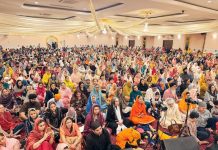
Kota Kinabalu gurdwara centenial celebration photoshoot of the Sanggat (congregation) on Sept 29, 2024 – Photo: GSKK

The 100-year journey of the Kota Kinabalu Gurdwara Sahib is not only a story of a physical structure standing the test of time; it is the story of a community bound together by shared beliefs, resilience, and pride. As we move forward, may the Gurdwara continue to serve as the cornerstone of our Sikh community, guiding us toward further unity and peace.

(Datuk Ram Singh is the committee president of the Gurdwara Sahib Kota Kinabalu. The gurdwara organised a string of event over three-day festival from Sept 26-29, 2024, for its centennial celebration)

RELATED STORY:

Kota Kinabalu gurdwara celebrates 100 years (Asia Samachar, 29 Sept 2024)

ASIA SAMACHAR is an online newspaper for Sikhs / Punjabis in Southeast Asia and beyond. You can leave your comments at our website, FacebookTwitter, and Instagram. We will delete comments we deem offensive or potentially libelous. You can reach us via WhatsApp +6017-335-1399 or email: asia.samachar@gmail.com. For obituary announcements, click here

What is Sikh greeting? Sat Sri Akal or the other one?

0
Sikh greeting: Sat Sri Akal or Waheguru Ji Ka Khalsa, Waheguru Ji Ki Fateh?

By Dr. B. S. Bains | Opinion |

In the Sikh faith, greetings hold significant spiritual meaning, reflecting the core principles of Sikhism. Sikhs use two primary greetings: “Sat Sri Akal” and “Waheguru Ji Ka Khalsa, Waheguru Ji Ki Fateh.” Both serve different purposes and are used in distinct contexts, but each one is deeply rooted in the teachings of Sikhism.

The congregational supplication (Ardas) ends with the rising call of ‘Bole (Jo) So Nihal’, to which the congregation responds with ‘Sat Sri Akal.’

Meaning: Those who condone, accept and praise The Lord to be the Eternal Truth (Sat Sri Akal) will always remain blessed (Nihal).

SAT SRI AKAL

This iconic phrase was coined by Guru Nanak who proclaimed apprenticeship was the only way to the Almighty.

“Sat Sri Akal” translates to “The Eternal is Truth” or “God is the Ultimate Truth.” The phrase is a reminder of the central Sikh belief in one God, who is eternal and all-powerful. This greeting emphasizes the truth and timelessness of the Almighty, an essential element of the Sikh faith.

“Sat Sri Akal” is the most common greeting among Sikhs and is widely used in day-to-day and one-to-one interactions. It is a respectful and friendly way to greet fellow Sikhs, regardless of whether they are religious or not. It is commonly used in casual settings.

This greeting is also used when parting, reflecting the belief that God’s truth and presence remain constant whether in arrival or departure. “Sat Sri Akal” can be seen as a universal Sikh greeting, applicable to various situations where a sense of mutual respect and goodwill is shared.

WAHEGURU JI KA KHALSA, WAHEGURU JI KI FATEH

“Waheguru Ji Ka Khalsa, Waheguru Ji Ki Fateh” translates to, in Purity (Khalsa – coined during the time of Bhagat Kabir – era of Bhagti movement in India between 14th and 15th century) we shall live… “The Khalsa belongs to God, and victory belongs to God.”

This greeting has a deeper historical and spiritual connotation. It is a declaration of Sikh sovereignty under God, recognizing the divine creation of the Khalsa (adopted officially to name the followers of the Sikh faith from the time of Guru Nanak – Nanak Panthis, Kabir Panthis etc) by Guru Gobind Singh in 1699.

Guru Gobind Singh then unifies in a very unique ceremony called Amrit (Sikh initiation), and called them the Khalsa. A Khalsa would take an oath to commit themselves to living by the high ideals of oneness of creation; to serve and protect mankind from any kind of oppression and help selflessly to their sufferings by providing shelter and food to their fellow human irrespective of their religious background, cast or color. They shall abide by the tenets of Guru Nanak 3 pillars Principle.

SEE ALSO: Guru Nanak’s 3 basic teachings

SEE ALSO: Guru Nanak’s 10 teachings we can practice daily

The second part of the greeting “Waheguru Ji Ki Fateh” symbolizes the victory of good over evil, and the ultimate triumph of righteousness under God’s will.

This greeting is generally used in more formal and religious contexts, often by initiated Sikhs or during religious ceremonies, at Gurdwaras (Sikh temples), or when meeting members of the Khalsa. It is also traditionally used at the beginning and end of prayers, as well as during the recitation of religious discourses.

During religious gatherings, Sikhs will often greet each other with “Waheguru Ji Ka Khalsa, Waheguru Ji Ki Fateh” to reaffirm their collective identity as part of the Khalsa and to invoke God’s divine will and grace in their lives.

The greeting is also used during Sikh festivals, especially Vaisakhi, which commemorates the creation of the Khalsa, or on other significant Sikh events like the Gurpurabs (Birthdays of Sikh Gurus), which celebrate the birth and death anniversaries of the Sikh Gurus.

In recent times, it has become a one-to-one form of greeting. The fact remains that it is congregational in origin.

CONCLUSION

In essence, both “Sat Sri Akal” and “Waheguru Ji Ka Khalsa, Waheguru Ji Ki Fateh” carry the fundamental beliefs of Sikhism. While “Sat Sri Akal” is a widely used greeting that reflects the eternal truth of God, the latter is a more formal acknowledgment of divine sovereignty and the values of the Khalsa. Both greetings serve as a reminder of the Sikh emphasis on truth, divinity, unity, and the unwavering belief in one God.

Dr Balwant Singh Bains is a Malaysia-based kirtan enthusiast and a practicing physiotherapist with a chain of physiotherapy clinics.

RELATED STORY:

Nurturing Our Roots: Embracing and Upholding Our Inherited Faith (Asia Samachar, 4 April 2024)

ASIA SAMACHAR is an online newspaper for Sikhs / Punjabis in Southeast Asia and beyond. You can leave your comments at our website, FacebookTwitter, and Instagram. We will delete comments we deem offensive or potentially libelous. You can reach us via WhatsApp +6017-335-1399 or email: asia.samachar@gmail.com. For obituary announcements, click here

Mata Narinder Kaur (1934 – 2024), Wife of Late Sardar Gurcharan Singh, JPP

MATA NARINDER KAUR D/O MEHAR SINGH

Age: 90

20.6.1934 – 8.10.2024

Wife of Late Sardar Gurcharan Singh JPP

Passed away peacefully on 8 October 2024.

Mata ji was born in Amritsar and married Sdr Gulchand Singh @ Gurcharan Singh of Malayan Railways in 1952.

She completed her Gyani-Bhudimani (Punjab University) programme in Sentul, Kuala Lumpur under the tutelage of Gyani Bhai Inder Singh ji Gill, in the late 1950s.

A devoted wife and mother to five children, Narinder Kaur ji actively participated in the Sikh community in numerous towns across Malaya.

She was passionate about learning and sharing true Sikhi parchaar. She picked up computer skills at a late age and became adept in typing her articles in Gurmukhi. She was a regular contributor to magazines like Gurmat Parkash (Sikh Missionary College, Ludhiana) and local newspaper the Malaya Samachar. She was an ardent promoter of Punjabi maboli and was a regular judge at various Bhasha Melas in Ipoh. She kept abreast with news over social media and quickly learned to take advantage of the latest apps.

Mata ji along with her husband were gracious hosts and would have a constant stream of visitors to their home. They simply loved to share their hospitality with friends and strangers alike. She never let any time slip by. She was always listening to Gurbani while staying nimble with handicraft projects… to the end.

Dearly Missed and fondly remembered by loved ones.

Leaving behind beloved children

Harbinder Singh
Tejinder Kaur
Navtej Singh
Ranbir Singh
Rippi Dhaman Kaur
And their spouses.
Grandchildren and their spouses.
And Great Grandchildren

ANTIM ARDAAS

Saturday, October 12, 2024
Wadda Gurdwara Sahib Ipoh

Programme:
6.30 pm – 7.00 pm – Rehraas
7.00 pm – 8.15 pm – Kirtan
8.15 pm – 8.30 pm – Sehaj Paath Di Sampooranta
8.30 pm – Antim Ardaas
8.45 pm – Langgar

Contact: 012 268 9755

Link to posting at Facebook and Instagram

| Entry: 11 Oct 2024 | Source: Family

ASIA SAMACHAR is an online newspaper for Sikhs / Punjabis in Southeast Asia and beyond. You can leave your comments at our website, FacebookTwitter, and Instagram. We will delete comments we deem offensive or potentially libelous. You can reach us via WhatsApp +6017-335-1399 or email: asia.samachar@gmail.com. For obituary announcements, click here

First Mithi Yaad: Mata Jit Kaur (1947 – 2023), Menglembu

FIRST MITHI YAAD
In Loving Memory of

MATA JIT KAUR D/O LATE SARDAR BISHAN SINGH

18.6.1947 – 4.11.2023

Wife of Late Sardar Housin Singh

Dearly missed by:
Daughter & Son In Law: Jasveender Kaur & Dr Harjeet Singh
Son & Daughter In Law: Ameer Singh & Nithiyaanjali
Granddaughter: Dissha Harleeyn Kaur
Grandson: Veer Varshaan Singh
Son: Late Navindar Singh
And a host of relatives and friends.

PATH DA BHOG
27 October 2024 (Sunday), from 10am to 12pm
Gurdwara Sahib Petaling Jaya

Please treat this as personal invitation from children and family

Jasveender Kaur 012 3055 827

Link to posting at Facebook and Instagram

| Entry: 11 Oct 2024 | Source: Family

ASIA SAMACHAR is an online newspaper for Sikhs / Punjabis in Southeast Asia and beyond. You can leave your comments at our website, FacebookTwitter, and Instagram. We will delete comments we deem offensive or potentially libelous. You can reach us via WhatsApp +6017-335-1399 or email: asia.samachar@gmail.com. For obituary announcements, click here

Sikhi and Atheism: Beyond belief and non-belief?

2

By Gurnam Singh | Opinion |

Debates about the nature of divinity and the existence of a supreme being, commonly referred to in the English language as ‘God’, have persisted within and between various faith traditions since their inception. While most faith traditions assert that their origins stem from divine intervention, it can also be argued that they emerged from significant theological disagreements. The Sunni/Shia divide in Islam and the Catholic/Protestant divide in Christianity exemplify this process. Without differences of thought and opinion, it can be argued that no faith tradition would have come into existence or developed.

Take Christianity, for example; it has had to contend with numerous internal divisions and external challenges, including heresies and the rise of various sects. As the German philosopher Hegel points out, the dialectical process of resolving conflicting viewpoints has prompted deeper philosophical and theological reflections, ultimately contributing to the evolution of Christian thought.

Within discussions about atheism, we encounter various religious viewpoints that seek to reject the very foundation of religion—the assertion of the existence of one or more deities that actively influence the universe and human affairs. At its simplest level, atheism represents a rejection of the existence of a divine entity, or at least one that actively influences human affairs. A closer exploration of dissenting traditions within world religions reveals many instances of atheistic discourses, albeit represented in specific ways.

In the Indic theological tradition, for instance, ‘atheism’ is classified as ‘nastikta,’ a term derived from Sanskrit, used primarily in Indian philosophy and religion to denote those who do not believe in the Vedas or reject the authority of Vedic texts. The term is often associated with atheistic or non-theistic schools of thought within Hinduism, such as Buddhism and Jainism. More broadly, “nastika” can refer to anyone considered an unbeliever or who does not adhere to traditional religious beliefs, especially those grounded in Vedic literature. This contrasts with “astika,” which refers to those who accept the authority of the Vedas, typically including orthodox Hindu schools like Vedanta and Nyaya.

Similarly, within Islam, the concept of the ‘kaffir’—often translated as “disbeliever” or “infidel”—denotes a person who denies or rejects the core tenets of the faith, specifically the oneness of God (Tawhid) and the prophethood of Muhammad. The term can carry various connotations, ranging from a neutral description of non-belief to a more pejorative implication, depending on the context. In some interpretations, it can denote someone who actively opposes Islam.

Contemporary debates on Atheism

In contemporary debates around atheism, there is a common view that the idea of the non-existence of a divine being emerged relatively recently. In many countries today, it is easier for atheistic beliefs to be expressed than in the past, when religious authorities wielded significant power. In his book In Battling the Gods (2016), Cambridge Professor Tim Whitmarsh challenges the assumption that atheism is a recent phenomenon tied to secular Western societies, suggesting instead that atheism is as ancient as belief itself, predating all major world faith traditions. Through a careful examination of ancient Greek history, he highlights that early city-states were abundant with various viewpoints, including atheism.

Challenging the idea that religious belief is humanity’s “default setting,” Whitmarsh concludes that disbelief has always been a part of human thought. Thus, while the language of the debate may have shifted over time, the fundamental question regarding the possibility and nature of an all-powerful, all-loving, and all-present supernatural entity is as old as humanity itself.

It is not to say that there are no new arguments for and against God; rather, they may exist as two sides of the same coin. Each may need the other to build its case! In his influential book The God Delusion (2006), Oxford Professor Richard Dawkins offers a devastating critique of belief in a supernatural creator. He characterizes belief in God as both irrational and unnecessary, suggesting that while not all mysteries of nature, creation, and existence have been fully understood, natural selection and scientific explanations are more plausible than those of an intelligent designer. Dawkins goes further, claiming that religion is destructive, fostering dogma, division, intolerance, and violence.

Sikhi’s Unique Perspective

If we turn to Sikhi, it is difficult to dispute that its founder, Baba Guru Nanak, was deeply affected by the corruption among the priestly class and the violent self-serving nexus between them and the rulers, which led to untold suffering and divisions within society. Whether it was centuries of Brahmin ideology asserting a link between caste and gender-based social inequality and divine will, or the Mughal rulers forcibly imposing a Islam in India, Guru Nanak sought to question both the violent practices committed in the name of religion and the theological justifications provided by the priestly classes. And for their efforts, Sikhs were labelled as both ‘nastiks’ and ‘kaffirs’ by the prevailing dominant Brahmani and Islamic religious authorities.

However, in making a clean break from the dominant traditions, Nanak was able to provide a unique, nuanced understanding of divinity that sought to combine reason, social justice, and spirituality, positioning Sikhi uniquely between traditional theism and the ritualistic practice of faith, as well as atheism—the total rejection of spirituality. While theistic religions emphasise belief in a personal God, atheism denies the existence of such a deity, viewing the universe as self-sufficient and governed by natural laws. Sikhi transcends this dichotomy by presenting a conception of God that is neither confined to a theistic framework nor wholly dismissive of the divine. It offers a path that bridges both worldviews, emphasizing a formless, omnipresent divine essence while rejecting the ritualistic and personified understandings of God found in many theistic traditions.

This unique perspective is encapsulated in Guru Nanak’s teachings, particularly his dialogue with the Sidh Jogis, who asked him: “Who is your Guru? What God do you worship?” Guru Nanak’s response was both simple and profound: “Divine wisdom (Shabad) is my Guru, and my mind is the disciple of this wisdom.” This reply reflects the essence of Sikh theology, where God is not worshipped as an external entity but understood as a transcendent force of wisdom and truth that pervades the self and all of creation and existence. Gurbani is clear that such a limitless force cannot be given a name. As Guru Arjan states, “Though with my tongue I chant the names humans have given to you depicting your infinite attributes, your true name is ‘Sat’ (i.e. infinite, limitless, timeless entity)” (Guru Granth Sahib p1082)

Atheism’s Rejection of the Personal God

Atheism, particularly in its modern form, rejects the existence of an interventionist God. Atheists argue that there is no need to appeal to a deity to explain the universe, events or morality and that reason, science, and empirical evidence are sufficient. In their view, the universe operates on natural laws, and any search for meaning or ethics can be grounded in human experience and rational thought.

Atheists often critique theistic traditions for attributing natural phenomena to supernatural forces and for relying on faith in an unseen deity. In this view, the existence of suffering, evil, and the seemingly arbitrary nature of life are incompatible with the idea of a benevolent, omnipotent God. Furthermore, the lack of empirical evidence for a divine being leads many atheists to conclude that belief in God is unnecessary or unfounded.

Sikhi’s Transcendent and Immanent God: Beyond Theism

Sikhi, while affirming the existence of a divine entity, it rejects the idea of a personal deity that sits in judgement and intervenes in the world like a human being. In Sikhi, God is described as Ik Onkar—the One, formless, and eternal reality present in all aspects of existence. This God is neither anthropomorphic (human like) nor limited to a particular form; rather, God is both Nirankar (formless) and Akal Purakh (timeless). In Sikhi, God does not sit on a throne or deliver divine judgments; instead, God permeates all creation, existing beyond the limitations of time, space, and human comprehension.

This understanding of God bridges the gap between theism and atheism by moving away from the idea of a deity requiring worship, offerings, or obedience in a conventional sense. Instead, God in Sikhi is experienced through the Shabad—the divine word or vibration that resonates in the heart of the seeker. God is both the creative force behind the universe and the inner truth that can be realised through living in balance with the world around you, but specifically through ethical and reflective living that seeks to reach beyond our base instincts associated with what are termed the five vices, namely, ‘desire’, ‘anger’, ‘greed’, ‘attachment’ and ‘pride’. Through practical spirituality, namely, reflective living and action, one slowly learns to manage and ultimately transform these vices into virtues. For example, desire, often linked with sexual urges, is transformed into devotional love; anger becomes harnessed as courage; greed turns into charity; attachment evolves into love and care; and pride, or egotism, is refashioned into self-respect and dignity.

While Sikhi acknowledges a divine presence, it does not demand belief in God as an external, controlling entity. In this regard, even the question, are you a believer, has no meaning! The question how one deploys the ability for self-reflection, which is unique to human beings, to realise the divine essence underlying all of reality, transcending the need for ritual worship or intermediaries. This conception of God as a formless, ineffable presence resonates with some of the philosophical inquiries of atheism, particularly those that reject simplistic or anthropocentric notions of a deity.

The Middle Path: God as Oneness

Where atheism emphasises the self-sufficiency of the universe and the absence of a creator, Sikhi promotes the idea of Oneness—a divine unity that connects all of creation. The universe, from the Sikh perspective, is not merely a random collection of matter; it is a manifestation of the divine. Guru Nanak’s teachings repeatedly stress the oneness of God and creation, blurring the lines between creator and creation. This is expressed in the opening lines of the Guru Granth Sahib: “Ik Onkar, Satnaam, Karta Purakh”—there is one reality, one name, one creative power.

For atheists, this interconnectedness may be seen as a purely material phenomenon, where the laws of physics and biology account for the complexity of life and the cosmos. Sikhi, while acknowledging the workings of the natural world and laws of nature (Kudrat de Nizam), imbues it with spiritual meaning. The divine is not separate from the universe; it exists within it as both the force that brings it into being and the essence that sustains it. As Guru Nanak notes: “the divine creator (Kadar) created himself, then he established his presence in time and space (Kudrat), seated within all of creation” (Guru Granth Sahib p463). In this sense, Sikhi offers a middle path between atheism and theism. It recognizes the inherent sacredness of the universe without reducing God to a distant figure who rewards only those who worship him but acts through the very laws of nature he established to govern the universe. His intervention in this regard has already been made and it is our challenge to learn to live within the divinely ordained nature that governs our existence.

Conclusion

Atheists often argue that humanity invented the concept of God primarily out of fear—specifically, the fear of death and the unknown that lies beyond it. They suggest that belief in a deity was constructed to comfort the mind, extending human existence into an afterlife. Interestingly, this viewpoint aligns in some ways with the Sikh rejection of a personified, judgmental God presiding over the world. Sikhi embraces a more nuanced understanding of divinity, one that transcends the simplistic notion of a deity overseeing human actions from afar.

However, in Sikhi, the pursuit of divine connection isn’t driven by the fear of what follows death. Rather, it is the human mind’s innate desire for knowledge, understanding, and perfection that fuels spiritual growth. The Sikh concept of Naam (practicing divine virtues) reflects this, as seekers aim to elevate themselves spiritually to align with the Divine, not for or in an afterlife but within this lifetime i.e. to become Jeevan Mukat.

Sikhi teaches that human consciousness encompasses both the tangible (sargun) and the intangible (nirgun) — the material world and the realm of creativity, imagination, and spirit. And through this unique synthesis of material and non-material realms of being, Sikhi offers a path that can bridge the gap between belief and non-belief, between theism and atheism. It invites a journey beyond the binary, where spiritual elevation is not tied to fear but to the desire for deeper understanding and connection in this life.

Gurnam Singh is an academic activist dedicated to human rights, liberty, equality, social and environmental justice. He is an Associate Professor of Sociology at University of Warwick, UK. He can be contacted at Gurnam.singh.1@warwick.ac.uk

* This is the opinion of the writer and does not necessarily represent the views of Asia Samachar.

RELATED STORY:

Harmony in Chanting and Silence: Exploring Spiritual Practices through a Sikhi Lens (Asia Samachar, 17 April 2024)


ASIA SAMACHAR is an online newspaper for Sikhs / Punjabis in Southeast Asia and beyond. You can leave your comments at our website, FacebookTwitter, and Instagram. We will delete comments we deem offensive or potentially libelous. You can reach us via WhatsApp +6017-335-1399 or email: asia.samachar@gmail.com. For obituary announcements, click here

Sikh top cop now heads KL crime prevention

0
SAC Ravindar Singh and KL police chief Rusdi Mohd Isa

By Asia Samachar | Malaysia |

Ravindar Singh Sarban Singh, who was recently promoted to the rank of Senior Asisstant Commissioner (SAC), has taken over as the Kuala Lumpur police contingent head of crime prevention and community safety department.

He assumed the new post today (Oct 9) in a ceremony witnessed by the Kuala Lumpur police chief Rusdi Mohd Isa.

Ravindar, who previously held the rank of Assistant Commissioner (ACP), took over as the police chief of Cheras, a district in Kuala Lumpur, in April.

The 55-year-old officer is the senior most serving Sikh in the Malaysian police force. He also heads the committee at Gurdwara Sahib Pulapol, a gurdwara located within the compounds of the Malaysian police training centre in Kuala Lumpur.

SAC Ravindar Singh took over as the Kuala Lumpur police contingent head of crime prevention and community safety department on Oct 9, 2024
RELATED STORY:

ACP Ravindar Singh appointed Cheras police chief (Asia Samachar, 19 April 2024)

‘When I joined the police, not many looked like me’ – British Sikh police officer (Asia Samachar, 5 Oct 2024)

ASIA SAMACHAR is an online newspaper for Sikhs / Punjabis in Southeast Asia and beyond. You can leave your comments at our website, FacebookTwitter, and Instagram. We will delete comments we deem offensive or potentially libelous. You can reach us via WhatsApp +6017-335-1399 or email: asia.samachar@gmail.com. For obituary announcements, click here

Indigo plans daily flights from Chandigarh to Singapore

0

By Asia Samachar | Singapore |

IndiGo is expected to introduce direct flight from Chandigarh to Singapore from October 27, when the winter schedule will kick in.

Passengers from Chandigarh, Panchkula and Mohali besides nearby districts will soon be able to fly directly to Singapore as Shaheed Bhagat Singh International Airport is planning to introduce this route from October 27, reported the Hindustan Times.

“IndiGo Airlines have scheduled a flight from Chandigarh to Singapore. However, we are awaiting confirmation from them, which is expected by October 20. We are also trying for other international destinations, like London and Istanbul,” the airport CEO Ajay Verma was quoted by the newspaper.

He said IndiGo was a codeshare partner with Qantas Airlines that operated several flights from Singapore to different countries. A codeshare flight is an agreement between airlines to sell seats on each other’s flights.

Currently, the airport offers only two international flights to Dubai and Abu Dhabi in the United Arab Emirates (UAE).

After the flight to Sharjah was discontinued in October 2023, the airport’s only international link was the IndiGo flight to Dubai, which operates seven days a week. Another daily flight to Abu Dhabi was launched in April this year. Meanwhile, the much-anticipated direct flight to London, initially slated for launch in October 2022, remains grounded, the report added.

The proposed route aimed to connect Mohali with either Heathrow Airport in London or Birmingham Airport.

RELATED STORY:

Malaysia Airlines to fly daily to Amritsar starting Aug 1 (Asia Samachar, 3 June 2024)

ASIA SAMACHAR is an online newspaper for Sikhs / Punjabis in Southeast Asia and beyond. You can leave your comments at our website, FacebookTwitter, and Instagram. We will delete comments we deem offensive or potentially libelous. You can reach us via WhatsApp +6017-335-1399 or email: asia.samachar@gmail.com. For obituary announcements, click here

First Mithi Yaad: Terlochan Singh @ Tochi (1967 – 2023)

TERLOCHAN SINGH @ TOCHI

May 1, 1967 – Oct 18, 2023

As the world changes and time moves on, the memory of our beloved dad remains eternal. On this day of remembrance, we honor the love, strength, and wisdom he shared with us. His spirit lives on in our hearts, bringing us comfort through the cherished memories. Forever loved, Forever missed.

We humbly invite you and your family to join us for Kirtan followed by Sehaj Path Da Bhog on:

Sunday, October 13, 2024 |10am – 12pm
Gurdwara Sahib Sungai Besi (Shapa), Kuala Lumpur

For further enquiries, contact:
Manjeet 012 2383 792
Taran 012 716 0887

Please treat this as a personal invitation from the family

Link to posting at Facebook and Instagram

| Entry: 8 Oct 2024 | Source: Family

ASIA SAMACHAR is an online newspaper for Sikhs / Punjabis in Southeast Asia and beyond. You can leave your comments at our website, FacebookTwitter, and Instagram. We will delete comments we deem offensive or potentially libelous. You can reach us via WhatsApp +6017-335-1399 or email: asia.samachar@gmail.com. For obituary announcements, click here