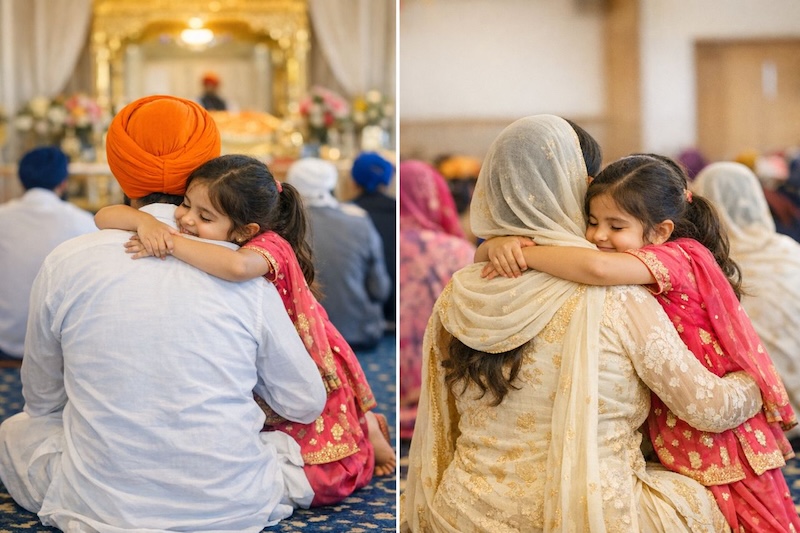
Young parents, Savour the magic while it is in front of you. Do not let the frequency of a child’s love dull its impact – AI aided image
By Dr Pola Singh | Malaysia |
I recently found myself at the Tat Khalsa Gurdwara Sahib, Kuala Lumpur, surrounded by the hum of prayer and the steady rhythm of tradition. But my attention was stolen not by the ceremony, but by a small, five-year-old cute girl.
In the quiet of the House of God, I watched her approach her father on the men’s side. Without a word or a nudge from anyone, she wrapped her small arms around his neck from behind, leaning her weight into him in a spontaneous, grounding hug. A minute later, she drifted to the women’s side to find her mother, repeating the same silent gesture of devotion.
To her, this wasn’t a “performance” of affection. It was as natural as breathing. She felt safe, she felt seen, and she was simply tethered to her world through those hugs.
As a 77-year-old granddad of two, I watched this scene with a mixture of mesmerisation and a twinge of envy. I noticed the parents remained somewhat nonchalant; they didn’t pull away, but they didn’t overtly reciprocate either. Perhaps these hugs are so frequent in their household that they have become part of the daily ‘noise’.
But from the outside looking in, I saw a wonder.
I wanted to whisper to them: “Do you know how lucky you are? Do you see the wealth you hold in those small arms?”
We are all born as clean slates. What this child demonstrated was not just ‘cuteness’—it was a public harvest of the seeds her parents have spent five years planting. You teach a child affection, and they become affectionate. You show them kindness, and they reflect it back to the world. That child was a walking testament to the love she has received.
Looking back at my own journey with my two children, now adults, I find myself in a moment of humbling reflection. Did they hug me like that? I’m sure they did. But like the parents in the Gurdwara, I suspect I took those moments for granted. I was likely too busy providing, too busy planning, too busy being a parent to actually savour the magic of being loved by a child.
In the Sikh faith, we say Waheguru—praising the wondrous Giver of Knowledge. As I watched that little girl, I felt certain that God was smiling down from the altar, blessing that family and the way the parents had brought up the girl.
My message to young parents is simple: Savour the magic while it is in front of you. Do not let the frequency of a child’s love dull its impact. These spontaneous, innocent gestures are the purest form of prayer. Don’t just receive the hug—feel it. And respond.
To that little girl, thank you for capturing my heart and reminding a senior that the best things in life aren’t taught through lectures, but felt through the quiet, certain embrace of a child who knows she is home where she feels safe and secure.
Join the conversation on this story on Asia Samachar’s Facebook and Instagram pages.
Dr Pola Singh, who retired as Maritime Institute of Malaysia director-general in 2011, is also the author of ‘Uphill — The Journey of a Sikh-Chinese Kampung Boy’
ASIA SAMACHAR is an online newspaper for Sikhs / Punjabis in Southeast Asia and beyond. You can leave your comments at our website, Facebook, Twitter, and Instagram. We will delete comments we deem offensive or potentially libelous. You can reach us via WhatsApp +6017-335-1399 or email: asia.samachar@gmail.com. For obituary announcements, click here
ASIA SAMACHAR is an online newspaper for Sikhs / Punjabis in Southeast Asia and beyond. You can leave your comments at our website, Facebook, Twitter, and Instagram. We will delete comments we deem offensive or potentially libelous. You can reach us via WhatsApp +6017-335-1399 or email: asia.samachar@gmail.com. For obituary announcements, click here
The Sikh community in Kuala Pilah gathered at Gurdwara Sahib Kuala Pilah on March 14, 2026, to welcome Chet — the Sikh New Year — with a spiritually uplifting semagam filled with Gurbani, kirtan and reflections on the wisdom of the Gurus.
Located in the heart of Negeri Sembilan, Kuala Pilah is a historic royal town that once served as the administrative centre of the state. Though small, it has long been home to a close-knit Sikh community, with the local gurdwara serving as an important spiritual and social hub for generations of Sikh families in the district.
Join the conversation on this story on Asia Samachar’s Facebook and Instagram pages.
ASIA SAMACHAR is an online newspaper for Sikhs / Punjabis in Southeast Asia and beyond. You can leave your comments at our website, Facebook, Twitter, and Instagram. We will delete comments we deem offensive or potentially libelous. You can reach us via WhatsApp +6017-335-1399 or email: asia.samachar@gmail.com. For obituary announcements, click here
Kulim Sikhs first-ever bowling session to celebrate the Sikh New Year on March 15, 2026 — Photo: Supplied to Asia Samachar
By Asia Samachar | Malaysia |
Kulim Sikhs organised their first-ever bowling session to celebrate the Sikh New Year with the onset of the month of Chet in the Nanakshahi calendar. About 30 participants — some as young as 10 — turned up for the inaugural event organised by the Kulim Naujawan, making it a lively and family-friendly gathering.
Kulim is a town in the Malaysian state of Kedah and is best known today for the flagship Kulim Hi-Tech Park, one of the country’s key high-technology industrial hubs.
Join the conversation on this story on Asia Samachar’s Facebook and Instagram pages.
ASIA SAMACHAR is an online newspaper for Sikhs / Punjabis in Southeast Asia and beyond. You can leave your comments at our website, Facebook, Twitter, and Instagram. We will delete comments we deem offensive or potentially libelous. You can reach us via WhatsApp +6017-335-1399 or email: asia.samachar@gmail.com. For obituary announcements, click here
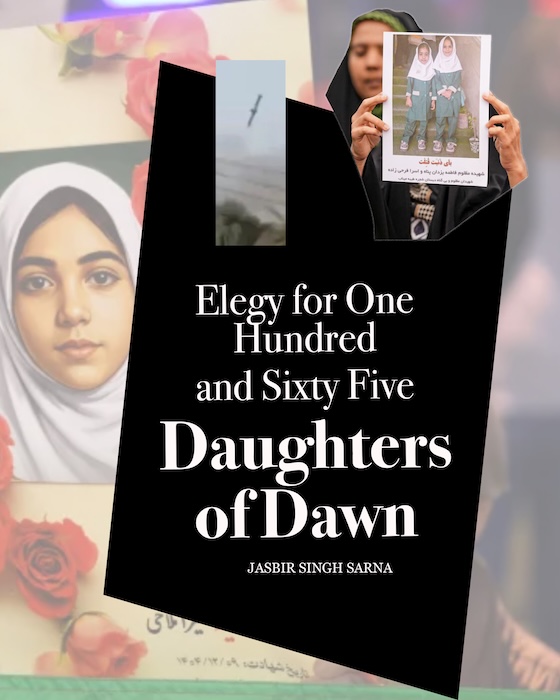
Elegy for One Hundred and Sixty Five Daughters of Dawn by Dr Jasbir Singh Sarna
By Jasbir Singh Sarna | Poem |
In Tehran at gentle break of day, Where schoolgirls traced their dreams in play, One hundred sixty five hearts in light Awoke to books and mornings bright.
Their satchels held both prose and rhyme, Soft histories of hope and time; No shadow crossed their tender art, No war had schooled the childlike heart.
But sudden split the startled sky, With iron wings that screamed on high; Missiles, fierce in fatal flight, Turned noon itself to ashen night.
The blackboard wept in fractured seam, Dust veiled each half-completed dream; Chalk and laughter, intertwined, Lay scattered by an unkind hand.
O daughters of the dawn’s first gleam, You were the nation’s living dream; Your voices rose in measured grace, Now silence keeps your vacant place.
What throne is built on children’s cries? What creed beneath such ruin lies? No victor’s wreath, no martial claim Can sanctify such a vast flame.
One hundred sixty five stars untimed Were written out before they rhymed; Yet in the ledger none can hide Your names in conscience are amplified.
For though the walls in embers fall, Memory outlives the burning wall; And from that shattered schoolyard ground Your witness speaks without a sound.
Sleep, daughters, where the just abide, Beyond the reach of hate and pride; History shall guard your flame— And humankind recall your name.
Join the conversation on this story on Asia Samachar’s Facebook and Instagram pages.
Dr Jasbir Singh Sarna, a native Kashmiri, is a retired Indian agriculture officer. He has authored more than four dozen books, including Sikhs in Kashmir and The Sikh Shrines in Jammu and Kashmir. He can contacted at Jbsingh.801@gmail.com
ASIA SAMACHAR is an online newspaper for Sikhs / Punjabis in Southeast Asia and beyond. You can leave your comments at our website, Facebook, Twitter, and Instagram. We will delete comments we deem offensive or potentially libelous. You can reach us via WhatsApp +6017-335-1399 or email: asia.samachar@gmail.com. For obituary announcements, click here
SKA Awaaz: Voices That Inspire back with Season 2. The podcast is fully supported by its media partner, Asia Samachar.
By Asia Samachar | Singapore |
SKA Awaaz: Voices That Inspire, an initiative by the Singapore Khalsa Association (SKA) and a Singapore-based Sikh podcast, returns with Season 2, building on the strong foundation laid in its inaugural season. The podcast is fully supported by its media partner, Asia Samachar.
Conceived as a platform to document and celebrate the stories of the Sikh community, SKA Awaaz began with a simple objective: to create a space where lived experiences could be heard, preserved and shared across generations.
Season 1 featured nine compelling conversations spanning sports, youth leadership, creative journeys and community pioneers. Listeners encountered narratives of resilience, faith, perseverance and quiet courage including stories that reaffirmed identity and heritage while highlighting the diverse contributions of the community.
In Season 2, SKA Awaaz moves beyond inspiration alone. The new season explores the choices, pathways and possibilities that shape individual journeys. Rather than focusing solely on achievements, the conversations examine how decisions are made, how challenges are navigated, and what lessons emerge along the way.
The aim is particularly to engage younger listeners, reminding them that success does not follow a single prescribed route. There are multiple pathways, different forms of strength, and varied perspectives through which one can shape a meaningful life.
Season 2 features community representatives, professionals, storytellers and mentors, sometimes in individual interviews and at other times in roundtable or dual-guest formats, hoping for more richer and more layered discussions. The focus remains on dialogue, reflection and growth.
The season opens with Sandeep Singh, an author and storyteller whose work resonates deeply with children and families. Known for his books Aman Goes to School and Harleen’s Home, Singh explores themes of belonging, emotion and everyday experience in ways that are accessible yet profound.
Beyond his writing, he actively contributes to community life through book readings at gurdwaras and community spaces, as well as through pro bono interpretation work. His work reflects the essence of Season 2: that storytelling is not merely about inspiration, but about empathy, guidance and opening possibilities.
Season 2 of SKA Awaaz continues its mission as a voice of the community; and a space where conversations shape futures.
Listen to SKA Awaaz: Voices That Inspire – Season 2 on Spotify, Apple Podcasts and Youtube Music:
Listeners are requested to tune in to the audio podcast and share the episodes widely within their networks, helping to amplify these community stories and ensure they reach younger generations and wider audiences alike.
Join the conversation on this story on Asia Samachar’s Facebook and Instagram pages.
ASIA SAMACHAR is an online newspaper for Sikhs / Punjabis in Southeast Asia and beyond. You can leave your comments at our website, Facebook, Twitter, and Instagram. We will delete comments we deem offensive or potentially libelous. You can reach us via WhatsApp +6017-335-1399 or email: asia.samachar@gmail.com. For obituary announcements, click here
The UK Labour Government’s recently published formal definition of “anti-Muslim hostility” (Department for Levelling Up, Housing and Communities, 2026) has come under attack from various quarters, including Muslim groups who feel their demand for a clear Islamophobia definition has been ignored. But most interring, though for different reasons, is the criticism from other faith groups, secularist and humanists and sections of the political right. The definition has come about after years of sustained pressure from sections of the Muslim community following complains that, while the government had accepted a separate definition of anti-Jewish hate crime in the form of ‘antisemitism’, given the levels of anti-Muslim hate, it was only right to introduce a similar protections against ‘Islamophobia’.
Issued on March 9, the definition along with nine pages of interpretive guidelines seeks to offer assurances that mocking, criticising, and insulting Islam will be protected by law. Most problematically, the definition conceptualises ant-Muslim hostility as a form of Racism, which, given Muslims are a religious group constituting different ethnic and racial groups, seems bizarre!
The government defines anti-Muslim hostility as “intentionally engaging in, assisting or encouraging criminal acts that are directed at Muslims. These can include verbal, written, or digital communications under criminal acts and expands the category of “Muslim” to cover anyone who is “perceived to be Muslim,” including where that “perception is based on assumptions about ethnicity, race, or appearance.” Though these provisions are already covered ion existing legislation. The definition covers individuals and institutions who engage in “unlawful discrimination” with the intention of disadvantaging Muslims in public and economic life.
In a clear attempt to appease potential objectors, the guidelines make it clear that definition is “non-statutory” and “must not be confused with legislation” and that the definition does not restrict criticism, ridiculing, or insulting Islam or academic and political debates.
The Network of Sikh Organisations (NSO), led by Lord Inderjit Singh, is one amongst a number of organisations that has consistently raised concerns about privileging any one religious group. The core of the NSO objection is that the policy risks creating preferential treatment for one faith community, leading to what they describe as “two-tier public policy.” They conclude that the definition and the appointment of an “Islamophobia tsar” could threaten freedom of speech and religion while potentially increasing resentment and marginalisation among other faith groups. Demand for Islamophobia definition in the UK
Muslim groups, such as the Muslim Council of Britain (MCB), mirroring policy in relation of antisemitism and the Jewish population, have consistently for the past 20 years been arguing for a formal, adopted definition of Islamophobia to combat rising hate crimes, systematic discrimination, and institutional biases against Muslims. However, the demand shifted from the streets to the corridors of power in 2018 when the All-Party Parliamentary Group (APPG) on British Muslims proposed a working definition: “Islamophobia is rooted in racism and is a type of racism that targets expressions of Muslimness or perceived Muslimness. Given the significance of the Muslim vote and their traditional support for the Labour Party many local councils adopted this definition, through the UK Conservative Government, rejected it, arguing it could stifle free speech or conflict with the Equality Act 2010.
However, with the defeat of the Conservatives and the election of a Labour Government who had a firm commitment in their manifesto that said if elected they would “Reverse the Conservatives’ decision to downgrade the monitoring of antisemitic and Islamophobic hate.”, in early 2025, the government established a new Working Group on Anti-Muslim Hatred/Islamophobia (chaired by Dominic Grieve KC). The result of this was the establishment of the definition on anti-Muslim hostility on 11 March 2026.
Antisemitism equivalence argument
While nobody can deny antisemitism and anti-Muslim hostility represent unacceptable forms of bigotry, treating the definition of anti-Muslim hostility as a direct parallel to the government’s stance on antisemitism is problematic for two key reasons:
First, antisemitism is historically rooted in conspiracism and the false belief that a small group (Jews) possesses secret, supernatural power to manipulate global finance, media, and politics. The International Holocaust Remembrance Alliance (IHRA) definition on antisemitism is specifically designed to catch these “conspiratorial tropes.” Whilst there are some Muslim groups that make a similar argument, the evidence for such claims is mostly anecdotal. Anti-Muslim Hostility, by contrast, is rooted in othering and dehumanization. It is fuelled by narratives of “demographic threat,” “cultural incompatibility,” or associations with terrorism and criminality. Hence, applying a conspiracism-based argument (like the IHRA) for a prejudice based on “cultural threat” fails to address the actual tropes used against Muslims, such as the “Great Replacement” theory or the “civilizational clash” narrative.
Second, while Judaism is a recognised faith, compared to Islam, the number of Jewish people is tiny and under existing UK legislation, Jews are defined as a racial or ethnic group. Accordingly, antisemitism often involves attacks on an ethnicity or a peoplehood, rather than on the theology of Judaism (Nirenberg, 2013). In contrast, Muslims, despite the popular stereotype are a multi-nation, multi-ethnic and multi-racial community, and the primary motive for anti-Muslim hostility is associated with stereotypes and uninformed views about Islam. Moreover, whereas antisemitism definitions are often used to define the boundaries of legitimate criticism of a specific state (Israel). Indeed, this has itself been a huge problem, demonstrated by the misuse of the IHRA definition of antisemitism to prevent criticism of Israel, which even the person who developed it now says he objects to the way it is used for precisely this reason. Applying this logic to Muslims, who belong to dozens of different nations, is impossible.
Establishing a hierarchy of victimhood
By isolating one religious group for a bespoke definition, we risk institutionalising a hierarchy of victimhood that diminishes the rising tide of hate against all communities. It is perhaps for this reason that the proposed definition recognises that anti-Muslim hostility can act as a proxy for generalised hate towards others based on perceptions: “…other people who are perceived to be Muslim, including Sikhs, Hindus or those who have left Islam.” Given this acknowledgement, then, the same argument could be applied to establishing an equivalent ‘Anti-Sikh hostility definition’ and to incorporate Muslims into this, which begins to appear absurd!
If the case for a separate definition for Muslims is based on a significant rise in anti-Muslim hate incidents and crimes, the very same argument can be applied to other ethno-religious groups. If we take the Sikh community, as Data from the UK Sikh Survey suggests that up to 95% of anti-Sikh hate crimes go unrecorded or are misclassified. Because attackers often target the turban or beard, many incidents are incorrectly logged as “Islamophobic.” This statistical erasure makes the 27% rise in recorded anti-Sikh hate over recent years only the tip of the iceberg.
Similarly, anti-Hindu hostility is significantly under-reported, particularly among those in the self-employed retail trade. For many shopkeepers, verbal abuse and low-level harassment are viewed as an “occupational hazard” rather than a reportable crime. Research from the Leicester Hate Crime Project indicates that when victims do not see their specific identity reflected in policy, their trust in the police wanes, leading to a cycle of silence.
Protecting freedom of speech and the principle of secularity.
The Government insists this move will not compromise freedom of speech within the principles of secularity or the right to criticize Islam as a belief system. However, for the majority of followers, the category “Muslim” is synonymous with “Islam” and to claim that Muslims constitute an ethnic, given the diverse backgrounds of followers of Islam, would be a wholly inaccurate.
Moreover, from a legal perspective, making a distinction between “hostility toward a person” and “criticism of their faith” is a subjectivity trap. This ambiguity may lead to endless legal challenges and confusion, providing a gift to extremists who wish to shut down legitimate discourse, not to mention the considerable financial benefits to wealthy anti-discrimination lawyers.
Weaponization of identity politics by the right
In terms of the wider political fallout, as well as dividing communities who in similar and different ways are on the receiving end of race hate crimes, there is a real danger that such a move could add fuel to the fire of dangerous “identity-politics” currently being weaponized by a whole range of extremist groups, from all the communities, but most significantly, white nationalists and supremacists. Indeed, as we have seen with the rise of right-wing groups in the UK who have weaponised both anti-asylum seeker, anti-migrant and anti-Muslim sentiment.
One such group is Reform UK, led by Nigel Farage, which has emerged as a significant populist force, experiencing a major surge in polling and membership throughout 2025 and 2026. Beyond mainstream populism, more radical nationalist and “Identitarian” groups are adopting strategic community-based approaches. The Homeland Party, a 2023 splinter from Patriotic Alternative (PA), is now identified by monitors like Hope Not Hate as the UK’s largest fascist organization, focusing on winning seats in local councils while maintaining a white nationalist ideology. Despite these splits, PA continues its “meta-political” efforts, blending street-level anti-asylum seeker protests with long-term culture and community-building initiatives to broaden its influence.
Political appeasement
As an academic exercise, a legitimate pursuit; academics formulate definitions to clarify phenomena all the time. However, when moving from theory to practice in the form of Government policy, we must look beyond intent and apply a rigorous dual test: the Kantian test of universalizability, that is, can this rule be applied to all? and the Utilitarian test of possible negative outcomes
Nobody can deny the rampant racism that Muslims face in our society and the need to confront this. As the definition cites, the latest Home Office data for the year ending March 2025 shows anti-Muslim hate crimes surging by 19%, now accounting for 45% of all religious hate crimes recorded by police. Yet, formally separating out anti-Muslim through a specific definition may actually undermine the very communities it seeks to protect.
Indeed, reading between the lines, one gets a distinct impression that even the Government have some reluctance about this move, suggesting it is more related to political appeasement that a sincere attempt to address this issue of racist hate crime in general. Perhaps this is why, though accepting that policy formation should take the definition in consideration, it “is non-statutory and must not be confused with legislation.”
One of the unintended consequences of the Governments adoption of a definition of anti-Muslim hostility is to unite all the faith groups, along with secularists and those on the far right in their opposition to it. Fur sure each has their own reasons, but it seems like in this case, nobody appears to be happy. Muslim groups feel it doesn’t go far enough, Sikhs and Hindus feel they are being treated less favourably to Muslims, and the political right argue this is another example of wokery and appeasement of Islamist’s which will create more resentment from ordinary ‘British’ people.
As for the Labour party, it seems like a deeply cynical move to promote “inclusive definitions” on the one hand while simultaneously overseeing a right-wing shift in social policy that divides the population along ethnic, religious, and class lines, on the other. Indeed, some of the government statements on refugees and migration, not to forget the current Labour Prime Minister, Keir Starmer’s May 2025 speech, where he argued that without stricter migration controls, the UK risked becoming an “island of strangers”, which by many was seen to be “xenophobic” and echoing Enoch Powell’s infamous “Rivers of Blood” speech in 1968.
The way forward
In an era of surging intolerance, where anti-Muslim sentiment has reached critical levels, the need for robust anti-racist legislation is undeniable. But laws alone are not enough; we need a unified anti-racist movement.
The strength of British anti-racism in the 1970s and 80s lay in its solidarity, famously captured by the slogan: ‘Black and white, unite and fight.’ And yet, a combination of geopolitics and government policy has since fractured this collective front. The movement has drifted into a landscape of identity politics where minority communities, rather than standing together, find themselves competing for government attention and resources. This fragmentation has created an opportunity that the far-right has successfully exploited, driving wedges between the very communities that should be each other’s strongest allies.
We must return to a universal stance against intolerance and stop the drift towards “vote bank” politics by appeasing specific demographics with poorly conceived statements that invite hate-mongers to hijack the narrative. We must defend our common humanity and isolate those who seek to demonize people of all faiths or none. We do not need more definitions that divide; we need a single, unshakeable standard of protection that recognizes the inherent dignity of every individual, whilst maintaining a collective effort to stand against racism.
Home Office (2025): Hate Crime, England and Wales, year ending March 2025. Statistics showing a 19% increase in anti-Muslim offences and the 45% share of religious hate crime.
Nirenberg, D. (2013) Anti-Judaism: the Western tradition. New York: W. W. Norton & Co.
APPG for British Sikhs (2020/2024 updates): Report into Anti-Sikh Hate Crimes. Research indicating that 95% of anti-Sikh incidents are either not reported or misclassified under race/Islamophobia.
University of Leicester: The Leicester Hate Crime Project (Chakraborti & Hardy). The UK’s largest study on victimisation, highlighting the “occupational hazard” of hate crime in the retail sector and barriers to reporting for Hindu and Sikh communities.
The UK Sikh Survey (2019/2023): Statistical data on the 85% non-reporting rate within the Sikh community.
Join the conversation on this story on Asia Samachar’s Facebook and Instagram pages.
Gurnam Singh is an academic activist dedicated to human rights, liberty, equality, social and environmental justice. He is a Professor of Sociology at University of Warwick, UK. He can be contacted at Gurnam.singh.1@warwick.ac.uk
* This is the opinion of the writer and does not necessarily represent the views of Asia Samachar.
ASIA SAMACHAR is an online newspaper for Sikhs / Punjabis in Southeast Asia and beyond. You can leave your comments at our website, Facebook, Twitter, and Instagram. We will delete comments we deem offensive or potentially libelous. You can reach us via WhatsApp +6017-335-1399 or email: asia.samachar@gmail.com. For obituary announcements, click here
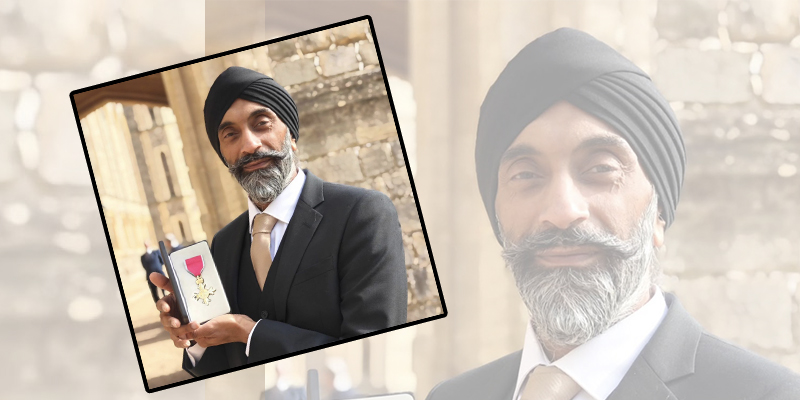
It has finally sunk in. I attended my investiture ceremony [today] and received my OBE.
My working life has been dedicated to education and in particular, empowering young voices and investing opportunities. I would never have dreamt where I am right now. Until around the age of 10, English was a second language. My parting interview with a careers officer at school recommended I registered on the YTS scheme, “education is not for you”. I did a national diploma and then a higher national diploma (I could t get onto a decent degree).
After my degree, I completed two masters and a PhD — all part time, balancing my family committments and work with my study. Finally, I graduated from the school of hard knocks.
During that time, I have led numerous degrees and taught thousands of students. I hope I’ve played my part in shaping their life views and professional journeys. I’ve tried to give them voices, opportunities, and inspirations that count and make a real difference.
In parallel, a resounding second chapter emerged: the rediscovery of a nearly extinct musical heritage. This was Sikh music as it sounded 500 years ago, in the time of our Gurus. Over centuries, the tradition had faded into a whisper—the sacred instruments had vanished, the voices had fallen silent, and the original melodies were little more than rumors. I felt a profound calling to bring that silence back to life.
I found myself asking: Why was I only now hearing this soul-capturing music? Why was it absent from every Sikh stage in the world? I knew I couldn’t just wonder—I had to act. I set out to breathe new life into these sounds. I taught it, I practiced it, and I shared its story wherever I could. What started as a personal mission grew into a movement: hundreds of students began to learn, we established a dedicated music school, I traveled the country giving talks, and we even launched a formal examination board to ensure this heritage would never be ‘lost’ again.
I realise there are a lot of ‘I’s’ in that story—which, in truth, isn’t very Sikh-like at all! In reality, none of this would have been remotely possible without the energy, enthusiasm, and love of the Sangat.
(Dr. Harjinder Singh Lallie is a University Reader in Cyber Security at the University of Warwick. He is a prominent academic and author specializing in AI-driven phishing detection, cyber security, and risk analysis, often featuring in cybersecurity industry discussions. He was awarded an OBE for his work in education and community service. The article was adapted from his social media posting)
ASIA SAMACHAR is an online newspaper for Sikhs / Punjabis in Southeast Asia and beyond. You can leave your comments at our website, Facebook, Twitter, and Instagram. We will delete comments we deem offensive or potentially libelous. You can reach us via WhatsApp +6017-335-1399 or email: asia.samachar@gmail.com. For obituary announcements, click here
Johor Menteri Besar Onn Hafiz Ghazi will be the guest of honour at the Johor State Vaisakhi Luncheon hosted by Gurdwara Sahib Pontian on March 28, 2026 (Saturday).
The programme, scheduled from 12pm to 3.30pm, is part of the gurdwara’s celebrations marking its 50th anniversary. Later the same day, the celebrations will continue with Vaisakhi games and a fireworks display.
An Akhand Path — the three-day continuous reading of the Guru Granth Sahib — will begin at 8.30am on March 26.
(What’s happening at your local gurdwara? Send us an update via WhatsApp at 017-335 1399)
Join the conversation on this story on Asia Samachar’s Facebook and Instagram pages.
ASIA SAMACHAR is an online newspaper for Sikhs / Punjabis in Southeast Asia and beyond. You can leave your comments at our website, Facebook, Twitter, and Instagram. We will delete comments we deem offensive or potentially libelous. You can reach us via WhatsApp +6017-335-1399 or email: asia.samachar@gmail.com. For obituary announcements, click here
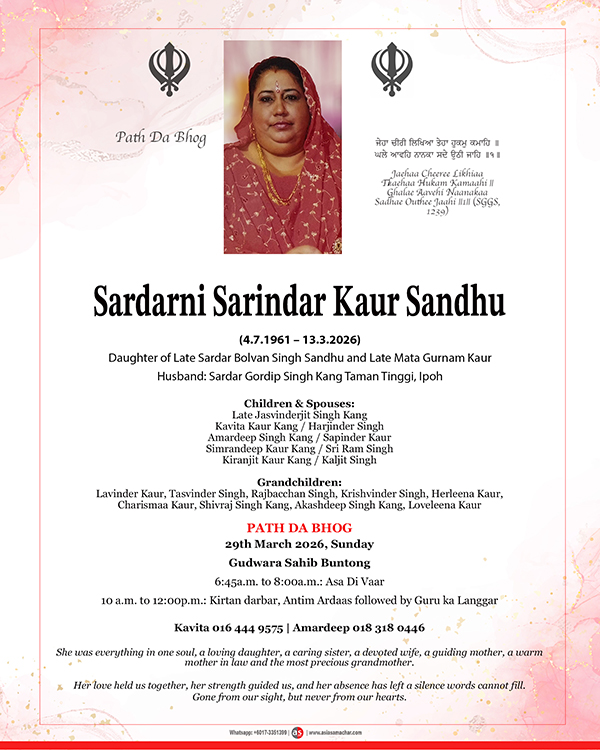
Daughter of Late Sardar Bolvan Singh Sandhu and Late Mata Gurnam Kaur Husband: Sardar Gordip Singh Kang Taman Tinggi, Ipoh
Children / Spouses: Late Jasvinderjit Singh Kang Kavita Kaur Kang / Harjinder Singh Amardeep Singh Kang / Sapinder Kaur Simrandeep Kaur Kang / Sri Ram Singh Kiranjit Kaur Kang / Kaljit Singh
PATH DA BHOG Sunday, 29th March 2026 Gurdwara Sahib Buntong, Ipoh, Perak
Programme: 6:45a.m. to 8:00a.m.: Asa Di Vaar 10 a.m. to 12:00p.m.: Kirtan darbar, Antim Ardaas followed by Guru ka Langgar
She was everything in one soul, a loving daughter, a caring sister, a devoted wife, a guiding mother, a warm mother in law and the most precious grandmother.
Her love held us together, her strength guided us, and her absence has left a silence words cannot fill.
| Entry: 13 March 2026; Updated: 25 March 2026 | Source: Family
ASIA SAMACHAR is an online newspaper for Sikhs / Punjabis in Southeast Asia and beyond. You can leave your comments at our website, Facebook, Twitter, and Instagram. We will delete comments we deem offensive or potentially libelous. You can reach us via WhatsApp +6017-335-1399 or email: asia.samachar@gmail.com. For obituary announcements, click here