ASIA SAMACHAR is an online newspaper for Sikhs / Punjabis in Southeast Asia and beyond. You can leave your comments at our website, Facebook, Twitter, and Instagram. We will delete comments we deem offensive or potentially libelous. You can reach us via WhatsApp +6017-335-1399 or email: asia.samachar@gmail.com. For obituary announcements, click here
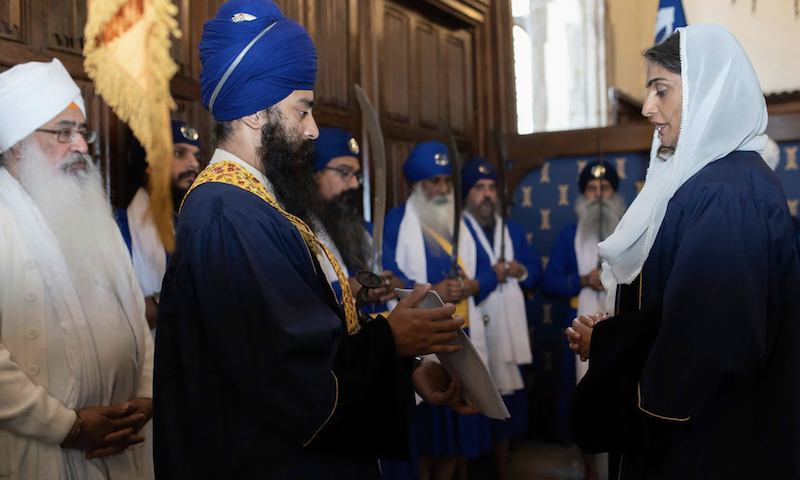
A swearing-in ceremony of The Sikh court at the Old Hall in Lincoln’s Inn, London. Photograph: Simran Channa Photography/The Sikh Court
By Sharan Kaur Bhachu | The Guardian |
I read with interest Pragna Patel’s opinion piece about the Sikh court (The world is getting its first Sikh court in London. That’s a threat to women’s rights, 31 May). Southall Black Sisters, the organisation of which she is a founding member, is an important institution in the South Asian community and has been defending women’s rights since it was founded. We are cognisant of Pragna’s concerns, which are rooted in her organisation’s experience.
We agree that religious courts can create safeguarding concerns and that traditionally patriarchal religious and cultural bodies can place pressure on women to comply or acquiesce.
The Sikh court is not a religious court. We operate with a Sikh ethos and apply the Sikh principles of equality, integrity and fairness to our conduct, but not to our decision-making. We apply the law of England and Wales to resolve disputes before us.
As family law practitioners, we are acutely attuned to the need for robust safeguarding procedures, which is why we have a comprehensive safeguarding policy, developed in collaboration with a number of womens’ rights charities, published on our website.
The inauguration of the Sikh Court at the Honourable Society of Lincoln’s Inn in the event on April 20, 2024
Our polling within the community indicated a desire among respondents to see “people who looked like them” on the bench. We recognise efforts in the judiciary to improve representation, but in the meantime, we offer a more representative forum – in fact, 67% of our judges are women.
Transparency and accountability are core to the Sikh court. We will publish an anonymised statement of reasons for each matter resolved by us, so that our decisions can be scrutinised.
We are also constituting an independent review panel to review our work – we welcome Pragna to engage with us and perhaps consider joining the panel.
The Sikh court is now open and we look forward to assisting anyone, Sikh or non-Sikh, who wishes to use our service in resolving their disputes.
ASIA SAMACHAR is an online newspaper for Sikhs / Punjabis in Southeast Asia and beyond. You can leave your comments at our website, Facebook, Twitter, and Instagram. We will delete comments we deem offensive or potentially libelous. You can reach us via WhatsApp +6017-335-1399 or email: asia.samachar@gmail.com. For obituary announcements, click here
LATE SARDAR SETWAN SINGH S/O LATE BESANT SINGH RANDHAWA
(Village: Thunda, Districts Amritsar)
Taman Sentosa, Klang | 26.7.1966 – 3.9.2023 | Age: 57
Setwan was a humble, kind, and simple man. He was a loving husband, a dedicated and caring father to his children, and a pillar of strength.
It’s been a year since you left us, but your love and legacy continue to guide us every day. Your memory will remain with us forever; we miss you deeply.
Parents: Late Besant Singh & Late Juginder Kaur
Wife: Sardarni Pal Kaur (Rani) d/o Late Naranjan Singh / Late Mohinder Kaur
ASIA SAMACHAR is an online newspaper for Sikhs / Punjabis in Southeast Asia and beyond. You can leave your comments at our website, Facebook, Twitter, and Instagram. We will delete comments we deem offensive or potentially libelous. You can reach us via WhatsApp +6017-335-1399 or email: asia.samachar@gmail.com. For obituary announcements, click here
And a host of relatives and friends who mourn his loss
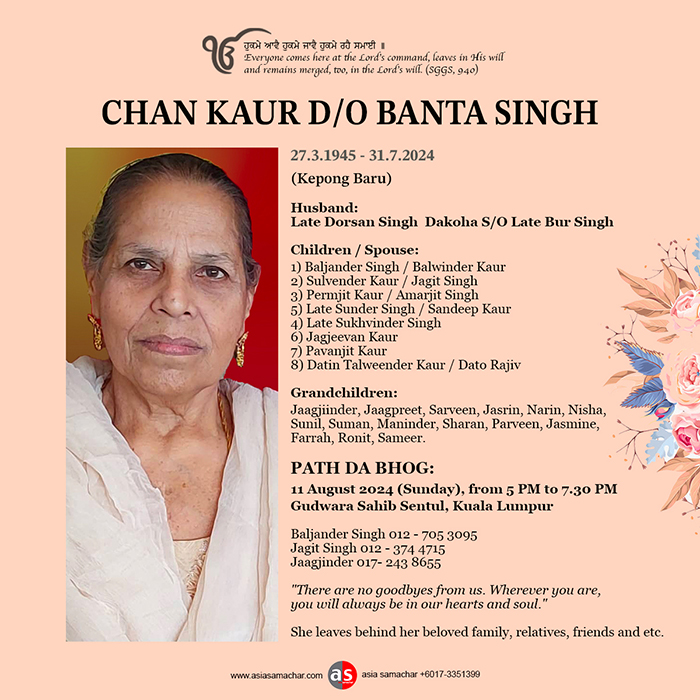
PATH DA BHOG (Culmination of Prayer service)
The Path Da Bhog (culmination of Prayer service) will be held to honour the memory of Harpal on Sunday, 11 Aug 2024 in Gurdwara Sahib Petaling Jaya (GSPJ) at No. 4, Lorong Utara B, Off Jalan Utara, 46200 Petaling Jaya, Selangor from 5.00pm to 7.00pm.
Datin Harwinder Kaur and her family would like to extend their gratitude to all who have supported them during this difficult time. The heartfelt messages of condolences, beautiful wreaths, words of comfort, and shared memories of Harpal have brought them solace and succour.
| Entry: 2 Aug 2024; Updated: 6 Aug 2024 | Source: Family
ASIA SAMACHAR is an online newspaper for Sikhs / Punjabis in Southeast Asia and beyond. You can leave your comments at our website, Facebook, Twitter, and Instagram. We will delete comments we deem offensive or potentially libelous. You can reach us via WhatsApp +6017-335-1399 or email: asia.samachar@gmail.com. For obituary announcements, click here
Harmanpreet Singh (left) and Hardik Singh in the India-Belgium game at 2024 Olympics Paris. India lost 2-1 – Photo: Hockey India
By Prabhjot Singh | France |
Defending champions Belgium overcame a spirited challenge from India to record its fourth consecutive win from as many matches in the 2024 Paris Olympic Games on Aug 1.
Overcoming a 0-1 deficit, Belgium ended the game with a 2-1 win to stay at the top of the pool with a maximum of 12 points. India now has seven points from four games with two wins, a draw, and a loss.
India plays Australia in its last pool game on Friday (Aug 2). In the second game, Australia thrashed bottom-placed New Zealand 5-0 to move to the second spot with three wins from four games. Australia had lost 2-6 to Belgium yesterday. New Zealand with four straight losses is already out of reckoning for a quarterfinal berth.
In another game later in the day, Argentina will play Ireland. A win for Argentina could also help it qualify for the quarterfinals.
India continued from where it left off in the last game against Argentina. Playing a well-coordinated game, India had the defending champions’ defence under pressure late in the first quarter and the early second quarter. During this period, Abhishek, who missed a chance earlier, made amends this time.
After intercepting a centre from the right flank, he latched onto the ball and surprised the Belgian goaltender with a rasping drive from the top of the circle. The goal infused a new life into the game. While India pepped up its attack, Belgium tried to retaliate.
Realising that India had resorted to tight zone and man-to-man marking, Belgium worked out a strategy to crowd the Indian goal in attack. Efforts paid immediate dividends. Three minutes into the second half, when Belgium got its well knot attack, Thibeau Stockbroekx, got the ball past Indian goalkeeper Sreejesh to restore the parity.
Once the teams were level 1-1, the game picked up pace. The 2020 Tokyo Olympic champions were more forceful, in their attack on the Indian citadel and forced a series of penalty corners. Veteran goaltender Sreejesh stood between Alexander Hendrickx and Tom Boon.
Once again, the Belgians managed to crowd the Indian goal in the 44th minute. Following the melee it was John-John Dohmen who managed to slid the ball across the goal line.
India had a chance to equalize in the 58th minute. Skipper Harmanpreet could not repeat his first three-game performance. He had a stinging flick at the goal where a defender got it deflected out from his arm, the resultant corner went begging.
ASIA SAMACHAR is an online newspaper for Sikhs / Punjabis in Southeast Asia and beyond. You can leave your comments at our website, Facebook, Twitter, and Instagram. We will delete comments we deem offensive or potentially libelous. You can reach us via WhatsApp +6017-335-1399 or email: asia.samachar@gmail.com. For obituary announcements, click here
ASIA SAMACHAR is an online newspaper for Sikhs / Punjabis in Southeast Asia and beyond. You can leave your comments at our website, Facebook, Twitter, and Instagram. We will delete comments we deem offensive or potentially libelous. You can reach us via WhatsApp +6017-335-1399 or email: asia.samachar@gmail.com. For obituary announcements, click here
Jab kacẖẖ na sīo ṯab kiā karṯā kavan karam kar āiā. Apnā kẖel āp kar ḏekẖai ṯẖākur racẖan racẖāiā. ||1|| Mere rām rāe mujẖ ṯe kacẖẖū na hoī. Āpe karṯā āp karāe sarab niranṯar soī. ||1|| rahāo. Gaṇṯī gaṇī na cẖẖūtai kaṯhū kācẖī ḏeh iāṇī. Kirpā karahu parabẖ karṇaihāre ṯerī bakẖas nirālī. ||2|| Jīa janṯ sabẖ ṯere kīṯe gẖat gẖat ṯuhī ḏẖiāīai. Ŧerī gaṯ miṯ ṯūhai jāṇėh kuḏraṯ kīm na pāīai. ||3|| Nirguṇ mugaḏẖ ajāṇ agiānī karam ḏẖaram nahī jāṇā. Ḏaiā karahu Nānak guṇ gāvai miṯẖā lagai ṯerā bẖāṇā. ||4||6||53||
By Harmanpreet Singh Minhas| Sikh Bulletin |
Do we only live once? It all depends on one’s perspective. If you think we’re nothing but chemicals with no soul, then yes, it is the end. If you believe in only one life and then it’s heaven or hell, then no.
It’s especially not the end if you happen to believe in reincarnation. Reincarnation suggests this is not our first life on Earth and it’s most likely not our last. The Hindu perspective suggests we have been around for millions of lifetimes and that there may be millions ahead. In that sense, we are all “old souls.” In each of our lives, somehow through some inconceivable system, all our positive and negative deeds are recorded. This means, no one gets away with anything. The mind propels us into action based on its conditioning which is based on actions of past life. So, when the body reaches its demise, the mind and soul get transferred into, hopefully, another human womb (human rebirth may not be guaranteed and a person can reincarnate into a different species). Even while in the womb, the mind may remain active and recall events from the previous life. The concept of reincarnation suggests that the soul moves through different bodies until it ultimately purifies itself of anger, greed, pride, and other vices.
The mind functions kind of like a hard drive with millions of files on it. If a hard drive is transferred into a different computer, the new computer will have all the same information as the previous one. So, when the mind and soul are relocated into a new body, the exterior is different, but all the programming stored in the mind are the same. This programming will make the person behave in very much the same way as they did in the previous life because the conditioning and impressions are the same. The car may be different, but the driver is the same. Hence, we are not very different from who we were in our previous life.
Having said all that, Gurbani does not agree with the concept of reincarnation and karma. The Gurbani takes the ball out of a higher court and places it firmly in our court. For our pain and pleasure, we can blame neither God nor a devil nor some third outside party. If some outside party is responsible for all our troubles, then we humans have no responsibility for our actions in our present life. Then why should we follow any religion, or engage in Gurbani-Vichar etc. It does not make any sense.
The concepts of reincarnation and karma are old, worn out and illogical, while Gurbani concepts are new, fresh, and logical. Yes, there are words used in Gurbani that may imply that Gurbani agrees with Karma of previous lives and Reincarnation. These words are merely used as examples to explain doctrines of Gurbani. It’s like using some logic that someone already understands to explain something new. Simply put, an example does not equate to the message or the doctrine.
On page 1,366 Bhagat Kabir Ji tells us the human life is priceless (Kabīr mānas janam ḏulambẖ hai). Every moment in life is precious and every single moment that passes cannot come back again. We do not get to live our life for the second or third or the infinite times (hoe na bārai bār). When some fruit ripens, it falls from the tree (Jio ban fal pāke bẖue girėh). It cannot reattach itself with the tree again (bahur na lāgėh dār). Similarly, we do not get a second chance to live our life (i.e. no reincarnation).
Mere rām rāe mujẖ ṯe kacẖẖū na hoī. Āpe karṯā āp karāe sarab niranṯar soī. ||1|| rahāo.
Since these are the Rahao lines, the central message of the shabd is contained within these lines. When reading and understanding the remaining lines, we need to relate them back to these. Rahao lines can also be considered as the title of the shabd. To gain full understanding of the shabd each line of the shabd must be related or linked back to the meaning or message within the Rahao lines. When singing the shabd, the Rahao lines must be sung multiple times.
To express his humility, Guru Ji while conversing with the Creator within, says that O’ My God (Mere rām rāe) I can do nothing without you (mujẖ ṯe kacẖẖū na hoī). He credits everything to God, saying that O’ God you are omni present (sarab niranṯar soī). You are the creator (Āpe karṯā), you are everywhere and within everyone (sarab niranṯar soī). Everything that happens, happens within your will (Hukam or Systems, āp karāe). Godly systems include, life and death, all the eco systems that sustain us on earth, sun, air, water, everything that goes on within our body and infinite other things which are beyond the comprehension of humans. A simplistic way to think about God is that God is the universal energy, that makes everything function.
Some people may think that all the actions humans perform (good or bad) are ordered by God (āp karāe). Such thinking is short sighted and illogical. Such thinking cannot be further from the truth. God and goodness are synonymous with each other. Evil, corrupt, immoral, unethical, dishonest, tainted actions of humans cannot be attributed as orders of God. Few excerpts from Gurbani suggest that humans have free will/choice to do what they want. Not everything a person does is pre-approved by God.
Simply put, we reap exactly what we sow. As indicated in the Gurbani, man is the architect of his own fate or destiny because every past or present thought and action lays the foundation for our future. Hence, self-effort called, “Uddam”, is a very important aspect of our life. In life, our self-effort is the best help we can count on. If we need to improve in any aspect of life, no magic will help us. A person does not become a doctor or a professional athlete without self-effort, without self-will, without hard work, without determination to succeed etc. As discussed previously, there is no hard drive with hard work and determination from previous life (concept of Karma) that propelled a person to become a doctor or a professional athlete.
To summarize, the Rahao lines tell us that everything that happens around is due to and within the Hukum and Systems of God. There is nothing that is outside of Hukum and Systems of God, except the evil, corrupt, immoral, unethical, dishonest, tainted actions of humans.
Jab kacẖẖ na sīo ṯab kiā karṯā kavan karam kar āiā. Apnā kẖel āp kar ḏekẖai ṯẖākur racẖan racẖāiā. ||1||
The definition of Karma suggests that we get to live either a happy and satisfied life or a life full of suffering based on the deeds and actions we accumulate in our previous lives. These actions are somehow tagged to our soul that transmigrates into a new body. Guru Ji debunks this definition. As mentioned, many times before, Gurbani is applicable within our present life only. It is for here and now. The concept of Karma is used within Gurbani but to represent the result of our present actions, NOT previous life. The outcome of good, moral, and ethical actions in our present life is good and the outcome of the evil, corrupt, immoral, unethical, dishonest and tainted actions in our present life is bad.
Guru Ji uses logic to kill the concept of Karma across multiple life terms. He questions the believers of Karma that when there was nothing (there was no life, Jab kacẖẖ na sīo) what Karma’s did you accumulate before you were born (ṯab kiā karṯā kavan karam kar āiā). What Karma’s shaped your very first life? Guess what, such logical questions stump people who believe in such illogical concepts.
Guru Ji and Gurbani want people to live their present life in the best possible way, without having to worry about what they did in the past or what will happen to them after they die. This implies that anyone can reach the pinnacle of success within their life. Everyone has the built-in capacity and capability to reach their goals. God does not hold anyone back. There is nothing from their past life that should impact their present life.
In the Rahao lines we learned that everything that happens around is due to and within the Hukum and Systems of God. The human life we get is not a result of Karma’s from our previous life. This life and everything around us are given to us by the one God (ṯẖākur racẖan racẖāiā). The life as we see it originated from God (Apnā kẖel) and he is part of/within his creation (āp kar ḏekẖai).
The people who were slaves to the religious leaders during the lifetime of Guru Ji believed that we have been around for millions of lifetimes and that there may be millions ahead. In each of our lives, somehow through some inconceivable system, all our positive and negative deeds are counted or recorded. There could be a tax return (of good and evil) at the end of life, and we must pay the outstanding bill in our future lives. The most shameful thing is that many Sikh’s (followers of Gurbani) still believe in such nonsensical rhetoric. Read this shabd, read this line and determine for yourself if such a tax bill needs to be paid across multiple lives.
The concept of reincarnation suggests that the soul moves through different bodies until it ultimately purifies itself of anger, greed, envy, and pride. Guru Ji says that to believe that when the count (Gaṇṯī gaṇī) of our good deeds outnumbers our bad deeds somehow the transmigration (na cẖẖūtai kaṯhū) of soul from one living body to another will stop is illogical and nonsensical (iāṇī). Our body is fragile (kācẖī ḏeh) and once our present life ends there is nothing after that. There is no transfer of tax bill of our good and bad deeds to the next life. There is no next life.
In the Rahao lines we learned that everything that happens around is due to and within the Hukum and Systems of God (parabẖ karṇaihāre). The human life we get is not a result of Karma from our previous life. This life and everything around us are given to us by the one God. The life as we see it originated from God and he is part of and within his creation. Here Guru Ji says that we should ask God for unique (ṯerī bakẖas nirālī) blessings (Kirpā karahu) in our present life. What is this unique blessing that Guru Ji is talking about? This unique blessing is to live present life with Godly virtues, such that all the deeds that we perform, all the actions we take (in our present life) align with the Godly characteristics.
In the Rahao lines we learned that everything that happens around is due to and within the Hukum and Systems of God. The life as we see it originated from God (Jīa janṯ sabẖ ṯere kīṯe) and he is part of and within everything (gẖat gẖat) in his creation. Everything that is living and all the systems that assist in sustenance of life are serving God (ṯuhī ḏẖiāīai). The details of how God works (Ŧerī gaṯ miṯ), how his systems work is known only by God (ṯūhai jāṇėh). Humans measure everything in units of price. How much is house, how much is your car, how much do you make… etc., are the common questions asked to assess the value of a human. Guru Ji says that no one can assess the value of the limitless God (kuḏraṯ kīm na pāīai) and the Godly systems. Measuring value of God is incomprehensible for humans.
Guru Ji in his most humble self, calls himself to be virtue-less (Nirguṇ), foolish (mugaḏẖ), thoughtless (ajāṇ) and ignorant(agiānī). He says that he does not know of any deeds (karam) or any religious ceremonies or prayers that could please God (ḏẖaram nahī jāṇā). Of course Guru Ji is not virtue-less, foolish, thoughtless, and ignorant. He is using these words to describe that state of mind of normal humans who think so highly of themselves but in a spiritual sense they are pure duds.
In line 2 of this shabd, Guru Ji says that we should ask God for unique (ṯerī bakẖas nirālī) blessings (Kirpā karahu) in our present life. What is this unique blessing that Guru Ji is talking about? This unique blessing is to live present life with Godly virtues, such that all the deeds that we perform, all the actions we take (in our present life) align with the Godly characteristics. Here, too, he is asking God for blessings (Ḏaiā karahu). The blessing he is seeking are that of establishing Godly virtues within his mind (Nānak guṇ gāvai). Ask yourself, when we ask God for blessings, what do you ask for? Are your requests in line with what Guru Ji is asking for? The most likely answer is NO. Most likely the Godly virtues and characteristics will not be readily acceptable to our mind. We may adopt Godly virtues due of fear of something, rather than love for God. As part of blessings that Guru Ji is seeking from God, he wants his mind to accept all the Godly virtues purely based on love for God.
The results of acting based on Godly virtues may not always be favorable, yet the lovers of God, do not care about such unfavorable results. While enacting life based on Godly virtues, all results (good or bad, favorable, or unfavorable) seem to be sweet to them (miṯẖā lagai ṯerā bẖāṇā). Our Guru’s lived their lives based on this principle.
ASIA SAMACHAR is an online newspaper for Sikhs / Punjabis in Southeast Asia and beyond. You can leave your comments at our website, Facebook, Twitter, and Instagram. We will delete comments we deem offensive or potentially libelous. You can reach us via WhatsApp +6017-335-1399 or email: asia.samachar@gmail.com. For obituary announcements, click here
Event | Malaysia: Stress Management Workshop for SPM Students conducted by English lecturer Jasvin Kaur Sidhu
ASIA SAMACHAR is an online newspaper for Sikhs / Punjabis in Southeast Asia and beyond. You can leave your comments at our website, Facebook, Twitter, and Instagram. We will delete comments we deem offensive or potentially libelous. You can reach us via WhatsApp +6017-335-1399 or email: asia.samachar@gmail.com. For obituary announcements, click here
Any conversation about the implications of artificial intelligence (AI) must begin with a definition of intelligence. Scholars, theologians, prophets, and gurus have long been fascinated by the mystery of creativity and the human mind think. In Sikhi, it is precisely such qualities that establish the uniqueness of the human mind and that is what differentiates us from other living entities. To be born a human (manuk/ਮਨੁੱਖ) is considered a great blessing, providing the opportunity for true self-realisation. Through a heightened state of consciousness, one ultimately comes to appreciate and feel the universal divine.
Closely associated with the human mind is the complex notion of human intelligence. There are essentially two different approaches to defining human intelligence. One approach reflects a mechanistic view, likening the human brain to a supercomputer. From this perspective, human intelligence is correlated with the capacity to perform cognitive challenges, akin to the classical notion of IQ. This approach suggests that intelligence can be measured according to an IQ scale, indicating the speed and breadth with which our brains can solve puzzles. This view underpins efforts to build machines that mimic the neural networks that process data in the human brain.
The other perspective is that, given the complexity of the human brain and consciousness, the uniqueness of human intelligence cannot be replicated by machines. Moreover, theologians argue that a fundamental difference between machines and humans is the existence of the human soul. The problem with this seemingly straightforward proposition is that there is no consensus on what constitutes ‘the soul’? However, this has not stopped theologians from positing the possibility of non-human super intelligence. Reflected in folklore and myth across various cultural traditions, this appears through mythological narratives of unimaginably powerful divine beings with superhuman intelligence. The Ancient Greek and Hindu Gods are perhaps the most compelling example of such super intelligent beings.
THE EVOLUTION AI
AI has evolved significantly since its conceptual beginnings in ancient myths and philosophical discourses. The journey from the early days of modern computing in the 1940s to today’s advanced machine learning systems highlights a remarkable trajectory of technological progress. Alan Turing’s proposal of the Turing Test in 1950 was a significant milestone, challenging machines to exhibit human-like intelligence.
The 1960s saw a surge of enthusiasm for AI, with significant progress in areas such as game playing, natural language processing, and theorem proving. However, by the 1970s, limitations in computing power slowed progress.
The 1980s brought a revival in AI research with the development of expert systems, and by the 1990s, machine learning began to dominate the field. Today, deep learning, inspired by the neural networks of the human brain, powers applications in image recognition, natural language processing, and robotics. This progress has led to the emergence of Artificial General Intelligence (AGI), a form of AI with cognitive capabilities akin to human intelligence, capable of learning and solving problems across various domains without specific training. While the future is horrendously difficult to predict, there is a growing consensus that AGI will arrive within most of our lifetimes, and even by the end of this decade.
QUANTUM COMPUTING: A QUANTUM LEAP FOR AI
In his recent book, ‘Quantum Supremacy: How the Quantum Computer Revolution Will Change Everything’ American physicist and science writer, Michio Kaku argues that with the coming of quantum computing we soon see the emergence of AGI, without which it would have been confined to the realms of science fiction. For Kaku, quantum computing represents a frontier in technological advancement that promises to revolutionise AI.
Quantum computers leverage the principles of quantum mechanics to perform computations at speeds unimaginable with classical computers. For instance, Google’s Sycamore quantum computer demonstrated the ability to solve a problem in 200 seconds that would take the fastest classical supercomputer 10,000 years (Kaku, 2023). This unprecedented computational power positions quantum computing as a pivotal force in addressing complex problems currently beyond our reach.
The integration of quantum computing with AI could catalyze breakthroughs in fields such as cryptography, materials science, and economics, potentially reshaping industries and economies. The implications for society are profound, necessitating thoughtful consideration of the ethical and philosophical dimensions of such transformative technology.
SIKHI AND TECHNOLOGICAL TRANSFORMATION
Because all faith traditions sustain their beliefs by reference to old and ancient systems of thought and wisdom, there is a general hostility to any kind of change, technological or social. As the guardians of tradition, one can understand why people of faith and their leaders may treat technological invocations with some scepticism. While we have sceptics amongst some Sikhs, in broadly speaking, perhaps because it is a relatively young and progressive belief system. Accordingly, Sikhi encourages technological change, though this must be seen underpinned by a deep commitment to ethical responsibility. Creativity is one of the characteristics of the divine and so, for Sikhi’s embracing creativity.
From a Sikh perspective, the rapid advancements in AI and quantum computing pose both opportunities and challenges. Sikh teachings emphasize the transformative power of the human mind (ਮਾਨ), recognizing the potential for technology to significantly impact human life. Ignoring these technological developments is not an option; rather, Sikhs are encouraged to engage actively in shaping the future.
One of the key concerns is the distinction between information and knowledge, and further, between knowledge and wisdom (ਗਿਆਨ). As AI systems increasingly handle information, there is a risk that the core principles of Gurbani and Gurmat could be misunderstood or misrepresented. Therefore, nurturing critical and ethical consciousness (ਬੁੱਧ/ਬਿਬੇਕ) becomes essential in navigating this new landscape.
Furthermore, the potential for AI system’s and robots to gradually undertake all kinds physical and mental labour, raises questions about the nature of earning a living and sharing wealth, core tenets of Sikh practice. As envisioned by thinkers like Elon Musk, a future where work is automated and wealth abundant necessitates a rethinking of societal roles and contributions. Similar challenges arise out of predictions that AI may eventually produce a world of abundance, where wealth or the lack of it is no longer an impediment to human development. How will the concept of ‘vand ke shako’/ਵੰਦ ਕੇ ਸ਼ਕੋ or share one’s wealth, be reconfigured in this new world?
BUILDING BRIDGES: THE WAY FORWARD
Sikh institutions, especially those in Panjab, as they stand, lack the capability to address these complex issues independently. Indeed, no individual or institution can claim this mantle and therefore, it is crucial to build new bridges with Sikh intellectuals, researchers, philosophers and theologians to develop a coherent response to the challenges posed by AGI and quantum computing. This collaborative approach aligns with the Sikh ethos of collective learning and adaptation. A failure to do so will further confine Sikh institutions to be reactive at best. Moreover, our Gurdwaras, which continue to drench most of the material resources of the Sikh community, must embrace change and innovation. Failure to do so will no doubt result in their destruction as Sikh’s decide to withdraw their financial support.
The marriage of AI, quantum computing, will open up all kinds of possibilities for human kind, and, based on previous experience of rapid technological developments, it everything will be good or desirable. For this reason, humanity needs to come together and develop ways of harnessing these technologies; head in the sand attitudes simply will not suffice. No doubt Sikhs and Sikhi can play a leading role in the March towards a brave new world, By leveraging the transformative potential of technology while adhering to the ethical and spiritual principles set out in Gurbani, I have no doubt we have a perfect opportunity to navigate this paradigm shift in a manner that benefits humanity as a whole.
Bibliography
Aristotle. (350 B.C.E.). “Nicomachean Ethics.”
Bhatia, A. (2024). “AI’s Exponential Journey: Milestones to AGI and Beyond.” LinkedIn Pulse.
Descartes, R. (1641). “Meditations on First Philosophy.”
Guru Granth Sahib ji.
Kaku, M (2023) Quantum Supremacy: How the Quantum Computer Revolution Will Change Everything. Doubleday.
Kuhn, T. (1962). “The Structure of Scientific Revolutions.” University of Chicago Press.
Turing, A. (1950). “Computing Machinery and Intelligence.” Mind, 59(236), 433-460
Gurnam Singh is an academic activist dedicated to human rights, liberty, equality, social and environmental justice. He is an Associate Professor of Sociology at University of Warwick, UK. He can be contacted at Gurnam.singh.1@warwick.ac.uk
* This is the opinion of the writer and does not necessarily represent the views of Asia Samachar.
ASIA SAMACHAR is an online newspaper for Sikhs / Punjabis in Southeast Asia and beyond. You can leave your comments at our website, Facebook, Twitter, and Instagram. We will delete comments we deem offensive or potentially libelous. You can reach us via WhatsApp +6017-335-1399 or email: asia.samachar@gmail.com. For obituary announcements, click here
I laid awake, not wide but in that twilight zone where my thoughts were swirling around my mind having their own heated Q&A session. My inner voice tells me the hours are running fast as the day approaches rapidly. My elder two, young ladies at the cusp of being two decades old, will be going halfway around the globe the next day, all too soon. 24 hours left before they flew off.
I wasn’t worried about them navigating through such a long-haul flight all by themselves. It was too expensive for either me or my better half, their mother, to follow them and provide moral support. I was, however, worried about missing them terribly when they’re both living halfway around the world from me.
I am very attached to my daughters, no shred of doubt about that.
As young adults, they’ve both been given opportunities to spread their wings in alien lands. It would be selfish of me not to allow them to do this. Even though I wished they would be in our home every night for a few more years.
The day arrived at warp speed. Before we knew it, both me and my wife were hugging both of them teary eyed. The dread that made me lay awake 24 hours earlier hadn’t lessened one bit.
I suspect the quietness at the dining table or in the kitchen will be deafening for me. The conversations we have had, the arguments that the neighbours could hear, the lectures I gave, the shrieks of laughter when I deny anything with my stupid defence, the tears of realisation when they learn life’s hard lessons, the consoling. This noise will soon be considerably volumed down.
Now, two days since they walked in the airport terminal, the dread has subsided effectively masked by the excitement of their adventure so far. New friends, new environment, new culture albeit not so alien after all. I’m thankful for modern technological tools to communicate with them, to see them and hear their voices clearly.
The realisation that they needed to experience this, allowing them to spread their wings and tumble around clumsily far away from their nest, has dawned upon me.
The dining table isn’t as quiet as I dreaded it to be. There’s still the growing voice of our youngest, now finding herself and discovering her own character that had always been buried in all the teenager noise from her elder sisters. Now, she has all the attention she has been screaming for as a child to create her own teenager noise.
She will have her own arguments at the dining table. She will learn to be vocal about her dreams and nightmares, just like her sisters. We will learn to adapt our lectures now to be more relevant with her times.
We will be there for it! Whoever designed this path for us, I am sincerely thankful for our youngest daughter being here at this crucial time when the empty nest syndrome I had dreaded would be remediated quite a bit.
Jagdesh Singh, a Kuala Lumpur-based executive with a US multinational company, is a father of three girls who are as opinionated as their mother
* This is the opinion of the writer, organisation or publication and does not necessarily represent the views of Asia Samachar.
ASIA SAMACHAR is an online newspaper for Sikhs / Punjabis in Southeast Asia and beyond. You can leave your comments at our website, Facebook, Twitter, and Instagram. We will delete comments we deem offensive or potentially libelous. You can reach us via WhatsApp +6017-335-1399 or email: asia.samachar@gmail.com. For obituary announcements, click here