Malaysian medalists at Paris Olympics 2024: Single shuttler Zii Jia (left) and doubles pair Chia-Soh
By Asia Samachar | Europe |
It was a nail-biting playoff for the men’s badminton bronze medal at the Paris. Zii Jia managed to stay the course to beat India’s Lakshya Sen to win his first Olympic medal and the second bronze for Malaysia.
The national men’s singles shuttler Zii Jia won 13-21, 21-16, 21-11 in a 71-minute match.
Malaysia’s first medal at the Paris games came from doubles pair Aaron Chia and Soh Wooi Yik.
ASIA SAMACHAR is an online newspaper for Sikhs / Punjabis in Southeast Asia and beyond. You can leave your comments at our website, Facebook, Twitter, and Instagram. We will delete comments we deem offensive or potentially libelous. You can reach us via WhatsApp +6017-335-1399 or email: asia.samachar@gmail.com. For obituary announcements, click here
Sukhbir Singh Badal (left) up against Akal Dal rebels (L-R) Prem Singh Chandumajra, Jagir Kaur and Gurpartap Singh Wadala and Parminder Singh Dhindsa
By Asia Samachar | Panjab |
The battle for the soul of the Shiromani Akali Dal (SAD) continues with Sukhbir Singh Badal pitted against a rebel group calling themselves the “Shiromani Akali Dal Sudhar Lehar”.
After the party’s disastrous showing at the last polls, Sukhbir is still in no mood to make way for others to rejuvenate the party. Instead, he has doubled down to continue his firm grip on the party.
In the latest manoeuvre, Sukhbir has reorganised the party’s core committee, a 23-person team that makes up its highest decision-making body.
On Sunday (Aug 4), Sukhbir, who had twice served twice as the Deputy Chief Minister of Punjab, has packed the committee with loyalists like Harjinder Singh Dhami, Balwinder Singh Bhunder, Naresh Gujral, Maheshinder Singh Grewal, Daljit Singh Cheema and Bikram Singh Majithia.
Sukhbir is also embroiled in a controversy following recent revelations that SAD chief had been meeting Dera Sacha Sauda head Gurmeet Ram Rahim Singh despite an edict issued by the Akal Takht directing Sikhs not to maintain any relations with convicted rapist.
Sukhbir had also allegedly played a pivotal role in ensuring that the dera head received a pardon in September 2015, a move that has sparked outrage and demands for a thorough investigation into the matter. The dera chief had coveted controversy in 2007 when he allegedly wore clothes associated with Guru Gobind Singh.
Local media have reported that Sukhbir’s rival group has called for him to step down in view of the party’s defeat in the recently held Lok Sabha elections.
Among the leaders in the group were former MP Prem Singh Chandumajra, former SGPC chief Bibi Jagir Kaur, former MLA Gurpartap Singh Wadala and former ministers Parminder Singh Dhindsa and Surjit Singh Rakhra, reported TNS.
ASIA SAMACHAR is an online newspaper for Sikhs / Punjabis in Southeast Asia and beyond. You can leave your comments at our website, Facebook, Twitter, and Instagram. We will delete comments we deem offensive or potentially libelous. You can reach us via WhatsApp +6017-335-1399 or email: asia.samachar@gmail.com. For obituary announcements, click here
“Death leaves a heartache no one can heal, love leaves a memory no one can steal.”
Their legacy of kindness and unwavering commitment to family and friends will forever live on in the hearts that were fortunate enough to know them. We will always love them beyond words.
LATE SARDARNI BALWANT KAUR GURNEY
(wife of Late Toki Peritam Singh Dhaliwal from Butterworth, and Daughter In Law of Late Toki Pertab Singh Dhaliwal and Late Mata Rajh Kaur, Butterworth)
&
Late Sardar Harjit Singh Dhaliwal
(son of Late Toki Peritam Singh Dhaliwal from Butterworth, and Grandson of Late Toki Pertab Singh Dhaliwal and Late Mata Rajh Kaur)
PATH DA BHOG: SUNDAY, 11 AUGUST 2024
Time: 9.30AM to 12.00pm Asa Di Vaar – 6.30am
Gurdwara Sahib Butterworth (Lot 5702, Jalan Todak, Seberang Jaya, 13700 Seberang Jaya, Pulau Pinang)
For further details please contact: Dr Jasjit Kaur Dhaliwal (JB) 013 – 204 8790 Keiranjit Kaur Dhaliwal (USA) 016 – 978 7921
ASIA SAMACHAR is an online newspaper for Sikhs / Punjabis in Southeast Asia and beyond. You can leave your comments at our website, Facebook, Twitter, and Instagram. We will delete comments we deem offensive or potentially libelous. You can reach us via WhatsApp +6017-335-1399 or email: asia.samachar@gmail.com. For obituary announcements, click here
Gurmeet Ram Rahim Singh (middle). Left: Parkash Singh Badal with Harnam Singh Dhumma and his son Sukhbir Singh Badal (right)
By Gurnam Singh | Opinion |
The recent revelations of Pardeep Kler, an accused in the 2015 sacrilege cases, about the pardon granted to Dera Sacha Sauda head Gurmeet Ram Rahim Singh have led to many unanswered questions and stirred significant controversy.
Kler, in an interview, claimed that Sukhbir Singh Badal, the chief of the Shiromani Akali Dal (SAD), had been meeting the dera head despite an edict issued by the Akal Takht, the highest temporal authority of Sikhs, directing Sikhs not to maintain any relations with Gurmeet Ram Rahim Singh. According to Kler, Sukhbir Singh Badal played a pivotal role in ensuring that the dera head received a pardon, a move that has sparked outrage and demands for a thorough investigation into the matter.
The accusations by Kler have intensified scrutiny on the relationship between the Badals and the controversial Dera Sacha Sauda. The Akal Takht’s edict had been a clear directive aimed at isolating the dera head, who has been a contentious figure due to various allegations and legal troubles, including his conviction in rape cases. Kler’s claims suggest that political influence and interventions might have undermined the authority of the Akal Takht and the sentiments of the Sikh community.
The situation has raised several critical questions.
Why did Sukhbir Singh Badal allegedly continue to meet with Gurmeet Ram Rahim Singh despite the Akal Takht’s orders?
What was the nature of these meetings, and what were the discussions and agreements that led to the pardon?
Was there any quid pro quo involved, and if so, what benefits were exchanged between the political leadership and the dera?
The alleged involvement of a political leader in facilitating a pardon for a figure as controversial as the dera head has also led to speculations about the extent of political maneuvering and influence peddling in sensitive religious matters.
These revelations have implications not just for the individuals involved but also for the broader political and religious landscape in Punjab and the authority and reputation of apex Sikh institutions. The Akal Takht, representing the religious authority, and the SAD, a major political force, are both seen as crucial pillars of Sikh society. Any actions perceived as undermining the Akal Takht’s authority or compromising the community’s values for political gains can lead to a significant loss of trust and credibility among the Sikh population.
In light of Kler’s statements, there have been calls from various quarters for a transparent and comprehensive investigation to uncover the truth and for the grave mistakes of Sukhbir Badal and his conspirators to be punished according to Sikh religious tradition. However, to evaluate the true extent of the damage caused by the Badal clan, it is necessary to conduct a much more expansive examination of their treacherous activities. While there are many complex factors behind the demise of the Akali party and 45 years of turmoil for Sikhs, there is no doubt that the Badal dynasty is the biggest culprit.
The Ram Rahim case is but the pinnacle of decades of manipulation and betrayal by the Badals. The contemporary crisis of the Panth begins on Vaisakhi day on April 13, 1978. A day of celebration turned into one of the darkest days in modern Sikh history. Thirteen Sikhs were killed, and scores were injured in a brutal confrontation between Sikhs and members of the Nirankari sect in Amritsar, Punjab.
Led by Bhai Fauja Singh, a small group of Gursikhs marched towards the Nirankari gathering in a peaceful protest. However, they were met with violence. The Nirankaris, protected by armed guards, attacked the protesters with firearms, acid, and other weapons, leading to the massacre of 13 Sikhs and injuries to many others.
At the time of the massacre, Parkash Singh Badal was the Chief Minister of Punjab, representing the Shiromani Akali Dal (SAD). Badal’s government was clearly complicit in the violence, by allowing the gathering to take place and then facilitating the perpetrators to escape accountability.
The only solution to the present crisis is a total clear-out of the Badal clan and all those, including the many Pakhandi Babas, Jathedars, and so-called Parcharaks, who benefited from their patronage. There is no value in these enemies of the Panth appearing before the Jathedars, who, too, are implicated in the demise of our institutions.
What we need is the revolutionary spirit of the Singh Sabha and Gaddar movements to free the Akal Takht from the modern-day Mahants and to rebuild both the Akali party and SGPC. What we need is a Sarbat Khalsa, whose agenda must be to reclaim our Panthic institutions from the clutches of the Hindutva BJP.
Gurnam Singh is an academic activist dedicated to human rights, liberty, equality, social and environmental justice. He is an Associate Professor of Sociology at University of Warwick, UK. He can be contacted at Gurnam.singh.1@warwick.ac.uk
* This is the opinion of the writer and does not necessarily represent the views of Asia Samachar.
ASIA SAMACHAR is an online newspaper for Sikhs / Punjabis in Southeast Asia and beyond. You can leave your comments at our website, Facebook, Twitter, and Instagram. We will delete comments we deem offensive or potentially libelous. You can reach us via WhatsApp +6017-335-1399 or email: asia.samachar@gmail.com. For obituary announcements, click here
India beats Britain to enter semi-finals of Paris Olympics 2024 – Photo: Hockey India
By Asia Samachar | India |
India hockey team has made its way into the semi-finals of the Paris Olympics after a thrilling match against Britain, braving the last 40 minutes of the game with one man down. India won their quarter-final match via penalty shoot-out thanks to PR Sreejesh’s heroics in the shootout.
India saw an uphill task when Amit Rohidas received a red card. However, they managed to seize the moment with captain Harmanpreet Singh scoring from the penalty corner – his seventh goal at Paris 2024 – to lead 1-0. But Britain scored with half-time in sight to level at 1-1, with the score staying there till the end of the 60-minute game.
Earlier, India had stunned Australia 3-2 to record their first win over the Aussie side in the Olympic Games in 52 years. India had last defeated nemesis Australia way back in the 1972 Munich Olympics before the playing surface shifted to astro-turf.
ASIA SAMACHAR is an online newspaper for Sikhs / Punjabis in Southeast Asia and beyond. You can leave your comments at our website, Facebook, Twitter, and Instagram. We will delete comments we deem offensive or potentially libelous. You can reach us via WhatsApp +6017-335-1399 or email: asia.samachar@gmail.com. For obituary announcements, click here
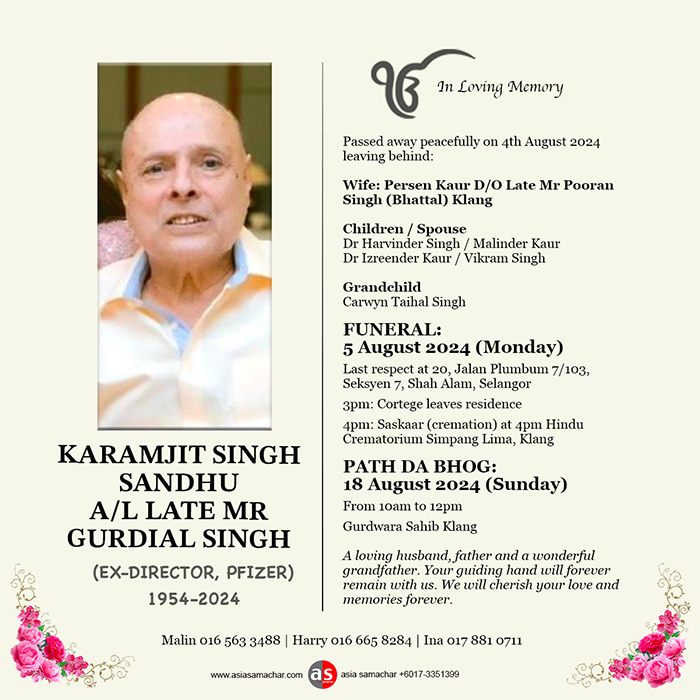
Passed away peacefully on 4th August 2024 leaving behind:
Wife: Persen Kaur D/O Late Mr Pooran Singh (Bhattal) Klang
Children / Spouse Dr Harvinder Singh / Malinder Kaur Dr Izreender Kaur / Vikram Singh
Grandchild Carwyn Taihal Singh
FUNERAL: 5 August 2024 (Monday)
Last respect at 20, Jalan Plumbum 7/103, Seksyen 7, Shah Alam, Selangor 3pm: Cortege leaves residence 4pm: Saskaar (cremation) at Hindu Crematorium Simpang Lima, Klang
PATH DA BHOG: 18 August 2024 (Sunday)
From 10am to 12pm Gudhwara Sahib Klang
Contact Details: Malin (016 563 3488) Harry (016 665 8284) Ina (017 881 0711)
A loving husband, father and a wonderful grandfather. Your guiding hand will forever remain with us. We will cherish your love and memories forever.
ASIA SAMACHAR is an online newspaper for Sikhs / Punjabis in Southeast Asia and beyond. You can leave your comments at our website, Facebook, Twitter, and Instagram. We will delete comments we deem offensive or potentially libelous. You can reach us via WhatsApp +6017-335-1399 or email: asia.samachar@gmail.com. For obituary announcements, click here
Front view of GS Port Dickson in a 2022 photograph. Inset: Post rennovation, south elevation
By Asia Samachar | Malaysia |
The second phase of the renovation of the Gurdwara Sahib Port Dickson building will likely commence in October 2024, with the first phase now 70% completed.
The gurdwara team is targeting for full completion by early 2025, according to a note sent to Asia Samachar.
The gurdwara on the beach front in the Malaysian state of Negeri Sembilan, serving 30-odd Sikh families living in the area, was in need of long overdue renovation. The last significant renovation took place some five decades ago.
In phase two, they will work to construct rooms for Punjabi school, install a lift for the Sanggat, arrival area and the main staircase to access the Darbar Sahib.
The team is appealing for donations.
BANKING DETAILS: Bank: CIMB Bank Account No: 8004 4868 13 Account Name: GSPD Building Fund Contact person: Sarjeet +6019-931-4861
ASIA SAMACHAR is an online newspaper for Sikhs / Punjabis in Southeast Asia and beyond. You can leave your comments at our website, Facebook, Twitter, and Instagram. We will delete comments we deem offensive or potentially libelous. You can reach us via WhatsApp +6017-335-1399 or email: asia.samachar@gmail.com. For obituary announcements, click here
Beekeepers in Panjab have been stung by a sharp fall in prices of honey, with some of them claiming that they had been forced to sell their produce for Rs 150 per kg.
One of the reasons behind this dip is adulteration done by traders to compete in the market, reports Tribune News Service.
The beekeepers have urged senior officials to come to their rescue and check malpractices, which they claim had paralysed the functioning of small apiary units.
“Having heard woes of beekeepers registered with the Madhu Kranti Bee Farmers’ Welfare Society, I met the Food Minister (Pralhad Joshi) and requested him to impress upon the authorities concerned to check the supply of adulterated honey, which is being sold in the market at lower prices,” the report quoted Fatehgarh Sahib MP Dr Amar Singh Boparai.
“Some beekeepers showed their inability to continue with the profession. They said no steps are being taken to check unhealthy competition and adulteration,” said the MP.
He said that while the actual production of natural honey was around 50,000 tonnes in India, the authorities had showed double produce, attributing the gap to circulation of spurious honey containing high amount of corn and other syrups.
ASIA SAMACHAR is an online newspaper for Sikhs / Punjabis in Southeast Asia and beyond. You can leave your comments at our website, Facebook, Twitter, and Instagram. We will delete comments we deem offensive or potentially libelous. You can reach us via WhatsApp +6017-335-1399 or email: asia.samachar@gmail.com. For obituary announcements, click here
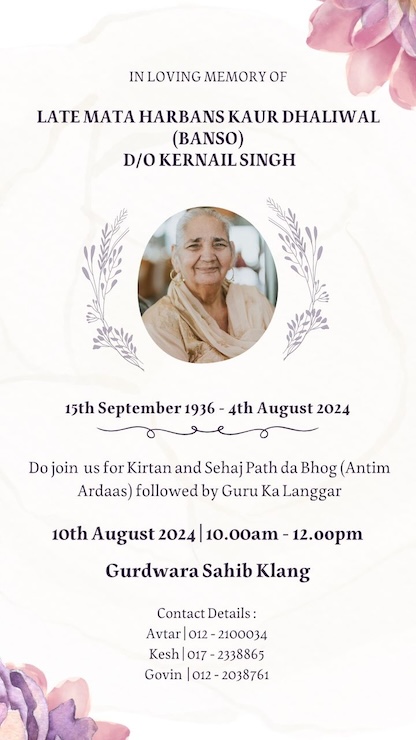
Maa, the one with the biggest smile, the sassiest response, the biggest heart, the warmest hugs and her unwavering support that was a constant source of strength. We will forever cherish the moments we shared and strive to honour her by living with the same grace and compassion she showed every day.
| Entry: 4 Aug 2024; Updated: 6 Aug 2024 | Source: Family
ASIA SAMACHAR is an online newspaper for Sikhs / Punjabis in Southeast Asia and beyond. You can leave your comments at our website, Facebook, Twitter, and Instagram. We will delete comments we deem offensive or potentially libelous. You can reach us via WhatsApp +6017-335-1399 or email: asia.samachar@gmail.com. For obituary announcements, click here
India’s shooting stars. Swapnil Kusale (left) won bronze medal in the 50m rifle 3 positions event to bag India’s third medal at the Paris Olympics 2024. The victory saw the 28-year-old Olympian receiving a double promotion from being a travelling ticket examiner (TTE) for the Indian Railways to Officer on Special Duty (OSD), Sports Cell in Mumbai. Kusale’s promotion file has been stuck for years. Manu Bhaker won India’s first medal at the 2024 games.
By Gurnam Singh | Opinion |
India, with its population of approximately 1.4 billion, has long been a paradox in the realm of sports, particularly at the Olympic Games. Despite its vast human resources, the country languishes in 44th place in the medal standings, behind nations with significantly smaller populations such as Fiji and Mongolia. The question arises: why does India perform so poorly in sports? The answer lies in a complex interplay of corruption, cultural factors, and systemic issues.
One of the most glaring issues is the corruption that permeates the selection process of athletes. Nepotism and favoritism often take precedence over merit, leading to the exclusion of genuinely talented athletes. Sports authorities in India have been repeatedly accused of selecting players based on connections rather than capabilities. This systemic corruption undermines the morale of potential athletes and discourages them from pursuing sports seriously.
For instance, numerous reports and testimonies have highlighted instances where athletes have had to pay bribes to be selected for state and national teams. This corrupt practice not only filters out talented but financially disadvantaged athletes, but also tarnishes the integrity of the selection process. Consequently, many potential sports stars either remain undiscovered or lose motivation to compete at higher levels.
Cultural and traditional factors also play a significant role in India’s underperformance in sports. Historically, India has placed a greater emphasis on academics and conventional career paths over sports. Parents and educational institutions often prioritize academic excellence, viewing sports as a recreational activity rather than a viable career option. This societal mindset discourages young talent from investing the time and effort required to excel in sports.
Moreover, traditional Indian values often impose restrictions, especially on women, limiting their participation in sports. Gender biases and societal expectations can deter female athletes from pursuing sports seriously. Although there have been trailblazers like P.T. Usha, Mary Kom, and P.V. Sindhu who have broken these barriers, the overall participation of women in sports remains low due to cultural constraints.
Inadequate infrastructure and insufficient funding further exacerbate India’s sporting woes. Many aspiring athletes lack access to proper training facilities, coaching, and equipment. Sports infrastructure in rural areas, where a significant portion of the population resides, is particularly underdeveloped. Without the necessary resources, even the most talented individuals cannot train to their full potential.
Furthermore, government and private sector investment in sports is relatively low compared to other nations. Countries that excel in the Olympics, such as the United States and China, invest heavily in sports development from a young age. In contrast, Indian athletes often have to rely on limited state funding and sporadic private sponsorships, which are not enough to sustain a robust sports ecosystem.
Whereas in the past India would blame poverty for its lack of participation in international sports, this is no longer a viable excuse. India is forecasted to achieve a US$4 trillion economy by the end of next year, surpassing Japan to become the world’s fourth-largest economy, so the money is there. It’s worth noting that as of today, compared to India’s paltry 3 bronze medals, Japan, with a population that is one-tenth of India’s, sits in 5th place with 8 Golds, 3 Silver, and 5 Bronze medals.
So what is to be done?
Clearly, money counts, and increasing investment in sports infrastructure and providing adequate funding for training programs is crucial. Developing sports facilities in rural areas and offering financial support to athletes from disadvantaged backgrounds can help nurture talent from all corners of the country.
There is a need to remove barriers to participation for women. Implementing policies that encourage and support female athletes can help bridge the gender gap in sports and inspire a whole new generation of women and girls as more successful women become role models. Given the epidemic of violence against women in India, creating safe and inclusive environments for women to train and compete is essential.
India’s struggle in the sporting arena, particularly at the Olympic Games, is a result of deep-seated corruption, cultural attitudes, and systemic deficiencies. Addressing these issues requires concerted efforts from the government, sports authorities, and society at large. With the right reforms and investments, India has the potential to emerge as a formidable force in global sports, unlocking the latent talent of its vast population.
Gurnam Singh is an academic activist dedicated to human rights, liberty, equality, social and environmental justice. He is an Associate Professor of Sociology at University of Warwick, UK. He can be contacted at Gurnam.singh.1@warwick.ac.uk
* This is the opinion of the writer and does not necessarily represent the views of Asia Samachar.
ASIA SAMACHAR is an online newspaper for Sikhs / Punjabis in Southeast Asia and beyond. You can leave your comments at our website, Facebook, Twitter, and Instagram. We will delete comments we deem offensive or potentially libelous. You can reach us via WhatsApp +6017-335-1399 or email: asia.samachar@gmail.com. For obituary announcements, click here