Manu Bhaker wins bronze in the women’s 10m air pistol event at Olympics Paris 2024, creating history by becoming the first Indian woman to win an Olympic shooting medal.
By Prabhjot Singh | Sports |
In a game of tantalizing turns between two former Olympic champion teams – India and Argentina – skipper Harmanpreet Singh pelted in a penalty corner goal in the 59th minute to help the former salvage a precious point in a pool B game.
India had beaten New Zealand 3-2 in the opener while for Argentina, it was its first point in two outings. Argentina had lost its opener to Australia by a solitary goal.
After Haryana girl Manu Bhaker stole the limelight on the second day, Punjab players turned to corner glory. While Sarabjot Singh of Punjab teamed up with Manu for the bronze shooting match, Harmanpreet Singh of Punjab helped India draw 1-1 with former Olympic champions Argentina.
Earlier, newly crowned bronze medallist Manu Bhaker and her colleague Sarabjot Singh gave a cheerful start to the day three proceedings by qualifying for the bronze medal in the 10m Air Pistol (Mixed Team) event. The Indian team had finished behind Turkey and Serbia.
While Indian shooters aggregated 580, Turkey topped the qualifying round with 582 followed by Serbia with 581. Indian team aggregated 580 and will take on Korea(579) in the bronze medal playoff.
If Manu Bhaker and Sarabjot manage to get better off the Korean team, it would be the second medal for Manu Bhaker, the first Indian female shooter to win an Olympic medal.
The India-Argentina game had attracted a substantial section of the Indian Diaspora in and around Paris. Not only the immigrants from the sub-continent but also in the audience was former Test cricketer and recently retired Chief Coach of the Indian team, Rahul Dravid, besides the Indian Olympic Association chief, Olympian PT Usha.
Since Cricket is being introduced in the 2028 Olympic Games, his presence was viewed with tremendous interest.
The International Hockey Federation chief, Tayyab Ikram, too, witnessed the pulsating game that saw supporters of the Indian team heaving a sigh of relief when Harmanpreet scored the match equaliser with a little more than a minute left for the end of the game. Tayyab Ikram was joined by his former colleagues, Leandro Negre, and Saif Ahmed of Egypt.
India came prepared for a win as it would have smoothened its passage to the knockout round. The South Americans, however, had different game plans. Their strategy was to earn as many penalty corners as possible without conceding many to their opponents.
Though the Argentines, winners of the 2016 Olympic games, had taken the lead in the 22nd minute through Lucas Martinez, it could not consolidate even after it earned a stroke in the 37th minute following a piercing flick taken by Maico Casella Schuth that caught Jarmanpreet Singh on the goal line on his body. The resultant flick taken by Maico himself was wide off the target to the great relief of experienced Indian custodian PR Sreejesh.
Desperate to get an equaliser, India did work out some good moves that were frustrated by the alert Argentine defence. At one stage, it looked like Argentina would hold to his first-half goal lead for its first win of the tournament. It was in the closing stages of the game, like the game against New Zealand on the other hand, that India built pressure.
A series of penalty corners in the 59th minute saw Harmanpreet succeed in breaking open the Argentine deep defence with a neat flick that got deflected into the net. The South Americans wanted a review of the decision. It, however, ended in disappointment for them as the third umpire also upheld the ground umpire’s judgment.
India will play Ireland in its third game tomorrow. A win would guarantee India a place in the next knockout round.
ASIA SAMACHAR is an online newspaper for Sikhs / Punjabis in Southeast Asia and beyond. You can leave your comments at our website, Facebook, Twitter, and Instagram. We will delete comments we deem offensive or potentially libelous. You can reach us via WhatsApp +6017-335-1399 or email: asia.samachar@gmail.com. For obituary announcements, click here
ASIA SAMACHAR is an online newspaper for Sikhs / Punjabis in Southeast Asia and beyond. You can leave your comments at our website, Facebook, Twitter, and Instagram. We will delete comments we deem offensive or potentially libelous. You can reach us via WhatsApp +6017-335-1399 or email: asia.samachar@gmail.com. For obituary announcements, click here
L-R: Harnam Singh Dhuma, Harpreet Singh and Gurbachan Singh
By Karminder Singh Dhillon | The Sikh Bulletin |
Why are Sikh religious leaders within Punjab infatuated with the notion of increasing the percentage of Sikh population within the state? Why are they fixated on the view that the number of Sikhs in Punjab are dwindling? Are they really concerned about the welfare of Sikhs and the future of Punjab? Or is there something else at play here? A look at the reasoning behind three calls by three leaders will help shed some light on the issue.
In May 2024, the head of Dera Chowk Mehta, known as Damdami Taksal from the 1970s onwards, Harnam Singh Dhuma called on Sikh families to have at least five children. He added that if the families could not afford to raise the children, then four of them should be handed over to the Dera to be brought up. He said that his organization would raise and nurture all these children. “You should not limit yourself to one child, otherwise, in the coming times, Sikhs will be a minority and will suffer,” he said.
He added that his Dera would transform children handed over to them as Sikh preachers who would promote the religion in an effective manner.
In August 2023, then Takht Damdama Sahib Jathedar and former Akal Takhat Interim Jathedar Harpreet Singh called on members of the Sikh community to not migrate from Punjab. He was concerned that the Sikh population within the state was dwindling due to migration and that such a trend was bad for the state.
In May of 2015, then Akal Takhat Jathedar Gurbachan Singh had called on every Sikh family to have at least 4 children. Facing criticism – both for the suggestion and for his dubious reasons behind the call, he doubled down during a media conference a few days later and said “it is easier for parents to discipline many children than just one.”
TO READ MORE ARTICLES FROM THE BULLETIN, CLICK HERE
The Hindustan Times, on May 16, 2015 reported Gurbachan Singh as saying: “Sikhs have followed the national family planning concept religiously and limited their numbers.” He added that “We adopted the two-child theory first and single-child idea now. It has done more harm than good to the community.
Single children get an overdose of love and affection, which spoils them, eroding human values and family discipline,” he explained. The Jathedar further claimed that in the “good old days”, families had three, four, or even more children; with no favorites and everyone treated equally and kept in check. “If one of the four children turns out to be bad, there still are three good ones; but when a single child goes astray, it shatters the family,” he contended.
THE HOLLOWNESS OF IT ALL.
All three calls by all three religious leaders are just different shades of a hollowness that rings loud and clear – even if disguised as being driven by “Sikh anxieties or panthik trepidations”.
They are empty calls devoid of sound logic, proper reasoning, and rigorous rationality. Jathedar Gurbachan Singh could not be bothered about the economic consequences of having large families and its impact on society. He had no answer to the criticism that his call – if implemented – would aggravate unemployment and make agricultural land holdings smaller.
Interim Jathedar Harpreet Singh did not appear concerned that Sikhs who migrated out of Punjab did so for pressing and legitimate reasons – chief amongst which being the inability of Sikhs to find gainful employment within Punjab – even if they had acquired decent education. Many a Sikh family had found it financially sound to spend their money to send their children out of Punjab rather than pay huge sums of money to corrupt officials to secure employment in Punjab. Harpreet Singh did not think that the push factors were as strong, if not stronger than the pull factors.
Harnam Singh Dhumma appeared least perturbed by the fact that if every family handed him four children to be turned into Sikh preachers, what would be the future of these “un-employable” persons. Is he trying to tell us that Sikh organizations have a severe shortage of Sikh preachers and are waiting for Dhuma’s outfit to produce them? Or is Dhumma merely concerned about keeping his dying outfit relevant? In any case, wouldn’t Dhuma’s call be going against the “don’t migrate” call of Harpreet Singh? After all, large numbers of Sikh parcharaks are lining up to migrate overseas – to fill up positions at diaspora Gurdwaras or become truck drivers or fast food join workers in Western countries.
SHOW OF FORCE: Sukhbir Singh Badal addressing the Sangrur rally – Photo: Sukhbir Singh Badal facebook page
All three calls by all three religious leaders are also not based on facts and figures. The Economic Advisory Council to the Prime Minister of India had reported that the percentage of Sikh polulations had increased by 1.24% over the period of 1950 to 2015, while that of Hindus declined by 7.82%. So, if its anyone whose religious leaders should be sounding the alarm, it ought to be ones of Hindu organizations.
Sikhs have finally come to realize that they served the function of being regularly called to the streets to take part in protests, agitations and demonstrations for an unending but unproductive slew of issues and demands. Sikh youth especially have realized that the time has come for them to put their own interests above those of their religious leaders. Migration out of Punjab is perhaps one solution for our youth. It may well be that the crux of the worry of our religious leaders is that they have become generals without an army to command.
Come to think of it; what’s the use of fussing to increase the population of Sikhs in Punjab, if large number of Sikhs are eventually going to fall prey to the colossal onslaught of religious conversion that is taking place in Punjab now. Given that these Sikh religious leaders are either un-concerned about this monumental shift in the religious demographics of Punjab; or actually have no response to it – are they even genuine in their concerns over the dwindling Sikh population in Punjab? After all, our religious leaders have told the Sikh world that there really is no such problem of religious conversion. It only concerns the “lower castes” and this group has no relevance within the designs and parameters of our religious leaders. It may well be that our religious leaders are losing their relevance within the parameters of Punjab and Sikhism – hence their nonsensical calls.
ASIA SAMACHAR is an online newspaper for Sikhs / Punjabis in Southeast Asia and beyond. You can leave your comments at our website, Facebook, Twitter, and Instagram. We will delete comments we deem offensive or potentially libelous. You can reach us via WhatsApp +6017-335-1399 or email: asia.samachar@gmail.com. For obituary announcements, click here
| Entry: 29 July 2024; Updated: 31 July 2024 | Source: Family
ASIA SAMACHAR is an online newspaper for Sikhs / Punjabis in Southeast Asia and beyond. You can leave your comments at our website, Facebook, Twitter, and Instagram. We will delete comments we deem offensive or potentially libelous. You can reach us via WhatsApp +6017-335-1399 or email: asia.samachar@gmail.com. For obituary announcements, click here
Punjabi Family – Sketch by Sketch: Arya Kumar Sharma
By Manjit Kaur | Opinion |
The family has long been recognized as the building block of human society. It provides emotional support, instils values, and ensures the continuation of cultural and social norms. There has been a long-held view that blood ties form a key natural basis for the family life. In this short piece, drawing from the changes I have experienced in my own family over the past 50 years, and observing society, around me, I explore how the family is changing.
Historically, strong family units were seen as key for maintaining stability. However, rapid social, cultural, and economic changes are leading to the collapse of the traditional family. Factors such as globalization, urbanization and technological advancements, especially social media, have altered how families interact and function. These changes have introduced new lifestyles and value systems that often conflict with traditional family roles and expectations. As a result, family bonds are weakening, and the traditional family model is breaking down.
The economy is one of the key factors behind the massive changes taking place. Increased work demands and the need for dual-income households have reduced the time families spend together, weakening familial bonds; everybody just seems to be too busy! Furthermore, financial difficulties have led to stress and conflict within families, sometimes resulting in separation or divorce.
Rapid cultural changes in the 20th century have resulted in shifting attitudes toward marriage and gender roles, further complicating the family dynamic. The emergence of alternative family structures, such as single-parent families, cohabitation without marriage, and same-sex partnerships, etc, reflects these shifts. While these changes can promote greater inclusivity and personal freedom, they also challenge the traditional attitudes, especially relisting to religious beliefs.
Although we tend to associate such developments with white Western norms, in truth, these changes are impacting all communities, including Sikhs. For example, reflecting on my own experience as a Panjabi Sikh woman born in the UK, though our community tends to live in a state of denial, I see the changes taking place all around me. It feels to me that what we are seeing today is nothing short of a transformation where blood relationships are perhaps less relevant than friendships that develop outside of the immediate family.
GENDER DISCRIMINATION & EDUCATION
One of the many factors is the empowerment of women, who are no longer willing to accept gender discrimination that restricted the choices they could have. In my parents’ time, the concept of individual choice was almost non-existent, and relationships were imposed. Life was not something that was planned like today but largely dictated by tradition and family expectations. The choice of a life partner, desires, and future ambitions were decisions made by parents or intermediaries, rather than individuals themselves.
The focus of traditional arranged marriages was less on the wishes and feelings of the potential couple and more on superficial qualities, such as social status, physical appearance, family reputation, and educational qualifications. In this system, strength and capability to manage family responsibilities were key considerations. The needs and wishes of parents and in-laws often overshadowed those of the couple, who rarely questioned these decisions.
However, due to migration and social change, second and third-generation parents have been forced to adapt to the changing times and new challenges. Today, our children grow up in different environments, influenced by different cultures and societies, such as those in England, the USA, or Canada. The contrast between Indian and Western cultures created a complex landscape full of tensions for both parents and children.
Education has always been a top priority for Punjabi families, and there is no doubt this has resulted in many children achieving good jobs, leading to significant shifts in thinking and lifestyle. Independence became more valued, and children naturally began making their own choices without consulting their parents. This shift is not about selfishness or cruelty; it’s a reflection of societal changes. This transformation is evident in both Punjabi communities in India and abroad. Surprisingly, even within India, particularly in big cities and small villages, people have become more advanced, often influenced by American culture and the film industry.
UNSTOPPABLE FORCES
Blaming individuals for these changes is wrong; technology, and societal advancements are unstoppable forces. This means the traditional Punjabi mindset of shielding children from outside influences is not possible. And rather than living in denial, which Panjabi families excel in, we need face reality and remove our blinkers. Some traditional minded parents still dream and plan for their children’s future, including expecting them to marry around in their early to mid-twenties. However, today’s young people are different expectations and priorities. They are much more individually minded, meaning career and friendships are more important than settling down, and marriage is often of secondary concern to them.
Marriage and divorce bring their own complexities. Upbringing, fears, and individual needs play significant roles in these decisions. Many young people now delay marriage or choose to remain single, which can be difficult for the parents to understand. The pressures on parents and children are immense, and it’s crucial to see the bigger picture and understand the individual’s inner world. In the Punjabi community, there’s a bad habit of judging unmarried, separated and divorced individuals. Breakdown of relationships, rather than receiving sympathy, is often associated with shame and embarrassment. Nobody wants to see their family splitting up, but there are often good reasons why this happens, and the stigma associated with divorce needs to end.
The idea of finding a partner based on community expectations is outdated. Making one’s own choices is not selfish; it’s a necessity in today’s world where we are all expected to take responsibility for our actions. In my own life I have made my own choices and valued my independence. That doesn’t mean that I haven’t consulted others, but I have come to learn that making your own choices is essential for personal growth.
MARRIAGE & DIVORCE
Marrying later in life has its advantages, such as maturity and wisdom, but it also comes with challenges. We often have a list of needs and desires, but it’s important to understand that not every box will be ticked. For sure, upbringing, race/caste/class considerations add to these challenges, though there is a trend amongst young Sikhs to reject these, which sometimes can result in conflict with their parents’ wishes. It’s worth reminding ourselves that Guru Nanak taught us to reject all social divisions and prejudice, but hypocrisy remains strong within sections of our community.
In contrast to many others in their generation, my parents never emphasised caste or labels; they focused on values, such as success, independence, and care for others. I carried this forward with my children, believing in supporting making the right choices for themselves, rather than pleasing others.
Divorce rates are rising across all communities and the reasons are complex, but clearly, women’s empowerment is one factor. Leaving a violent or unhappy relationship has its own challenges. But divorce and separation can offer individuals the opportunity for personal growth and a chance to pursue a healthier, more fulfilling life. However, it often comes with significant emotional stress, financial burdens, and legal complexities. Furthermore, the process can be particularly challenging for children, potentially impacting their emotional stability and sense of security.
While family life remains key to the future of humanity, the diversity of families will continue to increase. New reproductive technologies are likely to see an increase in the trend of freezing eggs among women in their 30s and 40s reflecting their changing priorities. Panjabis must stop living in denial and learn to live with these emerging realities. Navigating these changes requires understanding, adaptability, and a willingness to embrace both tradition and modernity, but above all to face reality with courage and an open mind.
Manjit Kaur, a UK-based therapist and counsellor, is a presenter at the 1 Show Live at Panjab Broadcasting Channel, UK. She can be contacted via email at manjitkaur1show@gmail.com
ASIA SAMACHAR is an online newspaper for Sikhs / Punjabis in Southeast Asia and beyond. You can leave your comments at our website, Facebook, Twitter, and Instagram. We will delete comments we deem offensive or potentially libelous. You can reach us via WhatsApp +6017-335-1399 or email: asia.samachar@gmail.com. For obituary announcements, click here
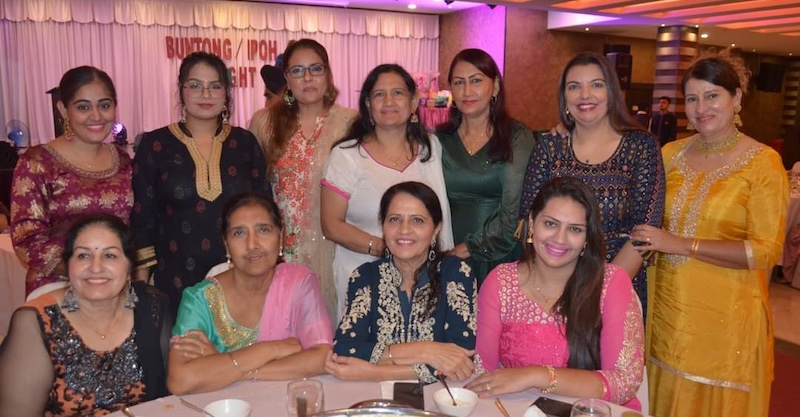
Some 300 current and former residents of Buntong, a suburb of Perak state capital of Ipoh, thronged a reunion night on Saturday (20 July 2024) that saw some of them catching up for the first time in two decades. They had a similar gathering in Ipoh two years ago. A wonderful reunion to cherish old memories, and to continue their friendship.
ASIA SAMACHAR is an online newspaper for Sikhs / Punjabis in Southeast Asia and beyond. You can leave your comments at our website, Facebook, Twitter, and Instagram. We will delete comments we deem offensive or potentially libelous. You can reach us via WhatsApp +6017-335-1399 or email: asia.samachar@gmail.com. For obituary announcements, click here
Kamaljit Kaur from Slough on one of her campaign rounds – Photo: Personal Facebook
By Nick Clark | Britain |
Two Slough residents claim their and their families’ lives are being put at risk by the Indian government – and one says he needs round-the-clock protection from the police.
Kamaljit Kaur and Gurcharan Singh allege they are being threatened because they support an independent Sikh state in the Punjab region – against the wishes of the Indian government.
They have spoken out as councillors were set to debate the issue at Slough Borough Council on Thursday July 25.
Mr Singh claimed he faced a ‘direct threat from the Indian government’ as a member of the Dal Khalsar organisation, which campaigns for a Sikh state of Khalistan.
English-language Indian news reports suggest India’s government wants Mr Singh to be arrested for his involvement in a protest outside the Indian High Commission in London last year.
Mr Singh said: “Two people in Slough are facing direct assassination threats from the Indian government.” He added: “I’m under direct 24/7 police protection.”
Mrs Kaur – a former Labour councillor – said her husband is also at risk. She said her husband is an activist campaigning for a referendum on Khalistani independence and, claimed that his details have been published on the website of India’s National Investigation Agency.
She said: “It’s true there are people in Slough that are at risk.”
Councillors in Slough are set to debate and vote on whether to write to the government expressing concerns about the safety of Khalistan activists in the town.
The call has been raised by independent councillors Sabia Akram and Waqas Sabah, who are both from Muslim backgrounds. But a former Slough mayor has sent a petition to the council calling for the motion to be removed from the agenda claiming it is divisive.
Mewa Singh Mann collected 56 signatures for a petition he says is on behalf of the Sikh community.
ASIA SAMACHAR is an online newspaper for Sikhs / Punjabis in Southeast Asia and beyond. You can leave your comments at our website, Facebook, Twitter, and Instagram. We will delete comments we deem offensive or potentially libelous. You can reach us via WhatsApp +6017-335-1399 or email: asia.samachar@gmail.com. For obituary announcements, click here
Britain Foreign Secretary David Lammy pays courtesy visit to Indian PM Narendra Modi on July 25, 2024 – Photo: Lammy
By Asia Samachar | Britain |
New Foreign Secretary David Lammy refused to repeat previous statements made before the Labour Party were elected about Jagtar Singh Johal, known as Jaggi, being “arbitrarily” detained by India since 2017.
The ‘callous u-turn’ by Lammy was exposed during a BBC Scotland News interview, led by reporter Katie Hunter, according to the Sikh Press Association. See here.
On the foreign secretary’s first visit to India, which began on July 24, Lammy will unlock the full potential of the UK-India partnership and push for a reset of the UK-India partnership including through reinforcing the UK’s commitment to securing a Free Trade Agreement that will benefit both economies, according to a statement from his office.
“I am travelling to India in my first month as Foreign Secretary because resetting our relationship with the Global South is a key part of how this government will reconnect Britain for our security and prosperity at home,” he said.
When sharing a photo of his meeting with Indian PM Narendra Modi, Lammy said: “We are working together to accelerate climate action while creating opportunities for British and Indian businesses.”
Talks about a free trade agreement with India have been stalled for months, following negotiations over the last two years. In March, India signed a free trade agreement with Norway, Switzerland, Iceland and Liechtenstein, which are all non-European Union states, reported the BBC.
Mr Johal, who is now 37, comes from Dumbarton in Scotland. He was a blogger and campaigner for Sikh human rights, which are said to have brought him to the attention of the Indian authorities.
He travelled to India in October 2017 to get married. It was reported that while he was out shopping with his wife, he was hooded, bundled into a car by men in plainclothes, “severely tortured”, and made to sign blank pieces of paper.
ASIA SAMACHAR is an online newspaper for Sikhs / Punjabis in Southeast Asia and beyond. You can leave your comments at our website, Facebook, Twitter, and Instagram. We will delete comments we deem offensive or potentially libelous. You can reach us via WhatsApp +6017-335-1399 or email: asia.samachar@gmail.com. For obituary announcements, click here
We celebrate your life today. You may be gone but all that love remains. It warms and comforts and its foundation is as real as ever. My beautiful mother, today and every single day from now on, your soul is free and happy! My mother was a dedicated – daughter, sister, wife and mother….
| Entry: 26 July 2024; Updated: 29 July 2024 | Source: Family
ASIA SAMACHAR is an online newspaper for Sikhs / Punjabis in Southeast Asia and beyond. You can leave your comments at our website, Facebook, Twitter, and Instagram. We will delete comments we deem offensive or potentially libelous. You can reach us via WhatsApp +6017-335-1399 or email: asia.samachar@gmail.com. For obituary announcements, click here
Shiromani Akali Dal president Sukhbir Singh Badal submits his explanation letter over allegations levelled by rebel SAD leaders to Akal Takht jathedar Giani Raghbir Singh in the presence of SGPC president Harjinder Singh Dhami, party leaders Balwinder Singh Bhundar, Daljit Singh Cheema and Maheshinder Singh Grewal at the Takht secretariat in Amritsar on July 24, 2024 – Photo: Panjabi Tribune video grab
By Sikh Digest | Punjab |
On 15 Jul, the five piaras (beloved-enthroned) met with the Akal Takht Jathedar Giani Raghbir Singh to deliberate on the actions of rebel Shiromani Akali Dal (SAD) leaders (SDW Vol. 2 Issue 27, Story 3).
The leaders had earlier submitted a written apology on their past errors during SAD tenure in Panjab (2007-2017) that led to the party’s decline.
The rebels have urged for the implementation of the Jhunda panel’s recommendations which was set up by SAD chief Sukhbir Singh Badal after the party’s debacle in the 2022 state assembly elections.
Though the report recommendations have never been made public, two rebel leaders Prem Singh Chandumajra and Gurpartap Singh Vadala recently announced some of the key recommendations which include dismantling the party’s student wing Student Organization of India, restoring All India Sikh Students Federation, creating a parliamentary board to distribute tickets for elections, moving SAD head office back to Amritsar, and limiting the SAD chief’s to two terms.
At the end of the meeting Jathedar announced a number of measures pertaining to sacrileges, environment, social services, and asked the SAD chief to explain not being able to represent the community’s sentiments within 15 days by 30 Jul.
Badal said that as a devout Sikh, he would follow the orders and appear before the Akal Takht.
Former Panjab Police Inspector General Ranbir Singh Khatra, who led the probe into the 2015 Bargari sacrilege cases, met the Jathedar to discuss the stalled trials.
Khatra highlighted that the Panjab government failed to appeal the stay on trials by the Punjab and Haryana High Court, leading to prolonged delays. He criticized SAD and Shiromani Gurdwara Parbandhak Committee for their inaction.
ASIA SAMACHAR is an online newspaper for Sikhs / Punjabis in Southeast Asia and beyond. You can leave your comments at our website, Facebook, Twitter, and Instagram. We will delete comments we deem offensive or potentially libelous. You can reach us via WhatsApp +6017-335-1399 or email: asia.samachar@gmail.com. For obituary announcements, click here